
Selective Opening Security for Receivers
∗Carmit Hazay† Arpita Patra‡ Bogdan Warinschi§
Abstract
In a selective opening (SO) attack an adversary breaks into a subset of honestly created ciphertexts and tries to learn information on the plaintexts of some untouched (but potentially related) ciphertexts. Contrary to intuition, standard security notions do not always imply security against this type of adver-sary, making SO security an important standalone goal. In this paper we studyreceiver security, where the attacker is allowed to obtain the decryption keys corresponding to some of the ciphertexts.
First we study the relation between two existing security definitions, one based on simulation and the other based on indistinguishability, and show that the former is strictly stronger. We continue with feasibility results for both notions which we show can be achieved from (variants of) non-committing encryption schemes. In particular, we show that indistinguishability-based SO security can be achieved from a tweaked variant of non-committing encryption which, in turn, can be instantiated from a variety of basic, well-established, assumptions. We conclude our study by showing that SO security is however strictly weaker than all variants of non-committing encryption that we consider, leaving potentially more efficient constructions as an interesting open problem.
Keywords:Selective Opening Attacks, Encryption Schemes, Non-Committing Encryption
∗
An extended abstract of this paper will appear in the proceedings of ASIACRYPT 2015. †
Faculty of Engineering, Bar-Ilan University, Israel. Email:[email protected]. ‡
Dept. of Computer Science & Automation, Indian Institute of Science, India. Email:[email protected]. §
1
Introduction
Security notions for encryption come in many forms that reflect different attacker goals (e.g. one-wayness, indistinguishability for plaintexts or non-malleability of ciphertexts), variations in possible attack scenarios (e.g. chosen plaintext or ciphertext attacks) and definitional paradigms (e.g. through games or simulation). A class of attacks motivated by practical considerations are those where the adversary may performselective openings(SO). Here, an adversary is allowed to break into a subset of honestly created ciphertexts leaving untouched other (potentially related) ciphertexts.
This attack scenario was first identified in the context of adaptively secure multi-party computation (MPC) where communication is over encrypted channels visible to the adversary. The standard trust model considers an adversary who, based on the information that he sees, can decide to corrupt parties and learn their internal state. In turn, this may allow the attacker to determine the parties’ long term secret keys and/or the randomness used to create the ciphertexts. The broader context of Internet communication also naturally gives rise to SO attacks. Attackers that access and store large amount of encrypted internet traffic are a reality, and getting access to the internal states of honest parties can be done by leveraging design or implementation weaknesses of deployed systems. For example the Heartbleed attack allowed a remote party to extract (among other things) the encryption keys used to protect OpenSSL connections.
Security against SO attacks comes in several distinct flavors. Depending on the attack scenario, we distinguish two settings that fall under the general idea of SO attacks. Insender security, we havensenders and one receiver. The receiver holds a secret key relative to a public key known to all the senders. The senders encrypt messages for the receiver and the adversary is allowed to corrupt some of the senders (and learn the messages and randomness underlying some of the ciphertexts). The concern is that the messages sent by uncorrupted senders stay secret. The second scenario deals withreceiver security. Here we consider one sender andnreceivers who hold independently generated public and secret keys. The attacker is allowed to corrupt some of the receivers (and learn the secret keys that decrypt some of the observed ciphertexts). Security in this setting is concerned with the messages received by uncorrupted receivers. For each of these settings, security can be defined using either the standard indistinguishability paradigm or simulation-based definitions. Importantly, both scenarios capture realistic attacks in secure computation where usually every party acts as either a sender or a receiver at some point of time during a protocol execution.
Since most of the existent encryption schemes have been analyzed w.r.t. traditional notions of security (e.g. indistinguishability under chosen plaintext or chosen ciphertext attacks (ind-cpa,ind-cca)), a central question in this area is to understand how security against SO attacks relates to the established definitions. Despite compelling intuition that the only information that an adversary obtains is what it can glean from the opened plaintexts, progress towards confirming or disproving this conjecture has been rather slow. Perhaps the most interesting and surprising results are due to Bellare et al. [BHY09, BDWY12] who showed that selective sender security as captured viasimulationbased definitions is strictly stronger than indistinguisha-bility under chosen plaintext attacks [GM84] (denoted by ind-cpa security). The gap between standard notions of security and SO security is uncomfortable: while SO attacks may naturally occur we do not have a clear understanding of the level of security that existing constructions offer nor do we have many ideas on how to achieve security against such attacks.
1.1 Related Work
Selective opening attacks were first introduced in [DNRS03] in the context of commitment schemes. In the context of encryption schemes, the first rigorous definitions were proposed by Bellare, Hofheinz and Yilek [BHY09]. They studied SO security for public key encryption (PKE), for both the receiver and the sender settings and for each setting proposed two types of definitions, indistinguishability-based and simulation-based ones. Very roughly, the indistinguishability-simulation-based definition (denoted by ind-so) requires that an adversary that sees a vector of ciphertexts cannot distinguish the true plaintexts of the unopened ciphertexts from independently sampled plaintexts. This is required even with access to the randomness used for gener-ating the opened ciphertexts (in the sender corruption setting), or with access to the secret keys that decrypt the opened ciphertexts (in the receiver corruption setting). This definition requires messages to come from a distribution that isefficiently resamplable. A stronger security variant that does not restrict the message distribution calledfullind-sohas been introduced later by B¨ohl, Hofheinz and Kraschewski [BHK12]. The simulation based notion (denoted by sim-so) is reminiscent of the definitional approach from [DNRS03] and requires computational indistinguishability between an idealized execution and the real one.
The first feasibility results for security against selective opening attacks are for the sender setting and leverage an interesting relation with lossy encryption: a lossy PKE implies ind-so for sender secu-rity [BHY09]. Furthermore, if the PKE scheme has an efficient opening algorithm of ciphertexts, then the scheme also satisfiessim-sosecurity. The work of Hemenway et al. [HLOV11] shows that lossy (and thereforeind-so) PKE can be constructed based on several generic cryptographic primitives.
For primitives that benefit from multiple security notions, a central question is to understand how these notions relate to each other. This type of results are important as they clarify the limitations of some of the notions and enable trade-offs between security and efficiency (to gain efficiency, a scheme with weaker guarantees may be employed, if the setting allows it). The relation between traditional security notions of encryption and security against selective opening attacks was a long-standing open problem that was solved by Bellare et al. [BDWY12]. Their result is that standardind-cpasecuritydoes notimplysim-so(neither in the sender nor in the receiver setting). There is no fully satisfactory result concerning the relation between
ind-cpaandind-so. Here, the best result is that these two notions imply each other in the generic group model [HR14] and that for the chosen-chiphertext attacks variant (CCA) the two notions are distinct.
Relations between the different notions for selective opening have mainly been studied in the sender setting. B¨ohl et al. establish that fullind-soandsim-soare incomparable. Recently, [ROV14] introduced an even stronger variant of the fullind-sodefinition, and showed that manyind-cpa,ind-soandsim-sosecure encryption schemes are insecure according to their new notion. They further showed thatsim-sodefinition does not imply lossy encryption even without efficient openability. Finally, SO security has been considered for CCA attacks in [FHKW10, HLQ13] and in the identity-based encryption scenario in [BWY11].
1.2 Our Contribution
With only two exceptions [BHY09, BDWY12] prior work on SO security has addressed mainly the sender setting. We concentrate on the receiver setting. Though theoretically the feasibility for SO security for the receiver is implied by the existence of non-committing encryption schemes [CFGN96, Nie02, DN00, CDSMW09], the state of the art constructions still leave many interesting open problems in terms of relations between notions and feasibility results. This is the focus of this work.
close relation between (variants of) non-committing encryption and security under selective opening attacks. For example, we show thatind-sosecurity follows from a tweaked variant of non-committing encryption which, in turn, we show how to instantiate from a variety of standard assumptions. Interestingly, we also show a separation between SO security and non-committing encryption (which leaves open the question of potentially more efficient constructions that meet the former notion but not the latter). Below, we elaborate on our results in details.
Notation-wise, we denote the indistinguishability and simulation-based definitions in the receiver setting byrind-soandrsim-so, respectively. For the corresponding notions in the sender setting we writesind-so
andssim-so, respectively. That is, we prepend “s” or “r” to indicate if the definition is for sender security or receiver security.
The relation betweenrind-so andrsim-so. First, we study the relation between the indistinguishabil-ity and simulation-based securindistinguishabil-ity notions in the receiver setting. We establish that the rind-sonotion is strictly weaker (and therefore easier to realize) than the notion ofrsim-so, by presenting a concrete pubic key scheme that meets the former but not the latter level of security. Loosely speaking, a ciphertext includes a commitment to the plaintext together with encryptions of the opening information of this commitment (namely, the plaintext and the corresponding randomness). We then prove that when switching to an alter-native fake mode the hiding properties of our building blocks (commitment and encryption schemes) imply that the ciphertext does not contain any information about the plaintext. Nevertheless, simulation always fails since it would require breaking the binding property of the commitment. Applying the observation that
rsim-soimpliesrind-sosecurity,1we obtain the result thatrind-sois strictly weaker.
In more details, our separating scheme is built from a commitment scheme and a primitive called non-committing encryption for the receiver (NCER) [CHK05] that operates in two indistinguishable ciphertexts modes: valid and fake, where a fake ciphertext can be decrypted into any plaintext using a proper secret key. This property is referred to assecret key equivocationand is implied by the fact that fake ciphertexts are lossy which, in turn, impliesrind-sosecurity. Specifically, the security of our scheme implies that:
Theorem 1.1. (Informal)There exists a PKE that isrind-sosecure but is notrsim-sosecure.
Somewhat related to our work, [BDWY12] proved that the standard ind-cpasecurity does not imply
rsim-sosecurity via the notion ofdecryption verifiability– the idea that it is hard to decrypt a ciphertext into two distinct messages (even using two different secret keys). Specifically, [BDWY12] showed that any
ind-cpasecure PKE that is decryption verifiable cannot be rsim-so secure. Compared with their result, our result implies thatrsim-sosecurity is strictly stronger thanrind-sosecurity (which may turn out to be stronger thanind-cpasecurity).
The feasibility of rind-so and rsim-so. We recall that in the sender setting, the notions sind-so and
ssim-soare achievable from lossy encryption and lossy encryption with efficient openability.2 We identify a security notion (and a variant) which plays for receiver security the role that lossy encryption plays in sender security. Specifically, we prove that NCER impliesrsim-soand that a variant of NCER, which we
1
This can be derived from the fact that the adversary’s view is identical for any two simulated executions with different sets of unopened messages, as the simulator never gets to see these messages.
2
refer astweaked NCER(formally defined in Section 3.3), impliesrind-so. Loosely speaking, the security of tweaked NCER is formalized as follows. Similarly to NCER, tweaked NCER has the ability to create fake ciphertexts that are computationally indistinguishable from real ciphertexts. Nevertheless, while in NCER a fake ciphertext can be efficiently decrypted to any plaintext (by producing a matching secret key), in tweaked NCER a fake ciphertext can only be efficiently decrypted to a concrete predetermined plaintext. Informally, our results are captured by the following theorem:
Theorem 1.2. (Informal)Assume the existence of tweaked NCER and NCER, then there exist PKE schemes that arerind-soandrsim-sosecure, respectively.
Interestingly, we show that the converse implications do not hold. That is, arsim-sosecure PKE is not necessarily a tweaked NCER or a NCER. This further implies that arind-sosecure PKE is not necessarily a tweaked NCER or NCER. This result is reminiscent of the previous result thatsim-soandrind-sosecure PKE do not imply lossy encryption even without efficient openability [ROV14].
Our separating scheme is based on an arbitrary key-simulatable PKE schemes. Intuitively, in such schemes, it is possible to produce a public key without sampling the corresponding secret key. The set of obliviously sampled public keys may be larger than the the set of public keys sampled together with their associated secret key, yet it is possible to prove a public key sampled along with a secret key as one sampled without. In these schemes we also require that the two type of keys are also computationally indistinguishable. Our proof holds for the case that the set of obliviously sampled keys is indeed larger, so that not every obliviously sampled public key can be explained to possess a secret key. In summary, we prove that:
Theorem 1.3. (Informal)Assume the existence of key-simulatable PKE, then there exists a PKE scheme that isrsim-sosecure but is neither tweaked NCER nor NCER.
The constructions that we present show thatrsim-so(andrind-so) security can be achieved under the same assumptions as key-simulatable PKE – there are results that show that the latter can be constructed from a variety of hardness assumptions such as Decisional Diffie-Hellman (DDH) and Decisional Composite Residuosity (DCR). They also show that we can construct schemes from any hardness assumption that implies simulatable PKE [DN00] (where both public keys and ciphertexts can be obliviously sampled).
Realizing tweaked NCER. Finally, we demonstrate the broad applicability of this primitive and show how to construct it from various important primitives: key-simulatable PKE, two-round honest-receiver statistically-hiding 21
oblivious transfer (OT) and hash proof systems (HPS). We stress that it is not known how to build NCER under these assumptions (or any other generic assumption), which implies that tweaked NCER is much easier to realize. In addition, we prove that the two existing NCER schemes [CHK05] with security under the DDH and DCR hardness assumptions imply the tweaked NCER notion, where surpris-ingly, the former construction that is a secure NCER for only polynomial-size message spaces, is a tweaked NCER for exponential-size message spaces (this further hints that tweaked NCER may be constructed more efficiently than NCER). These results imply that tweaked NCER (and thusrind-so) can be realized based on DDH, DCR, RSA, factoring and learning with errors (LWE) hardness assumptions.
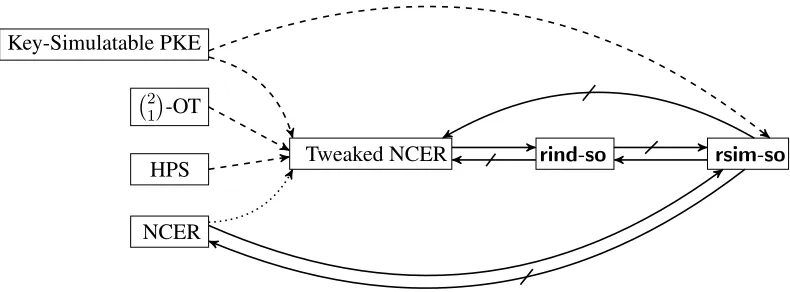
Our results are summarized in Fig. 1.
Key-Simulatable PKE
2 1
-OT
HPS
NCER
Tweaked NCER rind-so rsim-so
Figure 1: The arrows can be read as follows: solid arrows denote implication, crossed arrows denote counterexamples,dashed arrowsdenote assumption-wise implication anddotted arrowsdenote implication with respect to concrete instances (where the implication may not hold in general). The implication of receiver indistinguishability security by simulation security is a known result.
weaker than the notion ofssim-soby presenting a concrete public key scheme that meets the former but not the latter level of security. Our separating scheme is built using the two primitives lossy public key encryption and commitment scheme. We exploit the hiding properties of these building blocks to prove that our scheme impliessind-sosecurity. On the other hand, simulation always fails since it implies breaking the binding property of the commitment scheme. Informally, we prove the following theorem:
Theorem 1.4. (Informal)There exists a PKE that issind-sosecure but is notssim-sosecure.
We stress that this was already demonstrated indirectly in [BY09] (by combining two separation results). Here we design a concrete counter example to demonstrate the same in a simpler manner. A similar result has been shown forfullind-soandsim-soin [BHK12], demonstrating that these definitions donotimply each other in the sender setting.
To sum up, we study the different levels for receiver security in the presence of SO attacks. We clarify the relation between these notions and provide constructions that meet them using the close conceptual relation between SO security and non-committing encryption. From a broader perspective, our results position more precisely SO security for the receiver in the spectrum of security notions for encryption.
2
Preliminaries
Basic notations. Forx, y ∈ Nwithx < y, let[x] := {1, . . . , x} and[x, y] := {x, x+ 1, . . . , y}. We
denote the computational security parameter bykand statistical security parameter bys. A functionµ(·)is
explicitly. We write PPT for probabilistic polynomial-time. For a PKE (or commitment) schemeC, we use the notationMC and respectivelyRC to denote the input and the randomness space of the encryption (or commitment) algorithm ofC. We use bold fonts to denote vectors. Ifmis anndimensional vector, we writemifor thei-th entry inm; ifI ⊆[n]is a set of indices we writemI for the vector of dimension|I|
obtained by projectingmon the coordinates inI.
2.1 Public Key Encryption
A public key encryption (PKE) scheme PKE with message space M consists of three PPT algorithms (Gen,Enc,Dec). The key generation algorithmGen(1k)outputs a public keypkand a secret keysk. The encryption algorithmEncpk(m;r) takes pkand a messagem ∈ Mand randomness r ∈ R, and outputs
a ciphertextc. The decryption algorithm Decsk(c) takes sk and a ciphertextcand outputs a message m. For correctness, we require that m = Decsk(c) for all m ∈ M and all (pk, sk) ← Gen(1k) and all
c ← Encpk(m). The standard notion of security for PKE is indistinguishability under chosen plaintext
attacks, denoted by ind-cpa[GM84] (and the corresponding experiment is denoted asExpindPKE-cpa). As a general remark, we note that whenever we refer to a secret key, we refer to the randomness used to generate it by the key generation algorithm.
2.2 Selective Opening Security
Depending on the attack scenario, we distinguish two settings that fall under the general idea of SO attacks. Insender security, we havensenders and one receiver. The receiver holds a secret key relative to a public key known to all senders. The senders send messages to the receiver and the adversary is allowed to corrupt some of the senders (and learn the messages and randomness underlying some of the ciphertexts). The concern is that the messages sent by uncorrupted users stay secret. The second scenario deals withreceiver security. Here we consider one sender andnreceivers who hold independently generated public and secret keys. The attacker is allowed to learn the secret keys of some of the receivers. Security is concerned with the messages received by uncorrupted receivers.
For each of these settings we consider two definitions: (1) an indistinguishability based definition [BHY09] and (2) a simulation based definition that follows from [BHY09] which, in turn, builds on the one proposed by [DNRS03] in the context of commitments. Indistinguishability-based definitions require that an adversary that sees a vector of ciphertexts cannot distinguish the true plaintexts of the ciphertexts from independently sampled plaintexts, even in the presence of the randomness used for generating the opened ciphertexts (in the sender corruption setting), or the secret keys that decrypt the opened ciphertexts (in the receiver corruption setting). The indistinguishability based definitions use the notion of efficiently resamplablemessage distributions which we recall next following [BHK12].
Definition 2.1(Efficiently resamplable distribution). Letn=n(k)>0and letDistbe a joint distribution over {0,1}kn. We say thatDistis efficiently resamplable if there is a PPT algorithmResamp
Distsuch that
for anyI ⊆ [n]and any partial vectormI0 ∈ {0,1}k|I|
,ResampDist(m0I) returns a vectormsampled fromDist|m0I, i.e.m0is sampled fromDistconditioned onmI =m0I.
Below, we recall indistinguishability and simulation based definitions for security in the presence of selective opening attacks3. We present the definitions for sender and receiver security. To avoid heavy
3
notation we follow the following conventions when naming the security notions: we use “ind” or “sim” to indicate if the definition is indistinguishability-based or simulation-based, and prepend “s” or “r” to indicate if the definition is for sender security or receiver security; we keep “so” in the name of the notion to indicate that we deal with selective opening attacks. We also note that we consider chosen plaintext attacks only, but avoid showing this explicitly in the names of the security notions.
Definition 2.2(Indistinguishability based SO security). For a PKE schemePKE = (Gen,Enc,Dec), a polynomially bounded functionn=n(k) >0and a stateful PPT adversaryA, consider the following two experiments; the left experiment corresponds to sender corruptions, whereas, the right experiment corre-sponds to receiver corruptions.
Experiment. Expsind-soPKE (A, k) b← {0,1}
(pk, sk)←Gen(1k)
(Dist,ResampDist,state1)←A(pk) m:= (mi)i∈[n]←Dist
r:= (ri)i∈[n]← RnPKE
e:= (ei)i∈[n]←(Encpk(mi;ri))i∈[n]
(I,state2)←A(e,state1) m0 ←Resamp(mI)
m∗=mifb= 0, elsem∗=m0
b0 ←A(rI,m∗,state2),
Return 1 ifb=b0, and 0 otherwise.
Experiment. Exprind-soPKE (A, k) b← {0,1}
(pk,sk) := (pki, ski)←(Gen(1k))i∈[n]
(Dist,ResampDist,state1)←A(pk) m:= (mi)i∈[n]←Dist
r:= (ri)i∈[n]← RnPKE
e:= (ei)i∈[n]←(Encpki(mi;ri))i∈[n]
(I,state2)←A(e,state1) m0 ←Resamp(mI)
m∗=mifb= 0, elsem∗=m0
b0 ←A(skI,m∗,state2)
Return 1 ifb=b0, and 0 otherwise.
In the above experiments we only assume adversaries that are well-behaved in that they always output efficiently resamplable distributions together with resampling algorithms.
We say thatPKEissind-sosecure if for a well-behaved PPTAthere exists a negligible functionµ=µ(k)
such that
AdvsindPKE-so(A, k) := 2
Pr[ExpsindPKE-so(A, k) = 1]−1
2 ≤µ.
We say thatPKEisrind-sosecure if for a well-behaved PPTAthere exists a negligible functionµ=µ(k)
such that
AdvrindPKE-so(A, k) := 2
Pr[ExprindPKE-so(A, k) = 1]−1
2 ≤µ. Pr
ExpsindPKE-so(A, k) = 1
andPr
ExprindPKE-so(A, k) = 1
denote the winning probabilityofAin the re-spective experiments.
Simulation based security is defined, as usual, by comparing an idealized execution with the real one. Again, we consider both sender and receiver security.
Definition 2.3(Simulation based SO security). For a PKE schemePKE= (Gen,Enc,Dec), a polynomi-ally bounded functionn =n(k) >0, a PPT adversaryAand a PPT algorithmS, we define the following pairs of experiments.
We say thatPKEisssim-sosecure iff for every PPTAthere is a PPT algorithmS, a PPT distinguisher Dwith binary output and a negligible functionµ=µ(k)such that
AdvssimPKE-so(D, k) :=
Pr[1←D(Exp
ssim-so-real
PKE (A, k))]−Pr[1←D(ExpssimPKE-so-ideal(S, k))]
Experiment. Expssim-so-realPKE (A, k) (pk, sk)←Gen(1k)
(Dist,state1)←A(pk) m:= (mi)i∈[n]←Dist r:= (ri)i∈[n]← RnPKE
e:= (ei)i∈[n]←(Encpk(mi;ri))i∈[n]
(I,state2)←A(e,state1)
output←A(rI,mI,state2)
Return(m,Dist,I,output).
Experiment. Expssim-so-idealPKE (S, k) (Dist,state1)←S(·)
m:= (mi)i∈[n]←Dist
(I,state2)←S(state1)
output←S(mI,state2)
Return(m,Dist,I,output).
Experiment. Exprsim-so-realPKE (A, k)
(pk,sk) := (pki, ski)←(Gen(1k))i∈[n]
(Dist,state1)←A(pk) m:= (mi)i∈[n]←Dist r:= (ri)i∈[n] ← RnPKE
e:= (ei)i∈[n]←(Encpki(mi;ri))i∈[n]
(I,state2)←A(e,state1)
output←A(skI,mI,state2)
Return(m,Dist,I,output).
Experiment. Exprsim-so-idealPKE (S, k) (Dist,state1)←S(·)
m:= (mi)i∈[n]←Dist
(I,state2)←S(state1)
output←S(mI,state2)
Return(m,Dist,I,output).
We say thatPKEisrsim-sosecure iff for every PPTAthere is a PPT algorithmS, a PPT distinguisher Dwith binary output and a negligible functionµ=µ(k)such that
AdvrsimPKE-so(D, k) :=
Pr[1←D(Exp
rsim-so-real
PKE (A, k))]−Pr[1←D(ExprsimPKE-so-ideal(S, k))]
≤µ.
Our definitions consider non-adaptive attacks, where the adversary corrupts the parties in one go. We note that all our results will remain unaffected even in the face of an adaptive adversary [BHK12].
3
Building Blocks
Our constructions employ a number of fundamental cryptographic building blocks as well as a new primitive which we denote by tweaked NCER. We describe them and their security definitions below.
3.1 Commitment Schemes
We require a non-interactive commitment scheme (NISHCOM) that is statistically hiding.
Definition 3.1 (NISHCOM). A non-interactive commitment scheme nisCom consists of two algorithms
(nisCommit,nisOpen) defined as follows. Given a security parameter k, message m ∈ MnisCom and random coinsr ∈ RnisCom, PPT algorithmnisCommitoutputs commitmentc. Givenk, commitmentcand messagem, (possibly inefficient) algorithmnisOpenoutputsr. We require the following properties:
– Correctness. We require thatc=nisCommit(m;r)for allm∈ MnisComandr ←nisOpen(c, m).
– Security. A NISHCOMnisComisstat-hidesecure if commitments of two distinct messages are statis-tically indistinguishable. Specifically, for anyunbounded powerfuladversaryA, there exists a negli-gible functionµ=µ(s)such thatAdvnisComstat-hide(A, k) :=|Pr[1←A(c0)]−Pr[1←A(c1)]| ≤ µfor
ci ←nisCommit(mi)fori∈ {0,1}andm0, m1∈ MnisCom.
A(k) : nisCommit(m0;r0) =nisCommit(m1;r1)](with the probability over the choice of the coins ofA) is smaller than some negligible functionµ=µ(k).
A NISHCOMnisComis calledsecureit is{stat-hide,comp-bind}secure.
3.2 Non-Committing Encryption for Receiver (NCER)
A non-committing encryption for receiver (NCER) [JL00, CHK05] is a PKE with the property that there is a way to generate fake ciphertexts which can then be decrypted (with the help of a trapdoor) to any plaintext. Intuitively, fake ciphertexts are generated in a lossy way so that the plaintext is no longer well defined given the ciphertext and the public key. This leaves enough entropy for the secret key to be sampled in a way that determines the desired plaintext. We continue with a formal definition of NCER and a security notion for it referred asind-ncersecurity.
Definition 3.2(NCER). An NCERnPKEconsists of five PPT algorithms(nGen,nEnc,nEnc∗,nDec,nOpen)
defined as follows. Algorithms(nGen,nEnc,nDec)form a PKE. Given the public keypk, the fake encryp-tion algorithmnEnc∗ outputs a ciphertexte∗ and a trapdoort. Given the secret keysk, the public keypk, fake ciphertexte∗, trapdoortand plaintextm, algorithmnOpenoutputssk∗.
– Correctness. We require that m = nDecsk(c)for allm ∈ M, all(pk, sk) ← nGen(1k)and all c ←
nEncpk(m).
– Security.An NCER schemenPKEisind-ncersecure if the real and fake ciphertexts are indistinguishable. Specifically, for a PPT adversaryA, consider the experimentExpindnPKE-ncer defined as follows.
Experiment. Expind-ncernPKE (A, k) b← {0,1}
(pk, sk0)←nGen(1k)
m←A(pk) e0←nEncpk(m)
(e1, t)←nEnc∗pk(1k),sk1←nOpen(sk0, pk, e1, t, m)
b0←A(skb, eb)
Return 1 ifb=b0, and 0 otherwise.
We say that nPKE is ind-ncer-secure if for a PPT adversaryA, there exists a negligible function
µ=µ(k)such thatAdvindnPKE-ncer(A, k) := 2Pr[ExpindnPKE-ncer(A, k) = 1]−12 ≤µ. An NCERnPKEissecureif it isind-ncersecure.
3.3 Tweaked NCER
We introduce a variant of NCER which tweaks the definition of NCER in the following two ways. First, the opening algorithmnOpenmay beinefficient. In addition, the fake encryption algorithm is required to output a fake ciphertexte∗given the secret keyskand a plaintextm, so that decryption is “correct” with respect to e∗andm. This new notion is denoted astweaked NCER. We formalize this notion below.
e∗←tEnc∗pk(sk, m0)for somem0 ∈ MtPKEand a plaintextm, the inefficient algorithmtOpenoutputssk∗
such thatm=tDecsk∗(e∗).
– Correctness. We require thatm = tDecsk(c) for allm ∈ M, all(pk, sk) ← tGen(1k) and allc ←
tEncpk(m).
– Security. A tweaked NCER schemetPKE is ind-tciphersecure if real and fake ciphertexts are indis-tinguishable. Specifically, for a PPT adversaryA, consider the experimentExpindtPKE-tcipher defined as follows.
Experiment. Expind-tciphertPKE (A, k) b← {0,1}
(pk, sk)←tGen(1k)
m←A(pk) e0←tEncpk(m)
e1←tEnc∗pk(sk, m)
b0 ←A(sk, eb)
Return 1 ifb=b0, and 0 otherwise.
Experiment. Expind-tncertPKE (A, k) b← {0,1}
(pk, sk0)←tGen(1k)
m←A(pk)
e0←tEnc∗pk(sk0, m)
e1←tEnc∗pk(sk0, m0)form0∈ MtPKE sk1←tOpen(e1, m)
b0 ←A(skb, eb)
Return 1 ifb=b0, and 0 otherwise.
We say thattPKEisind-tciphersecure if for a PPT adversaryA, there exists a negligible function
µ=µ(k)such thatAdvindtPKE-tcipher(A, k) := 2
Pr[Exp
ind-tcipher
tPKE (A, k) = 1]−
1 2 ≤µ.
We say that tPKE is ind-tncer secure if for an unbounded adversary A, there exists a negligible functionµ=µ(s)such thatAdvindtPKE-tncer(A, k) := 2Pr[ExpindtPKE-tncer(A, k) = 1]−12
≤µ. A tweaked NCERtPKEissecureif it is{ind-tcipher,ind-tncer}secure.
3.4 Key-Simulatable PKE
A key-simulatable public key encryption scheme is a PKE in which the public keys can be generated in two modes. In the first mode a public key is picked together with a secret key, whereas the second mode implies an oblivious public key generation without the secret key. LetV denote the set of public keys generated in the first mode andKdenote the set of public keys generated in the second mode. Then it is possible thatK
containsV(i.e.,V ⊆ K). Moreover, in caseV ⊂ Kthe set of public keys fromK \ V is not associated with any secret key. We respectively denote the keys inVandK \ Vasvalidandinvalidpublic keys. In addition to the key generation algorithms, key-simulatable PKE also consists of an efficient key faking algorithm that explains a public key fromV, that was generated in the first mode, as an obliviously generated public key fromKthat was generated without the corresponding secret key. The security requirement asserts that it is hard to distinguish a random element fromKfrom a random element fromV. The formal definition follows. We note that the notion of key-simulatable PKE is very similar to the simulatable PKE [DN00] notion with the differences that the latter notion assumes thatK=Vand further supports oblivious ciphertext generation and ciphertext faking.
Definition 3.4 (Key-simulatable PKE). A key-simulatable public key encryption sPKE consists of five
PPT algorithms(sGen,sEnc,sDec,sGen],sGen]−1)defined as follows. Algorithms(sGen,sEnc,sDec)form a PKE. Given the security parameterk, the oblivious public key generator sGen] returns a public keypk0
– Correctness. We require thatm = sDecsk(c) for allm ∈ M, all (pk, sk) ← sGen(1k) and allc ← sEncpk(m).
– Security. A key-simulatable scheme sPKE is ind-cpa secure if (sGen,sEnc,sDec) is ind-cpa secure. It is calledksimsecure if it is hard to distinguish an obliviously generated key from a legitimately generated key. Specifically, for a PPT adversary A, there exists a negligible function µ = µ(k)
such that AdvksimsPKE(A, k) := Pr [1←A(r, pk)]−Pr
1←A(r0, pk0)
≤ µ where (pk, sk) ← sGen(1k),r←sGen]−1(pk)and(pk0, r0)←sGen](1k).
A key-simulatable schemesPKEissecureif it is{ind-cpa,ksim}secure.
Anextendedkey-simulatable PKE is a secure key-simulatable where in additionV ⊂ K and it holds that Pr
h
pk∈ K \ V |(pk, r)←sGen](1k)
i
is non-negligible.
3.5 Lossy PKE
A lossy public-key encryption scheme is a PKE with a standard key generation algorithm (that produces “real” keys) and a lossy key generation algorithm (that produces “lossy” keys that are indistinguishable from real ones), such that ciphertexts that are computed under real keys are committing to the plaintexts while ciphertexts that are computed under lossy keys are non-committing.
Definition 3.5(Lossy PKE). A lossy public key encryption schemeloPKEconsists of five algorithms(loGen,
loGen∗,loEnc,loDec,loOpen) defined as follows. Algorithms (loGen,loEnc,loDec) form a PKE. Given a security parameter k, the PPT lossy key generation algorithm loGen∗ outputs a public key pk∗ where
pk∗ is called alossy public key. Given a lossy public key pk∗, plaintext m ∈ MloPKE and ciphertext e=loEncpk∗(m), the (possibly inefficient) algorithmloOpenoutputsr0∈ RloPKE.
– Correctness. We require thatm = sDecsk(c) for allm ∈ M, all (pk, sk) ← sGen(1k) and allc ←
sEncpk(m). We further require thate = loEncpk∗(m;r0)forpk∗ ← sGen∗(1k), plaintextm ∈ M, ciphertexte=loEncpk∗(m)andr0 ←loOpen(pk∗, m, e).
– Security.A lossy PKE schemeloPKEisind-lossysecure if lossy keys are computationally indistinguish-able from real keys. Specifically, for a PPT adversaryA, there exists a negligible functionµ=µ(k)
such that
AdvindloPKE-lossy(A, k) :=|Pr[1←A(pk)]−Pr[1←A(pk∗)]| ≤µ
for(pk, sk)←loGen(1k)andpk∗←loGen∗(1k).
A lossy PKE scheme loPKEis ind-lossycipher secure if encryptions of two distinct messages are indistinguishable when encrypted under a lossy public key. Specifically, for anunbounded powerful
adversaryA, there exists a negligible functionµ=µ(s)such that
AdvindloPKE-lossycipher(A, k) :=|Pr[1←A(e0)]−Pr[1←A(e1)]| ≤µ
forpk∗ ← loGen∗(1k) ande ← loEncpk∗(m0),e1 ← loEncpk∗(m1)and anym0, m1 ∈ MloPKE
chosen byAgivenpk∗.
3.6 Statistically-Hiding 21-OT
We recall the definition of honest-receiver two-round statistically-hiding 21-OT. We follow the notation from [HLOV11], but modify their definition to consider statistical privacy with respect to the receiver rather than the sender. In addition, we only consider a binary plaintext space.
Definition 3.6 (Statistically-hiding OT). Oblivious transfer is a protocol between a sender Sen and a receiverRec = (Recq,Recr). The senderSenhas two input bitss0,s1, and the receiver has a bitb. The receiver Recq generates a queryq along with some state information sk and sends q to the sender. The sender evaluatesq(s0, s1)and sends the result rsp = Sen(q, s0, s1)to the receiverRecr who usessk to obtainsb. We require the following properties from(Sen,Rec):
– Correctness. For alls0, s1 ∈ {0,1}and for allb ∈ {0,1}, there exists a negligible functionµ =µ(k) such thatPr[sb =Recr(sk,rsp)|(q, sk)←Recq(1k, b);rsp←Sen(q, s0, s1)]≥1−µ.
– Receiver Privacy. bremains statistically hidden fromSen’s view. Specifically, for an unbounded powerful adversaryAand a negligible functionµ=µ(s)it holds that
|Pr[1←A(q0)]−Pr[1←A(q1)]| ≤µ
for(q0, sk)←Recq(1k,0)and(q1, sk)←Recq(1k,1)
– Sender Privacy.For anyb∈ {0,1}, for anys0, s1, s00, s01such thatsb =s0b ,the following must hold for a PPT adversaryAand a negligible functionµ=µ(k)
|Pr[1←A(rsp0)]−Pr[1←A(rsp1)]| ≤µ
for(q, sk)←Recq(1k, b);rsp0 ←Sen(q, s0, s1)andrsp1←Sen(q, s00, s01)
In all of the above,the probabilities are over the randomness ofRecqandSen.
3.7 Hash Proof Systems
We recall the definition of hash proof systems (HPS), introduced by Cramer and Shoup [CS02]. For sim-plicity we frame the description by viewing HPS as key-encapsulation mechanisms (KEM). A KEM is a public-key encryption scheme that is used for encrypting random messages that are used as encryption keys for a symmetric-key encryption scheme, which in turn encrypts the actual plaintext. A HPS can be viewed as a KEM in which ciphertexts can be generated in two modes. The ciphertexts that are generated using the first mode are referred to asvalidciphertexts. For such ciphertexts the encapsulated key is well defined, and can be decapsulated using the secret key and also using the public key along with the “witness” of the ciphertext validity. The ciphertexts that are generated using the second mode are referred to asinvalid
LetCbe the set of all ciphertexts,V ⊂ Cbe the set of allvalidciphertexts,Kbe the set of all symmetric keys,PKbe the set of all public keys andSKbe the set of all secret keys. We assume that there are efficient algorithms for samplingsk ∈ SK,c∈ V together with a witnessw, andc∈ C \ V. LetΛsk : C → Kbe
a hash function indexed withsk∈ SKthat maps ciphertexts inCto symmetric keys inK. A hash function Λsk isprojectiveif there exists a projectionδ : SK → PKsuch thatδ(sk)∈ PKdefines the action ofΛsk
over the subsetV. That is, for everyc∈ V, the valuek= Λsk(c)is uniquely determined bypk=δ(sk)and
c. In other words, even though there are many different secret keysskcorresponding to the same public key pk, the action ofΛsk over the subset of valid ciphertexts in completely determined by the public keypk. In
contrast, the action ofΛsk over the subset of invalid ciphertexts should be completely undetermined and it
might not be possible to computeΛsk frompkandc∈ C \ V. Formally,
Definition 3.7(HPS). A HPS HPS consists of three PPT algorithms (Param,Pub,Priv) defined as fol-lows. Given the security parameterk, algorithmParamgenerates the parameterized instances of the form
(G,K,C,V,SK,PK,Λ(·), δ(·)), where Gmay contain some additional structural parameters andΛ(·), δ are efficiently computable functions. Given a public key pk = δ(sk), ciphertext c ∈ V together with a corresponding witnesswforcbeing a valid ciphertext, the deterministic public evaluation algorithmPub outputs the encapsulated keyΛsk(c). Given a secret keyskand a ciphertextc∈ C, the deterministic private evaluation algorithmPrivoutputs the encapsulated keyΛsk(c).
– Projectiveness.Functionδ(·) :SK → PKis a projection such thatδ(sk)∈ PKdefines the action of the hash functionΛsk overV, where for everyC ∈ V, the valueK = Λsk(c)is uniquely determined by
pk=δ(sk).
– Security. A HPS schemeHPS isind-hps secure if valid and invalid ciphertexts are indistinguishable. Specifically, for a PPT adversaryAthere exists a negligible functionµ=µ(k)such that
AdvindHPS-hps(A, k) :=|Pr [1←A(C,V, c0)]−Pr [1←A(C,V, c1)]| ≤µ whereCandVare generated usingParam(1k),c0← V andc1← C \ V.
A HPS schemeHPSis1-universal if for a PPT adversaryAthere exists a negligible functionµ=µ(k)
such that
|Pr [1←A(pk,Privsk(c))]−Pr [1←A(pk, K)]| ≤µ
for allc∈ C \ V,sk∈ SK,K← Kandpk=δ(sk).
HPSHPSissecureif it isind-hpssecure and1-universal.
4
Selective Opening Security for the Receiver
4.1 rind-soSecure PKE =6⇒ rsim-soSecure PKE
In this section we construct arind-sosecure encryption schemePKEthat is notrsim-sosecure. Our start-ing point is anind-ncersecure schemenPKEand a{stat-hide,comp-bind}secure NISHCOMnisCom. The public key of our scheme is defined by two independent public keys ofnPKE, whereas the secret key corresponds to the matched secret keys. Moreover, encrypting a plaintext is carried out by computing a commitment of the plaintext and encrypting the opening information of this commitment under the public keys. Finally, decryption is computed by decrypting the opening information of the commitment and ver-ifying whether it is consistent with the commitment. Below we prove that PKEisrind-sosecure but not
rsim-sosecure (due tocomp-bindsecurity of the commitment scheme). Our separating scheme requires that the message and randomness spaces ofnisCom, denoted byMnisComandRnisCom, are compatible with the message spaceMnPKEofnPKE(as we encrypt the committed message as well as the randomness used for computing the commitment). We formally define compatibility as follows:
Definition 4.1. Anind-ncersecure NCERnPKEand a{stat-hide,comp-bind}secure NISHCOMnisCom are said to becompatibleifMnPKE=MnisCom=RnisCom.
We proceed with our main theorem for this section and provide a concrete example of schemes that satisfy the compatibility criteria in Section 4.1.1.
Theorem 4.2. Assume there exist anind-ncersecure NCER and a{stat-hide,comp-bind}secure NISH-COM that are compatible. Then, there exists a PKE that isrind-sosecure but is notrsim-sosecure.
Proof: We describe our separating encryption scheme first. Consider a scheme nPKE = (nGen,nEnc,
nEnc∗,nDec,nOpen)that is secure NCER (cf. Definition 3.2) and an NISHCOMnisCom = (nisCommit,
nisOpen)(cf. Definition 3.1) that are compatible. We define the encryption schemePKE= (Gen,Enc,Dec) as follows.
Gen(1k)
(pk0, sk0)←nGen(1k)
(pk1, sk1)←nGen(1k)
pk= (pk0, pk1) sk = (sk0, sk1)
Return(pk, sk)
Encpk(m)
c←nisCommit(m;r) e0←nEncpk0(m)
e1←nEncpk1(r) Returne= (e0, e1, c)
Decsk(e)
e:= (e0, e1, c)
m=nDecsk0(e0) r=nDecsk1(e1) ifc=nisCommit(m, r)
Returnm else Return⊥
The proof follows from Lemmas 4.1 and 4.5 below which formalize thatPKEisrind-sosecure but not
rsim-sosecure.
Lemma 4.1. Assume thatnPKEisind-ncersecure andnisComis{stat-hide,comp-bind}secure, then PKEisrind-sosecure.
Proof: More precisely we show that for any PPT adversaryAattackingPKEthere exist a PPT adversaryB
and an unbounded powerful adversaryCsuch that
AdvPKErind-so(A, k)≤n4·AdvnPKEind-ncer(B, k) +AdvstatnisCom-hide(C, k).
• Exp0=ExprindPKE-so.
• Exp1is identical toExp0 except that the first component of each ciphertext in the vectoreis com-puted usingnEnc∗ofnPKE. That is, for alli∈ [n]ciphertextei is defined by(e∗i0, ei1, ci)such that
(e∗i0, ti0)← nEnc∗pki0(1
k). Furthermore, ifi∈ I (i.e.,Aasks to open theith ciphertext), thenExp 1
computessk∗i0←nOpen(ski0, e∗i0, ti0, mi)and hands(sk∗i0, ski1)toA.
• Exp2 is identical to Exp1 except that the second component of each ciphertext in the vector eis computed using nEnc∗ of nPKE, That is, for all i ∈ [n] ciphertext ei is defined by (e∗i0, e∗i1, ci)
such that(e∗i1, ti1) ← nEnc∗pki1(1
k). Furthermore, ifi ∈ I (i.e.,Aasks to open theith ciphertext),
then Exp2 computessk∗i1 ← nOpen(ski1, e∗i1, ti1, ri) and hands (sk∗i0, sk ∗
i1) toA, where ri is the
randomness used to computeci.
• Exp3 is identical to Exp2 except that the third component of each ciphertext in the vector eis a commitment of a dummy message. That is, for alli∈[n]ciphertexteiis defined by(e∗i0, e
∗ i1, c
∗ i)such
thatc∗i ← nisCommit(m∗i;r∗i), wherem∗i is a dummy message fromMnisCom andri∗ ← RnisCom. Furthermore, ifi ∈ I thenExp3 first computesri ← nisOpen(c∗i, mi). Then it computessk∗i1 ← nOpen(ski1, e∗i1, ti1, ri)and hands(sk∗i0, sk∗i1)toA, whereriis the randomness returned bynisOpen.
We note that although the third experiment is not efficient (the experiment needs to equivocate the com-mitment without a trapdoor), it does not introduce a problem in our proof: an adversary that distinguishes betweenExp2andExp3gives rise to an unbounded adversary that breaks the statistical hiding property of the commitment scheme used by our construction.
Letj be the advantage ofAinExpj, i.e.j := 2
Pr[Expj(A, k) = 1]−12
. We first note that3= 0
since in experimentExp3the adversary receives a vector of ciphertexts that are statistically independent of the encrypted plaintexts, implying that the adversary (even with unbounded computing power) outputs the correct bitbwith probability 1/2. Next we show that|0−1| ≤ 2n∆ind-ncer and|1−2| ≤2n∆ind-ncer, where∆ind-ncer=AdvindnPKE-ncer(B, k)for a PPT adversaryB. Finally, we argue that|2−3| ≤n∆stat-hide where∆stat-hide = AdvnisComstat-hide(C, k)for an unbounded powerful adversaryC. All together this implies that|0−3| ≤4n∆ind-ncer+n∆stat-hideand that0 ≤4n∆ind-ncer+n∆stat-hide, which proves the lemma.
Claim 4.2. |0−1| ≤2n∆ind-ncer, where∆ind-ncer =AdvindnPKE-ncer(B, k).
Proof: We prove the claim by introducingnintermediate hybrids experiments betweenExp0andExp1; the difference between two consequent hybrids is bounded by a reduction to ind-ncersecurity ofnPKE. More specifically, we introducen−1intermediate hybrid experiments so thatE0 =Exp0,En =Exp1
and theith hybrid experimentEiis defined recursively. That is,
• E0 =Exp0.
• Fori= [n],Eiis identical toEi−1except that theith ciphertexteiis computed by(e∗i0, ei1, ci)where
(e∗i0, ti0) ← nEnc∗pki0(1
k). Furthermore, ifi ∈ I(i.e., ifAasks to open theith ciphertext), thenE i
computessk∗i0←nOpen(ski0, e∗i0, ti0, mi)and hands(sk∗i0, ski1)toA.
ClearlyEn = Exp1 where the first component of all ciphertext is computed usingnEnc∗. Letγi define
the advantage ofAinEi, i.e. γi := 2
Pr[Ei(A, k) = 1]−12
. Next we show that|γi−1−γi| ≤2∆ind-ncer
for all i ∈ [n]. This implies that |γ0−γn| ≤ 2n∆ind-ncer. Now, since γ0 = 0 andγn = 1 we get
We fixi∈[n]and prove that|γi−1−γi| ≤2∆ind-ncer. Specifically, we show that any adversaryBthat wishes to distinguish a real ciphertext from a fake one relative tonPKEcan utilize the power of adversary
A. Upon receivingpkfrom experimentExpindnPKE-ncerandi,Binteracts withAas follows.
1. Bsamples first a bitb ← {0,1}and sets pki0 = pk. It then usesnGento generate the rest of the
public keys to obtainpk (and all but(i0)th secret key).4 Finally, it handspktoAthat returnsDist
andResampDist.
2. Bsamplesm←Dist(1k)and outputsmi toExpnPKEind-ncer that returns(sk, e). Bthen setsski0 =sk.
(Note that this completes vectorsksinceBgenerated the rest of the secret keys in the previous step).
• Forj∈[i−1],Bcomputes the first component of ciphertextej by(ej0, tj0) ←nEnc∗pkj0(1k). Bcompletesej honestly (i.e., exactly as specified inEnc).
• Forj =i,Bsets the first component ofej to bee.Bcompletesej honestly.
• Forj ∈[i+ 1, n],Bcomputes ciphertextej honestly.
Lete= (ej)j∈[n].BhandsetoAthat returnsI.
3. Bresamplesm0←ResampDist(mI). Subsequently it handsm∗toAas well as secret keys for all the indices that are specified inI, wherem∗ =mifb= 0,m∗ =m0 otherwise. That is,
• Ifj∈ Ilies in[i−1], thenBcomputessk∗j0 ←nOpen(skj0, ej0, tj0, mj)and hands(sk∗j0, skj1).
• Ifj ∈ Iequalsi, thenBhands(skj0, skj1)whereskj0is same asskthatBhad received from ExpindnPKE-ncer.
• Ifj∈ I lies in[i+ 1, n], thenBreturns(skj0, skj1).
4. Boutputs1in experimentExpindnPKE-ncer ifAwins.
Next, note that B perfectly simulates Ei−1 if it received a real ciphertext e within (sk, e). Otherwise, B perfectly simulates Ei. This ensures that the probability that Boutputs 1 inExpindnPKE-ncer given a real ciphertext is at least as good as the probability thatAwins inEi−1. On the other hand, the probability that Boutputs1inExpindnPKE-ncer given a fake ciphertext is at least as good as the probability thatAwins inEi.
Since the advantage of AinEi isγi, its winning probability (cf. Definition 2.2)Pr[Ei(A, k) = 1]in the
experiment is γi
2 + 1
2. Similarly, the winning probability ofAin experimentEi−1is γi−1
2 + 1
2. Denoting the
bit picked inExpindnPKE-ncer bycwe get,
Prh1←B(sk, e)|(pk, sk)←nGen(1k)∧e←nEncpk(mi) i
| {z }
=Pr[1←B|c=0]
≥ γi−1
2 +
1
2 and
Pr
h
1←B(sk, e)|(pk, sk)←nGen(1k)∧(e, te)←nEnc∗pk(1k)∧sk←nOpen(sk, e, te, mi) i
| {z }
=Pr[1←B|c=1]
≥ γi
2+ 1 2.
4
This implies that
∆ind-ncer = AdvindnPKE-ncer(B, k) = 2
Pr[ExpindnPKE-ncer(B, k) = 1]− 1
2
= 2
Pr[0←B|c= 0] Pr(c= 0)
| {z }
=1/2
+Pr[1←B|c= 1] Pr(c= 1)
| {z }
=1/2
−1
2
= |Pr[0←B|c= 0] + Pr[1←B|c= 1]−1|
= |Pr[1←B|c= 0]−Pr[1←B|c= 1]|
≥ |γi−1−γi|
2 .
The following claim follows by a similar hybrid argument as the one described above.
Claim 4.3. |1−2| ≤2n∆ind-ncer, where∆ind-ncer =AdvindnPKE-ncer(B, k). Finally, we prove the following claim.
Claim 4.4. |2−3| ≤n∆stat-hide, where∆stat-hide=AdvstatnisCom-hide(C, k).
Proof: We prove the claim by introducingnintermediate hybrids experiments betweenExp2andExp3; we show that each pair of consecutive experiments is statistically indistinguishable based on stat-hide
security of the NISHCOM. These hybrid experiments are defined as follows:
• H0=Exp2.
• Fori= [n],Hiis identical toHi−1 except that theith ciphertextei ineis computed as(e∗i0, e∗i1, c∗i)
wherec∗i ← nisCommit(m∗i;ri∗), wherem∗i is a dummy message fromMnisComandr∗ ← RnisCom. Furthermore, ifi∈ I, thenHicomputesri ←nisOpen(c∗i, mi)and hands(sk∗i0, sk
∗ i1)toA.
We remark again that the hybrid experiments defined above are not efficient, but this is not an issue as we rely on the statistical security of the underlying NISHCOM.
Clearly,Hn=Exp3 where the third component of each ciphertext withineis computed using dummy
messages. Let νi be the advantage ofA inHi, i.e., νi := 2
Pr[Hi(A, k) = 1]−12
. Next, we show that
|νi−1−νi| ≤ ∆stat-hidefor alli ∈[n], where∆stat-hide = AdvnisComstat-hide(C, k) . All together, this implies that|ν0−νn| ≤n∆stat-hide. Sinceν0 =2 andνn =3 we get that|2−3| ≤n∆stat-hidewhich proves the claim.
Fixi ∈ [n]. The only difference between experimentsHi−1 andHi is relative to the third component
of ciphertextei. Namely, inHi−1, the third component inei is a commitment to mi where mi is the ith
element inm. On the other hand, inHi it is a commitment to a dummy message fromMnisCom. As the underlying NISHCOM satisfies statistical hiding property, even an unbounded adversaryCcannot distinct Hi−1andHiwith probability better than∆stat-hide, so|νi−1−νi| ≤∆stat-hideas desired.
We conclude with the proof of the following lemma.
Proof: We then rely on a result of [BDWY12] which establishes that no decryption verifiable ind-cpa
secure isrsim-so. Informally, decryption verifiability implies the existence of an algorithmW (that either outputs accept or reject), such that it is hard to findpk, sk0, sk1, distinctm0, m1and a ciphertextewhere
both W(pk, sk0, e, m0) andW(pk, sk1, e, m1) accept. Note that it is hard to find two valid secret keys
and plaintexts as required since decryption follows successfully only if the commitment that is part of the ciphertext is also correctly opened. In particular, an adversary that produces a ciphertext that can be successfully decrypted into two distinct plaintexts (under two different keys) must break thecomp-bind
security of the underlying commitment scheme.5This implies thatPKEis notrsim-sosecure.
4.1.1 Compatible Secure NCER and Secure NISHCOM
We instantiate the commitment scheme with the Paillier based scheme of Damg˚ard and Nielsen [DN02, DN03], which is comprised of the following algorithms that use public parameters (N, g) whereN is a k-bit RSA composite andg=xN modN2for an uniformly randomx←Z∗
N. Moreover,
– nisCommit, givenN, gand messagem∈ZN, pickr ←Z∗N and computegm·rN modN2.
– nisOpen, given commitmentcand messagem, compute randomnessrsuch thatc =gm·rN modN2. Namely, find firstr˜such that c = ˜rN modN2. This implies thatr˜N = (xN)m ·rN modN2 for somer∈Z∗N, since we can fixr= ˜r/xm.
This scheme is computationally binding, as a commitment is simply a random Paillier encryption of zero. Furthermore, opening to two different values implies finding theNth root ofg(which breaks the underlying assumption of Paillier, i.e., DCR). Finally, the NCER can be instantiated with the scheme from [CHK05] that is also based on the DCR assumption. The message space of these two primitives isZN. In addition,
the randomness of the commitment scheme isZ∗N and thus can be made consistent with the plaintext spaces,
as it is infeasible to find an element inZN/Z∗N.
4.2 Secure Tweaked NCER =⇒ rind-soSecure PKE
In this section we prove that every secure tweaked NCER is arind-sosecure PKE. Intuitively, this follows since real ciphertexts are indistinguishable from fake ones, and fake ciphertexts do not commit to any fixed plaintext. This implies that the probability of distinguishing an encryption of one message from another is exactly half, even for an unbounded adversary.
Theorem 4.3. Assume there exists an{ind-tcipher,ind-tncer}secure tweaked NCER, then there exists a PKE that isrind-sosecure.
Proof: More precisely, let tPKE = (tGen,tEnc,tEnc∗,tDec,tOpen) denote a secure tweaked NCER. Then we prove that tPKEis rind-sosecure, by proving that for any PPT adversary AattackingtPKE in therind-soexperiment there exist a PPT adversaryBand an unbounded powerful adversaryC such that
AdvtPKErind-so(A, k)≤2nAdvtPKEind-tcipher(B, k) +AdvindtPKE-tncer(C, k).
We modify experimentrind-sostep by step, defining a sequence of2n+ 1experiments and bound the advantage ofAin the last experiment. The proof is then concluded by proving that any two intermediate consecutive experiments are indistinguishable due to either ind-tciphersecurity orind-tncersecurity of
tPKE. Specifically, we define a sequence of hybrid experiments{Expi}2n
i=0as follows.
• Exp0=ExprindtPKE-so. 5
• For alli∈[n],Expiis identical toExpi−1except that theith ciphertext in vectoreis computed by
e∗i ←tEnc∗pk
i(ski, mi), so that ifi∈ I thenExpioutputs the secret keyskicomputed bytGenand
handsskito adversaryA(here we rely on the additional property oftEnc∗).
• For alli∈[n],Expn+iis identical toExpn+i−1except that theith ciphertext in vectoreis computed
by sampling a random messagem∗i ∈ MtPKEfirst and then computinge∗i ←tEnc ∗
pki(ski, m
∗
i). Next,
ifi∈ I thenExpn+i computes a secret keysk∗i ←tOpen(e∗i, mi)and handssk∗i toA.
Leti denote the advantage ofAin experimentExpi i.e. i :=
Pr[Expi(A, k) = 1]−12
. We first note
that 2n = 0 since in experiment Exp2n the adversary receives a vector of ciphertexts that are
statisti-cally independent of the encrypted plaintexts, implying that the adversary outputs the correct bit b with probability 1/2. We next show that |i−1−i| ≤ 2∆ind-tcipher for any i ∈ [n], where ∆ind-tcipher =
AdvindtPKE-tcipher(B, k) for a PPT adversary B. Finally, we prove that |n+i−1−n+i| ≤ 2∆ind-tncer for any i ∈ [n], where ∆ind-tncer = AdvindtPKE-tncer(C, k) for an unbounded powerful adversaryC. Together this implies that|0−2n| ≤ 2n(∆ind-tcipher+ ∆ind-tncer). So we conclude that0 ≤ n(∆ind-tcipher+ ∆ind-tncer) +2n= 2n(∆ind-tcipher+ ∆ind-tncer)which concludes the proof of the theorem.
Claim 4.6. |i−1−i| ≤2n∆ind-tcipherfor alli∈[n], where∆ind-tcipher=AdvtPKEind-tcipher(B, k).
Proof: In the following, we prove that one can design an adversaryBthat distinguishes a real ciphertext from a fake one inExpindtPKE-tcipher, using adversaryA.Binteracts withAas follows:
1. Upon receivingpkfromExpindtPKE-tcipherand an integeri,Bsetspki =pk. It picks a bitbrandomly. It then generates the rest of the public and secret key pairs usingtGenfor allj ∈[n]\i, obtainingpk. It handspktoAwho returnsDistandResampDist.
2. Bsamplesm← Dist(1k)and handsmitoExptPKEind-tcipher which returns(sk, e). Bfixesei =eand
completesskby settingski =sk. Next, forj ∈[i−1]it computesej ←tEnc∗pkj(skj, mj), whereas
for j ∈ [i+ 1, n] it samples randomnessrj ← RtPKE and computesej ← tEncpkj(mj;rj). Let
e= (ei)i∈[n].BhandsetoAwho returnsI.
3. Bsamplesm0 ←Resamp(mI)and handsAm∗and the following secret keys for all the indices that are specified inI. Herem∗ismifb= 0andm0 otherwise. That is,
• Ifj∈ I lies in[i−1]or in[i+ 1, n], thenBreturnsskj.
• Ifj∈ I equalsi, thenBreturnssk.
4. Boutputs1inExpindtPKE-tcipherifAwins.
Next, note thatBperfectly simulatesExpi−1 if it receives a real ciphertextewithin(sk, e). On the other hand,Bperfectly simulatesExpiifeis a fake ciphertext. This ensures that the probability thatBoutputs1 given a real ciphertext is at least as good as the probability thatAwins inExpi−1. On the other hand, the
probability thatBoutputs1given a fake ciphertext is at least as good as the probability thatAwins inExpi. Since the advantage ofAinExpi isi, its winning probability (cf. Definition 2.2)Pr[Expi(A, k) = 1]
in the experiment is i
2 + 1
2. Similarly, the winning probability ofAin experimentExpi−1 is i−1
2 + 1 2.
Denoting the bit picked inExpindtPKE-tcipherbycwe get,
Prh1←B(pk, sk, e, mi)|(pk, sk)←tGen(1k)∧e←tEncpk(mi) i
| {z }
=Pr[1←B|c=0]
≥ i−1
2 +
1
Prh1←B(pk, sk, e∗, mi)|(pk, sk)←tGen(1k)∧e∗ ←tEnc∗pk(sk, mi) i
| {z }
=Pr[1←B|c=1]
≥ i
2 +
1 2.
This implies that
∆ind-tcipher = AdvindtPKE-tcipher(B, k) = 2
Pr[ExpindtPKE-tcipher(B, k) = 1]−1
2 = 2
Pr[0←B|c= 0] Pr(c= 0)
| {z }
=1/2
+Pr[1←B|c= 1] Pr(c= 1)
| {z }
=1/2 −1 2
= |Pr[0←B|c= 0] + Pr[1←B|c= 1]−1|
= |Pr[1←B|c= 0]−Pr[1←B|c= 1]| ≥ |i−1−i|
2
Claim 4.7. |n+i−1−n+i| ≤2n∆ind-tcipherfor alli∈[n], where∆ind-tncer =AdvtPKEind-tncer(C, k).
Proof: Below, we prove that one can design an unbounded powerful adversary C that distinguishes two views generated inind-tncerexperiment, using adversaryA. Cinteracts withAas follows:
1. Upon receiving pk fromExpindtPKE-tncer and an integer i, C setspki = pk and picks a bit b. It then generates the rest of the public and secret key pairs usingtGenfor allj∈[n]\ {i}, obtainingpk. It handspktoAwho returnsDistandResampDist.
2. C samples m ← Dist(1k) hands mi to ExptPKEind-tncerwhich returns (sk, e). C fixes ei = e and
completes sk by setting ski = sk. Next, for j ∈ [i−1] it samples m∗j ← MtPKE and com-putesej ← tEnc∗pkj(skj, m
∗
j), whereas forj ∈ [i+ 1, n]it computesej ← tEnc∗pkj(skj, mj). Let
e= (ej)j∈[n].ChandsetoAwho returnsI.
3. Csamplesm0 ← Resamp(mI)and handsm∗ toAand the following secret keys for all the indices that are specified inI. Herem∗ismifb= 0andm0otherwise. That is,
• Ifj∈ I lies in[i−1], thenCreturnsskjsuch thatskj =tOpen(ej, mj).
• Ifj∈ I equalsi, thenCreturnssk.
• Ifj∈ I lies in[i+ 1, n], thenCreturnsskj.
4. Coutputs1inExpindtPKE-tncerifAwins.
Next, note thatBperfectly simulatesExpn+i−1 if it receives a real ciphertextewithin(sk, e). On the
other hand,Bperfectly simulatesExpn+iifeis a fake ciphertext andskis a secret key returned bytOpen. This ensures that the probability thatBoutputs1given a real ciphertext is at least as good as the probability thatAwins in Expn+i−1. On the other hand, the probability that Boutputs 1given a fake ciphertext is at least as good as the probability thatAwins inExpn+i. Since the advantage ofA inExpi isn+i, its
winning probability (c.f Definition 2.2)Pr[Expi(A, k) = 1]in the experiment is n+i
2 + 1
winning probability ofAin experimentExpn+i−1is n+i−1
2 +
1
2. Denoting the bit picked inExp
ind-tncer tPKE bycwe get,
Prh1←C(sk, e)|(pk, sk)←tGen(1k)∧e←tEnc∗pk(sk, mi) i
| {z }
=Pr[1←C|c=0]
≥ n+i−1
2 +
1
2 and
Pr
h
1←C(sk∗, e∗)|(pk, sk)←tGen(1k)∧e∗←tEnc∗pk(sk, m∗)∧sk∗←tOpen(e∗, sk, mi) i
| {z }
=Pr[1←C|c=1]
≥ n+i
2 +
1 2.
Following a similar argument as in the previous claim, we conclude that2∆ind-tncer ≥ |n+i−1−n+i|.
4.3 Secure NCER =⇒ rsim-soSecure PKE
In this section we prove that secure NCER implies selective opening security in the presence of receiver corruption. Our proof is shown for the stronger simulation based security definition but holds for the indis-tinguishability definition as well.
Theorem 4.4. Assume there exists anind-ncersecure PKE, then there exists a PKE that isrsim-sosecure.
Proof: More precisely, letnPKE = (nGen,nEnc,nEnc∗,nDec,nOpen) denote aind-ncer secure PKE. Then we prove thatnPKEisrsim-sosecure, by proving that for any PPT adversary AattackingnPKEin thersim-soexperiment there exists a PPT adversaryBsuch that
AdvrsimnPKE-so(A, k)≤n·AdvindnPKE-ncer(B, k).
In order to prove this theorem, we modify experimentrsim-so-realstep by step, defining a sequence ofn+1 experiments. We then design a simulator for the last experiment in this sequence and prove that it is identical to experimentrsim-so-ideal. The proof is then concluded by proving that any two intermediate consecu-tive experiments are computationally indistinguishable due to the ciphertext indistinguishability property (i.e.ind-ncerproperty) ofnPKE. Specifically, we define a sequence of hybrid experiments{Expi}n
i=0as
follows.
• Exp0=ExprindnPKE-so.
• For alli ∈ [n], Expi is identical toExpi−1 except that the ith ciphertext in vectoreis computed
by(e∗i, ti) ←nEnc∗pki(1
k), so that ifi∈ IthenExp
icomputessk∗i ← nOpen(ski, e∗i, ti, mi))and
handssk∗i to adversaryA.
Next, we design a simulator Sfor experiment rsim-so-ideal. Specifically, the simulator picks npairs of public and secret key pairs ofnPKEand hands the public key vectorpktoA. Upon receivingDistfrom
A, S outputs Dist. S then invokes nEnc∗ of nPKE n times in order to generate e and hands this vec-tor toA. Upon receiving I fromA, S outputs I and receives back a vector mI. For j ∈ I, S invokes sk∗j ← nOpen(skj, ej, tj, mj) and returns(sk∗j, mj)toA. Finally, the simulator outputs whateverA
It remains to show that Expi−1 andExpi are computationally indistinguishable for all i ∈ [n]. Fix
i ∈ [n]and let Di be an efficient distinguisher that distinguishesExpi−1 andExpi. Namely, let i−1 is
the probability that Di outputs 1 when given a distribution generated relative toExpi−1, and likewisei
is the probability that Di outputs 1 when given a distribution generated relative to Expi. We prove that
|i−1−i| ≤∆ind-ncer for anyi∈[n], where∆ind-ncer =AdvnPKEind-ncer(B, k). All together this implies that 0−n≤n∆ind-ncerwhich proves the theorem.
In the following, we prove that one can design a PPT adversary Bthat distinguishes a real ciphertext from a fake one in experimentExpindnPKE-ncerusing adversaryDithat distinguishes between experimentsExpi
andExpi−1.Binteracts withDi as follows:
1. Upon receivingpkfrom experimentExpindnPKE-ncerand an integeri,Bsetspki =pk. It then generates the rest of the public and secret key pairs usingnGenfor allj∈[n]\i, obtainingpk. It handspkto
Diwho returnsDist.
2. Bsamplesm←Dist(1k)and handsmito experimentExpnPKEind-ncerwhich returns(sk, e).Bfixesei=
eand completesskby settingski = sk. Next, for j ∈[i−1]it computes(ej, tj) ← nEnc∗pkj(1k),
whereas forj∈[i+ 1, n]it samples randomnessrj ← RnPKEand computesej ←nEncpkj(mj;rj).
Lete= (ei)i∈[n].BhandsetoDiwho returnsI.
3. BhandsDipairs of secret keys and plaintexts for all the indices that are specified inI. That is,
• Ifj∈ I lies in[i−1], thenBcomputessk∗j ←nOpen(skj, ej, tj, mj)and returns(sk∗j, mj).
• Ifj∈ I equalsi, thenBreturns(sk, m).
• Ifj∈ I lies in[i+ 1, n], thenBsimply returns(skj, mj).
4. Boutputs1in experimentExpindnPKE-ncer ifDi outputs 1.
Next, note thatBperfectly simulatesExpi−1 if it receives a real ciphertextewithin(pk, sk, e, m). On the
other hand, Bperfectly simulates Expi ifeis a fake ciphertext. This ensures that the probability that B
outputs1given a real ciphertext is at least as good as the probability thatDioutputs1inExpi−1. On the
other hand, the probability thatBoutputs1given a fake ciphertext is at least as good as the probability that
Dioutputs1inExpi. Denoting the bit picked inExpindnPKE-ncerbycwe get,
Prh1←B(pk, sk, mi, e)|(pk, sk)←nGen(1k)∧e←nEncpk(mi) i
| {z }
=Pr[1←B|c=0]
≥i−1 and
Pr
h
1←B(pk, sk, mi, e)|(e, t)←nEnc∗pk(1k)∧sk←nOpen(sk, e, t, mi) i
| {z }
=Pr[1←B|c=1]
≥i.
This implies that
∆ind-ncer = AdvindnPKE-ncer(B, k) = 2
Pr[ExpindnPKE-ncer(B, k) = 1]−1
2
4.4 rsim-soSecure PKE =6⇒ Secure NCER and Tweaked NCER
In this section we prove thatrsim-sodoes not imply both tweaked NCER and NCER by providing a concrete counter example based on an extended key-simulatable PKE (cf. Section 3.4). The key point in our proof is that in some cases simulatable public keys cannot be explained as valid public keys. Formally,
Theorem 4.5. Assume there exists an{ind-cpa,ksim} secure extended key-simulatable PKE, then there exists a PKE that isrsim-sosecure but is neither a{ind-tcipher,ind-tncer}secure tweaked NCER nor a ind-ncersecure NCER.
Proof: We describe our separating encryption scheme first. Namely, given an extended key-simulatable
PKEsPKE= (sGen,sEnc,sDec,sGen],sGen]−1)for a plaintext spaceMsPKE, we construct a new scheme
PKE= (Gen,Enc,Dec)with a binary plaintext space that isrsim-sosecure, and thus alsorind-sosecure, yet it does not imply tweaked NCER. For simplicity, we assume thatMsPKEis the binary space{0,1}. The DDH based instantiation ofsPKEwithV ⊂ Kfrom Section 4.4.1 is defined with respect to this space.
Gen(1k)
α← {0,1}
(pkα, skα)←sGen(1k)
(pk1−α, r1−α)←sGen](1k)
pk= (pk0, pk1) sk = (α, skα, r1−α)
Return(pk, sk)
Encpk(b)
e0←Encpk0(b) e1←Encpk1(b) Returne= (e0, e1)
Decsk(e)
sk= (α, skα, r1−α)
e:= (e0, e1)
b=Decskα(eα)
Returnb
The proof follows from Lemmas 4.8 and 4.11.
Lemma 4.8. PKEisrsim-sosecure.
Proof: Namely, we prove that for any PPT adversariesBandCrespectively attacking theind-cpaandksim
security ofsPKEthere exists a PPT adversaryAsuch that
AdvPKErsim-so(A, k)≤nAdvsPKEind-cpa(B, k) +AdvksimsPKE(C, k).
To prove this lemma, we modify experimentrsim-so-realstep by step, defining a sequence of2n+ 1 experiments. We then design a simulator and prove that the last experiment in this sequence is identical to experimentrsim-so-idealwhen executed along with the simulator. The proof is then concluded by proving that any two intermediate consecutive experiments are computationally indistinguishable due to theksim
andind-cpa security of sPKE. Specifically, we define a sequence of hybrid experiments{Expi}2n i=0 as
follows.
• Exp0=ExprindPKE-so.
• For all i ∈ [n], Expi is identical to Expi−1 except for the following change. Theith public key pki in vector pk consists of two public keys pki0, pki1 that are computed using sEnc. Namely (pkij, skij)←sGen(1k)forj∈ {0,1}. For a randomα, the secret keyskiis set to(α, skiα, ri(1−α))
whereri(1−α)←sGen] −1
![Poly[μ3 hydroxido μ (pyridine 2,4,6 tricarboxylato) dilead(II)]](data:image/gif;base64,R0lGODlhAQABAIAAAP///wAAACH5BAEAAAAALAAAAAABAAEAAAICRAEAOw==)