
Cube-Attack-Like Cryptanalysis of
Round-Reduced
Keccak
Using MILP
Ling Song
1,2and Jian Guo
21 State Key Laboratory of Information Security,
Institute of Information Engineering, Chinese Academy of Sciences, China 2
Nanyang Technological University, Singapore
[email protected],[email protected]
Abstract. Cube-attack-like cryptanalysis on round-reduced Keccakwas proposed by Dinuret al. at EUROCRYPT 2015. It recovers the key through two phases: the preprocessing phase for precomputing a look-up table and online phase for querying the output and getting the cube sum with which the right key can be retrieved by looking up the precomputed table. It was shown that such attacks are efficient specifically forKeccak-based constructions with small nonce or message block size. In this paper, we provide a mixed integer linear programming (MILP) model for cube-attack-like cryptanalysis on keyedKeccak, which does not impose any unnecessary constraint on cube variables and finds almost optimal cubes by balancing the two phases of cube-attack-like cryptanalysis. Our model is applied toKetjeJr,Ketje Sr, aXoodoo-based authenticated encryption andKeccak-MAC-512, all of which have a relatively small nonce or message block size. As a result, time complexities of 5-round attacks onKetjeJr and 7-round attacks onKetjeSr can be improved significantly. Meanwhile, 6-round attacks, one more round than the previous best attack, are possible if the key size of Ketje V1 (V2) is reduced to 72 (80) bits. ForXoodoo-based AE in Ketjestyle, the attack reaches 6 rounds. Additionally, a 7-round attack of Keccak-MAC-512 is achieved. To verify the correctness of our attacks, a 5-round attack onKetje V1 is implemented and tested practically. It is noted that this work does not threaten the security of any Keccak-based construction.
Keywords: Ketje,Xoodoo,Keccak-MAC, cube attack, auxiliary variable, MILP
1
Introduction
TheKeccakhash function [BDPV11] was designed by Bertoniet al. and selected as the Secure Hash Algorithm-3 (SHA-3) of the National Institute of Standards and Technology of the U.S. (NIST) in 2012. The formal standardization was made public in 2015 [The15]. As a new standard, it has attracted intensive cryptanalysis from the community regard-ing collision, preimage, and second-preimage resistance [NRM11,MS13,DDS12,DDS13, GLS16,QSLG17,SLG17]. Up to date, practical collision (preimage) attacks on Keccak reduced up to 6 (4) out of 24 rounds were achieved.
Apart from the keyless hash function,Keccakcan be used under keyed modes, such as message authentication codes (MAC), stream ciphers, etc. What’s more, theKeccak permutation or its variant has been employed in other designs, such as authenticated en-cryptions (AE) Keyak[BDP+16b], Ketje [BDP+16a] and the pseudorandom function Kravatte [BDH+17b]. Recently, a new permutation Xoodoo similar to the Keccak permutation has been proposed [DHAK18] and one of its purposes is to construct AE in
Ketjestyle. In the literature, there is a line of cryptanalysis focusing on keyedKeccak -based constructions. In [DMP+15], Dinuret al. analyzed keyed
Keccak with cube at-tacks [DS09]. Specifically, key recovery attacks and forgery attacks were mounted against KeyakandKeccakused as MAC and stream ciphers with reduced rounds. Particularly, a type of cube attacks (cube-attack-like cryptanalysis) which proceeds in preprocessing and online phases was proposed. In the cube-attack-like cryptanalysis, auxiliary variables which are supposed to be equal to certain key bits are used to balance the two phases such that the time complexity of the whole attack is reduced. Following [DMP+15], Dong
et al. provided cube-attack-like cryptanalysis on round-reduced Ketje in [DLWQ17], where dynamic variables inspired by dynamic cube attacks [DS11] are used. Auxiliary variables help reduce the diffusion of key bits, whereas dynamic variables, which depend on some of the cube variables and some key bits, help reduce the diffusion of both key bits and cube variables. In [HWX+17], Huang et al. proposed conditional cube attacks for Keccak where the propagation of cube variables is controlled under conditions in the first two rounds, resulting in improved attacks on round-reduced Keyak and Kec-cak used as MAC. In [HWX+17], conditional cubes were obtained through a program that has not been optimized, which allows further improvements via a mixed integer linear programming (MILP) model [LBDW17]. MILP-based methods have become pop-ular in the search for differential/linear characteristics since Mouha et al.’s pioneering work [MWGP11]. However, it is the first time that MILP has been applied to cube attacks on keyed Keccak. Later, a new MILP model for searching conditional cubes was proposed in [SGSL17], showing further improvements on attacks against most keyed Keccak constructions, such as Keccak used as MAC, Keyakand Ketje except the smallest instance of Ketje, Ketje Jr. Instead of analyzing a round-reduced target in cube attacks, Fuhret al.[FNR18] proposed a state-recovery attack against fullKetjeJr with increased rate size. AgainstKravatte, algebraic attacks which utilize its structural properties were proposed in [CFG+18].
As can be seen from the previous works [DLWQ17,SGSL17], cube-attack-like crypt-analysis has an advantage over conditional cube attacks in analyzing keyedKeccak-based constructions with small degrees of freedom, i.e., small message block size or nonce size. On the other hand, MILP-based methods have shown their efficiency in conditional cube attacks with significantly improved results. In this paper, we take the advantage of this efficiency and apply it to cube-attack-like cryptanalysis on keyedKeccak-based construc-tions with small degrees of freedom.
Our contributions. We develop techniques for building an MILP model for cube-attack-like cryptanalysis, which takes both auxiliary and dynamic variables into consideration and aims to find almost optimal attacks by balancing the two phases of cube-attack-like cryptanalysis. In many of previous works, cube variables are forced to be from the so-called column-parity-like (CP-like) kernel, while our model does not impose any unnecessary constraint on cube variables, and hence finds optimal cubes in terms of dimension. With regard to attack complexities, cubes found by our model are almost optimal. We apply our MILP model to keyed Keccak constructions with small nonce or message block length, including two smaller versions ofKetjeJr,KetjeSr, aXoodoo-based AE and Keccak-MAC-512. The results are as follows.
• Improved 5-round attacks on Ketje Jr V1 and V2, with time complexity signifi-cantly reduced;
• 6-round attacks onKetjeV1 and V2, with key size reduced to 72 and 80 bits;
• Improved 7-round attack onKetje Sr V2;
• 6-round attack onXoodoo-based AE inKetje style;
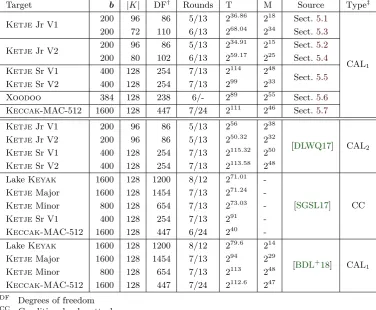
Table 1: Summary of our attacks on Ketje Jr, Ketje Sr, Xoodooand Keccak-MAC-512 under the nonce respected setting and comparison with related works
Target b |K| DF† Rounds T M Source Type‡
KetjeJr V1 200 96 86 5/13 2
36.86 218 Sect.5.1
CAL1 200 72 110 6/13 268.04 234 Sect.5.3
KetjeJr V2 200 96 86 5/13 2
34.91
215 Sect.5.2
200 80 102 6/13 259.17 225 Sect.5.4
KetjeSr V1 400 128 254 7/13 2114 248
Sect.5.5
KetjeSr V2 400 128 254 7/13 299 233
Xoodoo 384 128 238 6/- 289 255 Sect.5.6
Keccak-MAC-512 1600 128 447 7/24 2111 246 Sect.5.7
KetjeJr V1 200 96 86 5/13 256 238
[DLWQ17] CAL2 KetjeJr V2 200 96 86 5/13 250.32 232
KetjeSr V1 400 128 254 7/13 2115.32 250
KetjeSr V2 400 128 254 7/13 2113.58 248 LakeKeyak 1600 128 1200 8/12 271.01
-[SGSL17] CC KetjeMajor 1600 128 1454 7/13 271.24
-KetjeMinor 800 128 654 7/13 273.03
-KetjeSr V1 400 128 254 7/13 291
-Keccak-MAC-512 1600 128 447 6/24 240 -LakeKeyak 1600 128 1200 8/12 279.6 214
[BDL+18] CAL1 KetjeMajor 1600 128 1454 7/13 294 229
KetjeMinor 800 128 654 7/13 2113 248 Keccak-MAC-512 1600 128 447 7/24 2112.6 247
DF
Degrees of freedom
CC Conditional cube attacks
CAL1Cube-attack-like cryptanalysis with the help of MILP
CAL2Cube-attack-like cryptanalysis without the help of MILP
The results are summarized in Table 1. It is worth noticing that more rounds can be attacked against Ketje Jr when the key size is reduced,i.e., the security is reduced. Although 72 bits or 80 bits are not the recommended key size by the designers, it is good to see how the security is affected by varying the key/nonce sizes. For Ketje Sr V1, Ketje Major and Minor which have a relatively large nonce size, cube-attack-like crypt-analysis does not outperform conditional cube attacks. In addition, our crypt-analysis shows that Xoodoo-based AE bears good resistance against cube-attack-like cryptanalysis.
Comparison with Bi et al.’s model. Concurrently, another model for cube-attack-like cryptanalysis on keyed Keccak was proposed by Bi et al. [BDL+18]. Bi et al.’s model
that from [BDL+18].
Organization. The rest of the paper is organized as follows. In Section 2, a brief de-scription ofKetje,XoodooandKeccak-MACis given, followed by an introduction of related works. The MILP model is sketched in Section 4, and its application toKetje Jr, Ketje Sr, a Xoodoo-based AE and Keccak-MAC-512 is provided in Section 5. A comparison with related works is provided in Section 6. We conclude the paper in Section 7.
2
Description of
Ketje
and
Keccak-MAC
2.1
Notations
c Capacity of a sponge function r Rate of a sponge function
b Width of aKeccakpermutation in bits, b=r+c n Number of rounds inKeccak-p
d Dimension of the cube
ni Number of involved key bits
na Number of auxiliary variables
nk Number of recovered key bits
⊕ XOR operation
· AND operation
2.2
Keccak
-
p
TheKeccak-ppermutations, denoted byKeccak-p[b,n], are specified with two param-eters: the width of the permutation in bitsb= 25×2l, l= 0,· · ·,6, and the number of rounds n. The b-bit state a of the Keccak-p[b,n] can be seen as a three-dimensional array of bita[5][5][w]withw= 2l. The expressiona[x][y][z]represents the bit at position (x, y, z), where expressions in thexandycoordinates are always implicitly taken modulo 5 and expressions in thezcoordinate modulo w.
The two-dimensional parta[x][∗][∗]is called asheet. The one-dimensional parta[∗][y][z] is called arow,a[x][∗][z]acolumn anda[x][y][∗]alane. A lane of the state is also denoted as a[x][y]by omitting thez index. At lane level, the state a[x][y]becomes a 5×5 array withx for the column index andy for the row index. These notations are visualized in Figure1.
state sheet row column lane 0,4
0,3 0,2 0,1 0,0
1,4 1,3 1,2 1,1 1,0
2,4 2,3 2,2 2,1 2,0
3,4 3,3 3,2 3,1 3,0
4,4 4,3 4,2 4,1 4,0
Figure 1: Notations ofKeccak-p
The round function ofKeccak-p[b,n]consists of five steps R=ι◦χ◦π◦ρ◦θ, with details as follows.
θ: a[x][y][z] =a[x][y][z]⊕⊕4y=0a[x−1][y][z]⊕⊕4y=0a[x+ 1][y][z−1].
π: a[y][2x+ 3y][z] =a[x][y][z].
χ: a[x][y][z] =a[x][y][z]⊕((a[x+ 1][y][z]⊕1)·a[x+ 2][y][z]).
ι: a[0][0] =a[0][0]⊕RCir,whereRCir is their-th round constant.
In the specification ofKetjeV2, the twisted permutationsKeccak-p⋆are defined as
Keccak-p⋆[b,n] =π◦Keccak-p[b,n]◦π−1,
whereπ−1 is the inverse of the step mappingπwhich is expressed by
π−1: a[x+ 3y][x][z] =a[x][y][z].
The twist is to re-order the lanes in the state, as shown in Figure 2, so the twisted permutation is considered to apply the original permutation to the stateπ−1(a).
0,4 0,3 0,2 0,1 0,0
1,4 1,3 1,2 1,1 1,0
2,4 2,3 2,2 2,1 2,0
3,4 3,3 3,2 3,1 3,0
4,4 4,3 4,2 4,1 4,0
π−1
0,0 0,2 0,4 0,1 0,3
1,0 1,2 1,1
1,3 1,4
2,0
2,1 2,3 2,2 2,4
3,0 3,1 3,3 3,2 3,4
4,0 4,1
4,2 4,4 4,3
Figure 2: π−1
2.3
Ketje
Ketje is a set of authenticated encryption functions built onKeccak-p. KetjeJr and Ketje Sr are proposed in Ketje V1, of state size 200 and 400 bits respectively. Later, two larger instances, Ketje Minor and Ketje Major with 800-bit and 1600-bit state respectively, are added to the set in Ketje V2. The major difference between Ketje V1 and V2 is thatKeccak-p is used inKetje V1 whileKeccak-p⋆ is used instead in Ketje V2. In the following, we give a brief description ofKetjeV2.
Figure 3: Wrapping a header and a body with MonkeyWrap [BDP+16a]
The structure ofKetjefollows the MonkeyWrap, as illustrated in Figure3. Like other authenticated encryption functions,Ketje proceeds in four phases.
• Processing associated dataThe associated data is split intoδ-bit blocks (except the last one). Each time an associated data block of length up toδbits is padded toδ+4 bits and XORed to the state, followed by the application ofKeccak-p⋆[b,n
step]. If the associated data is empty, then a single block padded from the empty string will be processed.
• Processing message The message is also processed in δ-bit blocks in a similar way, where the ciphertext block is generated by XORing the message block andδbits of the internal state before the message block is absorbed.
• FinalizationKeccak-p⋆[b,nstride]is used to generateδbits. Ifδis greater than the required tag length, then the tag is extracted from theδ bits; otherwise,Keccak
-p⋆[b,nstep]is applied until enough bits are collected for generating the tag.
The parameters of the four instances ofKetjeV2 are summarized in Table2, and for all four instances, nstart = 12, nstep = 1 andnstride = 6. As can be seen from the above phases, the first ciphertext block is generated after at least nstart+nstep = 13 rounds. Most attacks onKetjein the literature, as well as this paper, consider versions ofKetje with this number reduced.
Table 2: Four instances ofKetjeV2
Name Key size Permutation δ Confidentiality
KetjeJr 96 Keccak-p⋆[200] 16 min(96,|K|)
KetjeSr 128 Keccak-p⋆[400] 32 min(128,|K|)
KetjeMinor 128 Keccak-p⋆[800] 128 min(128,|K|)
KetjeMajor 128 Keccak-p⋆[1600] 256 min(128,|K|)
2.4
Xoodoo
Xoodoo[DHAK18] is a 384-bit permutation designed by Daemenet al.. The design is very similar to Keccak-p, but also inspired by the permutation Gimli [BKL+17] which
also uses a 384-bit state and works efficiently on many platforms.
The 384-bit state ofXoodoocan be seen as a three-dimensional array of bita[4][3][w], wherew= 32. The round function ofXoodoohas five steps as follows.
θ: a[x][y][z] =a[x][y][z]⊕⊕2y=0a[x−1][y][z−5]⊕⊕y=02 a[x−1][y][z−14].
ρwest: a[x][1][z] =a[x−1][1][z], a[x][2][z] =a[x][2][z−11].
ι: a[0][0] =a[0][0]⊕RCir,whereRCir is their-th round constant.
χ: a[x][y][z] =a[x][y][z]⊕((a[x][y+ 1][z]⊕1)·a[x][y+ 2][z]).
ρeast: a[x][1][z] =a[x][1][z−1], a[x][2][z] =a[x−2][2][z−8].
It is noted in [BDH+17a] that
Xoodoo can be used as authenticated encryption in Ketje style.
2.5
Keccak-MAC
-512
Keccakfollows the sponge construction [BDPVA11] and usesKeccak-p[1600,24] as the underlying permutation. The sponge construction has two parameters, the capacity c and bit rate r. At first, the state is initialized to 0. Then Keccak takes in a message
Keccak-p[1600,24]. In [BDPA11], it is proposed thatKeccakcan be used as MAC by takingK||M as input. Such a MAC was calledKeccak-MACin [HWX+17] for the first
time and its round-reduced versions were analyzed in papers such as [DMP+15,LBDW17],
where the key size is 128 bits no matter which instance ofKeccakis used. KMAC[The16] is the NIST recommendation for constructing MAC fromKeccakwhere the key is processed as an independent block before processing the message. In this paper, we only focus on Keccak-MAC-512,i.e., the MAC based onKeccak-512.
3
Related Works
3.1
Cube Attacks
The cube attack, which can be seen as a variant of higher order differential attacks, was introduced by Dinur and Shamir [DS09] in 2009. It treats the output bit of a cipher as an unknown Boolean polynomial f(k0, ..., kn−1, v0, ..., vm−1)wherek0, ..., kn−1 are secret input variables andv0, ..., vm−1are public input variables. Given any monomialtI which is the product of variables in I ={i1, ..., id}, f can be represented as the sum of terms which are supersets ofI and terms which are not supersets ofI:
f(k0, ..., kn−1, v0, ..., vm−1) =tI·pSI+q(k0, ..., kn−1, v0, ..., vm−1),
wherepSI is called the superpoly ofI inf, and vi1, ..., vid are calledcube variables.
The idea behind cube attacks is that the sum of the Boolean polynomialf(k0, ..., kn−1,
v0, ..., vm−1) over the cube which contains all possible values for the cube variables is exactly pSI, while this is a random function for a random polynomial. In cube
at-tacks, low-degree pSIs in secret variables are exploited to recovery the key, while cube
testers [ADMS09] work by distinguishingpSI from a random function (e.g.,pSI= 0).
Dynamic cube attacks [DS11] are an extension of cube testers where certain variables (called dynamic variables) are assigned a function that depends on some of the cube variables and some private variables (the key bits), so that the output polynomial can be simplified and the cube attack can be improved.
3.2
Cube-Attack-Like Cryptanalysis on Round-Reduced
Keccak
In [DMP+15], Dinur et al. proposed cube-attack-like cryptanalysis on round-reduced
Keccak-MAC andKeyak, where the key is recovered in a divide-and-conquer manner. Specifically, the idea in the attack is to choose the cube variables in a way such that the superpoly involves only a small number of key bits, whose value can be recovered independently of the rest key using a cube attack separated into preprocessing and online phases. Once the cube is selected, then
• in thepreprocessing phase, one is to build a look-up table that stores cube sums under all possible values of the involved key bits;
• in theonline phase, one queries the cipher and obtains the cube sum, with which the actual value of the involved key bits can be retrieved from the look-up table.
Suppose the dimension of the cube isdand the number of involved key bits isni. Then the time complexities of the above two phases are 2d+ni and2d, respectively. As can be
sum involves. Suppose there are na auxiliary variables. Then in the online phase, one has to guess the key bits involved in the auxiliary variables and set the auxiliary variables accordingly. Under each setting of the auxiliary variables, one queries the cipher to obtain the cube sum. Consequently, the time complexity of the online phase is increased by a factor of2na. However, balanced attacks become more efficient.
Following this line, Donget al.[DLWQ17] studied the cube-attack-like cryptanalysis against round-reduced initialization ofKetje, where dynamic variables were used instead. They showed that dynamic variables are more effective than auxiliary variables since dynamic variables not only reduce the diffusion of key bits, but also reduce the diffusion of cube variables, potentially leading to cubes with larger dimensions. As a demonstration, attacks on 7-round Ketje Sr and 5-round Ketje Jr can be mounted successfully using dynamic variables, while cube-attack-like cryptanalysis with auxiliary variables fails.
3.3
Conditional Cube Attacks on Round-Reduced
Keccak
In [HWX+17], Huanget al. proposed conditional cube testers for keyed
Keccaksponge function, in which the propagation of certain cube variables are controlled in the first few rounds if some conditions are satisfied. If the conditions involve the key information, such cube tester could be used to recover the key. Using conditional cube testers, key recovery attacks were obtained for various instances ofKeccak-MACandKeyakin [HWX+17]. Later, the attacks onKeccak-MACandKetjeattacks were improved with better con-ditional cubes found by an MILP model by Liet al. in [LBDW17]. Inspired by [LBDW17], Songet al.[SGSL17] provided a new MILP model for searching conditional cubes of Kec-cak that fully describes the first two rounds, and the application of the new model leads to a series of better attacks against KMAC[The16],Keyak,KetjeandKeccak-MAC.
3.4
Motivations
As shown in Songet al.’s work, MILP widely improves conditional cube attacks on Kec-cak based constructions. However, there is no MILP modeling in the literature for cube-attack-like cryptanalysis on Keccak. Additionally, it is also noted from Song et al.’s work, that forKeccakconstructions with small rate (or nonce length), conditional cube attacks become less powerful whereas cube-attack-like cryptanalysis still works as shown by [DLWQ17]. So the major motivation of this work is to investigate the application of MILP in cube-attack-like cryptanalysis and access its efficiency inKeccakconstructions with relatively small rate, likeKetje Jr,Ketje Sr andKeccak-MAC-512.
4
MILP Model for Cube-Attack-Like Cryptanalysis
Mixed integer linear programming (MILP) is a general mathematical tool for optimization, which takes an objective function and a system of linear inequalities with respect to real numbers as input, and find solutions that optimize the objective function under the constraints of all inequalities. In [MWGP11], Mouhaet al. firstly showed that searching differential trails can be converted to an MILP problem.
In this section, ideas and techniques are introduced for searching cubes with auxil-iary/dynamic variables forKeccak-p based constructions.
4.1
Basic Idea
the algebraic degree of the output after n rounds is2n−1 if the first round is linearized. Therefore, a2n−1-dimensional cube can act as a cube tester forn-round
Keccakand be used to recover the key in cube-attack-like cryptanalysis. The time complexity of such cube attacks not only depends on the dimension (d) of the cube, but also depends on the number (ni) of key bits which the cube sum depends on, and the number (na) of auxiliary/dynamic variables. As introduced in Section 3, the time complexities of cube-attack-like cryptanalysis are
• Preprocessing phase: 2d+ni • Online phase: 2d+na
Note that, in previous papers [DMP+15,DLWQ17] either auxiliary variables or dynamic
variables are used, where auxiliary variables only contain some key bits while dynamic variables contain both cube variables and key bits. In this paper, we utilize both and call themauxiliary variablesfor simplicity since their impacts on the time complexity are the same.
With the basics of cube-attack-like cryptanalysis in mind, the main goals of the MILP modeling are clear:
1. Find2n−1-dimensional cubes wherenis as large as possible;
2. Find balanced attacks whereni andna are close and as small as possible.
The model for searching cubes ofKeccakusing auxiliary variables contains two lines: the propagation of cube variables through the linear layer and the propagation of key bits through the linear layer. At the nonlinear layerχin the first round, these two lines merge and interact. In the following subsections, the model will be introduced accordingly. For the sake of clarity, we takeKetje Jr V1 as an example.
4.2
Propagation of Cube Variables and the Dimension
d
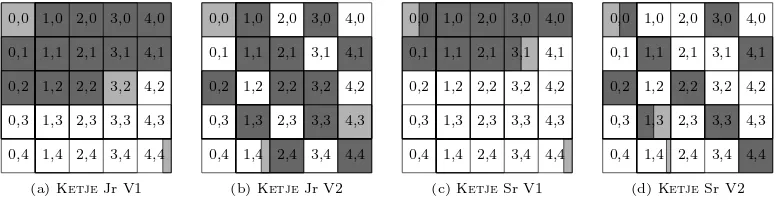
Cube variables have to traverse all possible values, so they should be placed where the values are under control of the attacker, e.g., the nonce or message. For Ketje Jr V1, as shown in Figure 4 (a), cube variables can be set only in white lanes under the nonce respected setting.
(a)KetjeJr V1 0,4 0,3 0,2 0,1 0,0 1,4 1,3 1,2 1,1 1,0 2,4 2,3 2,2 2,1 2,0 3,4 3,3 3,2 3,1 3,0 4,4 4,3 4,2 4,1 4,0
(b)KetjeJr V2 0,4 0,3 0,2 0,1 0,0 1,4 1,3 1,2 1,1 1,0 2,4 2,3 2,2 2,1 2,0 3,4 3,3 3,2 3,1 3,0 4,4 4,3 4,2 4,1 4,0
(c)KetjeSr V1 0,4 0,3 0,2 0,1 0,0 1,4 1,3 1,2 1,1 1,0 2,4 2,3 2,2 2,1 2,0 3,4 3,3 3,2 3,1 3,0 4,4 4,3 4,2 4,1 4,0
(d)KetjeSr V2 0,4 0,3 0,2 0,1 0,0 1,4 1,3 1,2 1,1 1,0 2,4 2,3 2,2 2,1 2,0 3,4 3,3 3,2 3,1 3,0 4,4 4,3 4,2 4,1 4,0
Figure 4: Key pack ofKetjeJr andKetjeSr, where gray lanes are the key, light gray lanes denote padded or encoded bits and white lanes are the nonce.
Suppose a[x][y][z], b[x][y][z], 0 ≤ x, y < 5,0 ≤ z < w, are the input and output of
variables in this column do not diffuse to other columns. If all column sums are constant, then the state a is in the column-parity-like kernel (CP-like kernel). In previous cube-attack-like cryptanalysis of Keccak-based constructions [DMP+15,DLWQ17], or even
conditional cube attacks [HWX+17,LBDW17], cube variables are set in CP-like kernel.
This is reasonable. If cube variables are set in CP-like kernel,A[x][y][z] =B[x][y][z] and
θ acts as the identity. In this way, the propagation of cube variables becomes simple. However, setting cube variables in CP-like kernel limits the dimension of the cube that can be obtained, and this drawback becomes non-negligible when the nonce or message block length is short.
In our model, we do not add any additional constraint to cube variables and take all possible cases into consideration. To do this, we introduce G[x][z], D[x][z], 0 ≤x <
5,0 ≤ z < w, where G[x][z] = 1 if the sum of column (x, z) contains cube variables and 0 otherwise;D[x][z] = 1 if the column(x, z)contains cube variables and the sum of these variables is a constant and 0 otherwise. For example, each column in the first four sheet ofKetje Jr V1 has only two bit positions, say (x, y0, z)and(x, y1, z)that can be chosen as cube variables, soG[x][z]andD[x][z]depend onA[x][y0][z]andA[x][y1][z]. The patternsA[x][y0][z], A[x][y1][z], G[x][z], D[x][z]follows are listed in Table3, as well as the inequalities describing these patterns. The inequalities that confine the 0-1 patterns into a finite set can be obtained through theinequality_generator()function in SageMath, as suggested in [SHW+14]. After that, an additional algorithm from [ST17], is used to select
a minimal number of inequalities from the inequalities returned byinequality_generator().
Table 3: Patterns of cube variables throughθ and inequalities. A[x][y0][z] A[x][y1][z] G[x][z] D[x][z] Inequalities
0 0 0 0
A[x][y0][z] +A[x][y1][z]−G[x][z]−2D[x][z]≥0, −A[x][y1][z] +G[x][z] +D[x][z]≥0, −A[x][y0][z] +G[x][z] +D[x][z]≥0.
0 1 1 0
1 0 1 0
1 1 1 0
1 1 0 1
For columns with other numbers of bit positions that can be chosen as cube variables, inequalities can be generated in a similar way. When the full column is available for cube variables, inequalities in Table9 in Appendix can be used.
According to the definition of θ, B[x][y][z] = 1 if any of A[x][y][z], G[x−1][z] or
G[x+ 1][z−1]is 1. This can be described by the following inequalities.
B[x][y][z]−A[x][y][z]≥0,
B[x][y][z]−G[x+ 1][z−1]≥0,
B[x][y][z]−G[x−1][z]≥0,
A[x][y][z] +G[x−1][z] +G[x+ 1][z−1]−B[x][y][z]≥0.
(1)
Since ρ and π just change the bit positions of the state, we let c = π◦ρ(b) and
C=π◦ρ(B). Now the propagation of cube variables through the linear layer is modeled. To linearize the first round, cube variables in c should not be adjacent, which can be constrained by
C[x][y][z] +C[x+ 1][y][z]≤1.
The dimension of the cube is determined byA[x][y][z]andD[x][y], and
d=∑A[x][y][z]−∑D[x][z].
4.3
Propagation of Key Bits and
n
aThis subsection presents the model for the propagation of key bits, and the number of auxiliary variables na is also calculated alongside.
First, let W[x][y][z] = 1 (Y[x][y][z] = 1) if a[x][y][z] (b[x][y][z]) contains a key bit; otherwise W[x][y][z] = 0 (Y[x][y][z] = 0). Additionally, Z = π◦ρ(Y). For Ketje Jr, the key pack is loaded into the gray and light gray lanes as depicted in Figure 4, so
W[x][y][z] = 1for bits in gray andW[x][y][z] = 0for bits in light gray. Among the white lanes,W[x][y][z] = 1indicates an auxiliary variable at(x, y, z).
Second, let X[x][z] = 1 if the sum of column (x, z) contains key bits, otherwise
X[x][z] = 0, meaning that no key bit in this column could diffuse to column(x−1, z+ 1) and (x+ 1, z) through θ. From Figure 4, it is known that each column of Ketje Jr contains key bits. Hence,X[x][z] = 0if and only if there is an auxiliary variable in that column. SoX[x][z]depends on the bits that can be chosen as auxiliary variables and the sum of them should be 1. Suppose there are two bit positions (x, y0, z)and (x, y1, z)in column (x, z)that can be chosen as auxiliary variables, then
X[x][z] +W[x][y0][z] +W[x][y1][z] = 1.
The relation ofY[x][y][z]andW[x][y][z]can be described withX[x][z]. EachY[x][y][z] is calculated fromW[x][y][z],X[x−1][z]andX[x+ 1][z−1], and any one is 1 will lead to
Y[x][y][z] = 1; otherwise Y[x][y][z] = 0. The inequalities describing this relation are the same as (1).
At last, the number of auxiliary variables is the sum ofW[x][y][z]in the white lanes. ForKetje Jr V1,
na=
∑
x,z,3≤y<5
W[x][y][z] +∑ z
W[4][2][z].
4.4
Interaction of Key Bits and Cube Variables, and
n
iRecall that Z = π◦ρ(Y) and Z[x][y][z] = 1 indicates that the input of χ in the first round at(x, y, z)contains key information. If its neighbouring bits contain cube variables,
i.e., C[x−1][y][z] = 1 or C[x+ 1][y][z] = 1, then the key bit propagated to position (x, y, z)affects the cube sum and thus it is an involved key bit. In order to calculate the number of involved key bits ni, U[x][y][z] is introduced, where U[x][y][z] = 1 if the key bit at (x, y, z) is an involved key bit and 0 otherwise. All possible patterns of (C[x−
1][y][z], C[x][y][z], C[x+ 1][y][z], Z[x][y][z], U[x][y][z])are listed in Table 4, which can be described with 5 inequalities, three of which are new and shown in the last line of Table4.
Table 4: Patterns of key bits and cube variables. Symbol ‘*’ denotes arbitrary value. C[x−1][y][z] C[x][y][z] C[x+ 1][y][z] Z[x][y][z] U[x][y][z]
0 * 0 0 0
0 * 0 1 *
1 0 * 0 0
1 0 * 1 1
0 0 1 0 0
0 0 1 1 1
Z[x][y][z]−U[x][y][z]≥0
C[x−1][y][z] +Z[x][y][z]−U[x][y][z]≤1
C[x+ 1][y][z] +Z[x][y][z]−U[x][y][z]≤1
To calculate the number of involved key bitsni, we sumU[x][y][z]together. Namely,
ni =
∑
Recall that θ adds the XORs of bits in column (x−1, z)and (x+ 1, z−1) to each bit of column(x, z). If at least two bits in column(x, z)do not contain key bits, then after
θ these bits contain either the same key bits or none. So the same key bit appearing in multiple positions may be counted more than once with ni =
∑
U[x][y][z], making ni inaccurate.
To partially solve this, we introduce the key patternV[x][y][z],0≤x, y <5,0≤z < w, after θ, where V[x][y][z]s in each column are equal if these bits do not contain key bit before θ. For Ketje Jr V1, V[x][0][z] = V[x][3][z] = V[x][4][z] for columns in the first sheet (x = 0), V[x][3][z] = V[x][4][z] for the second and third sheet (x = 1,2), and
V[x][2][z] =V[x][3][z] =V[x][4][z]for the fourth and fifth sheet (x= 4,5). Then, we let
U =π◦ρ(V), andni is set to be the sum of all distinct variables inU.
The problem remained unsolved is the impact of auxiliary variables on the key pattern
V[x][y][z] and the dependence of involved key bits. If W[0][3][z] = 1 for Ketje Jr V1,
i.e.,a[0][3][z]is an auxiliary variable, thenV[0][3][z]should not be equal toV[0][0][z]and
V[0][4][z] (butV[0][0][z] =V[0][4][z]). In addition, the ni involved key bits may be not fully independent and calculating the number of independent involved key bits is beyond the reach of MILP. Therefore, ni may be still inaccurate. We leave this problem to be fixed with a postprocessing procedure.
Now, the whole model for searching cubes using auxiliary variables can be built using techniques introduced in this section. We additionally set d = 2n−1 and the objective function to be ‘Minimizeni,na’. An MILP solver like Gurobi [Gur18] can then be invoked to find optimal solutions.
4.5
Postprocessing Procedure
Algorithm 1:Postprocessing procedure for recalculating ni.
Input: A, W of the solution, the cube dimensiondand the key length|K|
Output: ni
rel=∅;
BR= BooleanPolynomialRing(d+|K|,[k0, ..., k|K|−1, v0, ..., vd−1]);
a= zeroState();
loadKey(a,[k0, ..., k|K|−1]); loadCubeVar(a,A,[v0, ..., vd−1]); loadAux(a, W);
π◦ρ◦θ(a);
forAlla[x][y][z]do
if a[x][y][z] containsv0, ..., vd−1 then
if a[x−1][y][z] containsk0, ..., k|K|−1 then
rel←a[x−1][y][z];
end
if a[x+ 1][y][z] containsk0, ..., k|K|−1 then
rel←a[x+ 1][y][z];
end end end
returnrank(rel);
through the linear layer, and collect key bits (linear expressions of key bits) that are adjacent to the cube variables. The denser the key bits are in the initial state, the more complex the relation of involved key bits will be, but only the number of independent involved key bits matters and is the actualni. The detailed postprocessing procedure is described in Algorithm 1. Since the number of involved key bits optimized by our model may not be equal to the actualni, our model does not guarantee optimal solutions with respect to attack complexities, even though the dimension of cubes can be optimized. The experiments show that in most cases the actualni lies in[n⋆i −2, n⋆i + 2], wheren⋆i is the claimed number of involved key bits by the model. This means that our model still finds
almost optimal solutions.
5
Application to
Ketje
Jr,
Ketje
Sr,
Xoodoo
and
Keccak-MAC
-512
In this section, we apply the model described in Section 4 to Ketje Jr, Ketje Sr, Xoodoo-based AE in Ketje style andKeccak-MAC-512, all of which have relatively small nonce or message block length. First, improved 5-round attacks ofKetjeJr are ob-tained, where the time complexity of the attack is reduced significantly. Then, we consider KetjeJr with reduced key size. Namely, the key size is less than 96 bits, and the security goal of confidentiality becomes |K| = min(96,|K|) according to the security claims of Ketje [BDP+16a]. As a result, one more round of Ketje Jr V1 (V2) can be attacked if the key size is reduced to 72 (80) bits. Also, we give an improved 7-round attack on Ketje Sr V2. Finally, a 6-round attack on theXoodoo-based AE and a 7-round attack ofKeccak-MAC-512 are also achieved.
5.1
5-Round Attack against
Ketje
Jr V1 with Recommended Key
Size
The attack on 5-roundKetjeV1 sequentially utilizes three 16-dimensional cubes as shown in Table7 and8. Each cube helps to recover part of the key and these three cubes work together to make the whole time complexity low.
The first cube has ni = 18 involved key bits (linear combination of key bits) and
na = 17 auxiliary variables which are listed in Table 5. The two phases of the attack proceed as follows.
Preprocessing phase:
1. Set the 18 bits in light gray according to the encoding rule, as illustrated in Figure4
(a). Set all key bits to zero exceptk2, k75, k15, k63, k12, k60, k93, k61, k5, k78, k20, k23, k3,
k56, k57, k58, k59, k621. Set all other state bits to an arbitrary constant except the 16 cube variables, 9 out of the 17 auxiliary variablesa[1][3][1],a[1][4][4], a[4][2][0], a[4][2][1],
a[4][3][2], a[4][2][5], a[4][2][7], a[3][4][0], a[3][4][3], and a[0][3][0],a[0][3][1].
2. For the218values ofk2, k75, k15, k63, k12, k60, k93, k61, k5, k78, k20, k23, k3, k56, k57, k58,
k59, k62:
(a) For each of the 4 values of a[0][3][0], a[0][3][1], calculate the cube sum of the 16-bit output after 5 rounds.
(b) Store the four 16-bit cube sums in a sorted list L, next to the value of the corresponding k2, k2+k75, k15, k15+k63, k12, k12+k60, k93, k93+k61, k5, k5+
k78, k4+k20+k60, k23+k63, k3, k56, k57, k58, k59, k62.
Table 5: Auxiliary variables and involved key bits of the first cube forKetjeJr V1 where the gray key bits are set to be zero in the preprocessing phase.
Auxiliary variables Involved key bits
a[1][3][0] =k0+k40+k80 k2+k42+k27+k67+k82 a[1][3][1] =k1+k41+k81+v0 k2+k42+k27+k67+k82+k75
a[1][4][4] =k4+k44+k84+v1 k15+k30+k55+k70+k95 a[1][3][6] =k6+k46+k86 k15+k30+k55+k70+k95+k63
a[1][4][7] =k7+k47+k87 k12+k27+k52+k67+k92 a[2][3][0] =k8+k48+k88 k12+k27+k52+k67+k92+k60
a[2][3][1] =k9+k49+k89 k13+k28+k53+k68+k93
a[2][3][2] =k10+k50+k90 k13+k28+k53+k68+k93+k61
a[2][4][3] =k11+k51+k91 k5+k30+k45+k70+k85 a[2][3][6] =k14+k54+k94 k5+k30+k45+k70+k85+k78
a[3][4][0] =k16+k56 k5+k13+k45+k85+k20+k60
a[3][4][3] =k19+k59 k8+k23+k63
a[4][2][0] =k24+k64+v2 k3+k28+k43+k68+k83 a[4][2][1] =k25+k65+v4 k56, k57, k58, k59, k62
a[4][3][2] =k26+k66+v7
a[4][2][5] =k29+k69+v12
a[4][2][7] =k31+k71+v15
Online phase:
1. For all possible values of the 17 linear expressions of key bits in auxiliary variables:
(a) Set the auxiliary variables accordingly. For each of the 4 values of a[0][3][0],
a[0][3][1], request the 16-bit outputs for the cube and calculate the cube sums (setting the same constant values in the state as in the preprocessing).
(b) For each match in L, retrieve the 18-bit value for the involved key bits and record it and the current value of the 17 key bits in auxiliary variables as a candidate.
In the online phase, only one candidate for the 35-bit partial key will survive, since 218+17·2−64<1. The time complexity of the preprocessing phase is218+16+2= 236, and the memory complexity is218. The time complexity of the online phase is217+16+2= 235. In the end,nk= 35bits information of the key are obtained. However,96−35 = 51bits of the key are still unknown. Next, we use the second and the third cube to recover more key bits. Since the two phases of the attack using other cubes work similarly to those of the first cube for KetjeJr V1, details of the attacks are omitted afterward, and only complexities are given.
The second cube has ni = 22 involved key bits and na = 21 auxiliary variables, see Table7 in the appendix. With 35 bits of the key known from the first cube, the number of unknown involved key bits is n′i = 14, and the number of unknown key bits in the auxiliary variables is n′a= 9. So the complexities are as follows.
• Preprocessing phase: the time complexity is214+16+2 = 232 and the memory com-plexity is214;
• Online phase: the time complexity is29+16+2= 227.
• Preprocessing phase: the time complexity is216+16+2 = 234 and the memory com-plexity is216;
• Online phase: the time complexity is24+16+2= 222.
The number of key bits recovered from the three cubes isnk= 74.
In all, all key bits can be recovered with time complexity236+ 235+ 232+ 227+ 234+ 222+ 296−74= 236.86 and the memory complexity218.
5.2
5-Round Attack against
Ketje
Jr V2 with Recommended Key
Size
The attack on 5-round Ketje Jr V2 also uses three 16-dimensional cubes, shown in Table10,11. The attack on Ketje Jr V2 proceeds the same as the attack on V1. Here, we just calculate the complexities.
The first cube has ni = 14 involved key bits and na = 15 auxiliary variables (see Table10). The complexities using the first cube are as follows.
• Preprocessing phase: the time complexity is214+16+2 = 232 and the memory com-plexity is214;
• Online phase: the time complexity is215+16+2= 233.
The number of key bits recovered from the first cube isnk = 29.
The second cube has ni = 18 involved key bits andna = 15 auxiliary variables (see Table 10). With 29 bits of the key known from the first cube, the number of unknown involved key bits isn′i= 13, and the number of unknown key bits in the auxiliary variables isn′a = 9. So the complexities are as follows.
• Preprocessing phase: the time complexity is213+16+2 = 231 and the memory com-plexity is213;
• Online phase: the time complexity is29+16+2= 227.
The accumulated number of key bits recovered from the first two cubes isnk = 47. The third cube has ni = 32 involved key bits and na = 26 auxiliary variables (see Table 11). With 47 bits of the key known, the number of unknown involved key bits becomesn′i= 15, and the number of unknown key bits in the auxiliary variables isn′a= 1. So the complexities are as follows.
• Preprocessing phase: the time complexity is215+16+2 = 233 and the memory com-plexity is215;
• Online phase: the time complexity is21+16+2= 219.
The number of key bits recovered from the three cubes isnk= 63.
In all, the full key can be recovered with time complexity232+ 233+ 231+ 227+ 233+ 219+ 296−63= 234.91 and the memory complexity215.
5.3
6-Round Attack against
Ketje
Jr V1 with Reduced Key Size
When the key size ofKetjeJr V1 is reduced to 72 bits, i.e., the nonce size increases, 32-dimensional cubes can be found. Consequently, one more round can be attacked. The 32-dimensional cube used in our attack is presented in Table 12, and has 29 auxiliary variables and 34 involved key bits. The time complexities of the 6-round attack onKetje Jr V1 with a 72-bit key are calculated as follows.
• Preprocessing phase: the time complexity is234+32+2 = 268 and the memory com-plexity is234;
• Online phase: the time complexity is229+32+2= 263.
With this cube, 57 bits information of the key can be recovered. The remaining 72− 57 = 15 key bits can be recovered by brute force. In total, the time complexity is 268+ 263+ 215= 268.04, and the memory complexity is234.
5.4
6-Round Attack against
Ketje
Jr V2 with Reduced Key Size
The experiment shows that 32-dimensional cubes ofKetje Jr V2 that linearize the first round do not exist and the maximal dimension of such cubes is 24. When the key size of Ketje Jr V2 is reduced to 80 bits, 32-dimensional cubes can be found using our model, and the number of rounds attacked can be increased to 6. The 32-dimensional cube used in our attack is presented in Table 13 which has 22 auxiliary variables and 25 involved key bits. The time complexities of the 6-round attack onKetjeJr V2 with an 80-bit key are calculated as follows.
• Preprocessing phase: the time complexity is225+32+2 = 259 and the memory com-plexity is225;
• Online phase: the time complexity is222+32+2= 256.
With this cube,40bits information of the key can be recovered. The remaining80−40 = 40key bits can be recovered by brute force. In total, the time complexity is259+256+240= 259.17, and the memory complexity is225.
5.5
7-Round Attack against
Ketje
Sr
For Ketje Sr V1, the best 64-dimensional cube found by our model has 48 auxiliary variables and 48 involved key bits, leading to an attack on 7 rounds ofKetjeSr V1 with time complexity 2114, which is slightly better than the attack in [DLWQ17], but worse than the conditional attack in [SGSL17].
ForKetjeSr V2, the 64-dimensional cube used in our attack is presented in Table14
which has 33 auxiliary variables and 33 involved key bits. The time complexities of the 7-round attack onKetjeSr V2 are calculated as follows.
• Preprocessing phase: the time complexity is233+64+1 = 298 and the memory com-plexity is233;
• Online: the time complexity is233+64+1= 298.
(a)Xoodoo-based AE 0,2 0,1 0,0 1,2 1,1 1,0 2,2 2,1 2,0 3,2 3,1 3,0
(b)Keccak-MAC-512 0,4 0,3 0,2 0,1 0,0 1,4 1,3 1,2 1,1 1,0 2,4 2,3 2,2 2,1 2,0 3,4 3,3 3,2 3,1 3,0 4,4 4,3 4,2 4,1 4,0
Figure 5: Key pack ofXoodooinKetjestyle andKeccak-MAC-512, where gray lanes are the key, light gray lanes denote constants and white lanes are the nonce or message.
5.6
6-Round Attack against
Xoodoo
-based AE
Assume that the key of the Xoodoo-based AE has 128 bits and follows the Ketje’s packing, as shown in Figure 5 (a). Since the operations θ and χ of Xoodoo are very similar to those ofKeccak-pandρwestjust reorders the state bits, the model described in Section4can be adapted to Xoodooeasily.
When we only focus on cube variables, the experiment shows that 64-dimensional cubes linearizing the first round do not exist and the maximal dimension of such cubes is 62. Therefore, we mount an attack on 6-roundXoodoo-based AE using a 32-dimensional cube.
The 32-dimensional cube used in our attack is presented in Table 15 which has 55 auxiliary variables and 55 involved key bits. The time complexities of the 6-round attack on the Xoodoo-based AE are calculated as follows under the assumption that the rate is 32.
• Preprocessing phase: the time complexity is255+32+1 = 288 and the memory com-plexity is255;
• Online: the time complexity is255+32+1= 288.
With this cube,106 bits information of the key can be recovered. The remaining 128− 106 = 22 key bits can be recovered by brute force. In total, the time complexity is 288+ 288+ 222≈289, and the memory complexity is255.
Note that such cubes with dimension 64 exist for Ketje Sr but it is not the case for Xoodoo-based AE. One reason is that Ketje Sr has a slightly larger state which provides 16 more degrees of freedom. Another important reason lies in the differences of the underlying permutation as follows
• Columns in Xoodoo are shorter than those in Keccak-p. Note long columns (specifically, columns of more free bits) are advantageous to save degrees of freedom.
• The non-linear operation (S-box) is applied to every 3-bit column inXoodoobut to every 5-bit row inKeccak-p. More specifically, at most one bit in each column ofXoodoocontains cube variables while at most two bits in each row ofKeccak-p
contain cube variables.
5.7
7-Round Attack against
Keccak
-MAC-512
The key pack of Keccak-MAC-512 is shown in Figure 5 (b). One of 64-dimensional cubes forKeccak-MAC-512 is shown in Table 16, which has 46 auxiliary variables and 46 involved key bits. The time complexities of the 7-round attack onKeccak-MAC-512 are calculated as follows.
• Preprocessing phase: the time complexity is246+64 = 2110 and the memory com-plexity is246;
• Online: the time complexity is246+64= 2110.
With this cube, 92 bits information of the key can be recovered. The remaining 128− 92 = 36 key bits can be recovered by brute force. In total, the time complexity is 2110+ 2110+ 236≈2111, and the memory complexity is246.
5.8
Experiment and Verification
In this paper, cubes are searched by feeding the generated inequalities to Gurobi Opti-mizer [Gur18]. The running time for searching cubes varies from seconds to hours. Specif-ically, it takes seconds on a PC to search cubes forKetje Jr andKetje Sr, minutes for Xoodooand hours forKeccak-MAC-512.
To verify the correctness of the attacks in this section, we implemented the attack on 5-round Ketje Jr V1 using the first cube whose details are displayed in Table 7. The 18 involved key bits and 17 auxiliary variables are also presented in Table 5 for better understanding. The experiments show that the right value of the involved key bits and the key bits in auxiliary variables can be recovered successfully2.
6
Discussion and Comparison
Our results of Section5are summarized in Table1, along with a comparison with related works. Below, the comparison will be explained in more detail.
Cube-attack-like cryptanalysis with and without MILP. In [DLWQ17], Dong et al.
studied cube-attack-like cryptanalysis of Ketje, where cubes were constructed manu-ally. Compared with Dong et al.’s work, our automated method using MILP helps to find better cubes and thus obtains better attacks. Moreover, using our model, it becomes easier to carry out cube-attack-like cryptanalysis of keyedKeccakconstructions or prove that cubes of certain dimensions do not exist.
Cube-attack-like cryptanalysis and conditional cube attacks. In general, the most im-portant factor in both types of attack is the number of degrees of freedom,i.e., message block size or nonce size. Table6summarizes the numbers of degrees of freedom for keyed Keccakconstruction discussed in this paper. Recall that the first round of theKeccak permutation is linearized in both attacks, but in conditional cube attacks the propaga-tion of some cube variables is controlled in the second round by consuming addipropaga-tional degrees of freedom. If there are sufficient degrees of freedom in a keyed Keccak con-struction, only a few conditions are required to construct conditional cubes, resulting in a lower time complexity than cube-attack-like cryptanalysis. But on keyed Keccak constructions with small degrees of freedom, i.e., small message block size or nonce size, conditional cube attacks do not perform as well as cube-attack-like cryptanalysis. For example, 16-dimensional conditional cubes do not exist forKetjeJr [SGSL17], and thus
Table 6: Keccak-p-based constructions and their available degrees of freedom and dimensions of cubes used in attacks. ‘Type’ refers to the attack which is more advantageous.
Ketje
LakeKeyak Major Minor Sr Jr Keccak-MAC-512
b 1600 1600 800 400 200 1600
DF 1200 1454 654 254 86 447
d 64 64 64 64 16 64
Type CC CC CC CC/CAL CAL CAL
CC
Conditional cube attacks
CALCube-attack-like cryptanalysis
5-round attacks are impossible using conditional cube attacks, but both [DLWQ17] and our work show that it is not the case for cube-attack-like cryptanalysis.
Apart from the number of degrees of freedom, another important factor in both attacks is the layout of the state, especially the layout of free bits. This can be seen from the analysis of Ketje Sr and Keccak-MAC-512. Keccak-MAC-512 has 447 degrees of freedom which is much larger than that of Ketje Sr, but the dimension of conditional cubes ofKeccak-MAC-512 hardly reaches 64 while 64-dimensional conditional cubes of Ketje Sr can be found easily [SGSL17]. One reason is that each column in the initial state ofKeccak-MAC-512 has only one or two free bits while in that ofKetjeSr almost every column has at least three free bits. As discussed in Section 5.6, columns of more free bits are beneficial to save degrees of freedom.
Very recently, Bi et al.[BDL+18] also provided an MILP model for cube-attack-like cryptanalysis of keyed Keccak and applied it to Lake Keyak, Ketje Major, Ketje Minor and Keccak-MAC which were also analyzed in [SGSL17]. The comparison be-tween the results from [SGSL17] and [BDL+18] shows that for
Keyak,KetjeMajor and Ketje Minor which have relatively large degrees of freedom, conditional cube attacks outperform cube-attack-like cryptanalysis. Further, our work shows that for Ketje Sr V2, Ketje Jr, and Keccak-MAC-512 with relatively small degrees of freedom, cube-attack-like cryptanalysis is more efficient. To make sure we can stop atKetje Sr safely, we add an experiment onKetjeMinor and obtain a 7-round attack with complexity 292 by finding the cube in Table 17. This attack is better than the attack ofKetje Minor in [BDL+18] which has a time complexity of 2113, but worse than the conditional cube attack in [SGSL17] whose time complexity is273.03. Therefore, we do not apply our model to other targets with degrees of freedom larger than that of Ketje Sr, such as Ketje Major, andKeyak.
7
Conclusion
Acknowledgements
The first author is partially supported by the Fundamental Theory and Cutting Edge Technology Research Program of Institute of Information Engineering, CAS (Grant No. Y7Z0341103), Youth Innovation Promotion Association CAS, the National Natural Sci-ence Foundation of China (Grants No. 61802399, 61802400, 61732021, 61772519 and 61472415) and Chinese Major Program of National Cryptography Development Founda-tion (Grant No. MMJJ20180102).
References
[ADMS09] Jean-Philippe Aumasson, Itai Dinur, Willi Meier, and Adi Shamir. Cube Testers and Key Recovery Attacks On Reduced-Round MD6 and Trivium. In Helena Handschuh, Stefan Lucks, Bart Preneel, and Phillip Rogaway, editors,
Symmetric Cryptography 2009, volume 09031 of Dagstuhl Seminar Proceed-ings. Schloss Dagstuhl - Leibniz-Zentrum für Informatik, Germany, 2009.
[BDH+17a] Guido Bertoni, Joan Daemen, Seth Hoffert, Johan De Meulder, Michaël Peeters, Gilles Van Assche, and Ronny Van Keer. Innovations in permutation-based crypto. 21st Workshop on Elliptic Curve Cryptography, 2017. https: //ecc2017.cs.ru.nl/slides/ecc2017-daemen.pdf.
[BDH+17b] Guido Bertoni, Joan Daemen, Seth Hoffert, Michaël Peeters, Gilles Van Ass-che, and Ronny Van Keer. Farfalle: parallel permutation-based cryptography.
IACR Trans. Symmetric Cryptol., 2017(4):1–38, 2017.
[BDL+18] Wenquan Bi, Xiaoyang Dong, Zheng Li, Rui Zong, and Xiaoyun Wang. Milp-aided cube-attack-like cryptanalysis on keccak keyed modes. Designs, Codes and Cryptography, Aug 2018.
[BDP+16a] Guido Bertoni, Joan Daemen, Michaël Peeters, Gilles Van Assche, and Ronny Van Keer. CAESAR submission: Ketje v2. Candidate of CAESAR Compe-tition, September 2016.
[BDP+16b] Guido Bertoni, Joan Daemen, Michaël Peeters, Gilles Van Assche, and Ronny Van Keer. CAESAR submission: Keyak v2. Candidate of CAESAR Compe-tition, September 2016.
[BDPA11] Guido Bertoni, Joan Daemen, Michaël Peeters, and Gilles Van Assche. Du-plexing the Sponge: Single-Pass Authenticated Encryption and Other Appli-cations. In Ali Miri and Serge Vaudenay, editors,SAC 2011, volume 7118 of
LNCS, pages 320–337. Springer, 2011.
[BDPV11] Guido Bertoni, Joan Daemen, Michaël Peeters, and Gilles Van Assche. The Keccak Reference.http://keccak.noekeon.org, January 2011. Version 3.0.
[BDPVA11] Guido Bertoni, Joan Daemen, Michaël Peeters, and Gilles Van Assche. Cryp-tographic Sponge functions. Submission to NIST (Round 3), 2011.
[CFG+18] Colin Chaigneau, Thomas Fuhr, Henri Gilbert, Jian Guo, Jérémy Jean, Jean-René Reinhard, and Ling Song. Key-recovery attacks on full kravatte. IACR Trans. Symmetric Cryptol., 2018(1):5–28, 2018.
[DDS12] Itai Dinur, Orr Dunkelman, and Adi Shamir. New Attacks on Keccak-224 and Keccak-256. In Anne Canteaut, editor,FSE 2012, volume 7549 ofLNCS, pages 442–461. Springer, 2012.
[DDS13] Itai Dinur, Orr Dunkelman, and Adi Shamir. Collision Attacks on Up to 5 Rounds of SHA-3 Using Generalized Internal Differentials. In Shiho Moriai, editor,FSE 2013, volume 8424 ofLNCS, pages 219–240. Springer, 2013.
[DHAK18] Joan Daemen, Seth Hoffert, Gilles Van Assche, and Ronny Van Keer. Xoodoo cookbook. Cryptology ePrint Archive: Report 2018/767, 2018. https:// eprint.iacr.org/2018/767.
[DLWQ17] Xiaoyang Dong, Zheng Li, Xiaoyun Wang, and Ling Qin. Cube-like Attack on Round-Reduced Initialization of Ketje Sr. IACR Trans. Symmetric Cryptol., 2017(1):259–280, 2017.
[DMP+15] Itai Dinur, Pawel Morawiecki, Josef Pieprzyk, Marian Srebrny, and Michal Straus. Cube Attacks and Cube-Attack-Like Cryptanalysis on the Round-Reduced Keccak Sponge Function. In Elisabeth Oswald and Marc Fischlin, editors, EUROCRYPT 2015, Part I, volume 9056 of LNCS, pages 733–761. Springer, 2015.
[DS09] Itai Dinur and Adi Shamir. Cube Attacks on Tweakable Black Box Polyno-mials. In Antoine Joux, editor, EUROCRYPT 2009, volume 5479 of LNCS, pages 278–299. Springer, 2009.
[DS11] Itai Dinur and Adi Shamir. Breaking Grain-128 with Dynamic Cube Attacks. In Antoine Joux, editor, FSE 2011, volume 6733 of LNCS, pages 167–187. Springer, 2011.
[FNR18] Thomas Fuhr, María Naya-Plasencia, and Yann Rotella. State-recovery at-tacks on modified ketje jr. IACR Trans. Symmetric Cryptol., 2018(1):29–56, 2018.
[GLS16] Jian Guo, Meicheng Liu, and Ling Song. Linear Structures: Applications to Cryptanalysis of Round-Reduced Keccak. In Jung Hee Cheon and Tsuyoshi Takagi, editors, ASIACRYPT 2016, Part I, volume 10031 of LNCS, pages 249–274, 2016.
[Gur18] Gurobi. Gurobi. http://www.gurobi.com/, 2018.
[HWX+17] Senyang Huang, Xiaoyun Wang, Guangwu Xu, Meiqin Wang, and Jingyuan Zhao. Conditional Cube Attack on Reduced-Round Keccak Sponge Function. In Jean-Sébastien Coron and Jesper Buus Nielsen, editors, EUROCRYPT 2017, Part II, volume 10211 ofLNCS, pages 259–288, 2017.
[LBDW17] Zheng Li, Wenquan Bi, Xiaoyang Dong, and Xiaoyun Wang. Improved Con-ditional Cube Attacks on Keccak Keyed Modes with MILP Method. In Tsuyoshi Takagi and Thomas Peyrin, editors, ASIACRYPT 2017, Part I, volume 10624 ofLNCS, pages 99–127. Springer, 2017.
[MWGP11] Nicky Mouha, Qingju Wang, Dawu Gu, and Bart Preneel. Differential and Linear Cryptanalysis Using Mixed-Integer Linear Programming. In Chuankun Wu, Moti Yung, and Dongdai Lin, editors,Inscrypt 2011, volume 7537 ofLNCS, pages 57–76. Springer, 2011.
[NRM11] María Naya-Plasencia, Andrea Röck, and Willi Meier. Practical Analysis of Reduced-Round Keccak. In Daniel J. Bernstein and Sanjit Chatterjee, editors,INDOCRYPT 2011, volume 7107 ofLNCS, pages 236–254. Springer, 2011.
[QSLG17] Kexin Qiao, Ling Song, Meicheng Liu, and Jian Guo. New Collision At-tacks on Round-Reduced Keccak. In Jean-Sébastien Coron and Jesper Buus Nielsen, editors,EUROCRYPT 2017 Part III, volume 10212 ofLNCS, pages 216–243, 2017.
[SGSL17] Ling Song, Jian Guo, Danping Shi, and San Ling. New MILP Modeling: Im-proved Conditional Cube Attacks on Keccak-based Constructions. to appear in ASIACRYPT 2018, Cryptology ePrint Archive, Report 2017/1030, 2017.
https://eprint.iacr.org/2017/1030.
[SHW+14] Siwei Sun, Lei Hu, Peng Wang, Kexin Qiao, Xiaoshuang Ma, and Ling Song. Automatic Security Evaluation and (Related-key) Differential Characteris-tic Search: Application to SIMON, PRESENT, LBlock, DES(L) and Other Bit-Oriented Block Ciphers. In Palash Sarkar and Tetsu Iwata, editors, ASI-ACRYPT 2014, Part I, volume 8873 ofLNCS, pages 158–178. Springer, 2014.
[SLG17] Ling Song, Guohong Liao, and Jian Guo. Non-full Sbox Linearization: Ap-plications to Collision Attacks on Round-Reduced Keccak. In Jonathan Katz and Hovav Shacham, editors,CRYPTO 2017, Part II, volume 10402 ofLNCS, pages 428–451. Springer, 2017.
[ST17] Yu Sasaki and Yosuke Todo. New Algorithm for Modeling S-box in MILP Based Differential and Division Trail Search. In Pooya Farshim and Emil Simion, editors, SecITC 2017, volume 10543 of LNCS, pages 150–165. Springer, 2017.
[The15] The U.S. National Institute of Standards and Technology. SHA-3 Standard: Permutation-Based Hash and Extendable-Output Functions . Federal Infor-mation Processing Standard, FIPS 202, 5th August 2015.
[The16] The U.S. National Institute of Standards and Technology. SHA-3 Derived Functions: cSHAKE, KMAC, TupleHash and ParallelHash. NIST Special Publication 800-185, 21st December 2016.

![Figure 3: Wrapping a header and a body with MonkeyWrap [BDP+16a]](https://thumb-us.123doks.com/thumbv2/123dok_us/7975731.1322561/5.595.196.403.303.417/figure-wrapping-header-body-monkeywrap-bdp-a.webp)

![Table 3: Patterns of cube variables through θ and inequalities.[][][][][][][]Inequalities](https://thumb-us.123doks.com/thumbv2/123dok_us/7975731.1322561/10.595.103.494.380.459/table-patterns-cube-variables-th-inequalities-inequalities.webp)
![Table 4: Patterns of key bits and cube variables. Symbol ‘*’ denotes arbitrary value.[ 1][][][][][][ + 1][][][][][][][][]](https://thumb-us.123doks.com/thumbv2/123dok_us/7975731.1322561/11.595.153.441.568.705/table-patterns-bits-variables-symbol-denotes-arbitrary-value.webp)


