Performance Analysis and Comparison of MANET
Routing Protocols
Kuljit Kaur1,Swati Jindal2,Lavneet Bansal3 1
Department of Computer Engineering, GNDU, Amritsar 2
Computer Engineering, Guru Nanak Dev University, Amritsar 3
Department of Computer Engineering, MIMIT, Malout
ABSTRACT-Advances in wireless technology and portable computing along with demands for greater user mobility have provided a major movement towards development of ad-hoc networks. The main Method for evaluating the performance of MANET’s is simulation. An extensive simulation is performed using NS-2 simulator and end to end delay, packet delivery ratio, packet loss ratio, throughput and jitter for Reactive protocols TORA,DSR and proactive protocol DSDV for TCP and CBR traffic patten are evaluated for different scenarios i.e. pause time, simulation time and no of nodes . At the end it is concluded that in case of TCP DSDV(Proactive) is best and in case of CBR DSR(Reactive) is best. Performance of TORA is average in all cases except packet loss.
Keywords: TORA, DSR, DSDV, MANET, protocols, NS-2 simulator
1. INTRODUCTION
Ad-hoc networks are the key factor in the evaluation of wireless communication quoted as corner stones of future generation wireless networking. Wireless LANs support user demand for flawless connectivity, flexibility, and mobility. Generally there are two distinct approaches for enabling wireless mobile units to communicate with each other: Infrastructure-based - Wireless mobile networks have traditionally been based on the cellular concept and relied on good infrastructure support.
Infrastructure-less - Infrastructure-less approach, the mobile wireless network is commonly known as a mobile ad hoc network (MANET) i.e.collection of wireless nodes that can dynamically form a network to exchange information without using any preexisting fixed network infrastructure.
A fundamental problem in ad hoc networking is routing i.e. how to deliver data packets among MNs efficiently without predetermined topology or centralized control, which is the main objective of ad hoc routing protocols. Since mobile ad hoc networks change their topology frequently, routing in such networks is a challenging task. Moreover, bandwidth, energy and physical security are limited. The Mobile Ad-Hoc Network is characterized by energy constrained nodes, bandwidth constrained links and dynamic topology. Potential applications for this class of network includes instant network infrastructure to support collaborative computing in temporary or mobile environments, emergency rescue networks for disaster management, remote control of electrical appliance, communication systems such as IVC (Inter-Vehicle Communications), and mobile access to the global Internet. Routing protocols for Ad-hoc networking can be classified into four categories viz. (i) Based on routing information update routing mechanism (proactive or table-driven, reactive or on-demand and hybrid protocols), (ii)
Based on the use of Temporal information (Past Temporal and Future Temporal) for routing, (iii) Based on routing topology (Flat Topology, Hierarchical Topology), (iv) Based on the Utilization of Specific Resources (Power Aware Routing and Geographical Information Assisted Routing) [29].
1.1. DESTINATION-SEQUENCED DISTANCE-VECTOR ROUTING [DSDV] [6]: The Table-driven DSDV is a proactive protocol that is modified version of the Distributed Bellman-Ford (DBF) Algorithm that was used successfully in many dynamic packet switched networks The design goals of DSDV were to keep the simplicity of the distributed Bellmann –Ford and to avoid the looping problem in routing tables using the concept of sequence number. It uses full dump and update increment to lessen the traffic load. The improvement made in this is the avoidance of infinite loop. In DSDV, each node is required to transmit a sequence number that is linked to destination usually originated by owner ,at which is periodically increased by two and transmitted along with any other routing update messages to all neighboring nodes .A non-owner node updates a sequence number of a route is when it detects a link break on that route. Owner nodes uses even numbers and non owner nodes uses odd numbers as sequence number.
1.2.DYNAMIC SOURCE ROUTING PROTOCOL (DSR) [7]:
The Dynamic Source Routing (DSR) protocol is an on-demand reactive unicast routing protocol based on source routing. DSR protocol is composed by two “on-demand” mechanisms, which are requested only when two nodes want to communicate with each other. In DSR, each node uses buffer technology to keep route information of all the nodes. There are two major phases in DSR such as:
Route discovery
Route maintenance
.Moreover, it is desirable to detect network partition and delete invalid routes. TORA is unique by maintaining multiple routes to a destination .It also still maintain state on a per destination basis. However the shortest route paths are considered less important so preference is given to longer routes to minimize the overhead. It does not work well in low mobility networks.
2. RELATED WORK
Analysis and simulation of wireless AD-Hoc network routing was done by Mohamed et al [2004][1]. The simulation results show that AODV and DSDV can be used for most of ad-hoc applications delivering about 95% of data packets to the destination nodes.Performance analysis of three routing protocols(DSDV,AODV and DSR) in wireless mobile Ad Hoc networks were discussed by Lakshmi et al [2006][2]. It was analyzed that DSDV are more suitable for small networks where changes in the topology are limited. Chang
et al [2006] [53,3] evaluated that AODV and DSR, both
show better performance than the other in terms of certain metrics.Jayakumar et al [2007][4] concluded that for DSR and AODV, packet delivery ratio is independent of offered traffic load, with both protocols delivering between 85% and 100% of the packets in all cases.Kumar et al [2008]5] analyzed that Both reactive protocols performed well in high mobility scenarios than proactive protocol.Malany et
al[2009][47,13] has done the Throughput and Delay
Comparison and faced the problem of switching off of the scenario for higher node densities. It might be due to the processor capability (RAM usage).Karthik et al [2010][44,9] investigated that The performance of the DSR and AODV is superior to the DSDV in conformance.Manickam1 et al
[2011][10] analyzed that DSDV produces low end-to-end
delay compared to other protocols. Ambhaikar et
al[2011][11] has analyzed that the performance of AODV
protocol is better than the DSDV protocol. AODV performance is the best considering its ability to maintain connection by periodic exchange of information.Karthiga et
al[2011][12] has observed that DSDV performance is best
considering its ability to maintain connection by periodic exchange of information, which is required for TCP, based traffic.
3. SIMULATIONANDPERFORMANCEANALYSIS In this dissertation, we have taken three different scenarios. In scenarios five different nodes i.e. 100, 80, 60, 40, 30, different pause time i.e. 5,10,15,20 (sec) and simulation time i.e. 100, 75, 50 (sec) have been taken based on TCP based traffic pattern and CBR based traffic pattern.
Table 3.1: Simulation Parameters for test scenario 1
Parameter Value
Number of nodes 100,80,60,40,30
Maximum Speed 20 m/s
Simulation time 100 sec
Pause Time 20 sec
Environment Size 1000x1000
Packet Size 512 bytes
Traffic Type TCP
Packet Rate 8 packet/sec (1 kbps)
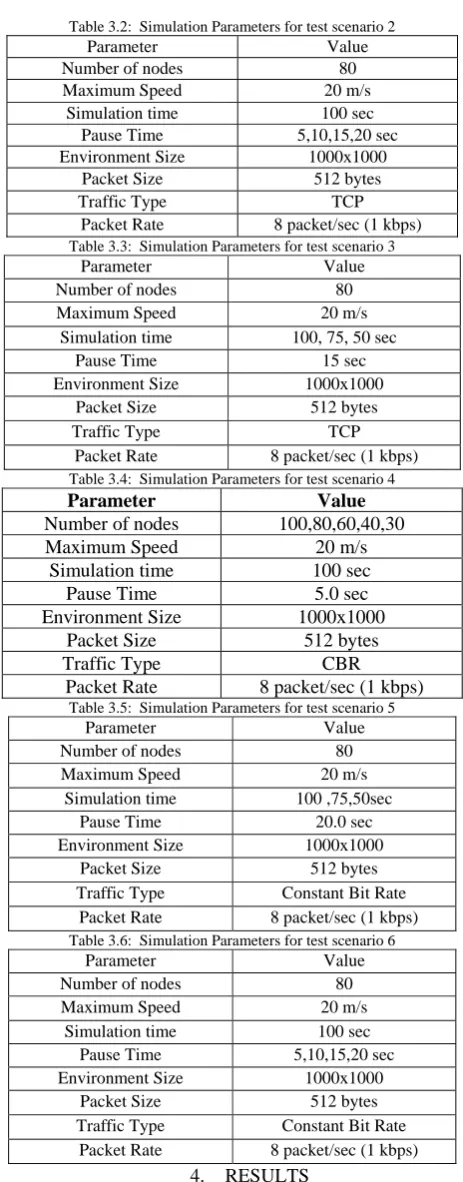
Table 3.2: Simulation Parameters for test scenario 2
Parameter Value
Number of nodes 80
Maximum Speed 20 m/s
Simulation time 100 sec
Pause Time 5,10,15,20 sec
Environment Size 1000x1000
Packet Size 512 bytes
Traffic Type TCP
Packet Rate 8 packet/sec (1 kbps) Table 3.3: Simulation Parameters for test scenario 3
Parameter Value
Number of nodes 80
Maximum Speed 20 m/s
Simulation time 100, 75, 50 sec
Pause Time 15 sec
Environment Size 1000x1000
Packet Size 512 bytes
Traffic Type TCP
Packet Rate 8 packet/sec (1 kbps) Table 3.4: Simulation Parameters for test scenario 4
Parameter Value Number of nodes 100,80,60,40,30
Maximum Speed 20 m/s
Simulation time 100 sec
Pause Time 5.0 sec
Environment Size 1000x1000 Packet Size 512 bytes
Traffic Type CBR
Packet Rate 8 packet/sec (1 kbps)
Table 3.5: Simulation Parameters for test scenario 5
Parameter Value
Number of nodes 80
Maximum Speed 20 m/s
Simulation time 100 ,75,50sec
Pause Time 20.0 sec
Environment Size 1000x1000
Packet Size 512 bytes
Traffic Type Constant Bit Rate
Packet Rate 8 packet/sec (1 kbps) Table 3.6: Simulation Parameters for test scenario 6
Parameter Value
Number of nodes 80
Maximum Speed 20 m/s
Simulation time 100 sec
Pause Time 5,10,15,20 sec
Environment Size 1000x1000
Packet Size 512 bytes
Traffic Type Constant Bit Rate
Packet Rate 8 packet/sec (1 kbps)
4. RESULTS
Tora has minimum packet Loss.jitter is more in case of TCP than CBR.
4.1.IMPACT ON END TO END DELAY
Figure 4.1:End to End Delay by varying no of nodes in CBR
Figure 4.2 End to End Delay by varying pause time in CBR
Figure 4.3 End to End Delay by varying simulation Time in CBR
Figure 4.4 End to End Delay by varying no of nodes in TCP
Figure 4.5 End to End Delay by varying pause time in TCP
Figure 4.6 End to End Delay by varying simulation time in TCP
In CBR TORA has maximum delay and DSDV has minimum.
In case of TCP DSDV has minimum delay and DSR has maximum Delay in all cases and TORA has average delay.
So DSDV has minimum delay because it’s a proactive protocol .
4.2.IMPACT ON PACKET DELIVERY RATIO
Figure 4.7 Packet Delivery Ratio by varying no of nodes in CBR
Figure 4.8 Packet Delivery Ratio by varying pause time in CBR
Figure 4.9 Packet Delivery Ratio by varying simulation time in CBR
Figure 4.10 Packet Delivery Ratio by varying no of nodes in TCP
Figure 4.11 Packet Delivery Ratio by varying Pause Time in TCP
Figure 4.12 Packet Delivery Ratio by varying simulation time in TCP
4.3.IMPACT ON THROUGHPUT
Figure 4.13 Throughput by varying Pause time in CBR
Figure 4.14 Throughput by varying no of nodes in CBR
Figure 4.15 Throughput by varying simulation time in CBR
Figure 4.16 Throughput by varying No of nodes in TCP
Figure 4.17 Throughput by varying Pause time in TCP
Figure 4.18 Throughput by simulation time in TCP
In case of CBR DSR has maximum throughput and DSDV has minimum.
In case of TCP DSDV has the maximum value of throughput in all cases. but overall In case of TCP DSR has average throughput and TORA has minimum.
As the no of nodes increases throughput also increases in case of CBR.
4.4.IMPACT ON PACKET LOSS
Figure 4.19 Packet loss by varying no of nodes in CBR
Figure 4.20 Packet loss by varying pause time in CBR
Figure 4.21 Packet Loss by varying simulation time in CBR
Figure 4.22 Packet Loss by varying no of nodes in TCP
Figure 4.23 Packet Loss by varying Pause time in TCP
Figure 4.24 Packet Loss by varying simulation time in TCP
4.5.IMPACT ON JITTER
Figure 4.25 Jitter by varying no of nodes in CBR
Figure 4.26 Jitter by varying pause time in CBR
Figure 4.27 Jitter by varying simulation time in CBR
Figure 4.28 Jitter by varying no of nodes in TCP
Figure 4.29 Jitter by varying pause time in TCP
Figure 4.30 Jitter by varying simulation time in TCP
Jitter is more in case of TCP than in CBR traffic pattern.
5. CONCLUSIONS & FUTURE SCOPE
In case of TCP DSDV is best in end to end delay, throughput, jitter. In case of TCP and CBR DSR is best in packet delivery
ratio. This is due to the fact that in DSDV the routing table exchanges would increase with larger number of nodes. And DSR is best in case of throughput in CBR traffic pattern. Packet loss Ratio is less in TORA for both CBR and TCP traffic patterns. At the end it is concluded that in case of TCP DSDV (Proactive) is best and in case of CBR DSR (Reactive) is best. Performance of TORA is average in all cases except packet loss. In particular, DSR uses source routing and route caches, and does not depend on any periodic or timer-based activities. DSR exploits caching aggressively and maintains multiple routes per destination.
During present work, impact of VBR traffic was also tried and studied for all three protocols using NS2 but it didn’t worked out as NS2 does not support VBR traffic. It was observed that VBR traffic can be studied using another simulator GloMoSim which supports this type of traffic and the results of VBR traffic can be validated by comparing with results of CBR traffic.
REFERENCES
1. Haimid Abdul Mohamed Bashir ” Analysis and Simulation of wireless Ad-hoc network routing protocols”, April 2004.
2. Lakshmi M and Sankaranarayanan P.E,” Performance Analysis of three Routing Protocols in Wireless Mobile Ad Hoc networks ”, Information Technology Journal 5(1): 114-120,2006, ISSN 1812-5638,
3. Chang Zhijiang, Gaydadjiev Georgi, Vassiliadis Stamatis,” Routing Protocols for Mobile Ad-hoc Networks: Current Development and Evaluation” Computer Engineering laboratory, EEMCS, Delft University of Technology.
4. Jayakumar G. and Gopinath G., “Ad Hoc Mobile Wireless Networks Routing Protocols- A Review,” Journal of Computer Science, Vol. 3, No.8, pp. 574-582, 2007.
5. Kumar A,Lokanatha B.R Reddy C. and Prakash S.Hiremath,” IJCSNS International Journal of Computer Science and Network Security, VOL.8 No.6, June 2008..
6. Perkins C. E. and Bhagwat P., “Highly Dynamic Destination-Sequenced Distance-Vector Routing (DSDV) for Mobile Computers”, SIGCOMM 94 8/94 London England UK @ 1994 ACM 089791 -682-4/94/0008.
7. Broch J., Johnson D. and Maltz D., "The Dynamic Source Routing Protocol for mobile ad hoc October 1999.
8. Huang R., Zhuang Y., Cao Q., “Simulation and Analysis of Protocols in Ad Hoc Network”, 2009 International Conference on Electronic Computer Technology © 2009 IEEE
9. Karthik.S,KannanS,Arunachalam A.P,.Ravichandran T,Valarmathi,M.l ” An Investigation about Performance Comparison of Multi-Hop
Wireless Ad-Hoc Network Routing Protocols in MANET ” in IJCSI International Journal of Computer Science Issues, Vol. 7, Issue 3, No 6, May 2010 35 ISSN (Online): 1694-0784.
10. Manickam P,Guru Baskar T,Girija M , Manimegalai D,” Performance comparison of routing protocols in mobilr Ad hoc networks ”, International Journal of Wireless & Mobile Networks (IJWMN) Vol. 3, No. 1, February 2011 DOI : 10.5121/ijwmn.2011.3109 98.
11. Ambhaikar A, Mitra D,Deshmukh R, ” Performance of MANET Routing Protocol for Improving Scalability ”, Published in International Journal of Advanced Engineering & Application, Jan 2011 Issue.
12. Karthiga G,Benitha J,Chandir Moses Jeban,” Performance Analysis of Various Ad-Hoc Routing Protocols in Multicast Environment”, Department of CSE, Karunya University, Coimbatore, Tamilnadu, India.