Trivially and Efficiently Composing Masked
Gadgets with Probe Isolating Non-Interference
Ga¨etan Cassiers and Franc¸ois-Xavier Standaert
ICTEAM/ELEN/Crypto Group, Universit´e catholique de Louvain, Belgium
e-mails: [email protected]; [email protected]
Abstract—We revisit the analysis and design of masked cryp-tographic implementations to prevent side-channel attacks. Our starting point is the (known) observation that proving the security of a higher-order masked block cipher exhaustively requires unrealistic computing power. As a result, a natural strategy is to split algorithms in smaller parts (or gadgets), with as main objectives to enable both simple composition (as initiated by Barthe et al. at CCS 2016) and efficient implementations.
We argue that existing composition strategies allow either trivial composition with significant overheads or optimized com-position with more analysis efforts. As a result, we first introduce a new definition of Probe Isolating Non-Interference (PINI) that allows both trivial composition and efficient implementations. We next prove general composition theorems for PINI gadgets that considerably simplify the analysis of complex masked im-plementations. We finally design efficient multiplication gadgets that satisfy this definition. As additional results, we exhibit a limitation of existing compositional strategies for the analysis of Multiple-Inputs / Multiple-Outputs (MIMO) gadgets, extend Barthe et al.’s definition of Strong Non-Interference (SNI) to deal with this context, and describe an optimization method to design efficient MIMO-SNI (sub)circuits. Our results allow proving the security of a recent masked AES implementation by Goudarzi and Rivain (EUROCRYPT 2017). From the implementation view-point, PINI implementations reach the level of performance of the best composable masking schemes for the AES Rijndael, and outperform them by significant factors for lightweight ciphers.
I. INTRODUCTION
Side-channel attacks such as differential power analysis [24] are a significant threat to security devices implementing cryp-tographic functionalities. Masking is among the most popular countermeasures to prevent such attacks. Its working principle is to split each sensitive data x manipulated by an imple-mentation into a randomized sharing(x0, . . . , xd−1)such that x=x0⊕· · ·⊕xd−1, and to perform the computations on those shares only by replacing each operation (e.g., Boolean gate) by a gadget that performs the operation over randomized sharings. Under now well understood (noise and independence) leakage assumptions, masking guarantees that the security of a masked implementation against any side-channel attack grows expo-nentially in the number of shares [17], [18].
a) State-of-the-art: In the current state-of-the-art, mask-ing schemes usually come with a security proof in the so-called probing model [22], [28]. In its simplest definition, t-probing security requires that the observation of up to t intermediate computations in the implementation does not reveal anything about the sensitive variables. It has later been shown that while locally sufficient, this definition does not
ensure secure composition [15]. Admittedly, a security proof in the (abstract) probing model is only a first step in the analysis of a masked implementation. Various physical defaults can contradict probing security [25], [1]. Yet, it is a necessary first step since an insecurity in the probing model usually leads to powerful concrete attacks [14], [26].
Many solutions have been introduced in order to mitigate this issue, but none of them is both generic and efficient. Genericity (that we also name trivial composition) means that a solution can be easily applied to any circuit for any t using a simple circuit transformation that maps each logic gate to a masked gadget implementing that kind of gate (independently of the structure of the circuit). Efficiency is harder to characterize in a binary way, hence we rely on two criteria: the number of shares dshould be minimal (i.e., d = t+ 1), and linear operations should be implemented trivially, by implementing these operations share by share.
Based on this observation, the problem we tackle in this paper is: Can we define generic composition rules for d =
t+ 1 masking such that the trivial implementation of linear functions is directly composable (i.e, does not need to be refreshed) without causing significant overheads for the non-linear operations?
b) Contribution: We answer this question positively by introducing a new security notion that we denote as Probe Isolating Non-Interference (PINI), which is satisfied by linear operations and enjoys the useful property that any composition of PINI gadgets is PINI. In contrast with the (Strong) Non-Interference (NI/SNI) definitions of Barthe et al. [3] that rely on the the number of probes in a target implementation, PINI rather relies on their position (i.e., the shares’ indices). We then show that this approach is applicable by designing mul-tiplication gadgets that are PINI. As a result, we can trivially analyze complex masked circuits, where all linear operations are trivially implemented and all non-linear operations are PINI. We apply our results to analyze the composition strategy of Goudarzi and Rivain [19], which can be viewed as a trivial composition that uses as non-linear element a special “double-SNI” multiplication gadget. We prove that this gadget is PINI, leading to a direct formal proof that the composition strategy of [19] is secure.
imple-mentations (such as the software bitslice AES by Goudarzi and Rivain [19]) for this purpose, which leads us to a couple of additional observations of independent interest.
First, we analyze the limitations of the SNI definition given in [3] for composition in such bit-level implementations (such limitations apply for any gadget with multiple inputs and multiple outputs). We define Multiple-Input Multiple-Output Strong Non-Interference (MIMO-SNI) as the natural extension of SNI that allows composition in this case. Interestingly, it turns out that such cases are not problematic in the PINI framework, and we show that any MIMO-SNI gadget is actually PINI.
Second, the optimized composition of complex circuits such as bit-level AES S-boxes requires significantly more efforts than its counterpart in F256 studied by Bela¨ıd et al. [6]. We propose a solution to this problem, by representing the circuit to mask as a “computation graph”, and describe how to express the definitions of NI, SNI and MIMO-SNI as graph properties, leading to an algorithm (implemented as an open-source tool) to minimize the number of SNI gadgets.
We finally illustrate that PINI gadgets lead to excellent performance often improving over state-of-the-art solutions, by comparing various masked block ciphers according to the use of only SNI gadgets, the double-SNI strategy, our MIMO-SNI optimization, the recent Tight Private Circuit (TPC) ap-proach [7] and the PINI framework. We use the AES block ci-pher as well as some lightweight block cici-phers (Noekeon [16], PRESENT [8] and Fantomas [21]). The results allow us to conclude that our tools enable both trivial composition and efficient masked implementations. We use abstract metrics (amount of randomness, operation count) to measure algorith-mic improvements, independently of the implementation (e.g., software, FPGA, ASIC). For AES, the TPC approach and the PINI framework lead to the best performances. For lightweight ciphers, the PINI approach outperforms all existing solutions by significant factors (2 to 4), making it a particularly relevant solution for lightweight ciphers submitted to the ongoing NIST competition.
This paper is organized as follows. Section II recalls the notion of masked circuit and gadget, along with the relevant security notions. We also explain the so-called “probe propaga-tion framework” used to build intuipropaga-tion about those nopropaga-tions. In Section III, we introduce the PINI definition and its properties. We instantiate it with two gadgets in Section IV, which com-pletes the main contribution of this paper. Section V details the limitations of SNI, introduces the notion of MIMO-SNI and covers the design of the optimized MIMO-SNI AES S-box. Related work is reviewed in Section VI. Finally, Section VII briefly compares the performance of various implementation strategies and concludes.
II. PRELIMINARIES A. Masked gadgets
We work with circuits and use the definition of [22]. A deterministic circuit C is a Directed Acyclic Graph (DAG) whose vertices are gates, inputs or outputs, and whose edges are wires carrying elements of Fq. A randomized circuit is a
circuit augmented with random gates. A random gate is a gate with fan-in 0 that produces a random output, uniformly and independently of everything else afresh for each invocation of the circuit.
Let x∗ = (xi)i=0,...,d−1 be a d-sharing of a sensitive variable xif x =Pd−1
i=0xi. The index i is named the share index. A setAis a set of share indices ifA⊂ {0, . . . , d−1}, and we denote xA :={xi :i∈A}. We say that the sharing
x∗ is fresh if any tuple of at most d−1 of its shares is distributed uniformly and independently of any other element under consideration.
A gadget G with m inputs and n outputs working with d shares implementing a function f : Fm
q → Fnq :
(x0, . . . , xm−1)7→(y0, . . . , yn−1)is a circuit withmdinputs grouped intom d-sharings denoted(x∗,0, . . . , x∗,m−1)andnd outputs grouped intonsharings denoted(y∗,0, . . . , y∗,n−1). A gadget must be correct. That is, ifxj =P
d−1
i=0xi,j for all j,
thenyj =P d−1
i=0yi,jfor allj and for any value of the outputs
of the random gates.
We additionally use the following notations: xi,∗={xi,j: 0 ≤ j ≤ m−1}, xA,∗ = {xi,j : i ∈ A,0 ≤ j ≤ m−1}
whereAis a set of share indices, andx∗,∗={xi,j : 0≤i≤
d−1,0≤j≤m−1}. When it is not clear from the context, we explicitly denote the gadget Gto which the inputs or the outputs are related with a superscript asxGi,j,yGi,j.
For any linear function f, there is atrivial implementation gadget which requires no random gates and consists in apply-ing the function independently to each share: yi,∗ =f(xi,∗) for i = 0, . . . , d−1. This also applies to affine functions (subtracting the offset(d−1)f(0)to one share).
In this article, we are primarily interested in composing gadgets, that is, connecting gadgets together to build more complex gadgets.
Definition 1 (Gadget composition): A gadget composition G over d shares is a directed acyclic graph (DAG) whose vertices are composing gadgets (which are gadgets over d shares) or inputs/outputs, and edges are connections between those gadgets. For each composing gadget, there is a one-to-one mapping between its m inputs and the incoming edges of the associated vertex. Furthermore, each outgoing edge is associated to an output of the gadget (there can be multiple edges associated to the same output). Output vertices (resp., input vertices) have one (resp., zero) incoming edge and zero (resp., any number of) outgoing edge(s).
A gadget composition can be instantiated by mapping each vertex to the corresponding gadget or d inputs/outputs, and each edge todwires (which connect the composing gadgets). The inputs and outputs of the composing gadgets are erased in the instantiation process. We use the termcomposite gadget to refer to the instantiation of a gadget composition.
B. Probing model and security definitions
x
y z
(a) If all inputs are deterministic, they are needed to simulate the output.
x
$ z
(b) When a fresh random is XORed, the output is independent of inputs.
x
$ z
(c) Multiplication with an input is not bijective, thus input is needed.
x
$ z1
y z2
(d) With two probes, the random is not fresh.
Fig. 1: Simulatability examples. All outputs (bold, red) are probed. Inputs needed for simulation are circled in blue.
all the input sharings are fresh. The parameter tis known as the security order. In the best situation, which is often studied in the literature and which we target,t=d−1(e.g., [28], [6] in software, [13], [20] in hardware), but this is not always the case:tcan also be smaller thand−1(e.g., for composability reasons [22], or in order to mitigate physical defaults such as glitches [27]). The trivial implementation of any linear function withdshares is alwaysd−1-probing secure.
One important limitation of t-probing security is that it is not sufficient to ensure composability: the connection of t-probing secure gadgets is not necessarily t-probing se-cure [15]. This has lead Barthe et al. to introduce stronger notions of security that enable composability in [3]. In order to define them, we use the simulatability framework put forward by Bela¨ıd et al. in [6], illustrated in Figure 1. Intuitively, a set of probes is simulatable knowing some input shares if there exists a simulator (which is specific to that set of probes) that (knowing the said input shares) can generate simulated probes that have the same statistical distribution as the true probes. Simulatability means that the true probes are independent of the input values that are not given to the simulator. As extreme cases, if probes can be simulated using no input values, then the probes are independent on the inputs of the gadgets. On the other hand, any set of probes can trivially be simulated using all the input values: the simulator can run the gadget itself. Note that the notion of (I,O)-Non-Interference introduced in [3] is equivalent.
Definition 2 (Simulatability): Let P = {p1, . . . , pl} be
a set of l probes of a gadget C and CP the tuple of
values of the probes for an execution of C. Let I =
{(i1, j1), . . . ,(ik, jk)} ⊂ {0, . . . , d−1} × {0, . . . , m−1}be a
set of input wires ofC. A simulator is a randomized function
S :Fk
q →Flq. The set of probesP can besimulated with the
set of input wires I if and only if there exists a simulatorS
such that for any inputs x∗,∗, the distributionsCP(x∗,∗)and
S(xi1,j1, . . . , xik,jk) are equal, where the probability is over the random coins inC andS.
We can now define Non-Interfering (NI) gadgets and Strong Non-Interfering (SNI) gadgets. We note that for now, those notions are limited to gadgets with only one output. We take the definitions from [6] and denote probes on shares of a
1-NI Mul. (a)
1-NI Mul. (b)
1-SNI Mul. (c)
1-SNI Mul. (d)
Fig. 2: Masked multiplication gadget with d = 2 shares. The arrows indicate the adversarial probes (there is thus one internal probe in the multiplication in (2a) and (2c), and one output probe in (2b) and (2d). The red snake wires are the inputs needed for simulation. Each internal probe requires knowledge of one share of each input to be simulated in both NI and SNI cases (2a, 2c). Simulating an output probe requires knowledge of one share of each of the inputs for the NI gadget (2b) while it requires no input knowledge for the SNI gadget (2d).
gadget’s outputs as output probes, and probes on any wire of the gadget including inputs and outputs as internal probes (therefore any output probe is also an internal probe). The definitions are illustrated in Figure 2.
Definition 3 (Non-Interference): A gadget with one output sharing ist-NI if and only if every set oft0≤tinternal probes can be simulated with at mostt0 shares of each input. For a gadget with d > t shares, satisfying t-NI is strictly stronger than t-probing security. Indeed, the inputs required by the simulator are independent of the sensitive variables, which implies that the simulated probes are likewise inde-pendent of the sensitive variables, and the adversarial probes have the same distribution as the simulated probes thanks to indistinguishability.t-NI is however not a necessary condition for probing security, because it requires indistinguishable simulation for any value of the input shares, not only for any value of the sensitive variables, which sometimes makes the simulation of probing secure gadgets impossible (e.g., in first-order threshold implementations, where non-linear gadgets leverage the input shares in order to reduce the randomness requirements [27]). The trivial implementation of any linear function is NI: the simulator can use the xi,∗ values for all thei’s for which there is a probe in the evaluation off(xi,∗). Next, t-SNI gadgets guarantee independence between the input and output shares, even in presence of a t-probing adversary.
Definition 4 (Strong Non-Interference):A gadget with one output sharing is t-SNI if and only if for every set I of t1 internal probes and every set Ooft2 output probes such that t1+t2≤t, the set of probesI ∪ Ocan be simulated witht1 shares of each input.
There are many designs of gadgets that implement elementary field operations and are NI or SNI. The most studied ones are NI and SNI field multiplication and SNI refresh gadgets (which implement the identity function in a SNI fashion) [22], [6]. Barthe et al. showed that it is possible to build secure composite gadgets based on NI and SNI gadgets [3].
1-SNI Mul.
y0
y1
z0
z1
x0x1
(a)
1-SNI Mul. R
y0
y1
z0
z1
x0x1
(b)
Fig. 3: Implementation of(x+y)(x+z)masked withd= 2
shares, with input sharings(x0, x1),(y0, y1)and(z0, z1). The circuit is made of a 1-SNI multiplication with linear circuits at its inputs (two trivial implementations of the addition). The circuits illustrate (a) the limitation of SNI input composability and (b) a simple fix. The arrows indicate the adversarial probes (there is thus one internal probe in the multiplication) and the red snake wires are the propagated probes. The R box is a 1-SNI refresh gadget.
This result gives a simple way to securely compose gadgets. However, it usually requires the use of many (expensive) refresh gadgets [19]. One important reason of these overheads, which is also the seed of our following investigations, is that the trivial implementation of a linear function is not SNI. It naturally suggests the quest for a security definition that allows simple composition, as Proposition 1, while also leveraging the efficiency and probing security of trivial implementations for linear functions, as an interesting research challenge.
C. Probe propagation framework
In this section, we describe an intuitive interpretation of the simulatability definition first used in [6], that we next call the probe propagation framework, and discuss its application to the NI and SNI notions.
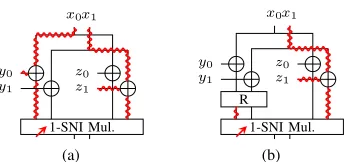
We start with the simple circuit example of Figure 3 which performs a multiplication of dependent values (masked with d = 2 shares). There is one adversarial (internal) probe in the SNI multiplication gadget and we show how to prove (or fail to prove) that the probe is not an attack in the 1-probing model (i.e., that it is independent of the sensitive inputs) by demonstrating that it is possible to simulate it using at most one share of each of the inputs. (Analyzing all possible sets of probes would prove 1-probing security. More efficient ways of making such proofs are discussed in the following sections.)
According to the SNI definition, it is possible to perfectly simulate the adversarial probe by knowing one share of each of the inputs of the SNI multiplication. Let those required shares be the red snake wires in the circuit (the set of wires shown is an arbitrary example, the shares required by the simulator depend on the position of the adversarial probe). Those wires are called propagated probes. The proof then works by ob-serving that if it is possible to simulate the propagated probes, then the adversarial probe can be simulated.
In our example of Figure 3a, we can propagate the probes one step further: a probe at the output of an addition can be simulated with probes on the two inputs of the addition. But then, we obtain all two propagated probes on the input sharing
of x. As a result, we cannot prove that the circuit is probing secure.
In order to circumvent this impossibility, the circuit of Figure 3b (which has the same functionality as the circuit of Figure 3a), implements a simple fix: there is a 1-SNI refresh gadget on one of the inputs of the multiplication gadget. The propagated probe at the output of the refresh gadget can then be simulated using no input of the gadget (thanks to the SNI property), which makes the circuit secure against this probe. As a result, this composite gadget is 1-NI (and thus 1-probing secure) thanks to Proposition 1.
Summarizing, the main idea of the probe propagation framework is to prove the security of an implementation by replacing the adversarial probes with propagated probes that can be used to simulate the adversarial probes, and by iterating the process until the propagated probes are all at the inputs of the circuit. The conclusion is then easy. More precisely, the propagation of probes always happens backwards in the circuit (probes on the outputs of a gadget are simulated by probes on the inputs of the gadget), and the definitions of NI and SNI can be expressed with the following set of simple rules.
a) Probe propagation rules:
• For a NI gadget withnoprobes on its output shares and
ni probes inside the gadget, there are propagated probes
onno+ni shares of each input.
• For a SNI gadget withnoprobes on its output shares and
ni probes inside the gadget, there are propagated probes
onni shares of each input. Hence, SNI gadgets (and SNI
refreshes) stop the propagation of probes.
There are then three probe propagation conditions to verify, in order to guarantee security against the considered adversarial probes (this is an application of the type system from [3]).
b) Probe propagation security conditions:
1) For some parameter t < d, all the gadgets must satisfy t-NI (or multiple-output variants discussed later such as PINI or MIMO-SNI).
2) For any edge in the gadget composition graph, there cannot be propagated probes on more thantshares (out of the maximumd).
3) For all SNI gadgets, the following must hold:ni+no≤t
(niandnoare the number of internal and output probes,
respectively). Note: For NI gadgets, this condition is redundant with the second probe propagation condition applied to input sharings.
III. TRIVIAL COMPOSITION& PINI
In this section, we introduce a new definition of Probe Isolating Non-Interference (PINI) which is directly satisfied by the trivial implementation of any linear function and enjoys a simple and practical composition property: any composite gadget whose composing gadgets are all PINI is itself PINI.
technique is cost-efficient, since it uses no refresh gadgets. In particular, for bit-level implementations, this compiler only needs a PINI multiplication gadget (i.e., an AND gate) for which we provide efficient instances in the next section. Another interest of the PINI definition is that it applies (and its properties apply) easily to gadgets with multiple outputs, which is not the case for NI/SNI, as will be discussed in Section V-A.
A. Intuition and probe propagation framework
The main idea behind the PINI definition is to take into account not the number of probes (or of required inputs for simulation) as in the NI/SNI definitions, but instead their position (i.e., the shares’ indices). The whole circuit can then be cut intodcircuit shares that are not interconnected, except for non-linear gadgets. If we neglect those gadgets, the circuit ist-probing secure (fort < d): the adversary can only probet of the circuit shares, hence it has no information about at least d−t≥1 circuit shares, which contains at least one share of each input. Non-linear PINI gadgets then behave in the probing model as if they had no connection between circuit shares (i.e., they can be simulated as such), which allows implementing non-linear functions while keeping the previous circuit sharing intuition.
In the probe propagation framework, probes propagate through PINI gadgets in a way that respects the isolation of the circuit shares. Output probes propagate to all input shares with the same share index (i.e., inside the same circuit share). Internal probes in non-linear PINI gadgets are more subtle since they cannot be trivially associated to a circuit share, because there is no circuit share isolation inside those gadgets (the isolation is only simulated). However, we can let those probes carry the same intuition as the output probes: each internal (adversarial) probe gives knowledge of at most one circuit share to the adversary. This preserves the feature that the adversary has knowledge of at most t of the d circuit shares, which we formalize with a new probe propagation rule.
• Each output probe on a PINI gadget propagates to all the input shares that are in the same circuit share as the output probe. Each internal probe propagates to all the input shares that are in one additional circuit share (this circuit share may depend on the position of the probes). No new probe propagation security condition is needed: if there are too many probes (internal and output), they propagate to the inputs (thanks to the previous rule), and violate the second security condition.
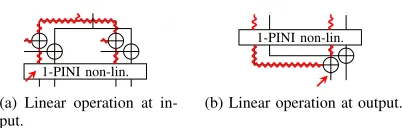
The way PINI works is illustrated in Figure 4, which takes the case discussed in the previous section (where a refresh was needed to prove security), and a new case not handled by (S)NI definitions: a gadget with multiple outputs.
In Figure 4a, there is one internal probe which propagates to one share of each input of the multiplication as it is the case for (S)NI multiplications. However, the propagated probes have the same share index (they are in the same circuit share),
1-PINI non-lin. (a) Linear operation at in-put.
1-PINI non-lin.
(b) Linear operation at output.
Fig. 4: Examples of PINI circuits masked with d= 2shares. The rectangle gadget implements a non-linear function. The arrows indicate the adversarial probes and the red snake wires are the propagated probes.
hence probe propagation through the linear operation does not violate the second probe propagation security condition.
In Figure 4b, the two propagated probes at the output of the S-box have the same share index, hence they propagate to only one circuit share.
B. Formalization: definition and properties
We now give the formal definition of PINI, and prove security and composability properties. For this purpose, we first show the link between the notion of circuit share and the notations of Section II. Namely, for a gadget with inputsxi,j
and outputsyi,j, all the inputs and outputs in the circuit share
iare xi,∗ andyi,∗.
In the following definition, the set A is the set of share indices (i.e., the circuit shares) that are probed through output probes, andBis the set of circuit shares requested to simulate the internal probes. The set of shares required to simulate all the probes is thusA∪B.
Definition 5 (Probe-Isolating Non-Interference): Let G be a gadget overd shares andP a set oft1 probes on wires of G(called internal probes). LetAbe a set oft2 share indices. G is t-Probe-Isolating Non-Interfering (t-PINI) iff for all P andA such thatt1+t2 ≤t, there exists a setB of at most t1 share indices such that probes on the set of wiresP∪yA,G∗ can be simulated with the wires xGA∪B,∗.
The following proposition shows that any PINI gadget is probing secure.
Proposition 2:Anyt-PINI gadget (with a number of shares d > t) ist-probing secure.
Proof:Any set of at mosttprobes can be simulated with at most t shares of each input. Thanks to the independent input encodings, this set of input shares is independent of all the sensitive input values.
We now look at composability properties for PINI gadgets. Proposition 3 (PINI composability):Any composite gadget made oft-PINI composing gadgets ist-PINI.
Proof: We build a PINI simulator that takes as input a set of probes P and a set of share indices of probed output shares A. Without loss of generality, we assume that there is no probe on wires connecting composing gadgets (hence there are only output probes and probes inside composing gadgets), since such probes can be considered to be inside one of the gadgets connected to the wire.
denote themG1, . . . , Gl. We build iteratively the setsAiwhich
are sets of circuit shares needed to simulate probes inside gadgetsG1, . . . , Gi−1 and output probes.
Let Pi be the set of probes inside the gadget Gi. Let
A1 = A be the set of share indices of the output probes. By induction, let Ai+1 = Ai ∪Bi, where Bi is obtained
by running the PINI simulator for gadget Gi, with set of
probes Pi and output share indices set Ai (this is possible
since |Pi| +|Ai| ≤ t). Let B = Al+1\A be the set of input share indices required to the oracle for the simulation (in addition to the shares with indices in A, always given). Simulation is performed from Gl to G1: the PINI simulator for Gi simulates yGAii,∗ and has access to x
Gi
Ai+1,∗ (obtained from oracle and/or other PINI simulators). We now have to show that the simulator respects the cardinality constraints of PINI, that is: |B| ≤ t1 = P
l
i=1|Pi|. This is obtained by
induction on the inequality |Ai+1| ≤ |Ai|+|Bi| ≤ |Ai|+|Pi|
and by the observation that A⊂Al+1.
We finally prove that the trivial implementations of linear gadgets are PINI.
Proposition 4:The trivial implementation of a linear func-tion is t-PINI for anyt.
Proof: The simulator requires access to inputs from all the circuit shares in which there is a probe. Simulation is then trivial.
IV. PINIMULTIPLICATION GADGETS
Given the results in the previous section, the main remaining challenge to leverage the trivial composition of PINI gadgets is to instantiate PINI field multiplications. We next propose two solutions for this purpose. The first one is based on the composition of existing (SNI) gadgets while the second one is a new design.
A. Goudarzi and Rivain double-SNI gadget
This gadget is based on an implementation strategy used in [19], where only SNI multiplications are used, and one input of every multiplication gadget is refreshed in a SNI manner. Goudarzi and Rivain claim (without proof) that linear operations can then be implemented in the trivial way, leading to a trivial composition using double-SNI multiplications (Al-gorithm 1) for every non-linear gadget. We next show that the AES implementation using this strategy is secure by showing that the double-SNI multiplication gadget is PINI.
Algorithm 1 Double-SNI multiplication gadget overd shares.Rd andMuldare SNIt-refresh andt-SNI multiplication gadgets overd shares, respectively.
Require: (ai)i,(bi)i∈Fdq such that P
iai=a, P
ibi=b. Ensure: Output(ci)i∈Fdq such that
P
ici=a·b.
(xi)i←Rd (ai)i
;
(ci)i←Muld (xi)i,(bi)i
;
Intuitively, this result comes from the fact that each probe inside the gadget of Algorithm 1 propagates to at most one share of one of the inputs, and output probes do not propagate, which implies PINI.
Proposition 5: Any double-t-SNI multiplication gadget is t-PINI.
Proof:Let us assume that there is a setP1 of probes on the output of the gadget (i.e., probes on (ci)i), a set P2 of probes inside the SNI multiplication gadget and a set P3 of probes inside the SNI refresh gadget, such that|P1|+|P2|+
|P3| ≤t. Any probe on(xi)i is counted as a probe inside the
SNI multiplication gadget.
Using the simulator for the SNI multiplication gadget, we can simulate the sets of probes P1 and P2 using a set P4 of shares of (xi)i and a set P5 of shares of (bi)i, such that |P4| ≤ |P2|and|P5| ≤ |P2|. Then, using the simulator for the SNI refresh gadget, we can simulate the sets of probesP3and P4using a setP6of shares of(ai)isuch that|P6| ≤ |P3|(since
|P3|+|P4| ≤t). Overall, we can simulate all the adversarial probes using the sets of input sharesP5 andP6.
Since|P2|+|P3|is the number of internal probes and|P5|+
|P6| ≤ |P2|+|P3|, the PINI simulator can request knowledge of all the input shares whose index is the one of a share in P5or P6. Hence, the PINI simulator knows the values of the shares in P5 and P6 and can use the two SNI simulators to complete the simulation.
B. PINI1: a more efficient field multiplication
We next introduce in Algorithm 2 a new PINI multipli-cation gadget for d shares. It is a variation of the ISW multiplication [22] and has the same randomness requirement (i.e.,d(d−1)/2 field elements). Compared to the double-SNI multiplication gadget, it is thus more efficient.
We defer the proof that this algorithm is d−1-PINI to Appendix A, but we give here the intuition behind it. The only probes that violate the PINI definition (i.e., probes that require knowledge of inputs from more than one circuit share to be simulated) in the ISW multiplication are partial products aibj, which are intermediate values of the computation of
zij = rij + aibj. This issue can be solved by using a
fresh random element rij0 and computing the same result as zij = (rij +air0ij) +ai(r0ij+bj). None of the intermediate
values in this computation require the knowledge of both ai and bj to be simulated. Such a technique requires more
random field elements, but it can be optimized by using only the rij’s and not fresh rij0 ’s, since the computation
zij = (1 +ai)rij +ai(rij +bj) enjoys the same security
and correctness as the previous expression.
This algorithm can be adapted to require only linear memory by re-ordering the operations: for each generatedrij, compute
directly zij and zji, and updateci and cj. The intermediate
values depending onrij can then be dropped. This does not
change the set of possible probes, hence the security proof is still valid.
V. COMPOSITION OF LARGER GADGETS
Algorithm 2 PINI1 multiplication gadget overdshares
Require: Factors a, b∈Fq such thatPiai=aand Pibi=b Ensure: Output(ci)i∈Fdq such that
P
ici=a·b. fori= 0tod−1do
forj=i+ 1tod−1do
rij
$
←−Fq;rji←rij; fori= 0tod−1do
forj= 0to d−1, j6=ido
sij←bj+rij;
p0ij←(ai+ 1)·rij;
p1ij←ai·sij;
zij←p0ij+p1ij; (zij=rij+ai·bj )
fori= 0tod−1do
ci←ai·bi+
Pd−1
j=0,j6=izij;
Peralta [9] that is used in [19] for this purpose. In order to obtain fair comparisons, we then follow the optimized approach to composition introduced by Bela¨ıd et al. [6], which has been shown to provide better performances than the straightforward application of Proposition 1. Doing so, we face two additional challenges.
First, in order to exploit optimized S-boxes, we require that such S-boxes lead to a secure circuit when composed with the trivial implementation of the AES linear layer. We observe that the SNI definition is not sufficient to reach this goal, and we introduce a natural extension of SNI that allows such a composition. It essentially extends SNI to a multiple-input and multiple-output setting (hence the name MIMO-SNI for the proposed extension).
Next, we observe that the optimization of a complex circuit such as the bit-level S-box in [9] is computationally intensive, and cannot be exhaustively analyzed like the F256 S-box investigated in [6]. So we propose an automated heuristic based on linear programming to mitigate this limitation.
A. Multiple-Input-Multiple-Output SNI
a) Multiple-Output SNI (MO-SNI): A first issue with the SNI definition is its specialization to single-output gad-gets (whereas a bit-level AES S-box has eight output bits). Therefore, we need to extend this definition to multiple-output gadgets. Two natural extensions can be considered for this purpose: (i) the gadget tolerates at most a total oftprobes for all the outputs, or (ii) it tolerates up to t probes for each of the outputs.
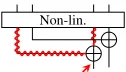
The next example shows that the first option is not sufficient to ensure composability with linear layers. In order to simplify the discussion, we take a simple case of 2-bit non-linear functions (i.e., each gadget has two inputs and two outputs) masked at order t= 1(i.e., d= 2), but our reasoning applies to any gadget (e.g., the 8-bit S-boxes of the AES) and any order.
We consider a linear operation between two outputs of a non-linear gadget (depicted in Figure 5). The adversary has t probes on one output of the linear operation. The probes propagate to2tprobes on the output of the non-linear gadget. Hence, the extension (i) of the SNI definition is not sufficient, and we prefer extension (ii), which we next call MO-SNI.
Non-lin.
Fig. 5: Multiple-output non-linear gadget with linear layer at the output: this circuit is insecure with SNI’s MO extension (i) for the non-linear gadget, while it is secure for extension (ii). Example ford= 2 and 2 bit gadget.
b) Multiple-Input (MI): A already discussed in Sec-tion II-C, in general a non-linear SNI gadget cannot have a linear layer at its input without refreshing some of these inputs. Therefore, we introduce a stronger constraint: the simulator must be able to simulate the probes using one input share per probe, while it is one input share per input and per probe for (S)NI.
c) Multiple-Input-Multiple-Output SNI (MIMO-SNI): The combination of the MO-SNI definition with the MI constraint gives the MIMO-SNI notion, that we first introduce in the probe propagation framework, and then define formally. There is a new probe propagation rule for MIMO-SNI gadgets (to cover the MI-SNI part of the definition):
• For a MIMO-SNI gadget with at most no probes on
each output and ni internal probes, there is a total of
ni propagated probes on the input shares.
There is then a fourth probe propagation security condition, which is the condition for SNI gadgets adapted to MO-SNI:
4) For any MIMO-SNI gadget with at most no probes on
each output and ni internal probes, the following must
hold:ni+no≤t.
Definition 6 (MIMO-SNI):LetOi be a set of share indices
for i= 0, . . . , n−1. A gadget ist-MIMO-SNI if and only if for any set I of t1 internal probes and any setsOi such that
there exists a t2 that satisfies t1+t2 ≤ t and |Oi| ≤ t2 for i= 0, . . . , n−1, the set of probesI ∪yO0,0∪ · · · ∪yOn−1,n−1 can be simulated with at mostt1 input shares.
This definition is very strong, in fact it is strictly stronger than PINI, as shown in the next proposition.
Proposition 6:Anyt-MIMO-SNI gadget ist-PINI. Proof:The MIMO-SNI simulator can be used as a PINI simulator, with the set of share indices B sent to the PINI oracle being made of the indices of thet1input shares required by the MIMO-SNI simulator.
This proposition shows that MIMO-SNI benefits from the same composability properties as PINI: a MIMO-SNI S-box can thus be trivially composed with linear layers. Despite it is stronger than PINI (which is already sufficient to compose se-curely), an interesting feature of MIMO-SNI is that this notion can be obtained by combining NI and SNI elementary gadgets in an optimized composition similar to the one proposed in [6] (see next).
weaker than MO-SNI: it does not require simulatability. The authors show that despite the weaker definition, it can be securely composed with linear layers to build a t-probing-secure circuit. This weaker requirement enables more efficient implementations than [19]: S-boxes only requires 32 SNI multiplication gadgets, and no refresh gadgets in this case. However, it does not enable trivial composition. First, this composability result is limited to full linear layers (which results in a need to refresh the key scheduling even if it is linear). Second, the analysis of the S-box itself is not trivial (it requires circuit-specific analysis to prove its security).
B. Building large MIMO-SNI gadgets from small (S)NI gad-gets
In order to fairly assess the interest of the PINI framework with respect to state-of-the-art solutions, and to allow sound performance comparisons in the next section, we now tackle the problem of building a large MIMO-SNI gadget by compo-sition of smaller (S)NI gadgets. For a given functionality, we try to minimize the amount of SNI gadgets in the implemen-tation in order to reduce its complexity. In other words, we investigate the optimized composition approach mentioned in the introduction as a natural competitor to the trivial one.
For this purpose, we first show how to express this opti-mization based on the properties of a graph describing the computations to perform. We then apply this optimization to the AES S-box in F256 (confirming the results in [6]) and to the bit-level AES S-box of Boyar, Matthews and Peralta [9], bringing significant improvements over the double-SNI strategy in [19].
1) Connecting composability to computation graph prop-erties: We introduce a new computation graph model based on the gadget composition DAG in order to explicitly put into evidence the cases where a sharing is used multiple times. The computation graph restricts the gadget composition DAG by forbidding the connection of more than one edge to an output of a gadget or an input gate. To handle the forbidden cases, we add a newSplitn gadget which has one input,n identical outputs and performs no operations (it only connects input to outputs). For simplicity, we assume that all the composing gadget are NI operation gadgets with one output (in practice mostly additions and multiplications), SNI refresh gadgets (with one input and one output) orSplitngadgets. SNI gadgets
are thus modeled as NI ones followed by a SNI refresh. Given a computation graph resulting from our optimization, an implementer can then replace NI multiplications followed by a SNI refresh by (sometimes more efficient) SNI multi-plications. This modeling is without loss of generality since it is equivalent from the probing model viewpoint and the respective costs of the different gadgets of a private circuit are parameters of the optimizations.
Using the link between computation graph and the probe propagation framework and capitalizing on the fact that SNI refresh gadgets stop the propagation of probes, we can simply remove them (and their incident edges) from the graph to build asimplified graph. The probes inside the refresh gadgets can be reported to gadgets connected to their input, hence the
simplified graph is equivalent to the original graph regarding security in the probing model.
Definition 7 (Simplified computation graph): The simplifi-cation of the computation graphGis the graph that is obtained fromGby removing all SNI refresh vertices and their incident edges.
Let us now analyze under which condition a simplified computation graph represents a NI composite gadget, leverag-ing the probe propagation framework. Since we only have NI gadgets in a simplified computation graph, the only case where the probe propagation security conditions are not respected is when there are more than t propagated probes on one share. Since there are at most t adversarial probes, violation of the security condition means that a single adversarial probe is duplicated, that is, it propagates to the same share through to different paths. We can thus derive a sufficient NI condition for simplified computation graphs: no probe should propagate backwards from a node to another one through two different paths. In other words, for any pair of vertices there should be at most one (directed) path between them. It can be seen that this condition cannot be weakened while guaranteeing security for any NI composing gadgets: if probes can propagate backwards through two paths from a node A to a node B and if the adversary hastprobes on the output of A, up to 2t shares of the output of B could be required to simulate.
We now formalize this security condition with the following propositions (which generalize the proof that the AES inver-sion ist-SNI in [6]). For this purpose, we first define a property for composite gadgets and their simplified computation graph, which specifies the NI condition of the previous paragraphs.
Definition 8 (Single-Path-NI-Built gadget (SP-NIB)): A composite gadgetGis SP-NIB if it is implemented with only NI gadgets and SNI refreshes, and if for any pair of vertices u,v in the corresponding simplified computation graph there exists at most one path fromutov.
Proposition 7:LetGbe a composite gadget. IfGis SP-NIB (as per Definition 8), then it ist-NI.
Proof: For each edge i in the computation graph, there is a number of adversarial probesai, a number of propagated
probespi and a total number of probessi. The sum of theai’s
is at mostt. For alli,si=ai+pi. For each edge, the number
of propagated probes is either 0 if the node at the end of the edge is a refresh or an output gate, or the sum of the total number of probes of the outgoing edges of the vertex at the end of the edge otherwise (i.e., for split or NI gadgets). The probes inside a NI gadget are not considered since they can equivalently be replaced with probes on output shares of the gadget. Furthermore, the probes on output gates are modeled as adversarial probes on the edges connected to those gates.
If for each input edgei(i.e., an edge connected to an input gate), a simulator knows si well-chosen shares, then it can
simulate all the probes of the adversary by using the simulator for each gadget in order to get the required intermediate values. We now prove that the SP-NIB hypothesis implies that for all input edges i, si ≤ t. This proves that the gadget is NI
We use a small lemma for this purpose: for all edges i, pi = Pjαijaj where αij is the number of paths from the
output node of i to the input node of j in the simplified computation graph. This can be proven by backwards induc-tion on the graph: if all the outgoing edges of a node satisfy this property, it is also satisfied for all the incoming edges to this node if the node is a refresh, split or NI operation. As a base case, this is trivially satisfied for output edges (i.e., edges connected to an output gate).
Next, we observe that for any i, αii = 0: there is no path
from the output node ofito the input node ofi(otherwise the graph is not a DAG). The previous lemma is thus strengthened topi=Pj6=iαijaj.
To conclude the main proof, we observe that the main hypothesis implies that αij ≤ 1 for all pairs of edges (i, j),
hence si=aipi=Pj=6 iαijaj≤Pjaj ≤t.
We now give similar computation graph properties that guarantee SNI and MIMO-SNI. Intuitively, a composite gadget is SNI if no probes can propagate from any output to any input (i.e., there must be no path from an input to an output).
Proposition 8: LetGbe a composite gadget. If the gadget is SP-NIB and if for any input node uand any output node v, there is no path from utov, then the gadget is t-SNI.
Proof:Looking at the proof of Proposition 7, we observe that, under the current stronger hypothesis, αij = 0 for all
input edgesiand output edgesj. Hence for all input edgesi, si ≤t1 wheret1 is the number of internal probes.
For MIMO-SNI, we additionally require that no probe can propagate to two inputs simultaneously (otherwise, t internal probes could propagate into strictly more thantinput probes). Furthermore, there must be no composing gadget to which probes could propagate from two different outputs: otherwise, up totprobes could propagate from each output, resulting into up to 2t propagated probes on the output of the composing gadget.
Proposition 9:A composite gadget Gis t-MIMO-SNI if it satisfies the three following conditions. (i) Gis SP-NIB. (ii) For any pair of output nodes u1,u2 there is no nodev such that there is a path fromvtou1 and a path fromv tou2. (iii) For any pair of input nodes u1, u2 there is no node v such that there is a path from u1 tov and a path fromu2 tov.
Proof: We first have to prove that for all edgesi,si≤t.
Under the current hypothesis, the lemma from the proof of Proposition 7 is strengthened: for any edgei,P
j∈Oeαij ≤1
where Oe is the set of output edges. Furthermore, for any i,
j, αij ≤ 1. This implies that si ≤ t1+t2 ≤ t, taking the definitions oft1 andt2 from the MIMO-SNI definition.
Second, we have to prove that P
i∈Iesi ≤t1 whereIe is
the set of input edges. We know that for all j,P
i∈Ieαij ≤1
and for output edges j, P
i∈Ieαij = 0. Hence
P
i∈Iesi ≤
P
j6∈Oeaj=t1.
2) Optimizing the AES S-box in F256: Using the previous graph formalization, we built a tool [11] that checks if a circuit is (MIMO-)(S)NI. If we want to build a SNI S-box with the multiplication chain from [6], there are 16 wires on which we could insert a refresh. This number is sufficiently small to make an exhaustive search, which confirms the result of [6] and shows that it is the only solution with only three
refresh elements (up to the permutation of refresh gadgets with the (·)2α power gadgets): two refresh gadgets and one SNI multiplication. ([6] actually mentions two SNI multiplications are needed, but it was observed by Jean-S´ebastien Coron that one is enough during Adrian Thillard’s PhD defense.) It also shows that two refresh gadgets is the minimum possible, even with all multiplications implemented as SNI gadgets.
3) Optimizing the bit-level AES S-box of Boyar et al.: We now optimize the implementation of a bit-level AES S-box. We take the logic circuit by Boyar et al. in [9] and search, starting from an implementation with NI gadgets, where it is required to add SNI refresh elements to get a MIMO-SNI implementation.
Due to the large size of the non-linear part of the AES S-Box (more than 124 wires), it is not possible to apply exhaustive search as done for the S-Box inF256. We instead re-write this problem as a mixed integer linear optimization problem, for which there exists solvers with efficient heuristics. The formu-lation of the optimization problem is explained in Appendix B and implemented in [11].
We ran the optimization with a uniform cost for all edges, which is sound if we assume that the cost of replacing a NI operation with a SNI one is the same as adding a SNI refresh. This assumption is valid for state-of-the-art gadgets at very high order (as confirmed Section VII). The optimization solver gave a solution with 41 SNI elements and a lower bound of 34 SNI elements (after two hours of running time). In comparison, the implementation of Goudarzi and Rivain in [19] uses two SNI elements per AND gate, totaling 64 SNI elements.
The same technique can be applied to other S-boxes, which gives 7 SNI elements for the Noekeon S-box (4 bit), 8 SNI elements for the Present S-box (4 bit) and 17 SNI elements for the Fantomas S-box (8 bit). Thanks to the lower gate count of those S-boxes, the solver is able to find an optimal solution.
VI. RELATED WORK
In this section, we compare our new composition strategies to other strategies from the literature.
First, the seminal masking transformation of Ishai et al. [22] is composable. The composition proof is based on the obser-vation that if a share index i belongs to the set of shares I required for simulation (for both inputs of a multiplication gadget), then the output with share indexican be simulated. This constraint also appears in the PINI definition. However, Ishai et al. require a number of shares at leastd= 2t+ 1(for security at order t). The additional requirements in the PINI definition improve this bound tod=t+ 1.
All the composition schemes we discuss next used=t+ 1
masking. The strategy of Goudarzi and Rivain [19], for instance, is based on trivial composition but uses a more complex multiplication gadget, namely the double-SNI con-struction, where both the multiplication and the refresh are based on the ISW multiplication gadget. However, they do not prove that the composite circuit is probing secure (see Section IV-A).
Any circ. Simplicity d=t+ 1 Triv. Lin.
Verification tool 7 7 3 (3)
ISW [22] 3 3 7 3
Only SNI [3] 3 3 3 7
MIMO-SNI (this work) 3 7 3 3
TPC [7] 3 7 3 3
Double-SNI [19] 3 3 3 3
PINI (this work) 3 3 3 3
TABLE I: Characteristics of masking strategies:
• Any circuit: the method works for complex circuits (e.g., by enabling composition of smaller gadgets) and any masking order.
• Simplicity: the masking transformation is a straightforward gate-to-gadget translation without more global analysis. • d=t+ 1: the number of shares is minimal.
• Trivial linear: no refresh gadget inside linear layers.
SNI definitions. Their main composition result (Proposition 1) is simple, but leads to poor performance (see Section VII): it requires refresh gadgets to protect linear operations. The NI and SNI definitions are used by Bela¨ıd et al. [6] as the basis for building a more efficient F256 AES S-box circuit. This approach is the basis for the techniques developed in Section V.
Recently, Bela¨ıd et al. [7] introduced the Tight Private Circuit (TPC) composition strategy. It is based on the use of SNI multiplication gadgets and a careful analysis of the structure of non-linear layers, in order to insert SNI refresh gadgets where needed. This approach allows to greatly reduce the number of refresh gadgets needed for masking the AES compared to previous approaches. It exploits the circuit shares isolation property of the linear operations, as well as the bijectivity of the XOR operations with respect to one of its inputs. One (slight) downside of the TPC strategy is that it is specialized to block ciphers with a given (admittedly very usual) structure. More importantly, it requires some specific optimizations leading to better or worse performances depending on the cipher to protect (see the next section). It also requires to add some refresh gadgets in linear key schedules (as frequently used in lightweight cryptography).
We note that for hardware implementations, other ap-proaches have been introduced to deal with hardware partic-ularities such as glitches, notably the Threshold Implementa-tions [27] (TI) and the Domain Oriented Masking (DOM) [20]. Those approaches have no formal proof of composability. In the DOM approach, the notion of domain is similar to what we call a circuit share. They however analyze more the physical propagation of glitches inside or across domains whereas the probe propagation framework is based on statistical depen-dency propagation. We do not analyze glitch-resistance in the PINI framework and leave it as an interesting open problem.
A completely different approach for composing masked gadget is based direct verification of t-probing security of the composite circuit using automated tools [2]. Circuit verifica-tion is a computaverifica-tionally expensive problem, hence those tools are limited in circuit size and masking order.
The main features of these compositional strategies are summarized in Table I.
Finally, a related work [12] introduces other gadgets that satisfy the PINI definition, one of those (PINI2) improving
2 4 8 16 32
106 107 108
d
Cost
All-SNI TPC MIMO-SNI Double-SNI PINI1 PINI2
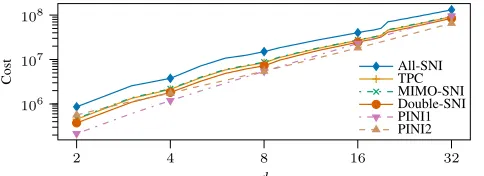
Fig. 6: Cost estimates for AES128 encrypt implementations.
the randomness cost at very high orders.
VII. PERFORMANCE COMPARISON
We conclude the paper by briefly discussing the perfor-mance aspects of various compositional strategies introduced in the literature (including ours).
For this purpose, we consider state-of-the art gadgets at each order (order-specific and generic constructions) for each property needed: SNI refresh, NI multiplication, SNI multi-plication and PINI multimulti-plication (whose costs are given in Appendix C). Namely, the refresh gadgets are taken from [4], the NI multiplications and SNI multiplication come from [22], [6], [5], the PINI1 multiplication comes from this work (Al-gorithm 2), while the PINI2 multiplication was introduced in [12]. For the construction of a SNI multiplication, we observe that for sufficiently high orders (d ≥ 12), the mul-tiplication of Bela¨ıd et al. followed by a SNI refresh has a lower cost than the multiplication of Ishai, Sahai and Wagner, which justifies the assumptions made for the optimization in Section V-B3.
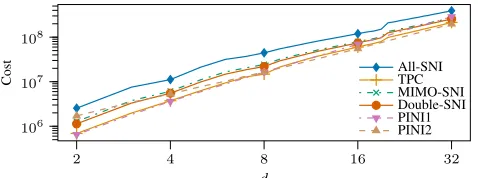
Next, we analyze the strategies on various block ciphers. We take AES with the bit-level implementation of Boyar, Matthews and Peralta masked at various orders as a first realistic case study (since it is the basis for the best-reported masked software performances in [19]). We also consider lightweight block ciphers, which are arguably more relevant for embedded devices where masking is needed and when performance is a constraint: PRESENT (with80 bitkey) and Noekeon (with4 bitS-boxes), and Fantomas (8 bitS-boxes). A synthetic evaluation is shown for each compositional strategy and each block cipher in Figures 6, 7, 8 and 9 (the data is also given in tables in Appendix C for power-of-2 d). For this purpose, we use a simple model where the cost is the number of F2 operations, assuming that the generation of one random F2 element has the same cost as 80F2 operations. This model is admittedly abstract and based on the PRNG performances on a particular ARM Cortex M4 processor mentioned in [23]. We note that our conclusions are stable for a wide range of PRNG costs, and refer to [12] for more empirical confirmations of these comparisons.
2 4 8 16 32 106
107 108
d
Cost
All-SNI TPC MIMO-SNI Double-SNI PINI1 PINI2
Fig. 7: Cost estimates for Noekeon encrypt implementations.
2 4 8 16 32
106 107 108
d
Cost
All-SNI TPC MIMO-SNI Double-SNI PINI1 PINI2
Fig. 8: Cost estimates for PRESENT encrypt implementations (80 bitkey).
an implementation with the PINI1 multiplication gadget and another one with the PINI2 gadget, which performs better at high orders.
For lightweight ciphers, the PINI strategy performs best (by taking the best amongst PINI1 and PINI2), reducing cost by a factor of roughly 2 compared to the Double-SNI strategy, which comes second in performance.1The difference in performance observed between the strategies is mainly due to the difference in number of refreshings needed.
The AES case is particular: it is a sweet spot for the TPC strategy which then reaches performance similar to PINI. This is due to the large number of AND gates in the AES S-box (32 [10], whereas Fantomas, Noekeon and PRESENT have respectively 11, 4 and 4). This reduces the relative cost of the refreshing of the key schedule (needed for TPC and not for competing strategies). Moreover, contrary to lightweight ciphers, the non-linear part of the AES S-box ends with a full layer of AND gates, avoiding the need of additional refreshing for the TPC strategy (for which the S-boxes must end with a full SNI layer).
1 For asymptotic d, the PINI gadgets are worse than Double-SNI or TPC since they require more arithmetic operations (overhead scaling asd2), which makes the cost of refresh gadgets (dlogd) asymptotically negligible. However, this has no significant impact at practical masking orders for bit-level masking. Performance evaluations in larger fields (e.g., F256) where multiplication cost is larger is left to future work.
2 4 8 16 32
106 107 108
d
Cost
All-SNI TPC MIMO-SNI Double-SNI PINI1 PINI2
Fig. 9: Cost estimates for Fantomas encrypt implementations.
These results confirm that PINI is a good strategy to build masked circuits. First, it enjoys the trivial composition property, which leads to simplicity (such as dealing with only one kind of gadget, while e.g., other strategies need rules to decide whether to use NI/SNI multiplications and SNI refresh gadgets). Second, PINI leads to high-performance implementations that reduce by 2 the cost of lightweight block cipher implementations. We believe those results are timely for enabling the comparison of side-channel resistant imple-mentations in the ongoing NIST competition in lightweight cryptography, and are in general relevant to the security and efficiency of any embedded cryptographic implementation, which are important building blocks of many secure systems. Finally, we recall that such performance comparisons (e.g., between the MIMO-SNI, TPC and PINI approaches) are dependent on the cost of the (state-of-the-art) gadgets used. Hence, the search of more optimized such gadgets is an interesting scope for further research, to further refine our understanding of cost-optimized masked implementations. Acknowledgments. Ga¨etan Cassiers and Franc¸ois-Xavier Standaert are resp. Research Fellow and Senior Associate Researcher of the Belgian Fund for Scientific Research (FNRS-F.R.S.). This work has been funded in part by the ERC project 724725.
REFERENCES
[1] J. Balasch, B. Gierlichs, V. Grosso, O. Reparaz, and F. Standaert. On the cost of lazy engineering for masked software implementations. In CARDIS 2014, Revised Selected Papers.
[2] G. Barthe, S. Bela¨ıd, F. Dupressoir, P. Fouque, B. Gr´egoire, and P. Strub. Verified proofs of higher-order masking. InEUROCRYPT 2015, Proceedings.
[3] G. Barthe, S. Bela¨ıd, F. Dupressoir, P. Fouque, B. Gr´egoire, P. Strub, and R. Zucchini. Strong non-interference and type-directed higher-order masking. In Proceedings of the 2016 ACM SIGSAC Conference on Computer and Communications Security.
[4] G. Barthe, S. Bela¨ıd, F. Dupressoir, P.-A. Fouque, B. Gr´egoire, F.-X. Standaert, and P.-Y. Strub. Improved parallel mask refreshing algorithms: generic solutions with parametrized non-interference and automated optimizations. Journal of Cryptographic Engineering, Jan 2019. [5] G. Barthe, F. Dupressoir, S. Faust, B. Gr´egoire, F. Standaert, and P. Strub.
Parallel implementations of masking schemes and the bounded moment leakage model. InEUROCRYPT 2017, Proceedings.
[6] S. Bela¨ıd, F. Benhamouda, A. Passel`egue, E. Prouff, A. Thillard, and D. Vergnaud. Randomness complexity of private circuits for multipli-cation. InEUROCRYPT 2016, Proceedings.
[7] S. Bela¨ıd, D. Goudarzi, and M. Rivain. Tight private circuits: Achieving probing security with the least refreshing. In ASIACRYPT 2018, Proceedings.
[8] A. Bogdanov, L. R. Knudsen, G. Leander, C. Paar, A. Poschmann, M. J. B. Robshaw, Y. Seurin, and C. Vikkelsoe. PRESENT: an ultra-lightweight block cipher. InCHES 2007, Proceedings.
[9] J. Boyar, P. Matthews, and R. Peralta. Logic minimization techniques with applications to cryptology. J. Cryptology, 26(2), 2013.
[10] J. Boyar and R. Peralta. A new combinational logic minimization technique with applications to cryptology. InSEA 2010, Proceedings. [11] G. Cassiers. Randomness requirements optimization tool for masked
S-Boxes implementation. https://github.com/cassiersg/mimopsni/, 2018. [12] G. Cassiers and F. Standaert. Towards globally optimized masking: From low randomness to low noise rate or probe isolating multiplications with reduced randomness and security against horizontal attacks.IACR Trans. Cryptogr. Hardw. Embed. Syst., 2019(2).
[13] T. D. Cnudde, O. Reparaz, B. Bilgin, S. Nikova, V. Nikov, and V. Rijmen. Masking AES with d+1 shares in hardware. InCHES 2016, Proceedings.
[14] J. Coron, E. Prouff, and M. Rivain. Side channel cryptanalysis of a higher order masking scheme. InCHES 2007, Proceedings.
[16] J. Daemen, M. Peeters, G. Van Assche, and V. Rijmen. Nessie proposal: Noekeon, 2000.
[17] A. Duc, S. Dziembowski, and S. Faust. Unifying leakage models: From probing attacks to noisy leakage. InEUROCRYPT 2014, Proceedings. [18] A. Duc, S. Faust, and F. Standaert. Making masking security proofs
concrete - or how to evaluate the security of any leaking device. In EUROCRYPT 2015, Proceedings.
[19] D. Goudarzi and M. Rivain. How fast can higher-order masking be in software? InEUROCRYPT 2017, Proceedings.
[20] H. Groß, S. Mangard, and T. Korak. An efficient side-channel protected AES implementation with arbitrary protection order. InCT-RSA 2017, Proceedings.
[21] V. Grosso, G. Leurent, F. Standaert, and K. Varici. Ls-designs: Bitslice encryption for efficient masked software implementations. InFSE 2014, Revised Selected Papers.
[22] Y. Ishai, A. Sahai, and D. A. Wagner. Private circuits: Securing hardware against probing attacks. InCRYPTO 2003, Proceedings.
[23] A. Journault and F. Standaert. Very high order masking: Efficient implementation and security evaluation. InCHES 2017, Proceedings. [24] P. C. Kocher, J. Jaffe, and B. Jun. Differential power analysis. In
CRYPTO ’99, Proceedings.
[25] S. Mangard, T. Popp, and B. M. Gammel. Side-channel leakage of masked CMOS gates. InCT-RSA 2005, Proceedings.
[26] T. Moos, A. Moradi, T. Schneider, and F. Standaert. Glitch-resistant masking revisited or why proofs in the robust probing model are needed. IACR Trans. Cryptogr. Hardw. Embed. Syst., 2019(2).
[27] S. Nikova, V. Rijmen, and M. Schl¨affer. Secure hardware implementa-tion of nonlinear funcimplementa-tions in the presence of glitches. J. Cryptology, 24(2):292–321, 2011.
[28] M. Rivain and E. Prouff. Provably secure higher-order masking of AES. InCHES 2010, Proceedings.
APPENDIXA PINI1SECURITY PROOF
Proposition 10: The multiplication gadget of Algorithm 2 is d−1-PINI.
Proof: Let us build a PINI simulator: first, given a set of probes P and probed output shares A, Algorithm 3 gives the set of required input shares X = A∪B. All the probes that depend only on input shares with index in X and on randomness are computed as specified by Algorithm 2 (required randomness is generated). If somezij orsijappears
in the expression of some probe and cannot be computed from known inputs, it is assigned a fresh random (we say that the simulator cheatson that value) and evaluation continues until all probes are computed.
Let us now show that this algorithm produces the same probe distribution as Algorithm 2. The behavior of the simu-lator is identical to the behavior of the gadget, except for some zij andsij. If the simulator cheats onzij, thenzij or a sum
in which it appears is probed, and there is no probe on zji
(or their intermediate values, or a sum in which it appears) or on intermediate values of the computation of zij. Therefore,
rij is only observable through zij, which means that zij is
behaves like a uniform random variable independent of all other variables, which is what the simulator generates. Forsij,
the same argument applies: if the simulator cheats, then rij
is only observable through sij (or probes depending on sij),
hencesij behaves as a uniform independent random variable.
APPENDIXB
MIMO-SNI S-BOX OPTIMIZATION PROBLEM The AES S-Box of is made of three parts: a top lin-ear transformation, a middle non-linlin-ear transformation and
Algorithm 3 Input shares chooser for the simulator of PINI1
multiplication
Require: Set of probesyG A,∗∪P
X← ∅;
fori= 0tod−1do
ifai,ai+ 1,bi,ai·biorciis probedthen
X←X∪ {i};
else ifthere existsksuch thatPkj=1zijis probedthen
X←X∪ {i};
forj= 0tod−1do
if there are at least two probes on intermediate values of computation of zij (these values are rij, pkij, skij and zij) then
X←X∪ {i, j};
else if there is one probe on an intermediate value of the computation ofzij then
ifi∈X orj∈X then
X←X∪ {i, j};
else
X←X∪ {i};
B←X\A;
Ensure: |B| ≤ |P|
a bottom linear transformation. Since our goal is to have a probing secure implementation of the AES, we do not need to have a full MIMO-SNI S-box. Having only the middle non-linear transformation MIMO-SNI is enough since the top and bottom linear transformations can be considered as combined with the other linear operations of the AES (i.e., ShiftRow, MixColumns and AddRoundKey) when applying MIMO-SNI composability.
The non-linear transformation is made of 30 XOR gates and 32 AND gates, hence it contains more than2·(30+32) = 124
wires. This means that it is impossible to apply the exhaustive search used for the S-Box in F256. We therefore reformulate our graph optimization problem into a integer linear program-ming problem, for which there exists numerous solvers. This does not guarantee that we can find an optimal solution with a reasonable amount of resources, but solvers have efficient heuristics to find good solutions and can prove lower bounds for the solution. Since we take care that our representation as an optimization problem admits as acceptable solutions all the possible implementations of the considered logic circuit, we are able to provide upper and lower bounds on the cost of the optimal implementation.
We write the linear optimization problem in the following way. A binary variableei is associated to each edgeiof the
graph, indicating if it is cut (i.e., if a refresh is inserted). All the paths in the graph are then computed and a binary variable pj is assigned to each path j, again indicating if it is cut. A
path is cut if any edge in the path is cut. It implies a first general constraint pj ≤Piei (the sum is over the edges in
the path).
We can then add the various constraints related to Non-Interference properties. First, to enforce NI, for each pair of vertices(u, v)all but one paths from utov must be cut. Let J be the set of paths fromutov,P
j∈Jpj≥ |J| −1. Next, to
enforce SNI, whenuis an input node andv an output node, the constraint becomes P
need: for any nodeu, letJ be the set of paths from any input node to u, P
j∈Jpj ≥ |J| −1. Finally, for the MO part we
need: for any node u, letJ be the set of paths fromuto any output node, P
j∈Jpj≥ |J| −1.
The objective function to be minimized is a weighted sum of the ei variables. The weigh associated to each variable is
the cost of adding a refresh on the corresponding edge. This cost can be any metric, such as the amount of random bits required, the computation time, etc. Since each edge has a distinct associated cost parameter, this is the point where we can take into account that the cost of adding a SNI refresh gadget may not be the same as replacing a NI multiplication with a SNI multiplication.
This simple way of writing our problem has two limitations. First, there are many paths in the computation graph (in the order of magnitude of105for the AES S-box) which leads to many variables and constraints in the optimization problem. This can be mitigated by grouping paths into clusters that share common parts and associating them to a single variable. The second issue is related to split nodes: there are multiple trees of binary split nodes that represent the split of a value in more than two parts, and all these representations do not give equivalent possibilities for inserting refresh elements. Fur-thermore, no tree can provide all the optimization degrees of freedom. Since it would be impractical to run the optimization for all the possible trees, we instead modified the optimization problem. Each split node is replaced by a set of split nodes that form a fully connected DAG and constraints are set to ensure that a constant number of added edges is cut, which ensures that the added edges do not distort the objective function.
APPENDIXC
COST OF MASKED IMPLEMENTATIONS
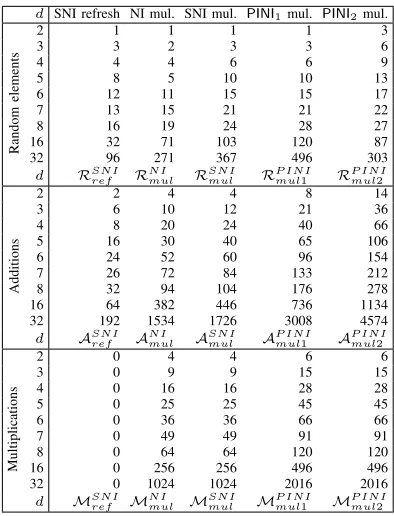
The randomness and field operations cost for SNI refresh, NI & SNI multiplication, and PINI multiplication gadgets are given in Table II for some small orders. The cost formula for any order are given next:
• Randomness (the formula forRSN I
ref (d)isO(dlogd)):
RSN I
ref (d) = 2bd/2c+RSN Iref (bd/2c) +RSN Iref (dd/2e)
RN Imul(d) =
(d−1)2/4
+d−1
RSN I
mul(d) = min
d(d−1)/2,RN I
mul(d) +RSN Iref (d)
RP IN I
mul1(d) =d(d−1)/2
RP IN I mul2(d) =
(d−1)2/4
+ 2d−1
• Additions:
ASN I
ref (d) = 2RSN Iref (d)
AN I
mul(d) = 2RN Imul(d) +d(d−1)
ASN Imul(d) = 2RmulSN I(d) +d(d−1)
AP IN I
mul1(d) = 2RP IN Imul1(d) + 2d(d−1) +d
AP IN I
mul2(d) = 2RP IN Imul2(d) + 4d(d−1)
• Multiplications:
MSN I ref = 0
MN I mul=d2
MSN I mul =d2
MP IN I
mul1 =d(2d−1) +d
MP IN I
mul2 =d(2d−1) +d
The cost for whole encryptions are given in Tables III, IV, V and VI. The cost metric used is explained in Section VII.
d SNI refresh NI mul. SNI mul. PINI1mul. PINI2mul.
Random
elements
2 1 1 1 1 3
3 3 2 3 3 6
4 4 4 6 6 9
5 8 5 10 10 13
6 12 11 15 15 17
7 13 15 21 21 22
8 16 19 24 28 27
16 32 71 103 120 87
32 96 271 367 496 303
d RSN I ref R
N I mul R
SN I mul R
P IN I mul1 R
P IN I mul2
Additions
2 2 4 4 8 14
3 6 10 12 21 36
4 8 20 24 40 66
5 16 30 40 65 106
6 24 52 60 96 154
7 26 72 84 133 212
8 32 94 104 176 278
16 64 382 446 736 1134
32 192 1534 1726 3008 4574
d ASN I ref A
N I mul A
SN I mul A
P IN I mul1 A
P IN I mul2
Multiplications
2 0 4 4 6 6
3 0 9 9 15 15
4 0 16 16 28 28
5 0 25 25 45 45
6 0 36 36 66 66
7 0 49 49 91 91
8 0 64 64 120 120
16 0 256 256 496 496
32 0 1024 1024 2016 2016
d MSN I
ref MN Imul MSN Imul MP IN Imul1 MP IN Imul2
TABLE II: Randomness and field operations cost of known gadgets.
d All-SNI TPC MIMO-SNI Double-SNI PINI1 PINI2 2 2548960 689200 1282880 1135280 648880 1711280 3 7556760 1977480 3758520 3315720 1837320 3469320 4 11176480 3737440 6112160 5521760 3601760 5304160 5 21162040 6283960 11033400 9852600 5942200 7740600 8 44568000 14811840 24310720 21949120 16419520 16560320 16 119638400 60126080 79123840 74400640 69703040 55354240 32 392354560 213817600 270810880 256641280 286862080 198068480 TABLE III: Cost metric for AES128 bit encryption.
d All-SNI TPC MIMO-SNI Double-SNI PINI1 PINI2 2 1943552 558080 516096 390144 234496 574464 3 5761536 1605120 1479168 1101312 628224 1150464 4 8034304 2492416 2324480 1820672 1206272 1751040 5 15647232 4563456 4227584 3219968 1968640 2544128 8 31985664 9818112 9146368 7131136 5361664 5406720 16 73732096 29396992 28053504 24023040 22519808 17928192 32 231682048 98676736 94646272 82554880 92225536 63811584 TABLE IV: Cost metric for Noekeon encryption.
d All-SNI TPC MIMO-SNI Double-SNI PINI1 PINI2 2 1237520 535928 556264 383408 223200 573128 3 3668664 1563888 1624896 1106328 619380 1156920 4 5254128 2447760 2529104 1837680 1205280 1766008 5 10101784 4489048 4651736 3268888 1980900 2573248 8 20933184 9707712 10033088 7267392 5446080 5492456 16 51913096 29462152 30112904 24581512 23034240 18308104 32 166677576 99324744 101277000 84682824 94636800 65390408 TABLE V: Cost metric for PRESENT80 bitencryption.