Balanced permutations Even-Mansour ciphers
Shoni Gilboa1 and Shay Gueron2,3
1
The Open University of Israel, Raanana 43107, Israel 2
University of Haifa, Israel 3
Intel Corporation, Israel Development Center, Israel
July 21, 2014
Abstract. Ther-rounds Even-Mansour block cipher usesrpublic per-mutations of{0,1}n
andr+1 secret keys. An attack on this construction was described in [6], forr= 2,3. Although this attack is only marginally better than brute force, it is based on an interesting observation (due to [10]): for a ”typical” permutationP, the distribution ofP(x)⊕xis not uniform. To address this, and other potential threats that might stem from this observation in this (or other) context, we introduce the notion of a “balanced permutation” for which the distribution ofP(x)⊕xis uniform, and show how to generate families of balanced permutations from the Feistel construction. This allows us to define a 2n-bit block cipher from the 2-rounds Even-Mansour scheme. The cipher uses public balanced permutations of{0,1}2n
, which are based on two public permu-tations of{0,1}n. By construction, this cipher is immune against attacks
that rely on the non-uniform behavior ofP(x)⊕x. We prove that this ci-pher is indistinguishable from a random permutation of{0,1}2n, for any
adversary who has oracle access to the public permutations and to an encryption/decryption oracle, as long as the number of queries iso(2n/2). As a practical example, we discuss the properties and the performance of a 256-bit block cipher that is based on AES.
Keywords:Even-Mansour, block-cipher, Feistel rounds
1
Introduction
The Even-Mansour (EM) block cipher [7] uses a randomly chosen (public) per-mutation P of {0,1}n, two secret keysk
1, k2 ∈ {0,1}n, and encrypts an n-bit plaintext m by the transformation EMP;k1,k2(m) = P(m⊕k1)⊕k2 (the de-cryption transformation is obvious). The interesting feature of the EM cipher is that confidentiality is achieved even if the permutation P is made public. An adversary needs to make at least 2n/2oracle queries before he can decrypt a new message with high success probability (the model adversary has black box access to P,P−1, and to an encryption and decryption oracle) [7]. The only assump-tion is that P is chosen uniformly at random from the set of all permutations of {0,1}n before it is published (obviously, the EM cipher is not secure with
Bogdanov et al. [2] generalized the EM construction to anr-rounds iterated EM cipher (withr= 1, it is the original EM cipher). This cipher usesrpublicly known random permutations of {0,1}n, P
1, P2, . . . , Pr, and r+ 1 secret keys
k1, k2, . . . , kr, kr+1 ∈ {0,1}n. Encryption of an n-bit plaintext mis carried out by the transformation
EMP1,P2,...,Pr;,k1,k2,...,kr+1(m) =Pr(. . . P2(P1(m⊕k1)⊕k2). . .⊕kr)⊕kr+1
(decryption is obvious). They showed that the r-rounds EM cipher (r ≥ 2) is secure in the following sense: an adversary who sees no more than 22n/3 cho-sen plaintext-ciphertext pairs cannot distinguish the encryption oracle from a random permutation of {0,1}n.
As a practical example, Bogdanov et al. defined the 128-bit block cipher AES2, which is an instantiation of the 2-rounds EM cipher where the two public permutations are AES (encryption) with two publicly known “arbitrary” keys (they chose the binary digits of the constant π). The complexity of the best (meet-in-the-middle) attack they showed used 2129.6cipher revaluations. Conse-quently, they conjectured that AES2 offers 128-bit security.
Dinur et al. [6] designed a chosen-plaintext key-recovery attack on a single key variant (i.e., the choice ofk1=k2=k3=k4) of the 3-rounds and also 2-rounds EM cipher, in timeOlognn2n. This attack is based on the observation that for a ”typical” permutationP of{0,1}n, the distribution ofP(x)⊕xover uniformly chosen x ∈ {0,1}n is not uniform. Their paper attributes this observation to Nikoli´c et al. [10], who demonstrated a chosen-plaintext key-recovery attack on the 2-rounds EM cipher with complexity slightly lower than exhaustive key search. In addition, [6] used the same observation to describe an attack on AES2 (with three different keys) that is∼7 times faster than the best known meet-in-the-middle attack of Bogdanov et al. [2], therefore invalidating their conjecture on the security of AES2. Although these attacks are not really practical, and not far from an exhaustive search, they demonstrates that the observation of Nikoli´c et al. can open a door to some potential threats.
In this paper we define a new variation of the EM cipher, which is immune against attacks based on any non-uniform properties ofP(x)⊕x. To this end, we first introduce the notion of a “balanced permutation”, which is a permutation
2
Balanced permutations and balanced permutations EM
ciphers
2.1 Balanced permutations
Definition 1 (Balanced permutation). Let σ be a permutation of {0,1}n.
Define the function eσ : {0,1}n → {0,1}n by
e
σ(ω) = ω ⊕σ(ω), for any ω ∈ {0,1}n. We say thatσis a balanced permutation if
e
σ is also a permutation.
Example 1. LetA∈Mn×n(Z2) be a matrix such that both AandI+Aare in-vertible. DefineπA:Zn2 →Zn2 byπA(x) =Ax. ThenπAis a balance permutation of{0,1}n. One such matrix is defined byA
i,i=Ai,i+1= 1 fori= 1,2, . . . , n−1,
An,1= 1 andAi,j= 0 for all other 1≤i, j≤n.
Example 2. Letabe an element ofGF(2n) such thata6= 0,1. IdentifyGF(2n) with{0,1}n, so field addition corresponds to bitwise XOR. The field’s multipli-cation is denoted by ×. The function x→a×xis a balanced permutation of {0,1}n. Note that this example is actually a special case of the previous one.
The balanced permutations provided by the above examples are a small fam-ily of permutations, and moreover are all linear. We now give a recipe for gen-erating a large family of balanced permutations, by employing the Feistel con-struction that turns any function f : {0,1}n → {0,1}n to a permutation of {0,1}2n.
Let us use the following notations. For a string ω ∈ {0,1}2n, denote the string of its first n bits by ωL ∈ {0,1}n, and the string of its last n bits by
ωR ∈ {0,1}n. Denote the concatenation of two stringsω1, ω2 ∈ {0,1}n (in this order) byω1∗ω2∈ {0,1}2n. We have the following identities:
(ω1∗ω2)L=ω1, (ω1∗ω2)R=ω2, ωL∗ωR=ω (1) Definition 2 (2 Feistel rounds permutation).Let f :{0,1}n → {0,1}n be
any function, and letπf :{0,1}2n → {0,1}2n be the function
πf(ω) :=ωR∗(ωL⊕f(ωR)). (2)
The permutation π2
f :=πf◦πf of{0,1}2n is called a 2 Feistel rounds
permuta-tion.
Clearly, πf (the well known Feistel round) is a permutation of {0,1}2n, and thus the composition πf2 (i.e., two Feistel rounds) is also a permutation of {0,1}2n. We prove the following property for the special case where the function
f is a permutation.
Proposition 1. Let f be a permutation of {0,1}n. Then, the2 Feistel rounds
permutation π2
f is a balanced permutation of {0,1}
2n. We call it a 2 Feistel
Proof. First observe that
π2f(ω) =πf(πf(ω)) =πf(ωR∗(ωL⊕f(ωR))) =
= (ωL⊕f(ωR))∗(ωR⊕f(ωL⊕f(ωR))). (3) Therefore,
f π2
f(ω) =f(ωR)∗f(ωL⊕f(ωR)). Assume thatx, y∈ {0,1}2n such that
f π2
f(x) =πf2f(y), i.e.,
f(xR)∗f(xL⊕f(xR)) =f(yR)∗f(yL⊕f(yR))
Then, f(xR) =f(yR) and f(xL⊕f(xR)) =f(yL⊕f(yR)). Since (by assump-tion) f is one-to-one, xR = yR and xL⊕f(xR) = yL⊕f(yR), it follows that
xL= (xL⊕f(xR))⊕f(xR) = (yL⊕f(yR))⊕f(yR) =yL. We established that
f π2
f(x) =fπ 2
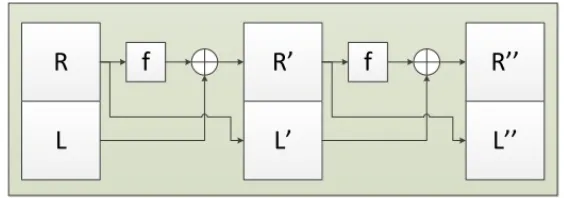
f(y) impliesx=xL∗xR=yL∗yR=ywhich concludes the proof. ut Figure 1 shows an illustration of 2 Feistel rounds (balanced) permutation.
Fig. 1. The figure shows a function from {0,1}2n to {0,1}2n, based on two Feistel
rounds with a functionf :{0,1}n→ {
0,1}n
. For any functionf, this construction is a permutation of {0,1}2n, denotedπ
f2. We call it a “2 Feistel rounds permutation”.
Proposition 1, shows that iff itself is apermutationof{0,1}n
, thenπf2 is a balanced
permutation of{0,1}2n
. We call it a “2 Feistel rounds balanced permutation”.
2.2 Balanced permutations EM ciphers
Definition 3 (r-rounds balanced permutations EM ciphers (BPEM)).
Let n≥1 andr≥1be integers. Let k1, k2, . . . , kr+1 ber+ 1 string in{0,1}2n.
Let f1,f2,. . .,fr be rpermutations of {0,1}n. Their associated2 Feistel rounds
balanced permutations (of {0,1}2n) byπ2 f1,π
2 f2,. . .,π
2
fr, respectively.
The r-rounds balanced permutations EM (BPEM) block cipher is
EMπ2 f1,π
2 f2,...,π
2
fr,k1,k2,...,kr+1 It encrypts 2n-bit blocks with an r-rounds EM
{0,1}2n) are set to beπ2 f1, π
2 f2, . . . , π
2
fr, respectively.
The use of ther-rounds BPEM cipher for encryption (and decryption) starts with an initialization step, where the permutationsf1, f2, . . . , frare selected uniformly
and independently, at random from the set of permutations of{0,1}n. After they
are selected, they can be made public. Subsequently, per session/message, the se-cret keys k1, k2, . . . , kr+1 are selected uniformly and independently, at random,
from{0,1}2n.
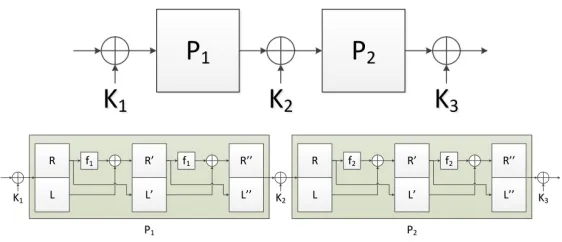
Figure 2 illustrates a 2-rounds BPEM cipher, which is the focus of this paper.
Remark 1. The 1-round BPEM cipher does not satisfy the requirement for a “random permutation selection” as in the definition of the EM scheme. Not surprisingly, it is easy to see that the 1-round BPEM does not preserve plaintext confidentiality. For any plaintextsm∈ {0,1}2n, we have
πf2(m⊕k1)L= (mL⊕(k1)L)⊕f(mR⊕(k1)R) Therefore,
EMπ2
f;k1,k2(m)
L
= π2f(m⊕k1)
L⊕(k2)L= =mL⊕(k1)L⊕(k2)L⊕f(mR⊕(k1)R). It follows that if, e.g., (m1)R= (m2)R then
EMπ2
f;k1,k2(m1)⊕EMπf2;k1,k2(m2)
L
= (m1⊕m2)L
which means that the ciphertexts leak out information on m1, m2. This implies that the r-rounds BPEM cipher must be used withr≥2 to have any hope for achieving security.
Remark 2. Ther-rounds BPEM cipher is not necessarily secure withanychoice of balanced permutations as π2
f1, π 2 f2, . . . , π
2
fr, even if r ≥2. For example, the cipher can be easily broken when using the linear balanced permutations shown in Examples 1 and 2.
Remark 3. By construction,EMπ2 f1,π
2 f2,...,π
2
fr,k1,k2,...,kr+1 (r≥2) is immune against any attack that tries to leverage the non-uniformity ofP(x)⊕x(including [10] and [6])). Obviously, this does not guarantee it is secure (as indicated in Remark 2).
In the next section, we prove that the 2-round EMBP cipher is indistinguish-able from a random permutation.
3
Indistinguishability analysis for the 2-rounds BPEM
cipher
Fig. 2.The 2-rounds balanced permutations EM (BPEM) cipher operates on blocks of size 2n bits. The permutations P1 and P2 are balanced permutations of {0,1}2n, defined as 2 Feistel rounds permutations.f1 and f2 are two (public) permutations of
{0,1}n
. Each one ofk1,k2,k2 is a 2n-bit secret key. See explanation in the text.
in {0,1}2n. Then it selects a permutation F of {0,1}2n, which is either P or
EMπ2 f1,π
2
f2;k1,k2,k3 .
An adversary selects a “querying and guessing” algorithm. He first uses it to submit to the oracle an adaptive series of queries of typesf1,f2 andF. Queries of type fi are of the form fi(x) =? or fi−1(x) =? for x ∈ {0,1}n and queries of type F are of the form F(w) =?, F−1(w) =? for w ∈ {0,1}2n. After col-lecting the responses, the adversary uses his algorithm to guess whether F is
EMπ2 f1,π
2
f2;k1,k2,k3
orP. The quality of such an algorithm (in the cryptographic
context) is the ability to distinguish between the two cases (rather than to suc-cessfully guess which one it is). It is measured by the difference between the probability that the algorithm outputs a certain answer, given that the oracle choseF to beEMπ2
f1,π2f2;k1,k2,k3, and the probability that the algorithm outputs the same answer, given that the oracle choseF to be the random permutation. This is called the ”advantage” of the algorithm. We are interested in bounding
AdvEM
f1,f2;k1,k2,k3(q1, q2, qF), which is the maximal advantage of the adversary, over all possible algorithms, as a function of the budgetq1of queries of typef1, the budgetq2 of queries of typef2 and the budgetqF of queries of typeF. The total budget of queries is thusq:=q1+q2+qF. We show
Theorem 1. If 2(q+qF)qF <2n then
AdvEMf
1,f2;k1,k2,k3(q1, q2, qF)≤
(6q+ 5qF)qF 2n−2(q
F+q)qF
.
and from the other direction, we also show
Proposition 2. If qF ≤2·2n then
Advf1,f2;k1,k2,k3EM (q1, q2, qF)≥ 1 8q
For the proof of Theorem 1 we consider an algorithm that achieves the largest advantage. We may assume that:
1. The adversary never repeats a query that was already made, and does not make ‘”opposite” queries (i.e.,π−1(x) =? after already receivingxas a reply to a queryπ(·) =? whereπis one off1, f1−1, f2, f2−1, F, F−1).
2. By adding superfluous queries whose answers the algorithm will ignore, we may assume the adversary makes exactly q1 queries of type f1, exactly q2 queries of typef2 and exactlyqF queries of typeF.
3. The adversary’s algorithm, and the choice of the queries in particular, are completely deterministic. This means that the first query the adversary makes is fixed, and any subsequent query he makes depends only on the answers he got for the previous queries. Therefore, if the oracle usesF =
EMπ2 f1,π
2
f2;k1,k2,k3
, for some choice of f1, f2, k1, k2, k3, then all queries and their answers are completely determined byf1, f2, k1, k2, k3. We denote this sequence of queries and answers byqa(f1, f2;k1, k2, k3).
LetQA be the set of all possible sequences of query-answer pairs that can be obtained through the interaction between the adversary and the oracle. For any ¯s∈QA, we denote by prperm(¯s) the probability that ¯swill be the sequence of pairs obtained by the adversary-oracle interaction when the oracle uses a random permutation as F. Similarly, PrEM(¯s) is the probability that ¯s will be the sequence of pairs obtained by the adversary-oracle interaction when the oracle uses a balanced EM block cipher asF.
Let E ⊆ QA be the set of sequences of query-answer pairs for which the adversary will guess that F is a balanced EM block cipher. The advantage of the algorithm is|PrEM(E)−Prperm(E)|.
Let us say that the pair< x, z >is established by a query if either the query isπ(x) =? (whereπis eitherF, f1 orf2) and its answer isz, or if the query is
π−1(z) =? (where, again,π is eitherF,f
1 orf2) and its answer isx. For an ¯s∈QA, let
(u11(¯s), v11(¯s)),(u12(¯s), v21(¯s)), . . . ,(uq11 (¯s), v1q1(¯s)) be the pairs established by queries of typef1 in ¯s, let
(u21(¯s), v12(¯s)),(u22(¯s), v22(¯s)), . . . ,(uq22 (¯s), v2q2(¯s)) be the pairs established by queries of typef2 in ¯s. Let
(x1(¯s), z1(¯s)),(x2(¯s), z2(¯s)), . . . ,(xqF(¯s), zqF(¯s))
be the pairs established by queries of typeF in ¯s. LetqF,1(¯s) :=|{(xi(¯s))R}qi=1F |,
qF,2(¯s) :=|{(zi(¯s))L}qi=1F |.
LetS2nbe the set of permutations of{0,1}n. For any ¯s∈QA, ¯k= (k1, k2, k3)∈ {0,1}2n3
and ¯y= (y1, y2, . . . , yqF)∈ {0.1} 2nqF
let
em(¯s,k,¯ y¯) :={(f1, f2)∈(S2n)2|qa(f1, f2;k1, k2, k3) = ¯s ,∀1≤i≤qF :
It is easy to see that ifem(¯s,k,¯ y¯)6=∅then for any 1≤i < j≤qF, (xi(¯s))R= (xj(¯s))R↔(yi⊕xi(¯s))L= (yj⊕xj(¯s))L, and
(yi⊕zi(¯s))R= (yj⊕zj(¯s))R↔(zi(¯s))L= (zj(¯s))L. LetY(¯s) be the set of all ¯y’s in {0,1}2nqF
satisfying those conditions. For anyS⊆QA, let
b
S:={(¯s,¯k,y¯)|s¯∈S ,k¯∈ {0,1}2n3
,y¯∈Y(¯s)}.
For any (¯s,¯k,y¯)∈QAdlet
α(¯s,¯k,y¯) := |em(¯s, ¯
k,y¯)|
((2n)!)2(22n)3. For any ¯s∈QAlet
β(¯s) := Prperm(¯s) (22n)3|Y(¯s)|. Lemma 1. For anyS ⊆QA
PrEM(S)−Prperm(S) =
X
(¯s,¯k,¯y)∈Sb
α(¯s,¯k,y¯)−β(¯s) .
Proof. For any ¯s∈QA
PrEM(¯s) =
X
¯
k∈({0,1}2n)3 ¯ y∈Y(¯s)
α(¯s,¯k,y¯),
therefore
PrEM(S)−Prperm(S) =
X
¯ s∈S
(PrEM(¯s)−Prperm(¯s)) =
=X
¯ s∈S
X
¯
k∈({0,1}2n)3 ¯ y∈Y(¯s)
α(¯s,k,¯ y¯)−β(¯s)= X
(¯s,¯k,¯y)∈Sb
α(¯s,k,¯ y¯)−β(¯s).
u t
In Subsection 3.1 we define a setD∗⊆QAdof ”unfortunate instances”, and prove
the following two Lemmas.
Lemma 2.
X
(¯s,k,¯¯y)∈D∗
β(¯s)≤ (4q+ 3qF)qF 2n−q
Lemma 3. Suppose2(q+qF)qF <2n. For any (¯s,¯k,y¯)∈QAd−D∗,
α(¯s,k,¯ y¯)
β(¯s) −1
< 2(qF+q)qF
2n−2(q
F+q)qF
The proof of Theorem 1 follows via a standard argument which we describe in Subsection 3.2.
We comment that up to some obvious changes, the same arguments show that the same bound holds for the single key variation of the 2-rounds BPEM cipher. To put it formally, we consider an oracle that chooses uniformly and independently, at random, permutations f1, f2 of {0,1}n, a permutation P of {0,1}2n and a single key k ∈ {0,1}2n. Then, it selects a permutation F of {0,1}2n, which is either P or EM
π2 f1,π
2 f2;k,k,k
. As before, the adversary is ex-pected to guess whetherF isEMπ2
f1,π 2 f2;k,k,k
orP, after collecting the responses
to q queries, where qF of them are of type F. Let AdvfEM1,f2;k,k,k(q, qF) be the maximal advantage of the adversary, over all possible algorithms.
We have then
Theorem 2. If 2(q+qF)qF <2n then
AdvfEM1,f2;k,k,k(q, qF)≤
(6q+ 5qF)qF 2n−2(q
F+q)qF
.
We also comment that similar arguments yield bounds for the following vari-ations of the 2-rounds BPEM cipher: single permutation, and both single key and single permutation (the formal description is analogous to the one above).
Theorem 3. If 4(q+qF)qF <2n then
AdvEMf,f;k1,k2,k3(q, qF)≤
(12q+ 11qF)qF 2n−4(q
F+q)qF
.
Theorem 4. If 4(q+qF)qF <2n then
AdvEMf,f;k,k,k(q, qF)≤
(12q+ 11qF)qF 2n−4(q
F+q)qF
.
3.1 Definition of the set D∗ and proofs of its properties
The setD∗will be the union of all the sets defined below.
Definition 4. For1≤i≤q1,1≤j≤qF let
Dui,j1,R:={(¯s,¯k,y¯)∈QAd|u1i(¯s) = (xj(¯s)⊕k1)R},
Dui,j1,L:={(¯s,¯k,y¯)∈dQA|u1i(¯s) = (yj)L},
Dvi,j1,L:={(¯s,k,¯ y¯)∈QAd|vi1(¯s) = (yj⊕xj(¯s)⊕k1)L},
for1≤i≤q2,1≤j≤qF let
Di,ju2,L:={(¯s,k,¯ y¯)∈QAd|u2i(¯s) = (zj(¯s)⊕k3)L},
Di,ju2,R:={(¯s,¯k,y¯)∈QAd|u2i(¯s) = (yj⊕k2)R},
Di,jv2,L:={(¯s,k,¯ y¯)∈QAd|vi2(¯s) = (yj⊕zj(¯s)⊕k2⊕k3)L},
Di,jv2,R:={(¯s,k,¯ y¯)∈QAd|v2i(¯s) = (yj⊕zj(¯s)⊕k2⊕k3)R},
for1≤i, j≤qF let
DyL,xR
i,j :={(¯s,k,¯ y¯)∈QAd|(yi)L = (xj(¯s)⊕k1)R},
DyR,zL
i,j :={(¯s,k,¯ y¯)∈QAd|(yi⊕k2)R= (zj(¯s)⊕k3)L},
Di,jy,x:={(¯s,k,¯ y¯)∈QAd|(yi⊕xi(¯s))L= (yj⊕xj(¯s))R},
Di,jy,z:={(¯s,¯k,y¯)∈QAd|(yi⊕zi(¯s))L= (yj⊕zj(¯s))R},
and finally, for1≤i < j ≤qF let
DyL
i,j :={(¯s,¯k,y¯)∈QAd|(yi)L= (yj)L},
DyR
i,j :={(¯s,k,¯ y¯)∈QAd|(yi)R= (yj)R},
DyR,xR,6=
i,j :={(¯s,¯k,y¯)∈dQA|(yi⊕xi(¯s))R= (yj⊕xj(¯s))R,(yi⊕zi(¯s))R6= (yj⊕zj(¯s))R},
DyL,zL,6=
i,j :={(¯s,¯k,y¯)∈QAd|(yi⊕zi(¯s))L= (yj⊕zj(¯s))L,(yi⊕xi(¯s))L6= (yj⊕xj(¯s))L},
DyR,xR,=
i,j :={(¯s,¯k,y¯)∈dQA|(yi⊕xi(¯s))R= (yj⊕xj(¯s))R,(yi⊕zi(¯s))R= (yj⊕zj(¯s))R},
DyL,zL,=
i,j :={(¯s,¯k,y¯)∈QAd|(yi⊕zi(¯s))L= (yj⊕zj(¯s))L,(yi⊕xi(¯s))L= (yj⊕xj(¯s))L}.
The number of sets defined in Definition 4 is
4q1qF + 4q2qF+ 4q2F+ 6
q
F 2
<(4q+ 3qF)qF,
Therefore, Lemma 2 follows directly from the following lemma.
Lemma 4. Let D be any of the sets defined in Definition 4. Then
X
(¯s,¯k,¯y)∈D
β(¯s)≤ 1 2n−q
F
(4)
Proof. To show (4), it is enough to show that either
X
¯ s∈QA ∃¯k∈({0,1}2n)3
,¯y∈Y(¯s):(¯s,¯k,¯y)∈D
Prperm(¯s)≤ 1 2n−q
F
or that for any ¯s∈QA,
X
¯ y∈Y(¯s) ∃¯k∈({0,1}2n)3
:(¯s,k,¯¯y)∈D 1 |Y(¯s)| ≤
1 2n−q
F
,
or that for any ¯s∈QAand ¯y∈Y(¯s),
X
¯
k∈({0,1}2n)3 (¯s,¯k,¯y)∈D
1 (22n)3 ≤
1 2n−q
F
.
We now verify that for any set D, defined in Definition 4, at least one of the above holds.
1. If D is any of the sets Dui,j1,R, Dvi,j1,L, Di,jv1,R, Dui,j2,L, Di,ju2,R, DyL,xR
i,j , then for any ¯s∈QAand ¯y∈Y(¯s),
X
¯
k∈({0,1}2n)3 (¯s,¯k,¯y)∈D
1 (22n)3 =
1 2n.
2. IfD is any of the setsDui,j1,L, Di,jv2,L, DyL,zL,6=
i,j then for any ¯s∈QA,
X
¯ y∈Y(¯s) ∃k¯∈({0,1}2n)3
:(¯s,¯k,¯y)∈D 1 |Y(¯s)| =
1 2n−(q
F,1(¯s)−1)
.
In the case thatD=DyL,zL,6=
i,j we rely on the observation that the condition (yi⊕xi(¯s))L 6= (yj ⊕xj(¯s))L ensures that the condition (yi ⊕zi(¯s))L = (yj⊕zj(¯s))L is independent of the conditions definingY(¯s).
3. IfD is any of the setsDvi,j2,R, DyR,zL i,j , D
yR,xR,6=
i,j then for any ¯s∈QA,
X
¯ y∈Y(¯s) ∃k¯∈({0,1}2n)3
:(¯s,¯k,¯y)∈D 1 |Y(¯s)| =
1 2n−(q
F,2(¯s)−1)
.
In the case thatD=DyR,xR,6=
i,j we rely on the observation that the condition (yi⊕zi(¯s))R 6= (yj ⊕zj(¯s))R ensures that the condition (yi⊕xi(¯s))R = (yj⊕xj(¯s))Ris independent of the conditions defining Y(¯s).
4. IfD is any of the setsDy,xi,j, Dy,zi,j then for any ¯s∈QA,
X
¯ y∈Y(¯s) ∃¯k∈({0,1}2n)3
:(¯s,¯k,¯y)∈D 1 |Y(¯s)| =
5. IfD is any of the setsDyL
i,j then for any ¯s∈QA,
X
¯ y∈Y(¯s) ∃k¯∈({0,1}2n)3
:(¯s,¯k,¯y)∈D 1 |Y(¯s)| ≤
1 2n−(q
F,1(¯s)−1)
,
since the condition (yi)L = (yj)L is either contradicting or independent of the conditions definingY(¯s)
6. IfD is any of the setsDyR
i,j then for any ¯s∈QA,
X
¯ y∈Y(¯s) ∃k¯∈({0,1}2n)3
:(¯s,¯k,¯y)∈D 1 |Y(¯s)| ≤
1 2n−(q
F,2(¯s)−1)
,
since the condition (yi)R = (yj)R is either contradicting or independent of the conditions definingY(¯s)
7. Finally, ifD is any of the setsDyL,zL,= i,j , D
yR,xR,=
i,j then since
DyL,zL,=
i,j ⊆ {(¯s,¯k,y¯)∈QAd|(xi(¯s)⊕zi(¯s))L = (xj(¯s)⊕zj(¯s))L},
DyR,xR,=
i,j ⊆ {(¯s,¯k,y¯)∈QAd|(xi(¯s)⊕zi(¯s))R= (xj(¯s)⊕zj(¯s))R}, we get that
X
¯ s∈QA ∃k¯∈({0,1}2n)3
,¯y∈Y(¯s):(¯s,k,¯¯y)∈D
Prperm(¯s)≤ 2n 22n−1.
u t
We now address the proof of Lemma 3. We use the following computational lemma.
Lemma 5. For any integersr, N ≥1andm≥0,
1≥ r
Y
i=1
1−i+m−1
N
>1− 1
2(r+ 2m)r
N . Proof. 1≥ r Y i=1
1−i+m−1
N = v u u t r Y i=1
1−i+m−1
N 1−
r−i+m N
≥
≥
1−r+ 2m−1
N r2
≥1− 1
2(r+ 2m−1)r
N >1−
1
2(r+ 2m)r
N .
Proof of Lemma 3. A pair (f1, f2)∈(S2n)2 belongs to em(¯s,k,¯ y¯) if and only if
f1 satisfies: – f1(u1i(¯s)) =v
1
i(¯s) for 1≤i≤q1,
– f1((xi(¯s)⊕k1)R) = (yi⊕xi(¯s)⊕k1)Lfor 1≤i≤qF, – f1((yi)L) = (yi⊕xi(¯s)⊕k1)R for 1≤i≤qF,
andf2satisfies:
– f2(u2i(¯s)) =vi2(¯s) for 1≤i≤q2,
– f2((yi⊕k2)R) = (yi⊕zi(¯s)⊕k2⊕k3)L for 1≤i≤qF, – f2((zi(¯s)⊕k3)L) = (yi⊕zi(¯s)⊕k2⊕k3)R for 1≤i≤qF.
The definitions ofD∗ and Y(¯s) guarantees that for (¯s,k,¯ y¯)∈QAd−D∗, these are exactlyq1+qF,1(¯s) +qF non-contradicting requirements forf1(some of the requirements of the formf1((xi(¯s)⊕k1)R) = (yi⊕xi(¯s)⊕k1)L coincide), and exactly q2 +qF,2(¯s) +qF non-contradicting requirements for f2 (some of the requirements of the formf2((zi(¯s)⊕k3)L) = (yi⊕zi(¯s)⊕k2⊕k3)R coincide). Hence
em(¯s,k,¯ y¯)= (2
n
−(q1+qF,1(¯s) +qF))! (2n−(q2+qF,2(¯s) +qF))!. Since|Y(¯s)|=QqF,1(¯s)
i=1 (2n−(i−1))·
QqF,2(¯s)
i=1 (2n−(i−1)) and Prperm(¯s) =
1
Qq1
i=1(2n−(i−1))·
Qq2
i=1(2n−(i−1))·
QqF
i=1(22n−(i−1))
,
we get that
α(¯s,k,¯ y¯)
β(¯s) =
QqF,1(¯s) i=1 1−
i−1 2n
·QqF,2(¯s) i=1 1−
i−1 2n
·QqF i=1 1−
i−1 22n
QqF,1(¯s)+qF
i=1 1−
i+q1−1 2n
·QqF,2(¯s)+qF
i=1 1−
i+q2−1 2n
.
Hence by Lemma 5
α(¯s,¯k,y¯)
β(¯s) ≥ qF,1(¯s)
Y
i=1
1−i−1 2n
· qF,2(¯s)
Y
i=1
1−i−1 2n · qF Y i=1
1−i−1 22n > > 1− 1 2qF,1(¯s)
2
2n 1−
1 2qF,2(¯s)
2
2n 1−
1 2q 2 F 22n > 1− 1 2q 2 F 2n 3 >
>1− 3 2q
2 F 2n >1−
2(qF+q)qF 2n−2(q
F+q)qF
.
On the other hand, again by Lemma 5,
qF,1(¯s)+qF
Y
i=1
1−i+q1−1 2n
>1−
1
2(qF,1(¯s) +qF+ 2q1)(qF,1(¯s) +qF)
2n ≥
and
qF,2(¯s)+qF
Y
i=1
1−i+q2−1 2n
>1−
1
2(qF,1(¯s) +qF+ 2q2)(qF,1(¯s) +qF)
2n ≥
≥1−2(qF+q2)qF
2n ,
therefore
β(¯s)
α(¯s,¯k,y¯) ≥
qF,1(¯s)+qF
Y
i=1
1−i+q1−1 2n
·
qF,2(¯s)+qF
Y
i=1
1−i+q2−1 2n
>
>
1−2(qF +q1)qF
2n 1−
2(qF +q2)qF 2n
≥
≥1−2(2qF+q1+q2)qF
2n = 1−
2(qF +q)qF
2n ,
hence
α(¯s,¯k,y¯)
β(¯s) <
1
1−2(qF+q)qF 2n
= 1 + 2(qF+q)qF 2n−2(q
F+q)qF and the lemma follows.
u t
3.2 Proof of Theorem 1
We first show a simple corollary of Lemma 3.
Corollary 1.
X
(¯s,¯k,¯y)∈QAd−D∗
α(¯s,¯k,y¯)−β(¯s)≤
2(qF+q)qF 2n−2(q
F+q)qF
.
Proof. By Lemma 3,
X
(¯s,¯k,¯y)∈QAd−D∗
α(¯s,k,¯ y¯)−β(¯s)=
X
(¯s,¯k,¯y)∈QAd−D∗ β(¯s)
α(¯s,k,¯ y¯)
β(¯s) −1
≤ ≤ X
(¯s,¯k,¯y)∈QAd−D∗ β(¯s)
2(qF+q)qF 2n−2(q
F +q)qF ≤
X
(¯s,¯k,¯y)∈QAd β(¯s)
2(qF +q)qF 2n−2(q
F+q)qF =
= 2(qF +q)qF 2n−2(q
F +q)qF
.
We will also use the following simple lemma
Lemma 6.
X
(¯s,k,¯¯y)∈D∗
α(¯s,¯k,y¯)≤ X
(¯s,k,¯¯y)∈dQA−D∗
α(¯s,¯k,y¯)−β(¯s)+ X
(¯s,¯k,¯y)∈D∗
β(¯s).
Proof. By Lemma 1,
X
(¯s,k,¯¯y)∈dQA
α(¯s,k,¯ y¯)−β(¯s)= PrEM(QA)−Prperm(QA) = 0.
Therefore, by Corollary 1,
X
(¯s,k,¯¯y)∈D∗
α(¯s,k,¯ y¯)−β(¯s)
=− X
(¯s,¯k,¯y)∈QAd−D∗
α(¯s,k,¯ y¯)−β(¯s)
≤
≤ X
(¯s,k,¯¯y)∈dQA−D∗
α(¯s,¯k,y¯)−β(¯s).
hence
X
(¯s,k,¯¯y)∈D∗
α(¯s,k,¯ y¯) = X
(¯s,¯k,¯y)∈D∗
α(¯s,k,¯ y¯)−β(¯s)
+ X
(¯s,¯k,¯y)∈D∗
β(¯s)≤
≤ X
(¯s,¯k,¯y)∈QAd−D∗
α(¯s,k,¯ y¯)−β(¯s)+ X
(¯s,¯k,¯y)∈D∗
β(¯s).
u t
Proof of Theorem 1. Recall that the advantage of the adversary’s algorithm is |PrEM(E)−Prperm(E)|, whereE is the set of sequences of queries and answers for which the adversary will guess that F is a balanced EM block cipher. For anyA⊆QA, by Lemma 1,
|PrEM(A)−Prperm(A)|=
X
(¯s,k,¯¯y)∈Ab
α(¯s,¯k,y¯)−β(¯s)
= = X
(¯s,¯k,¯y)∈Ab−D∗
α(¯s,¯k,y¯)−β(¯s)
+ X
(¯s,¯k,¯y)∈Ab∩D∗
α(¯s,¯k,y¯)− X
(¯s,k,¯¯y)∈Ab∩D∗
β(¯s)
≤ ≤ X
(¯s,¯k,¯y)∈Ab−D∗
α(¯s,¯k,y¯)−β(¯s)+
X
(¯s,¯k,¯y)∈Ab∩D∗
α(¯s,¯k,y¯) + X
(¯s,k,¯¯y)∈Ab∩D∗ β(¯s).
In particular,
|PrEM(E)−Prperm(E)| ≤
≤ X
(¯s,¯k,¯y)∈Eb−D∗
α(¯s,¯k,y¯)−β(¯s)+
X
(¯s,k,¯¯y)∈Eb∩D∗
α(¯s,¯k,y¯) + X
and forEc:=QA−E
|PrEM(Ec)−Prperm(Ec)| ≤
≤ X
(¯s,¯k,¯y)∈Ecc−D∗
α(¯s,¯k,y¯)−β(¯s)+
X
(¯s,¯k,¯y)∈Ecc∩D∗
α(¯s,¯k,y¯) + X
(¯s,k,¯¯y)∈Ecc∩D∗
β(¯s),
hence, using Lemma 2, Corollary 1 and Lemma 6,
|PrEM(E)−Prperm(E)|+|PrEM(Ec)−Prperm(Ec)| ≤
≤ X
(¯s,¯k,¯y)∈QAd−D∗
α(¯s,¯k,y¯)−β(¯s)+ X
(¯s,¯k,¯y)∈D∗
α(¯s,k,¯ y¯) + X
(¯s,¯k,¯y)∈D∗
β(¯s)≤
≤2 X
(¯s,¯k,¯y)∈QAd−D∗
α(¯s,¯k,y¯)−β(¯s)+ 2 X
(¯s,k,¯¯y)∈D∗
β(¯s)≤
≤2 2(qF+q)qF 2n−2(q
F +q)qF
+ 2(4q+ 3qF)qF 2n−q
F
<2 (6q+ 5qF)qF 2n−2(q
F+q)qF
.
Now, since
|PrEM(Ec)−Prperm(Ec)|=|(1−PrEM(E))−(1−Prperm(E))|= =|PrEM(E)−Prperm(E)|,
we get that
|PrEM(E)−Prperm(E)|= =1
2(|PrEM(E)−Prperm(E)|+|PrEM(E c)−Pr
perm(Ec)|)<
< (6q+ 5qF)qF
2n−2(q
F +q)qF
u t
3.3 A lower bound for the advantage - Proof of Proposition 2
For the proof of Proposition 2 we need the following technical lemma
Lemma 7. Let EM :=EMπ2
f1,πf22;k1,k2,k3. If x, y∈ {0,1}
2n such that (EM(x))L= (EM(y))L
(x⊕EM(x))R= (y⊕EM(y))R
thenx=y.
Proof. Denote
ˇ
x:=πf21(x⊕k1)⊕k2, ˇ
y:=πf2
We have that
(EM(x))R= ˇxR⊕f2((EM(x))L)⊕(k3)R= (x⊕k1)R⊕f1(ˇxL)⊕f2((EM(x))L)⊕(k3)R. Hence
f1(ˇxL) = (x⊕EM(x))R⊕f2((EM(x))L)⊕(k1⊕k3)R. Similarly
f1(ˇyL) = (y⊕EM(y))R⊕f2((EM(y))L)⊕(k1⊕k3)R.
so since (EM(x))L = (EM(y))L and (x⊕EM(x))R = (y⊕EM(y))R we get that f1(ˇxL) =f1(ˇyL), and then, sincef1is one-to-one, that ˇxL= ˇyL. Now
(EM(x))L= ˇxL⊕f2(ˇxR)⊕(k3)L, hence
f2(ˇxR) = (EM(x))L⊕ˇxL⊕(k3)L. Similarly
f2(ˇyR) = (EM(y))L⊕yˇL⊕(k3)L,
so since (EM(x))L= (EM(y))Land ˇxL= ˇyL we get thatf2(ˇxR) =f2(ˇyR), and then, sincef2 is one-to-one, that ˇxR= ˇyR. Therefore ˇx= ˇy, i.e.,
π2f
1(x⊕k1)⊕k2=π 2
f1(y⊕k1)⊕k2 hencex=y.
u t
Proof of Proposition 2. For simplicity, assume qF is even. Suppose that the adversary uses the following strategy. First he takes arbitrary distinct a, b ∈ {0,1}n. Then he makesq
F/2 queries of the form F(x∗a) =? for distinctx’s in {0,1}n andq
F/2 queries of the formF(y∗b) =? for distincty’s in{0,1}n (not necessarily different from thex’s). The adversary will guess thatF is a random permutation if and only if there arexandyfor which (F(x∗a))L= (F(y∗b))L and (F(x∗a))R⊕a= (F(y∗b))R⊕b. The previous lemma guarantees that if
F is a BPEM then the adversary will not find suchx and y. To conclude the proof, it only remains to show that the probability that the adversary finds such
xandyis at least 18· q2F
22n. One way to show this is to observe that by Bonferroni inequality, this probability is at least
(qF/2)2 22n−1 −
2 qF/2 2
2
(22n−1)(22n−3).
4
A practical constructions: 256-bit cipher EM256AES
We show here a practical construction of a 256-bit block cipher based on the 2-rounds BPEM EM cipher, where the underlying permutation is AES.
Definition 5 (EM256AES: a 256-bit block cipher). Let `1 and `2 be two 128-bit keys, selected uniformly and independently at random, from{0,1}128, and
letk1, k2, k3 be three 256-bit secret keys selected uniformly and independently at
random from {0,1}256. Let the permutations f
1 and f2 be the AES encryption
using`1 and`2 as the AES key, respectively.
The 256-bit block cipher EM256AES is defined as the associated instantiation of the 2-rounds BPEM cipher EM π2
f1, π 2
f2, k1, k2, k3.
Usage:
• `1 and `2 are determined during the setup phase, and can be made public
(e.g., sent from the sender to the receiver as an IV).
• k1, k2, k3 are selected per encryption session.
Single key EM256AES is the special case where a single valuek∈ {0,1}256 and
a single value`∈ {0,1}128 are selected uniformly and independently at random,
and the EM256AES cipher usesk1=k2=k3=k and`1=`2=`.
Hereafter, we use the single key EM256AES. To establish security proper-ties forEM256AES, we make the standard assumption about AES: if a secret key is selected (uniformly at ranomd), an adversary has negligible advantage in distinguishing AES from a random permutation of{0,1}128even after seeing a (very) large number of plaintext-ciphertext pairs (i.e., that AES satisfies its de-sign goals ([1], Section 4). This assumption is certainly reasonable if the number of blocks that are encrypted with the same keys setup is limited to be much smaller than 264. Therefore, in our context, we can consider assigning the ran-domly selected key `at setup time as an approximation for a random selection of the two (identical here) permutationsf1=f2. Under this assumption, we can rely on the result of Theorem 4 for the security ofEM256AES.
EM256AES efficiency: An encryption session between two parties requires exchanging a 256-bit secret key and transmitting a 128-bit IV (=`). One key (and IV) can be used forN blocks as long as we keepN 264.
Computing one (256-bit) ciphertext involves 4 AES computations (with theIV
EM256AES performance: To test the actual performance ofEM256AES, and validate our predictions, we coded an optimized implementation of
EM256AES. Its performance is reported here.
The performance was measured on an Intel Core i7-4700MQ (microarchitecture Codename Haswell) where the enhancements (Intel Turbo Boost Technology, Intel Hyper-Threading Technology, and Enhanced Intel Speedstep Technology) were disabled. The code used the AES instructions (AES-NI) that are available on such modern processors.
On this platform, we point out the following baseline: the performance of AES (128-bit key) in a parallelized mode (CTR) is 0.63 C/B, and in a serial mode (CBC) it is 4.44 cycles per byte (C/B hereafter).
The measured performance of ourEM256AESimplementation was 1.44 C/B for the parallel mode, and 8.92 C/B for the serial mode. The measured performance clearly matches the predictions.
It is also interesting to compare the performance ofEM256AESto another 256-bit cipher. To this end, we prepared an implementation of Rijndael256 cipher [4]2. For details on how to code Rijndael256 with AES-NI, see [8]). Rijndael256 (in ECB mode) turned out to be much slower thanEM256AES, performing at 3.85 C/B.
5
Discussion
We presented here a new variation, BPEM, of the EM cipher, which is immune against attacks that attempt to leverage any non-uniform behavior ofP(x)⊕x. Theorem 1 (and its variants, Theorems 2, 3, 4) implies that if BP EM cipher is used much less than 2n/2 times, the probability of distinguishing it from a random permutation, let alone breaking it in any sense, is negligible.
One interesting feature of our EM-based construction is obtaining a 2n-bit block size while using ann-bit permutation primitive. The computational cost of encrypting (decrypting) one 2n-bit block is 4 evaluation of ann-bit permutation (plus a relatively small overhead). Note that this make BEMP ready to be used in practice, for example to define a 256-bit cipher, because “good” permutations of {0,1}128are available. We demonstrated the specific cipherEM256AES, which is based on AES, and confirmed its efficiency to be (only) half the performance of AES (2.5 times faster than Rijndale256). With the standard assumption on AES, Theorem 4 ensures that it can be used up to 252times with the same keys before its outputs can be distinguished from a random permutation of{0,1}256 with an advantage exceeding 10−6. Changing a key/IV every 252 encryptions does not impose a practical limitation.
A variation on the way by which BPEM is used, can make it a naturally tweakable 2n-bit block cipher as follows. A public IV (=`) can be associated with each encrypted block as its unique identifier, and can therefore be viewed
2
as the tweak. To randomized these IV’s, it is possible to encrypt (using k) a block identifier such as its “address”.
The expression of the advantage Theorem 1 behaves linearly with the number of queries to the public permutations, and quadratically with qF. This proves the security of a protocol, described below, for using BPEM cipher where the secret keys are changed more frequently than the public permutations. This protocol fits well the reasonable assumption that the essential limitations on the number of adversary queries should be on the encryption/decryption invocations, while no limitations should be imposed on the number of queries to the public permutations.
Protocol:choose the public permutations for a period of 1 10002
2n/3 blocks, di-vided into 2n/3sessions of 1
10002
n/3blocks. Change the secret keys every session. This way, the relevant information on the block cipher, from a specific choice of keys, is limited to a session, while the adversary can accumulate relevant information from replies to the public permutations across sessions. Therefore,
qF is limited to 10001 2n/3, whileqis limited to 10001 22n/3. Theorem 1 guarantees that this usage is secure.
We point out that the upper bound of Theorem 1 and the lower bound of Proposition 2 leave the problem of determining the actual order of magnitude of the adversary’s advantage widely open. Two observations indicate that Theorem 1 is not tight.
• An examination of the proof of Theorem 1 reveals that the randomness of
k2 does not play any role, and it remains valid even if k2= 0. It is natural to expect that including a randomk2 improve sthe security of the resulting cipher. The choice wherek2 = 0 in BPEM degenerates it to a special form of an EM cipher. In this case, the attack of Daemen [3] applies.
• The result of Bogdanov et al. [2], translated to the 2n-bit block size, shows that the regular 2-rounds EM cipher is indistinguishable from a random permutation of{0,1}2n even with 24n/3 queries (and this bound is tight for an adversary with unlimited computational resources). The gap between this number and Theorem 1 can be only partly attributed to the fact that the regular EM construction uses permutations of {0,1}2n, while BPEM uses only permutations of{0,1}n.
References
1. –, Announcing request for candidate algorithm nominations for the Ad-vanced Encryption Standard (AES), http://csrc.nist.gov/CryptoToolkit/aes/pre-round1/aes 9709.htm (1997).
3. J. Daemen, Limitations of the Even-Mansour construction, in Advances in cryptology—ASIACRYPT ’91, Lecture Notes in Computer Science, 739, Springer, Berlin, (H. Imai, R. L. Rivest, T. Matsumoto, editors) 495-498 (1993).
4. J. Daemen, V. Rijmen, AES Proposal: Rijndael (National Institute of Standards and Technology), http://csrc.nist.gov/archive/aes/rijndael/Rijndael-ammended.pdf (1999).
5. O. Dunkelman , N. Keller, A. Shamir, Minimalism in Cryptography: The Even-Mansour Scheme Revisited, inAdvances in cryptology—EUROCRYPT 2012, Lec-ture Notes in Comput. Sci., 7237, Springer, Heidelberg. 336–354 (2012).
6. I. Dinur, O. Dunkelman, N. Keller, A. Shamir, Key Recovery Attacks on 3-round Even-Mansour, 8-step LED-128, and full AES2, http://eprint.iacr.org/2013/391 (2013).
7. S. Even, Y. Mansour, A construction of a cipher from a single pseudorandom permutation, J. Cryptology10(1997), no. 3, 151–161.
8. S. Gueron, Intel Advanced Encryption Standard (AES) Instructions Set (Rev 3.01), http://software.intel.com/sites/default/files/article/165683/aes-wp-2012-09-22-v01.pdf (2014).
9. C. Hall, D. Wagner, J. Kelsey, B. Schneier, Building PRFs from PRPs, in: Pro-ceedings of CRYPTO-98: Advances in Cryptography, Springer Verlag, 1998, pp. 370-389.