Editorial
Riccardo Poli
Department of Computer Science, University of Essex, Wivenhoe Park, Colchester, CO4 3SQ, UK Email:[email protected]
Stefano Cagnoni
Department of Computer Engineering, University of Parma, 43100 Parma, Italy Email:[email protected]
1. INTRODUCTION
Darwinian evolution is probably the most intriguing and powerful mechanism of nature mankind has ever discov-ered. Its power is evident in the impressive level of adapta-tion reached by all species of animals and plants in nature. It is intriguing because despite its simplicity and randomness, it produces incredible complexity in a way that appears to be very directed, almost purposeful. Like for other powerful natural phenomena, it is no surprise that several decades ago a few brilliant researchers in engineering and computer sci-ence started wondering whether they could steal the secrets behind Darwinian evolution and use them to solve prob-lems of practical interest in a variety of application domains. Those people were pioneers of a new field which, after more than 30 years from its inception, is now big, well established, and goes under the name ofgenetic and evolutionary compu-tation(GEC).
An almost endless number of results and applications of evolutionary algorithms have been reported in the literature, showing that the ideas of these pioneers were indeed right. Nowadays, evolutionary techniques can routinely solve prob-lems in domains such as automatic design, optimisation, pat-tern recognition, control, and many others. Until recently, however, only very occasionally could one claim that GEC techniques approached the performance of human experts in these same domains, particularly in the case of large scale ap-plications and complex engineering problems. This is why, initially, successful applications of GEC techniques to the fields of computer vision, image analysis, and signal process-ing were few and far in between. Towards the late 1990s, how-ever, the research interest in these areas seemed to be rapidly growing, and the time seemed right for the creation of an infrastructure that could foster the interaction between re-searchers in this area. This is what led, in early 1998, the two editors of this special issue, together with people from
vari-ous other European institutions, to create a working group of the European Network of Excellence in Evolutionary Com-putation, entirely devoted to the applications of evolution-ary algorithms to image analysis and signal processing. The working group organises a regular meeting, the European Workshop on Evolutionary Computation in Image Analysis and Signal Processing (EvoIASP), which reached its fifth edi-tion this year. This event gives European and non-European researchers, as well as people from industry, an opportunity to present their latest research, discuss current developments and applications, besides fostering closer interaction between members of the GEC, image analysis, and signal processing scientific communities. However, the event is, and intends to remain, a workshop. Therefore, the work presented there can never have the depth allowed by more substantial and mature archival publications such as this journal.
This special issue of EURASIP JASP on GEC for signal processing and image analysis, being the first of its kind, has offered computer scientists and engineers from around the world a unique opportunity to submit their best mature research for inclusion in this unified, high-quality “venue.” The timing of this special issue could not have been better; well over thirty papers were submitted by contributors from around the world. The papers were reviewed by a pool of over thirty international expert reviewers. Only about one third passed our strict criteria for acceptance and are now in this volume.
2. EVOLUTIONARY COMPUTATION: THE BASICS
What were the main secrets behind Darwinian evolution, that the pioneers of GEC stole to make them the propelling fuel of evolutionary computation processes?
Inheritance
Individuals have a genetic representation (in nature, the chromosomes and the DNA) such that it is possible for the offspring of an individual to inherit some of the features of its parent.
Variation
The offsprings are not exact copies of the parents, but in-stead, reproduction involves mechanisms that create innova-tion as new generainnova-tions are born.
Natural selection
Individuals best adapted to the environment have longer life and higher chances of mating and spreading their genetic makeup.
Clearly, there is a lot more to natural evolution than these main forces. However, like for many other nature-inspired techniques, not all the details are necessary to obtain working models of a natural system. The three ingredients listed above are in fact sufficient to obtain artificial systems showing the main characteristic of natural evolution,the ability to search for highly fit individuals.
For all these ingredients (representation, variation, and selection), one can focus on different realisations. For exam-ple, in nature, variation is produced both through mutations of the genome and through the effect of sexually recombin-ing the genetic material comrecombin-ing from the parents when ob-taining the offspring chromosomes (crossover). This is why many different classes of evolutionary algorithms have been proposed over the years. So, depending on the structures un-dergoing evolution, on the reproduction strategies and the variation (orgenetic) operators adopted, and so on, evolu-tionary algorithms can be grouped into several evoluevolu-tionary paradigms: genetic algorithms (GAs) [1], genetic program-ming (GP) [2], evolution strategies (ESs) [3,4], and so forth. All the inventors of these different evolutionary algo-rithms (EAs) have to make choices as to which bits of nature have a corresponding component in their algorithms. These choices are summarised in the nature-to-computer mapping shown inTable 1. That is, the notion of individual in nature corresponds to a tentative solution to a problem of interest in an EA. The fitness (ability to reproduce and have fertile offsprings that reach the age of reproduction) of natural in-dividuals corresponds to the objective function used to eval-uate the quality of the tentative solutions in the computer. The genetic variation processes of mutation and recombina-tion are seen as mechanisms (search operators) to generate new tentative solutions to the problem. Finally, natural selec-tion is interpreted as a mechanism to promote the diffusion and mixing of the genetic material of individuals represent-ing good quality solutions and therefore havrepresent-ing the potential to create even fitter individuals (better solutions).
Table1: Nature-to-computer mapping at the basis of EAs.
Nature Computer
Individual Solution to a problem Population Set of solutions Fitness Quality of a solution
Chromosome Representation for a solution(e.g., set of parameters)
Gene Part of the representation of a solution(e.g., parameter or degree of freedom)
Crossover Search operator Mutation Search operator
Natural selection Promoting the reuse of good (sub-)solutions
Despite their differences, most EAs have the following general form.
(1) Initialise population and evaluate the fitness of each population member.
(2) Repeat.
(a) Select subpopulation for reproduction on the basis of fitness (selection).
(b) Copy some of the selected individuals without change (cloningorreproduction).
(c) Recombine the “genes” of selected parents (recom-binationorcrossover).
(d) Mutate the mated population stochastically (muta-tion).
(e) Evaluate the fitness of the new population. (f) Select the survivors based on fitness.
Not all these steps are present in all EAs. For example, in modern GAs [5] and in GP phase, (a) is part of phases (b) and (c), while phase (f) is absent. This algorithm is said to be generationalbecause there is no overlap between generations (i.e., the offspring population always replaces the parent pop-ulation). In generational EAs, cloning is used to simulate the survival of parents for more than one generation.
In the following, we will analyse the various compo-nents of an EA in more detail, mainly concentrating on the GA, although most of what we will say also applies to other paradigms.
2.1. Representations
Because normally the user of a GA has no ideas as to what constitutes a good initial set of choices/parameters for adult individuals (tentative solutions to a problem), the chromo-somes to be manipulated by the GA are normally initialised in an entirely random manner. That is, the initial population is a set of random binary strings or of random real-valued vectors.
2.2. Selection in GAs
Selection is the operation by which individuals (i.e., their chromosomes) are selected for mating or cloning. To emulate natural selection, individuals with a higher fitness should be selected with higher probability. There are many models of selection, some of which, despite fitting well the biologically inspired computational model and producing effective re-sults, are not biologically plausible. We briefly describe them below.
Fitness proportionate selection, besides being the most di-rect translation into the computational model of the prob-abilistic principles of evolution, is probably the most widely used selection scheme. This works as follows. LetN be the population size, fi the fitness of individual i, and ¯f =
(1/N)j fj the average population fitness. Then, in fitness proportionate selection, individualiis selected for reproduc-tion with a probability
pi=fi j fj =
fi ¯
f N. (1)
In normal GAs, populations are not allowed to grow or shrink, soNindividuals have to be selected for reproduction. Therefore, theexpected numberof selected copies of each in-dividual is
Ni=piN= fif¯. (2)
So, individuals with an above-average quality (fi > f¯) tend to be selected more than once for mating or cloning, while individuals below the average tend not to be used.
Tournament selection, instead, works as follows. To select an individual, first a group ofT(T≥2) random individuals is created. Then the individual with the highest fitness in the group is selected, the others are discarded (tournament).
Another alternative isrank selectionwhere individuals are first sorted (ranked) on the ground of their fitness so that if an individualihas fitness fi > fj, then its rank isi < j. Then each individual is assigned a probability of being se-lected pitaken from a given distribution (typically a mono-tonic rapidly decreasing function), with the constraint that
ipi=1. 2.3. Operators
EAs work well only if their genetic operators allow an efficient and effective search of the space of tentative solutions.
One desirable property of recombination operators is to guarantee that two parents sharing a useful common characteristic always transmit such a characteristic to their
Parents 111000 1110 101010 1010
Crossover point
Offspring 111000 1010 101010 1110 Crossover point
(a)
Parents 11 1000 1110 10 1010 1010 Crossover points
Offspring 10 1000 1010 11 1010 1110 Crossover points
(b)
Parents 1110001110 1010101010
Offspring 111010 1 110
(c)
Figure1: Three crossover operators for binary GAs: (a) one-point
crossover, (b) two-point crossover, (c) uniform crossover.
offspring. Another important property is to also guarantee that different characteristics distinguishing two parents may be all inherited by their offspring. For binary GAs, there are many crossover operators with these properties.
One-point crossover, for example, aligns the two par-ent chromosomes (bit strings), then cuts them at a ran-domly chosen common point and exchanges the right-hand side (or left-hand side) subchromosomes (see Figure 1a). In two-point crossover, chromosomes are cut at two ran-domly chosen crossover points and their ends are swapped (seeFigure 1b). A more modern operator,uniform crossover, builds the offspring, one bit at a time, by randomly se-lecting one of the corresponding bits from the parents (see Figure 1c).
Normally, crossover is applied to the individuals of a pop-ulation with a constant probabilitypc(oftenpc∈[0.5,0.8]). Cloning is then applied with a probability 1−pcto keep the number of individuals in each generation constant.
Mutation site
101 0 101010
Mutation site
101 1 101010
Figure2: Bitwise mutation in binary GAs.
values of one or more genes in a chromosome. Mutation is often applied to the individuals produced by crossover and cloning before they are added to the new population. In bi-nary chromosomes, mutation often consists of inverting ran-dom bits of the genotypes (seeFigure 2). The main goal with which mutation is applied is preservation of diversity, which helps GAs to explore as much of the search space as possi-ble. However, due to its random nature, mutation may have disruptive effects onto evolution if it occurs too often. There-fore, in GAs, mutation is usually applied to genes with a very low probability.
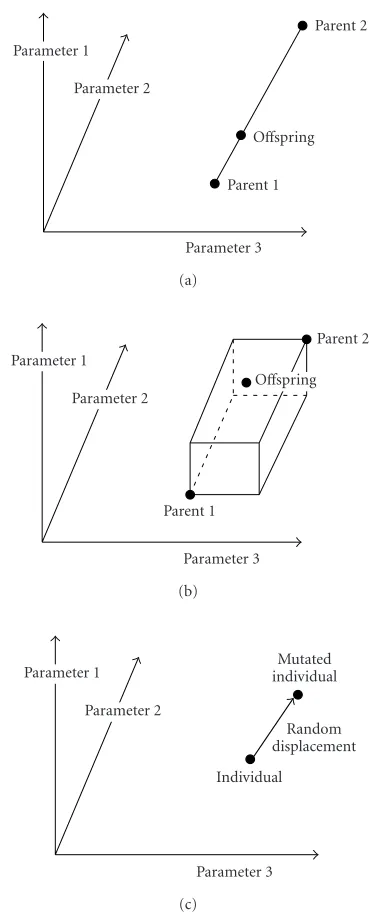
In real-valued GAs, chromosomes have the form x = x1, . . . , xwhere each genexiis represented by a floating-point number. In these GAs, crossover is often seen as an in-terpolation process in a multidimensional Euclidean space. So, the components of the offspringoare calculated from the corresponding components of the parents pandpas fol-lows:
oi=pi+rpi −pi, (3) where r is a random number in the interval [0,1] (see Figure 3a). Alternatively, crossover can be seen as the explo-ration of a multidimensional hyperparallelepiped defined by the parents (see Figure 3b), that is, the componentsoi are chosen uniformly at random within the intervals
minpi, pi ,maxpi, pi . (4)
Mutation is often seen as the addition of a small random vari-ation (e.g., Gaussian noise) to a point in a multidimensional space (seeFigure 3c).
2.4. Other GEC paradigms
As mentioned before, the principles on which GAs are based are also shared by many other EAs. However, the use of dif-ferent representations and operators has led to the develop-ment of a number of paradigms, each having its own pe-culiarities. With no pretence of being exhaustive, in the fol-lowing, we will shortly mention those paradigms, other than GAs, that are used in the papers included in this special issue.
Genetic programming [2,6] is a variant of GA in which the individuals being evolved are syntax trees, typically repre-senting computer programs. The trees are created using user-defined primitive sets, which typically include input vari-ables, constants, and a variety of functions or instructions.
Parameter 1 Parameter 2
Parameter 3 Parent 1
Offspring Parent 2
(a)
Parameter 1 Parameter 2
Parameter 3 Parent 1
Offspring Parent 2
(b)
Parameter 1 Parameter 2
Parameter 3 Individual
Random displacement
Mutated individual
(c)
Figure 3: (a), (b) crossover operators and (c) mutation for
real-valued GAs.
The syntax trees are manipulated by specialised forms of crossover and mutation that guarantee the syntactic valid-ity of the offspring. The fitness of the individual trees in the population is evaluated by running the corresponding pro-grams (typically multiple times, for different values of their input variables).
Artificial immune systems(see [7, Part III, Chapters 10– 13] or [8] for an extensive introduction) are distributed com-putational systems inspired by biological immune systems, which can recognise patterns and can remember previously seen patterns in an efficient and effective way. These systems are very close relatives of EAs (sometimes involving an evolu-tionary process in their inner mechanics) although they use a different biological metaphor.
3. THE PAPERS IN THIS SPECIAL ISSUE
In their paper entitledBlind search for optimal Wiener equal-izers using an artificial immune network model, Attux et al. exploit recent advances in the field of artificial immune sys-tems to obtain optimum equalisers for noisy communication channels, using a technology that does not require the avail-ability of clean samples of the input signal. This approach is very successful in a variety of test equalisation problems. The approach is also compared with a more traditional EA, a GA with niching, showing superior performance.
The paper by Dunn and Olague, entitled Evolutionary computation for sensor planning, shows how well-designed evolutionary computation techniques can solve the problem of optimally specifying sensing tasks for a workcell provided with multiple manipulators and cameras. The problem is NP hard, effectively being a composition of a set partition-ing problem and multiple travelpartition-ing salesperson problems. Nonetheless, thanks to clever representations and the use of evolutionary search, this system is able to solve the problem, providing solutions of quality very close to that of the solu-tions obtained via exhaustive search, but in a tiny fraction of the time.
The paper entitledAn evolution approach for joint blind multichannel estimation and order detection by Fangjiong et al. presents a method for the detection of the order and the estimation of the parameters of a single-input multiple-output channel. The method is based on a hybrid GA with specially designed operators. The method shows perfor-mances comparable with existing closed-form approaches which, however, are much more restricted in that they either assume that the channel order is known or treat the problems of order estimation and parameter estimation separately.
InApplication of evolution strategies to the design of track-ing filters with a large number of specifications, Herrero et al. attack the problem of tracking civil aircrafts from radar information within the extremely tight performance con-straints imposed by a civil aviation standard. They use in-teractive multiple mode filters optimised by using an ES and a multiobjective optimisation approach obtaining a high-performance aircraft tracker.
Making EAs more at hand and easy to apply for general practitioners by self-tuning their parameters is one of the main aims with which Pignalberi et al. developed GASE, a GA-based tool for range image segmentation. The system, along with some practical results, is described in the pa-perTuning range image segmentation by genetic algorithm. A multiobjective fitness function is adopted to take into con-sideration problems that are typically encountered in range
image segmentation.
The paperParameter estimation of a plucked string syn-thesis model using a genetic algorithm with perceptual fitness calculation describes the use of GAs to estimate the con-trol parameters for a widely used plucked string synthesis model. Using GAs, Riionheimo and V¨alim¨aki have been able to automate parameter extraction, which had been formerly achieved only through semiautomatic approaches, obtaining comparable results, both in quantitative and in qualitative terms. An interesting feature of the approach is the inclu-sion of knowledge about perceptual properties of the human hearing system into the fitness function.
Schell and Uhl compare results obtained with a GA-based approach to the near-best-basis (NBB) algorithm, a well-known suboptimal algorithm for wavelet packet decompo-sition. In their paperOptimization and assessment of wavelet packet decompositions with evolutionary computation, they highlight the problem of finding good cost functions in terms of correlation with actual image quality. They show that GAs provide cost solutions that, however, provide lower-quality images than NBB.
In the paper entitledOn the use of evolutionary algorithms to improve the robustness of continuous speech recognition systems in adverse conditions, Selouani and O’Shaughnessy show how a GA can tune a system based on state-of-the-art speech recognition technology so as to maximise its recog-nition accuracy in the presence of severe noise. This hybrid of evolution and conventional signal processing algorithms amply outperforms nonadaptive systems. The EA used is a GA with real-coded representation, rank selection, a heuris-tic type of crossover, and a nonuniform mutation opera-tor.
The paperEvolutionary techniques for image processing a large dataset of early Drosophila gene expressionby Spirov and Holloway describes an evolutionary approach to image pro-cessing to process confocal microscopy images of patterns of activity for genes governing early Drosophila development. The problem is approached using plain GAs, a simplex ap-proach, and a hybrid between these two.
The use of GAs to track time-varying systems based on recursive models is tackled in A comparison of evolutionary algorithms for tracking time-varying recursive systems. The pa-per first compares a plain GA with a GA variant, called “ran-dom immigrant strategy,” showing that the latter performs better in tracking time-varying systems even if it has prob-lems with fast-varying systems. Finally, a hybrid combination of GAs and local search that is able to tackle even such hard tasks is proposed.
the other includes also transcendental functions. The results reported in the paper provide interesting clues to practition-ers that would like to use GP to tackle image processing tasks.
4. CONCLUSIONS
The guest editors hope that the readership of the journal will enjoy reading the papers in this special issue as we did ourselves. We hope that the broadness of domains to which EAs can be applied, demonstrated by the contents of this is-sue, will convince other researchers in image analysis and signal processing to get acquainted with the exciting world of evolutionary computation and to apply its powerful tech-niques to solve important new and old problems in these areas.
APPENDIX
POINTERS TO FURTHER READING IN GEC
1. David E. Goldberg.Genetic Algorithms in Search, Op-timization, and Machine Learning. Addison-Wesley, Reading, Massachusetts, 1989. A classic book on ge-netic algorithms and classifier systems.
2. David E. Goldberg.The Design of Innovation: Lessons from and for Competent Genetic Algorithms. Kluwer Academic Publishers, Boston, 2002. An excellent, long-awaited followup of Goldberg’s first book.
3. Melanie Mitchell,An introduction to genetic algorithms, A Bradford Book, MIT Press, Cambridge, MA, 1996. A good introduction to genetic algorithms.
4. John H. Holland,Adaptation in Natural and Artificial Systems, second edition, A Bradford Book, MIT Press, Cambridge, MA, 1992. Second edition of a classic from the inventor of genetic algorithms.
5. Thomas B¨ack and Hans-Paul Schwefel. An overview of evolutionary algorithms for parameter optimiza-tion.Evolutionary Computation, vol. 1, no. 1, pp. 1–23, 1993. A good introduction to parameter optimisation using EAs.
6. T. B¨ack, D. B. Fogel and T. Michalewicz, Evolution-ary Computation 1: Basic Algorithms and Operators, Institute of Physics Publishing, 2000. A modern in-troduction to evolutionary algorithms. Good both for novices and more expert readers.
7. John R. Koza.Genetic Programming: On the Program-ming of Computers by Means of Natural Selection. MIT Press, 1992. The bible of genetic programming by the founder of the field. Followed by GP II (1994), GP III (1999), and GP IV (forthcoming).
8. Wolfgang Banzhaf, Peter Nordin, Robert E. Keller and Frank D. Francone,Genetic Programming—An Intro-duction; On the Automatic Evolution of Computer Pro-grams and its Applications, Morgan Kaufmann, 1998. An excellent textbook on GP.
9. W. B. Langdon and Riccardo Poli,Foundations of Ge-netic Programming, Springer, February 2002. The only
book entirely devoted to the theory of GP and its rela-tions with the GA theory.
10. Proceedings of the International Conference on Ge-netic Algorithms (ICGA). ICGA is the oldest confer-ence on EAs.
11. Proceedings of the Genetic Programming Conference. This was the first conference entirely devoted to GP. 12. Proceedings of the Genetic and Evolutionary
Compu-tation Conference (GECCO). Born in 1999 from the “recombination” of ICGA and the GP conference men-tioned above, GECCO is the largest conference in the field.
13. Proceedings of the Foundations of Genetic Algorithms (FOGA) Workshop. FOGA is a biannual, small but very prestigious and highly selective workshop. It is mainly devoted to the theoretical foundations of EAs. 14. Proceedings of the Congress on Evolutionary
Compu-tation (CEC). CEC is a large conference under the pa-tronage of IEEE.
15. Proceedings of Parallel Problem Solving from Nature (PPSN). This is a large biannual European conference, probably the oldest of its kind in Europe.
16. Proceedings of the European Workshop on Evolution-ary Computation in Image Analysis and Signal Pro-cessing (EvoIASP). This is a small workshop, reaching its fifth edition in 2003. It is the only event worldwide uniquely devoted to the research topics covered by this special issue.
17. Proceedings of the European Conference on Genetic Programming. EuroGP was the first European event entirely devoted to GP. Run as a workshop in 1998 and 1999, it became a conference in 2000. It has now reached its sixth edition with EuroGP 2003 held at the University of Essex. Currently, this is the largest event worldwide solely devoted to GP.
ACKNOWLEDGMENTS
The guest editors would like to thank Professor David E. Goldberg for his insightful foreword, the former and present editors-in-chief of EURASIP JASP, Professor K. J. Ray Liu and Professor Marc Moonen, for their support in putting to-gether this special issue, and all the reviewers who have gen-erously devoted their time to help ensure the highest possible quality for the papers in this volume. All the authors of the manuscripts who have contributed to this special issue are also warmly thanked.
Riccardo Poli Stefano Cagnoni
REFERENCES
[1] J. Holland, Adaptation in Natural and Artificial Systems, Uni-versity of Michigan Press, Ann Arbor, Mich, USA, 1975. [2] J. R. Koza,Genetic Programming: On the Programming of
[3] I. Rechenberg,Evolutionsstrategie: Optimierung technischer Sys-teme nach Prinzipien der biologischen Evolution, Frommann-Holzboog, Stuttgart, Germany, 1973.
[4] H.-P. Schwefel, Numerical Optimization of Computer Models, Wiley, Chichester, UK, 1981.
[5] M. Mitchell,An Introduction to Genetic Algorithms, MIT Press, Cambridge, Mass, USA, 1996.
[6] W. B. Langdon and R. Poli, Foundations of Genetic Program-ming, Springer-Verlag, New York, NY, USA, 2002.
[7] D. Corne, M. Dorigo, and F. Glover, Eds., New Ideas in Opti-mization, McGraw-Hill, London, UK, 1999.
[8] D. Dasgupta, Ed.,Artificial Immune Systems and Their Applica-tions, Springer-Verlag, New York, NY, USA, 1999.
Riccardo Poli received a Ph.D. degree in bioengineering (1993) from the University of Florence, Italy, where he worked on im-age analysis, genetic algorithms, and neu-ral networks until 1994. From 1994 to 2001, he was a lecturer and then a reader in the School of Computer Science of the University of Birmingham, UK. In 2001, he became a Professor at the Department of Computer Science of the University of
Essex, where he founded the Natural and Evolutionary Compu-tation Group. Professor Poli has published around 130 papers on evolutionary algorithms, genetic programming, neural networks, and image analysis and signal processing, including the book Foun-dations of Genetic Programming (Springer, 2002). He has been Cochair of EuroGP, the European Conference on GP, in 1998, 1999, 2000, and 2003. He was Chair of the GP theme at the Ge-netic and Evolutionary Computation Conference (GECCO) 2002 and Cochair of the Foundations of Genetic Algorithms Workshop (FOGA) 2002. He will be General Chair of GECCO 2004. Profes-sor Poli is an Associate Editor ofEvolutionary Computation(MIT Press) andGenetic Programming and Evolvable Machines(Kluwer), a reviewer for 12 journals, and has been a programme committee member of 40 international events.
Stefano Cagnonihas been an Assistant Pro-fessor in the Department of Computer En-gineering of the University of Parma since 1997. He received the Ph.D. degree in bio-engineering in 1993. In 1994, he was a Visiting Scientist at the Whitaker College Biomedical Imaging and Computation Lab-oratory at the Massachusetts Institute of Technology. His main research interests are in computer vision, evolutionary