A comprehensive analysis of game-based ballot privacy definitions
David Bernhard1, V´eronique Cortier2, David Galindo2,3, Olivier Pereira4, and Bogdan Warinschi1
1
University of Bristol Bristol, United Kingdom
2
CNRS, Loria, UMR 7503 Vandoeuvre-l`es-Nancy, France
3
Scytl Secure Electronic Voting Barcelona, Spain
4
Universit´e Catholique de Louvain – ICTEAM Louvain-la-Neuve, Belgium
Abstract. We critically survey game-based security definitions for the privacy of voting schemes. In addition to known limitations, we unveil several previously unnoticed shortcomings. Surprisingly, the conclusion of our study is that none of the existing definitions is satisfactory: they either provide only weak guarantees, or can be applied only to a limited class of schemes, or both.
Based on our findings, we propose a new game-based definition of privacy which we call BPRIV. We also identify a new property which we callstrong consistency, needed to express that tallying does not leak sensitive information. We validate our security notions by showing that BPRIV, strong consistency (and an additional simple property called strong correctness) for a voting scheme imply its security in a simulation-based sense. This result also yields a proof technique for proving entropy-based notions of privacy which offer the strongest security guarantees but are hard to prove directly: first prove your scheme BPRIV, strongly consistent (and correct),then study the entropy-based privacy of the result function of the election, which is a much easier task.
Keywords:Voting, Privacy, Ballot Privacy, Cryptography
1 Introduction
Privacy of votes was the subject of major debates during the 19th century, at the time of the progressive introduction of universal suffrage. Since then, it has become a standard in all major democracies.
The introduction of electronic technologies as part of the voting process however raises new challenges and privacy concerns. Cryptographic voting protocols aim to guarantee ballot privacy in e-voting by defining security models and then constructing schemes1to meet these models. Generally, cryptographic voting schemes may be categorised into the purely electronic where voters may vote from the privacy of their own computers (e.g., He-lios [3, 4] or Civitas [19]) and hybrid systems which use paper ballots and computers to facilitate the tally (e.g., ThreeBallot [40], Prˆet-`a-Voter [41] and Scantegrity [17]).
Modelling privacy The development of security models for ballot privacy started with the work of Benaloh [21, 6] and has recently started to receive more attention with new models being developed in both symbolic models [32] and computational ones [37, 38, 11]. Unlike related privacy notions such as confidential message transmission, ballot privacy is not absolute but relative to specific election bylaws and voter choices. Consider a voting system that discloses the number of votes received by each candidate: such a system essentially reveals how each voter voted in the case where all voters vote for the same candidate. Classifying such a system as insecure is clearly undesirable; ballot privacy notions require a more nuanced classification.
One generic approach is to define vote privacy through the design of an ideal functionality [35, 30, 39]: a voting scheme is declared to satisfy privacy if it securely realizes (in some formal sense) the ideal functionality. While being very powerful, these definitions are also quite difficult to prove on real cryptographic voting protocols. For
1The terms “scheme” and “protocol” can be read interchangeably without much loss of precision. We use the former to refer to a collection
example, Helios is a purely cryptographic voting protocol (that does not rely on paper ballots) which has been used for real elections, and we are not aware of any security proofs for Helios in a simulation-based model2.
Another, more general, approach to ballot privacy definitions focuses on entropy [22, 12], used as a measure of the amount of information that a voting system leaks about votes. Early works were based on Shannon entropy, but other entropy notions, based on min-entropy and Hartley entropy showed to be particularly informative in natural contexts. The interest of these entropy-based definitions is that they capture many possible sources of privacy leakage: the privacy leakage can be caused by the choice of the cryptographic primitives but it may also be due to the election result itself (which is out of the scope of simulation-based models) or from the distribution of the votes. A voting scheme should be considered as private under such a notion, if its privacy leakage is (computationally) close to the privacy leakage of an associated “ideal protocol” where voters send their vote on a secure channel to a trusted party that simply computes and announces the result. Furthermore, the amount of information that is leaked by this result is precisely measured, making it possible to compare different election tallying rules in various contexts.
A third approach, initiated in the early works of Benaloh [6], considers game-based definitions of vote privacy. This approach has been used in the literature to model e.g. Helios. The literature is actually quite abundant in terms of game-based definitions of vote privacy, the differences between them are poorly understood, and there is little guidance on how to select one to analyze protocols. This work started as an attempt to understand the strength and weaknesses of the many game-based notions (as well as those of several non game-based ones). In these game-based notions, privacy is described as the negligible probability of an adversary to distinguish between two situations, precisely described as games in the definition. By only focusing on the information leakage due to the cryptography, leaving the measurement of the leakages due the tally to be measured with information theoretic techniques, this approach typically leads to simpler, more generic and more modular security proofs.
The boundaries between these three definition approaches can of course sometimes become fuzzy, with some works mixing them into a single definition. For instance, K¨usters, Truderung, and Vogt [38] provide a privacy metric that focuses on the probability that an attacker notices when an (honest) voter changes her vote, while all of the other (honest) votes follow a given distribution. These authors show how to analyze the privacy offered by several paper-based voting protocols such as ThreeBallot and VAV.
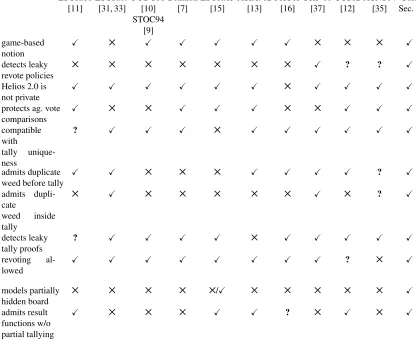
Comparing existing notions of privacy Our first contribution is to systematically review, compare, and discuss existing game-based computational notions for vote privacy. In particular, we present them in a unified framework which facilitates their comparison. Our review of the literature shows that none of the existing definitions is sat-isfactory. Some limitations were already known but we discovered further unnoticed shortcomings in several of them. In short, based on our findings, we classify existing definitions in three categories:
– too weak [14, 13, 23, 16]: these declare protocols to be secure which intuitively do not preserve vote privacy. We give examples which we think should be considered privacy breaches, despite the examples meeting the given privacy definitions.
– too strong [15]: by contrast, this definition is so strong that no verifiable protocol can meet the privacy con-straint. More precisely, we show that any protocol meeting this definition must allow the authorities to announce any result that is consistent with the number of votes on the board. Therefore this definition cannot be used for any protocol that aims at some verifiability, which is the case of most protocols of the literature.
– too limited [10, 7, 9, 11, 38, 12, 29]: while we did not identify any flaw in these definitions, they restrict the class of protocols or privacy breaches that can be considered.
For example, they may lead to inconsistent results when applied to protocols that use some natural result functions (e.g., the majority function) or may not be applicable to protocols that output not only a result but also a proof of correct tallying (such as most cryptographic protocols do), or they may only detect specific privacy breaches (e.g. the case whether two voters vote the same is not covered).
2Groth [35] proved a class of protocols to be UC-secure that at a first glance might seem to include Helios. However, Groth requires that
We summarise the limitations of each definition in Table 1 later in the paper. For our classification, we designed several test-case (dummy) protocols that may be used to evaluate a privacy definition; these are available in Ap-pendix A.
A new notion for privacy Our second contribution is to propose a new game-based definition of privacy, called BPRIV, that incorporates the lessons learned from our study. Our new definition accounts for auxiliary data in the tally (such as proofs of correct decryption), is compatible with verifiability, and does not suffer from any of the flaws we uncovered. As a test of our new definition, we prove the Helios voting protocol to be BPRIV secure. Specifically, we analyze what could be considered the standard version of Helios nowadays (at least, academically speaking), that uses strong Fiat-Shamir proofs [13], implements duplicate weeding [25] and homomorphic tallying. With respect to the threat model, we consider an honest single trustee, an honest ballot box, and an adversary that can adaptively corrupt a subset of voters. Apart from the single trustee (that can be dealt of by adapting BPRIV to a multi-authority setting), the other adversarial assumptions are similar to those used in previous ballot privacy analyses of Helios.
The first of two novelties of our definition is that it accounts for tallying operations that possibly include revote policies (for example, only your last vote counts). Understanding tallying is crucial for the privacy of ballots: not only does the tallying operation usually disclose auxiliary data in addition to the result (such as proofs of correct tallying) but it also performs some cleaning operations such as removing invalid or duplicate ballots or ballots that should be erased due to re-voting, etc. For example, in Civitas [19], coercion-resistance crucially relies on the fact that ballots submitted under coercion can be (anonymously) identified and removed, without endangering the voter’s identity. In Helios 2.0, removing duplicates is necessary for privacy, otherwise the protocol is subject to replay attack [26]. These operations are often considered harmless but, perhaps surprisingly, they may be crucial for the security of a voting system. Since these cleaning operations may be used to guarantee privacy, they may also damage it if performed incorrectly. Therefore, a good privacy definition should account for these operations too. In this direction, we identify a second security property, which we callstrong consistency, that ensures that the tally phase counts the votes properly, even in the presence of an adversary. While this property is clearly desirable for verifiability, it is also crucial for privacy: otherwise the tally phase could leak information on honest votes in the result itself or, more subtly, in the choice of ballots that are removed during the cleaning operations.
A simulation-based notion of security A natural question is how to convince ourselves that the new definition BPRIV is not flawed as well. The second novelty of our definition is that we establish a tight relation between BPRIV and security in a simulation-based3 model. Specifically, any voting scheme that is BPRIV, strongly con-sistent (and strongly correct) securely implements an ideal functionality. The privacy guarantees of this ideal func-tionality are simpler to understand compared to game-based definitions, but simulation-based security proofs are harder to carry out. We view the relation with the simulation-based notion as a validation of our new BPRIV notion. In addition, we obtain the first security proof for Helios in a simulation-based model.
A potential advantage of simulation-based models is that their security guarantees are easier to understand intu-itively than game-based ones. Our ideal functionality can be described in one sentence: it simply collects all votes from the voters, then computes and announces the result. Any scheme that securely implements this functionality cannot leak any more information (in particular about people’s votes) than this functionality. This result gives us a way to explain the privacy guarantees of Helios even to non-cryptographers. In addition, the result provides a bridge towards entropy-based security notions (similar to [12]), which incorporates, simultaneously, privacy loss due to cryptography in use and to leaking result functions.
A potential disadvantage however is that direct simulation-based proofs are harder to get right; an incorrect proof does not prove anything, however intuitive the functionality involved might be. Furthermore, simulation based-definitions are quite constraining, as far as security against adaptive corruption is concerned.
3
Summary We review existing game-based privacy notions and find them insufficient. We develop a new privacy notion BPRIV based on our insights from the reviewed notions and subject it to three tests to assure its validity: (1) we prove that Helios meets the new BPRIV notion (2) we check that the new notion does not fail under any of the counter-examples that we identified for existing notions and (3) we prove that BPRIV (together with strong consistency) implies a simulation-based notion of security. To our knowledge, BPRIV is the first game-based notion that comes with a justification in a simulation-based model too. As a corollary we obtain the first simulation-based security proof for Helios. In addition, BPRIV is the first notion to capture security requirements for two features found in real voting systems: (1) revote policies and (2) auxiliary data output by the tallying algorithm.
2 Terminology and basic properties
We first introduce some terminology. In particular, we consider here single-pass voting systems where voters only have to post a single message to the ballot box to cast their vote.
2.1 Single-Pass Voting
A voting scheme is relative to a result functionρ: (I×V)∗→RwhereIis the set of voters identifiers,Vis the set of possible votes, andRis the result space. Depending on the voting scheme, voters identifiers range from voters public identity (appended to ballots in Helios [8] for example) to pseudonyms as well as sets of private credentials. For example in Civitas [20], voters are supposed to use invalid credentials when under coercion and valid ones when they wish to cast their true vote.
The result function explains how the election system should behave. When voters cast their votes, possibly several times, ρ is in charge of specifying which votes shall be counted and how. This involves typically two main tasks. First, usually arevote policyspecifies which votes shall be retained. A typical revote policy consists in keeping the last cast vote from each voter. However, more complex revote policies can be considered such as computing the average of the votes or counting a vote at a polling station in preference to all online votes4 (for the same voter). Then, once the revote policy has been applied, votes are counted with some appropriate counting function. Typical counting functions are:
– themultiset functionmultisetthat discloses the sequence of all the casted votes, in a random order;
– thecounting functioncountingthat tells how many votes each candidate received;
– themajority functionmajoritythat only discloses the winner.
We consider a setI of voters, a subsetH ⊆ I of honest voters, a ballot boxBBand a public bulletin board
PBB. A single-pass protocolπρexecutes in three phases.
1. In thesetupphase, the ballot box expects one message from an administrator after which it may either transition to thevotingphase or abort.
2. In the voting phase, all parties may post messages to the ballot box at any time; the ballot box decides to accept or reject a message based on its current state and a public algorithm. The ballot box stores all accepted messages. Any party may ask to read the bulletin board at any time; the ballot box replies by running a public filtering5algorithm (that we will callPublish) on its current state and returns the result. Once the voting phase is closed, the ballot box transitions to theresultphase.
3. In theresultphase, the ballot box is closed: it accepts no more messages but can still be read. The administrator computes the final outcomer and a proof of valid tabulationΠ via a tallying procedure that may operate on the ballot box.
4
This is the policy in Estonian elections, for example.
5
Formally, a voting scheme V = (Setup,Vote,Publish,Valid,Tally,Verify), for a list of votersI and a result functionρ, consists of six algorithms with the syntax given below. The new features of our formalisation are (1) thePublishalgorithm, which allows ballot boxes to store more information than they display to the public (i.e. they may keep invalid ballots internally but not display them) and (2) we let each ballot have an explicit identity, which seems to be required to model revoting policies (i.e. “the last ballot from each voter counts”). Our model matches how e.g. Helios handles identities in practice.
– Setup(λ)on input a security parameterλoutputs an election public keypkand a secret tallying keysk. We assumepkto be an implicit input of the remaining algorithms.
– Vote(id, v)is used by voteridto cast his votev∈Vfor the election, as a ballotb←Vote(id, v)6.
– Valid(BB, b)takes as input the ballot boxBBand a ballotband checks it validity. It returns>for valid ballots and⊥for invalid ones (ill-formed, contains duplicated ciphertext from the ballot box, etc.).
– Publish(BB)takes as input the ballot boxBBand outputs the public viewPBBofBB, called public bulletin board.
– Tally(BB,sk) takes as input the ballot box BBand the secret keysk. It outputs the tally r, together with a proof of correct tabulationΠ. Possibly,r =⊥. This algorithm might be (partially) in charge of implementing the revote policy.
– Verify(PBB, r, Π)takes as input a public bulletin boardPBB, and a result/proof pair(r, Π)and checks whether Πis a valid proof of correct tallying forr, it returns>if so, otherwise it returns⊥.
Any voting protocol should ensure that if everyone acts correctly, the protocol indeed computesρon the votes submitted. Formally, a voting scheme iscorrect if the following properties hold with overwhelming probability. Let v1, . . . , vn ∈ V be valid votes and id1, . . . , idn ∈ I be voter identities. We consider an honest execution.
Let (pk,sk) ← Setup(λ). Let bi ← Vote(idi, vi) and BBi := [b1, . . . , bi] for all i. Then honest ballots are
valid, that is, Valid(BBi−1, bi) = > for all i; and the protocol computes the correct election result, that is, let
(r, Π)←Tally(BBn,sk)thenr=ρ((id1, v1), . . . ,(idn, vn))andVerify(Publish(BBn), r, Π) =>.
An important contribution of our work is an explicit formalisation of revote policies. Intuitively, there are two main and distinct reasons for removing a ballot:
– Cryptographic cleaning: This deletion might be due to the cryptographic implementation. In Helios for exam-ple, a ballot may be removed because it is ill-formed (e.g. invalid zero-knowledge proofs) or because it contains a duplicated ciphertext, which may yield a privacy breach [25]. In our formalism, this cleaning operation can be taken care of either by theValidpredicate or by theTallyfunction itself.
– Mandatory revote policy: This deletion might correspond to the implementation of the “ideal” revote policy specified by the result function ρ. A typical revote policy is that, for each voter, only the last ballot shall be retained.
2.2 Tally uniqueness
We define tally uniqueness, a “minimal” property that any verifiable system should satisfy. This property is of course not mandatory for ballot privacy but we will use it in the next sections to illustrate that some ballot privacy definitions are incompatible with any verifiable system.
Intuitively, tally uniqueness of a voting scheme ensures that two different tallies r 6= r0 for the same board cannot be accepted by the verification algorithm, even if all the players in the system are malicious. The goal of the adversary against tally uniqueness is to output a public keypk, a list of legitimate public identities, a ballot box
BB, and two talliesr6=r0, and corresponding proofs of valid tabulationΠandΠ0, such that both pass verification. We define tally uniqueness by the experiment ExpuniqA in Figure 1. A voting scheme V has tally uniqueness if
Succuniq(A)is a negligible function for any PPT adversaryA, where
Succuniq(A) = Pr h
ExpuniqA (λ) = 1 i
Tally uniqueness is often considered as a requirement forelection verifiability[31, 36].
6We do not include in our syntax, as most of the related work in the area, the necessary algorithms that allow an election administrator to
Experiment ExpuniqA (λ)
(1) (pk,BB, r, Π, r0, Π0)← A(1λ) (2) PBB←Publish(BB)
(3) ifr06=rand
(4) Verify(PBB, r, Π) =Verify(PBB, r0, Π0) =>
return1else return0
Fig. 1.Tally Uniqueness
3 Survey and analysis of previous game-based computational vote privacy definitions
Game-based privacy [10, 7, 9, 11, 14, 13, 29, 15, 23, 16] (our terminology) definitions require that it should be hard for an adversary to win a game with a challenger behaving in a fully specified manner, in the spirit of traditional indistinguishability definitions for encryption. In this section we review the most relevant ballot privacy definitions in the literature. We unveil that some previous definitions present shortcomings that have gone unnoticed: either ballot secrecy and election verifiability are incompatible [15], or ballot secrecy does not guarantee that the choices of the voters remain private once the election result is published [13, 16]. We also discuss known limitations of the approaches in [10, 9, 7, 31, 33]. A summary of our findings is shown in Table 1, at the end of this section.
Most existing definitions do not distinguish between the ballot box and what is actually published, i.e. the bulletin board. Therefore, in this section, we implicitly assumePublish(BB) =BB. Moreover, some definitions do not model voters identifiers. By a slight abuse of notation, we may writeVote(v)instead ofVote(id, v)whenidis ignored.
We formalize ballot privacy definitions by using two ballot boxes BB0 andBB1, from which only one box will be visible to the adversary. Of course, the adversary’s goal is to learn which one of them is visible. For the uniformity of the presentation, we write explicitly both ballot boxes in each of the definitions that follow, even if some of them can be defined using only one ballot box (such as Definitions 3.1 and 3.2).
We use the notation and some terminology that we fix above to discuss the existing game-based definitions. We proceed following, roughly, the chronological order.
3.1 Ballot privacy for permutations of honest votes - PODC 1986 [10], STOC 1994 [9]
One first definition of ballot privacy follows a simple idea: an attacker should not notice if the votes of two voters are swapped. More precisely, a coalition of voters should not be able to distinguish when two honest votersid0, id1
vote respectivelyv0 andv1, from the case where they vote respectivelyv1andv0.
Definition 1 (IND-BB).Iis a list of voters.BB0,BB1are lists initialized at empty. The challenger starts by picking a random bitβ, and the adversaryB= (B1,B2)is given access to listsI andBBβ. The challenger runs the setup
algorithm and the keys(pk,sk)are created. The adversaryB1can repeatedly query the oracleOcastas follows:
– Ocast(id, b): runsbb7→bbkbon ballot boxesBB0andBB1. (The expressionbbkbappendsbtobb.)
The adversary can also queryoncean oracleOVoteIND(·,·)as follows:
– OVoteIND(id0, id1, v0, v1) :ifvδ ∈/ Vforδ = 0,1, halt. Else, runsBB0←BB0k{Vote(id0, v0),Vote(id1, v1)}
as well asBB1 ←BB1k{Vote(id0, v1),Vote(id1, v0)}.
At some point, the adversary B1 asks to see the result. The challenger computes(r, Π) ← Tally(BBβ,sk).
Finally theIND-BBadversaryB2 outputsβ0as the guess forβ.
Formally, we say that a voting schemeVisIND-BBsecure if no PPT algorithmBcan distinguish between the outputs in the experiment just described forβ = 0andβ = 1, i.e. for any PPT adversaryB,
Pr
h
ExpindbbB ,0(λ) = 1 i
−Pr h
ExpindbbB ,1(λ) = 1 i
The definition IND-BB can be seen as a generalization of theprivate electionsdefinition by Benaloh and Yung [10], which was defined only with respect to referendum elections, so that onlyv0 = 0andv1 = 1were considered,
and by Benaloh and Tuinstra [9]. It also resembles the symbolicvote privacydefinition by Delaune, Kremer and Ryan [31], which states that “no party receives information which would allow them to distinguish one situation from another one in which two voters swap their votes”. Dreier, Lafoucarde and Laknech have generalised the swap-equivalent symbolic privacy definition to weighted votes [33].
However IND-BB privacy does not guarantee indistinguishability between different assignments that lead to the same result but which are not equivalent permutation-wise. For instance, consider the case where voters can give a score of 0, 1, or 2 to a (single) candidate. It may be the case that an attacker cannot distinguish the sequences of votes [(ida,0); (idb,2)]from[(ida,2); (idb,0)] but could well distinguish[(ida,0); (idb,2)] from[(ida,1); (idb,1)]. In
fact, this example serves as a simplified abstraction of actual voting rules, such as those in the European Parliament elections in Luxembourg [2] or the Swiss Government Federal Elections. Definitions [10, 9, 31] do not capture these real cases.
3.2 Benaloh’s ballot privacy [7]
To cope with the aforementioned limitation, [7] has generalized the previous definition to an arbitrary set of voters that may vote arbitrarily provided that the tally corresponding to honest voters remains unchanged.
The following definition is a restatement, using contemporary notation, of Benaloh’s privacy definition for voting schemes [7].
Definition 2 (PRIV).BB0,BB1, V0, V1are lists initialized at empty. The challenger starts by picking a random bit
β, and adversaryB = (B1,B2)is given access to listBBβ. The challenger runs the setup algorithm and the keys
(pk,sk)are created.B1on inputpkis given access to oraclesOvote(·),Oballot(·)as follows: – Ovote(id, v0, v1) :runsBBδ←BBδkVote(id, vδ)), Vδ ←Vδk(id, vδ))forδ= 0,1.
– Oballot(b): runsbb7→bbkbon ballot boxesBB0,BB1(that is, appendsbto both boards).
At some point,B2 asks to see the tallying output. The challenger proceeds as follows: ifρ(V0)6=ρ(V1), halts.
Otherwise, the challenger outputs(rβ, Πβ)←Tally(BBβ,sk). Finally,B2outputsβ0a the guess forβ. Formally,
we declare a voting schemeV Benaloh’s privateif for any PRIV adversaryB,
Pr
h
ExpprivB ,0(λ) = 1 i
−Pr h
ExpprivB ,1(λ) = 1 i
is negligible, whereExpprivB ,βis the experiment defined above.
The main drawback of Benaloh’s definition is that it restricts the set of functions for which eventually a scheme could be declared ballot private. To see this, let us assume that the possible votes are{a, b}and consider the result functionmajority. We assume thatawins in case of a tie. LetBbe an adversary that chooses to play the game such thatV0 = [(id1, a); (id2, a)]andV1 = [(id1, a); (id2, b)]. Clearlymajority(V0) =majority(V1) =a(V1
is a tie) soawins). Let nowBcast a ballot query for voteb. Thenr0 = aandr1 = band thusSuccpriv(B) = 1,
independently of the schemeV.
3.3 Ballot privacy ESORICS 2011 - CCS 2012 [11, 14, 12]
More recently, a definition has been proposed, that aims to deal with arbitrary result functions. It is inspired by cryptographic security for encryption and roughly says that an attacker should not be able to tell whether he is seeing the real board or a fake board where all (honest) voters vote for the same arbitrary dummy vote. Of course, the tally itself is always performed on the real ballot box.
Definition 3 (BPRIV1).BB0,BB1,BB0are lists initialized at empty. A distinguished vote value∈ Vis chosen by the challenger. The challenger starts by picking a random bitβ, and the adversaryB= (B1,B2)is given access
to list BBβ. The challenger runs the setup algorithm to create keys (pk,sk). Next, the adversaryB1 can query
– Ovote(v) :computesb0 :=Vote(v)andb1 :=Vote(); next runsBBβ ←BBβkbβ andBB0 ←BB0kb0. – Oballot(b): runsbb←bbkbon inputsBBβ,BB0.
At some point, the adversaryB2 asks to see the tallying output. The challenger obtains(r, Π) ← Tally(BB0,sk) and returnsrto the adversary. Finally theBPRIV1adversaryB2outputsβ0as its guess forβ.
Formally, we say that a voting schemeVisBPRIV1 secureif no PPT algorithmBcan distinguish between the outputs in the previous experiment forβ = 0andβ = 1, i.e. for any PPT adversaryB,
Pr
h
Expbpriv1B ,0(λ) = 1 i
−Pr h
Expbpriv1B ,1(λ) = 1 i
is negligible, whereExpbpriv1B ,β is the experiment defined above.
In the BPRIV1 definition, tally is executed either over the faithful ballot box (namely, BB), or a fake box (namely,BB0), containing fake votesfor honest voters. A limitation of this definition is that the adversary is not allowed to see the auxiliary dataΠ. Indeed in most cases, if the adversary can seeΠ (e.g. a proof of correct tally of the ballot box), he would be immediately able to tell whether he has seen the real or the fake board. Therefore BPRIV1 does not fully model verifiable voting protocols such as Helios or Civitas.
Recently, Cuvelier, Pereira and Peters [29] proposed a variant of the BPRIV1 setting/definition to capture ballot privacy even in the presence of computationally unbounded adversaries, and which is namedperfectly private audit trail(PPAT). Similarly to BPRIV1, the definition PPAT is limited in the sense that an adversary is not allowed to see the auxiliary dataΠ.
3.4 Ballot privacy - ASIACRYPT 2012 [13, 23]
A variation of the BPRIV1 definition has been proposed, that we name as BPRIV2 privacy. Its goal is to be able to fully model verifiable voting protocols where the tally does not produce just a result but also proofs of correct tally. Intuitively, to avoid that the adversary immediately wins the game because of the auxiliary data, this data needs to be simulated on the fake board. This definition makes therefore use of a simulatorSimProofthat simulates the auxiliary data of the tally when the adversary is not given the real board.
Definition 4 (BPRIV2).BB0,BB1, Lare lists initialized at empty. The challenger starts by picking a random bit
β, and the adversaryB = (B1,B2)is given access to listBBβ. The challenger runs the setup algorithm to create
keys(pk,sk).B1is given access to oraclesOcorrupt,OvoteLRandOballot(·)as follows:
– OvoteLR(id, v0, v1) :ifvγ ∈/ Vforγ = 0,1, halts. Else, runsBBγ ← BBγkVote(id, vγ))forγ = 0,1and
setsL←L∪ {id}, meaning thatidhas already voted.
– Ocast(id, b): ifid∈L(a honest user already cast a ballot), halts. Else runsBBβ ←BBβkb.
At some point,B2asks to see the tallying output. The challenger proceeds as follows: ifβ= 0, the challenger out-puts(r, Π) ←Tally(BB0,sk). But ifβ = 1, the challenger sets(r, Π†)← Tally(BB0,sk)andΠ ← SimProof(
BB0,BB1,pk,info), where info contains any information known to the challenger. The challenger outputs
(r, Π).
Finally the BPRIV2 adversaryB2outputsβ0a the guess forβ.
We say that a voting schemeVisBPRIV2 secureif no PPT algorithmBcan distinguish between the outputs in the experiment just described forβ = 0andβ = 1, i.e. for any PPT adversaryB, there exists a simulatorSimProof
such that
Pr
h
Expbpriv2B ,0(λ) = 1i−PrhExpbpriv2B ,1(λ) = 1i
Unfortunately, allowing the auxiliary data to be simulated actually weakens too much the definition of ballot privacy. We show next that BPRIV2 privacy declares as private, protocols that revealexactlyhow voters voted in the tabulation proofΠ. Such protocols should clearly not be declared private.
BPRIV2 fails to ensure ballot privacy LetV0be any BPRIV2 secure scheme. We assume that ballots ofV0can be extracted, that is, we assume a functionExtract(sk, b) that returns the vote v corresponding to ballot b. For example, if b contains the encryption ofv then Extract is simply the decryption function. Let Leak(V0) be the scheme obtained fromV0such that the tally now outputs the correspondence between ballots and votes. Formally,
Leak(V0)is obtained fromV0by changingTally0,Verify0toTally,Verifyas follows:
– (r, Π) ← Tally(sk,BB), where (r, Π0) ← Tally0(sk,BB) and Π ← Π0|| {(b, vb)}b∈BB, where vb ← Extract(sk, b);
– Verify(PBB, r, Π)parsesΠasΠ0|| {(b, vb)}b∈BBand outputsVerify0(PBB, r, Π0).
We writeV := Leak(V0). Intuitively, it is easy to see thatV satisfies BPRIV2 although it is not private. Indeed, the simulatorSimProofknows all theOvoteLR(id, v0, v1)queries made by the adversary. It may therefore pretend
that any ballotbcorresponding to a queryOvoteLR(id, v0, v1)corresponds tov0 even when it corresponds tov1
(whenβ = 1). This argument is worked out in detail in Appendix B.
3.5 Ballot secrecy - ESORICS 2013 [15]
Another definition, called IND-SEC, has been recently been proposed [15] to fix the privacy breach of the definition BPRIV2. This definition can be seen as a combination of the BPRIV2 [13, 23] and the Benaloh’s [7] definitions. Indeed, the IND-SEC game is intuitively defined as follows. The honest voters vote for an arbitrary sequence of votesV0 in the first board and an other arbitrary sequence of votesV1 in the second board. If the two sequences
coincide when viewed as multisets, then the real tally is disclosed (as in Benaloh’s [7] definition). If the two multisets differ, the tally is always performed on the first ballot box (even when the adversary has seen the second ballot box).
Definition 5 (IND-SEC).BB0,BB1, V0, V1are lists initialized at empty. The challenger starts by picking a random
bitβ, and the adversaryB = (B1,B2)is given access to listBBβ. The challenger runs the setup algorithm and
the keys(pk,sk)are created. On inputpk the adversaryB1 can query oraclesOvoteLR(·,·)andOballot(·)as
follows:
– Ovote(v0, v1) :runsBBγ ←BBγk{Vote(vγ)},and updatesVγ ←Vγ∪ {vγ}forγ = 0,1. – Oballot(b): runsbb7→bbkbon ballot boxesBB0,BB1.
At some point,B2 asks to see the tallying output. The challenger proceeds as follows:
– IfV0 =V1(as multisets) the output is set to be that of(r, Π)←Tally(BBβ,sk). – IfV0 6=V1the challenger outputs(r, Π)←Tally(BB0,sk).
Finally theIND-SECadversaryB2outputsβ0 a the guess forβ.
Formally, we say that a voting schemeVhasIND-SEC secrecyif no PPT algorithmBcan distinguish between the outputs in the experiment just described forβ = 0andβ = 1, i.e. for any PPT adversaryB,
Pr
h
ExpindsecB ,0(λ) = 1 i
−Pr h
ExpindsecB ,1(λ) = 1 i
IND-SEC and Tally Uniqueness are Incompatible. While IND-SEC declares theLeak(V)voting scheme inse-cure, it turns out that IND-SEC secrecy and verifiability are incompatible properties. In other words, any verifiable protocol will be declared not private by IND-SEC.
Let V be a (correct) voting scheme with tally uniqueness for a non-trivial result function ρ. We describe next a IND-SEC adversary B that has advantage negligibly close to 1/2 againstV in the IND-SEC game. More precisely, for any IND-SEC adversaryB there exists a tally uniqueness adversaryB0 such that Succbpriv1(B) ≥ 1−Succuniq(B0). Therefore both advantages can not be negligible at the same time, and thus IND-SECl and tally uniqueness are incompatible properties.
The adversaryBproceeds as follows. It chooses votesv, such thatρ(v) 6= ρ()and it makes a single query Ovote(v, ), which causes b0 := Vote(v) and b1 := Vote() to be created. Then B sets its guessβ0 := 0 if Verify(BBβ, ρ(v), Π) = >, where Π is computed by the IND-SEC challenger as(r, Π) ← Tally({b0},sk);
otherwise setsβ0:= 1. The claim follows from the following facts:
– Verify({b0}, ρ(v), Π) =>, sinceV is correct;
– Verify({b1}, ρ(), Π1) =>, whereΠ1is not explicitly known but it is defined by(r1, Π1)←Tally({b1},sk).
This holds sinceVis correct;
– Verify({b1}, ρ(v), Π) = ⊥with overwhelming probability. Indeed, since V has tally uniqueness, and given thatVerify(Publish({b1}), ρ(), Π1) = >, the equationVerify(Publish({b1}), ρ(v), Π) = >forρ(v) 6=ρ()
is satisfied only with negligible probability.
The latter implies in particular that Helios, in any of its known flavours,cannot beboth IND-SECprivateand verifiable.
3.6 Ballot privacy for restricted adversaries - PKC 2013 [16]
Another definition has been recently proposed by Chaseet al.[16]. As for the previous IND-SEC definition, the adversary triggers honest voters, providing a left and right votes for each voter. The tally is performed on the visible ballot box, that is, the one the adversary sees (no simulation). However, if the result announced differs depending on whetherβ = 0andβ = 1, then the adversary loses the game.
Definition 6 (RPRIV).BB0,BB1, V0, V1are lists initialized at empty. The challenger starts by picking a random
bitβ, and the adversaryB= (B1,B2)is given access to listBBβ. The challenger runs the setup algorithm and the
keys(pk,sk)are created.B1on inputpkis given access to oraclesOvote(·),Oballot(·)as follows: – Ovote(id, v0, v1) :runsBBδ←BBδkVote(id, vδ)), Vδ ←Vδ∪ {vδ}forδ= 0,1.
– Oballot(id, b): runsbb7→bbkbon ballot boxesBB0,BB1.
At some point, B2 asks to see the tallying output. The challenger computes(r0, Π0) ← Tally(BB0,sk)and
(r1, Π1) ← Tally(BB1,sk). Ifr0 6= r1, the adversary loses. Otherwise, the challenger replies (rβ, Πβ) toB2.
Finally,B2outputsβ0a the guess forβ. Formally, we declare a voting schemeVRPRIV privateif for any adversary Bthe advantage
Pr
h
ExprprivB ,0(λ) = 1 i
−Pr h
ExprprivB ,1(λ) = 1 i
is negligible, whereExp rpriv,β
B is the experiment above.
ESOR.11 ESOR.09 PODC86 Benaloh ESOR.13 ASIA. 12 PKC13 S&P 10 CCS12 ACNS04 Ours [11] [31, 33] [10] [7] [15] [13] [16] [37] [12] [35] Sec. 4
STOC94 [9] game-based
notion
X 5 X X X X X 5 5 5 X
detects leaky revote policies
5 5 5 5 5 5 5 X ? ? X
Helios 2.0 is not private
X X X X X X 5 X X X X
protects ag. vote comparisons
X 5 5 X X X 5 5 X X X
compatible with
tally unique-ness
? X X X 5 X X X X X X
admits duplicate weed before tally
X X 5 5 5 X X X X ? X
admits dupli-cate
weed inside tally
5 X 5 5 5 5 5 X 5 ? X
detects leaky tally proofs
? X X X X 5 X X X X X
revoting al-lowed
X X X X X X X X ? 5 X
models partially hidden board
5 5 5 5 5/X 5 5 5 5 5 X
admits result functions w/o partial tallying
X 5 5 5 X X ? 5 X 5 X
Table 1.Summary of our survey.X= definition satisfies a desirable property (the moreXs a definition has, the better);5= definition does not satisfy the property;?= result is not addressed in the definition or we could not establish it from the reference.
Let us argue that RPRIV does not capture replay attacks. Consider a protocol where voters submit their en-crypted votes on a secure channel, to an election server that publishes the enen-crypted votes on the board (thus allowing ciphertext copying). Assume moreover that only the result of the election is published, once the voting phase is closed. Clearly, this protocol is subject to replay attacks and therefore does not ensure privacy. However, it is declared private by RPRIV.
Indeed, the only information that the adversary obtains is the encrypted ballots and the result of the election. Since the encryption scheme is IND-CPA, the adversary does not get any information from the encrypted votes, so it must use the result itself to try to win the RPRIV distinguishing game. Moreover, by definition of this game, the adversary can see the result only in cases where both ballots boxes yield identical results. Therefore the adversary cannot win the game, since encrypted votes without the result give no information, and the result does not help distinguishing the boxes, since it is identical in both boxes. For similar reasons, RPRIV would declare Helios 2.0 private.
4 Ballot privacy: a comprehensive cryptographic game-based definition for vote privacy
We give our new security notion in two steps. We start with a vanilla variant that reflects the core definitional ideas behind our notion and allows a focused discussion on its features. Then, we explain how to incorporate in the definition the existence of global setup assumption (e.g. random oracles or common reference strings) as used by many existing voting protocols.
Recall that ballot privacy attempts to capture the idea that during its execution a secure protocol does not reveal information about the votes cast, beyond what is unavoidably leaked (e.g. what the result of the election leaks). As in previous definitions, we formalize this idea via an adversary that attempts to distinguish between two worlds. In the first world the adversary has (indirect) access to a ballot box that contains ballots created by honest users as well as adversarial ballots and gets to see the result corresponding to the ballot box. In the second world the adversary sees a fake board instead of the real one, yet gets to see the result of the election as tallied on the real ballot box. Since we model explicitly the additional information that the tally may include besides the result (e.g. a proof of correct tally), we require that this information does not reveal any information either: we require the existence of a simulator that can “fake” the additional information corresponding to the real result, but with respect to the fake ballot box.
We formalize this discussion via the experimentsExpbprivA,V,β(λ)defined in Figure 2. In these gamesBB0,BB1
are ballot boxes that start out empty. Ballot box BB0 corresponds to the real election (that will be tallied). The adversary gets access to BB0 in the first game and access toBB1 (a fake ballot box) in the second game. The
experiment starts with generating long term keysskandpk; the adversaryAis given the public key and access to the oracles that we describe below and formalize in Figure 2.
Oboard: This models the ability of the adversary to see the publishable part of the ballot box, i.e. the bulletin board. The oracle returnsPublish(BBβ).
OvoteLR: The left-right oracleOvoteLRtakes two potential votes(v0, v1)for userid, produces ballotsb0 andb1
for these votes and places them on the ballot box (one onBB0 and one one onBB1), provided thatbβ is valid
with respect toBBβ.
Ocast: This oracle allows the adversary to cast a ballotbon behalf on any party. If the ballot is valid with respect toBBβ, it is placed on both ballot boxes.
Otally: This oracle allows the adversary to see the result of the election. In both worlds the result is obtained by tallyingBB0. In the first experiment the additional information calculated by the tally is given to the adversary,
whereas in the second experiment the additional information is simulated.
The adversary can call oraclesOvoteLR,Ocast,Oboardin any order, and any number of times. Finally,Acan callOtally once; after it receives the answer to his queryAreturns a guess bit on the value ofβ. This bit is the result returned by the game.
Definition 7 (BPRIV). Consider a voting schemeV = (Setup,Vote,Valid,Publish,Tally,Verify) for a setI of voter identities and a result functionρ. We say the scheme has ballot privacy if there exists an algorithmSimProof
such that no efficient adversary can distinguish between games ExpbprivB,V ,0(λ) and ExpbprivB,V ,1(λ) defined by the oracles in Figure 2, that is for any efficient algorithmA
Pr
h
ExpbprivA,V,0(λ) = 1 i
−Pr h
ExpbprivA,V,1(λ) = 1 i
is negligible inλ.
4.1 Extension of the definition to setup assumptions
ExpbprivA,V,β(λ)
(pk,sk)←Setup(1k)
d← AO
(pk) Outputd
OvoteLR(id, v0, v1)
Letb0=Vote(id, v0)andb1=Vote(id, v1).
IfValid(BBβ, bβ) =⊥return⊥.
ElseBB0←BB0kb0andBB1←BB1kb1 Ocast(id, b)
IfValid(BBβ, b) =⊥return⊥.
ElseBB0←BB0kbandBB1←BB1kb. Oboard()
returnPublish(BBβ)
Otally()forβ= 0
(r, Π)←Tally(BB0,sk)
return(r, Π)
Otally()forβ= 1 (r, Π)←Tally(BB0,sk)
Π0←SimProof(BB1, r)
return(r, Π0)
Fig. 2. In the experiments ExpbprivA,V,β(λ) defined above for β = 0,1 adversary A has access to the set of oracles O =
{Ocast,Oboard,OvoteLR,Otally}. The adversary is allowed to querryOtallyonly once. Forβ = 1the experiment also depends on
SimProof– we do not show the dependence explicitly to simplify notation.
We also note that this extension is needed, not only to allow for the analysis of more schemes, but also because in its vanilla format BPRIV security would be too strong: the existence of a simulator that can fake the proof without using a global setup, would mean that secure schemes would not satisfy tally uniqueness.
A global setup consists of a set public parameters and algorithms that can be accessed by all parties, and in par-ticular by the adversary. These parameters are initialized at the beginning of the execution. We writeGlobalSetup.init for the algorithm that initializes the parameters of the global setup, and writeAGlobalSetupto indicate that algorithm A can access GlobalSetup. For example, in the CRS case GlobalSetup.init would select a random string (of some fixed length) andGlobalSetupsimply makes this string available to all parties. In the random oracle model
GlobalSetupconsist of a truly random function to which parties only have oracle access.
The power of setup assumptions comes from the ability to generate simulated setups, indistinguishable to an adversary from a normal one. The simulated setup however, grant to a simulator additional powers that are useful in crafting reduction proofs. For example in the CRS model the fake setup would consist of a CRS indistinguishable from an honestly generated one, but which comes with a trapdoor that allows, for example, to produce valid looking proofs for false statements. In the random oracle model the oracle is under the control of a simulator who can “pro-gram” (i.e. fix) its output on some values of interest. Naturally, this programming should be such that the adversary cannot distinguish the simulated oracle from a truly random one. We writeSimGlobalSetupfor a simulated setup andSimGlobalSetup.initfor its initialization algorithm. WhenSimGlobalSetupis used, some of the parties in the system may have access to its associated trapdoor (like in the CRS setting), or control it in some other way (like in the RO model).
We provide a fully worked out instantiation of our definition in the ROM in Appendix C, since this is the model used for Helios.
4.2 Strong Consistency
The ballot privacy definition BPRIV strongly relies on a split between the resultrand the auxiliary dataΠreturned by the tally. This split should bemeaningful, that isrshould correspond to the expected result and should not contain hidden auxiliary data. To enforce this, we introduce a companion definition of BPRIV, calledstrong consistency, that has two main goals. Firstly, it ensures that the result always corresponds to the result function applied to the votes, and nothing more. Secondly, it controls the damages that an intentionally leaky revote policy couldimplicitly cause while tallying. In fact, since tallying takes as inputs the ballot box and the secret key, this allows a malicious designer/election administrator to implement a leaky revote policy. We limit the damages of such a behaviour by asking the voting scheme to satisfy a stronger correctness property, that we namestrong consistency.
Intuitively, strong consistency guarantees that the Tally algorithm behaves like ρ except possibly on invalid ballots. (Note that BPRIV is independent of ρ.) We formalize the requirement by requiring the existence of an “extraction” algorithm which, with the help of the secret key, can determine for each ballot the underlying vote and the identity/identifier with which it was created or⊥if the ballot is somehow invalid. We require that from an honestly created ballot the extraction algorithm works as desired. Using the extraction algorithm we can capture the intuition that theTallyalgorithm works as expected: we demand that the result reported for some valid ballot boxBBbyTallyis the same as the result function applied to the votes that underlie the ballots onBB, as defined using the extraction algorithm.
Definition 8 (Strong consistency).A schemeV = (Setup,Vote,Valid,Publish,Tally,Verify)relative to a result functionρ: (I×V)∗ →Rhas strong consistency if there exist
– an extraction algorithmExtractthat takes as input a secret keyskand a ballotband outputs(id, v) ∈I×V or⊥;
– a ballot validation algorithmValidIndthat takes as input the public key of the electionpkand a ballotband outputs>or⊥;
which satisfy the following conditions:
1. For any (pk,sk) that are in the image of Setup and for any (id, v) ∈ I ×V if b ← Vote(pk, id, v) then
Extract(sk, b) = (id, v)with overwhelming probability.
2. For any(BB, b)←A,Valid(BB, b) =>impliesValidInd(b) =>. 3. Consider an adversaryAwhich is givenpkand consider the experiment:
ExpsA,-consV (λ)
(pk,sk)←Setup(λ);
BB←A
(r, Π)←Tally(sk,BB)
Ifr6=ρ(Extract(sk, b1), . . . ,Extract(sk, bn))
Then return 1 Else return 0
Above we consider only adversaries A that returnBB of the form [b1, . . . , bn]such that ValidInd(bi) = > for
i= 1..n. We require that the probabilityPr[ExpsA,-consV (λ) = 1]is negligible in the security parameter.
In case the result functionρdoes not use voter identifiers, that is
for anyvj, idj, id0j, then the functionExtractis not required to output the voter identifier.
Informally, strong consistency prevents an adversary from encoding instructions in her own ballots, causing the tallying to leak information on the honest votes or prevent the validation of honestly generated ballot boxes. Indeed, the extraction algorithm works “locally” on each ballot so it cannot respond to instructions encoded in one ballot on how to treat another ballot or to return no result. This is not to say that the tallying algorithm cannot be aware of adversarial instructions — indeed, it is free to write what it likes to the auxiliary data. It is only the result that is protected by strong consistency. The rest is handled by the BPRIV definition.
Just like in the case of the ballot privacy definition, we started with a vanilla variant of strong consistency that does not account for global setups. The definition above can be extended to this more realistic setup by pro-viding to adversaryAand to the Tallyalgorithm access toGlobalSetup initialized, as usual, viaGlobalSetup ←
GlobalSetup.init.
4.3 Strong Correctness
This notion requires a strong independence relation between honestly created ballots and the ballot box (and the global setup) in the voting scheme, which we capture by requiring that an honestly created ballot is valid, even with respect to an adversarially created ballot box.
Definition 9 (Strong correctness).Consider an adversaryAagainstπthat takes as inputpkand has access to a global setupGlobalSetupgenerated as expected. Then,
Pr[(id, v,BB)←A(pk);b←Vote(id, v) :Valid(b,BB)6=>]
is negligible. The probability is over the coins used by the adversary andVote, but also over the coins used in the generation ofpk.
4.4 Necessity of Strong Consistency and Strong Correctness
Let us see an example of a voting scheme that satisfies BPRIV but that implements a leaky revote policy while tallying. LetVbe a BPRIV voting scheme for the multiset result function (i.e.ρ(v1, . . . , vn)outputs{v1, . . . , vn}
viewed as a multiset), such thatPublish(BB) =BB,Π=∅(i.e. there are no proofs of correct tallying),Verify(PBB, r,∅) = >(i.e. since there are no tallying proofs, we accept any result published by the election administrator) andV =
{0,1}. To simplify further, let us assume thatVonly allows single voting (i.e. voters cannot revote).
We build a voting schemeV0that inherits BPRIV privacy fromV, but which possibly reveals how the first voter voted, and thus it is, intuitively, not ballot private.V0 is obtained by replacing algorithmTallybyTally0as follows:
Tally0(BB,sk)first checks whether the first ballot inBBcontains a 1-vote. If so, removes this ballot fromBB, and letBB0 be the resulting ballot box. Finally, outputsTally(BB0,sk). Let us sketch a proof thatV0 is BPRIV.
In the first place, letBB0contain in its first entry a 1-vote, whileBB1contains in its first entry a 0-vote. Ifβ= 0,
the adversary sees ballot boxBB0. The output of tallying in this case isTally0(BB0,sk) =Tally(BB0\ {b1},sk).
Ifβ = 1, the adversary sees ballot boxBB1, but still sees the same tallying outputTally0(BB0,sk).
In the second place, let us consider the complementary case whereBB0contain in its first entry a 0-vote, while BB1contains in its first entry a 1-vote. Ifβ = 0, the adversary sees boardBB0. The output of tallying in this case is Tally0(BB0,sk) = Tally(BB0,sk). Ifβ = 1, the adversary sees boardBB1, but still sees the same tallying output
Tally0(BB0,sk).
Finally, ifBB0 andBB1 both contain ballots at their first entry for the same votev ∈ {0,1}, thenTally0 does
not help distinguishing when compared to the original Tally. Thus, for every adversaryA0 against BPRIV ofV0 there exists an adversaryAagainst BPRIV ofVwith roughly the same distinguishing advantage. IfVis BPRIV, so isV0. Unfortunately,V0 reveals how a honest voter voted, since the output ofTallytells whether the first ballot on
BBcontains the vote 1.
Regarding the need for strong correctness, let us assume a BPRIV voting scheme V0. We build a new voting schemeVsuch that ballotsbinVare obtained by appending at-bit to ballotsb0 inV0 (say at the beginning ofb0). The vote algorithm in V just appends a 0-bit to the result of the vote algorithm in V0. Tally in V just drops the appended bit from any ballotband next applies the tally fromV0.Valid(BB, b)is defined as follows:
– if there is any ballot inBBstarting with 1-bit, rejectsb
– otherwise, drops the the appended bit from any ballot inBBand fromb, letBB0 andb0 be the corresponding outputs, and computesValid0(BB0, b0)
V is BPRIV but not strongly correct. In particular, a malicious voter can cause votes from honest voters to be rejected. Actually, this remark also applies to other privacy definitions, such as IND-BB.
4.5 Revote policies
Formalizing revote policies has been rarely done in the literature on foundations of electronic voting. Previously, revote policies were considered as an external component of the voting scheme. Roughly speaking, one used to proceed as follows. Firstly the cryptographic workflow of the voting protocol is described, next its ballot privacy is proven, and then the revote policy is decided at the implementation level by the election administrator. The bottom line is that reasonable revote policies will not impact the ballot privacy of the underlying voting scheme, so they can chosen independently of the scheme (we just need to make sure that the protocol implements the given revote policy).
One of our findings is that a good ballot privacy definition must restrict the class of revote policies allowed. This is because the algorithms implementing a revote policy might need the secret key as an input — some voting schemes, such as JCJ/Civitas, need the election secret key to implement revote. This opens the door to intentionally leaky revote policies, which could use this secret key to gain information on voters’ votes.
In Civitas [20], ballots with invalid credentials are removed based on a plaintext-equivalence test that uses some trapdoor unavailable to the ballot privacy attacker. This can be captured in a strongly consistent way by including this operation inρ. Given a ballotbthat contains a votevand a credentialcred, theExtractfunction should return bothcred andv. Thenρshould remove any vote that corresponds to an invalid credential.
Other schemes also require the election secret key to be able to clean the ballots. Sometimes, (part of) the private key is needed to determine the validity of ciphertexts, e.g., when Cramer-Shoup encryption is used [42]. This can be captured by having Extract performing the appropriate tests. In some other cases, e.g., in mixnet-based schemes, the validity of ballots can only be determined even later, after full decryption. We also include this cleaning operation inρ: wheneverρsees an invalid votev, then this vote shall be removed. In this way,Tally
remains strongly consistent.
5 A simulation-based model of ballot privacy
In this section we define an ideal functionality for voting protocols, in the spirit of Groth [35] and de Marneffe et al. [30], but handling voters that submit multiple votes. The inspection of this functionality should make it obvious to the reader that, if a trusted party were available to provide its service, then we would have a voting system offering all expected privacy guarantees and that all adversaries against that functionality are harmless.
We show that any voting scheme satisfying BPRIV and strong consistency offers at least as much7privacy guar-antees as this ideal functionality. This will be demonstrated using the traditional real-world/ideal world paradigm: we show that anything that can be done by an adversary against the voting protocol can also be done by an ad-versary interacting with the ideal functionality. Since we know that any adad-versary against the ideal functionality is harmless, this shows that the real protocol adversary must be harmless too. Our treatment leaves out many technical
7
details of the execution model and focuses on the crucial part. We expect that it could be cast formally in traditional security frameworks in which universal composition theorems hold, even though we are not concerned with any such composition result here.
We start by describing our ideal world setting, then the real world one, and eventually show the implications of our game-based security definitions.
5.1 An ideal functionality for voting
We describe an ideal voting functionality for a set of identities I and a result function ρ : (I ×V)∗ → R. This functionality has a simple behavior:
1. It first expects to receive one or more votes, both from honest and from corrupted voters. Every time a vote is received, the identity of the voter and the vote content are stored, and the functionality lets the adversary know who submitted a vote (but not the content of the vote, of course). This captures the idea that submitting a vote is a public action but could be relaxed in settings where voting would be private (though this usually has a cost in terms of eligibility verifiability.)
2. When it receives the order to tally, the functionality evaluates theρfunction on the sequence of pairs of identities and votes that it has received, and sends the result to the adversary.
Following the traditional ideal world/real world terminology, we give the control of the honest voters to an entity called theenvironment, which submits honest votes of its choice directly to the functionality. This single entity coordinating the honest voters ensures that security will be satisfied whoever the honest votes are and whatever distribution they follow. The ideal-world adversary, which we also call thesimulator(following the tradition), can also submit arbitrary votes to the functionality, on behalf of (maybe temporarily) corrupted voters. Furthermore, this simulator can receive arbitrary information from the environment. This captures information that the adversary could obtain about the honest votes externally from the voting protocol (e.g., through polls, . . . ). It also interacts with the environment as part of its adversarial behavior, reporting its achievements. Eventually, the environment outputs a single bit that expresses whether or not it feels that it is interacting in the ideal-wold we just described. If the environment can notice that it is not running in this ideal world when it is actually running with a real protocol, then the real world protocol will be claimed to be insecure.
Definition 10. The functionalityFvoting(ρ), interacting with an environment Eand an adversaryS, proceeds as follows:
1. On inputvote(id, v)fromEorS, store(id, v)and sendack(id)toS.
2. On inputtallyfromS, return to bothEandS the result of the functionρapplied on the sequence of(id, v) pairs received, then halt.
This functionality has clear privacy properties: it reveals who votes, and the result of the election, but nothing more. Furthermore, the votes from the simulator are sent to the functionality in complete independence of the honest votes from the environment unless the environment itself tipped the simulator in the first place (which cannot be prevented by any voting system): the functionality does not give S any information related to the honest votes before it provides the election result. This seems to be the best we can hope for in terms of privacy of votes.
The full process in which an environment E, an adversary S and an ideal functionalityFvoting(ρ) interact, returning the single output bitβproduced by the environment, is writtenβ ←idealexec(EkSkFvoting(ρ)).
5.2 The real protocol execution
ballot box. A global setup might be available to all these parties, e.g., under the form of a random oracle or a common random string, as provided byGlobalSetup. These three honest elements, i.e. the administrator, the ballot box and the global setup, can be seen as incorruptible ideal functionalities, and we say that a protocol running in the presence of these three functionalities runs in theABG-hybrid model. If they are not readily available, these functionalities can be securely implemented using lower-level protocols, which are kept out of our model here. For instance, one would typically have multiple administrators running a threshold scheme in a real election.
As in the ideal world, there is an environmentEwho commands the election: it asks the administrator to setup the election, provides voting instructions to the honest voters, asks to read the ballot box, and can also have arbitrary interactions withA.
An execution of the schemeVin interaction with environmentEand adversaryAworks as follows.
1. At first, and if there is a global setup,Esends aglobalsetup.initcommand in order to initialize the setup that is available to everyone.
2. Esends asetupcommand to the administrator, who sends the election public keypkto everyone. 3. The ballot box creates an emptyBBand can have two types of interaction:
(a) It can receive aballot(b)command. In this case, it runsValid(BB, b)and, if successful, appendsbtoBB. (b) It can receive apublishcommand, on which returnsPublish(BB)to the party that issued that command. 4. The following commands can be issued in arbitrary sequence.
(a) Ecan send vote instructionsvote(id, v)to honest voters, who compute a ballotb=Vote(id, v)and send ballot(b)to the ballot box.
(b) Possibly in coordination withE, the adversaryAcan submit arbitraryballot(b)commands to the ballot box on behalf of dishonest voters.
(c) Anyone can sendpublishqueries toBB.
5. At some point, the adversary sendstallyto the ballot box. The content ofBBis then sent to the administrator who, using the secret keysk, runsTallyon the ballots and sends the resultrand proofΠto the adversary.
The scheduling mechanism we use can be seen as token passing with the environment as master scheduler:E is active first and, every time a command is issued to a party, this party gets the token. When a party halts,Egets the token back, until it sends its output bit which halts the entire system.
The full process in which an environmentEand an adversaryArun in an execution of a voting schemeV as described above, returning the single output bitβproduced byE, is writtenβ ←realexec(EkAkV).
5.3 Secure implementation
The following definition captures the idea that a secure protocol should not leak more information than whatever is leaked in the ideal world.
Definition 11. We say that scheme V securely implements functionalityFvoting(ρ) in the ABG-hybrid model if for any real adversary A there exists an ideal adversary S such that for any environment E the distribution
idealexec(E||S||Fvoting(ρ))is computationally indistinguishable fromrealexec(E||A||V).
The following theorem establishes that correctness, ballot privacy, and strong consistency for the voting scheme are sufficient conditions to ensure that its associated voting protocol is secure in the sense defined above.
Theorem 1. If a voting schemeV for result functionρis strongly correct, strongly consistent, and ballot private, then the protocol forV securely implementsFvoting(ρ)in theABG-hybrid model.
Proof. We prove the stronger statement that there is a simulator, with black-box access to the adversary, which works for any (adversary, environment) pair. We proceed by “game hopping”.
Game 1 is a modified version of Game 0:
– The board that the adversary sees contains ballots to some fixed votev∗ ∈Vinstead of the honest voters’ votes.
– The election result is obtained from the tally of a ballot box containing ballots for the real votes (which is hidden from the adversary).
– The auxiliary data are faked, usingSimProof as defined from the BPRIV property.
The reader can immediately observe the close correspondence between the changes made to Game 0 and the guarantees offered by the BPRIV definition. Indeed, we show that Game 0 and Game 1 cannot be distinguished, unless the underlying voting scheme is not BPRIV secure.
We now give a more detailed description of Game 1 and sketch the proof for the above statement. The initial-ization step in Game 1 includes, besides the steps in the intialinitial-ization of Game 0, the initialinitial-ization of the fake board
BB1. In the case of a global setup, a simulated global setupSimGlobalSetup is produced and add added onBB1: we formally add:
BB1 ←[];SimGlobalSetup←SimGlobalSetup.init
to the initialization step in Game 0, and the adversary gets access toSimGlobalSetup.
Next, asetupcommand is issued to the administrator, and the adversary gets access topk.
The adversary and the environment E are allowed the same queries as in Game 0. These are answered as follows:
– onvote(id, v)∈(I×V)fromE:
b0 ←Vote(id, v);b1 ←Vote(id, v∗); ifValid(BB1, b1)thenBB0←BB0kb0,BB1←BB1kb1. – onballot(b)∈({0,1}∗)fromA:
ifValid(BB1, b)thenBB0 ←BB0kbandBB1←BB1kb.
– onreadfromA:
returnPublish(BB1)to the adversary. – ontallyfromA:
run(r, Π)←Tally(sk,BB0),Π1 ←SimProof(r,BB1); return(r, Π1)to the adversary and halt.
We writerealexec0(E||A||V)for the output ofAin the above execution (which is also the output of Game 1). We claim that for any adversaryAand environmentE, the distance between the outputs of the games Game 0 and Game 1, is at most the advantage of some adversaryBagainst BPRIV security ofV.
LetDbe a distinguisher (for the outputs ofrealexecandrealexec0). AdversaryB against BPRIV usesDand operates as follows.B runsEandAinternally and answers their queries as follows.
– on vote(id, v) ∈ I ×VfromE: adversary B setsv0 ← v andv1 ← v∗ and submits(id, v0, v1) to its own
OvoteLRoracle.
– onballot(b)fromA: adversaryBissuesbto its ownOcastoracle.
– onreadfromA: adversaryBqueriesOboardand forwards the result toA.
– ontallyfromA: adversaryB queriesOtallyand forwards the result toA.
– queries issued byAto his global setup are forwarded byBto his own global setup; the answers are sent toA.
WhenEstops,B runsDon the local output ofEand outputs whateverDoutputs. WhenB is in the BPRIV game withβ = 0the view thatBprovides toAand theEis as inrealexec(E||A||V). At the same time, ifβ = 1, then the view ofAandEis the one they have inrealexec0(E||A||V). It follows that wheneverDsuccessfully distin-guishes between the outputs of these two games, thenBsuccessfully distinguishes the corresponding experiments
ExpbprivA,V,0andExpbprivA,V,1.
Game 2 We introduce the next game in order to establish a set of invariants that hold for the execution above; these will serve as stepping stone to identify and argue about the properties of the simulatorS.
Recall that, in Game 1, ballot box BB0 contains the real ballots submitted (by the adversary and the honest
a list(id, v) of the actual votes cast by the users. The ballot box is initially empty and is updated when ballots are submitted. Specifically, we modify the way queries vote(id, v) andballot(b)are processed in Game 1, as follows (to ease readability we underline the parts added in Game 2):
– onvote(id, v)∈(I×V)fromE: b0 ←Vote(id, v);b1 ←Vote(id, v∗);
if Valid(BB1, b1) then BB0 ← BB0kb0, BB1 ← BB1kb1, BB2 ←BB2k(id, v) and return (id,ack) to the
simulator.
– onballot(b)∈(I× {0,1}∗):
ifValid(BB1, b)thenBB0 ←BB0kb,BB1 ←BB1kb;(id, v)←Extract(sk, b);BB2←BB2k(id, v).
As a result from these changes, every time a ballot is added toBB0 andBB1, a corresponding vote is added on BB2: this is just the vote submitted in clear in the case of avotequery, or the extracted vote in the case of aballot
query, using theExtractalgorithm resulting from the strong consistency guarantee. The view of the adversary is not modified in any way for the moment.
WhenAissuestally, Game 2 checks that the content ofBB2coincides with the votes extracted fromBB08. If this is not the case the game aborts the execution, otherwise the result provided to the adversary is computed as in Game 1. Formally, the tally step in Game 2 is as follows:
– ontallyfromA:
ifBB2 6=Extract(sk,BB0)output⊥and halt;
run(r, Π)←TallyGlobalSetup(sk,BB0);
runΠ1 ←SimProof(r,BB1); return(r, Π1)to the adversary.
Here, the view of the adversary can differ from Game 1 only if the testBB26=Extract(sk,BB0)succeeds. We
claim that this can only happen with negligible probability, thanks to the properties ofExtractguaranteed by strong consistency (Item1.of Def. 8).
Indeed, we show how to build an adversaryB that breaks strong consistency with a probability identical to the probability thatBB2 6=Extract(sk,BB0)in Game 2.
B starts by emulating Game 2 internally, running by itself the roles of the administrator, adversary, environ-ment, . . . and inspects whether, in the end, BB2 6= Extract(sk,BB0). If it is the case, B extracts the query that makes those boards differ.
This query can certainly not be asetup,readortallyquery, since these queries do not modify any board. It can also not be aballotquery, since the vote that is added onBB2 in that case is, by definition, the extraction of the ballot added onBB0. Eventually, if it is avote(id, v)query, thenB found a situation where the extraction
ofVote(id, v) (which appears onBB0) differs from(id, v) (which appears onBB2). But, from the first item of
the definition of strong consistency, this can only happen with negligible probability, and so does the BB2 6=
Extract(sk,BB0)property.
Game 3 This game is identical to the one above, with the difference that, duringvotequeries, we check whether theb0ballot is valid with respect toBB0 and trigger an error othewise. Formally, we make the following changes
(underlining the changes compared to Game 2, as before).
– onvote(id, v)∈(I×V)fromE: b0 ←Vote(id, v);b1 ←Vote(id, v∗);
if notValid(BB0, b0)then output⊥and halt.
if Valid(BB1, b1) then BB0 ← BB0kb0, BB1 ← BB1kb1, BB2 ← BB2k(id, v) and return (id,ack) to the
simulator.
8