
Available Online atwww.ijcsmc.com
International Journal of Computer Science and Mobile Computing
A Monthly Journal of Computer Science and Information Technology
ISSN 2320–088X
IJCSMC, Vol. 3, Issue. 2, February 2014, pg.596 – 602
REVIEW ARTICLE
Lane Detection Techniques - A Review
Anjali Goel
Department of Computer Science
Guru Nanak Dev University, Amritsar (Punjab) India [email protected]
Abstract
Lane coloration has become popular in real time vehicular ad-hoc networks (VANETs). The main emphasis of this paper is to find the further ways which can be used further to improve the result of lane detection algorithms. Noise, visibility etc. can reduce the performance or the existing lane detection algorithms. The methods developed so far are working efficiently and giving good results in case when noise is not present in the images. But problem is that they fail or not give efficient results when there is any kind of noise or fog in the road images. The noise can be anything like dust, shadows, puddles, oil stains, tire skid marks, etc. So the overall goal of this paper is to evaluate the gaps in existing literature and suitable solution for the same.
Index terms: Lane detection, VANETs, Fog, ITS
1. Introduction
Traffic accidents have become one of the most serious problems in today's world. Roads are the mostly chosen modes of transportation and provide the finest connections among all modes. Most frequently occurring traffic problem is the negligence of the drivers and it has become more and more serious with the increase of vehicles.
Increasing the safety and saving lives of human beings is one of the basic function of Intelligent Transportation System (ITS). Intelligent transportation systems are advanced applications which aim to provide innovative services relating to different modes of transport and traffic management. This system enables various users to be better informed and make safer, more coordinated, and smarter use of transport networks.
Fig 1 Road scene image (adapted from [2])
Most roads such as highways have at least two lanes, one for traffic in each direction, separated by lane markings. Major highways often have two roadways separated by a median, each with multiple lanes. To detect these road lanes some system must be employed that can help the driver to drive safely.
Lane detection is an area of computer vision with applications in autonomous vehicles and driver support systems.
Fig 2: Lane detection (adapted from [2])
Despite the perceived simplicity of finding white markings on a simple road, it can be very difficult to determine lane markings on various types of road. These difficulties can be shadows, occlusion by other vehicles, changes in the road surfaces itself, and different types of lane markings. A lane detection system must be able to detect all manner of markings from roadways and filter them to produce a reliable estimate of the vehicle position relative to the lane.
To detect road markings and road boundaries various methodologies are used like Hough Transform, Canny edge detection algorithm, bilateral filter. The main working of all these are as follows:
A. Hough Transform
Figure 3: Input Image
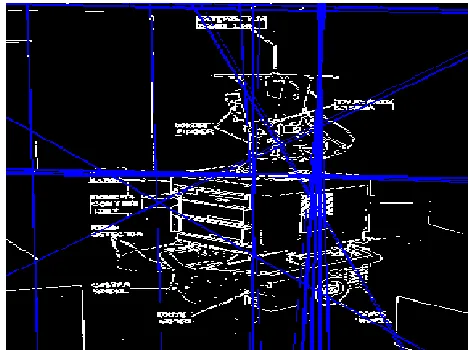
The simplest case of Hough transform is finding straight lines that are hidden in large amounts of image data. For detecting lines in images, the image is first converted into binary image using some form of thresholding and then the positive or suitable instances are added into the dataset. The main part of Hough transform is the Hough space. Each point (d, T) in Hough space matches to a line at angle T and distance d from the origin in the data space. The value of a function in Hough space gives the point density along a line in the data space.
Figure 4: Finding lines using Hough Transform (adapted from [10])
For each point in the Hough space, consider all the lines which go through that point at an actual discrete set of angles that are chosen on the priority basis. For each angle T, calculate the distance to the line through the point at that angle and discretize that distance using a priori chosen discretization, giving value d. Now make a corresponding discretization of the Hough space. This will result in a set of boxes in Hough space. These boxes are called the Hough accumulators. For each line it considers above, we increment a count (initialized at zero) in the Hough accumulator at point (d, T). After considering all the lines through all the points, a Hough accumulator with a high value will probably correspond to a line of points.
B. Edge Detection
Good detection – the algorithm should be able to detect as many real edges in the image as possible.
Good localization – edges marked through this algorithm should approach as close as possible to the edge in the
real image.
Minimal response – a given edge in the image should only be marked once so as to reduce false edges.
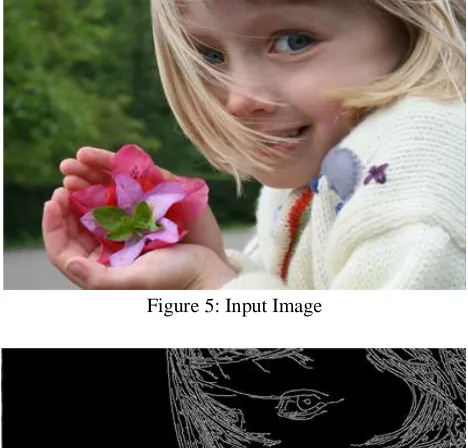
Figure 5: Input Image
Figure 6: Edge detection using Canny Edge detection algorithm (adapted from [9])
C. Bilateral filter
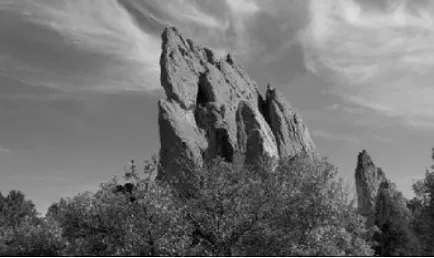
Figure 7: Input Image
Figure 8: Smoothed (structure, large scale)
Figure 9: Residual (texture, small scale (adapted from [8]))
In this filter every sample is replaced by a weighted average of its neighbors. These weights reflects two forces i.e. the closeness of the neighborhood with the center sample so that larger weight is assigned to the closer samples, and similarity between neighborhood and the center sample so that larger weight is assigned to the similar samples [8].
As it is seen in figures below, the output image is almost similar to the input image inspite of smoothening
Figure 11: Filtered image using Bilateral Filter (adapted from [8])
2. Literature Survey
Saha et al. [2012] [1] discussed an algorithm for detection of marks of road lanes and road boundary by using intelligent vehicles. It converted the RGB road scene image into gray image and employed the flood-fill algorithm to label the connected components of that gray image. After that the largest connected component obtained by the algorithm and which was the road region was extracted. The unwanted region was detected and subtracted like outer-side of the road. The extracted connected component was filtered to detect white marks of road lane and road boundary. The road lane detection algorithm still had some problems such as critical shadow condition of the image and color of road lanes other than white.
Tseng et al. [2005] [2] gave a lane marking detection algorithm by using geometry information and modified Hough transform. In that algorithm the captured image was divided into road part and non-road part by using camera geometry information. The color road image was quantized into a binary image. The modified Hough transform with road geometry consideration was used to detect the lane markings. The histogram of intensities was applied to quantize the road image into a binary image. A modified Hough transform method has been developed to detect the lane markings in road image by using the road geometry information. It was time consuming because Hough transform was a full search algorithm in parameter space. It also failed when the lane boundaries intersected in a region which was a non-road part.
Shen et al. [2012] [3] discussed a monocular vision system that could locate the positions of the road lane in real time. An algorithm proposed for lane detection using single camera. The algorithm worked in five steps. Initially edge detection was done to find all present edges from road image as road line required was included in it. Canny approach has been used to achieve the edge map from road image for its accurate edge detection. Then matching was done to eliminate unwanted figures. A priority and orientation based searching method has been used for enhance and label potential lane segments from edge map, degrading unwanted edge features. Based on results from search, a linking condition was used to assemble matched segment that further strengthen the confidence of the potential lane line. Finally a cluster algorithm was used to localize the road-lane lines.
M. Dhana Lakshmi et al. [2012] [4] discussed a novel algorithm to detect white and yellow colored lanes on the road. An automatic lane marking violence detection algorithm was designed and implemented in real time. The lane detection method was robust and effective in finding the exact lanes by using both color and edge orientations. The color segmentation procedure identified the yellow and white colored lanes followed by edge orientation in which the boundaries was eliminated, regions was labeled and finally the lanes was detected. As the height of the camera was relatively constant with respect to the road surface, the road portion of the image can be exclusively cropped by providing the coordinates, so that identifying the lanes became much more efficient.
This method has also been evaluated and compared with existing approaches. It has been found that the potential of the method in challenging environmental conditions.
Shan Xu et al. [2012] [6] discussed a method of structured road lane detection for blind travel aid. Median Filter has been implemented to process image firstly, then mark off the region of interesting in the initial image. Using Canny Edge Enhancement, threshold has been used to segment the image; road lane was fitted by modified Hough Transformation. Finally, according to the detected region, it judged whether racing course of bind has a deviation. It has been proved that this algorithm was very robust and real-time.
Zhao et al. [2013] [7] discussed lane detection and tracking method based on annealed particle filter algorithm which combined multiple images with annealed particle filter. It has been found that the time cost of annealed particle filter algorithm for each frame is largely reduced compared with conventional particle filter algorithm.
3. Conclusion
The lane detection has proved to be an efficient technique to prevent accidents in Intelligent Transportation Systems. The review on lane detection has shown that the most of the researchers has neglected the problem of the fog and noise in images. Thus noise and fog may reduce the accuracy of the existing systems. one can use bilateral filter and dark channel prior methods to improve the results further. In near future we will propose a new technique which will integrate the performance of lane detection by using bilateral filter.
References
[1] Saha, Anik, Dipanjan Das Roy, Tauhidul Alam, and Kaushik Deb. "Automated Road Lane Detection for Intelligent
Vehicles." Global Journal of Computer Science and Technology 12, no. 6 (2012).
[2] Tseng, Chien-Cheng, Hsu-Yung Cheng, and Bor-Shenn Jeng. "A lane detection algorithm using geometry information
and modified Hough transform." 2005 IPPR.
[3] Xiaodong Miao, Shunming Li, Huan Shen. "On-board lane detection system for intelligent vehicle based on
monocular vision." International Journal on Smart Sensing and Intelligent Systems 12, no. 4 (2012).
[4] M DhanaLakshmi and B.J. Rani Deepika, “A brawny multicolor lane coloration method to Indian scenarios”, IJRET
OCT, pp. 202 – 206, 2012.
[5] Le, Manh Cuong, Son Lam Phung, and Abdesselam Bouzerdoum. "Pedestrian lane detection for assistive navigation
of blind people." In Pattern Recognition (ICPR), 2012 21st International Conference on, pp. 2594-2597. IEEE, 2012.
[6] Xu, Shanshan, Jie Ying, and Yanbin Song. "Research on road detection based on blind navigation device." In Cyber
Technology in Automation, Control, and Intelligent Systems (CYBER), 2012 IEEE International Conference on, pp. 69-71. IEEE, 2012.
[7] Zhao, Hongying, Zhu Teng, Hong-Hyun Kim, and Dong-Joong Kang. "Annealed Particle Filter Algorithm Used for
Lane Detection and Tracking." Journal of Automation and Control Engineering 1, no. 1 (2013).
[8] “Bilateral Filter”, [online available]: wikipedia.org
[9] Mallick, Rajendra Nath. "Implementation of Canny Edge Detection Algorithm." PhD diss., 2012.
![Fig 1 Road scene image (adapted from [2]) Most roads such as highways have at least two lanes, one for traffic in each direction, separated by lane markings](https://thumb-us.123doks.com/thumbv2/123dok_us/1995318.1264130/2.612.189.427.292.456/road-scene-adapted-highways-traffic-direction-separated-markings.webp)
![Figure 11: Filtered image using Bilateral Filter (adapted from [8])](https://thumb-us.123doks.com/thumbv2/123dok_us/1995318.1264130/6.612.195.415.71.202/figure-filtered-image-using-bilateral-filter-adapted-from.webp)
