Special Article
CME
Immunization and MS
A summary of published evidence and recommendations
Olivier T. Rutschmann, MD, MPH; Douglas C. McCrory, MD, MHSc;
David B. Matchar, MD; and the Immunization Panel of the Multiple Sclerosis Council for Clinical Practice Guidelines*
Abstract—Objective:To review the risk of MS exacerbations after infectious episodes potentially preventable by vaccina-tion, and the risks and benefits of immunizing patients with MS. Methods: The authors searched MEDLINE (1966 to January 2001; U.S. National Library of Medicine, Bethesda, MD), HealthSTAR, and Cumulative Index to Nursing and Allied Health Literature (CINAHL) database (Cinahl Information Systems, Glendale, CA) for English-language articles. Each study was summarized and rated for quality of evidence. Then feasible data were pooled and analyzed in meta-analysis.Results:The risk of contracting common infectious diseases in patients with MS is not well established. There is strong evidence for an increased risk of MS exacerbations during weeks around an infectious episode. There is strong evidence against an increased risk of MS exacerbation after influenza immunization. There is no evidence that hepatitis B, varicella, tetanus, or Bacille Calmette–Guerin vaccines increase the risk of MS exacerbations. Insufficient evidence was found for other vaccines.Conclusions:Evidence supports 1) strategies to minimize the risk of acquiring infectious diseases that may trigger exacerbations of MS; and 2) the safety of using influenza, hepatitis B, varicella, tetanus, and Bacille Calmette–Guerin (BCG) vaccines in patients with MS.
NEUROLOGY 2002;59:1837–1843
Although the direct or the indirect pathogenic role of numerous infectious agents is debated,1,2there is ev-idence that MS exacerbations occur around infec-tious episodes, which could potentially be prevented by vaccination.3,4
However, there are concerns about the safety of immunization in patients with MS, particularly about the risk of relapses after vaccination. To ad-dress these concerns, the MS Council for Clinical Practice Guidelines commissioned a systematic re-view to obtain background for guidelines on immuni-zation and convened an expert panel to establish guidelines. This systematic review has three objec-tives. First, we aim to provide the information on the need to vaccinate patients with MS by evaluating the risk of MS exacerbation after potentially preventable infections. Second, we review the available evidence on safety and efficacy of vaccines in patients with MS. Finally, we provide an overview of the guide-lines for vaccinating patients with MS.
Methods. Identification of topics for literature search. Topics were identified by the Immunization Panel of the MS Council for Clinical Practice Guidelines and the methodological advisory panel of the Center for Clinical Health Policy Research at Duke University. Two topic questions were formulated to address the need to vaccinate patients with MS: 1) Are vaccine-preventable infectious diseases more fre-quent in patients with MS than in the general popu-lation? 2) Do vaccine-preventable infectious diseases increase the risk of MS exacerbations?
Two other topic questions addressed the risks and the benefits of immunizing patients with MS: 3) Does vaccination increase the risk of exacerbations of MS, and is there a difference in this risk between live attenuated and inactivated vaccines? 4) Are vac-cines as effective in patients with MS as in the gen-eral population?
Search strategy and inclusion process. We re-viewed English language MEDLINE (from 1966 to
*See the Appendix on page 1843 for a list of Immunization Panel of the Multiple Sclerosis Council for Clinical Practice Guidelines’ members. From the Duke Center for Clinical Health Policy Research (Dr. Matchar), Duke University Medical Center, Durham, NC.
This statement has been reviewed and endorsed by the American Academy of Neurology.
Approved by the AAN Therapeutics and Technology Assessment Subcommittee July 17, 2002. Approved by the AAN Practice Committee August 3, 2002. Approved by the AAN Board of Directors October 19, 2002.
January 2001; U.S. National Library of Medicine, Bethesda, MD) and two other online bibliographic databases, HealthSTAR and Cumulative Index to Nursing and Allied Health Literature (CINAHL) (Cinahl Information Systems, Glendale, CA), and the reference lists of all included articles and review ar-ticles. Search strategies included index terms and text words for “MS,” “transverse myelitis,” and index terms for “optic neuritis,” “encephalomyelitis,” “de-myelinating diseases,” and for general and specific terms relating to vaccination and related infectious diseases. Six hundred and sixty-seven citations were obtained and 280 full-text articles were screened for inclusion by two independent reviewers according to criteria developed by the methodologists guided by the expert panel. One hundred and thirty articles were included; 53 experimental or observational studies were abstracted in evidence tables, and 77 case reports were summarized in a summary table.
Twenty-five articles addressed the four first topic questions.
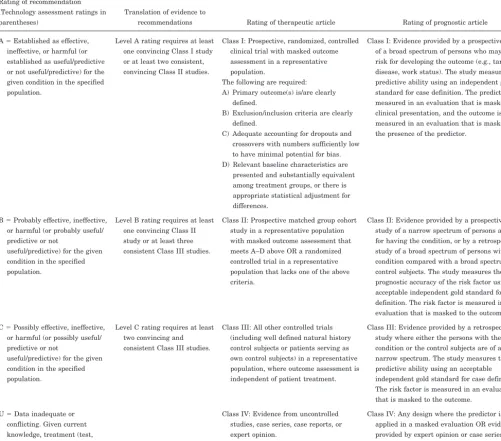
Assessment of the quality of available evidence. Each included and abstracted study was evaluated and rated for quality of evidence using the classification scheme developed by the American Academy of Neurol-ogy (table 1).
When feasible, data were pooled and analyzed in meta-analysis using Comprehensive Meta-Analysis software for Windows (version 1.09; Biostat, Engle-wood, NJ).
Results. Are potentially vaccine-preventable infec-tious diseases more frequent in patients with MS than in the general population? One prospective co-hort study (Class II evidence)5 and two case-control studies (Class IV evidence)6,7 were identified. The first study showed that viral infections including cold, influenza, enteric, and herpetic infections were
Table 1American Academy of Neurology Evidence Classification Scheme
Rating of recommendation (Technology assessment ratings in parentheses)
Translation of evidence to
recommendations Rating of therapeutic article Rating of prognostic article A⫽Established as effective,
ineffective, or harmful (or established as useful/predictive or not useful/predictive) for the given condition in the specified population.
Level A rating requires at least one convincing Class I study or at least two consistent, convincing Class II studies.
Class I: Prospective, randomized, controlled clinical trial with masked outcome assessment in a representative population.
The following are required: A) Primary outcome(s) is/are clearly
defined.
B) Exclusion/inclusion criteria are clearly defined.
C) Adequate accounting for dropouts and crossovers with numbers sufficiently low to have minimal potential for bias. D) Relevant baseline characteristics are
presented and substantially equivalent among treatment groups, or there is appropriate statistical adjustment for differences.
Class I: Evidence provided by a prospective study of a broad spectrum of persons who may be at risk for developing the outcome (e.g., target disease, work status). The study measures the predictive ability using an independent gold standard for case definition. The predictor is measured in an evaluation that is masked to clinical presentation, and the outcome is measured in an evaluation that is masked to the presence of the predictor.
B⫽Probably effective, ineffective, or harmful (or probably useful/ predictive or not
useful/predictive) for the given condition in the specified population.
Level B rating requires at least one convincing Class II study or at least three consistent Class III studies.
Class II: Prospective matched group cohort study in a representative population with masked outcome assessment that meets A–D above OR a randomized controlled trial in a representative population that lacks one of the above criteria.
Class II: Evidence provided by a prospective study of a narrow spectrum of persons at risk for having the condition, or by a retrospective study of a broad spectrum of persons with the condition compared with a broad spectrum of control subjects. The study measures the prognostic accuracy of the risk factor using an acceptable independent gold standard for case definition. The risk factor is measured in an evaluation that is masked to the outcome. C⫽Possibly effective, ineffective,
or harmful (or possibly useful/ predictive or not
useful/predictive) for the given condition in the specified population.
Level C rating requires at least two convincing and consistent Class III studies.
Class III: All other controlled trials (including well defined natural history control subjects or patients serving as own control subjects) in a representative population, where outcome assessment is independent of patient treatment.
Class III: Evidence provided by a retrospective study where either the persons with the condition or the control subjects are of a narrow spectrum. The study measures the predictive ability using an acceptable independent gold standard for case definition. The risk factor is measured in an evaluation that is masked to the outcome.
U⫽Data inadequate or conflicting. Given current knowledge, treatment (test, predictor) is unproven.
Class IV: Evidence from uncontrolled studies, case series, case reports, or expert opinion.
significantly less frequent in patients with MS than in control subjects.5The second showed no difference in the monthly cold frequency comparing 39 patients with MS with 39 community control subjects.6 In contrast, the third study reported a significantly higher rate of sinusitis in patients with MS than in control subjects.7
Thus, there is conflicting evidence on the risk of common infectious diseases in the MS population
compared with control populations (Level U
Recommendation).
Do potentially vaccine-preventable infectious dis-eases increase the risk of MS exacerbations? Six co-hort studies (Class II, Class IV evidence)3,5,8-11 and two case-control studies (Class IV evidence)6,7 were identified. In a prospective cohort of 60 patients with MS, the annual number of infections was 3.50 in the group of 46 patients who had one or more relapses, compared with 2.34 in the group of 14 patients who did not experience a relapse (p ⬍ 0.01) (Class II evidence).3In a 4-week period beginning 1 week be-fore the infection and ending 3 weeks after the infec-tion, the relative risk of relapse was 1.3 (p⫽0.0477) compared with all other periods.
In another prospective cohort of 41 patients, the attack rate of clinical exacerbations was 3.3 during “at risk” periods, defined as periods from 2 weeks before to 2 weeks after an upper respiratory tract infection, compared with 1.6 in “not at risk” periods (OR: 2.0, 95% CI: 1.3 to 3.2) (Class II evidence).8
In a third cohort of 30 patients, nearly two-thirds of exacerbations were observed during at risk period (from 1 week before an episode of upper respiratory tract infection to 5 weeks after), and one-third of infections were associated with exacerbations. At-tack rates of exacerbations were 2.92 per year during at risk periods compared with 1.16 during not at risk periods (p⬍0.001) (Class II evidence).9
The incidence of viral infections and the relation between infections and MS exacerbations was stud-ied in a cohort of 170 patients with MS with 134 concurrent control subjects (Class II evidence).5Viral infections were significantly less frequent in patients with MS than in control subjects. The overall exacer-bation rates were almost three times greater during at risk (⫺2 weeks to⫹3 weeks around the infection) peri-ods (0.64/year, 95% CI: 0.49 to 0.79) compared with not at risk periods (0.23/year, 95% CI: 0.19 to 0.26).
Serum antibody levels to various viruses were pro-spectively determined in 34 patients with MS. (Class II evidence).10 There were no significant changes in measles, adenovirus, or mumps antibody levels. Three patients had significant changes in herpes simplex and three others in respiratory syncytial vi-rus antibodies. For both vivi-ruses, the increase was related to an MS attack in one patient. Thirty-four other patients with MS were prospectively followed for a period of 461 patient-months (Class II evi-dence).10 During this period, 48% of 69 MS attacks were associated with infections, and 40% of infec-tions were associated with exacerbainfec-tions.
In a cohort of 233 patients, influenza episodes were recorded in 36 patients with relapsing-remitting MS (Class IV evidence).11Thirteen (36%) of these episodes were associated with an exacerbation. Four patients with the progressive form of MS had symptoms of influenza illness with an increase in fatigue in two patients.
In a case– control study, the rate of nasopharyn-geal infections was determined in a group of 92 pa-tients with MS and compared with control subjects (Class IV evidence).7The rate of sinusitis was signif-icantly higher in the MS group than in the control group (up to four-fold higher). The rate of MS attacks was 0.025 per patient per year during the at risk periods (from 2 months before to 6 months after an episode of sinusitis), compared with 0.012 during not at risk periods.
In another case– control study, the monthly cold frequency was 13.3% in 39 patients with MS and 13.7% in 39 control subjects (Class IV evidence).6 During a 294 patient–months period, 19 MS exacer-bations were observed, and six occurred in associa-tion with colds; the rate of exacerbaassocia-tion was more than three times higher in cold months than in non-cold months (p⫽0.028).
Thus, there is definitive evidence for an increased risk of MS exacerbations during the weeks around an infectious episode (Level A Recommendation).
Does vaccination increase the risk of exacerbations of MS, and is there a difference in this risk between live attenuated and inactivated vaccines?
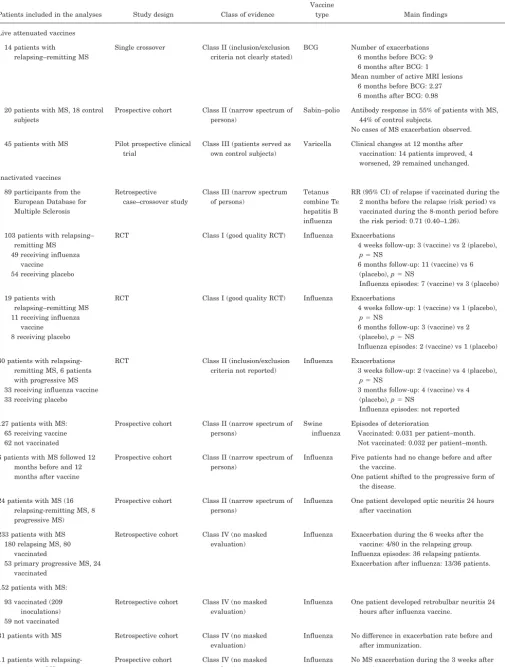
Live attenuated vaccines. BCG. In a crossover trial (Class II evidence),12BCG vaccine was adminis-tered to 14 patients with relapsing-remitting MS. MRI were performed monthly during a 6-month run-in period before the administration of BCG vac-cine and during 6 months after the injection. There was a 57% reduction in the mean number of active MRI lesions from the run-in period (2.27) to the post-BCG period (0.98;p⫽0.008).
Thus, there is suggestive evidence that BCG vac-cine is safe in patients with MS and that it might reduce disease activity (Level B Recommendation) (table 2).
Measles. None of three MS patients immunized with a live attenuated measles vaccine experienced any clinical changes during the month after vaccina-tion (Class IV evidence).10 Thus, there is insufficient published evidence to support or to reject an in-creased risk of MS exacerbation after measles vacci-nation (Level U Recommendation).
Sabin-polio. In a prospective cohort study of 20 patients with MS receiving a polyvalent Sabin vaccine, no cases of clinical deterioration were observed.10 In contrast, five cases of exacerbation of definite or possi-ble MS have been reported after Sabin polio vaccine (Class IV evidence).13,14
Smallpox. Two case reports were identified (Class IV evidence).15,16 The first showed an exacer-bation of MS after immunization,15 and the second reported an improvement of MS symptoms after re-peated smallpox vaccine injections.16 Thus, there is insufficient evidence to support or to reject an in-creased risk of exacerbation after smallpox vaccine (Level U Recommendation).
Varicella. Fifty patients with MS participated in a pilot trial testing the safety and the efficacy of live-attenuated varicella vaccine, with a 12-month follow-up (Class III evidence).17 Among the 45 pa-tients able to be evaluated, all papa-tients had a signif-icant rise in antibodies after vaccination. Fourteen had an improvement in their clinical status, four worsened, and 29 remained unchanged. Similarly, two patients with MS experienced improvement of their disease after having contracted varicella as adults.18Thus, there is suggestive evidence that vari-cella vaccine is safe in patients with MS and that it
might reduce the disease activity (Level C
Recommendation).
Inactivated vaccines. Hepatitis B. In a case– crossover study (Class III evidence),19 the effect of vaccination on the short-term risk of relapse was assessed in 643 patients with MS who had experi-enced a relapse preceded by a relapse-free period of at least 12 months. Exposure to any type of vaccine during the 2 months period before the relapse (risk period) was compared with exposure to vaccine dur-ing the 8 months preceddur-ing the risk period (four 2-month control periods). The relative risk (95% CI) of having a relapse during the risk period was 0.71 (0.40 to 1.26) compared with the control periods. An-alyzing the different types of vaccines (tetanus alone, combined tetanus, hepatitis B, influenza, monova-lent, combined), the results were similar. For hepati-tis B vaccine, the relative risk (95% CI) was 0.67 (0.20 to 2.17). Previously, four cases of MS exacerba-tion after hepatitis B immunizaexacerba-tion had been re-ported in a retrospective analysis of post-vaccine neurologic complications reported to the manufac-turer of the vaccines (Class IV evidence).14
Thus, there is suggestive evidence that hepatitis B vaccine does not increase the risk of relapse in pa-tients with MS (Level C Recommendation).
Influenza. Three randomized, placebo-controlled trials (Class I, Class II evidence),20-22 one case– crossover (Class III evidence),19 and seven cohort studies (Class II, Class IV evidence)10,11,23-28 were identified (see table 2). For each of the three random-ized, controlled trials, the rate difference for early MS exacerbation (3 to 4 weeks after vaccine/placebo), for late exacerbation (4 to 6 months after vaccine/ placebo), and for occurrence of influenza was esti-mated and combined in a meta-analysis (figure). Within the limits of the few studies included in the analysis, no heterogeneity was found (p ⫽ 0.58). Rate difference for early MS exacerbation ranged from ⫺6.1% to 2.0%, with an overall rate difference of 0% (95% CI: ⫺6.9% to 6.9%). For late
exacerba-tion, the rate difference ranged from 0% to 11.3%, with a pooled rate difference of 6.1% (95% CI:⫺4.1 to 16.3%). Finally, the rate difference for influenza during the 6 months after the intervention range from 5.7% to 8.7%, with a pooled rate difference of 8.4% (95% CI:⫺2.5% to 19.3%). Although these neg-ative studies are reassuring, they do not definitely exclude a slight risk of increase of exacerbation after immunization. Nevertheless, the 95% CI excludes an absolute increase in exacerbation rate beyond 0.08 per patient per year.
Thus, there is definitive evidence against a sub-stantial increased risk of MS exacerbation after in-fluenza vaccine (Level A Recommendation).
Tetanus. In a case– crossover study (Class III ev-idence),19the relative risk (95% CI) of relapse associ-ated with exposure to tetanus vaccine alone was 0.75 (0.23 to 2.46) and 0.22 (0.05 to 0.99) when tetanus was combined with poliovirus, diphtheria, or both.
Thus, there is suggestive evidence that tetanus vaccine does not increase the risk of relapses in pa-tients with MS (Level C Recommendation).
Typhoid fever. Four patients with MS experi-enced an exacerbation of their symptoms from 12 hours to 14 days after typhoid fever vaccine (Class IV evidence).15 Thus, there is insufficient evidence that typhoid vaccine does or does not increase the risk of MS exacerbation (Level U Recommendation) (see table 2).
Are vaccines as effective in patients with MS as in the general population? Four experimental trials reported efficacy data (Class I, Class II evi-dence).10,17,20,21 Two randomized controlled trials on influenza vaccine reported influenza episodes during a 6-month follow-up after immunization (see table 2). None of these studies reported data regarding anti-body response to vaccine.
The immune response to a live attenuated poliovi-rus vaccine was explored in 20 patients with MS and 18 control subjects.10Eleven patients with MS (55%) and eight control subjects (44%) were considered as “infected” after immunization.
In a pilot trial of varicella immunization in 50 patients with MS, a significant rise in varicella anti-bodies after vaccination was observed in all patients and persisted for 7 to 12 months.17
Thus, there is insufficient evidence regarding the efficacy of immunization in patients with MS (Level U Recommendation).
Discussion. The interrelation between vaccines, natural infections, and MS has been an ongoing source of concern for the community of patients with MS, clinicians, and the general public for decades. The evidence consolidated in the current systematic review provides some answers to several difficult questions.
Table 2Studies exploring the risk of relapses or exacerbation of MS symptoms after immunization in patients with MS
Patients included in the analyses Study design Class of evidence
Vaccine
type Main findings Ref Live attenuated vaccines
14 patients with relapsing–remitting MS
Single crossover Class II (inclusion/exclusion criteria not clearly stated)
BCG Number of exacerbations 6 months before BCG: 9 6 months after BCG: 1 Mean number of active MRI lesions
6 months before BCG: 2.27 6 months after BCG: 0.98
12
20 patients with MS, 18 control subjects
Prospective cohort Class II (narrow spectrum of persons)
Sabin–polio Antibody response in 55% of patients with MS, 44% of control subjects.
No cases of MS exacerbation observed.
10
45 patients with MS Pilot prospective clinical trial
Class III (patients served as own control subjects)
Varicella Clinical changes at 12 months after vaccination: 14 patients improved, 4 worsened, 29 remained unchanged.
17
Inactivated vaccines 89 participants from the
European Database for Multiple Sclerosis
Retrospective case–crossover study
Class III (narrow spectrum of persons)
Tetanus combine Te hepatitis B influenza
RR (95% CI) of relapse if vaccinated during the 2 months before the relapse (risk period) vs vaccinated during the 8-month period before the risk period: 0.71 (0.40–1.26).
19
103 patients with relapsing– remitting MS
49 receiving influenza vaccine
54 receiving placebo
RCT Class I (good quality RCT) Influenza Exacerbations
4 weeks follow-up: 3 (vaccine) vs 2 (placebo),
p⫽NS
6 months follow-up: 11 (vaccine) vs 6 (placebo),p⫽NS
Influenza episodes: 7 (vaccine) vs 3 (placebo) 20
19 patients with relapsing–remitting MS 11 receiving influenza
vaccine 8 receiving placebo
RCT Class I (good quality RCT) Influenza Exacerbations
4 weeks follow-up: 1 (vaccine) vs 1 (placebo),
p⫽NS
6 months follow-up: 3 (vaccine) vs 2 (placebo),p⫽NS
Influenza episodes: 2 (vaccine) vs 1 (placebo) 21
60 patients with relapsing-remitting MS, 6 patients with progressive MS 33 receiving influenza vaccine 33 receiving placebo
RCT Class II (inclusion/exclusion criteria not reported)
Influenza Exacerbations
3 weeks follow-up: 2 (vaccine) vs 4 (placebo),
p⫽NS
3 months follow-up: 4 (vaccine) vs 4 (placebo),p⫽NS
Influenza episodes: not reported
22
127 patients with MS: 65 receiving vaccine 62 not vaccinated
Prospective cohort Class II (narrow spectrum of persons)
Swine influenza
Episodes of deterioration
Vaccinated: 0.031 per patient–month. Not vaccinated: 0.032 per patient–month.
23
6 patients with MS followed 12 months before and 12 months after vaccine
Prospective cohort Class II (narrow spectrum of persons)
Influenza Five patients had no change before and after the vaccine.
One patient shifted to the progressive form of the disease.
24;25
24 patients with MS (16 relapsing-remitting MS, 8 progressive MS)
Prospective cohort Class II (narrow spectrum of persons)
Influenza One patient developed optic neuritis 24 hours after vaccination
10
233 patients with MS 180 relapsing MS, 80
vaccinated
53 primary progressive MS, 24 vaccinated
Retrospective cohort Class IV (no masked evaluation)
Influenza Exacerbation during the 6 weeks after the vaccine: 4/80 in the relapsing group. Influenza episodes: 36 relapsing patients. Exacerbation after influenza: 13/36 patients.
11
152 patients with MS: 93 vaccinated (209
inoculations) 59 not vaccinated
Retrospective cohort Class IV (no masked evaluation)
Influenza One patient developed retrobulbar neuritis 24 hours after influenza vaccine.
26
31 patients with MS Retrospective cohort Class IV (no masked evaluation)
Influenza No difference in exacerbation rate before and after immunization.
27
11 patients with relapsing-remitting MS
Prospective cohort Class IV (no masked evaluation)
Influenza No MS exacerbation during the 3 weeks after vaccine.
28
diseases in the population of patients with MS com-pared with control subjects, there is strong and con-sistent evidence that infections— even common upper respiratory tract infections such as colds—are associ-ated with an increased risk of MS exacerbations. Therefore, it seems reasonable to promote any health care strategy that may reduce the risk of acquiring in-fections. Immunizations are health care strategies that can reduce the risk of some infections.
Second, patients with MS and their physicians are often concerned about an increased risk of exacerba-tion after immunizaexacerba-tion. Influenza vaccine is the most commonly administered vaccine, and current recommendations propose universal yearly influenza vaccination for every individual aged 50 or older, making many patients with MS potential recipients for this vaccine.29This review identified strong, reas-suring evidence that influenza vaccine is safe and is not associated with a significant increased risk of MS exacerbation. Regarding the efficacy of this vac-cine, only three small- to medium-sized prospective, randomized trials addressed this question. Because they were not sufficiently powered,20,21or did not re-port influenza episodes,22 it is not possible to draw any conclusion about the efficacy of this vaccine for the prevention of flu in the MS population.
Regarding other vaccines, the evidence is much spottier. One carefully conducted study provides re-assurance that hepatitis B and tetanus vaccines do not increase the risk of exacerbations,19 but the
evi-dence is even more scarce for measles, polio, or ty-phoid fever vaccines and is completely absent for commonly used vaccines, such as those for hepatitis A, mumps, rubella, or pneumococcus. This should stimulate researchers in designing prospective trials or at least well designed, retrospective studies ad-dressing safety and efficacy of these vaccines.
Interestingly, two small pilot studies explored the potential beneficial immunomodulatory effects of BCG and varicella vaccines.12,17 Although both stud-ies suggest that these vaccines might reduce disease activity, it is certainly premature and may be hazard-ous to draw any conclusions from these results. These findings do offer promise for possible future research.
Recommendations. Based on this review, the Im-munization Panel of the MS Council for Clinical Practice Guidelines recommends that:
1) Patients with MS should follow Centers for Dis-ease Control indications for immunizations (http:// www.cdc.gov/nip/recs/adult-schedule.pdf). (Influenza: Level A Recommendation; hepatitis B, varicella, tet-anus: Level C Recommendation; other vaccines: Level U Recommendation, expert opinion.)
2) Vaccination should be delayed during clinically significant relapses, until patients have stabilized or have begun to improve from the relapse, typically 4 to 6 weeks after the start of the relapse. There is, however, no evidence regarding this practice (Level U Recommendation, expert opinion). For patients
who require tetanus vaccination after a wound, the panel recommends not to delay vaccination even if they are in a midst of a relapse although, again, there is no actual evidence on this point (Level U Recommen-dation, expert opinion).
3) There is a divided opinion among experts re-garding the potential usefulness of influenza vaccine in patients with MS who do not otherwise meet the CDC indications for vaccination. The panel recom-mends that potential risks and benefits of vaccina-tion in these circumstances be discussed individually with each patient (Level U Recommendation, expert opinion).
4) Pneumococcal vaccine should be considered for patients with compromised pulmonary function, such as wheelchair-dependant or bed-bound patients. There is, however, no evidence regarding this prac-tice (Level U Recommendation, expert opinion).
A complete guidelines document is available at http://www.pva.org/NEWPVASITE/publications/ onlinepubs.htm
Disclaimer. This statement is provided as an edu-cational service of the American Academy of Neurol-ogy. It is based on an assessment of current scientific and clinical information. It is not intended to include all possible proper methods of care for a particular neurologic problem or all legitimate criteria for choosing to use a specific procedure. Neither is it intended to exclude any reasonable alternative methodologies. The AAN recognizes that specific pa-tient care decisions are the prerogative of the papa-tient and the physician caring for the patient, based on all of the circumstances involved.
Appendix
Immunization Panel of the Multiple Sclerosis Council for Clinical Practice Guidelines’ Members:Dennis Bourdette, MD (chair), Oregon Health & Science University, Portland; Lois Copperman, PhD, OT, Oregon Health & Science Uni-versity, Portland; Patricia Coyle, MD, State University of New York at Stony Brook; Frank DeStafano, MD, MPH, Centers for Disease Control and Prevention, Atlanta, GA; Thomas Marrie, MD, The Queen Elizabeth Health Science Center, Halifax, Nova Scotia, Canada; Deborah Miller, PhD, LISW, Cleveland Clinic Foundation, OH; Cindy Phair, RN, Fairview Multiple Sclerosis Center, Minneapo-lis, MN; John Richert, MD, Georgetown University Medi-cal Center, Washington, DC.Therapeutics and Technology Assessment Subcommittee Members: Douglas S. Goodin, MD (chair); Carmel Armon, MD; Elliot M. Frohman, MD, PhD; Robert S. Goldman, MD; David Hammond, MD; Chung Y. Hsu, MD, PhD; Andres M. Kanner, MD; David S. Lefkowitz, MD; Isaac E. Silverman, MD; Michael A. Sloan, MD; Yuen T. So, MD, PhD.
References
1. Noseworthy JH, Lucchinetti C, Rodriguez M, Weinshenker BG. Multiple sclerosis. N Engl J Med 2000;343:938 –952. 2. Poser CM. Notes on the pathogenesis of multiple sclerosis.
Clin Neurosci 1994;2:258 –265.
3. Andersen O, Lygner PE, Bergstrom T, Andersson M, Vahlne A. Viral infections trigger multiple sclerosis relapses: a
pro-spective seroepidemiological study. J Neurol 1993;240: 417– 422.
4. Panitch HS, Bever CT, Katz E, Johnson KP. Upper respira-tory tract infections trigger attacks of multiple sclerosis in patients treated with interferon. J Neuroimmunol 1991;36: 125.
5. Sibley WA, Bamford CR, Clark K. Clinical viral infections and multiple sclerosis. Lancet 1985;1:1313–1315.
6. Narod S, Johnson–Lussenburg CM, Zheng Q, Nelson R. Clinical viral infections and multiple sclerosis. Lancet 1985;ii:165–166. 7. Gay D, Dick G, Upton G. Multiple sclerosis associated with
sinusitis: case-controlled study in general practice. Lancet 1986;1:815– 819.
8. Edwards S, Zvartau M, Clarke H, Irving W, Blumhardt LD. Clinical relapses and disease activity on magnetic resonance imaging associated with viral upper respiratory tract infec-tions in multiple sclerosis. J Neurol Neurosurg Psychiatry 1998;64:736 –741.
9. Panitch HS. Influence of infection on exacerbations of multiple sclerosis. Ann Neurol 1994;36(suppl):S25–S28.
10. Sibley WA, Foley JM. Infection and immunization in multiple sclerosis. Ann NY Acad Sci 1965;122:457– 468.
11. De Keyser J, Zwanikken C, Boon M. Effects of influenza vac-cination and influenza illness on exacerbations in multiple sclerosis. J Neurol Sci 1998;159:51–53.
12. Ristori G, Buzzi MG, Sabatini U, et al. Use of Bacille Calmette– Guerin (BCG) in multiple sclerosis. Neurology 1999;53:1588 – 1589.
13. Riikonen R. The role of infection and vaccination in the gene-sis of optic neuritis and multiple sclerogene-sis in children. Acta Neurol Scand 1989;80:425– 431.
14. Quast U, Herder C, Zwisler O. Vaccination of patients with encephalomyelitis disseminata. Vaccine 1991;9:228 –230. 15. Miller H, Cendrowski W, Shapira K. Multiple sclerosis and
vaccination. BMJ 1967;2:210 –213.
16. Ono F. Possible relation of small pox vaccination to multiple sclerosis-like disease. A personal note. Med Hypotheses 1986; 20:339 –340.
17. Ross RT, Nicolle LE, Cheang M. The varicella zoster virus: a pilot trial of a potential therapeutic agent in multiple sclero-sis. J Clin Epidemiol 1997;50:63– 68.
18. Ross RT. Varicella and remission of multiple sclerosis. Lancet 1991;337:300.
19. Confavreux C, Suissa S, Saddier P, Bourdes V, Vukusic S. Vaccinations and the risk of relapse in multiple sclerosis. N Engl J Med 2001;344:319 –326.
20. Miller AE, Morgante LA, Buchwald LY, et al. A multicenter, randomized, double-blind, placebo-controlled trial of influenza immunization in multiple sclerosis. Neurology 1997;48:312–314. 21. Mokhtarian F, Shirazian D, Morgante L, Miller A, Grob D, Lichstein E. Influenza virus vaccination of patients with mul-tiple sclerosis. Mult Scler 1997;3:243–247.
22. Myers LW, Ellison GW, Lucia M, et al. Swine influenza virus vaccination in patients with multiple sclerosis. J Infect Dis 1977;136 (suppl):S546 –54.
23. Bamford CR, Sibley WA, Laguna JF. Swine influenza vaccina-tion in patients with multiple sclerosis. Arch Neurol 1978;35: 242–243.
24. Salvetti M, Pisani A, Bastianello S, Millefiorini E, Buttinelli C, Pozzilli C. Clinical and MRI assessment of disease activity in patients with multiple sclerosis after influenza vaccination. J Neurol 1995;242:143–146.
25. Salvetti M, Pisani A, Bastianello S, Millefiorini E, Buttinelli C, Pozzilli C. Influenza immunization in multiple sclerosis. Neurology 1997;49:1474 –1475.
26. Sibley WA, Bamford CR, Laguna JF. Influenza vaccination in patients with multiple sclerosis. JAMA 1976;236:1965–1966. 27. Kurland LT, Molgaard CA, Kurland EM, Wiederholt WC,
Kirkpatrick JW. Swine flu vaccine and multiple sclerosis. JAMA 1984;251:2672–2675.
28. Michielsens B, Wilms G, Marchal G, Carton H. Serial mag-netic resonance imaging studies with paramagmag-netic contrast medium: assessment of disease activity in patients with mul-tiple sclerosis before and after influenza vaccination. Eur Neurol 1990;30:258 –259.
DOI 10.1212/WNL.59.12.1837
2002;59;1837-1843
Neurology
Olivier T. Rutschmann, Douglas C. McCrory, David B. Matchar, et al.
Immunization and MS: A summary of published evidence and recommendations
This information is current as of December 24, 2002
Services
Updated Information &
http://n.neurology.org/content/59/12/1837.full
including high resolution figures, can be found at:
References
http://n.neurology.org/content/59/12/1837.full#ref-list-1
This article cites 23 articles, 4 of which you can access for free at:
Citations
http://n.neurology.org/content/59/12/1837.full##otherarticles
This article has been cited by 6 HighWire-hosted articles:
Subspecialty Collections
http://n.neurology.org/cgi/collection/multiple_sclerosis
Multiple sclerosis
http://n.neurology.org/cgi/collection/all_demyelinating_disease_cns
All Demyelinating disease (CNS)
following collection(s):
This article, along with others on similar topics, appears in the
Permissions & Licensing
http://www.neurology.org/about/about_the_journal#permissions
its entirety can be found online at:
Information about reproducing this article in parts (figures,tables) or in
Reprints
http://n.neurology.org/subscribers/advertise
Information about ordering reprints can be found online:
Online ISSN: 1526-632X.