Available Online atwww.ijcsmc.com
International Journal of Computer Science and Mobile Computing
A Monthly Journal of Computer Science and Information Technology
ISSN 2320–088X
IMPACT FACTOR: 5.258
IJCSMC, Vol. 5, Issue. 6, June 2016, pg.102 – 107
A Review on
Improving Packet
Analysis in Wireless Sensor Network
using Bit Rate Classifier
Amol Shende
1, Prof. Vikrant Chole
2¹Department of Computer Science and Engineering, G. H. Raisoni Academy of Engineering and Technology, Nagpur, India
²Department of Computer Science and Engineering, G. H. Raisoni Academy of Engineering and Technology, Nagpur, India
Abstract - Wireless sensor network is a group of sensor nodes and, where each node is connected to several sensors. The concept of Wireless Sensor Networks(WSNs) has been brought into reality only by the rapid advancements in the areas of sensor design, information technologies, and wireless networks that have developed the way for the proliferation of WSNs. The different characteristics of sensor networks introduce new challenges, amongst which prolonging the sensor lifespan is the most important. Wireless sensor networks have seen a progressive growth in various application areas including health care, environmental monitoring, security, and military purposes despite prominent performance and availability challenges. Clustering plays an important role in enhancement of the life span and scalability of the network, in such
applications. The type of distributions for arrivals at the cluster head and intermediary
I . I N T R O D U C T I O N
Wireless sensor networks with their robust characteristics are very much used in various fields where capturing, gathering and analyzing of live environment data is done[9]. These robust characteristics and internal properties of individual sensor nodes and Wireless Sensor Networks differs them from other communication networks, and challenges them for the development of communication protocols in terms of energy consumption as the energy reserves of the sensor nodes make the energy consumption of primary importance[1]. Along with one or more sensors, each node in a wireless sensor network is typically equipped with a radio transceiver or other wireless communications device, a small microcontroller and an energy source, usually a battery[2].
The various types of routing protocols are addressed in many areas. Compared to table driven protocols, on demand routing protocols can do effort less routing overhead[10]. These sensors are battery operated and consequently require a low power protocol[14].
In this paper, an implementation is carried out to avoid the most appropriate transmission of packets at the basis of priority decided. Simulation results are presented and analyzed in detail to characterize end to end drop or loss between arriving data packets. Regardless of the medium access scheme employed, energy efficiency is of utmost importance in WSNs. The main motivation must be to minimize the delay that may occur due to high traffic rate. In this paper, the bit rate analysis for incoming packets is presented, while priority basis is considered to continue the flow of packets in regular manner.
In this paper, in section II some earlier related work is explained, in section III current approaches for the existing systems explained. Finally in section IV, the conclusion is given.
I I . R E L A T E D W O R K
In this paper, Performance modelling continues to be of great importance in supporting research as well as in the design, development and optimization of Wireless Sensor Network and their applications[1]. The previous work provides a trade-off between energy consumption and average end-to-end delay incurred in the network, along with the necessity of validating the types of distributions and limitations of Q-Q plots for estimating the distribution of arrivals between cluster and cluster heads of sensor nodes.
The other previous works formulates the MAC problem, in the context of minimizing energy utilization, in wireless sensor communications. Two prominent MAC protocols used for many applications, random access and Time Division Multiple Access (TDMA), were studied[9],[11].
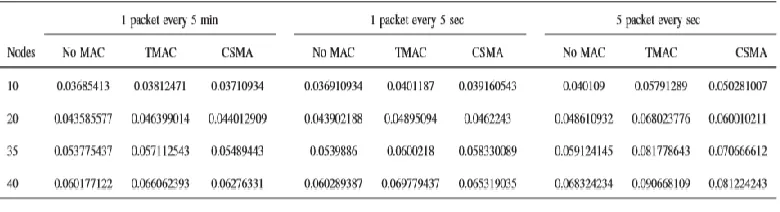
Fig. 1
Paper[11] proposes the works focusing on data traffic arrival process, sequence relations among general kinds of packets, and data traffic load distribution. For periodic data generation scenarios, constant bit rate (CBR) can be used to model the data traffic arrival process when the bit rate is constant. When the bit rate is variable, a Poisson process can be used to model the data traffic arrival process as long as the data traffic is not bursty. The sequence relations among some special kinds of packets are possible to be specified according to protocol specifications, the sequence relations among general kinds of packets can also be learned automatically by on-line training. The data traffic load over a node in planar WSNs also increases as the node moves closer to the sink. For a symmetric sensor network (i.e. all nodes of the same distance from the center of the network are similar) with nodes evenly distributed in the sensing field, the author of this article concludes that the expected data traffic load over a node is in direct proportion to the network radius, in inverse proportion to the mean routing hop length, and independent of the node density.
Paper[12] elaborates that in the first procedure, carrier sense multiple access with collision avoidance (CSMA-CA), dictates how 802.15.4 devices shall gain access to the wireless channel. The length of time required to execute CSMA-CA and the probability of CSMA-CA terminating without granting channel access increase with the activity level. The remaining steps of a packet’s transmission are executed if the CSMA-CA procedure grants channel access and are assumed to be error free, so they cannot have variable transmission times for a given packet. Throughput calculations first estimate the average time required to execute CSMA-CA then calculate the time required to complete the remaining four steps of the transmission process for a packet of a given length.
Paper[5] elaborates ON/OFF Markovian MAC protocol(OOM-MAC) that acts according to ON/OFF Markov model. This protocol allows the node to conserve energy and reduce time latency through their regular sleep time, that undergoes to ON/OFF Markov model rules.
and frequency bands. The exact formula for direct communication is drawn up. This gives an overview and an easy way to calculate the maximum throughput without the need to completely analyze the standard. All the information needed for obtaining these results can be found in the standard. This paper also looks into the other frequency bands and offers a more thorough analysis, including the influence of the back off window.
Paper[2] clears that continuous monitoring does not necessarily imply continuous reporting. Instead, it is demonstrate that continuous monitoring using an event-driven reporting approach can be achieved. Building on this idea, the paper proposes two new mechanisms that enable energy conservation in continuous-monitoring WSNs. The first mechanism can augment any existing protocol, whereas the second mechanism is conceived for cluster-based WSNs.
Paper[7] determines several important performance matrices related to the sensor node’s energy consumption. Numerical analysis was provided to validate the proposed model and the results obtained. The results show that the energy consumption for switching between the active mode and sleep mode does not depend significantly on the number of data packets. However, the energy consumption for transmitting the data packets depends on the rate at which data packets are generated, which means that transmitting high-density data requires the expenditure of more energy.
Paper[3] describes that developed framework accurately models the distribution of the end-to-end delay and captures the heterogeneous effects of multihop WSNs. The developed framework can be used to guide the development of QoS-based scheduling and communication solutions for WSNs. Based on the framework, models are also developed for event detection delay distributions in WSNs.
II I. CUR RENT APP RO ACHES
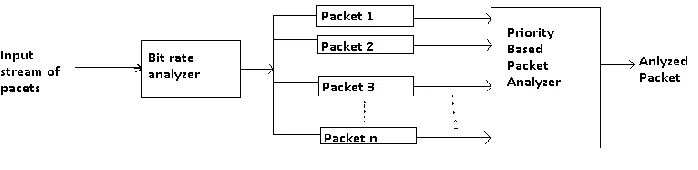
Fig. 2
IV. CON CLUSION
In this review, we understood the importance of bit rate analysis of the incoming packet. We also realized that if the b[t rate is not analyzed, then there inefficiency in network performance. This comparison study will prove a good base for further research in the area of bit rate analysis of packet arrivals. Additionally, some of parameters like delay and energy consumed can be calculated. In this way we can achieve the goal of improving bit rate packet analysis resulting a network efficiency.
REFERENCES
[1] K. Doddapaneni, P. Shah, E. Ever, A. Tasiran, F. A. Omondi, O. Gemikonakli and L. Mostarda, “Packet Arrival Analysis in Wireless Sensor Networks.,” in Advanced Information Networking and Applications, 2015 29th International Workshop on, pp. 165–169, 2015.
[2] N. Bouabdallah, M. E. Rivero-Angeles, and B. Sericola, “Continuous monitoring using event-driven reporting for cluster-based wireless sensor networks,” IEEE Transactions on Vehicular Technology, vol. 58, no. 7, pp. 3460–3479, 2009.
[3] Y. Wang, M. C. Vuran, and S. Goddard, “Cross-layer analysis of the end-to-end delay distribution in wireless sensor networks,” IEEE/ACM Transactions on Networking (TON), vol. 20, no. 1, pp. 305–318, 2012.
[4] I. F. Akyildiz, W. Su, Y. Sankarasubramaniam, and E. Cayirci, “Wireless sensor networks: a survey,” Computer networks, vol. 38, no. 4, pp. 393–422, 2002.
M. GEl’bala, and M. Klonowski, eds.), vol. 7960 of Lecture Notes in Computer Science, Springer Berlin Heidelberg, 2013.
[7] Y. Zhang and W. W. Li, “Modeling and energy consumption evaluation of a stochastic wireless sensor network.,” EURASIP J. Wireless Comm. and Networking, p. 282, 2012.
[8] Y. Zhang and W. Li, “An energy-based stochastic model for wireless sensor networks.,” Wireless Sensor Network, vol. 3, no. 9, pp. 322–328, 2011.
[9] L. Chaari and L. Kamoun, “Wireless sensors networks MAC protocols Analysis.,” Journal of telecommunications, vol. 2, issue 1, April 2010.
[10] E. Gnanamanoharan and R.Bensraj, “Impact of Variable Bit Rate and Packet Size on the Performance Evaluation of Neighbor Aware AODV and DSDV Routing Protocols for MANET's.,” International Journal of Computer Applications, Volume 92 – No.8, 0975 – 8887, 2014.
[11] Q. Wang, “Traffic Analysis & Modeling in Wireless Sensor
Networks and Their Applications on Network Optimization and Anomaly Detection.,” Network Protocols and Algorithms, Vol. 2, No. 1, 1943-3581, 2010.
[12] T. R. Burchfield , S. Venkatesan and D. Weiner, “Maximizing Throughput in ZigBee Wireless Networks through Analysis, Simulations and Implementations.,” Wireless Monitoring Solutions, pp. 1-13, 2014.
[13] P. Moravek, D. Komosny, M. Simek, D. Girbau, A. Lazaro, “Energy Analysis of Received Signal Strength Localization in Wireless Sensor Networks.,” Radioenngineering, vol. 20, no. 4, 2011.