FUSION OF SCALE INVARIANT FEATURES
TRANSFORM AND WAVELET TRANSFORM
TECHNIQUES FOR OBJECT DETECTION
Anjana Kumari
1,
Mupnesh Thakur
2 1Student, M.Tech,
2Lecturer, CSE, L.R.I.E.T Solan (India)
ABSTRACT
Detecting the salient regions on feature points in an image is very fundamental and important task to digital image processing. There are numbers of techniques present now days for recognizing the objects in an image. The paradigm that is followed in this paper is to detect the object based on features. The feature based techniques include SIFT, SURF, FAST, MSER and so on. This paper presents only one method for scale and rotation invariant features descriptors that is SIFT based on transformation techniques DWT. A Haar wavelet type of wavelet transform is used in the research and these are the forms that are used in many methods of discrete wavelet transform and processing. Decomposing an image to low and high resolution is the basic idea of transformation. corner detection technique is applied to low resolution image and SIFT is applied to high resolution image further matching of features is done over them which is further followed by estimating geometric transformation and object detection will be done. SIFT descriptor of fused DWT are computed to form final features match and detect the particular region or object in image.
Keywords: Corner Detection, Digital Image Processing, Discrete Wavelet Transform, Geometry
Estimation, Scale Invariant Feature Transform.
I. INTRODUCTION
1.1 Introduction to Digital Image Processing (DIP)
Detecting the desired region/object in an image is a long-lasting research topic in an image processing system.
In our everyday life we come across various objects and we recognize, detect them with little efforts. Despite
the fact that the objects may vary in color, shape, texture etc. We have senses and thus we can easily classify
and distinguish the objects. But if we want that a computer has to perform this task, which does not have any
sort of sense and intelligence. For this we have to indulge the intelligence to the system and that is considered as
artificial intelligence which we can attain with the help of training or programs [1]. Image Processing now a
days is used in almost every area. Especially, it is finding its use in an application area such as the quality based
studies, generalizes its use with its structure that meets the needs of the people.
Digital Images are electronic snapshots taken of a scene or scanned from documents, such as photographs,
manuscripts, printed texts, and artwork. The digital image is sampled and mapped as a grid of dots or picture
elements (pixels). Each pixel is assigned a value (black, white, shades of gray or color), which is represented in
identification and detecting of the image that the digital environment carries out. [2] It is the process of
modification done upon images or the sequence of images in digital environment. Most of the IP techniques
treat the images as a 2D signal and then applying standard techniques to it. DIP involves a number of
fundamental steps such as: image acquisition, image enhancement and preprocessing, edge detection and
segmentation, representation, description, matching and detection. The output of these steps is either an image
itself or an attribute of an image [3].
1.2 Object Detection:
Object detection,tracking, and recognition in images are very key problem in computer vision. Object detection
is a technique or method for identifying the objects in an image or it can be simply defines as the task of finding
and identifying the objects in the real world from an image of the world with the help of object models which
are known priory [4]. But if we talk about the computer vision it can be termed as the task to perform. Humans
can recognize the objects effortlessly without being aware of the changes in an object’s appearance due to
number of factors such as view point variation, shadow, illumination etc. To detect an object from digital image
is major task in image processing. It is a hot research issue to detect and classify the features based on IP
technology.
The detection process in the image is carried out by the process of extracting the key points from an image
which is very important and valuable. These key points have many applications in image processing like the
detection of objects in an image, registration of an image, tracking of an object [5]. Object and shape recognition
etc. by simply extracting the key points, we can use them for find the particular objects in number of images. If
the points matched in the images they can simply be categorized as the detected object in an image. Object
detection mainly consists of two steps:
1.2.1 Object Detection Approaches: Generally there are three methods available for detecting the object, they
are:
1.
Geometry Based Approach2.
Appearance Based Approach3.
Feature Based ApproachFeature Based method: - A search is used to find feasible matches between object features and image features.
The primary constraint is that a single position of the object must account for all of the feasible matches. This
technique first computes the entire responses of features that are detected in the scene and collects them into a
feature vector.
Feature based approach is concerned with the detection of the object based on the features of the object. The
central idea behind the feature object detection algorithms lies in identifying the key points, often occurred at
intensity discontinuity that are invariant to change due to scale and illumination. Methods that extract features
from the objects to be detected and the images to be searched.
surface patches
corners detection
Based on the features there are two main classes, i.e., local and global approaches [8] [9]. A local feature is a
property of an image (object) located on a single point or small region. It is a single piece of information
describing a rather simple, but ideally distinctive property of the object’s projection to the camera (image of the
object). Examples for local features of an object are, e.g., the color, (mean) gradient or (mean) gray value of a
pixel or small region. For object detection tasks the local feature should be invariant to illumination changes,
noise, scale changes and changes in viewing direction, but, in general, this cannot be reached due to the
simpleness of the features itself. Global features try to cover the information content of the whole image or
patch, i.e., all pixels is regarded.
1.3
Scale–Invariant Feature Transform (SIFT)
SIFT, currently best known feature descriptor, solve many real world applications in object recognition and
detection. SIFT is a descriptor that was proposed by Lowe, is one of the most widely used feature detection
algorithm. Objects can be indexed and detected with the help of histograms of key points in images.
Scale-invariant feature transform is an algorithm in computer vision to detect and describe local features in image
.object recognition, detection, robotic mapping and navigation, 3D modeling, gesture recognition is its
applications. The SIFT (scale invariant feature transform) is one of the most widely used feature representation
scheme for vision application. The SIFT approach is able to extract feature that are intensive to certain scale and
illumination changes. SIFT based methods are expected to perform better for objects with rich texture
information as sufficient numbers of point can be extracted. On the other hand they also require sophisticated
indexing and matching algorithm for effective object detection[6].
1.3.1 SIFT Algorithm overview
1.3.1.1 Feature Descriptors: It is a sort of method for representing the visual information for detection is to
store descriptions of objects that only consists the features that are visible from a particular view point. An
object can be concluded as the detected one, if the feature description i.e. derived from an image of the object
matches well to the feature descriptor i.e. stored in the memory.
1.3.1.2 Feature detection: Detection is followed by feature description. To represent any region, which are
detected point, a large number of different method have been developed. It is also refers to the interest point
detection or the key points detection for finding the image which are some how special. Typically it means that
these points correspond to some elements of the scene that can be reliably located in different views of that
scene.That means Feature detection = how to represents the intensity points or features in an image.
1.3.1.3 Feature matching: Image matching refers to finding a correspondence between the data sets. In the
application of computer vision and image processing, the concept of feature detection refers to the methods that
aim at computing abstractions of image information and making local decisions at every image point whether
there is an image feature of a given type at that point or not. The resulting features are considered as the subsets
of the image domain.
1.4
Corner Detection
- CornerDetection is an approach within computer vision to extract certain Kinds of features and after infer the
contents of an image. Corner Detection is frequently used in motion detection, image matching, video
edges. A corner can also be defined as a point for which there is two dominant and different edges direction
in local neighborhood of the point. Many applications require relating two or more images in order to
extract information from them. The brute force method of comparing every pixel in the two images is
computationally prohibitive for the majority of applications .Intuitively, one can image relating two images
by matching only locations in the image that are in some way interesting. Such points are referred to as
interest points and are located using an interest point detector. Finding a relationship between images is
then performed using only these points. This drastically reduces the required computation time. Many
different interest point detectors have been proposed with a wide range of definitions for what points in an
image are interesting [7].
1.5
Discrete Wavelet Transform
A DWT is any wavelet transform for which the wavelets are discretely sampled. In case of images, image has
been decomposed on wavelet decomposition techniques using transform with different levels of decomposition.
Decomposition mainly performs on two different images . Wavelet consists of many types like Haar, Morlet,
Daubechies etc. Haar is the first DWT, was invented by Hungarian mathematical Aefred Haar. For an input
represented by list of 2n numbers, the Haar wavelet transform may be considered to pair up input values, storing
the difference and passing the sum. The discrete wavelet transform, a generalization of Fourier analysis, is
widely used in several signal and image processing applications [7] [8].
1.5.1 Haar Wavelet: Nowadays, several definitions of the Haar functions and various Generalizations as well
as some modifications were published and used Wavelet transforms have advantages over other traditional
transforms because local features can be described better with wavelets. Wavelet analysis consists of
decomposing a signal or an image into a hierarchical set of approximations and details. For images analysis we
used two-dimensional wavelets and corresponding scaling functions obtained from one dimensional wavelets by
tensorial product. Haar and wavelet transform provides a multi resolution representation of an image with
wavelet features at different scale capturing different levels of details [9].
II. LITERATURE SURVEY
D. Kaur et al. The texture of skin images is studied and various processes has been applied to observe the skin
color in images. They shifted the skin texture analysis towards the gray level profile analysis which helps
providing the idea about the skin sensitivity. They explained the work as skin gray color profile has been taken
as the input parameter in order to ascertain the skin profile.
R. Yogamangalam et al. Presents a brief outline on some of the most common segmentation techniques like
thresholding, Model based, Edge detection, Clustering etc., mentioning its advantages as well as the drawbacks.
Some of the techniques are suitable for noisy images. In that Markov Random Field (MRF) is the strongest
method of noise cancellation in images whereas thresholding is the simplest technique for segmentation.
III. RESEARCH METHODOLOGY
3.1 Problem Formulation
- As the research work is related to the object detection, number of objects will betechnique followed for detecting the objects in cluttered images with the help of detecting the features. The
feature based algorithms SIFT using Wavelet transformation is considered for detecting the features. Earlier,
numbers of algorithms were there for detecting the objects in an image, such as SURF, SIFT, FAST, MSER etc.
In this research, the fusion of two techniques is done for having the appropriate results. The Haar wavelet
technique is used for decomposition of image and applying SIFT, a features based algorithm for detecting the
object in a cluttered images. SIFT is applied on high resolution decomposed image and corner detection in
applied on low resolution image. The parameter considered for fusion is the time taken by both of the algorithms
and the region detected by both of them. Analysis and performance table will show the time and accuracy for
detecting the region and will detect the exact region which has to be expected. As the work is related to the
detection of object using feature based approach applying wavelet transformation (Haar Wavelet), the cluttered
images are considered for implementing purpose. Image processing techniques are also applied for performing
the tasks over the images. Such sort of problems can be solved with the help of image processing techniques and
appropriate algorithm.
3.2 Research Methodology
The methodological steps adopted in the study are:Stage 1 Sample Design
Sample unit
: cluttered images, images which consist of large number of objects/ images.Sample size
:
set of images of cluttered image for objective. For the purpose of checking the correctness of thealgorithms with DWT technique numbers of the different images are considered for detecting the feature based
objects in an image.
Stage 2 Approaches of Data Collection
Secondary Data
:
Collected from reports, books, magazines, internet, journals and organizations. DataCollection: Secondary data is collected for the purpose of study. As in case of clutter Image, it is quite difficult
to collect information by own. Thus, the data is collected from various journals, organizations, and other
sources. On the basis of data gathered the functions and operations are applied for detecting the objects.
Stage 3 Research Type:
Quantitative Research: The results of objective are a quantitative. Quantitative research focuses in counting
and classifying features and constructing statistical models and figures to explain what is observed. The
description in such research is focused and it is a conclusive type of research.
Qualitative Research: The objective is actually also related to the Qualitative Research. Qualitative research is
concerned with the personal information and deeper responses. It is an exploratory type of research. As the
study is related to the object detection it will only provide the quality measurement of the data
3.3
Flowchart for working Algorithms:
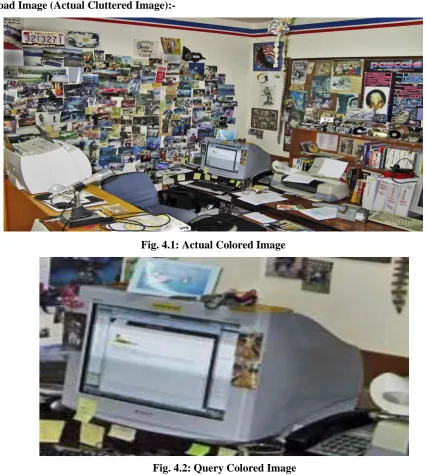
- As the very first step is the acquisition of an image, here weare considering the set of cluttered images. For using this methodology in the thesis work, first the Actual image
is required where the object has to be detected. Further, the query image is required i.e. the image/object which
has to be detect in the Actual image. After that, transformation technique DWT is applied on images which will
decompose the images into low-frequency sub-band and high frequency sub-band using wavelet transformation.
two algorithms are considered to detect the region that are SIFT and corner detection. Feature detection is used
to detect the interest points or key points in the image.
Fig.3.1: Flowchart for features based object Detection using DWT technique
Typically it means that these points correspond to some elements of the scene that can be reliably located in
different views of that scene. Now the extracted features will be matched of both of the images.Generally
matching the points the query image is transformed and further the location of the object is estimated over the
actual image. At last if the object is detected it will be shown and if no inliers are matched with actual image
IV. IMPLEMENTATION
Load Image (Actual Cluttered
Image):-Fig. 4.1: Actual Colored Image
Fig. 4.2: Query Colored Image
Gray Scale Conversion and Pre-processing Operation
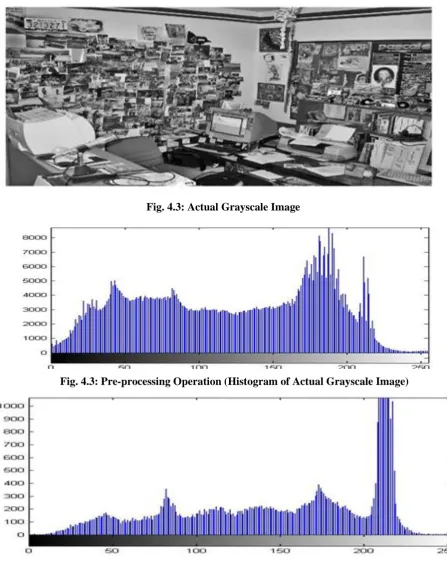
-In next Step Gray scale conversion andPre-processing operations like brightness, Histograms of Actual and Query grayscale Images to remove unwanted
Fig. 4.3: Actual Grayscale Image
Fig. 4.3: Pre-processing Operation (Histogram of Actual Grayscale Image)
Fig.4.4: Histogram of Query Grayscale Image
Discrete Wavelet Transform(Haar Wavelet)- In next step, DWT(Haar Wavelet), a decomposition technique
Fig.4.5: Low Resolution Image
Fig.4.6: High Resolution Image
Features Detection Using SIFT- In next step, features Detection on Actual and Query image using SIFT, a
features based algorithm
Fig.4.7: Features Detection using SIFT on Actual Image
-Fig.4.8: Features Detection using Corner detection algorithm on Query Image
Features Matching-
Fig.4.9: Features Matching between Actual and Query Image
Region Detection-
Fig.4.10: Detected region between Actual and Query Image
Similarly, same steps are followed for ten set of cluttered images, in some case when it does not match inliers
Fig.4.11: No matched inliers
4.12 Analysis Table
V. CONCLUSION AND FUTURE SCOPE
As the study undergoes the observational study the work has been conducted on the dataset that has been
selected with the help of simple random sampling. When we capture the image, there are some facts involve in
objects present in the image. Here the objects can be detected on the basis of features, whether they are
decomposed using Haar Wavelet and apply SIFT features detection and corner detection algorithm for features
detection, matching, geometric transformation for detecting inliers and region detection. As the work is related
to feature based object detection, further facts can be there in cluttered image applications by fusing scale
invariant features transform and Haar wavelet Transform. From the result obtained, it is gathered that under
similar conditions, SIFT has optimal performance in regard to its predecessors. SIFT can be used to discover
Algorithm (SIFT+DWT) Dimensions for Actual Images Dimensions for Query Images detected points in Actual Images detected points in Query Images matched points in both images Detected object/region Time taken in seconds
Image Set 1 (757X1024) (243X219) 4301 200 4 Very Clear 17.9888s
Image Set 2 (757X1024) (190X210) 4301 200 3 Very Clear 17.5941s
Image Set 3 (757X1024) (263X435) 4301 200 No Matched
inliers for
SIFT+DWT
(0)
Not Detected 13.5949s
Image Set 4 (757X1024) (198X264) 4301 155 3 Clear 13.0859s
Image Set 5 (338X450) (133X156) 579 66 3
Very Clear
2.2255s
Image Set 6 (550X420) (108X112) 710 83 3 Clear 3.2390s
Image Set 7 (525X700) (182X187) 1984 71 3 Clear 6.1423s
Image Set 8 (525X700) (222X123) 1984 120 4 Very Clear 6.1608s
Image Set 9 (466X700) (167X111) 2186 114 5 Very Clear 5.5620s
analogous objects in two different images. The SIFT algorithm is evidently competent to detect whether the
query object exists in actual image or not. Finally, determine how much efficient the fusion of SIFT and Corner
detection with transformation technique DWT, also time taken by different images for detection of objects.
The SIFT and Corner features algorithm improves on previous approaches by being largely invariant to change
in scale, illumination, partial occlusion in cluttered images. A final stage that detect object using SIFT and
Corner detection is used for accuracy determination.
REFERENCES
[1] R.Yogamangalam et al. “Segmentation Techniques Comparison in Image Processing “International
Journal of Engineering and Technology (IJET), Vol. 5, No 1, pp.-307-313, Feb-Mar 2013.
[2] Md.Amran Hossen Bhuiyan et al. “Image Processing for Skin Cancer Features Extraction”, International
Journal of Scientific & Engineering Research, Volume 4, Issue 2, pp. 1-6, February-2013.
[3] Ms. Shubhada. K. Nagralei et al. “Application of Image Processing for Development of Automated
Inspection System”, International Journal of Computational Engineering Research (ijceronline.com) Vol. 3
Issue. 3, 2013.
[4] Devis Tuia et al. “recent advances in remote sensing image processing” IEEE, Conference: 7-10 Nov.
2009.
[5] B.B. Chaudhuri et al. “Target Detection: Remote Sensing Techniques for Defense Applications”, Defence
Science Journal, Vol 45, No.4, October 1995, DESIDOC.
[6] Juergen Gall et al.“Class-Specific Hough Forests for Object Detection”,Decision Forests for Computer
Vision and Medical Image Analysis Advances in Computer Vision and Pattern Recognition,CVPR’09
conference, 2013, pp 143-157; Springer.
[7] Ireyuwa. E. Igbinosa, “ Comparison of Edge Detection Technique in Image Processing Techniques”,
International Journal of Information Technology and Electrical Engineering, Volume 2, Issue 1, pp. 25-29,
February 2013.
[8] Amiraj Dhawan et al.”Implementation of Hand Detection based Techniques for Human Computer
Interaction”International Journal of Computer Applications IJCA Journal, Volume 72 - Number 17, pp.
6-13, 2013.
[9] Ms. Shweta Tyagi, Mr. Hemant Amhia., Mr. Shivdutt Tyagi, “Comparative Study of Image Enhancement
and Analysis of Thermal Images Using Image Processing and Wavelet Techniques”, International Journal