ISSN (Print) : 2320 – 3765 ISSN (Online): 2278 – 8875
I
nternational
J
ournal of
A
dvanced
R
esearch in
E
lectrical,
E
lectronics and
I
nstrumentation
E
ngineering
(An ISO 3297: 2007 Certified Organization)
Vol. 4, Issue 5, May 2015
Rendezvous Planning in Wireless Sensor
Networks with Mobile Elements
S.Rajayoka priyadharshini1 , S.Sumithra2
PG Student (CN), Dept.of ECE, Pavendar Bharathidasan College of Engineering and Technology,
Trichy,Tamilnadu,India1
Associate Professor, Dep.of ECE,Pavendar Bharathidasan College of Engineering and Technology, Trichy,Tamilnadu,
India2
ABSTRACT:The problem that has been faced in WSNs is the increased latency in data collection due to the speed at which the data have been collected. So in order to collect the data efficiently a rendezvous point (RP) is used. Here data are collected by the base station while visiting the rendezvous points. The rendezvous points collect the data which are being buffered from various source nodes which aggregate at a particular point known as RP. This work proposes an efficient rendezvous design algorithm with provable performance bounds with mobility and fixed tracking.
KEYWORDS-cluster,basestation, rendezvouspoint,Routing
I. INTRODUCTION
A wireless sensor network (WSN) of spatially distributed autonomoussensors to monitor physical or environmental conditions, such as temperature, sound, pressure, etc. and to cooperatively pass their data through the network to a main location. The more modern networks are bi-directional, also enabling control of sensor activity. The development of wireless sensor networks was motivated by military applications such as battlefield surveillance; today such networks are used in many industrial and consumer applications, such as industrial process monitoring and control, machine health monitoring, and so on.The WSN is built of "nodes" – from a few to several hundreds or even thousands, where each node is connected to one (or sometimes several) sensors. Each such sensor network node has typically several parts: a radiotransceiver with an internal antenna or connection to an external antenna, a microcontroller, an electronic circuit for interfacing with the sensors and an energy source, usually a battery or an embedded form of energy harvesting.
The existing system, The energy expenditure of the sensor nodes occurs during the wireless communication, the environment sensing and the data processing. The routing protocols in WSNs aim mainly at the attainment of power conservation. And the routing protocols developed for wired networks pursue the attainment of high Quality of Service (QoS), they are practically improper for application in WSNs. For these reasons, many protocols have been proposed for data routing in sensor networks.The existing system used the Energy Efficient Cluster Formation Protocol (EECFP) elects the nodes with the higher energy as cluster heads and rotates them in each round to provide a balance of energy consumption and to minimize the energy spend for cluster formation.The main problem faced in wireless sensor network is the network lifetime that must operate for an extended period of time on limited power supplies by means of batteries.These schemes focused of the individual device, and that approach is too narrow when working with wireless sensor networks. Sensor nodes have limited transmitting ranges, only a few nodes can communicate directly with the sink node..
II. RELATED WORKSIN RENDEZVOUS PLANNING
A.NETWORK FORMATION
ISSN (Print) : 2320 – 3765 ISSN (Online): 2278 – 8875
I
nternational
J
ournal of
A
dvanced
R
esearch in
E
lectrical,
E
lectronics and
I
nstrumentation
E
ngineering
(An ISO 3297: 2007 Certified Organization)
Vol. 4, Issue 5, May 2015
structure is the equilibrium in a fixed-size network. Networks are formed with the given range of the sensors. Nodes are grouped automatically depends upon their radio waves Agents are formed for group registration.
Fig.2.1 Flow Diagram
B. NEIGHBOUR ESTIMATION
Proposed to achieve trade-off of energy consumption and time delay. Sensors send their measurement to a subset of sensors called relay points (RPs) by multi-hop communication.a sink moves around in the network and retrieves data from encountered RPs. RPs are static, data dissemination to RPs is equivalent to data dissemination to static sinks.Multihop ,a wireless network adopting multihop wireless technology without deployment of wired backhaul links.Tree based topology, one end of the path is the base station Broadband Multimedia Wireless Research Lab,Dedicated carrier owned infrastructure.Benefit of multi-hop technology are Rapid deployment with lower-cost backhaul, Easy to provide coverage in hard-to-wire areas, Under the right circumstances, it may, Extend coverage due to multi-hop forwarding Broadband Multimedia Wireless Research Lab.
C. CLUSTER HEAD SELECTION
ISSN (Print) : 2320 – 3765 ISSN (Online): 2278 – 8875
I
nternational
J
ournal of
A
dvanced
R
esearch in
E
lectrical,
E
lectronics and
I
nstrumentation
E
ngineering
(An ISO 3297: 2007 Certified Organization)
Vol. 4, Issue 5, May 2015
Fig.2.1 Cluster Head Selection
III. SELECTION OF CLUSTERING TECHNIQUES
Due to the communication devices on sensor nodes have limited battery capacity and transmission range, wireless sensor networks (WSNs) are considered to be energy constrained. In this paper, we propose a novel clustering algorithm called limiting member node clustering (LmC) algorithm to limit the number of member nodes for each cluster head by using a threshold value. The proposed clustering approach selects a cluster head based on a new cost function which considers the residual battery level, energy consumption and distance to the base station. In our experiments, we considered the transmission range of the base station in WSNs to improve the clustering performance. From experimental results, the proposed algorithm can efficiently achieve high number of successfully delivered packets as well as the longest network lifetime while give the shortest delay time and low energy consumption when compared with different existing algorithms.
IV. RENDEZVOUSPOINT CALCULATION
This module describes about how to calculate the RP for the purpose of tracking By placing the RPs on an approximate Steiner Minimum Tree of source nodes allows the data to be efficiently aggregated to RPs and shortening the data collection tour of base station.The RP point can be assumed to be the shortest node in the cluster from the base station. The source nodes will send the data to the RP and the RP can accumulate all the data sends by the source nodes in its data cache .This uses the N-to-one aggregation model in which a node can aggregate multiple data packets it received into one packet before relaying it.
ISSN (Print) : 2320 – 3765 ISSN (Online): 2278 – 8875
I
nternational
J
ournal of
A
dvanced
R
esearch in
E
lectrical,
E
lectronics and
I
nstrumentation
E
ngineering
(An ISO 3297: 2007 Certified Organization)
Vol. 4, Issue 5, May 2015
D.MOBILITY BS TRACKING
This method analyzes the rendezvous design problem when the BS can freely move in the network deployment region along any track. To find a BS tour no longer than L and a set of routing trees that are rooted on the tour and connect all sources, such that the total Euclidean length of the tree is minimized. It develops the tracking by the shortest distance of the RP from the BS. When the first track has been drawn from the BS to any one of the shortest RP, the RP will check for the next shortest RP in the network.
E.sFIXED BS TRACKING
ISSN (Print) : 2320 – 3765 ISSN (Online): 2278 – 8875
I
nternational
J
ournal of
A
dvanced
R
esearch in
E
lectrical,
E
lectronics and
I
nstrumentation
E
ngineering
(An ISO 3297: 2007 Certified Organization)
Vol. 4, Issue 5, May 2015
V. PERFORMANCE EVALUATION
This Module evaluates the performance of rendezvous design algorithms. The simulations are based on a geometric network model in which the shortest point from the base station in the network region can be chosen as an RP.The performance metric is the total Euclidean length of routing trees that connect sources to the RPs. Such a geometric network model allows us to validate the design of MT and FT and the tightness of derived performance bounds.
VI. PACKET FORWARDING
Assigned Cluster heads collect the recorded information from the sensor nodes and perform filtering upon raw data and forward the filtered information to the appropriate “Ingress Node”. The latency in data collection due to low speed of Mobile element can be addressed by using subset of nodes as ingress nodes that buffer and aggregate data from other nodes and transfer to the ME when it arrives, achieving a balance between energy saving and data collection delay.
Fig.5.1 Packet send to source to base station
Data collection is the process of gathering and measuring information on variables of interest, in an established systematic fashion that enables one to answer stated research questions, test hypotheses, and evaluate outcomes. The data traces are collected from a real deployed WSN. The distributed spatial data correlation detection and spatial redundancy destruction is achieved by dividing a WSN into several clusters.ADC achieves low communication cost by fair certain stable state and strong sensual used to sensors.
VII. RESULTS AND SIMULATION ANALYSIS
ISSN (Print) : 2320 – 3765 ISSN (Online): 2278 – 8875
I
nternational
J
ournal of
A
dvanced
R
esearch in
E
lectrical,
E
lectronics and
I
nstrumentation
E
ngineering
(An ISO 3297: 2007 Certified Organization)
Vol. 4, Issue 5, May 2015
Fig 6.1 Rendezvouspoint Collect Data From Various Node
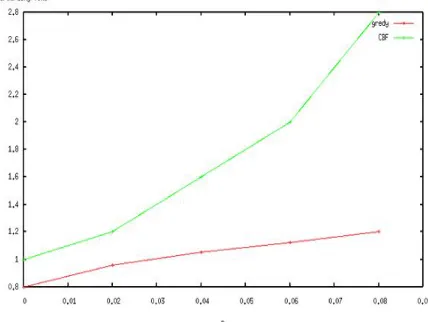
Fig 6.2Node Density vs End to End Delay Of The Node
In the Fig 6.2, it shows the graph ofNode Density vs End to End Delay of the Node.we have by simulation evaluated
how well connected a system of randomly placed nodes are for different node densities and network sizes.
ISSN (Print) : 2320 – 3765 ISSN (Online): 2278 – 8875
I
nternational
J
ournal of
A
dvanced
R
esearch in
E
lectrical,
E
lectronics and
I
nstrumentation
E
ngineering
(An ISO 3297: 2007 Certified Organization)
Vol. 4, Issue 5, May 2015
In the Fig 6.3, it shows the graph of Packet Forwarding Time vs Packet Sending.Relaying of packetsfrom one network segment to another by nodes in a computer network. A unicast forwarding pattern, typical of many networking technologies including the over whelming majority of Internet traffic.
Fig.6.4 Packet Delivery Ratio vs Node Density
In the Fig 6.4, it shows the graph ofPacket Delivery Ratio vs Node Density.Packet delivery ratio the ratio of the number of delivered data packet to the destination
VIII. CONCLUSION
In the relay-based data compilation access RPs are static, once preferred they do not change. However due to message relay overhead, uneven energy reduction will appear around RPs as the network evolves, offsetting the efficiency of the algorithm for network lifetime elongation. Our work identifies data resemblances among the sensor nodes by matching their local guesstimate models rather than their original data. The simulation outputs show that our approach can greatly reduce the volume of messages in wireless communications.A greedy heuristic algorithm to get an approximate solution. A monitoring method to adjust the configuration of node subsets confer to the changes of sensor readings. The data traces are collected from a real deployed WSN.The distributed spatial data correlation detection and spatial redundancy destruction is achieved by dividing a WSN into several clusters.ADC achieves low communication cost by fair certain stable state and strong sensual used to sensors.Our work detects data similarities among the sensor nodes by comparing their local estimation models rather than their original data. The simulation results show that our approach can greatly reduce the amount of messages in wireless communications.The spatial, temporal parallel within WSNs used in novel evaluation model to approximate all sensor readings. In this scheme prove rated error bounds of data assemblage using this model.The result show that our approach can greatly reduce the volume of messages in wireless communications.
REFERENCES
[1]G. Tolle, J. Polastre, R. Szewczyk, D. Culler, N. Turner, K. Tu, S. Burgess, T. Dawson, P. Buonadonna, D. Gay, and W. Hong, “A Macroscope in the Red Woods,” Proc. Third Int’l Conf. Embedded Networked Sensor Systems (SenSys ’05), 2005.
[2] M. Li, Y. Liu, and L. Chen, “Non-Threshold Based Event Detection for 3D Environment Monitoring in Sensor Networks,” IEEE Trans. Knowledge and Data Eng., vol. 20, no. 12, pp. 1699-1711, Dec. 2008.
[3] M. Li and Y. Liu, “Underground Coal Mine Monitoring with Wireless Sensor Networks,” ACM Trans. Sensor Networks, vol. 5, no. 2, pp. 1-29, 2009.
[4] Z. Yang and Y. Liu, “Quality of Trilateration: Confidence based Iterative Localization,” IEEE Trans. Parallel and Distributed Systems, vol. 21, no. 5, pp. 631-640, May 2010.
[5] G. Werner-Allen, K. Lorincz, J. Johnson, J. Lees, and M. Welsh, “Fidelity and Yield in a Volcano Monitoring Sensor Network,” Proc. Seventh Symp. Operating Systems Design and Implementation (OSDI ’06), 2006.
[6] L. Mo, Y. He, Y. Liu, J. Zhao, S. Tang, X. Li, and G. Dai, “Canopy Closure Estimates with GreenOrbs: Sustainable Sensing in the Forest,” Proc. Seventh ACM Conf. Embedded Networked Sensor Systems (SenSys ’09), 2009.