286 | P a g e
AN EFFICIENT AND FAST SUPER RESOLUTION
RECONSTRUCTION ALGORITHM
Divya T P
1, Dr. M Z Kurian
24
thsem, M.tech
1, Head of the Department
2Department of E&C, Sri Siddhartha Institute of Technology, Tumkur, Karnataka, (India)
ABSTRACT
Due to the factors like processing power limitations, channel capabilities and storage capability limitation, images are often down sampled and transmitted at low bit rates, thus resulting in a low resolution compressed image. Restoration of such images is the difficult task in Image Processing. High resolution images can be reconstructed from several blurred and down sampled low resolution image using a computational process known as super resolution reconstruction. Super resolution is the process of combining multiple aliased low quality images to produce a high resolution, high quality image. This paper presents the Design and implementation of Super Resolution algorithm using sparse representation and FFT based Image Registration. Research on image statistics suggests that the image patches can be well represented as a sparse linear combination of elements from an appropriately chosen over-complete dictionary. Inspired by
this observation, sparse representation for each patch of the low-resolution input, and then use these
coefficients for the representation to generate the high-resolution image.
Key Words: Image Registration, Image Super Resolution, Sparse Representation, Image
Restoration.
I
INTRODUCTION
287 | P a g e Frequency domain approach, and Spatial domain approach. Frequency domain approach, which can perform Fourier transform of an image. These methods are simple and computationally cheap, they are extremely sensitive to model error, limiting their use and Spatial domain approach, which can perform directly on pixel and it is also more popular method. These methods are computationally expensive.
Image resolution can be improved when the relative displacements in image sequence are known accurately. Since the setup for high resolution imaging proves expensive and also it may not always be feasible due to the inherent limitations of the sensor, optics manufacturing technology. High resolution images are not always available. Need to increase the current resolution by two ways, either reducing the pixel size or by increasing the chip size. However it has some limitations which can generate noise and degrade the image quality. These problems can be overcome through the use of image processing algorithms, which are relatively inexpensive, giving rise to concept of super-resolution. It provides an advantage as it may cost less and the existing low resolution imaging systems can still be utilized. Super-resolution is the process of combining a sequence of low resolution images in order to produce a higher resolution image or sequence. It is not an easy task as one low resolution image might relate to different high resolution images. Hence, they need to impose some constraints on the original images to make sure that the image super resolution is well tractable. Primarily, these rules make use of the correlations within the image or across different images.
II. EXISTING SYSTEM
In the existing system a High resolution image is created from landmark images by implementing global registration and SIFT. A Bi-cubic interpolation algorithm is used to interpolate the input image. With the help of Scale invariant feature transform method, SIFT feature points are identified on the image. Identification of SIFT feature point of all the images in the test database using the same method happens in parallel. A threshold value is set for the number of matching feature points and all the images which are having matches beyond this threshold are identified. These images and the input image could differ in terms of its color, focal length, texture, orientation etc. All these images will be aligned to the input image using global registration in the next step. Correlation of the above images is used to create a high resolution image during the final phase. The existing system recovers high frequency details from a training set consisting of high resolution/low resolution pairs. The up-sampled image of the input image is split into overlapping sections and each of these sections is searched against the training set to retrieve matching parts. The high resolution section from the retrieved image patch will be then added to the input image to create the HR image. But the matched patch should be similar to the input patch and the retrieved HR patch should create consistency while adding to the original input image. In order to comprehend reasonable details in image regions, high-level image analysis is integrated with low level image synthesis. The input LR image is considered as small textures and each of these textures is matched against relevant textures within the database. The results of this method demonstrate the potential of finding matched sections in a similar object set.
288 | P a g e such as recognition of face and animals. Also, the images containing rich textural regions without dominant structures, such as grass and leaves, which are hard to register using the SIFT descriptors; this method of registration is not accurate. Also, in this existing system, exemplar based image SR is used to build high resolution images from the registered images. Though, this method creates a better image in terms of resolution compared to the input image, the noise percentage is still high. Also, this method may not always provide a better structure similarity between the input and the output images. So, our aim is to find a better method to overcome the above limitations. This could be achieved by employing FFT based image registration and a better SR algorithm to produce high resolution image.
III.PROPOSED SYSTEM
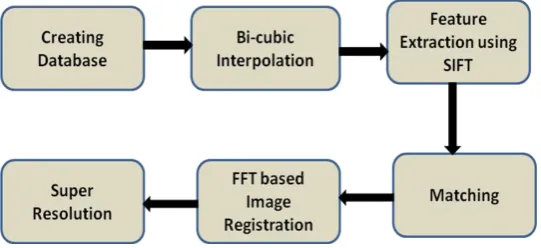
This proposed system employs FFT based image registration and a better SR algorithm to produce high resolution. First creating the database then the low resolution image is subjected to interpolation, feature extraction of interpolated image and input image are done. Then matching of interpolated image and reference image takes place. FFT based Image registration will be implemented to get high resolution image. There are six modules in the proposed system.
The modules are as follows: 1. Create database
2. Bicubic Interpolation 3. Feature Extraction 4. Matching
5. Image Registration 6. Super Resolution
The system design is as shown in the below figure
Fig 1: Proposed System block diagram
3.1
Create database
289 | P a g e automatically, compared with similar operations on text. An easy way to make a searchable image database is to label each image with a text description, and to perform the actual search on those text labels. However, a huge amount of work is required in manually labeling every picture, and the system would not be able to deal with any new pictures not labeled before. Furthermore, it is difficult to give complete descriptions for most pictures. We need to make a good collection of images for this.
3.2 Interpolation
The process of interpolation is one of the fundamental operations in image processing. Interpolation is the process of transferring image from one resolution to another without losing image quality. In Image processing field, image interpolation is very important function for doing zooming, enhancement of image, resizing any many more. The image quality highly depends on the type of interpolation technique used. The interpolation techniques are divided into two categories, deterministic and statistical interpolation techniques. The difference is that deterministic interpolation techniques assume a certain variability between the sample points, such as linearity in case of linear interpolation. Statistical interpolation methods approximate the signal by minimizing the estimation error. This approximation process may result in original sample values not being replicated. Among many interpolation techniques Bicubic Interpolation technique is used in this project.
Bicubic Interpolation
When using the bi-cubic interpolation zoomed image intensity(x,y) is defined as interpolated point is filled with sixteen closest pixel‟s weighted average of the original image. Let the zooming factor is „s‟, and the mapped pixel point in the orginal image is given by „r‟ and „c‟. Then the neighbor-hood matrix can be defined as
11 12 13 14
21 22 23 24
31 32 33 34
41 42 43 44
( 1, 1) ( 1, ) ( 1, 1) ( 1, 2) ( , 1) ( , ) ( , 1) ( , 2) ( 1, 1) ( 1, ) ( 1, 1) ( 1, 2) ( 2, 1) ( 2, ) ( 2, 1) ( 2
p p p p f r c f r c f r c f r c
p p p p f r c f r c f r c f r c
p p p p f r c f r c f r c f r c
p p p p f r c f r c f r c f r
,c 2)
Using the bi-cubic algorithm
3 3
0 0
( , )
ij iji j
v x y
a p
The coefficients aij can be find using the La-grange equation.
a
ij
a
i* ...
b
j3.3 Feature extraction
290 | P a g e illumination and 3D camera viewpoint. Scale-invariant feature transform (or SIFT) is an algorithm used to identify and depict local features in images. The SIFT algorithm takes an image as input and transforms the image into a compilation of local feature vectors. Each of these vector attributes is believed to be distinguishing and invariant to any scaling, translation or rotation of the image. In the implementation, these features are used to find distinguished objects in different images and the transform can be extended to match objects in images. Following are the major stages of SIFT computation used to generate the set of image features:
Fig 2 :Stages of SIFT algorithm
a) Scale-space extrema detection: The first stage of computation searches over all scales and image locations. It is implemented efficiently by using a difference-of-Gaussian function to identify potential interest points that are invariant to scale and orientation. In order to detect the local maxima and minima each sample point is compared to its eight neighbors in the current image and nine neighbors in the scale. It is selected only if it is larger than all of these neighbors or smaller than all of them. The cost of this check is reasonably low due to the fact that most sample points will be eliminated following the first few checks.
b) Keypoint localization: Keypoints are selected based on measures of their stability. Once a keypoint candidate has been found by comparing a pixel to its neighbors, the next step is to perform a detailed fit to the nearby data for location, scale, and ratio of principal curvatures. This information allows points to be rejected that have low contrast (and are therefore sensitive to noise) or are poorly localized along an edge.
c) Orientation assignment: One or more orientations are assigned to each keypoint location based on local image gradient directions. All future operations are performed on image data that has been transformed relative to the assigned orientation, scale, and location for each feature, thereby providing invariance to these transformations. By assigning a consistent orientation to each keypoint based on local image properties, the keypoint descriptor can be represented relative to this orientation and therefore achieve invariance to image rotation. This approach contrasts with the orientation invariant descriptors of Schmid andMohr, in which each image property is based on a rotationally invariant measure.
d) Keypoint descriptor: The local image gradients are measured at the selected scale in the region around each keypoint. These are transformed into a representation that allows for significant levels of local shape distortion and change in illumination. The previous operations have assigned an image location, scale, and orientation to
Scale-space extrema detection
Keypoint descriptor Orientation assignment
291 | P a g e each keypoint. These parameters impose a repeatable local 2D coordinate system in which to describe the local image region, and therefore provide invariance to these parameters.
3.4 Matching
This method uses an adaptively retrieved HR image collection from a large-scale database created by crawling images from the Internet. Bundled SIFT descriptors are used for image retrieval in our method, which are more distinguished than a single descriptor in a large scale partial-duplicate web image search. In the bundled recovery, the SIFT descriptors are classified according to spatial correlations between them. One image region coupled with a large-scale descriptor normally contains a few small-scale descriptors. These descriptors are bundled as one set to serve as a primary unit in feature matching. To step up the search process, the BoW (Bag-of-Words) is used in which the SIFT descriptors are accumulated into visual words. The bundled sets of one image are then saved as one inverted-file index, as demonstrated in Fig. 4. Each visual word has an entry in the index which consists of the list of images in which the visual word is presnt. It also has the number of members in the set centered on this visual word, which is followed by the members of visual words and sector index. The number of member visual words in a set is restricted to 128 and the count of indices is set at 4. Then each of these bundled set is matched against the bundled sets saved in the inverted-file index. The matching is scored by the amount of matching visual words and the geometric relationship. Then this score is mapped to the image associated with the matched group. Once all the bundled sets in the query image are matched, the correlation among a candidate image and the query image is calculated by the sum of the scores of matched bundle groups among them. A higher total score suggests a better correlation. Images with many highest total scores are preferred as correlated images for the query image. The visual group based retrieval normally performs better than the Bow method in terms of the mean average precision (mAP) owing to the usage of spatial correlations between descriptors.
3.5 Image registration
292 | P a g e to log-polar coordinates. Owing to the properties of the Fourier transform, the scaling and rotation parameters can be measured in a manner invariant to transformation.
Algorithm for FFT based image registration
1. Provide one reference image and three matched images 2. Use image registration via correlation
3. Compute error for no pixel shift
4. Compute cross correlation by an IFFT and locate the peak 5. Up-sample by a factor of 2 to obtain initial estimate 6. Embed Fourier data in a 2x larger array
7. Compute cross correlation and locate the peak
8. Obtain shift in original pixel grid from the position of the cross correlation peak 9. If up sampling > 2, then refine estimate with matrix multiply DFT
10. Locate maximum and map back to original pixel grid 11. Compute registered version of first image.
12. Continue the above steps for the other two images
3.6 Super Resolution
293 | P a g e
IV.RESULT
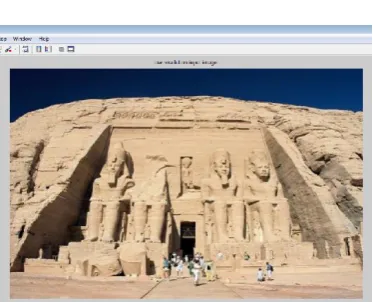
Fig 3: Input low resolution Image Fig 4: Bicubic interpolated image
Fig 5: Feature extraction using SIFT Fig 6: Matched image
Fig 7: Registered Image Fig 8: Output Image
V. APPLICATIONS
A. The need for high resolution is common in computer vision applications for better performance in pattern recognition and analysis of images.
294 | P a g e Mammography images allow the acquisition of several images, which can be combined in order to obtain a higher-resolution image.
C. Many applications require zooming of a specific area of interest in the image wherein high resolution becomes essential, e.g. surveillance, forensic and satellite imaging applications.
D. In Astronomical imaging where it is possible to obtain different looks of the same scene.
VI. RESULT ANALYSIS
Parameters Input Image SR Image
Dimensions Width height
600 X 400 600 pixels 400 pixels
3598 X 2598 3598 pixels 2598 pixels
Image size 400
1800
2398 10794
VII. CONCLUSION
Creation of image database, implementation of Interpolation technique, feature extraction is by using Scale Invariant Feature Transform algorithm, matching, Image registration and Super Resolution algorithm are implemented.
REFERENCES
[1] Archana Vijayan, Vincy Salam “ A New Approach for Super resolution by Using Web Images and FFT Based Image Registration” International Journal of Engineering Trends and Technology (IJETT) – Volume 12 Number 9 - Jun 2014.
[2] R. Kokila, and P. Thangavel “ Image Registration Based on Fast Fourier Transform Using Gabor Filter” International Journal of Computer Science and Electronics Engineering (IJCSEE) Volume 2, Issue 1 (2014) . [3] Georgios Tzimiropoulos and Tania Stathaki Robust FFT-Based Scale-Invariant Image Registration
Communications and Signal Processing Group, Imperial College London, Exhibition Road, London, SW7 2AZ 2014.
[4] Mr.Huanjing Yue, Mr.Xiaoyan Sun, Mr.Jingyu Yang and Mr.Feng Wu have done a research on “Landmark Image Super-Resolution by Retrieving Web Images” IEEE Transactions on Image Processing, VOL. 22, No. 12, December 2013.
[5] Mr.Niyanta Panchal, Mr.Bhailal Limbasiya and Mr.Ankit Prajapati “Survey On Multi-Frame Image Super-Resolution” International Journal of Scientific & Technology Research volume 2, issue 11, November 2013. [6] Ankit Prajapati, Sapan Nayak and Sheetal Mehta “Evaluation of Different Image Interpolation Algorithms”
295 | P a g e [7] Mr.Liyakathunisa and Mr.C.N .Ravi Kumar “A Novel Super Resolution Reconstruction of Low Resolution
Images Progressively using DCT and Filter based” International Journal of Computer Science & Information Technology (IJCSIT), Vol 3, No 1, Feb 2011.
[8] Medha V. Wyawahare, Dr. Pradeep M. Patil, and Hemant K. Abhyankar “ Image Registration Techniques: An overview International Journal of Signal Processing, Image Processing and Pattern Recognition Vol. 2, No.3, September 2009.