Page | 80
INTERVAL - VALUED INTUITIONISTIC FUZZY
ASSIGNMENT PROBLEM WITH REPLACEMENT
BASED ON FUZZY AGGREGATION
B. Pothiraj
1, S. Rajaram
2 1Assistant Professor, Department of Mathematics
2
Associate Professor, Department of Mathematics
Sri S. R. N. M. College, Sattur , Virudhunagar (Dt.),Tamil Nadu, ( India)
ABSTRACT
In this paper the theory of interval valued intuitionistic fuzzy sets (IVIFS) is used to propose an interval valued intuitionistic fuzzy assignment model involving the replacements. Under the fuzzy environment the individuals may provide the information conveniently with interval valued intuitionistic fuzzy numbers (IVIFN). Corporate competitiveness is heavily influenced by the professional (skilled) staff involved in the decision making. The job performance of a professional may correlate to the time taken to task. Two issues being analysed in this approach. The first one is to develop an ideal priority of the professional staff of the groups and the second one is to replace the staff where we need to avoid breakdowns. Replacement is made in the form of maximum intuitionistic fuzzy scoring by utilizing the intuitionistic fuzzy aggregation operator to aggregate the given intuitionistic fuzzy information and by the weight vector. The feasibility and applicability of the proposed method are illustrated with a numerical problem.
Keywords : Aggregative operators, Ideal priority, IVIF set, IVIF number.
I.
INTRODUCTION
Atanassov and Gargov (1989) generalized the concept of instuitionistic fuzzy set (IFS) to interval - valued intuitionistic fuzzy set (IVIFS) and define some basic operational laws of IVIFS. In the corporate sector the assignment problem plays a vital role. Among researchers it has received a significant amount of attention. The costs are not known exactly in real world application. Employing fuzzy theory to model uncertainity in real problem it is assumed that the membership function of parameters are known. However in reality it is not always easy. In order to solve this problem, the best thing is to determine the uncertain as intervals. In some situations if an individual is not familiar with the problem, it is difficult to determine the exact values of the preference degrees. His views may be positive, negative and hesitative points. In this realistic situation intuitionistic fuzzy set is the useful tool to express.
Page | 81
aggregate all individual decision into a collective decision. Since the individuals in the groups may have different capabilities it is necessary to use weighted aggregation. In the present complex socio economic environment and the insufficient knowledge of the problem, under the fuzzy environment, individuals in the group may provide their information over alternatives with interval valued intuitionistic fuzzy number (IVIFN). Chen (1985) introduced a fuzzy assignment model that considers all individuals have same skills. Huang and Zhang (2006) proposed a mathematical model for the fuzzy assignment problem with restriction on qualification. Mukherjee and Basu (2011) proposed intuitionistic fuzzy assignment problem by using similarity measures and score functions. Xu (2007) defined the concept of interval - valued intuitionistic fuzzy number. Xu and Chen (2007) define an interval-valued intuitionistic fuzzy ordered weighted averaging operator and an interval-valued intuitionistic hybrid averaging operator. Lin and Wen (2004) concentrate on the assignment problem where costs are not deterministic numbers but imprecise ones. Gaurav and Bajaj (2014) proposed interval-valued intuitionistic fuzzy assignment problem by using similarity measure and score functions.
II. Preliminaries On Interval Valued Intuitionistic Fuzzy Sets
This section presents the basic concepts related to Interval-Valued Intuitionistic Fuzzy Set, which was originally introduced by Atanassov and Gargov (1989).
2.1. Interval-Valued Intuitionistic Fuzzy Set(IVIFS):
Let be a fixed set. Then is called an interval- valued intuitionistic
fuzzy set (IVIFS), where and , with the condition:
Clearly, if and , then IVIFS reduces to a traditional IFS.
2.2 Ranking Of Interval Valued Intuitionistic Fuzzy Number :
Definition 1
Let be an IVIFN. Then we call
, (1)
the score of , is the score function of , . Clearly the greater the , the larger the . In
particular, if , then is the largest IVIFN: ([1, 1] , [0, 0]); If then is the smallest
IVIFN: ([0, 0], [1, 1]).
Page | 82
, where (2)
Definition 2
Let and be any two IVIFNs. Then
if , then
if and
if , then
if , then
if , then .
2.3 Operational Laws Of Interval-Valued Intuitionistic Fuzzy Number ( Xu, 2007) :
Let , and be IVIFNs. Then
(1) where is the complement of
(2)
(3)
(4) ([
(5) ([
(6)
(7)
Definition 3
Let be the weight vector. Weight is the ratio of cost in the ijth cell to the total cost for each job . i.e.,
Page | 83
Also for each i. We define , , … ,
.
2.4 Interval -Valued Intuitionistic Fuzzy Hybrid Averaging Operator (Xu And Chen 2007) :
Let be the set of all IVIFNs. An interval-valued intuitionistic fuzzy hybrid averaging (IIFHA) operator is a
mapping IIFHA : . Suppose
(4)
where is the weighting vector associated with the IIFHA function, with
and . is the jth largest of the weighted IVIFNs , here
, is the weight vector of a collection of the IVIFNs
( , with and , and n is the balancing coefficient.
Theorem 1 (Xu and Chen 2007)
Assume that and .
Then the aggregated value by using equation (4) is an IVIFN, and
(5)
III. Multi-Attribute Decision Making Problem
Let be a finite set of alternatives, a set of attributes, and
the weight vector of attributes, where
and . Suppose that the characteristic information on the alternatives
Page | 84
(6)
where indicates the degree that the alternative satisfies the attributes , indicates the
degree that the alternative does not satisfy the attribute . Here and are given in the value
ranges, i.e., interval numbers, and , , (7)
Let and ,
Consequently, we can get the interval-valued intuitionistic fuzzy decision matrix ,
. In general, there are two types of attributes, that is benefit attributes
and cost attributes. We can normalize into the interval-valued intuitionistic fuzzy decision matrix
,
where
(8)
where is the complement of ,
IV. Mathematical Model Of Interval Valued Intuitionistic Fuzzy Assignment Problem
An assignment problem is a special type of transporation problem which can be stated in the form of cost
matrix of interval-valued intuitionistic fuzzy numbers as follows:
Table 1 :
Cost matrix of an IVIF assignment problem
Job
Group 1 2
Page | 85
2n
The objective is to assign a number of origins to an equal number of destinations at a minimum cost or maximum profit. Each job must be done by exactly one group and one group can do, at most one job. Mathematically assignment problem can be denoted as
subject to
, (9)
, (10)
where is the decision variable defined as
The cost of a group doing the job is considered as an interval-valued intuitionistic fuzzy number
where denotes the degree of acceptance
and denotes the degree of rejection.
As our objective is to minimize the cost and maximize the profit, we should go for maximize the acceptance
degree . Then the objective function becomes a multi-objective function as
Page | 86
with condition
subject to , (11)
(12)
(13)
Thus the model becomes
.
subject to the conditions (9), (10), (11), (12) and (13).
V. SOLUTION PROCEDURE
Step 1: Identify the teams with members and jobs. Fix the number of persons (alternatives) in a team and fix characteristics (attributes) to develop ideal priorities to each job.
Step 2: Represent attributes of the alternatives by the IVIFNs in an interval-valued intuitionistic fuzzy decision
matrix
Step 3: Transform the attribute value of cost type of each job into attribute values of benefit type using equation
(8) and represent the transformed matrix as
Step 4: Weight all the alternative values by the weight vector (as in equation (3)) of the attributes and
multiply these values by the coefficient values and then get the weighted attribute values and represent
in an interval-valued intuitionistic fuzzy decision matrix
Step 5: Utilize the IIFHA operator calculate the aggregated
values of
Page | 87
Step 7: If there is no breakdown find the maximum of acceptance and minimum of rejection of the cost to do
each job by the persons of the teams. Assign these IVIFNs representing the cost in a matrix to a particular team to do a particular job.
Step 8: Find the score values of the entries of the matrix and represent in a matrix . Using Hungarian
method or any other software find the assignment.
Step 9: If there exist a break down in a team with a particular person then the assignment will be affected. Replace the person corresponding to the break down from the pool whose priority is higher in the ideal priority of the pool.
Step 10: Find the score values of the matrix and represent in a matrix . Using Hungarian method find the assignment.
VI. ILLUSTRATIVE EXAMPLE
Let us consider five teams (alternatives) to do five jobs. Each team consists of four skilled
persons. By considering the following five attributes to decide the priorities of the persons in the team: :
capacity, : performance, : cost to do job, : time management and : Experience. Assume that the
characteristic information of the alternatives and the attribute value information corresponding
to the person of the teams are represented by the IVIFNs.
Team
a) Let us consider team correspondings to job and it has four alternatives and five
attributes Assume that the characteristic information of the alternatives are
represented by the IVIFNs, as shown in the interval-valued intuitionistic fuzzy decision matrix
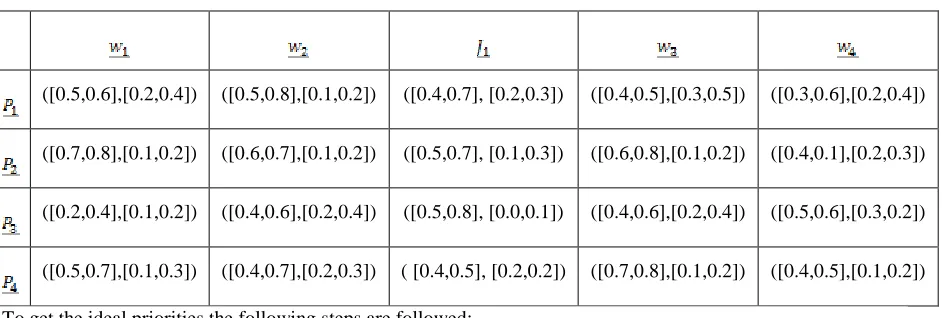
Table 2:
Interval-valued intuitionistic fuzzy decision matrix
([0.5,0.6].[0.2,0.4]) ([0.5,0.8],[0.1,0.2]) ([0.2,0.3],[0.4,0.7]) ([0.4,0.5],[0.3,0.5]) ([0.3,0.6],[0.2,0.4])
Page | 88
([0.2,0.4],[0.1,0.2]) ([0.4,0.5],[0.2,0.4]) ([0.0,0.1],[0.5,0.8]) ([0.4,0.6],[0.2,0.4]) ([0.5,0.6],[0.3,0.2])
([0.5,0.7],[0.1,0.3]) ([0.4,0.7],[0.2,0.3]) ([0.2,0.2],[0.4,0.5]) ([0.7,0.8],[0.1,0.2]) ([0.4,0.5],[0.1,0.2])
0.2, 0.1, 0, 0.2), (0.3, 0.3, 0.1, 0.2)], [min (0.4, 0.5, 0.5, 0.4), (0.7, 0.7, 0.8, 0.5)])
Transform the attribute values of cost type in the attribute values of benefit type by using equation (8). Then
is transformed into .
Table 3:
Interval-valued Intuitionistic fuzzy decision matrix
([0.5,0.6],[0.2,0.4]) ([0.5,0.8],[0.1,0.2]) ([0.4,0.7], [0.2,0.3]) ([0.4,0.5],[0.3,0.5]) ([0.3,0.6],[0.2,0.4])
([0.7,0.8],[0.1,0.2]) ([0.6,0.7],[0.1,0.2]) ([0.5,0.7], [0.1,0.3]) ([0.6,0.8],[0.1,0.2]) ([0.4,0.1],[0.2,0.3])
([0.2,0.4],[0.1,0.2]) ([0.4,0.6],[0.2,0.4]) ([0.5,0.8], [0.0,0.1]) ([0.4,0.6],[0.2,0.4]) ([0.5,0.6],[0.3,0.2])
([0.5,0.7],[0.1,0.3]) ([0.4,0.7],[0.2,0.3]) ( [0.4,0.5], [0.2,0.2]) ([0.7,0.8],[0.1,0.2]) ([0.4,0.5],[0.1,0.2])
To get the ideal priorities the following steps are followed:
First weight all the attribute values by weight vector of the
attributes and multiply these values by the balancing coefficient and then get the
weighted attribute values as listed in the weighted
interval-valued intuitionistic fuzzy decision matrix . Utilizing
definition 3 calculate the weight vector of .
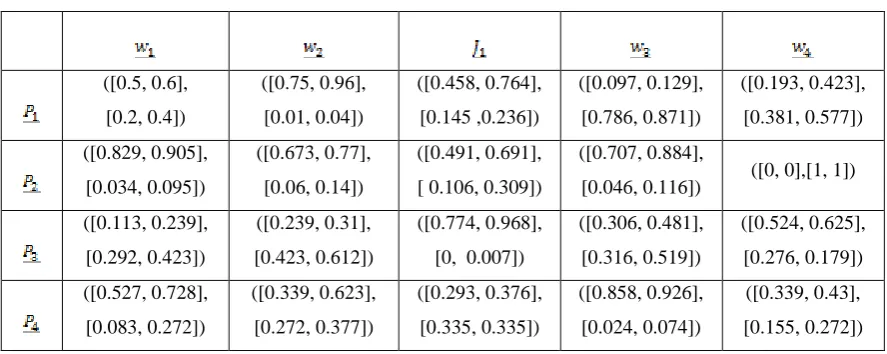
From table 3 we utilize the operational laws (4) and (6) in section 2.3 to get weighted IFNs:
Page | 89
= ([0.75, 0.96], [0.01, 0.04]),
= ([0.458, 0.764], [0.145, 0.236])
= ([0.097, 0.129], [0.786, 0.871]),
= ([0.193, 0.423], [0.381, 0.9]).
Similarly .
Table 4:
The weighted interval-valued intuitionistic fuzzy decision matrix
([0.5, 0.6], [0.2, 0.4]) ([0.75, 0.96], [0.01, 0.04]) ([0.458, 0.764], [0.145 ,0.236]) ([0.097, 0.129], [0.786, 0.871]) ([0.193, 0.423], [0.381, 0.577]) ([0.829, 0.905], [0.034, 0.095]) ([0.673, 0.77], [0.06, 0.14]) ([0.491, 0.691], [ 0.106, 0.309])
([0.707, 0.884],
[0.046, 0.116]) ([0, 0],[1, 1])
([0.113, 0.239], [0.292, 0.423])
([0.239, 0.31], [0.423, 0.612])
([0.774, 0.968], [0, 0.007])
([0.306, 0.481], [0.316, 0.519]) ([0.524, 0.625], [0.276, 0.179]) ([0.527, 0.728], [0.083, 0.272]) ([0.339, 0.623], [0.272, 0.377]) ([0.293, 0.376], [0.335, 0.335]) ([0.858, 0.926], [0.024, 0.074]) ([0.339, 0.43], [0.155, 0.272])
The scores of
s( ,
s( ,
s( ,
s( ,
s( .
Page | 90
, ),
, ,
Similarly we can calculate the values of other rows.
Let be its weighting vector as derived by the normal distribution
based method of Xu (2005). Utilize the IIFHA operator (4) derive the overall attribute values
of alternatives
We obtained
,
,
The scores of by equation (1) are
s( ,
s( ,
s( ,
s( .
Since , we represent the ideal priorities of the persons of team corresponding
Page | 91
b) Consider the cost values of the persons of the team to the job as, , and and the
remaining values of attributes are as in Table 2.The ideal priorities of the persons of team corresponding to
job represented by .
c) Consider the cost values of the persons of the team to the job as
, , and and
the remaining values of attributes are as in Table 2. The ideal priorities of the persons of team corresponding
to job represented by .
d) Consider the cost values of the persons of the team to the job as
, , and and
the remaining values of attributes are as in Table 2. The ideal priorities of the persons of team corresponding
to job represented by
e) Consider the cost values of the persons of the team to the job as
, , and and
the remaining values of attributes are as in Table 2. The ideal priorities of the persons of team corresponding
to job represented by .
Team
a) Let us consider team correspondings to job and it has four alternatives and five
attributes Assume that the characteristic information of the alternatives are
represented by the IVIFNs, as shown in the interval-valued intuitionistic fuzzy decision matrix
Page | 92
([0.6,0.3].[0.2,0.4]) ([0.7,0.6],[0.3,0.1]) ([0.2,0.1],[0.7,0.8]) ([0.2,0.6],[0.3,0.4]) ([0.9,0.7],[0.1,0.1])
([0.4,0.5],[0.3,0.4]) ([0.6,0.7],[0.1,0.2]) ([0.2,0.3],[0.3,0.7]) ([0.3,0.4],[0.1,0.2]) ([0.4,0.6],[0.4,0.3])
([0.3,0.6],[0.3,0.4]) ([0.6,0.7],[0.3,0.2]) ([0.1,0.3],[0.4,0.5]) ([0.7,0.6],[0.2,0.3]) ([0.6,0.5],[0.3,0.4])
([0.7,0.4],[0.3,0.2]) ([0.7,0.9],[0.1,0.1]) ([0.0,0.4],[0.3,0.4]) ([0.7,0.8],[0.2,0.1]) ([0.6,0.5],[0.4,0.3])
0.2, 0.2, 0.1, 0.0), (0.1, 0.3, 0.3, 0.4)], [min (0.7, 0.3, 0.4, 0.3), (0.8, 0.7, 0.5, 0.4)])
Following similar process of team we get the ideal priorities of the persons of team corresponding to job
represented by .
b) Consider the cost values of the persons of the team to the job as
, , and and
the remaining values of attributes are as in Table 5. The ideal priorities of the persons of team corresponding
to job represented by .
c) Consider the cost values of the persons of the team to the job as
, , and and
the remaining values of attributes are as in Table 5. The ideal priorities of the persons of team corresponding
to job represented by
d) Consider the cost values of the persons of the team to the job as
, , and and
the remaining values of attributes are as in Table 5. The ideal priorities of the persons of team corresponding
Page | 93
e) Consider the cost values of the persons of the team to the job as, , and and
the remaining values of attributes are as in Table 5. The ideal priorities of the persons of team corresponding
to job represented by
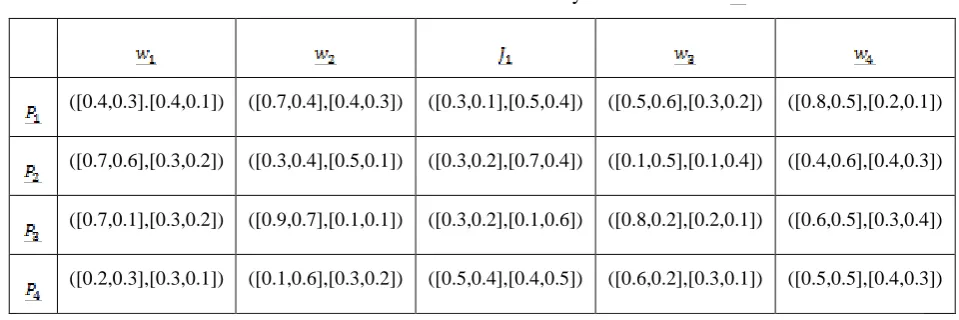
Team
a) Let us consider team correspondings to job and it has four alternatives and five
attributes Assume that the characteristic information of the alternatives are
represented by the IVIFNs, as shown in the interval-valued intuitionistic fuzzy decision matrix
Table 6:
Interval-valued intuitionistic fuzzy decision matrix
([0.4,0.3].[0.4,0.1]) ([0.7,0.4],[0.4,0.3]) ([0.3,0.1],[0.5,0.4]) ([0.5,0.6],[0.3,0.2]) ([0.8,0.5],[0.2,0.1])
([0.7,0.6],[0.3,0.2]) ([0.3,0.4],[0.5,0.1]) ([0.3,0.2],[0.7,0.4]) ([0.1,0.5],[0.1,0.4]) ([0.4,0.6],[0.4,0.3])
([0.7,0.1],[0.3,0.2]) ([0.9,0.7],[0.1,0.1]) ([0.3,0.2],[0.1,0.6]) ([0.8,0.2],[0.2,0.1]) ([0.6,0.5],[0.3,0.4])
([0.2,0.3],[0.3,0.1]) ([0.1,0.6],[0.3,0.2]) ([0.5,0.4],[0.4,0.5]) ([0.6,0.2],[0.3,0.1]) ([0.5,0.5],[0.4,0.3])
0.3, 0.3, 0.3, 0.5), (0.1, 0.2, 0.2, 0.4)], [min (0.5, 0.7, 0.1, 0.4), (0.4, 0.4, 0.6, 0.5)])
Following similar process of team we get the ideal priorities of the persons of team corresponding to job
represented by .
b) Consider the cost values of the persons of the team to the job as
Page | 94
the remaining values of attributes are as in Table 6. The ideal priorities of the persons of team corresponding
to job represented by .
c) Consider the cost values of the persons of the team to the job as
, , and and
the remaining values of attributes are as in Table 6. The ideal priorities of the persons of team corresponding
to job represented by .
d) Consider the cost values of the persons of the team to the job as
, , and and
the remaining values of attributes are as in Table 6. The ideal priorities of the persons of team corresponding
to job represented by .
e) Consider the cost values of the persons of the team to the job as
, , and and
the remaining values of attributes are as in Table 6. The ideal priorities of the persons of team corresponding
to job represented by .
Team
a) Let us consider team correspondings to job and it has four alternatives and five
attributes Assume that the characteristic information of the alternatives are
represented by the IVIFNs, as shown in the interval-valued intuitionistic fuzzy decision matrix
Table 7:
Interval-valued intuitionistic fuzzy decision matrix
Page | 95
([0.5,0.6],[0.1,0.2]) ([0.2,0.3],[0.2,0.1]) ([0.1,0.0],[0.2,0.1]) ([0.5,0.8],[0.2,0.1]) ([0.8,0.7],[0.1,0.2])
([0.7,0.3],[0.3,0.2]) ([0.5,0.7],[0.3,0.3]) ([0.3,0.2],[0.4,0.3]) ([0.6,0.5],[0.4,0.3]) ([0.6,0.2],[0.2,0.4])
([0.7,0.3],[0.3,0.1]) ([0.5,0.6],[0.3,0.4]) ([0.2,0.3],[0.6,0.4]) ([0.8,0.6],[0.2,0.1]) ([0.1,0.4],[0.3,0.1])
0.1, 0.1, 0.3, 0.2), (0.2, 0.0, 0.2, 0.3)], [min (0.3, 0.2, 0.4, 0.6), (0.2, 0.1, 0.3, 0.4)])
Following similar process of team we get the ideal priorities of the persons of team corresponding to job
represented by .
b) Consider the cost values of the persons of the team to the job as
, , and and
the remaining values of attributes are as in Table 7. The ideal priorities of the persons of team corresponding
to job represented by .
c) Consider the cost values of the persons of the team to the job as
, , and and
the remaining values of attributes are as in Table 7. The ideal priorities of the persons of team corresponding
to job represented by .
d) Consider the cost values of the persons of the team to the job as
, , and and
the remaining values of attributes are as in Table 7. The ideal priorities of the persons of team corresponding
to job represented by .
e) Consider the cost values of the persons of the team to the job as
Page | 96
the remaining values of attributes are as in Table 7. The ideal priorities of the persons of team corresponding
to job represented by .
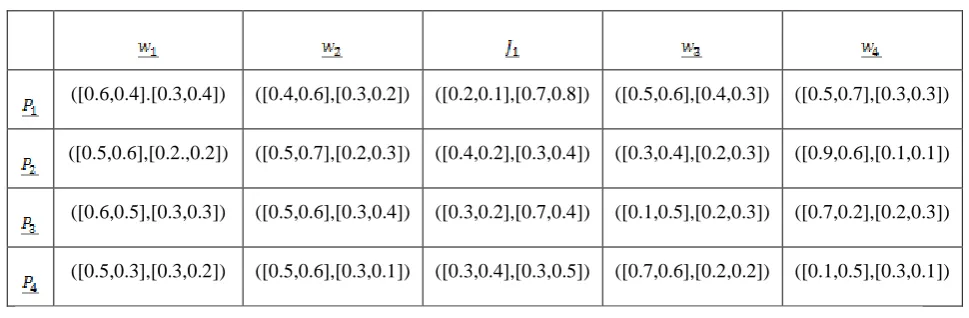
Team
a) Let us consider team correspondings to job and it has four alternatives and five
attributes Assume that the characteristic information of the alternatives are
represented by the IVIFNs, as shown in the interval-valued intuitionistic fuzzy decision matrix
Table 8:
Interval-valued intuitionistic fuzzy decision matrix
([0.6,0.4].[0.3,0.4]) ([0.4,0.6],[0.3,0.2]) ([0.2,0.1],[0.7,0.8]) ([0.5,0.6],[0.4,0.3]) ([0.5,0.7],[0.3,0.3])
([0.5,0.6],[0.2.,0.2]) ([0.5,0.7],[0.2,0.3]) ([0.4,0.2],[0.3,0.4]) ([0.3,0.4],[0.2,0.3]) ([0.9,0.6],[0.1,0.1])
([0.6,0.5],[0.3,0.3]) ([0.5,0.6],[0.3,0.4]) ([0.3,0.2],[0.7,0.4]) ([0.1,0.5],[0.2,0.3]) ([0.7,0.2],[0.2,0.3])
([0.5,0.3],[0.3,0.2]) ([0.5,0.6],[0.3,0.1]) ([0.3,0.4],[0.3,0.5]) ([0.7,0.6],[0.2,0.2]) ([0.1,0.5],[0.3,0.1])
0.2, 0.4, 0.3, 0.3), (0.1, 0.2, 0.2, 0.4)], [min (0.7, 0.3, 0.7, 0.3), (0.8, 0.4, 0.4, 0.5)])
.
Following similar process of team we get the ideal priorities of the persons of team corresponding to job
represented by .
b) Consider the cost values of the persons of the team to the job as
, , and and
the remaining values of attributes are as in Table 8. The ideal priorities of the persons of team corresponding
Page | 97
c) Consider the cost values of the persons of the team to the job as, , and and
the remaining values of attributes are as in Table 8. The ideal priorities of the persons of team corresponding
to job represented by .
d) Consider the cost values of the persons of the team to the job as
, , and and
the remaining values of attributes are as in Table 8. The ideal priorities of the persons of team corresponding
to job represented by .
e) Consider the cost values of the persons of the team to the job as
, , and and
the remaining values of attributes are as in Table 8. The ideal priorities of the persons of team corresponding
to job represented by .
Team pool
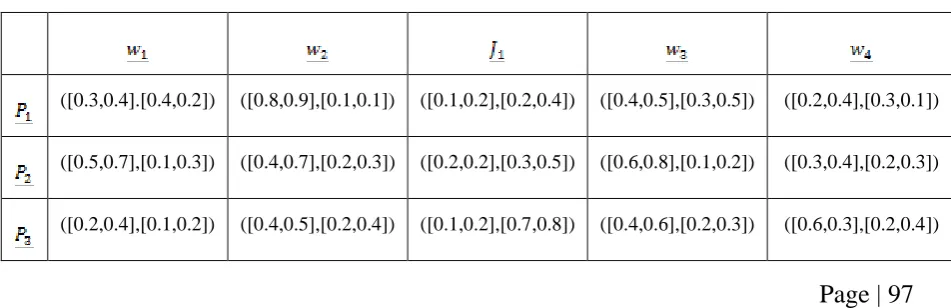
a) Let us consider team correspondings to job and it has four alternatives and five
attributes Assume that the characteristic information of the alternatives are
represented by the IVIFNs, as shown in the interval-valued intuitionistic fuzzy decision matrix .
Table 9:
Interval-valued intuitionistic fuzzy decision matrix
([0.3,0.4].[0.4,0.2]) ([0.8,0.9],[0.1,0.1]) ([0.1,0.2],[0.2,0.4]) ([0.4,0.5],[0.3,0.5]) ([0.2,0.4],[0.3,0.1])
([0.5,0.7],[0.1,0.3]) ([0.4,0.7],[0.2,0.3]) ([0.2,0.2],[0.3,0.5]) ([0.6,0.8],[0.1,0.2]) ([0.3,0.4],[0.2,0.3])
Page | 98
([0.7,0.8],[0.1,0.2]) ([0.5,0.7],[0.1,0.2]) ([0.4,0.5],[0.5,0.4]) ([0.4,0.5],[0.1,0.2]) ([0.3,0.2],[0.0,0.2])
Following similar process of team we get the ideal priorities of the persons of team corresponding to job
represented by .
b) Consider the cost values of the persons of the team to the job as
, , and and
the remaining values of attributes are as in Table 9. The ideal priorities of the persons of team corresponding
to job represented by .
c) Consider the cost values of the persons of the team to the job as
, , and and
the remaining values of attributes are as in Table 9. The ideal priorities of the persons of team corresponding
to job represented by .
d) Consider the cost values of the persons of the team to the job as
, , and and
the remaining values of attributes are as in Table 9. The ideal priorities of the persons of team corresponding
to job represented by .
e) Consider the cost values of the persons of the team to the job as
, , and and
the remaining values of attributes are as in Table 9. The ideal priorities of the persons of team corresponding
to job represented by .
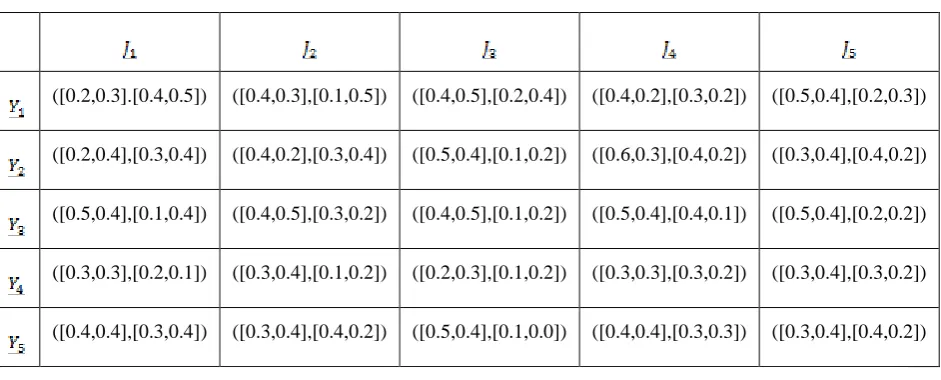
Page | 99
([0.2,0.3].[0.4,0.5]) ([0.4,0.3],[0.1,0.5]) ([0.4,0.5],[0.2,0.4]) ([0.4,0.2],[0.3,0.2]) ([0.5,0.4],[0.2,0.3])
([0.2,0.4],[0.3,0.4]) ([0.4,0.2],[0.3,0.4]) ([0.5,0.4],[0.1,0.2]) ([0.6,0.3],[0.4,0.2]) ([0.3,0.4],[0.4,0.2])
([0.5,0.4],[0.1,0.4]) ([0.4,0.5],[0.3,0.2]) ([0.4,0.5],[0.1,0.2]) ([0.5,0.4],[0.4,0.1]) ([0.5,0.4],[0.2,0.2])
([0.3,0.3],[0.2,0.1]) ([0.3,0.4],[0.2,0.2]) ([0.2,0.3],[0.1,0.2]) ([0.3,0.3],[0.5,0.2]) ([0.5,0.4],[0.4,0.2])
([0.4,0.4],[0.3,0.4]) ([0.3,0.4],[0.4,0.2]) ([0.5,0.4],[0.1,0.0]) ([0.4,0.4],[0.3,0.3]) ([0.3,0.4],[0.4,0.2])
Suppose the person is absent in the team . Choose the person from the pool whose priority is higher
corresponding to job and replace the value of above said person in the team with the place
corresponding to job . Find the maximum of acceptance and minimum of rejection of the cost to do job by
the person of the team . Put the value in the table with respect to the team corresponding to the job .
Similarly we do for other values of by the team Suppose more than one person are absent
replacement is made from the hierarchical order.
Table 11
: After break down the cost matrix
([0.2,0.3].[0.4,0.5]) ([0.4,0.3],[0.1,0.5]) ([0.4,0.5],[0.2,0.4]) ([0.4,0.2],[0.3,0.2]) ([0.5,0.4],[0.2,0.3])
([0.2,0.4],[0.3,0.4]) ([0.4,0.2],[0.3,0.4]) ([0.5,0.4],[0.1,0.2]) ([0.6,0.3],[0.4,0.2]) ([0.3,0.4],[0.4,0.2])
([0.5,0.4],[0.1,0.4]) ([0.4,0.5],[0.3,0.2]) ([0.4,0.5],[0.1,0.2]) ([0.5,0.4],[0.4,0.1]) ([0.5,0.4],[0.2,0.2])
([0.3,0.3],[0.2,0.1]) ([0.3,0.4],[0.1,0.2]) ([0.2,0.3],[0.1,0.2]) ([0.3,0.3],[0.3,0.2]) ([0.3,0.4],[0.3,0.2])
([0.4,0.4],[0.3,0.4]) ([0.3,0.4],[0.4,0.2]) ([0.5,0.4],[0.1,0.0]) ([0.4,0.4],[0.3,0.3]) ([0.3,0.4],[0.4,0.2])
Utilizing equation (1) calculate the score matrix
Page | 100
-0.2 0.05 0.15 0.05 0.2
-0.05 -0.05 0.3 0.15 0.05
0.2 0.2 0.3 0.2 0.25
0.15 0.2 0.1 -0.05 0.05
0.05 0.05 0.4 0.1 0.05
The table 12 is the cost matrix of the assignment problem in the maximization form and it can be solved by Hungarian method or by using any standard software.
The optimal assignment without break down is
1st job is assigned to the 1st team. 2nd job is assigned to the 2nd team. 3rd job is assigned to the 3rd team. 4th job is assigned to the 4th team. 5th job is assigned to the 5th team.
The optimal assignment after break down is
1st job is assigned to the 1st team. 2nd job is assigned to the 2nd team. 3rd job is assigned to the 4th team. 4th job is assigned to the 3rd team. 5th job is assigned to the 5th team.
VII.
CONCLUSION
In this paper a new real life interval-valued intuitionistic fuzzy assignment model with replacement is proposed. Two stages of solution procedure are discussed with intuitionistic fuzzy aggregation operators. By an example ideal priorities of the professionals of teams are found and replacement is made where it is necessary by means of the priorities to do the job in time.
REFERENCES
[1]. K Atanassov, G. Gargov, Interval-valued intuitionistic fuzzy sets, Fuzzy Sets and Systems 31, 1989, 343 - 349.
Page | 101
[3]. Long – Sheng, Huang Li – pu, Zhang., Solution method for Fuzzy Assignment Problem with Restriction of Qualification, Proceedings of the Sixth International Conference on Intelligent Systems Design and Applications, 2006, (ISDA’06).
[4]. S Mukherjee, K. Basu, Solving intuitionistic fuzzy assignment problem by using similarity measures and score Functions , International journal of pure and Applied Sciences and Technology, 2 , 2011, pp 1 –18. [5]. Z. S Xu, Methods for aggregation interval-valued intuitionistic fuzzy information and their application to decision making , Control and Decision, 19, 2007, 215 – 219.
[6]. Z S Xu, J Chen, On geometric aggregation over interval-valued intuitionistic fuzzy information, The 4th International Conference on Fuzzy Systems and Knowledge Discovery, Haikou, China, 2007, 466-471. [7]. Lin Chi – Jen, Wen Ue – pyng, A labeling algorithm for the fuzzy assignment problem, Fuzzy Sets and Systems, 142, 2004, 373 – 391.
[8]. K Gaurav, R. K. Bajaj, On solution of interval valued intuitionistic fuzzy assignment problem using similarity measure and score function, International Scholarly and Scientific Research and Innovation, 8(4), 2014.
[9]. Z S Xu, J. Chen, An approach to group decision making based on interval-valued intuitionistic judgment matrices, Systems Engineering Theory and Practice, 27, 2007, 126 – 133.
[10]. Z S Xu, An overview of methods for determining OWA weights. International Journal of Intelligent Systems, 20, 2005, 843-865.
[11]. K T Atanassov, Intuitionistic fuzzy sets, Fuzzy Sets and Systems, 20, 1986, 87 96.
[12]. Z. S Xu, R R Yager, Some geometric aggregation operators based on intuitionistic fuzzy sets, International Journal of General Systems, 35, 2006, 417-433.
[13]. Z S Xu, Intuitionistic fuzzy aggregation operators. IEEE transactions of Fuzzy Systems 15, 2007, 1179- 1187.