Face Recognition has attaining very much consideration in security systems, due to its fast and precise results, non-intrusiveness etc. The work proposed here uses different feature extraction and classification methods and the result has been compared. Local Binary Pattern Histogram Features (LBPH) and Eigen features are used. Minimum distance classifier and SVM classifiers are used and results are compared. Algorithm is realized using OpenCV with python.
Algorithm is tested on FEI, ORL and our own MSRIT datasets.
Index terms— face recognition, SVM,PCA, LBPH, Euclideandistance
I.INTRODUCTION
Face recognition is one of the techniques used in biometric validation by comparing with the stored templates in the datasets. Biometric is the capability of the computer to recognize the people based on people‟s inimitable physical or behavioral characteristics. It is one of the firmest evolving field in advanced technology. Physical characteristics are the traits of a human body that are not exposed to modification over ageing that includes face recognition, fingerprint recognition, iris recognition, palm print recognition, finger geometry, retina scanning and DNA matching. Behavioral characteristics of biometrics allied to the personal behavior of individuals such as voice recognition, signature recognition, and gait and keystroke dynamics.
Face recognition is extensively used in biometrics because of its universality, user friendly, non-intrusiveness and easily manageable system. Now-a-days the systems that requires heavy security are becoming prone to illicit entry, deceits. This complications can be elucidated by taking the actual identity of the person into deliberation by means of various face recognition techniques. All around the preceding years innumerable face recognition techniques have been developed.
II. LITERATURE SURVEY
Face detection is the first step in the face recognition. There are various approaches used for the face detection. The face detection approaches divided into four key categories: Knowledge-based [1], Feature invariant [2], Template matching and Appearance-based approaches [3][4][5].
1. Knowledge-based methods: This method is rule-based methods that interprets human knowledge of what it generates a distinctive face .Typically, the rules gain the relationships between facial features. These methods are predominantly intended for face localization.
2. Feature invariant approaches: These algorithms targets to find out structural features that exist even when the pose, viewpoint, or lighting conditions vary, and then use these features to locate face. These methods are mainly designed for face localization.
3. Template matching methods: A number of typical patterns of a face are deposited to label the face as an entire or the facial features independently .The connections between an input image and the stored patterns are computed for detection
.These methods can be used for both face localization and detection.
4.Appearance-based methods: In this method, the models (or templates) are learned from a set of training images which should capture the evocative variations of facial appearance. This learned models are then used for detection. These methods are principally intended for face detection.
To date, Viola-Jones face detector [6] has the most influence in face detection research. Face recognition falls into three main categories.
(1).Holistic matching methods: These methods use the complete face region as the raw input to a recognition system. One of the most comprehensively used depictions of the face region is Eigen-pictures, which are based on principal component analysis. The variants in this method are:
Principal-component analysis (PCA) Eigenfaces
Fisher faces/subspace LDA SVM
Feature lines ICA
(2) Feature-based (structural) matching methods: Typically, in these methods, local features such as the eyes, nose, and mouth are first extracted and their locations and local statistics (geometric and/or appearance) are fed into a Structural classifier. These methods are
Pure geometry methods Dynamic link architecture Hidden markov model
(3) Hybrid methods: These methods conglomerates both the features of Holistic based approach and Feature based approach. One can argue that these methods could hypothetically offer the better of the two types of
Though from so many decades face recognition system exists, still there are lot of challenges to be addressed and it has become a continuous research interest.
For the algorithm putting into practice OpenCV Library has been used which is developed to deliver aid in building systems that involves image processing. OpenCV library has many in-built packages that afford assistance in face detection and recognition and implements tasks taking up fewer processing time and providing augmented proficiency.
PROPOSED FACE RECOGNITION MODEL
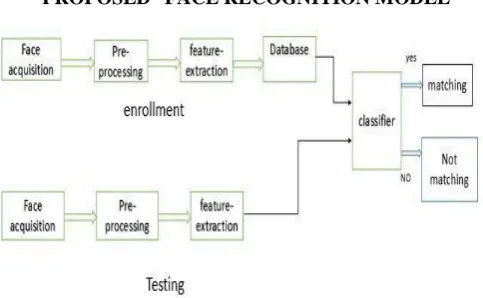
Fig 1: Block diagram of face recognition
Figure 1 shows block diagram representation of face recognition system. It has two phases of operation: training phase and test phase. In training phase features are extracted from preprocessed faces and stored in a database. During test phase same feature extraction is applied and machine learning algorithm is used to recognize the test face with the stored template face in the database. The system includes following operations in each phase:
(1) Face detection:
It is the pre-processing step in the face recognition step. Viola Jones face detection algorithm has been used. There are four key steps in this technique:
1. Haar-like features
2. Integral image
3. Adaboost training
4. Cascading classifier
1. Haar feature selection
All human faces share few analogous properties. Haar like features are used to detect difference in the black and light portion of the image. These regularities may be presented using Haar Features. A few properties common to human faces are:
2.The nose bridge region is brighter than the eyes. Composition of properties forming match able facial features:
Location and size: eyes, mouth, bridge of nose Value: oriented gradients of pixel intensities
If an image is given we will take a 24X24 window and apply each Haar feature to that window pixel by pixel. The value is calculated applying Haar features is
Value = Σ (pixels in black area) - Σ (pixels in white area) Variations in brightness between the white and black rectangles over a specific area. Each feature is related to a specific location in the sub-window
2. Integral images
The second step of the Viola-Jones face detection algorithm is to transmute an input image into an integral image. The integral image at the location (x,y) contains the sum of the pixels to the above and to the left of (x ,y).
This makes the calculation of the addition to the entire pixels within any specified rectangle using only four values. In the integral image, these values are the pixels that resemble with the edges of the rectangle in the input image.
3.Adaboost machine learning method
Viola-jones algorithm uses a 24X24 window as the base window size to evaluate all the features in an image. If we think about all the feasible parameters of the Haar features then we need to evaluate 160,000+ features in given window. The basic idea is to exclude the redundant features which are not beneficial.
Adaboost is a machine learning algorithm which helps in judging only the most outstanding features from 160,000+ features. After these features forms a weighted arrangement of all the features which are used in gaging and deciding any given window has face or not. These features are called weak classifiers.
4.Cascading classifiers
The cascading classifier is an assembly of stages that contains a strong classifier. The work of each phase is to authenticate a particular sub-window is absolutely not a face or may be face. A sub window classified as a may be face is passed to the next stage in the cascade, if these fails we conclude there is no face and discard that sub window and move on to the next stage.
a. input image detected face extracted face
b. input image detected face extracted face
c. input image detected face extracted face
Fig 2: detected faces invariant of rotation
Fig 2 illustrates the input image fed to the Viola-Jones face detection algorithm, detected face from the input image and face extracted from the detected face.
(2)FEATURE EXTRACTION
1. LOCAL BINARY PATTERN HISTOGRAM
There exists several methods for extracting the features from the preprocessed images.one is the Local Binary Pattern Histograms (LBPH).this was introduced by ojala et al which is done by dividing an image into several small regions from which the features are extracted.
The LBPH feature vector, is computed which is given below:
Divide the examined window into cells (e.g. 16x16 pixels for each cell).
For each pixel in a cell, compare the pixel to each of its 8 neighbors (on its top, middle, left-bottom, right top, etc.). Follow the pixels along a circle, i.e. clockwise or counter-clockwise.
When the center pixel's value is greater than the neighbor's value, assign "1". Otherwise, assign "0". This gives an 8-digit binary number (which is usually converted to decimal).
Compute the histogram, over the cell, of the frequency of each "number" occurring (i.e., each combination of which pixels are smaller and which are greater than the center).
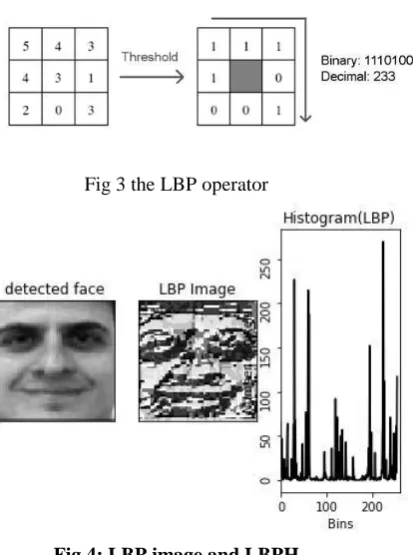
Fig 3 the LBP operator
Fig 4: LBP image and LBPH
Fig 3 illustrates the local binary patterns for the detected face and fig 4 illustrates the Histograms extracted from the local binary patterns
2.PRINCIPAL COMPONENT ANALYSIS
Principle Component Analysis (PCA) or „Eigen faces‟ is a method used to reduce dimension of a dataset and for the feature extraction. It is used to reserve the important information of the pattern and to remove redundant information. Technically, PCA finds the eigenvectors of a covariance matrix with the highest eigenvalues and then uses those components to project the data into a new subspace of equal or less dimensions. Practically, PCA converts a matrix of „n‟ features into a new dataset of less than „n‟ features. That is, it reduces the number of features by creating a new, smaller number variables which capture a substantial portion of the information found in the original features.
i. Prepare the data: let suppose we have M vectors of size N (=rows and columns of image) representing a set of images, then the training set becomes:Γ1, Γ2, Γ3……..ΓM .
ii. Subtract the mean: The average matrix Ψ has to be calculated, then subtracted from the original faces (Γi) and the result is stored in variable Φi
iii. Determine the co-variance matrix: In this step the covariance matrix B is calculated according to: B=ΦTΦ iv. Determine the Eigenvectors and Eigenvalues of covariance matrix: In this stage, the eigenvectors Xi and the eigenvalues λi are determined.
v. Determining Eigen faces: [Φ]Xi =Fi Where Xi and Fi are eigenvectors and eigenfaces respectively
vi. Classifying the faces: The new image is transformed into its eigenface components, the resulting weights
forms the weight vector .
Where k=1,2,3,4….. and
(3)Matching or classification:
First we had done the face detection then from the detected face, we extract the features and then we feed it to the classifier. In this paper, we considered two types of classifier support vector machines (SVM) and Euclidean distance classifier.
(I) SUPPORT VECTOR MACHINES
Support vector machines (SVM) is a supervised machine learning algorithm which can be used for both classification and regression purpose. SVMs are widely used for classification purpose.
A distinct property of SVM is that it instantaneously reduces the classification error and exploits the margin. Therefore, it is well-known as maximum margin classifiers.
i. Binary classification: SVM belongs to set of maximum margin classification. They perform recognition between two classes by determining the decision surface that has the maximum distance to the closest points in the training set which are defined as support vectors. A direct method for building a classifier for person A is to feed the SVM algorithm a training set with one class containing facial images of person A, and other class containing facial images of different person.
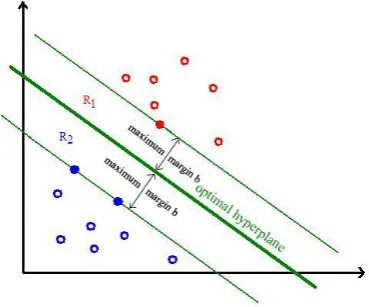
Above fig 5 illustrates that SVM optimal hyperplane is the one with the maximum distance from the adjacent training patterns. The support vectors (solid dots) are those adjacent patterns, a distance b from the hyperplane.
To estimate the margin, two parallel hyperplanes are built, one on each side of the separating one, which are pushed up against the two data sets. Instinctively, a good separation is attained by the hyperplane that has the largest distance to the adjoining data points of both classes. The larger the margin or distance between these parallel hyperplanes, the better the simplification error of the classifier.
A SVM algorithm will generate a linear decision surface, and the identity of image p will be accepted if
w.p+b≤0,
otherwise the claim will be rejected.
ii. Multi-class classification:
There are two fundamental strategies for solving n-class problem with SVMs:
a. In the one-vs.-all approach n SVMs are trained. Each of the SVMs separates a single class from the remaining class.
b. In the one-vs.-one approach n(n-1)/2 SVMs are trained. Each SVM separates a pair of classes. The pairwise
classifiers are organized in trees, where each tree node signifies an SVM.
we opted for the one-vs.-all strategy where the number of SVMs is linear with the number of classes.
(II) EUCLIDEAN DISTANCE:
Euclidean distance classifier computes the sum of the squared distance (SSD) between the corresponding histograms of the test image and the template image.
The smaller the distance is, the more similar the source image and the template Image.
After obtaining the Euclidean distance between the test image with all the images in the dataset, we classify the images based on the minimum distance obtained between the test image and all the images in the dataset. DATASETS USED
FEI dataset- 48 persons, where each image is of size 112X92
ORL dataset-40 persons, where each image is of size 128X128
MSRIT (our own acquired) dataset-100 persons, where each image is of size 128X128
Each dataset contains 10 samples /person.
Totally we have considered 1880 images for experimental purpose.
VII. Simulation and Experimental Results:
For each face Viola Jones algorithm is applied to detect only the face area. From detected face, Eigen features and LBPH for feature extraction, then we will feed the features to the classifier.
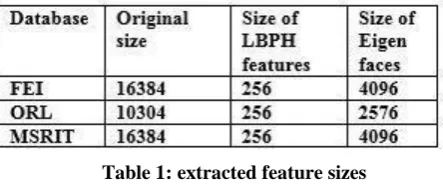
Feature vector size for the databases are listed below:
Table 1: extracted feature sizes
Table 1 illustrates the extracted feature sizes from the detected faces. the size of LBPH features remained same and the size of Eigen face varies depending on the image size
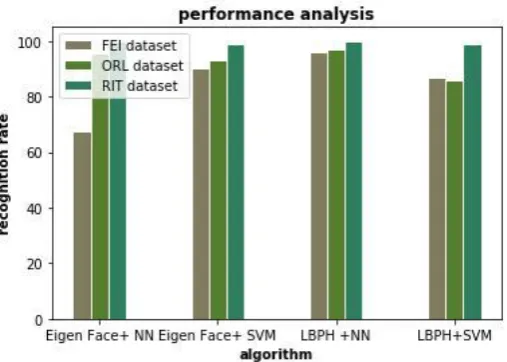
Each dataset contains 10 samples /person and randomly training samples are selected and varied and each time recognition rate is calculated. Recognition rate is defined as the ratio of number of test samples recognized to the total number of test samples considered. Figure(6) shows the graph of recognition rate for all three databases. We have considered 6:4 train: test ratio for simulation purpose.
Table 2: Recognition rates(in percentage)
Table 2 illustrates the recognition rates for the different classifiers.
Fig 6: performance analysis for different methods Conclusion
In this paper,we have tested and obtained results for face detection using viola-jones face detection algorithm, feature extraction by Eigen Faces or PCA and LBPH and face recognition using SVM classifier and Euclidean distance classifier. The training and testing ratio we have considered is 6:4 which selects from the dataset randomly. From the above graphs we can conclude that LBPH and Euclidean distance has better recognition rate.
REFERENCES
[1] M.-H. Yang, D. Kriegman, and N. Ahuja, “Detecting faces in Images: A survey,” IEEE Trans. On PAMI, vol.24, pp. 34– 58, January 2002.
[2] Shailaja A Patil and Dr. P. J. Deore,” Face Recognition: A Survey”, Informatics Engineering, an International Journal (IEIJ) ,Vol.1, No.1, December 2013
[3] B.S.Khade , H.M.Gaikwad , A.S.Aher , K.K.Patil,” Face Recognition Techniques: A Survey”,
IJCSMC, Vol. 5, Issue. 11, November 2016, pg.65 – 72
[4] Kavita , Ms. Manjeet Kaur ,” A Survey paper for Face Recognition Technologies” International Journal of Scientific and Research Publications, Volume 6, Issue 7, July 2016.
[5] Muhammad Sharif , Farah Naz1 , Mussarat Yasmin ,Muhammad Alyas Shahid and Amjad
Rehman,” Face Recognition: A Survey, Journal of Engineering Science and Technology Review 10 (2) (2017) 166- 177”