A New Algorithm for Skew Detection and Correction
of Historical Kannada Documents
Banumathi K L
Research Scholar, Dept. of E&C Adichunchangiri Institute of TechnologyChickmagalore, India [email protected]
Dr. Jagadeesh Chandra A P
Professor, Dept. of E&C Adichunchangiri Institute of TechnologyChickmagalore, India [email protected]
Abstract - Huge collections of historical document are available in libraries are of great challenge to preserve in
digital format. Segmentation and skew detection of historical document images is a great challenge due to variety of writing styles with non-uniform overlapped and touching lines. The proposed technique presents ainnovative algorithm for skew finding and rectification based on choosing location of a letter leaving 100 pixels from left and right margin of the resized (256X256) image. Based on the selection of the initial and final letter on the preprocessed image, skew angle is estimated and skew is corrected. The efficiency of the proposed algorithm is experimented on a custom dataset as well as on our own dataset consisting different categories of document images and obtained results were found to be encouraging with skew less than 1°.
Keywords—Historical, Multiple Skew, Skew Detection and Correction
I. INTRODUCTION
Sharing and exchanging information through electronically is a trend in current decade. It is necessary to convert existing Historical documents into electronic ones to overcome the difficulties for retrieval, low efficiency and insecurity is a
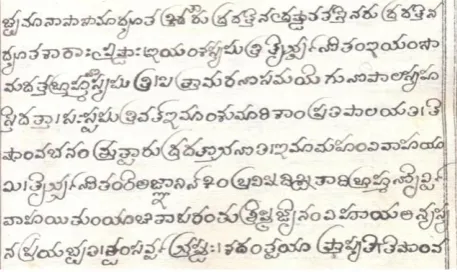
challenging task. Historical documents are of low quality contains holes, spots due to aging. Whenever we scan Historical images we noticed that the quality of the scanned images is degraded and is shown in Fig.1.
Figure. 1 Scanned Copy of Devanagari Script from Nimichandra
Major drawback in the handwritten Historical document are Spacing between the characters and words is not uniform also shapes varies from person to person. Conversion of handwritten historical documents into electronic forms requires scanning and digitization. During scanning noise and skew are common especially dealing with aged documents. The very challenging task in analyzing handwritten documents with skew introduced while writing [2].
D S Guru [14] proposed a model which detectsmultiple skews in the entire handwritten
multilingual documents. This method is based on segmenting handwritten document to identify the dissimilar blocks written in different deviations to approximation multiple skew of multilingual handwritten document. Proposed method works superior for image blocks with characters written in Historical kannada language.
on our own data set are offered in the Section 4 and the conclusions are drawn in Section 5
II. LITERATURE REVIEW
Numerous methods have been proposed for skew angle detection of document images. Leading approaches for skew detection include: Hough Transform, Projection Profile, Nearest
Neighbor and Principal component Analysis etc.
The Hough transform basedapproaches [6][7][8] [11] uses block-based Hough transform to detect lines and merging methods to correct false alarms achieves 93% detection even though not flexible to follow variation of skew angle of the same text line. Projection profiles [9][10][12] it is one of the common approach to estimate skew. The process of converting binary image (2 dimensional matrix) into one-dimensional array (Projection Profile) is called projection. Each line in the document is represented by horizontal projection profile, whereas each line in projection profile has a value that represents number of black pixels in the corresponding row of the image. For the documents with skewed angle zero, valleys are observed in the horizontal projection profile that correspondstothe space between the lines.Heights of the text lines in document are represented by the height of maximum peak in the profile.
Projection profile methods provide honest results buthigh computation cost and low efficiency in case of iterative process are the major limitations of the above methods. Furthermore, image with charts or graphs along with data reduces the precision of detecting the angle and also very sensitive to noise interference. Projection profile methods are approximating the skew angle in range from 10° to 15°.
Nearest Neighbor (NN) [13] method, the system finds connection between the adjacent components in the documentdiscovers the histogram of the direction vectors for all nearest neighbors and then calculates the first nearest neighbor of each component. The histogram stores the centroid angles of nearest neighbor components. The main peak in the histogram represents skew angle of the document.
Fairly, nearest neighbor methods can be used to detect and correct skew angles of the document which contains different types of font
size and scripts. This method is not proposed for the corrupted and historical documents.
Based on the survey we noticed that,a good number of the existing approaches aredesigned to estimate skew in printed documentsand cannot be suggested for Historical Handwritten documents with noise interference. Figure 1 shows sample Handwritten Historical documents containing numerous skew. To the greatest of our awareness there is no work found in the literature which can estimate skew of a Historical Kannada document containing numerous skews and correcting it. Therefore in this work we have projected new algorithm for skew finding and rectification of historical handwritten document study and recognition.
III.PROPOSED ALGORITHM
Proposed algorithm comprises of two stages: Skew detection and correction. and correction for minor orientations.
Step 3: The resized image is subjected for skew
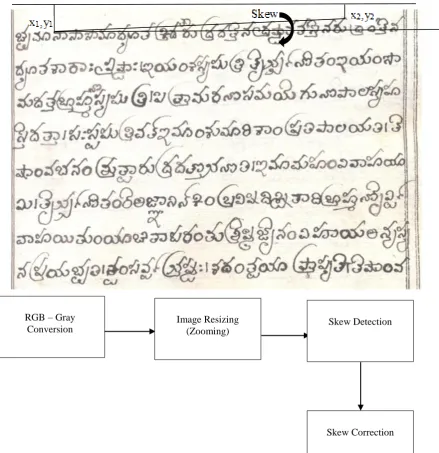
detection by finding coordinates of the initial letter (x1,y1) of the line chosen to the final one (x2,y2) in
the script as shown below.
Step 4: After finding the coordinates, the
orientation (slope) can be calculated by using the equation of the straight i.e.,
( ) (
) (1)
The skew angle obtained by equation (1) will be in radians and it should be converted to degrees in order to rotate the input script to the desired angle.
Step 5: To the required angle the script is rotated in
Figure. 2 Skew angle measurement in the context
Figure 3 Flow diagram of the proposed system
IV. EXPERIMENTAL RESULTS
Matlab2016a software is used for the analysis of the proposed algorithm. Five standard images are considered for the analysis which is test images made available in Skew detection and
correction contest held in China 2013. Four standard images are considered for the analysis form Devanagari script. The results are tabulated below.
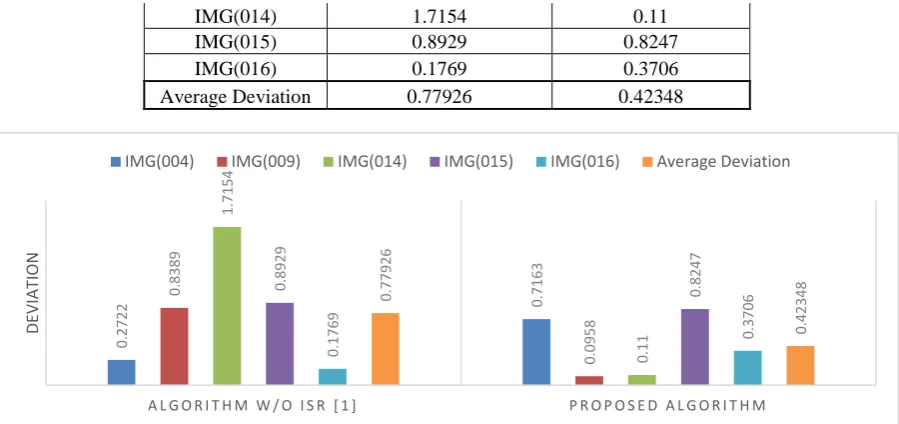
Table 1 Skew angles detected and corrected in degrees for test images
Image Algorithm w/o ISR [22] Proposed Algorithm
IMG(004) 0.2722 0.7163
IMG(009) 0.8389 0.0958
RGB – Gray Conversion
Image Resizing (Zooming)
Skew Detection
IMG(014) 1.7154 0.11
IMG(015) 0.8929 0.8247
IMG(016) 0.1769 0.3706
Average Deviation 0.77926 0.42348
Figure 4 Performance analysis of proposed algorithm with algorithm designed without ISR
Table 2 Skew angles detected and corrected in radians and degrees for Devanagari scripts
Figure 5 Input Image Figure 6Skew Corrected Image
V. CONCLUSION
Proposed algorithm detects and corrects skew with precision less than a degree with great accuracy. It is found that the projected algorithm gives more effectiveness compared to the existing ones. The skew angle is measured by leaving 100 pixels form either side of an image reduces the chance of considering any noise contents as context in the image. From this more accuracy is achieved for a set of standard test images as well as data set of Devanagari script. The proposed algorithm detects and corrects positive and negative skews in both clockwise and anticlockwise directions.
REFERENCES
[1] DarkoBrodic, Carlos A B Mello : An Approach to Skew Detection of Printed Documents : Journal of Universal Computer Science Vol 20, no 4 (2014), pp 488-506 [2] Babu, D R., Kumat. P M., : Skew angle
estimation and correction of handwritten, textual and large areas of non-textual document images: A noval approach. International conference on image processing, computer vision and pattern recognition. pp 510-515, (2006)
0.27
22 0.71
63
0.83
89
0.09
58
1.71
54
0.11
0.89
29
0.82
47
0.17
69
0.370
6
0.77
926
0.42
348
A L G O R I T H M W / O I S R [ 1 ] P R O P O S E D A L G O R I T H M
DE
V
IA
TIO
N
IMG(004) IMG(009) IMG(014) IMG(015) IMG(016) Average Deviation
Image (Script) Skew angle detected
(Radians)
Skew angle corrected (Degrees)
Nemichandra -0.0100 -0.5730
Chavundravya 0.0540 3.0911
Kanakadasa 0.0525 3.0054
Ratnakaravarni
[3] N .Nandini, K. Srikanta Murthy, and G. Hemantha Kumar, ―Estimation of skew Angle in binary document images using Hough transform,‖ Journal of World Academy of Science, Engineering and Technology, vol. 32, pp. 50-55, August 2008.
[4] A.Amin and S.Fischer, ―A document skew detection method using the Hough transform,‖ Pattern Analysis and Applications, vol. 3, pp.243-253, September 2000
[5] Stuart C.Hinds, James L.Fisher and Donald P.D’Amato, ―A Document skew Detection Method Using Run – Length Encoding and the Hough Transform,‖ Proceedings of the Tenth International Conference on Pattern Recognition, pp.209 - 213, June 1990.
[6] ] Kapoor, R., Bangi, D., Kamal, T, S.,: A new algorithm for skew detection and correction. Pattern Recognition Letters, vol. 25, pp. 1215-1229. (2004)
[7] Das, K., Chanda, B.,: A fast algorithm for skew detection of document images using morphology, International Journal on Document Analysis and Recognition, Vol. 4, pp. 109 – 114 (2001)
[8] Amin, A., Fischer, S.,: Robust skew detection method using the Hough transform, Pattern Analysis and Applications, Vol. 3, pp. 243-253. (2000)
[9] Dey, P., Noushath, S.,: e- PCP: A robust skew detection for scanned document images. Pattern Recognition. Vol. 43, pp. 937-948 (2009
[10]Kwag, K, H., Kim, H, S.,:Jeong, H, S., Lee, S. G.,: Efficient skew estimation and correction algorithm for document images. Image and Vision Computing, Vol. 19, pp. 25-35. (2002 [11]G. Louloudis, B Gatos, C Halatsis, Text line
detection in unconstrained handwritten documents using a block- based Hough transform approach, in: Proceedings of International conference on DocumentsAnalyosis and Recognition 40 (2) (2007) 443-455
[12]W. Postl, ―Detection of linear oblique structures and skew scan in digitized documents,‖ In Proceedings of the 8th International Conference on Pattern Recognition, pp. 687-689. 1986
[13]Y. Lu, Tan, C. Lim. "Improved nearest neighbor based approach to accurate document skew estimation." In Document Analysis and Recognition, 2003. Proceedings. Seventh International Conference on, pp. 503-507. IEEE, 2003.
[14]D S Guru, M Ravikumar, S Manjunath: Multiple Skew Estimation in Multilingual Handwritten Documents in International Journal of Computer Science issues Vol 10 Issue 5 No 2 September 2013.
[15]M. Wagdy, I. Faye, D. Rohaya. Fast and Efficient Document Image Clean Up and Binarization Based on Retinex Theory. In: 2013 IEEE 9th International Colloquium on Signal Processing and its Applications. [16]Rajesh Bodade, Ram Bilas Pachori, Aakash
Gupta, Pritesh Kanani, Deepak Yadav, ―A Novel Approach for Automated Skew Correction of Vehicle Number Plate Using Principal Component Analysis‖ 2012 IEEE International Conference on Computational Intelligence and Computing Research
[17]Marian Wagdy, Ibrahima Faye, DayangRohaya. Document Image Skew Detection and Correction Method Based on Extreme Points. In: 2014 IEEE.
[18]B. Aditya, A. Kumar and B. M. Yadav, ―Skew Detection in Handwritten Documents‖ international journal of computer applications, vol. 69, pp. 0975-8887, 2013.
[19]M. Wagdy, I. Faye and D. Rohaya, "Document image skew detection and correction Method based on extreme points", Centre of intelligent signal and imaging research (IEEE), vol. 6, issue 1, pp. 4799-0059, 2014
[20]L. Shah, R. Patel, S. Patel and J. Maniar, ―Skew Detection and Correction for Gujarati Printed and Handwritten Character using Linear Regression‖, International journal of advanced research in computer science and software engineering, vol. 4, issue 1, pp. 642-648, 2014.
[21]D. Sunanda, H. S. Narayan and M. Belur, "Kannada text line extraction based on energy minimization and skew correction", International advance computing conference (IEEE), 2014.