
Expert Finding for Microblog Misinformation Identification
Chen Liang
∗Zhi yuan Liu
∗M aosong Sun
Department of Computer Science and Technology State Key Lab on Intelligent Technology and Systems National Lab for Information Science and Technology
Tsinghua University, Beijing 100084, China
{chenliang.harry,lzy.thu}@gmail.com, [email protected]
A
BSTRACTThe growth of social media provides a convenient communication scheme for people, but at the same time it becomes a hotbed of misinformation. The wide spread of misinformation over social media is injurious to public interest. We design a framework, which integrates collective intelligence and machine intelligence, to help identify misinformation. The basic idea is: (1) automatically index the expertise of users according to their microblog contents; and (2) match the experts with given suspected misinformation. By sending the suspected misinformation to appropriate experts, we can collect the assessments of experts to judge the credibility of information, and help refute misinformation. In this paper, we focus on ex-pert finding for misinformation identification. We propose a tag-based method to index the expertise of microblog users with social tags. Experiments on a real world dataset demon-strate the effectiveness of our method for expert finding with respect to misinformation identification in microblogs.
T
ITLE ANDA
BSTRACT INC
HINESE¡
¡¡ÆÆÆØØØ¢¢¢&&&EE£E££OOO;;;[[[uuuyyy
3Ǒ<JøB|6ªÓ§¬xNǑ¤ǑØ¢&ED§K"Ø
¢ & E 3 ¬ x N ¥ 2 D Â ò é ú | E ¤ ³ "ù p§ · J Ñn Ü |^ +N
UÚÅìUÏ£OØ¢&E§Äg´ µ£1¤ âÆ ^r )SN gÄ© ÛÚ
¢Ú^r;¶£2¤gÄòØ¢&E A ;[ "Ï LòØ ¢&E ux
Ü · ; [ § · ± Â 8 ; [ é& E & 5 µ § Ï £ OØ ¢& E Ú8 "
Ø © ò Ì & ? ¡ Ø ¢ & E £ O ;[ u y¯ K" · æ ^Ä u I\ { 5¢ Ú Æ
^ r ; " 3 ý ¢ ê â þ ¢ L ²§ · { ±k ? 1 Æ ;[ u y^ uØ ¢
&E£O"
K
EYWORDS:
misinformation identification, expert finding, microblog.K
EYWORDS INC
HINESE:
Ø¢&E£O,;[uy,Æ.1 Introduction
Although rumors lack a specific definition, most theories agree that a rumor is a statement of information, whose veracity is not quickly or ever confirmed, spreading from person to person and pertaining to an object, event or issue in public concern (Peterson and Gist, 1951). Rumors are regarded as a type of misinformation. In recent years, online social media is growing rapidly. Social media provides a convenient communication scheme be-tween people. Meanwhile, the scheme enables unreliable sources to spread large amounts of unverified information among people. Rumors are thus possible to spread more quickly and widely through online social media compared to traditional offline social communities. The wide spread of misinformation may bring disorder to people especially when they are facing crises. This indicates that it is crucial for social media to identify misinformation in time so as to limit the spread of rumors.
Most existing research efforts on rumors in social media focus on their external features, such as spread and conversation patterns. It is a consensus that automatically identifying rumors via in-depth content analysis is a challenging task. Social media still lacks solutions to effectively identify and refute misinformation to stop it from wide spread. Although fully-automatic identification of misinformation is currently a mission impossible for com-puter programs, most rumors can be easily identified by human experts with corresponding knowledge or experiences. Due to the popularity of social media, most experts can be found in social media. Under such a scenario, we design a framework to identify misinformation with the help of experts in microblogs. We automatically route suspected misinformation to a set of experts who can assess the credibility. With the assessments from experts, we can help determine the credibility of the information, identify and refute misinformation, and eventually stop the wide spread of rumors.
The most crucial part of the framework is finding appropriate experts for suspected misin-formation. A relevant task has been studied as expert finding. However finding experts for suspected misinformation is different from the traditional task in many aspects, which make it more challenging. In this paper, we focus on expert finding for misinformation identification. With the help of experts, we incorporate the power of natural language pro-cessing techniques and the knowledge of human experts. With the method, we may help social media achieve self-management and self-organization.
2 Empirical Analysis of Rumors
We give empirical analysis of rumors on Sina Weibo, the largest microblog service in China. Sina Weibo has more than 250 million registered users as of October 2011, over 60% net-work users have accounts of Sina Weibo, and 31% Weibo users post more than 3 messages per day. Due to the overflow of rumors, Sina Weibo maintains a team to refute rumors. Since the process is carried out manually, it is manpower intensive while the refutation is usually delayed and the scope is limited.
topics. Most people do not master the corresponding professional knowledge and thus can-not verify the correctness. For example, a rumor claimed that “A nutritionist finds that if you eat a bag of instant noodles, the liver will need 32 days for detoxification”, which is related to the knowledge of food hygiene and nutrition. (2) 271 out of 859 rumors aretime-space constrained (TSC) misinformation. This type of misinformation is usually related to some events that occur in some places and time. Most people have not experienced these events and thus cannot check the authenticity. For example, a rumor claimed that “Some mentally retarded children in Xiangyang, Hubei were cut out tongues and genitals”. The people not living in that city will not be able to verify the reliability of the information. According to the analysis, we summarize that the two types of rumors are different in: (1) Their topics are quite different. DKC rumors focus on the topics of science and technologies, while TSC rumors focus on the topics of public security, society and politics. (2) TSC rumors usually talk about events and thus often mention specific names of persons, places or organizations; while DKC rumors seldom mention specific names.
We build a two-class classifier using the occurrences of names and topics as features to quantitatively identify the differences between the two types of misinformation. The clas-sifier is built using LIBLINEAR (Fan et al., 2008). For each message, features are boolean values indicating the appearance of names and topics. We perform 5-cross validation for evaluation and the prediction accuracies are 0.848, 0.804, and 0.865 when using names, topics or both as features. We can see that most misinformation can be well distinguished according to these features. Based on the characteristics of DKC and TSC misinformation, we propose a unified method to find applicable experts for them.
3 Tag-based Method for Expert Finding
Suppose all microblog users are candidate experts denoted as a setE. These users may be either people or organizations. Given a suspected misinformationm, the probability of selecting a microblog userefromEbeing an expert onmcan be estimated as
Pr(e|m) =Pr(m|e)Pr(e)
Pr(m) ∝Pr(m|e)Pr(e), (1) where Pr(e)is the prior probability of an expert; Pr(m)is the prior probability ofm, which remains the same for all candidate experts and thus is ignored for expert ranking. Here, Pr(e)is estimated as the authority ofe, and Pr(m|e)is as the expertise of the experteonm. We adopt social tags annotated by microblog users to model expertise.
For DKC misinformation, we use Eq.(1) to find experts fromEdirectly; while for TSC mis-information, we have to restrict the set of candidate experts with respect to the named entities that have appeared inm. We introduce our method in details in the following three aspects: (1) modeling expertise with tag-based method to compute Pr(e|m); (2) computing authorities of experts, i.e., Pr(e); and (3) restricting candidate set of experts for TSC.
3.1 Modeling Expertise with Tag-based Method
We denote the set of tags asT. Suppose Pr(m|e)is a generation process as follows. An expert
efirst generates a tagt∈T, and thentgenerates the messagem. Given the generation process, the probability Pr(m|e)can thus be estimated as follows:
Pr(m|e) =X
where Pr(t)indicates the prior probability for the tagt, Pr(t|m)measures the probability of tgiven the messagem, and Pr(t|e)computes the probability of expertisetgiven the expert
e. The prior Pr(t)can be estimated using the number of microblog users who annotate themselves with the tagt; while Pr(t|m)and Pr(t|e)are modeled as a problem of social tag suggestion task. Pr(t|e)can be decomposed into two parts: one is the suggestion score oftgiven the messages posted bye, and the other is whetherehas annotated itself with
t. The two parts are combined with a smoothing factorγranging from 0 to 1, Pr(t|e) =
γPm∈MePr(t|m)Pr(m|e) + (1−γ)1t∈Te, whereMeis the set of messages that are posted by
e, Pr(t|m)is the ranking score oftgiven the messagem, Pr(m|e)indicates the weight of messagemwithin all messages posted bye, and1t∈Teequals 1 if the tag setTeannotated
byecontainstand 0 otherwise. In this paper, we simply set the weights of all messages Pr(m|e)foreto be equal, and setγ=0.5.
Based on the above analysis to Pr(t|m)and Pr(t|e), the essential task is to suggest social tags for a messagem. As the rapid growth of social media, social tag suggestion has been well studied (Gupta et al., 2010). There are two approaches for social tag suggestion: graph-based approach and content-graph-based approach. Since we have to suggest tags according to the content ofm, we follow the content-based approach. The specialty of our problem compared to previous problems lies in: (1) the method should be robust to noise and informal format of microblog messages; and (2)mis short with no more than 140 Chinese characters in Sina Weibo.
Taking the specialty in consideration, we propose to use word alignment model (WAM) in statistical machine translation (Brown et al., 1993) for social tag suggestion, which has been verified to outperform other existing content-based methods (Liu et al., 2011, 2012). Here we give a brief introduction to WAM, and introduce some important extensions to make the method appropriate to suggest social tags for microblog messages.
WAM for Social Tag Suggestion.Given a messagem, WAM ranks candidate tags by com-puting their likelihood PrWAM(t|m) =
P
w∈mPr(t|w)Pr(w|m), where Pr(w|m)is the weight
of the wordwinm, and Pr(t|w)is the translation probability fromwtotobtained from the translation models. Pr(w|m)is estimated using term-frequency and inverse message frequency (TFIMF), which is similar to TFIDF. According to the ranking scores, we suggest the top-M as tags form. WAM can avoid the problem caused by noise and informal for-mat of microblogs. Moreover, WAM can suggest tags that have not appeared in the given message. However, a tag that appears in the given message may be more important. There-fore, we improve WAM by combining WAM with frequency-based methods. A simple and effective frequency-based method is using TFIMF to rank candidate tags in a given mes-sage. We thus compute the ranking score using improved WAM (IWAM) for a candidate tag as follows, PrIWAM(t|m) =αPrWAM(t|m) + (1−α)PrTFIMF(t|m), whereαis a smoothing
Training Translation Models for WAM.Training WAM for tag suggestion consists of two steps: preparing translation pairs and training translation models. The training set for traditional WAM consists of a number of translation pairs written in two languages. In our task, we have to collect sufficient translation pairs of microblog messages and their tags to capture the semantic relationship between them. However, microblogs are usually not annotated with tags. We thus propose to prepare translation pairs by automatically extracting tags using a simple and effective method for each message. The basic idea is that most results of the simple method are correct, while the errors can be filtered out by WAM. The preparation process is as follows. We first collect all tags annotated by microblog users in Sina Weibo. For each tagt, we record the users that annotate tagtasEt. We group
all tags with|Et|>10 as a tag list. After that, we collect a large set of microblog messages. For each messagem, we extract several tags according to the score of tag-frequency and inverse expert-frequency TFIEF(t,m)=TF(t,m)|E|/|Et|. Similar to TFIDF, TF(t,m)indicates the significance of the tagtinm, and|E|/|Et|indicates the discriminative ability of the tagt. Using messages and their corresponding extracted tags, we build the translation pairs for WAM training.
We use IBM Model 1 (Brown et al., 1993) for WAM training. IBM Model 1 is a widely used word alignment algorithm which does not require linguistic knowledge for two languages. We have also tested more sophisticated word alignment algorithms such as IBM Model 3 for tag suggestion. However, these methods do not achieve better performance than IBM Model 1. Therefore, in this paper we only demonstrate the experimental results using IBM Model 1. In experiments, we select GIZA++(Och and Ney, 2003) to train IBM Model 1.
3.2 Measuring Authority
Some works have been devoted to authority analysis of social media (Pal and Counts, 2011). The basic conclusion is that a microblog user has more authority if it has more followers and posts more original messages. Therefore, in this paper, we simply compute authority of a usereas:
whereFeis the follower set ofeandAeis the user set followed bye. The score is normalized
over all experts inEm.
3.3 Restricting Candidate Expert Set for TSC
We denote the names of each usere∈EasNeand the names inmasNm. We perform named entity disambiguation forNmaccording to microblog users, and link each name
ninNmto all relevant microblog users thatnreally mentions. We denote the restricted
candidate experts as a setEm. To restrict candidate expert set for TSC, we perform the following three steps.
have obvious patterns, we can obtain the labeling accuracy of above 90% by training on a set of 500 manually annotated users.
Named Entity Recognition form. Since Sina Weibo is in Chinese, we first perform Chi-nese word segmentation (CWS) and part-of-speech (POS) tagging for messages using the algorithm originally proposed in (Jiang et al., 2008). After that, we perform named entity recognition (NER). Since misinformation always pretends to be credible by written in a for-mal style, we can thus achieve high accuracy using the algorithm CRF (Nadeau and Sekine, 2007) based on the CWS and POS tagging output.
Named Entity Disambiguation. We disambiguate the names inmwith respect to mi-croblog users, and thus restrict candidate expert set fromEtoEm={e|Ne∩Nm6=;}. First,
we find all microblog users by substring match between the names of microblog users and the names extracted from the message, denoted asEs. These users are not all relevant to the names inm. The following task is to disambiguate the names inmto microblog users inEsaccording to the relevance of these users withm. We follow the state-of-the-art algorithm in (Zheng et al., 2010), and use list-wise learning to rank (L2R) framework to address the problem. After investigating various combinations of features, we use the fol-lowing effective features for L2R: (1) Follow-attention ratio which indicates the popularity ofe. (2) The number of original messages thatehas posted which indicates the vitality of
e. (3) The numbers of comments and reposts for recent 100 messages which also indicates the recent vitality ofe. (4) The number of microblog user names that appear in both recent 100 messages ofeandm. This measures the semantic relatedness betweeneandm. Since the number of TSC rumors are limited for training and testing, we instead manually annotate 6394 names in news articles ranging from June to December, 2011 as dataset, with each name linked to a microblog user. By training on 3, 985 instances and testing on 2, 409 instances, we obtain accuracy of 96.3%, which indicates the effectiveness of L2R for named entity disambiguation to microblog users. With the trained model on the dataset, we perform named entity disambiguation to names in given messagemand restrict the candidate expert set toEm.
4 Experiments and Analysis
We perform experiments on 859 rumors manually collected from Sina Weibo. We also collect 5 million the most active microblog users with their profiles and messages to build expert database. For each rumor, we recommend 10 experts from microblog users. We ask two editors to manually annotate the correctness of the results, who discussed and finally achieved final agreement on annotation. For the inconsistent annotations, the two editors discuss to achieve agreement. We use P@N for evaluation whereNranges from 1 to 10.
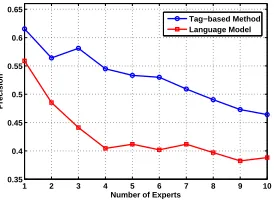
Evaluation Results on DKC Rumors.To investigate the effectiveness of tag-based method, we compare our method with language model, the state-of-the-art method for expert find-ing, on 588 DKC rumors. For each DKC rumor, we suggest maximum 10 microblog experts. In language model, a candidate experteis represented by a multinomial probability dis-tribution over the vocabulary of words, i.e., Pr(w|θe). A messagemis represented by a
bag of words with each word generated independently. Therefore, the probability ofm
being generated by the language modelθecan be obtained by taking the product across all
words inm: Pr(m|e) =Qw∈mPr(w|θe)n(w,m), where Pr(w|θe)is the probability of a wordw
ofe, Pr(w|θe), is estimated as Pr(w|θe) =
P
m∈MePr(w|m)Pr(m|e), where Pr(m|e)is the
weight of an message posted bye, and Pr(w|m)is the generation probability by the mes-sagem. We set Pr(m|e)equal for all messages posted bye; while Pr(w|m)is estimated using the TFIMF score ofw. We also apply the Jelinek-Mercer method to smooth language model (Zhou et al., 2009), which is not introduced in detail for space limit.
We show the evaluation results in Fig. 1. From Fig. 1 we observe that: (1) The tag-based method consistently and significantly outperforms language model for expert finding. This indicates the effectiveness of the tag-based method. The reason is that tags are annotated by microblog users and provide sufficient information. (2) Although the performance of expert finding is far from perfection, it can help find experts and reduce manual work to a great extent. Moreover, the performance of expert finding can be further improved as more knowledge are taken into consideration, which will be our future work.
1 2 3 4 5 6 7 8 9 10 0.35
0.4 0.45 0.5 0.55 0.6 0.65
Number of Experts
Precision
Tag−based Method Language Model
Figure 1: Evaluation results on expert finding for DKC rumors.
We also analyze the sample errors in expert finding for DKC rumors. The main reasons for these errors are: (1) Some tags are ambiguous and we may find experts that are irrelevant tom. For example, the tag “apple” may refer to either a type of fruits or an IT company. Although the tag-based method takes the topics ofminto consideration, it still cannot thor-oughly solve the problem. In future work, we may adopt tag disambiguation (Yeung et al., 2007) in our method. (2) We treat all tags annotated by experts equally. However, mi-croblog users may annotate tags arbitrarily, which will thus import noise to our method. In future work, we will estimate confidence scores to the tags annotated by microblog users.
Evaluation Results on TSC Rumors. Different from DKC rumors, for TSC rumors our method will identify named entities in the suspected message to restrict the candidate ex-pert set. In experiments, we set a person name may correspond to only one microblog user, while a place/organization name may refer to multiple microblog users. We evaluate the disambiguation for person names to demonstrate the performance of named entity disam-biguation. The accuracy achieves 0.818 for all person names occurred in 271 TSC rumors. The precisions of expert finding for TSC rumors are 0.760 and 0.592 when suggesting 1 and 10 experts. The performance is slightly better than DKC rumors due to the impact of restricting candidate expert set, and is also much better than language model.
matching, we find microblog users such as “Unicom Xiangyang” (a mobile company), “PSB Xiangyang”, and “News Broadcast Xiangyang”. According to the relatedness between the given message and microblog experts, we rank “PSB Xiangyang” and “News Broadcast Xi-angyang” higher than other microblog experts, which are more probable to refute the rumor.
Discussion. From the above evaluation and analysis, we validate the effectiveness of our tag-based method for expert finding from microblog users. This will greatly improve the efficiency of refuting misinformation and further prevent rumors from wide spread.
5 Related Work
Rumors have been extensively studied in sociology (Pendleton, 1998). However, quanti-tative studies of rumors have just begun, and microblog services provide a chance. Re-cently, researchers have developed different approaches to study rumors or misinformation. Some researchers devoted to finding information diffusion patterns over social networks (Kempe et al., 2003; Gruhl et al., 2004; Leskovec et al., 2009; Romero et al., 2011) and limiting the spread of misinformation by means of network structure (Budak et al., 2011). The spread patterns of rumors with respect to the content and conversations were also stud-ied (Ennals et al., 2010; Mendoza et al., 2010; Qazvinian et al., 2011; Castillo et al., 2011). On one hand, most of these methods all focused onexternalfeatures of rumors, which can-not ultimately determine whether a message is misinformation. On the other hand, the features can be obtained only after the information has spread over social networks. Existing methods find experts based on either people relations (graph-based approach) or people meta-data (content-based approach). In the graph-based approach, users are ranked according to their authority scores computed by the algorithms such as HITS and PageRank (Zhang et al., 2007; Jurczyk and Agichtein, 2007). In the content-based ap-proach, topic models (Mimno and McCallum, 2007) and language models (Balog et al., 2006; Petkova and Croft, 2006; Zhou et al., 2009; Li et al., 2011) have been explored. Due to sound foundations in statistical theory and sufficient performance, language models have been dominating techniques for expert finding (Balog, 2012). Different from existing meth-ods, this paper proposes a tag-based method to find experts for suspected misinformation.
Conclusion and Future Work
This paper proposes a novel framework for microblog misinformation identification with the favor of experts. We focus on the task of finding experts for suspected misinformation. By categorizing rumors into two types, i.e. domain-knowledge constrained and time-space constrained, we propose a unified tag-based method to find experts from microblog users and match suspected misinformation to appropriate experts. Experiments on the real-world dataset indicate the effectiveness of our method.
This is an initial step to fight against microblog misinformation. We plan the following future work. (1) Build a real-world system to fight against rumors and evaluate the ef-fectiveness of our method. (2) Extend the work by considering more factors, such as the spread patterns (Budak et al., 2011) and conversation patterns (Ennals et al., 2010) of ru-mors. (3) Improve our method by considering social networks and tag disambiguation.
Acknowledgments
References
Balog, K. (2012). Expertise retrieval. Foundations and Trends in Information Retrieval, 6(2-3):127–256.
Balog, K., Azzopardi, L., and De Rijke, M. (2006). Formal models for expert finding in enterprise corpora. InProceedings of SIGIR, pages 43–50.
Brown, P., Pietra, V., Pietra, S., and Mercer, R. (1993). The mathematics of statistical machine translation: Parameter estimation.Computational linguistics, 19(2):263–311.
Budak, C., Agrawal, D., and El Abbadi, A. (2011). Limiting the spread of misinformation in social networks. InProceedings of WWW, pages 665–674.
Castillo, C., Mendoza, M., and Poblete, B. (2011). Information credibility on twitter. In
Proceedings of WWW, pages 675–684.
Ennals, R., Byler, D., Agosta, J., and Rosario, B. (2010). What is disputed on the web? In
Proceedings of the 4th workshop on Information credibility, pages 67–74.
Fan, R., Chang, K., Hsieh, C., Wang, X., and Lin, C. (2008). Liblinear: A library for large linear classification.The Journal of Machine Learning Research, 9:1871–1874.
Gruhl, D., Guha, R., Liben-Nowell, D., and Tomkins, A. (2004). Information diffusion through blogspace. InProceedings of WWW, pages 491–501.
Gupta, M., Li, R., Yin, Z., and Han, J. (2010). Survey on social tagging techniques.ACM SIGKDD Explorations Newsletter, 12(1):58–72.
Jiang, W., Mi, H., and Liu, Q. (2008). Word lattice reranking for chinese word segmenta-tion and part-of-speech tagging. InProceedings of COLING, pages 385–392.
Jurczyk, P. and Agichtein, E. (2007). Discovering authorities in question answer commu-nities by using link analysis. InProceedings of CIKM, pages 919–922.
Kempe, D., Kleinberg, J., and Tardos, É. (2003). Maximizing the spread of influence through a social network. InProceedings of SIGKDD, pages 137–146.
Lafferty, J., McCallum, A., and Pereira, F. (2001). Conditional random fields: Probabilistic models for segmenting and labeling sequence data. InProceedings of ICML, pages 282–289.
Leskovec, J., Backstrom, L., and Kleinberg, J. (2009). Meme-tracking and the dynamics of the news cycle. InProceedings of SIGKDD, pages 497–506. ACM.
Li, B., King, I., and Lyu, M. (2011). Question routing in community question answering: putting category in its place. InProceedings of CIKM, pages 2041–2044.
Liu, Z., Chen, X., and Sun, M. (2011). A simple word trigger method for social tag sugges-tion. InProceedings of EMNLP, pages 1577–1588.
Mendoza, M., Poblete, B., and Castillo, C. (2010). Twitter under crisis: can we trust what we rt? InProceedings of the 1st workshop on social media analytics, pages 71–79.
Mimno, D. and McCallum, A. (2007). Expertise modeling for matching papers with re-viewers. InProceedings of SIGKDD, pages 500–509.
Nadeau, D. and Sekine, S. (2007). A survey of named entity recognition and classification.
Lingvisticae Investigationes, 30(1):3–26.
Och, F. and Ney, H. (2003). A systematic comparison of various statistical alignment mod-els.Computational linguistics, 29(1):19–51.
Pal, A. and Counts, S. (2011). Identifying topical authorities in microblogs. InProceedings of WSDM, pages 45–54.
Pendleton, S. (1998). Rumor research revisited and expanded. Language & Communica-tion, pages 69–86.
Peterson, W. and Gist, N. (1951). Rumor and public opinion.American Journal of Sociology, pages 159–167.
Petkova, D. and Croft, W. (2006). Hierarchical language models for expert finding in enterprise corpora. InProceedings of ICTAI, pages 599–608.
Qazvinian, V., Rosengren, E., Radev, D., and Mei, Q. (2011). Rumor has it: Identifying misinformation in microblogs. InProceedings of EMNLP, pages 1589–1599.
Romero, D., Meeder, B., and Kleinberg, J. (2011). Differences in the mechanics of informa-tion diffusion across topics: Idioms, political hashtags, and complex contagion on twitter. InProceedings of WWW, pages 695–704. ACM.
Yeung, C., Gibbins, N., and Shadbolt, N. (2007). Tag meaning disambiguation through analysis of tripartite structure of folksonomies. InProceedings of WI, pages 3–6. IEEE Computer Society.
Zhang, J., Ackerman, M., and Adamic, L. (2007). Expertise networks in online communi-ties: structure and algorithms. InProceedings of WWW, pages 221–230.
Zheng, Z., Li, F., Huang, M., and Zhu, X. (2010). Learning to link entities with knowledge base. InProceedings of HLT-NAACL, pages 483–491.
![Effectiveness of a tailor made intervention for pregnancy related pelvic girdle and/or low back pain after delivery: Short term results of a randomized clinical trial [ISRCTN08477490]](data:image/gif;base64,R0lGODlhAQABAIAAAP///wAAACH5BAEAAAAALAAAAAABAAEAAAICRAEAOw==)