Improving Topic Coherence with Latent Feature Word Representations
in MAP Estimation for Topic Modeling
Dat Quoc Nguyen, Kairit Sirts and Mark Johnson Department of Computing
Macquarie University, Australia
[email protected], {kairit.sirts, mark.johnson}@mq.edu.au
Abstract
Probabilistic topic models are widely used to discover latent topics in document col-lections, while latent feature word vec-tors have been used to obtain high per-formance in many natural language pro-cessing (NLP) tasks. In this paper, we present a new approach by incorporating word vectors to directly optimize the max-imum a posteriori (MAP) estimation in a topic model. Preliminary results show that the word vectors induced from the experi-mental corpus can be used to improve the assignments of topics to words.
Keywords: MAP estimation, LDA, Topic model, Word vectors, Topic coherence
1 Introduction
Topic modeling algorithms, such as Latent Dirich-let Allocation (LDA) (Blei et al., 2003) and re-lated methods (Blei, 2012), are often used to learn a set of latent topics for a corpus of docu-ments and to infer document-to-topic and topic-to-word distributions from the co-occurrence of words within the documents (Wallach, 2006; Blei and McAuliffe, 2008; Wang et al., 2007; Johnson, 2010; Yan et al., 2013; Xie et al., 2015; Yang et al., 2015). With enough training data there is suf-ficient information in the corpus to accurately esti-mate the distributions. However, most topic mod-els consider each document as a bag-of-words, i.e. the word order or the window-based local context information is not taken into account.
Topic models have also been constructed using latent features (Salakhutdinov and Hinton, 2009; Srivastava et al., 2013; Cao et al., 2015). La-tent feature vectors have been recently success-fully exploited for a wide range of NLP tasks
(Glorot et al., 2011; Socher et al., 2013; Pen-nington et al., 2014). Rather than relying solely on word count information as the standard multi-nomial LDA does, or using only distributed fea-ture representations, as in Salakhutdinov and Hin-ton (2009), Srivastava et al. (2013) and Cao et al. (2015), Nguyen et al. (2015) integrated pre-trained latent feature word representations con-taining external information from very large cor-pora into existing topic models and obtained sig-nificant improvements on small document collec-tions and short text datasets. However, their im-plementation is computationally quite expensive because they have to compute a MAP estimate in each Gibbs sampling iteration.
In this paper, we experiment with MAP estima-tion using word vectors forLDA. Instead of mixing the Gibbs sampling and MAP estimation, we pro-pose to optimize the MAP estimation of the full model directly. In addition, instead of using the pre-trained word vectors learned on external large corpora, we propose to learn the internal word vec-tors from the same topic-modeling corpus that we induce the document-to-topic and topic-to-word distributions from. In this manner, we can also handle the words that are not found in the list of the pre-trained word vectors. Furthermore, the ternal word vectors can capture various aspects in-cluding word order information or local context information in the topic-modeling corpus. Prelim-inary results show that the internal word vectors can also help to significantly improve the topic-to-word assignments.
2 Related work
LDA (Blei et al., 2003) represents each document din the document collection D as a mixture θd overT topics, where each topiczis modeled by a probability distributionφzover words in a
ularyW. As presented in Figure 1, whereα and
βare hyper-parameters, the generative process for
LDAis described as follows:
θd∼Dir(α) zdi ∼Cat(θd)
φz∼Dir(β) wdi ∼Cat(φzdi)
where Dir and Cat stand for a Dirichlet distri-bution and a categorical distridistri-bution, and zdi is
the topic indicator for the ith word wdi in
[image:2.595.308.525.527.639.2]docu-mentd. Inference forLDAis typically performed by variational inference or Gibbs sampling (Blei et al., 2003; Griffiths and Steyvers, 2004; Teh et al., 2006; Porteous et al., 2008; Yao et al., 2009; Foulds et al., 2013).
Figure 1: Graphical representation ofLDA
When we ignore the Dirichlet priors and ap-ply the Expectation Maximization (EM) algorithm to optimize the likelihood over the document-to-topic and document-to-topic-to-word parametersθd,zandφz,w, we obtain the Probabilistic Latent Semantic Anal-ysis model (Hofmann, 1999; Girolami and Kab´an, 2003). Optimizing the MAP estimation for the
LDA model has been suggested before. Chien and Wu (2008), Asuncion et al. (2009) and Taddy (2012) proposed EM algorithms for estimating
θd,z andφz,w, while we use direct gradient-based optimization methods. Sontag and Roy (2011) op-timized the MAP estimates ofφz,wandθd,zin turn by integrating outθd,z andφz,w respectively. We, on the other hand, estimate all parameters jointly in a single optimization step.
In addition to Taddy (2012)’s approach, apply-ing MAP estimation to learn log-linear models for topic models is also found in Eisenstein et al. (2011) and Paul and Dredze (2015). Our MAP model is also defined in log-linear representation. However, unlike our MAP approach, those ap-proaches do not use latent feature word vectors to characterize the topic-to-word distributions.
Furthermore, Berg-Kirkpatrick et al. (2010) proposed a direct optimization approach of the objective function for Hidden Markov Model-like generative models. However, they applied the ap-proach to various unsupervised NLP tasks, such as part-of-speech induction, grammar induction, word alignment, and word segmentation, but not to topic models.
3 Direct MAP estimation approach
In this section, we describe our new direct MAP estimation approach using word vectors forLDA.
Following the likelihood principle, the document-to-topic and topic-to-word distri-butionsθdandφzare determined by maximizing the log likelihood function:
L=X
d∈D X
w∈W
nd,wlog X
z
θd,zφz,w (1)
wherend,w is the number of times the word type
wappears in documentd.
Estimating the parameters θd,z andφz,w in the original simplex space requires constraints:θd,z ≥ 0, φz,w ≥ 0,Pzθd,z = 1andPwφz,w = 1. In order to avoid those constraints and to improve estimation efficiency, we transfer the parameters into the natural exponential family parameteriza-tion. So we defineθd,zandφz,was follows:
θd,z=
exp(ξd,z) P
z0
exp(ξd,z0)
φz,w=
exp(vw.µz+ψz,w) P
w0∈W
exp(vw0.µz+ψz,w0) (2)
wherevw is them-dimensional vector associated with wordw, whileµzis them-dimensional topic vector associated with topicz. Herevis fixed, and we will learnµtogether withξandψ.
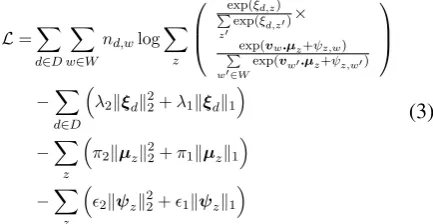
WithL2andL1regularizers, we have a new ob-jective function as follows:
L=X
d∈D X
w∈W
nd,wlog X
z
exp(ξd,z)
P
z0
exp(ξd,z0)
×
exp(vw.µz+ψz,w)
P
w0∈Wexp(vw0.µz+ψz,w0)
−X
d∈D
λ2kξdk22+λ1kξdk1
−X
z
π2kµzk22+π1kµzk1
−X
z
2kψzk22+1kψzk1
(3)
The MAP estimate of the model parameters is obtained by maximizing the regularized log like-lihoodL. The derivatives with respect to the pa-rametersξd,zandψz,ware:
∂L
∂ξd,z
= X
w∈W
nd,wP(z|w, d)−ndθd,z
−2λ2ξd,z−λ1sign(ξd,z)
where P(z | w, d) = θd,zφz,w
P
z0
θd,z0φz0,w, and nd is the
total number of word tokens in the documentd.
∂L
∂ψz,w
=X
d∈D
nd,wP(z|w, d)
−φz,w X
d∈D X
w0∈W
nd,w0P(z|w0, d)
−22ψz,w−1sign(ψz,w)
(5)
And the derivative with respect to the jth ele-ment of the vector for each topiczis:
∂L
∂µz,j
=X
d∈D
X
w∈W
nd,wP(z|w, d)vw,j−
X
w0∈W
vw0,jφz,w0
−2π2µz,j−π1sign(µz,j)
(6)
We usedOWL-QN1(Andrew and Gao, 2007) to
find the topic vector µz and the parameters ξd,z andψz,w that maximizeL.
4 Experiments
To investigate the performance of our new ap-proach, we compared it with two baselines on topic coherence: 1) variational inference LDA
(Blei et al., 2003); and 2) Gibbs sampling LDA
(Griffiths and Steyvers, 2004). The topic coher-ence evaluation measures the cohercoher-ence of the topic-to-word associations, i.e. it directly evalu-ates how the high-probability words in each topic are semantically coherent (Chang et al., 2009; Newman et al., 2010; Mimno et al., 2011; Stevens et al., 2012; Lau et al., 2014; R¨oder et al., 2015).
4.1 Experimental setup
We conducted experiments on the standard bench-mark 20-Newsgroups dataset.2
In addition to converting into lowercase and removing non-alphabetic characters, we removed stop-words found in the stop-word list in the Mal-let toolkit (McCallum, 2002). We then removed words shorter than 3 characters or words appear-ing less than 10 times. Table 1 presents details of the experimental dataset.
As pointed out in Levy and Goldberg (2014) and Pennington et al. (2014), the prediction-based methods and count-based methods for learning word vectors are not qualitatively different on a
1We employed the
OWL-QN implementation from the Mallet toolkit (McCallum, 2002).
2We used the “all-terms” version of the 20-Newsgroups
dataset available at http://web.ist.utl.pt/acardoso/datasets/ (Cardoso-Cachopo, 2007).
Dataset #docs #w/d |W|
20-Newsgroups 18,820 105 20,940
Table 1: Details of the experimental dataset. #docs: number of documents; #w/d: the average number of words per document;|W|: the number of word types.
range of semantic evaluation tasks. Thus, we sim-ply use the Word2Vec toolkit3 (Mikolov et al., 2013) to learn 25-dimensional word vectors on the experimental dataset, using a local 10-word win-dow context.4
The numbers of topics is set to 20. For vari-ational inference LDA, we use Blei’s implemen-tation.5 For Gibbs sampling LDA, we use the
jLDADMM package6 (Nguyen, 2015) with
com-mon hyper-parameters β = 0.01 and α = 0.1 (Newman et al., 2009; Hu et al., 2011; Xie and Xing, 2013). We ran Gibbs sampling LDA for 2000 iterations and evaluated the topics assigned to words in the last sample. We then used the document-to-topic and topic-to-word distributions from the last sample of Gibbs sampling LDA to initialize the parametersξd,z andψz,w while topic vectors µz are initialized as zero vectors in our MAP learner. For our MAP approach, we set7
λ2 = π2 = 0.01,λ1 = π1 = 1.0e−6, 2 = 0.1 and1 = 0.01. We report the mean and standard deviation of the results of ten repetitions of each experiment.
4.2 Quantitative analysis
For a quantitative analysis on topic coherence, we use the normalized pointwise mutual information (NPMI) score. Lau et al. (2014) showed that hu-man scores on a word intrusion task are strongly correlated withNPMI. A higherNPMI score indi-cates that the topic distributions are semantically more coherent.
Given a topic t represented by its top-N topic words w1, w2, ..., wN, the NPMI score for t is:
NPMI(t) = P16i<j6N
logP(P(wi,wj)
wi)P(wj)
−log P(wi,wj), where the
3
https://code.google.com/p/word2vec/
4
The parameters of Word2Vec are set to “-cbow 0 -size 25 -window 10 -negative 0 -hs 1.”
5
http://www.cs.princeton.edu/∼blei/lda-c/. We used
ini-tial value α = 0.1 and settings of “var max iter 20,
var convergence 1.0e−12, em convergence 1.0e−8, em max iter 500,alpha estimate”.
6http://jldadmm.sourceforge.net/ 7We simply fixed the values ofλ
2,π2,λ1,π1, and then
Topic 1 Topic 2 Topic 12 Topic 18 Topic 19
G-LDA MAP+V G-LDA MAP+V G-LDA MAP+V G-LDA MAP+V G-LDA MAP+V
car car power sale game game space space medical medical
writes cars sale power team team nasa nasa disease disease
article engine work shipping year games gov earth article health
cars oil battery offer games year earth gov health food
engine speed radio battery hockey play writes launch drug drug good miles good radio writes hockey article moon food cancer oil price high ground play players launch orbit cancer doctor price dealer sound sound players season moon shuttle msg drugs
speed ford ground high season win orbit mission drugs msg
miles drive writes cable article baseball shuttle henry writes patients
Table 3: Examples of the 10 most probable topical words on the 20-Newsgroups dataset. G-LDA →
Gibbs samplingLDA;MAP+V →Our MAP approach using internal word vectors. The words found by G-LDAand not byMAP+Vare underlined. The words found byMAP+Vbut not by G-LDAare inbold.
Method Top-10 Top-15 Top-20
V-LDA -4.2±0.4 -12.2±0.6 -24.1±0.6 G-LDA -4.2±0.4 -11.7±0.7 -22.9±0.9
MAP-O -3.8±0.5 -10.8±0.6 -22.1±1.2
MAP+V -3.4±0.3 -10.1±0.7 -20.6±1.0
Improve. 0.8 1.6 2.3
Table 2: NPMI scores (mean and standard devia-tion) on the 20-Newsgroups dataset with different numbers of top topical words; V-LDA → Varia-tional inference LDA; G-LDA → Gibbs sampling
LDA; MAP-O → Our MAP learner where we fix
topic vectorsµas zero vectors and only learn pa-rameters ξ andψ; MAP+V → Our MAP learner where we learnµtogether withξ andψ. The Im-prove. row denotes the absolute improvement ac-counted forMAP+Vover the best result produced by the baselines V-LDAand G-LDA.
probabilities are derived from a 10-word sliding window over an external corpus.8 TheNPMIscore for a topic model is the average score for all topics. Table 2 shows that our approach using inter-nal word vectors MAP+V produces significantly higher9 NPMI scores than the baseline variational inference LDA and Gibbs sampling LDA models. So this indicates that the word vectors contain-ing internal context information from experimen-tal dataset can help to improve topic coherence.
4.3 Qualitative analysis
This section provides an example of how our ap-proach improves topic coherence. Table 3
com-8
We use the English Wikipedia dump of July 8, 2014, con-taining 4.6 million articles as our external corpus.
9Using the two sample Wilcoxon test, the improvement is
significant (p<0.01).
pares the top-10 words produced by the baseline Gibbs sampling LDA and our MAP+V approach on the 20-Newsgroups dataset. It is clear that all top-10 words learned with ourMAP+V model are qualitatively more coherent. For example, topic 19 of the Gibbs samplingLDA model consists of
words related to “medicine” together with other unrelated words, whereas our MAP+V approach produced a purer topic 19 only about “medicine.”
On 20-Newsgroups dataset, it is common that the baseline variational inference LDAand Gibbs samplingLDAmodels include the frequent words
such as ”writes” and ”article” as top topical words in many topics. However, ourMAP+Vmodel using the internal word vectors is able to exclude these words out of the top words in these topics.
5 Conclusions and future work
In this paper, we proposed a new approach of fully direct MAP estimation for the LDA topic model inference, incorporating latent feature representa-tions of words. Preliminary results show that the latent feature representations trained from the ex-perimental topic-modeling corpus can improve the topic-to-word mapping.
Acknowledgments
The first author is supported by an International Postgraduate Research Scholarship and a NICTA NRPA Top-Up Scholarship.
References
Galen Andrew and Jianfeng Gao. 2007. Scalable Training of L1-regularized Log-linear Models. In Proceedings of the 24th International Conference on Machine Learning, pages 33–40.
Arthur Asuncion, Max Welling, Padhraic Smyth, and Yee Whye Teh. 2009. On Smoothing and Inference for Topic Models. In Proceedings of the Twenty-Fifth Conference on Uncertainty in Artificial Intelli-gence, pages 27–34.
Taylor Berg-Kirkpatrick, Alexandre Bouchard-Cˆot´e, John DeNero, and Dan Klein. 2010. Painless Un-supervised Learning with Features. InHuman Lan-guage Technologies: The 2010 Annual Conference of the North American Chapter of the Association for Computational Linguistics, pages 582–590.
David M. Blei and Jon D. McAuliffe. 2008. Super-vised Topic Models. InAdvances in Neural Infor-mation Processing Systems 20, pages 121–128. MIT Press.
David M. Blei, Andrew Y. Ng, and Michael I. Jordan. 2003. Latent Dirichlet Allocation. Journal of Ma-chine Learning Research, 3:993–1022.
David M. Blei. 2012. Probabilistic Topic Models. Communications of the ACM, 55(4):77–84.
Ziqiang Cao, Sujian Li, Yang Liu, Wenjie Li, and Heng Ji. 2015. A Novel Neural Topic Model and Its Su-pervised Extension. InProceedings of the Twenty-Ninth AAAI Conference on Artificial Intelligence, pages 2210–2216.
Ana Cardoso-Cachopo. 2007. Improving Methods for Single-label Text Categorization. PhD Thesis, Insti-tuto Superior Tecnico, Universidade Tecnica de Lis-boa.
Jonathan Chang, Sean Gerrish, Chong Wang, Jordan L. Boyd-graber, and David M. Blei. 2009. Reading Tea Leaves: How Humans Interpret Topic Models. InAdvances in Neural Information Processing Sys-tems 22, pages 288–296.
Jen-Tzung Chien and Meng-Sung Wu. 2008. Adaptive Bayesian Latent Semantic Analysis. IEEE Transac-tions on Audio, Speech, and Language Processing, 16(1):198–207.
Jacob Eisenstein, Amr Ahmed, and Eric Xing. 2011. Sparse Additive Generative Models of Text. In Pro-ceedings of the 28th International Conference on Machine Learning, pages 1041–1048.
James Foulds, Levi Boyles, Christopher DuBois, Padhraic Smyth, and Max Welling. 2013. Stochas-tic Collapsed Variational Bayesian Inference for La-tent Dirichlet Allocation. InProceedings of the 19th ACM SIGKDD International Conference on Knowl-edge Discovery and Data Mining, pages 446–454.
Mark Girolami and Ata Kab´an. 2003. On an Equiv-alence Between PLSI and LDA. InProceedings of the 26th Annual International ACM SIGIR Confer-ence on Research and Development in Informaion Retrieval, pages 433–434.
Xavier Glorot, Antoine Bordes, and Yoshua Bengio. 2011. Domain Adaptation for Large-Scale Senti-ment Classification: A Deep Learning Approach. In Proceedings of the 28th International Conference on Machine Learning, pages 513–520.
Thomas L. Griffiths and Mark Steyvers. 2004. Find-ing scientific topics. Proceedings of the National Academy of Sciences of the United States of Amer-ica, 101(Suppl 1):5228–5235.
Thomas Hofmann. 1999. Probabilistic Latent Seman-tic Indexing. InProceedings of the 22nd annual in-ternational ACM SIGIR conference on Research and development in information retrieval, pages 50–57.
Yuening Hu, Jordan Boyd-Graber, and Brianna Sati-noff. 2011. Interactive Topic Modeling. In Pro-ceedings of the 49th Annual Meeting of the Associ-ation for ComputAssoci-ational Linguistics: Human Lan-guage Technologies - Volume 1, pages 248–257.
Mark Johnson. 2010. PCFGs, Topic Models, Adaptor Grammars and Learning Topical Collocations and the Structure of Proper Names. InProceedings of the 48th Annual Meeting of the Association for Com-putational Linguistics, pages 1148–1157.
Han Jey Lau, David Newman, and Timothy Baldwin. 2014. Machine Reading Tea Leaves: Automatically Evaluating Topic Coherence and Topic Model Qual-ity. In Proceedings of the 14th Conference of the European Chapter of the Association for Computa-tional Linguistics, pages 530–539.
Omer Levy and Yoav Goldberg. 2014. Neural Word Embedding as Implicit Matrix Factorization. In Ad-vances in Neural Information Processing Systems 27, pages 2177–2185.
Andrew McCallum. 2002. MALLET: A Machine Learning for Language Toolkit.
Tomas Mikolov, Ilya Sutskever, Kai Chen, Greg S Cor-rado, and Jeff Dean. 2013. Distributed Representa-tions of Words and Phrases and their Composition-ality. InAdvances in Neural Information Processing Systems 26, pages 3111–3119.
In Proceedings of the 2011 Conference on Empiri-cal Methods in Natural Language Processing, pages 262–272.
David Newman, Arthur Asuncion, Padhraic Smyth, and Max Welling. 2009. Distributed Algorithms for Topic Models. The Journal of Machine Learn-ing Research, 10:1801–1828.
David Newman, Jey Han Lau, Karl Grieser, and Tim-othy Baldwin. 2010. Automatic Evaluation of Topic Coherence. In Human Language Technolo-gies: The 2010 Annual Conference of the North American Chapter of the Association for Computa-tional Linguistics, pages 100–108.
Dat Quoc Nguyen, Richard Billingsley, Lan Du, and Mark Johnson. 2015. Improving Topic Models with Latent Feature Word Representations. Trans-actions of the Association for Computational Lin-guistics, 3:299–313.
Dat Quoc Nguyen. 2015. jLDADMM: A Java pack-age for the LDA and DMM topic models. http: //jldadmm.sourceforge.net/.
Michael Paul and Mark Dredze. 2015. SPRITE: Generalizing Topic Models with Structured Priors. Transactions of the Association for Computational Linguistics, 3:43–57.
Jeffrey Pennington, Richard Socher, and Christopher Manning. 2014. Glove: Global Vectors for Word Representation. In Proceedings of the 2014 Con-ference on Empirical Methods in Natural Language Processing, pages 1532–1543.
Ian Porteous, David Newman, Alexander Ihler, Arthur Asuncion, Padhraic Smyth, and Max Welling. 2008. Fast Collapsed Gibbs Sampling for Latent Dirich-let Allocation. In Proceedings of the 14th ACM SIGKDD international conference on Knowledge discovery and data mining, pages 569–577.
Michael R¨oder, Andreas Both, and Alexander Hinneb-urg. 2015. Exploring the Space of Topic Coherence Measures. InProceedings of the Eighth ACM Inter-national Conference on Web Search and Data Min-ing, pages 399–408.
Ruslan Salakhutdinov and Geoffrey Hinton. 2009. Replicated Softmax: an Undirected Topic Model. In Advances in Neural Information Processing Systems 22, pages 1607–1614.
Richard Socher, John Bauer, Christopher D. Manning, and Ng Andrew Y. 2013. Parsing with Compo-sitional Vector Grammars. In Proceedings of the 51st Annual Meeting of the Association for Compu-tational Linguistics (Volume 1: Long Papers), pages 455–465.
David Sontag and Dan Roy. 2011. Complexity of In-ference in Latent Dirichlet Allocation. InAdvances in Neural Information Processing Systems 24, pages 1008–1016.
Nitish Srivastava, Ruslan Salakhutdinov, and Geoffrey Hinton. 2013. Modeling Documents with a Deep Boltzmann Machine. InProceedings of the Twenty-Ninth Conference on Uncertainty in Artificial Intel-ligence, pages 616–624.
Keith Stevens, Philip Kegelmeyer, David Andrzejew-ski, and David Buttler. 2012. Exploring Topic Co-herence over Many Models and Many Topics. In Proceedings of the 2012 Joint Conference on Empir-ical Methods in Natural Language Processing and Computational Natural Language Learning, pages 952–961.
Matthew A. Taddy. 2012. On Estimation and Selection for Topic Models. In Proceedings of the 15th In-ternational Conference on Artificial Intelligence and Statistics.
Yee W Teh, David Newman, and Max Welling. 2006. A Collapsed Variational Bayesian Inference Algo-rithm for Latent Dirichlet Allocation. InAdvances in Neural Information Processing Systems 19, pages 1353–1360.
Hanna M Wallach. 2006. Topic Modeling: Beyond Bag-of-Words. InProceedings of the 23rd interna-tional conference on Machine learning, pages 977– 984.
Xuerui Wang, Andrew McCallum, and Xing Wei. 2007. Topical N-Grams: Phrase and Topic Discov-ery, with an Application to Information Retrieval. In Proceedings of the 2007 Seventh IEEE International Conference on Data Mining, pages 697–702.
Pengtao Xie and Eric P. Xing. 2013. Integrating Doc-ument Clustering and Topic Modeling. In Proceed-ings of the Twenty-Ninth Conference on Uncertainty in Artificial Intelligence, pages 694–703.
Pengtao Xie, Diyi Yang, and Eric Xing. 2015. In-corporating Word Correlation Knowledge into Topic Modeling. InProceedings of the 2015 Conference of the North American Chapter of the Association for Computational Linguistics: Human Language Tech-nologies, pages 725–734.
Xiaohui Yan, Jiafeng Guo, Yanyan Lan, and Xueqi Cheng. 2013. A Biterm Topic Model for Short Texts. In Proceedings of the 22Nd International Conference on World Wide Web, pages 1445–1456.
Yi Yang, Doug Downey, and Jordan Boyd-Graber. 2015. Efficient Methods for Incorporating Knowl-edge into Topic Models. InProceedings of the 2015 Conference on Empirical Methods in Natural Lan-guage Processing, pages 308–317.