University of South Carolina
Scholar Commons
Theses and Dissertations
2018
The Impact Of Teaching Growth Mindset On
Archery Skill Achievement: An Action Research
Study
Phillip Thomas
University of South Carolina - Columbia
Follow this and additional works at:https://scholarcommons.sc.edu/etd
Part of theCurriculum and Instruction Commons
This Open Access Dissertation is brought to you by Scholar Commons. It has been accepted for inclusion in Theses and Dissertations by an authorized administrator of Scholar Commons. For more information, please [email protected].
Recommended Citation
T
HEI
MPACT OFT
EACHINGG
ROWTHM
INDSET ONA
RCHERYS
KILLA
CHIEVEMENT:
A
NA
CTIONR
ESEARCHS
TUDYby
Phillip Thomas
Bachelor of Science
Clemson University,2006
Master of Arts in Teaching The Citadel, 2009
Submitted in Partial Fulfillment of the Requirements
For the Degree of Doctor of Education in
Curriculum and Instruction
College of Education
University of South Carolina
2018
Accepted by:
Suha Tamim, Major Professor
Leigh D’Amico, Committee Member
William Morris, Committee Member
Linda Silvernail, Committee Member
DEDICATION
This dissertation is dedicated to my wife, Caroline, my three sons, Levi, Micah,
ACKNOWLEDGEMENTS
There are many people who deserve to be acknowledged for their role, whether
direct or indirect, in this dissertation. First, I would like to thank my family, especially
by beautiful wife, Caroline, who has given nothing but encouragement and sacrifice
throughout this entire process. I want to thank my parents, John and Phyllis, my sister,
Suzanne, and my in-laws, Lou and Victoria Norment, who have provided much support
and sacrifice along the way. Thank you, Sarah Toton for all of your statistical wisdom.
I owe much gratitude to my school administration that not only supports me as an
educator, but also gives me the opportunity to go to my dream job every day. Thank you
Dr. Bill Coon, Dr. Natalie Osborne, Dr. Kyle Meetze, and Kai Brailey.
I would like to thank Mindset Works, Inc. for their support during this study. This
study would not have been possible without your help.
I would like to thank my dissertation committee for their time and feedback. I am
especially grateful for my advisor, Dr. Suha Tamim. Thank you for everything you taught
me in this program, your feedback, and especially pushing me out of my comfort zone
and encouraging me to have a growth mindset on qualitative data. I am a better researcher
ABSTRACT
Although setbacks and failure are common in school, especially in outdoor
adventure physical education classes, the ways in which students handle those setbacks
and failure impact their academic achievement and performance. This dissertation
describes a problem of practice based on observations of how the researcher’s students
handle setbacks and failure in his outdoor adventure education class, specifically how
these setbacks and failure affect the students’ archery performance. This study examined
how teaching noncognitive skills using the computer program Brainology impacts student
skill performance in archery and the students’ perceptions of this impact. This study used
a concurrent mixed methods action research methodology. The quantitative data showed
that students had significant increases in their archery scores and Mindset Assessment
Profile scores. However, a weak relationship between mindset and archery scores
indicated that moving more toward a growth mindset was not related to increases in
archery scores. The qualitative data indicated four themes: (1) students’ connection from
Brainology to archery, (2) Brainology strategies used in archery, (3) students’ attitudes
toward Brainology, and (4) factors not related to Brainology. Based on the findings, the
researcher recommends a different approach to teaching growth mindset in physical
education and outdoor adventure education.
Keywords: action research, mindset theory, growth mindset, fixed mindset, outdoor
TABLE OF CONTENTS
DEDICATION ... iii
ACKNOWLEDGEMENTS ... iv
ABSTRACT ... v
LIST OF TABLES ... x
LIST OF FIGURES ... xi
LIST OF ABBREVIATIONS ... xii
CHAPTER 1INTRODUCTION ... 1
IMPLICIT THEORIES OF INTELLIGENCE AND MINDSET THEORY ... 1
OUTDOOR ADVENTURE EDUCATION ... 3
THEORETICAL FRAMEWORK ... 5
PROBLEM OF PRACTICE STATEMENT ... 14
PURPOSE STATEMENT ... 16
STUDY RATIONALE ... 18
RESEARCH QUESTIONS ... 20
RESEARCH DESIGN ... 20
DISSERTATION IN PRACTICE OVERVIEW ... 24
GLOSSARY OF KEY TERMS ... 25
CHAPTER 2LITERATUREREVIEW ... 28
RATIONALE FOR THE PROBLEM OF PRACTICE ... 30
UNDERLYING CAUSES OF THE PROBLEM ... 31
ORGANIZATION OF THE CHAPTER ... 32
HISTORICAL PERSPECTIVES ON PHYSICAL EDUCATION,OUTDOOR ADVENTURE, AND ARCHERY ... 34
MINDSET ... 37
GRIT ... 42
GOAL COMMITMENT AND PERSISTENCE ... 44
ACHIEVEMENT BEHAVIOR AND CULTURAL FACTORS ... 47
PERFORMANCE AND MASTERY CLIMATES,SELF-REGULATION, AND SOCIALIZATION ... 48
BRAINOLOGY COMPUTER PROGRAM ... 51
SUMMARY ... 52
CHAPTER 3METHODOLOGY ... 54
PROBLEM OF PRACTICE ... 54
RESEARCH QUESTIONS ... 54
DESIGN OF THE STUDY ... 55
PROCEDURES ... 59
RESEARCH CONTEXT ... 61
SAMPLE ... 63
INTERVENTION ... 64
ROLE OF THE RESEARCHER ... 67
DATA COLLECTION INSTRUMENTS ... 67
DATA ANALYSIS ... 75
ETHICAL CONSIDERATIONS ... 78
RIGOR AND TRUSTWORTHINESS ... 80
SUMMARY ... 81
CHAPTER4FINDINGS ... 83
PROBLEM OF PRACTICE ... 83
RESEARCH QUESTIONS ... 83
METHODOLOGY ... 84
ARCHERY SHOOTING TEST RESULTS ... 85
MINDSET ASSESSMENT PROFILE (INTELLIGENCE)RESULTS ... 85
MINDSET ASSESSMENT PROFILE (ARCHERY)RESULTS ... 88
PEARSON CORRELATION RESULTS ... 90
MINDSET VERSUS ARCHERY CHANGE SCORE ... 92
FOCUS GROUP FINDINGS ... 92
EXPLANATION OF SIGNIFICANT CHANGES IN ARCHERY SCORES ... 95
STUDENT PERCEPTIONS OF THEIR ARCHERY ABILITY IN RELATION TO THEIR MINDSET ... 109
TRIANGULATION OF FINDINGS ... 114
SUMMARY ... 120
CHAPTER5IMPLICATIONSANDRECOMMENDATIONS ... 124
PURPOSE OF STUDY ... 124
RESEARCH QUESTIONS ... 124
METHODOLOGY ... 125
ACTION PLAN ... 126
IMPLICATIONS ... 128
LIMITATIONS ... 133
SUMMARY ... 135
REFERENCES ... 136
APPENDIX A–OFFICIAL NASPSCORECARD ... 155
APPENDIX B–MINDSET ASSESSMENT PROFILE (INTELLIGENCE) ... 156
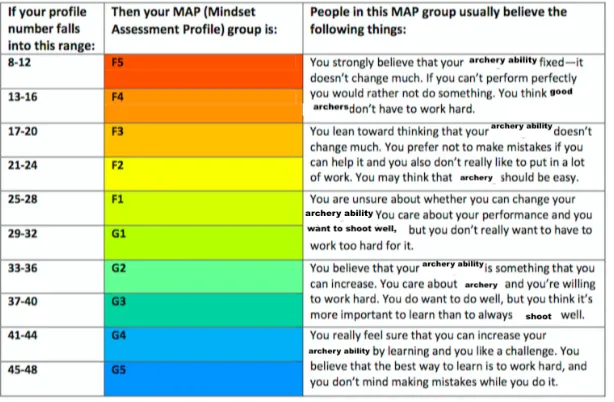
APPENDIX C–MINDSET ASSESSMENT PROFILE (ARCHERY) ... 157
APPENDIX D–NASPARCHERY EQUIPMENT SPECIFICATIONS ... 158
APPENDIX E–NASPTARGET SCORING GUIDE ... 163
APPENDIX F–FOCUS GROUP INTERVIEW GUIDING QUESTIONS ... 164
APPENDIX G–NASPARCHERY SHOOTING RULES ... 165
APPENDIX H–NASPSCORING RULES ... 169
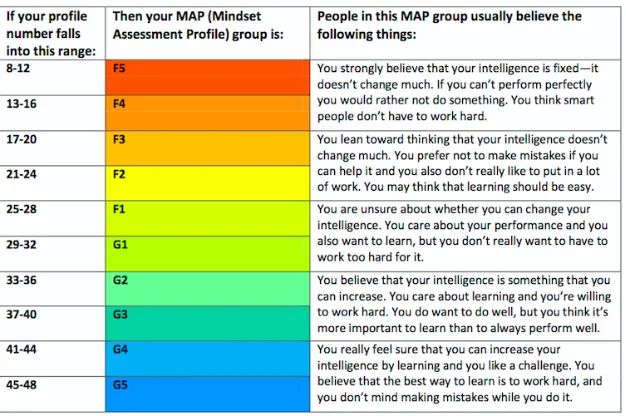
APPENDIX I–MAPCHART (INTELLIGENCE) ... 172
LIST OF TABLES
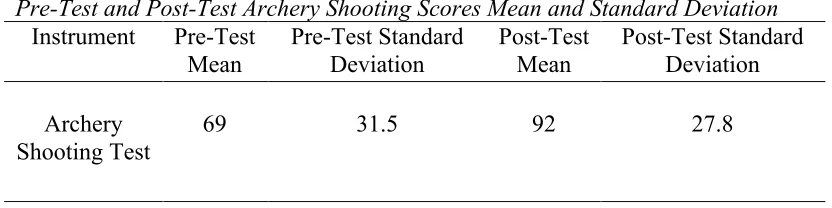
Table 4.1 Pre-Test and Post-Test Archery Shooting Scores Mean and Standard
Deviation ... 85
Table 4.2 Mean Pre-Test and Post-Test MAP (Intelligence) Scores ... 87
LIST OF FIGURES
Figure 3.1 Summer curriculum implementation guide used in this study ... 65
Figure 3.2 Screenshot of online Brainology interface used in this study ... 65
Figure 3.3Brainology Study Plan Journal worksheet used in this study ... 66
Figure 4.1 Mindset Assessment Profile (Intelligence) Chart used to determine MAP (Intelligence) group and description ... 87
Figure 4.2 Mindset Assessment Profile (Archery) Chart used to determine MAP (Archery) group and description. ... 89
Figure 4.3 Correlation between MAP (Intelligence) change scores and archery change scores ... 91
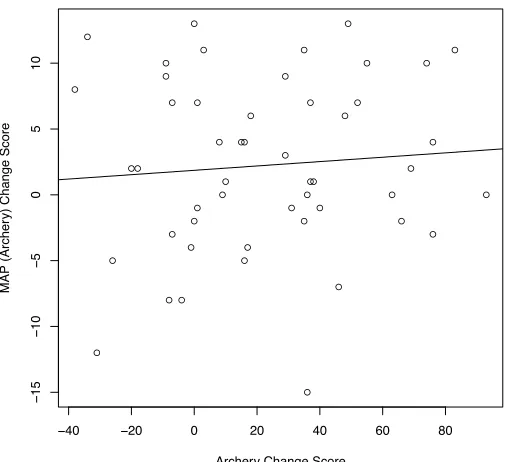
Figure 4.4 Correlation between MAP (Archery) change scores and archery change scores ... 91
Figure 4.5 Students’ perceived impacts on archery post-test shooting scores ... 109
Figure 4.6 Ryan’s Brainology Study Plan Journal ... 118
LIST OF ABBREVIATIONS
EL ... Expeditionary Learning
MAP ... Mindset Assessment Profile
NASP ... National Archery in the Schools Program
CHAPTER1
INTRODUCTION
Obstacles, setbacks, and failure are not only part of academics, but also they are
part of life (Dweck, 2006). While some students may experience major failures such as
getting kicked out of school or cut from a sports team, most students will experience
frequent minor setbacks and failures, such as failing an assignment or not being able to
perform a given task. These minor setbacks and failures may happen daily, especially as
teachers encourage students to try challenging activities with which the students may not
be familiar, comfortable, or knowledgeable (Dweck, 2010). While challenging activities
may lead to setbacks and failure, students often show considerable agency in choosing
how to respond. They may respond to these failures in ways that are more or less
productive; some will react with a distinct lack of motivation that leads them to avoid
similar challenges in the future, while others will react energetically by evaluating the
causes of their setback and by planning strategies to address the problems they face in the
future (Aditomo, 2015).
Implicit Theories of Intelligence and Mindset Theory
The psychology of student response to failure relates to the implicit theories of
intelligence, which refers to a person’s beliefs about whether people are born with a fixed
level of intelligence that cannot be changed or whether intelligence is malleable (Martin,
2015). Dweck (2010) refers to this spectrum as between the fixed mindset and growth
fixed and unchangeable; when these students encounter a novel or challenging obstacle,
challenge, or topic of research or classroom consideration, they will use their first
reactions to this challenge to inform their interactions. Such immediate reactions and
judgments will inform these students’ judgments about whether they are able or unable to
perform a given task or handle a certain subject. These students do not react well to tasks
that require them to show considerable effort and tenacity, and most importantly, perform
hard work in order to achieve a level of competence or mastery. Instead, these students
tend to assume that topics of education should come naturally, and they use initial
failures as a means of exhibiting discouragement and a lack of motivation that causes
them to question their abilities and intelligence (Dweck, 2010).
On the other hand, students who exhibit a growth mindset tend to believe that
their intelligence and capabilities are malleable and can be developed and improved over
time and with effort. In contrast to those students who exhibit a fixed mindset, students
who demonstrate a growth mindset will often welcome challenging activities, even if
their education and experimentation in such activities causes instances of early failure.
They do not view such failure as tantamount to their inability to gain competence or
mastery in that subject, but instead they tend to view such failure as a step toward
mastery. They are more resilient and capable of recognizing the value that presents in
failure and are consequently more able or willing to show greater effort in the future to
master a complicated subject or understand an intricate or advanced task (Dweck, 2010;
Meierdirk, 2016). In contrast to students who exhibit a fixed mindset, students with a
growth mindset are more likely to respond to initial challenges not by shirking the task as
using resources at their disposal for learning (Dweck, 2010). These students tend to view
challenges not as obstacles but as learning opportunities (O’Brien, 2015).
Outdoor Adventure Education
Outdoor adventure education incorporates many activities that provide
challenging circumstances that illuminate the mindset responses that are most necessary
to development (O’Brien, 2015). Outdoor experiential education consists of educational
situations in a wilderness setting and incorporates an element of adventure or challenge
as a means of providing direct experience as a vehicle for education (Warren, 2005).
Students involved in the researcher’s outdoor adventure education classes engage
in a range of challenging activities, most of which they will have little previous
experience. These activities include archery, bouldering, ropes courses, kayaking, or
backpacking. Students come to this class with their varied levels of ability and past
experience, as well as varied preconceptions of such outdoor adventure education and
other related activities. Into this context, these students are presented with novel
challenges and their educators are placed in the unique position by which they may be
able to aid these students in developing a growth-oriented mindset (Warren, 2005).
Outdoor education professionals strive to help students recognize the predetermined
limitations of their own capacities that they set for themselves and to develop a growth
mindset that helps them succeed in their skills achievement, as well as improve their
ability to meet challenging situations through effort and perseverance (O’Brien & Lomas,
2017).
Archery. The action research study that follows is based on a particular focus of
fastest growing sports in the United States. According to USA Archery (2014), the
national governing body for the Olympic sport of archery, archery membership increased
105% between 2011 and 2013, and 21.6 million United States residents participated in
archery in 2014, a jump from 18 million participants in 2012. An increase in youth
archery participants is linked to popular presentations of the activity, particularly as a
result of movies such as The Hunger Games, as well as the increasing prevalence of
archery programs in public schools resulting from the National Archery in the Schools
Program [NASP] (USA Archery, 2014; Responsive Management, 2015).
Archery provides many physical, psychological, and social benefits including
increased higher-order thinking and self-management skills, and increased focus and
concentration. Additionally, archery can improve student motivation and motor skills
(Arem, 2006; Hargrove & Vercelletto, 2013; NASP History, n.d.). Archery provides
excellent opportunities for students, not just with regard to learning a new skill, but as a
means of learning how to react to a new situation and set of objectives – and the setbacks
and failure that invariably result, at first – in a manner that leads to their exhibiting the
perseverance necessary to increase skill achievement.
The National Archery in the Schools Program (NASP) curriculum forms the basis
for this larger consideration. NASP is a 501c(3) non-profit educational foundation that
partners with wildlife conservation agencies to teach outdoor skills. The NASP mission
emphasizes outdoor skills development as beneficial because it results in students
spending more time outside, as well as gaining greater levels of self-reliance, all while
helping to foster character development amid a strong emphasis on nature and wildlife
archery, and provide competitive opportunities through local, state, national, and world
tournaments. (NASP Program Description, n.d.)
Theoretical Framework
Outdoor adventure education relies heavily on the work of John Dewey. In his
work Experience and Education (1938), Dewey describes the term experience as well as
what is necessary to imbue that experience with educational value. Student experience
results from the interaction between the environment and the student (Dewey, 1938).
While nearly every student experiences failure, a student’s experience in archery
will either be positive and valuable, or negative, resulting in the student quitting.
Research shows that students are more likely to quit an activity if they lack
self-confidence, lack initial ability, or if they face initial failure. However, ability, skills, and
talent may be less important than perseverance for students to achieve a successful
outcome (Sproule et al., 2011). This theoretical framework will examine social-learning
theory, including self-efficacy and self-concept, and implicit theories of intelligence and
mindset, which include both entity theory and incremental theory.
Social-learning theory. A crucial basis from which to mount this consideration is
the work of Albert Bandura (1967; 1986), particularly his theories of learning and
self-efficacy. As Bandura describes, learning is a process achieved in a social context. He
considers how people learn from one another and discusses core concepts including
observational learning, imitation, and modeling. Conceptual foundations of Bandura’s
social learning theory include four ideas. First, people learn by observing the behavior of
others as well as the outcomes of those behaviors. Second, learning can occur without a
whose proponents argue that learning is only reflected by a permanent change in behavior
(Pigot-Upshall, 2017). This is crucial because it argues that learning may occur but may
not necessarily be reflected in a change in performance, such as greater classroom
efficacy or in testing. Third, cognition plays a role in learning and learning is often based
upon the anticipatory capacity of the learner, especially through the presence or absence
of conditions of reinforcements, such as rewards or punishments, or the learner’s
individual tendency or perception of his or her own degree of effectiveness (Bandura,
1967). Fourth, the environment, such as the classroom, plays a strong role in the capacity
of a given learner to learn, and that an environment that is conducive to learning
improves students’ ability to model their behavior on others and to gain a stronger
understanding of their own efficacy.
Both modeling and reinforcement are crucial elements of social learning theory.
As Bandura (1967) explains, students exemplify strong learning behaviors through the
modeling of learning behavior, and as a result, struggling students may achieve stronger
outcomes in their learning provided the educator has reinforced such modeling by
noticing and praising not only the student upon whom behavior is modeled, but the
observer as well (Bandura, 1967). Social reinforcement, as observed through the
approval or disapproval of one’s peers, parents, and other significant observers forms a
strong basis for determining the learner’s belief in his own self-efficacy, or in his or her
ability to complete educational activities or to accomplish educational goals (Akers &
Jensen, 2011). Bandura (1986) defines self-efficacy as “people’s judgments of their
capabilities to organize and execute personal courses of action required to attain
efficacy beliefs impact his or her perseverance, effort, and choice of activity (Bandura,
1997; Schunk 1991).
Self-efficacy and self-concept. Bandura (as cited in Usher & Pajares, 2008)
theorized that people’s beliefs about their capabilities and about the outcomes of their
efforts greatly influence their behavior. His social learning theory and self-efficacy
beliefs help determine the choices people make, their effort levels, and the persistence
and perseverance they expend during difficulties, setbacks, and failure. Not only has
self-efficacy been shown to predict student academic achievement, but self-self-efficacy beliefs
are critical determinants of human motivation and behavior (Schunk, 1991). In academic
settings, they influence motivation, self-regulation, and achievement; moreover,
“Self-efficacy beliefs are most likely to change during skill development, when individuals are
faced with novel tasks. Although failure may occur periodically, when students notice a
gradual improvement in skills over time, they typically experience a boost in their
self-efficacy” (Usher & Pajares, 2008; p. 752).
Derived from the general concept of self-efficacy conceptualized by Bandura
(1986), Schunk (1991) proposed the construct of academic self-efficacy, a type of
academic motivation in terms of personal expectancy. It is a person’s perception that he
or she can perform a given task at a certain level (Schunk, 1991). Current research shows
academic self-efficacy is a stronger predictor of achievement than ability (Britner &
Pajares, 2006; Usher & Pajares, 2008). A closely related concept to academic
self-efficacy is the term academic self-concept. The general term self-concept can be defined
as “a person’s self-perceptions formed through experience with and interpretation of his
academic, physical, and social self-concepts (Cohrssen, Niklas, Logan, & Tayler, 2016).
Students with higher academic self-concepts are usually willing to invest more effort into
their academic work; moreover, students who are confident in their ability in a specific
area are more likely to persevere, expend effort, and succeed than are students with less
belief in their ability. Marsh, Cairns, Relich, Barnes, and Debus (1984) found that
attributions of success to ability and effort are positively correlated, and both are
positively correlated to academic self-concept. Additionally, after failure, attributions of
ability and effort are both negatively correlated with self-concept. The distinction
between academic self-efficacy and academic self-concept could explain why some
students may be confident in their ability with certain concepts within a discipline yet
lack the confidence in their ability in the entire domain (Denissen et al., 2007; Ferla,
Valcke, & Cai, 2009). For example, a student in outdoor adventure education may be
confident in his or her ability to demonstrate proper archery form (self-efficacy), but
believes he or she is not good at archery (self-concept).
Self-efficacy and self-concept are multi-dimensional and include a range of
domains; thus, the research findings in the academic domain regarding the relationship
between academic self-efficacy, academic self-concept, effort, and achievement are also
found in the physical domain (Ommundsen, 2006). Some studies have suggested that
self-efficacy is a major determinant of activity choice, willingness to expend effort,
performance, and persistence in sport and physical education (Ommundsen, 2001a;
Ommundsen, 2003; Ommundsen, 2006; Sami Kalaja et al., 2007). In sport and physical
activity, research has shown little or no association between outcome expectancy and
Attribution theory. One of the foundational theories from which this study was
based is attribution theory. Attribution theory is concerned with causal inferences, or the
perceived reasons why a particular event occurred (Weiner, 1985). This has significant
implications for the educational process, and it has been demonstrated that “causal
attributions influence the likelihood of undertaking achievement activities, the intensity
of work at these activities, and the degree of persistence in the face of failure” (Weiner,
1972, p. 213). Thus, these behaviors will influence the degree of learning. Attribution
theory involves a three-stage process: 1) behavior must be observed or perceived; 2)
behavior is intentional; and 3) behavior is attributed to internal or external causes
(Weiner, 2010). The causal dimensions of behavior, or how people explain their
successes or failures, are locus, stability, and controllability.
Locus. The locus dimension is the perception of the cause of an event as being
either internal or external to a person (Judge & Bono, 2001). Internal attribution is
attributing causes that are within a person such as personal effort or ability, and external
attribution is attributing causes not within a person such as the weather or another person.
Internal attribution is related to increased self-efficacy and self-esteem (Gist & Mitchell,
1992; Judge & Bono, 2001). When students believe their effort led them to success,
self-efficacy and self-esteem increases.
Stability. The stability dimension refers to the cause of the behavior either being
stable or unstable across time and circumstances (Mikulincer, 1988). Stable causes are
ones that change little such as personality traits, whereas unstable causes are ones that are
temporary such as illness. Students who attribute failure to stable causes often experience
1988). However, an attributing failure to unstable causes prevents the negative effects of
setbacks on subsequent performance, and students are more likely to persevere.
Controllability. The controllability dimension refers to the extent to which a
person can influence the cause of an event. Although controllability is similar to locus of
control, it should be separated (Weiner, 2010). For example, a person’s aptitude is an
internal but uncontrollable attribution. While some internal causes are controllable and
others are not, all external causes are uncontrollable.
The various combinations of locus, stability, and controllability attributions
greatly impact students’ academic motivations and persistence at a given task (Weiner,
1985). If a student attributes academic failure or success to factors that are internal and
controllable, such as effort, then he or she is likely to show persistence and increased
motivation (Dweck, 2000). On the other hand, the opposite is true when students attribute
failure and success to uncontrollable external factors.
It is important to note that self-serving bias is, in part, assumed to influence the
attributional process (Roesch & Amirkhan, 1997). A self-serving attributional bias refers
to the tendency to attribute favorable events to oneself and unfavorable events to external
causes. This attributional style serves to enhance self-esteem following success and
protect it following failure. Both self-serving bias and Weiner’s model for attributions
both include hedonistic motivations, which are motivations based on the pursuit of
pleasure. Weiner’s model differs from the self-serving attributional bias style in that
Weiner’s model does not view hedonistic motivations as the sole motivations underlying
or fail, should attribute alike and the motivation is hedonistic in nature (Roesch &
Amirkhan, 1997).
In the early 1970’s attribution theory formed a basis of the field of social
cognition (Dweck, 2018). However, there were two branches – one that embraced a more
purely cognitive form, and the other investigated more motivational and emotional
consequences of different explanations of people’s behaviors. Weiner (1972) pioneered
the latter branch, which consequently, influenced Carol Dweck’s research on implicit
theories of intelligence and mindset.
Implicit theories of intelligence and mindset. Implicit theories of intelligence
are a person’s fundamental beliefs about whether his or her intelligence can be changed
(Bernardo, 2012; Dweck, 2006). Individuals who tend to view intelligence as an
unchangeable, inborn trait or entity hold an entity belief or an entity theory, whereas
those with who tend to view intelligence as that which can be increased through effort
and developed over time hold an incremental belief or incremental theory (Blackwell et
al., 2007). It is important to note that the term implicit theories of intelligence, which
refer to entity theory and incremental theory, is synonymous with mindset theory, with
the terms fixed and growth mindsets broadly reflecting entity and incremental theories
about intelligence respectively (Martin, Bostwick, Collie, & Tarbetsky, 2017). The author
most important to this consideration is Carol Dweck, from whom mindset theory and the
concepts of fixed and growth mindset originate. Individuals’ behaviors and beliefs are
often influenced by their implicit beliefs about intelligence being malleable or inherent
and fixed (Dweck, 2000; Dweck, 2006). Their beliefs about their intelligence affect how
Henderson & Dweck 1990), differences in the degree of social stereotyping (Levy,
Stroessner, & Dweck, 1998), and their predictions of others’ future behaviors (Chiu,
Hong, & Dweck, 1997).
The qualities of individuals with a fixed mindset are thus vastly limited in terms
of their potential for academic achievement. When students view intelligence as fixed,
they will tend to value looking smart, and will overwhelmingly seek to avoid poor
performance (Dweck, 2008; Dweck, 2010).
Fixed mindset students tend to avoid effort in their academic endeavors based on
their internalization of the idea that if someone has the ability, then success should come
naturally. These students report feeling “dumb” when attempting to work hard on a
challenging or novel goal or subject (Dweck, 2010). As a result, students with fixed
mindsets will tend not to handle setbacks and failure well and in a crucial psychological
point, will tend to believe that any such setback necessarily makes them question their
intelligence, leading them to become discouraged or defensive (Martin, 2015), withdraw
from classroom activities, blame others, accept failure, or even consider cheating, if
success does not come immediately (Dweck, 2010).
By contrast, students who possess a growth mindset are described as tending to
“view challenging work as an opportunity to learn and grow,” will embrace the challenge
that comes with new concepts and difficult novel objectives, and will often express
understanding that “even geniuses have to work hard” (Dweck, 2010, p. 16). As opposed
to students who present a fixed mindset, those with a growth mindset tend to respond to
persevere toward their goals, as well as pursue alternative resources to help them get back
on track (Martin et al., 2017).
One important theoretical basis for differentiating between the fixed and growth
mindset in educational objectives can be extrapolated from the work of McClelland et al.
(1989). These researchers explain that the growth mindset is the product of different
motivational factors that they separate into self-attributed and implicit motives.
Self-attributed motives are those that are conscious and explicit, and that are derived from
environmental factors, such as direct instructions or expectations from an educator.
Implicit motives, by contrast, are often subconscious and will often be combined with
social incentives as a means of informing behavior (McClelland et al., 1989). Based on
this consideration, while implicit motives will generally sustain spontaneous behavioral
trends over time due to the pleasure that is often associated with the activity explicitly
imposed, self-attributed motivation is more difficult to seek out or determine and tends to
track with social motivational factors (McClelland et al., 1989; Martin et al., 2017). As a
result, these researchers argue that the key means of effectuating motivational
effectiveness and instilling a growth mindset in a given student is through implicit
motivation. This motivation is more basic and is derived from affective experiences,
whereas self-attributed motives are based on cognitively elaborated constructs.
The growth and fixed mindset result in different school behaviors (Dweck, 2010).
If a student views intelligence itself as fixed or otherwise unchangeable, he or she will
value the social perception of being smart and talented and tend to view novel
experiences or challenges as being negative, due to the risk of failure or poor
some students will tend to believe that “their intelligence [or skills] can be developed,”
thus embracing a growth mindset, whereas others who exhibit a fixed mindset “believe
that [their intelligence and skills are] fixed” (Dweck, 2010, p. 243). More specifically,
Blazer (2011) provides evidence that indicates that the prevalence of these mindsets is
roughly even; approximately 40 percent of students have a growth mindset, 40 percent of
students have a fixed mindset, and 20 percent do not indicate that their learning behaviors
are determined by either mindset (Blazer, 2011). Because there is an inherent risk and
difficulty in outdoor adventure education, there is a strong tendency of students with
fixed mindsets to easily give up on these activities following setbacks and failure
(Davidson, Ewert, & Chang, 2016). Students with a fixed mindset who fail to commit to
novel tasks after initial failure or difficulty can be adversely affected in a range of areas,
not least of which is their psychomotor development (Vermette & Kline, 2017). Much of
the current literature provides theoretical frameworks and constructs to help provide a
foundation and guide for the action research study. Chapter 2 of this dissertation will
present a more extensive review of the extant literature.
Problem of Practice Statement
Students with a fixed mindset will find it difficult to perform classroom tasks for
which their motivation is hampered by a preconception or anticipation of failure as
motivated by initial difficulty or setbacks (Dweck, 2006). Often due to fear of public
humiliation, students who have experienced one or more instances of initial failure will
begin to believe that they do not have the ability to be successful. These students tend to
give up in their attempts to master tasks and begin to focus instead on preserving their
understanding that they are incapable of performing a given task, and they tend to give up
easily in the face of initial failure (Brophy, 1998; Dweck, 2010).
There are several reasons why students may be quick to give up in the face of
novel challenges. Silver (2012) argues that there are implicit social messages that stress
the idea that success is based on talent and ability, not effort. In addition, struggle, failure,
and vulnerability, which are often poorly emphasized in education and in the media, and
the widespread phenomenon of overnight stardom presents an unrealistic view of success
achieved in the absence of hard work (Silver, 2012).
Due to these factors, the researcher has often witnessed students in his outdoor
adventure education classes quickly giving up after experiencing failure, especially when
trying the more difficult activities such as archery, bouldering, kayaking, backpacking, or
team-building challenges, such as those on a low ropes course. As a result, these
students’ psychomotor skill development and achievement are adversely affected,
resulting in their low scores in archery, poor performance in kayaking and bouldering,
and an unwillingness to complete challenges on a low ropes course. In this experiential
physical education instruction, because many activities not only involve physical exertion
but also psychomotor skills, the researcher noticed that students are generally quick to
give up in the face of initial failure, most notably in their attempts at archery.
In the researcher’s outdoor adventure classes, his students look forward to
participating in archery more than any other activity; however, he often finds that after
the archery unit, many students have not enjoyed the unit as much as they initially
most of them explain that the activities were more difficult than they had expected, or
they kept missing the target, or they never could hit a bullseye.
Students who are unsuccessful in archery will often justify their disinterest in the
face of failure by explaining that they are simply not skilled enough to be proficient at
sports like archery, or by claiming that they are not strong enough to use the equipment.
As a result, while some students (even in the face of initial failure), will show increased
archery assessment scores throughout the unit, many students show little to no increase in
scores. This can be related to their mindset. As described by Arem (2006) with regard to
archery, “if students are not successful they may become discouraged and lose motivation
to continue participation” (p. 34). Thus, these students’ reason for failure is not due to
their failure to master archery techniques the first time they pick up a bow, but instead to
their lack of persistence or unwillingness to practice and expend effort learning and
correcting their technique. Students with fixed mindsets believe that they cannot improve
through effort and perseverance, and by correlation, will tend to view other successful
students as having natural archery ability.
In the light of these factors, the focus of this action research project is on teaching
students how to develop a growth mindset during the archery unit and assessing this
emphasis as a factor of its effect on archery scores.
Purpose Statement
The purpose of the proposed action research study is to increase student skill
achievement in outdoor adventure education activities and classes at the researcher’s
intended goal of this study is to discover whether teaching students to employ a growth
mindset has a positive effect on their archery scores.
Recent literature suggests that students’ success in outdoor adventure programs
may be attained through linking outdoor personal development and psychology, such as
mindset theory (O’Brien, 2015). Mindset theory offers a model that considers how beliefs
regarding the self can transform into powerful motivational processes, such as through
the interpretation of significant “patterns of cognition (thinking), affect (feeling) and
behavior (doing)” (O’Brien, 2015, p. 19). This action research study will help to
determine the impact that teaching the growth mindset has on skill achievement.
Increased skill achievement in outdoor adventure classes may, as a result of this
psychological emphasis and the increased effort that students bring to this activity, lead to
their increased participation in similar activities, thereby allowing more students to enjoy
the health benefits of outdoor adventure physical activity.
There is much scholarship on mindset theory. Carol Dweck is one such author and
is one of the most well known for coining the terms fixed mindset and growth mindset
(Aditomo, 2015; Mawer, 2014). However, nearly all the research examining the effect of
a growth mindset on student achievement and motivation (including that of Dweck) is
contextualized in core subject areas such as math, science, ELA, and social studies. In
addition, while many studies examine student participation and motivation in physical
education and outdoor adventure education, these studies often fail to incorporate mindset
theory. O’Brien (2015) is one of the only authors to address mindset theory within an
outdoor and physical activity-based environment; however, her study considers an
O’Brien (2015) concludes that an understanding of mindset theory and ability to
emphasize a growth mindset in an explicit manner can maximize the strengths of this
educational method. Thus, through providing scientific evidence regarding personal
growth, and by implementing “empirically validated intervention techniques,” an
emphasis on the growth mindset stands to “compliment the outdoor experience and
strengthen the learning” (O’Brien, 2015, p. 19)
By teaching growth mindset in the archery unit, the researcher will seek to
intervene and improve students’ mindset toward experiential learning through a greater
understanding of how growth and fixed mindsets manifest, while teaching students a skill
that extends beyond the classroom. Mindset theory offers a theoretical model based on
extensive research that can provide a framework to use in supporting the researcher’s
students, and in helping them to overcome challenges and failures throughout their lives
(O’Brien, 2015).
Study Rationale
Archery is becoming commonplace in physical education programs (Ballard &
Chase, 2004). Students are still required to meet state and national physical education
standards, which include psychomotor, cognitive, and affective development (Brett,
2015; Holt/Hale, & Persse, 2015). Unfortunately, many students view these learned skills
– the product of perseverance and effort – as fixed elements. The idea of the natural
athlete – that is, someone who has high psychomotor skill ability without having to
commit themselves to the necessary effort and practice – is especially discouraging to
students with a fixed mindset and a lower relative level of skill ability (Vermette & Kline,
exhibit a fixed mindset) has been shown to be inconclusive (Baker, 2007). As a result
“key psychological behaviors such as motivation and learning strategies” are perhaps as
important to the “development [of talent]…both in sport and other performance areas” as
genetic factors (Gray & Plucker, 2010, p. 365).
The rationale for this work is based on the idea that outdoor adventure educators
may fail to recognize the importance of mindset, as it has been defined in this work,
among the students they teach. Archery skill achievement, as well as general outdoor
skills achievement, is as much the product of motivation and perseverance as innate
talent, and it is the view of this researcher that such a motivated and perseverant mindset
will have a measurable increase on archery skills achievement among students.
Furthermore, by teaching growth mindset using the Brainology computer program in an
archery unit, the researcher believes it will improve his outdoor education class’ mindset
toward overcoming not only challenges in learning archery skills, but in facing
challenges that will manifest throughout their lives. Also, the researcher believes that as a
result of an increased growth mindset, students will have higher psychomotor and
cognitive achievement in other units that the researcher teaches. Research indicates that
students who exhibit growth mindsets outperform peers with fixed mindsets (Dweck,
2007). Additionally, research supports that students who are taught to employ growth
mindsets can are able to attain significant increases in their levels of achievement.
Furthermore, the researcher believes this intervention may have positive social justice
implications in the researcher’s outdoor adventure class. Research suggests that a growth
mindset can close the achievement gap between Black, Hispanic, and White students, as
growth mindset in students may serve as a powerful alleviation to some of the social
justice issues present at his school and in his classes. Not only may it help encourage
more minority and female students to take the researcher’s class in the future as a result
of decreased stereotype threat found in many adventure activities, but it may also reduce
gender bias and foster leadership potential in these students.
Research Questions
Students with fixed mindsets exert little effort on difficult tasks, and usually only
attempt activities in which they are confident they will succeed (Blazer, 2011). Because
employing a growth mindset has the potential to increase achievement, participation,
motivation, and perseverance, the following research questions guide the present study:
RQ1:How does implementing and emphasizing the growth mindset in an outdoor
adventure education curriculum using the computer program Brainology impact student
archery scores during an archery unit?
RQ2: How do students perceive their archery ability in relationship to their
mindset?
RQ3: How will students explain any significant changes in archery scores?
Research Design
The best method for this action research study was a concurrent mixed methods
study utilizing both quantitative and qualitative research methods (Teddlie & Yu, 2007).
In a concurrent mixed methods design, the researcher collects both quantitative and
qualitative data during the same stage; however, the researcher may give priority to one
form of data over the other (Castro, Kellison, Boyd, & Kopak, 2011). Quantitative
numerical data. In addition, quantitative data also include concrete ratings of attitudes,
perceptions, interests, or feelings as expressed on a numerical scale. Such data can be
collected via questionnaires, surveys, rating scales, checklists, and tests (Mertler, 2014).
Techniques of quantitative data collection are efficient in that data may be collected from
many individuals simultaneously. To this end, a quantitative data collection methodology
may be optimized by focusing on a single subject, setting, or event; therefore, this action
research study focused on an archery unit in the researcher’s outdoor adventure education
class.
Quantitative data may present less depth when compared to qualitative
techniques, which involve less concrete terms and data. Therefore, in order to provide
more depth, rigor, and validity to the study, the researcher also collected qualitative data.
Qualitative research methodologies involve the collection of data that consists of
descriptive, narrative accounts (Mertler, 2014). Such data may be collected via
interviews, observations, journals, or existing records and documents. This data, as a
form of social inquiry, provided an understanding of certain social phenomena in the
researcher study (Renz et al., 2018). The benefit of using a mixed methods research
design is that both the quantitative and qualitative data may provide a better
understanding of the problem than either type of data alone (Creswell, 2005).
Setting. This action research study took place at a middle school in Lexington,
South Carolina in two of the teacher researcher’s sixth grade outdoor adventure education
classes. The researcher’s school is a public sixth-eighth grade school with 1,145 students
consisting of the following demographics: 27% of students are on the Free and Reduced
African American, 6% are Hispanic, 6% are Asian, 5% are of two or more races, and
49% are male and 51% are female (J. Dean, personal communication, July 18, 2016).The
researcher’s outdoor adventure education class counts as a physical education credit.
There are three outdoor education teachers, all teaching identical semester-long classes
including two eight grade classes, two seventh grade classes, and two sixth grade classes.
Sample. This study consisted of 50 sixth grade students in both of the
researcher’s outdoor adventure education classes. Each sixth grade class consisted of 25
students. The sample included 29 males and 21 females; 36 White, 6 Black, 5 Hispanic, 2
Asian, and 1 Indian. The sampling method used was convenience nonprobability
sampling due to the nature of the action research study. This grade level was chosen
because in the researcher’s own observation, sixth graders tend to give up more quickly
and tend not to try as hard, especially after initial failure, compared to other grade levels,
and show a greater likelihood to attribute their poor achievement to an innate inability.
Intervention. This study used the Brainology curriculum, specifically the
summer school curriculum published by Mindset Works, Inc. Brainology, an online
computer software program, is a growth mindset intervention that relates the concept of
brain neuroplasticity to academic improvement. The summer school curriculum consisted
of online lessons with classroom-based lessons to supplement the online learning. The
students used their school-issued iPads to complete the online lessons, which consisted of
an introduction and four 30-minute units that showed students how they can grow and
strengthen their brains through practice and effort. They also completed eleven
cooperative activities, and worksheets. More details about the intervention are presented
in Chapter 3 of this dissertation.
Data collection methods and instruments. This study first quantitatively
determined students’ baseline archery skill abilities using a standardized international
style archery shooting assessment that was modified to accommodate the timeframe of
the study, and two Mindset Assessment Profile surveys to determine students’ initial
mindsets. At the end of the unit, a second archery skills assessment determined the
impact teaching growth mindset had on their archery skills achievement levels, and the
same two Mindset Assessment Profile surveys were given to determine the impact
teaching growth mindset had on their mindsets. Qualitative data was collected via a
semi-structured focus group interview, the researcher’s observations and field notes, and
student reflections and worksheets within the Brainology curriculum.
Data analysis. Quantitative data was analyzed using descriptive statistics and
inferential statistics. Descriptive statistics used in this study included calculating the
mean, standard deviation, and change score for the archery and MAP scores. Inferential
statistics were used to infer the effectiveness of the Brainology program. A paired t-test
was used to compare the average performance and variability between the students’
scores prior to and after using the Brainology curriculum. The researcher used simple
Pearson correlations to determine the degree of correlation between archery scores and
mindset scores. After the researcher calculated the change scores for each student’s
archery scores, the researcher split the class into fixed mindset (MAP score ≤ 28) and
growth mindset (MAP scores ≥ 29) groups and calculated the average archery change
Qualitative data was analyzed using the constant comparison method. This
method records social phenomena and classifies them using inductive category coding,
then compares them across categories (Dye, Schatz, Rosenberg, & Coleman, 2000). This
helped interpret the quantitative data, provide multiple perspectives of what was being
studied, increase the validity of the study, and decrease researcher bias (Renz, Carrington,
& Badger, 2018). The qualitative data helped determine how students perceive their
archery ability in relationship to their mindset and how they explain any significant
changes in their archery scores.
Dissertation in Practice Overview
Chapter One of this Dissertation in Practice (DiP) has introduced the reader to the
theories of implicit intelligence and mindset as these theories relate to achievement,
participation, perseverance, and grit. It has described the identified problem of practice
(PoP) in outdoor adventure education classes, as well as the purpose for this action
research study, and presented the research questions central to this consideration. A
theoretical framework as been established, and the methodology of the action research
study to follow has been presented.
Chapter Two of this DiP will review the related relevant literature on fixed and
growth mindset, implicit theory of intelligence, outdoor adventure education, and archery
in outdoor adventure education. Chapter Three will explain the mixed methods research
methodology that was used to collect and analyze collected data and report findings.
Chapter Four of this DiP will report the data findings relative to the identified PoP and
interpret the results of the study. Chapter 5 will provide an overview and summary,
of growth mindset into an outdoor adventure curriculum through an action plan and its
effects on student skill performance, including ways in which data derived can be
incorporated into other school and outdoor-focused curricula across the U.S. and around
the world.
Due to the benefits of physical education, it is imperative that students receive high
quality physical education (Ommundsen, 2001a). Adventure outdoor activities are
notable among students’ physical education options because they involve major
opportunities for setbacks and failure, in the face of which students must learn how to
cope in order to increase learning and achievement (Duckworth, 2015). This work
examined the impact of teaching a growth mindset on increasing skill performance in an
outdoor adventure education classroom and revealed the effect of implementing and
emphasizing the growth mindset in an outdoor adventure education curriculum as it
manifested in the form of student scores during an archery unit (O’Brien, 2015). Skill and
cognitive development were considered and this work considered the impact that
non-cognitive skill development, especially that grounded in mindset theory, can have on an
outdoor adventure curriculum.
Glossary of Key Terms
11 Steps to Archery Success – created by NASP (n.d.), these are 11 tips used for
successful shooting; they include (1) stance, (2) nock arrow, (3) bow hand set, (4) draw
hand set, (5) pre-draw, (6) draw, (7) anchor, (8) aim, (9) shot set-up, (10) release, and
Action Research – Systematic inquiry conducted by administrators, counselors,
or teachers to gather information about how teaching methodologies or school operations,
or how students learn (Mertler, 2014).
Entity Theory – Commonly referred to as “fixed mindset,” it is the belief that
intelligence or ability is a fixed quantity that an individual either does or does not possess
(Dweck, 2010; Dweck, Walton, & Cohen, 2014). If a student views intelligence as being
fixed or otherwise unchangeable, he or she will value the social perception of being smart
and talented and tend to view novel experiences or challenges as being negative due to
the risk of failure or poor performance, rather than as important opportunities to learn
(Dweck, 2010).
Incremental Theory – Commonly referred to as “growth mindset,” it is thethe
belief that intelligence or ability is a changeable quantity that can be increased with effort
and learning, and can be developed over time (Dweck, 2010; Dweck et al., 2014).
Students who demonstrate a growth mindset will often take on challenging activities,
even if they experience initial failure. They do not view such failure as an innate inability
in that subject; but rather they tend to view such failure as a step toward mastery. They
are more resilient and recognize the value of challenge and failure and usually show
greater effort in the future to master a complicated task (Dweck, 2010; Meierdirk, 2016).
Implicit Theory of Intelligence – Commonly referred to as “Mindset Theory,” it
is a person’s fundamental beliefs about whether his or her intelligence and abilities can be
changed (Bernardo, 2012; Dweck, 2006). Individuals’ behaviors and beliefs are often
influenced by their implicit beliefs about intelligence being malleable or inherent and
how they respond to achievement challenges and obstacles (Dweck & Leggett, 1988;
Henderson & Dweck 1990), differences in the degree of social stereotyping (Levy,
Stroessner, & Dweck, 1998), and their predictions of others’ future behaviors (Chiu,
Hong, & Dweck, 1997).
Outdoor Adventure Education - Educational situations that take place in a
wilderness/outdoor setting and have an element of adventure or challenge often used to
educate through direct experience (Warren, 2005).
Target Archery – Archery that involves shooting a certain number of arrows from
a specific distance at one target. Shooting is scored by adding up the points for the
location that each arrow that strikes the target (Darst & Pangrazi, 2004).
Brainology – Created by Carol Dweck in 2007, Brainology is a computer
program that encourages growth mindset. This computer program “leads users through
activities and challenges developed around the assumption that intelligence is malleable
and can be improved through effort and application” (Donohoe, Topping, & Hannah,
2012, p. 642).
Archery Skill Achievement – Archery skill achievement can be measured both
quantitatively as archery scores on a target, and qualitatively as archery shooting form.
Archery is a closed skill – that is, the environment does not change – compared to an
open skill such as soccer, where the environment is constantly changing; however, there
are various approaches to measuring archery skill achievement (Woods, 2001). The most
common measurement of skill achievement, especially in the K-12 educational setting,
CHAPTER 2
LITERATURE REVIEW
As student desire for adventure physical education activities shifts away from
traditional physical education activities, archery is becoming commonplace in physical
education programs (Ballard & Chase, 2004). Students are still required to meet state and
national physical education standards, which include psychomotor, cognitive, and
affective development (Brett, 2015; Holt/Hale, & Persse, 2015). Unfortunately, many
students view these learned skills – the product of perseverance and effort – as elements
with which someone is born. The idea of the natural athlete, that is, someone who has
high psychomotor skill ability without having to commit themselves to the necessary
effort and practice, is especially discouraging for students with a lower relative level of
skill ability and the belief that intelligence and ability are innate (Gray & Plucker, 2010).
Students with what Carol Dweck (2010) call a fixed mindset will find it difficult
to perform classroom tasks for which their motivation is hampered by a preconception or
anticipation of failure as motivated by initial difficulty or setbacks. Often due to fear of
public humiliation, students who have experienced one or more instances of initial failure
will begin to believe that they do not have the ability to be successful. These students
tend to give up in their attempts to master tasks and begin to focus instead on preserving
their self-esteem and reputations; they justify their lack of perseverant effort with an
internalized understanding that they are incapable of performing a given task, and tend to
research regarding natural performance ability, which shows exceptional athletic ability
to be innate (the view often taken by those who exhibit a fixed mindset), is inconclusive
(Baker, 2007). While there is evidence to indicate that skills proficiency can be linked to
a genetic predisposition, research has also shown that “key psychological behaviors such
as motivation and learning strategies” are also highly important to the “development [of
talent]…both in sport and other performance areas” (Gray & Plucker, 2010, p. 365).
Therefore, teaching growth mindset – the idea that intelligence and ability can be
increased through effort (Dweck, 2006) – in an outdoor adventure education program
reminds students who may have a fixed mindset that skill and talent can be learned and
developed and can be used as grounds for encouraging these students to put forth their
best effort in order to increase their achievement.
Problem of Practice
Students who give up and quit after experiencing failure will often have their
psychomotor skill development and outdoor sports achievement adversely affected
(Haarens et al., 2015). However, this researcher has witnessed that student interest in
such activities – though it varies – will invariably peak when it comes to performing
archery. Unfortunately, in this researcher’s experience, students rarely enjoy the unit as
much as they had initially expected. Upon asking these students to describe the reason for
their change in attitude, most of them explained that it was more difficult than they
expected, they kept missing the target, or they could never hit a bullseye.
Students who are unsuccessful at archery will often justify their own disinterest
after initial failure by explaining that they are simply not skilled enough to be proficient
they cannot improve through effort and perseverance and by correlation also may view
other successful students as having natural or innate archery ability (Dweck, 2015). In
light of these factors, the focus of this action research project is on teaching students how
to develop a growth mindset during the archery unit via the computer program
Brainology and on assessing the result of this emphasis and its effect on archery scores.
Rationale for the Problem of Practice
The purpose of the proposed action research study is to increase student skill
achievement in outdoor adventure education activities that require strong psychomotor
skills, such as archery. The intended goal of this study is to determine whether teaching
students to employ a growth mindset through use of the computer program Brainology,
has a positive effect on their archery scores. Recent literature suggests that students’
success in outdoor adventure programs may be attained through linking outdoor personal
development and psychology, such as mindset theory (O’Brien, 2015). Additionally,
recent research has shown that Brainology has a positive impact on student confidence
and classroom achievement, especially in reading skills (Saunders, 2013), and in science
(Esparza, Shumow, & Schmidt, 2014); however, there have been no studies examining
the impact of Brainology on psychomotor skill achievement.
This action research study will help to determine the impact that teaching a
growth mindset through the use of an online computer program will have on skill
achievement in an outdoor adventure class. By teaching growth mindset using the
Brainology computer program in an archery unit, this researcher will seek to improve an
learning archery skills, but also in facing challenges which will manifest throughout their
lives (O’Brien, 2015).
Underlying Causes of the Problem
There are several reasons why students may be quick to give up in the face of
adversity. Research on personal and situational determinants of students’ beliefs about
their achievement in physical education have been influenced by social-cognitive theories
of motivation and control. Evidence shows that “the achievement belief systems people
construct have important implications for the way they interpret and emotionally respond
in achievement settings” (Ommundsen, 2001a, p. 220). One potential determinant is
students’ achievement goal approach, including implicit theories of ability in which
students believe their ability level is fixed, or that it can be increased through effort
(Dweck, 2010; Dweck & Leggett, 1988). Other potential underlying causes are students’
lack of self-regulation (Ommundsen, 2003; Ommundsen, 2006), perceived ability
(Jackson-Kersey & Spray, 2013), student self-efficacy (Bandura 1986; Chase, 2001;
Ryan & Dzewaltowski, 2002), and teacher self-efficacy (Dweck, 2007; Ferrer-Caja &
Weiss, 2000). Indirectly related to student achievement in physical education is the
students’ participation in after-school physical activity. Omundsen and Kvalo (2007)
found that “young people’s decisions about after-school physical activity seem heavily
influenced by past experiences in PE, such that a sense of boredom, lack of choice,
incompetence and negative peer evaluation negatively influence pupils’ motivation to
participate in sports outside PE” (p. 386).
Silver (2012) argues that there are implicit social messages which stress the idea
failure, and vulnerability, which are often poorly emphasized in education and in the
media, and the widespread phenomenon of “overnight” stardom presents an unrealistic
view of success achieved in the absence of hard work (Silver, 2012). It is likely that some
combination of these factors is causing this larger problem.
Organization of the Chapter
This review will consider a range of scholarly works and findings, which will
inform the following action research study. As this work is a pedagogical consideration,
particularly as derived from the theoretical work of Carol Dweck, this work will consider
Dweck’s work in some detail, as well as the antecedent theoretical learning theory work
of Albert Bandura. Mindset theory will be considered extensively, especially as it relates
to physical education. Considerations of the difference between self-attributed and
implicit motives will follow, as well as other psychological theories and studies such as
achievement goal theory, which support Dweck’s theories and assertions. Methodological
considerations will be presented, especially by O’Rourke et al. (2014), that consider ways
of inducing students to embrace a growth mindset in their education, including the
computer program Brainology. In addition to Dweck’s work, Duckworth’s (2015)
concept of grit and the ways in which its definition of persistence differs from the growth
mindset will be explored, as well as other studies that investigate the concepts of
commitment, motivation, and perseverance as they relate to educational objectives and
skill development. Self-efficacy, achievement, and other cultural factors, particularly the
emphasis on innate talent fostered in the U.S. and other western cultures, will also be
considered. Finally, the many benefits of outdoor and adventure education will be
The materials presented in this chapter came from articles in online databases and
books related to the psychosocial influences of motivation and achievement in academic
and physical education settings. The researcher primarily used the search engines
Education Source, ERIC (EBSCO), SAGE Journals, PsychInfo, and Physical Education
Index; and included important keywords such as motivation, self-efficacy, self-concept,
achievement goal theory, implicit theory of intelligence, growth mindset, fixed mindset,
stereotype threat, self-regulation, and perceived ability. From these related articles and
books, the search was refined and focused on these factors in physical education and
outdoor adventure education settings.
The purpose of this review is to discuss relevant scholarly works and findings that
provide a theoretical foundation and context for the following study as it relates mostly to
mindset theory. There is much scholarship on mindset theory, particularly that of Carol
Dweck, most well-known for coining the terms fixed mindset and growth mindset
(Aditomo, 2015; Mawer, 2014). However, most of the research examining the effect that
growth mindset has on student achievement and motivation, including that of Dweck, is
contextualized to central subject areas such as math, science, ELA, and social studies
rather than physical education or outdoor adventure education. This literature review
seeks to identify theories and concepts related to implicit theories of intelligence in order
to provide a holistic view of the psychosocial factors influencing motivation,
achievement, and what causes students to persist when faced with setbacks and failure, as