
University of Windsor University of Windsor
Scholarship at UWindsor
Scholarship at UWindsor
Electronic Theses and Dissertations Theses, Dissertations, and Major Papers
10-5-2017
FPGA IMPLEMENTATION FOR ELLIPTIC CURVE CRYPTOGRAPHY
FPGA IMPLEMENTATION FOR ELLIPTIC CURVE CRYPTOGRAPHY
OVER BINARY EXTENSION FIELD
OVER BINARY EXTENSION FIELD
Che Chen
University of Windsor
Follow this and additional works at: https://scholar.uwindsor.ca/etd
Recommended Citation Recommended Citation
Chen, Che, "FPGA IMPLEMENTATION FOR ELLIPTIC CURVE CRYPTOGRAPHY OVER BINARY EXTENSION FIELD" (2017). Electronic Theses and Dissertations. 7243.
https://scholar.uwindsor.ca/etd/7243
This online database contains the full-text of PhD dissertations and Masters’ theses of University of Windsor students from 1954 forward. These documents are made available for personal study and research purposes only, in accordance with the Canadian Copyright Act and the Creative Commons license—CC BY-NC-ND (Attribution, Non-Commercial, No Derivative Works). Under this license, works must always be attributed to the copyright holder (original author), cannot be used for any commercial purposes, and may not be altered. Any other use would require the permission of the copyright holder. Students may inquire about withdrawing their dissertation and/or thesis from this database. For additional inquiries, please contact the repository administrator via email
FPGA IMPLEMENTATION FOR ELLIPTIC CURVE CRYPTOGRAPHY OVER BINARY EXTENSION FIELD
by
Che Chen
A Thesis
Submitted to the Faculty of Graduate Studies
through the Department of Electrical and Computer Engineering in Partial Fulfillment of the Requirements for
the Degree of Master of Applied Science at the University of Windsor
Windsor, Ontario, Canada
2017
FPGA IMPLEMENTATION FOR ELLIPTIC CURVE CRYPTOGRAPHY OVER
BINARY EXTENSION FIELD
by
Che Chen
APPROVED BY:
______________________________________________ D. Wu
School of Computer Science
______________________________________________ R. Rashidzadeh
Department of Electrical and Computer Engineering
______________________________________________ H. Wu, Advisor
Department of Electrical and Computer Engineering
iii
AUTHOR'S DECLARATION OF ORIGINALITY
I hereby certify that I am the sole author of this thesis and that no part of this thesis has been published or submitted for publication.
I certify that, to the best of my knowledge, my thesis does not infringe upon anyone’s copyright nor violate any proprietary rights and that any ideas, techniques, quotations, or any other material from the work of other people included in my thesis, published or otherwise, are fully acknowledged in accordance with the standard referencing practices. Furthermore, to the extent that I have included copyrighted material that surpasses the bounds of fair dealing within the meaning of the Canada Copyright Act, I certify that I have obtained a written permission from the copyright owner(s) to include such material(s) in my thesis and have included copies of such copyright clearances to my appendix.
iv ABSTRACT
Elliptic curve cryptography plays a crucial role in network and communica t io n
security. However, implementation of elliptic curve cryptography, especially the
implementation of scalar multiplication on an elliptic curve, faces multiple challenges. One
of the main challenges is side channel attacks (SCAs). SCAs pose a real threat to the
conventional implementations of scalar multiplication such as binary methods (also called
doubling-and-add methods). Several scalar multiplication algorithms with
countermeasures against side channel attacks have been proposed. Among them,
Montgomery Powering Ladder (MPL) has been shown an effective countermeasure against
simple power analysis. However, MPL is still vulnerable to certain more sophisticated side
channel attacks. A recently proposed modified MPL utilizes a combination of sequence
masking (SM), exponent splitting (ES) and point randomization (PR). And it has shown to
be one of the best countermeasure algorithms that are immune to many sophisticated side
channel attacks [11]. In this thesis, an efficient hardware architecture for this algorithm is
proposed and its FPGA implementation is also presented. To our best knowledge, this is
the first time that this modified MPL with SM, ES, and PR has been implemented in
v
DEDICATION
To my loving parents:
vi
ACKNOWLEDGEMENTS
I would like to thank my supervisor Dr. Huapeng Wu for his patient instruction on
my thesis. Dr. Wu is the most knowledgably and kind professor I have ever met, and
offered many invaluable opinions and advices during my study and work. I also thank Dr.
Dan Wu for his feedbacks on the thesis, and Dr. Rashid Rashidzadeh for his detailed
comment to improve this thesis.
Additionally, I would like to appreciate my loving parents. Without their support
and encouragement, it is impossible for me to achieve such accomplishment.
I would also grateful to all my colleagues and friends for their support and time.
Finally, I wish to show my gratitude to everyone at the Faculty of ECE for the help I
vii
TABLE OF CONTENTS
AUTHO R'S DECLARATION OF ORIGINALITY ... iii
ABSTRACT... iv
DEDICATION ... v
ACKNOWLEDGEMEN TS ... vi
LIST OF TABLES ... x
LIST OF FIGURES ... xi
LIST OF ALGORITHMS ... xii
LIST OF ACRONYMS ...xiii
CHAPTER I INTRODUCTION ...1
1.1 Motivation ... 1
1.2 Summary of Contribution ... 4
1.3 Thesis Organization... 5
CHAPTER II MATHEMATICAL BACKGROUND ...6
2.1 Finite Field ... 6
2.2 Elliptic Curve over 𝐺𝐹(2𝑚) ... 7
2.3 Elliptic Curve Public Key cryptography ... 10
2.3.1 System Setup ... 10
2.3.2 Generation of the Key Pairs ... 10
2.3.3 Elliptic Curve Integrated Encryption Scheme ... 11
2.3.4 Elliptic Curve Diffie–Hellman Key Exchange ... 12
2.3.5 Elliptic Curve Digital Signature Algorithm ... 13
CHAPTER III SIDE CHANNEL ATTACKS...15
3.1 Timing Attack ... 16
viii
3.3 Electromagnetic Attack... 17
3.4 Power Analysis Attack... 18
CHAPTER IV EXISTING WORK REVIEW AND SECURITY ANALYSIS...20
4.1 Classical Binary Algorithm ... 21
4.2 Double-and-Add Always Algorithm ... 23
4.3 Non Adjacent Form Method... 25
4.4 Montgomery Powering Ladder Algorithm... 27
4.4.1 Explanation of Algorithm ... 27
4.4.2 Advantage of MPL ... 28
4.4.3 Relative Doubling Attack against MPL... 29
4.4.4 M-Safe Error Attack against MPL ... 30
4.4.5 Comparative Power Analysis against MPL ... 31
4.4.6 MPL Based Hardware Implementation ... 30
CHAPTER V AN ALYSIS OF MODIFIED MPL WITH COUNTERMEASUR ES .33 5.1 Existing Countermeasure Techniques ... 33
5.1.1 Coron’s three countermeasures to DPA ... 33
5.1.2 Exponent Splitting... 34
5.1.3 Blinded Fault Resistant Exponentiation ... 35
5.2 Security Analysis of Existing Countermeasure Techniques ... 36
5.2.1 High-Order Attack ... 36
5.2.2 Template Attack... 38
5.3 Modified MPL with sequence masking and exponent splitting... 39
5.3.1 Algorithm Explanation ... 39
5.3.2 Security Analysis ... 42
CHAPTER VI PROPOSED HARDWARE IMPLEMENTATION ...46
6.1 Hierarchical of ECC Architecture ... 46
6.2 Random Number Generation ... 47
6.3 Addition in 𝐺𝐹(2𝑚) ... 49
6.4 Multiplication in 𝐺𝐹(2𝑚) ... 49
ix
6.6 Inversion in 𝐺𝐹(2𝑚) ... 51
6.7 Elliptic Curve Group Operations ... 53
6.8 Scalar Multiplication ... 54
6.9 Synthesis Results... 56
CHAPTER VII DISCUSSION AND POSSIBLE FUTURE WORKS...60
7.1 Discussion ... 60
7.2 Possible Future Work ... 60
REFERENCES...62
APPENDICES ...68
x
LIST OF TABLES
1.1 Public key systems and the hard math problems ...2
1.2 A comparison of key sizes ...3
3.1 Category of SCAs. ...16
4.1 Doubling attack against double-and-add always algorithm...24
4.2 Doubling attack against NAF method ...26
4.3 Relative doubling attack against MPL...30
5.1 Probability transition ...37
5.2 An example of bit- level imbalance [36] ...38
6.1 NIST-recommended parameters ...46
6.2 Hardware usage of different algorithms implemented ...56
6.3 FPGA implementation complexity comparison between proposed design and related works...57
xi
LIST OF FIGURES
2.1 Point addition on ECC. ...8
3.1 Traditional cryptosystem ...15
4.1 Vulnerability of binary method to SPA ...22
4.2 Comparative power analysis against MPL ...32
5.1 Resistance of Algorithm 5.2 to relative doubling attack ...43
6.1 Hierarchical architecture for computation involved in ECC ...47
6.2 233-bit LFSR ...48
6.3 Multiplication unit ...50
6.4 Squaring a polynomial ...51
6.5 Hardware architecture of point addition ...53
6.6 Hardware architecture of point doubling ...54
6.7 Architecture of proposed implementation ...55
xii
LIST OF ALGORITHMS
4.1 Right to left version of double-and-add method ...20
4.2 Left to right version of double-and-add method. ...21
4.3 Double-and-add always method. ...23
4.4 Non adjacent form method ...25
4.5 Montgomery powering ladder ...28
5.1 Masked montgomery powering ladder ...35
5.2 Modified MPL with SM, ES and PR ...41
xiii
LIST OF ACRONYMS
DPA Differential Power Analysis
ECC Elliptic Curve Cryptosystem
ECDHKE Elliptic Curve Diffie–Hellman Key Exchange
ECDLP Elliptic Curve Discrete Logarithm Problem
ECDSA Elliptic Curve Digital Signature Algorithm
ECIES Elliptic Curve Integrated Encryption Scheme
EM Electro Magnetic
FPGA Field-programmable Gate Array
VHDL VHSIC Hardware Description Language
VHSIC Very High Speed Integrated Circuits
LUT Look Up Table
MPL Montgomery Powering Ladder
MVN Multivariate Normal Distribution
RSA Rivest, Shamir, Adleman
SCA Side Channel Attack
1 CHAPTER I
INTRODUCTION
1.1 Motivation
The Internet is increasingly important to the people all over the world who use it
for personal and business purposes. While the internet brings much convenience to people,
there still exist security risks and vulnerabilities in using the internet. For example, various
cyber-attacks, including side channel attacks, pose a great danger for the Internet users.
Network security, which provides physical and software countermeasures to protect the
network from unauthorized access and attacks, becomes a very active research area and
industry. Cryptography plays a critical role in providing essential and unique network
security services to the internet.
There are two main families of cryptography from the point of view of key
generation, symmetrkey cryptography and asymmetrkey cryptography. In symmetr
ic-key cryptography system, there is only one ic-key used both for encryption and decryption.
This system requires that both parties involved in the communication share one secret key,
which has to be pre-arranged in advance in a procedure called key establishment. This is
regarded as a main drawback of symmetric-key cryptography system since it cannot
resolve the issue of key establishment without resorting to a third party.
Unlike symmetric-key cryptography system, the asymmetric-key cryptography
system (more popularly known as public-key system) uses two keys, one for encryption
and the other for decryption. The key used for encryption is the public key, which is
accessible to the public and can be distributed widely and easily. The other one used for
2
the cryptosystem. By differentiating the encryption key and decryption key, the
asymmetric-cryptography system can provide very important and unique security services
such like key exchange and digital signature. A drawback of asymmetric-cryptograp hy
systems is that they have higher computational complexity, compared to symmetrical key
systems.
Since Diffie and Hellman proposed the Diffie-Hellman key exchange scheme as
the first asymmetric-cryptography system in 1976 [3], several asymmetric- key
cryptography systems have been presented, such like RSA, ElGamel, and Elliptic curve
cryptography. All these algorithms are based on some different hard mathemat ica l
problems. Based on their underlying mathematical problems, these algorithms can be
classified as follows.
Table 1.1 Public key systems and the hard math problems
The security strength of the cryptosystem relies on the fact it is hard to solve these
mathematical problems. The Elliptic Curve Cryptosystem (ECC), first proposed by Miller
and Koblitz in 1985 [1], [2], can provide higher security strength per bit compared to other
asymmetric-cryptography system such like RSA. This is because elliptic curve discrete
logarithm problem (ECDLP) is much harder to solve than factorization of a product of two
large primes.
Public key system Hard Math Problems
RSA Integer factorization
ElGamal Discrete logarithm problem
3
Table 1.2 A comparison of key sizes
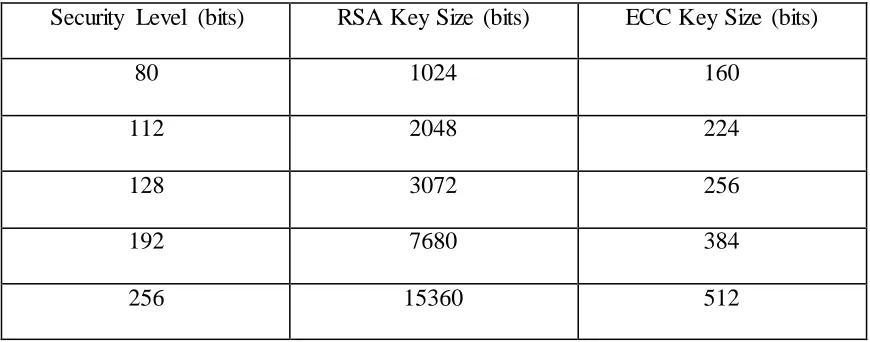
The large RSA key size requires long computation time and large VLSI area when
implemented in hardware. While ECC is based on the elliptic curve discrete logarit hm
problem, the security of ECC relies on the difficulty of elliptic curve discrete logarit hm
problem. ECC can provide same level security strength as RSA with much shorter keys.
Table 1.2 shows a comparison of key sizes needed to achieve equivalent level of security
strength. This feature of ECC makes it very suitable for smart cards, credit cards, pagers,
PDAs and mobile phones [4].
Other than solving the difficult ECDLP to break ECC mathematically, attackers
can take advantage of the physical implementation and retrieve secret parameters by
observing the information leaked during the computation. This method is referred to as
Side Channel Attacks (SCA) and discussed in [5], [6]. Scalar multiplication, which
multiplies a point on an elliptic curve by a scalar, is the main computation involved in ECC.
Unguarded scalar multiplication algorithms are vulnerable to SCAs. In order to protect Security Level (bits) RSA Key Size (bits) ECC Key Size (bits)
80 1024 160
112 2048 224
128 3072 256
192 7680 384
4
ECC from SCA, the computation steps involved in the scalar multiplication algorit hms
have to be regular so that less useful side channel informa tion can be leaked to attackers.
There have been several existing algorithms for computing the scalar multiplication. A
classical algorithm is the binary algorithm or doubling-and-add., it can be easily cracked
by Simple Power Analysis (SPA) since it may consume different power in each iteration,
depending on binary bit of the scalar. To withstand SPA, a double and add always
algorithm is proposed by Coron in 1999 [7]. The idea is to add a dummy operation to make
every iteration consume same power, thus the computation is regular in each step. However,
this algorithm still remains insecure against a doubling attack proposed by Fouque in 2003
[8]. To provide further protection against various SCAs, Montgomery Powering Ladder
(MPL) is invented by Marc Joye and Sung-Ming Yen in 2003 [9]. Although MPL is highly
regular and efficient compared to the classical algorithms, it is still subject to SCAs such
like Differential Power Analysis (DPA). Introduced by Kocher in 1999 [10], Different ia l
Power Analysis focus on capturing the power consumption of the target device and by
analyzing the power consumption to get information of the secret key. Another Modified
Montgomery Power Ladder algorithm proposed by He in [11] can provide protection to
more SCAs than the regular MPL. To the best of our knowledge, scalar multiplica t io n
based on this algorithm has not yet been implemented. Thus an efficient implementa t io n
of ECC, which can resist more SCAs is needed for modern cryptographic applications.
1.2 A Summary of Contributions
In this thesis we propose an efficient hardware architecture for the modified MPL
5 algorithm [11]. More specifically we
Proposed an efficient hardware architecture for the modified MPL with SM,
ES and PR algorithm [11].
Presented a FPGA implementation for the modified MPL with SM, ES and
PR algorithm [11], which is the first time in literature.
1.3 Thesis Organization
The rest of the thesis is organized as follows. Chapter II provided mathemat ica l
background in finite field and elliptic curve which are important for understanding the
proposed work. The concept of SCA is introduced and then many types of SCAs are
reviewed in Chapter III. In Chapter IV an overview of existing related works is given.
Chapter V provides a detailed discussion on a modified MPL with SM, ES and PR. Chapter
VI proposes an efficient hardware architecture for the modified MPL with SM, ES and PR.
FPGA implementation of the proposed architecture is also presented and the FPGA results
are analyzed and discussed. Conclusive remarks are given and possible future works are
6 CHAPTER II
MATHEMATICAL BACKGROUND
This chapter introduces the related mathematical background of the ECC based
systems. Definition of finite field and elliptic curve are given. Arithmetic over finite field,
point operations over elliptic curve is also curved. Finally, some ECC scheme is introduced.
2.1 Finite Field
Finite field, also known as Galois Field (GF), is proposed by Galois in 1832. Galois
Theory emphasis a relation between groups and fields. Finite field was introduced as an
example of a field. A finite field is a finite set of numbers in which addition and
multiplication are defined. It is an additive group under the addition operation. All the
nonzero elements in a finite field form a multiplicative group under multiplica t io n
operation. Primitive element is the generator of the multiplicative group. For a finite field
𝐹, if n is the smallest integer satisfying that 𝑛𝑎 = 0 for every field element a in the finite
field 𝐹, then n is the characteristic of 𝐹.
Prime finite field 𝐺𝐹(𝑝) consists of elements {0,1,2 … 𝑝 − 1}, where p is a prime
number. Arithmetic in 𝐺𝐹(𝑝) can be described as follows. Addition is defined as
modulo-𝑝 addition. Multiplication is defined as modulo-𝑝 multiplication. 𝑝 is the characteristic of
𝐺𝐹(𝑝).
Extension finite field 𝐺𝐹(𝑝𝑚), where p is a prime and m is a positive integer greater
than 1, the elements of 𝐺𝐹(𝑝𝑚) are polynomials of degree up to 𝑚 − 1 with coefficie nts
belonging to 𝐺𝐹(𝑝),
𝐺𝐹(𝑝𝑚) = {𝑎
𝑚−1𝑥𝑚−1+ 𝑎𝑚−2𝑥𝑚−2 + ⋯ + 𝑎2𝑥2+ 𝑎1𝑥 + 𝑎0}
7
greater than 1, the elements of 𝐺𝐹(𝑝𝑚) are polynomials of degree up to 𝑚 − 1 with
coefficients belonging to 𝐺𝐹(𝑝). The irreducible polynomial 𝑓(𝑥) cannot be factored into
product of polynomials that has degree less than m.
Binary Extension finite field 𝐺𝐹(2𝑚) is a special case of 𝐺𝐹(𝑝𝑚), where is
consists of 2𝑚elements and its characteristic is 2.
𝐺𝐹(2𝑚) = {𝑎
𝑚−1𝑥𝑚−1+ 𝑎𝑚−2𝑥𝑚−2+ ⋯ + 𝑎2𝑥2+ 𝑎1𝑥 + 𝑎0},
where 𝑎𝑖 ∈ 𝐺𝐹(2), irreducible polynomial is 𝑓(𝑥). Elements in this field can be
represented as (𝑚 − 1) degree polynomial, for example if 𝐴 is an element in 𝐺𝐹(2𝑚), 𝐴
can be represented as
𝐴 = 𝑎𝑚−1𝑥𝑚−1+ 𝑎
𝑚−2𝑥𝑚−2 + ⋯ + 𝑎2𝑥2+ 𝑎1𝑥 + 𝑎0, 𝑤ℎ𝑒𝑟𝑒 𝑎𝑖∈ 𝐺𝐹(2)
It can also be represented as an m bits binary string (𝑎𝑚−1, 𝑎𝑚−2, …, 𝑎1, 𝑎0), where 𝑎𝑖∈
𝐺𝐹(2). This representation is defined as the polynomial basis representation. This
representation is beneficial in hardware implementation since its operations like addition
and multiplication can be realized using AND logic gate and XOR logic gate. The additio n
operation over binary extension field is modulo 2 addition. The multiplication is modulo
𝑓(𝑥), modulo 2 multiplication.
2.2 Elliptic Curve over GF(2m)
Let p be a prime number greater than 3, and coefficients 𝑎, 𝑏 in the field 𝐺𝐹(𝑝),
then the elliptic curve E over 𝐺𝐹(𝑝) is defined with equation:
E: 𝑦2 = 𝑥3+ 𝑎𝑥2+ 𝑏
This equation is a simplified Weierstrass equation. The points on the curve satisfy
8
two points 𝑃 (𝑥1, 𝑦1) and 𝑄 (𝑥2, 𝑦2) on the curve. The group operator point addition obeys
the following rules. Draw a line through point 𝑃 and 𝑄, if there exists a third point
𝑅 (𝑥3, 𝑦3) which intersects with the curve. The mirror reflection of 𝑅 about the 𝑥-axis is
defined as the addition result. If such an intersection point does not exist, we consider the
result as infinity. The point at infinity 𝑂, defined by 𝑃 + 𝑂 = 𝑂, exists for every ellipt ic
curve. The additive inverse of point 𝑃 is its reflection across the 𝑥-axis. All the points on
curve E and the point at infinity forms a group 𝐺 defined by the point addition operator. 𝐺
is an abelian group sine the group operator addition is commutative.
Figure 2.1 Point addition on ECC
If 𝑃 and 𝑄 satisfy 𝑥1≠ 𝑥2, then we have point addition computed using the
9
{
𝜆 =𝑦1+ 𝑦2 𝑥1+ 𝑥2 𝑥3= 𝜆2+ 𝑥
1+ 𝑥2
𝑦3 = (𝑥1+ 𝑥3)𝜆 + 𝑦1
If 𝑃 and 𝑄 satisfy 𝑃 = 𝑄 and 𝑦1 ≠ 0, then point doubling is defined below.
{
𝜆 =3𝑥1
2+ 𝑎
2𝑦1 𝑥3 = 𝜆2+ 2𝑥
1
𝑦3 = (𝑥1+ 𝑥3)𝜆 + 𝑦1
For an integer 𝑘, scalar multiplication 𝑘𝑃 is defined as repeated addition like
𝑘𝑃 = 𝑃 + 𝑃 + ⋯ 𝑃
repeated for 𝑘 times.
The order n of point P is defined as the minimal integer satisfies 𝑛𝑃 = 𝑂.
Let a and b be elements in 𝐺𝐹(2𝑚). An elliptic curve E over 𝐺𝐹(2𝑚) can be
defined by the equation
E: 𝑦2 + 𝑥𝑦 = 𝑥3+ 𝑎𝑥2+ 𝑏
Points over elliptic curve defined in 𝐺𝐹(2𝑚) have similar operations to that defined
in 𝐺𝐹(𝑝). Consider two points 𝑃 (𝑥1, 𝑦1) and 𝑄 (𝑥2, 𝑦2) on the curve, and 𝑅 (𝑥3, 𝑦3) be
the result of 𝑃 + 𝑄. If 𝑃 = 𝑄, point addition is computed as follows.
{
𝜆 =𝑦1+ 𝑦2 𝑥1+ 𝑥2
𝑥3 = 𝜆2+ 𝜆 + 𝑥
1+ 𝑥2+ 𝑎
𝑦3 = (𝑥1+ 𝑥3)𝜆 + 𝑥3+ 𝑦1
If 𝑃 ≠ 𝑄, point doubling is performed as below.
{
𝜆 =𝑦1 𝑥1+ 𝑥1 𝑥3= 𝜆2+ 𝜆 + 𝑎
10
All the addition, multiplication and inversion involved in there equations are finite
field arithmetic. The most time consuming operations are finite field multiplication and
inversion.
2.3 Elliptic Curve
For a given field 𝐺𝐹(𝑝) and curve E over the field, it is easy to calculate 𝑘𝑃 for a
point 𝑃 on the curve. However, if 𝑘𝑃 and 𝑃 is known, it is considered very difficult to
calculate integer 𝑘. This is called the ECDLP problem, and the security strength of ECC
relies on it.
2.3.1 System Setup
To setup a secure elliptic curve cryptography system, the parameters of the curve
has to be chosen very carefully. The elliptic curve used in the system need to be
non-singular since non-singular curves are easy to crack.
The parameters needed to construct an elliptic curve cryptography system includ ing
the following. Finite field 𝐺𝐹(𝑝) defined by 𝑝, elliptic curve E defined by 𝑎 and 𝑏, base
point 𝑃, the order of the base point 𝑛 and the factor ℎ. The parameter set is known to the
public.
If the system is over 𝐺𝐹(𝑝), the parameter set is 𝐷 = {𝑝, 𝑎, 𝑏, 𝑃, 𝑛, ℎ}. The
parameters are defined as above stated. If the cryptography system is built over 𝐺𝐹(2𝑚),
the parameter set is 𝐷 = {𝑚, 𝑓(𝑥), 𝑎, 𝑏, 𝑃, 𝑛, ℎ} where 𝑓(𝑥) is the irreducible polynomia l
define the field. To calculate factor ℎ, first count all the points and the point at infinity to
get the order of the elliptic curve #E, then h is #E divided by 𝑛.
2.3.2 Generation of the key pairs
11 will choose the keys as introduced below.
Step 1: Choose a random integer 𝑑 ∈ [1, 𝑛 − 1]
Step 2: Computes point 𝑄 = 𝑑𝑃
The public key is point 𝑄, and private key is integer 𝑑.
2.3.3 Elliptic Curve Integrated Encryption Scheme (ECIES)
The most extended encryption and decryption scheme based on ECC is the Ellip t ic
Curve Integrated Encryption Scheme (ECIES). This scheme is a variant of the ElGama l
scheme proposed in [12]. This scheme is described as follows:
System Setup:
Step 1: Alice sets the ECC system parameter sets 𝐷 = {𝑝, 𝑎, 𝑏, 𝑃, 𝑛, ℎ}
Step 2: Computes Key Pair (𝑄, 𝑑)
Encryption:
Step 1: Bob selects a random number 𝑘 ∈ [1, 𝑛 − 1]
Step 2: Computes 𝑅 = 𝑘𝑃, and 𝑍 = ℎ𝑘𝑄.
Step 3: 𝑋-coordinate of 𝑍 and 𝑅 is converted to (𝑘1, 𝑘2) using a key derivation hash
function
Step 4: Message m is encrypted with 𝑘1 using a symmetrical key cipher to get 𝐶 =
𝐸𝑁𝐶 (𝑚)
Step 5: Computes 𝑡 = 𝑀𝐴𝐶 (𝐶) using 𝑘2, where 𝑀𝐴𝐶 is a message authentication code
Step 6: Cipher text (𝑅, 𝐶, 𝑡) is sent to Alice
Decryption:
Step 1: Alice computes 𝑍 = ℎ𝑑𝑅
12 function
Step 3: Computes 𝑡 = 𝑀𝐴𝐶 (𝐶) using 𝑘2, where 𝑀𝐴𝐶 is a message authentication code
Step 4: Message m is decrypted with 𝑘1 using a symmetrical key cipher to get 𝑚 =
𝐷𝐸𝐶 (𝐶)
This scheme works since when Alice generates 𝑍, it follows that,
𝑍 = ℎ𝑑𝑅 = ℎ𝑑 (𝑘𝑃) = ℎ𝑘(𝑑𝑃) = ℎ𝑘𝑄
So both the encryption and decryption generate the same key pair (𝑘1, 𝑘2).
2.3.4 Elliptic Curve Diffie–Hellman Key Exchange (ECDHKE)
ECDHKE is the generic key exchange scheme based on the Diffie-Hell ma n
mechanism applied to elliptic curves [13]. The information available to the public is the
elliptic curve E over 𝐺𝐹(𝑝), and a point 𝑃 with order n on the curve. The computations are
described as follows:
Computation of Alice:
Step 1: Alice chooses random number 𝑎 ∈ [1, 𝑛 − 1]
Step 2: Computes 𝑎𝑃 and it is sent to Bob
Step 3: After receiving 𝑏𝑃 form Bob, Alice computes scalar multiplication 𝑎(𝑏𝑃) to get
𝑎𝑏𝑃
Computation of Bob:
Step 1: Bob chooses random number 𝑏 ∈ [1, 𝑛 − 1]
Step 2: Computes 𝑏𝑃 and it is sent to Alice
Step 3: After receiving 𝑎𝑃 form Alice, Bob computes scalar multiplication 𝑏 (𝑎𝑃) to get
𝑏𝑎𝑃
13 secret key is securely exchanged.
2.3.5 Elliptic Curve Digital Signature Algorithm (ECDSA)
ECDSA is the elliptic curve variant of the Digital Signature Algorithm [14]. This
scheme can be introduced as the following steps:
System Setup:
Step 1: Alice sets the ECC system parameter sets 𝐷 = {𝑝, 𝑎, 𝑏, 𝑃, 𝑛, ℎ}
Step 2: Computes Key Pair (𝑄, 𝑑)
Signing of the message:
Step 1: Alice calculates 𝑒 = 𝐻 (𝑚), where H is a hash function.
Step 2: Chooses random number 𝑘 ∈ [1, 𝑛 − 1]
Step 3: Calculates point 𝑅 = 𝑘𝑃 (𝑥1, 𝑦1).
Step 4: Calculates 𝑠𝑖𝑔1 = 𝑥1 mod 𝑛. If 𝑠𝑖𝑔1 = 0, Alice chooses another 𝑘.
Step 5: Calculates 𝑠𝑖𝑔2 = 𝑘−1(𝑒 + 𝑑𝑥1) mod 𝑛.
Step 6: The signature is the pair (𝑠𝑖𝑔1, 𝑠𝑖𝑔2).
Verification of the signature:
Step 1: Bob calculates 𝑒 = 𝐻 (𝑚), where 𝐻 is a hash function.
Step 2: Calculates 𝑤 = 𝑠𝑖𝑔2−1 mod 𝑛.
Step 3: Calculates 𝑢1 = 𝑒𝑤 mod 𝑛 and 𝑢2 = 𝑠𝑖𝑔1𝑤 mod 𝑛.
Step 4: Calculates point 𝑋 = 𝑢1𝑃 + 𝑢2𝑄 and retrieve the 𝑥-coordinate of 𝑋 denoted by
𝑥2
14
To prove the correctness of the algorithm, the following equation can be performed.
𝑋 = 𝑢1𝑃 + 𝑢2𝑄
= 𝑢1𝑃 + 𝑢2𝑑 × 𝑃
= (𝑢1+ 𝑢2d) × P
= (𝑒 × 𝑠𝑖𝑔2−1 + 𝑠𝑖𝑔1 × 𝑠𝑖𝑔2−1 𝑑) × 𝑃
= (𝑒 + 𝑠𝑖𝑔1𝑑)𝑠𝑖𝑔2−1× 𝑃
= (𝑒 + 𝑠𝑖𝑔1𝑑) (𝑒 + 𝑠𝑖𝑔1𝑑)−1(𝑘−1)−1× 𝑃 = 𝑘𝑃
Thus from the computation it is verified 𝑠𝑖𝑔1 = 𝑥2 mod n from point 𝑋 = 𝑘𝑃.
From all the above algorithms, it can be seen that scalar multiplication is the main
computation involved in elliptic curve cryptography. SCAs mainly target the scalar
15 CHAPTER III
SIDE CHANNEL ATTACKS
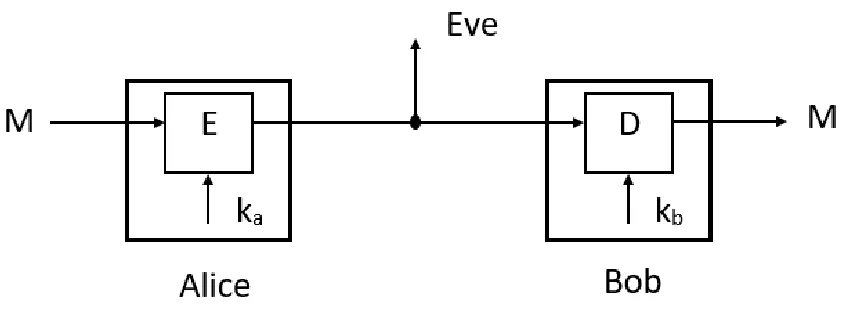
To consider a cryptosystem under mathematically circumstances, a black-box
model is usually used. In the black-box scheme, attackers cannot get any intermed iate
computation results [15]. The only information available to the attackers are plaintext and
cipher text. Thus in order to break the cryptosystem, the attackers need to solve the hard
math problem such like ECDLP in ECC.
Figure 3.1 Traditional cryptosystem
However, such model is not adequate under most scenarios in practice. When a
cryptosystem is implemented on hardware, there will be unintended information leaked
during the execution of the algorithm. The attackers thus can try to find correlation between
the leaked information and the secret key. Side Channel can be classified based on the types
of side channel information. Information can be extracted from timing, power consumptio n
or electromagnetic radiation features. Hardware or software faults, computational errors,
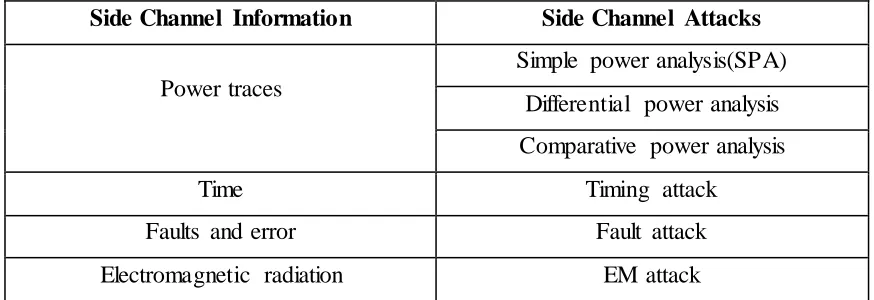
and changes in frequency or temperature can also lead to leak of information. Table 3.1
16
Table 3.1 Category of SCAs
3.1 Timing Attack
Many of the implementations of cryptographic algorithms perform the
computations in a non-constant time. The time variations sometimes can become a
breakthrough point of the system. If the difference of time is correlated to the secret
parameters, then a statistical analysis can reveal enough information to access the key.
Timing attack was first introduced by Kocher in [5].
The working principle of timing attack is to capitalize on the time difference, thus
an easy countermeasure is to make the implementation on the hardware equalize the
computation time in each step.
3.2 Fault Attack
The idea of fault attack is to inject a fault and force the system to leak informa t io n
related to the secret parameter. Fault attack was first introduced in [16]. Consider a
hardware implementation of a cryptosystem, the execution of a fault attack usually two
steps [17]. The first step is to inject a fault and the second step is to do a cryptanalys is
based on the erroneously result.
Side Channel Information Side Channel Attacks
Power traces
Simple power analysis(SPA)
Differential power analysis
Comparative power analysis
Time Timing attack
Faults and error Fault attack
17
Among the many fault attacks, differentia l fault attack (DFA) caught most attention
of the scientists and researchers. To initialize DFA, a bit error is enforced into the hardware
before or during the computation. By analyzing the correct result and the erroneous result,
the information of the secret key is compromised. Biehl and Műller proposed an effective
DFA against ECC in 2000 [18]. The main idea is to construct a reference elliptic curve Er
and choose a reference point 𝑃𝑟 on the Curve. By inputting this reference point into the
tamper-proof hardware, the reference result 𝑑 × 𝑃𝑟 on the curve is 𝐸𝑟 computed. Since
curve 𝐸𝑟 is carefully chosen that the order of the curve has a factor 𝑟 equals to the order of
𝑃𝑟, the ECDLP is deduced to the subgroup of order 𝑟. Next another reference point is
carefully chosen and the whole process is duplicated. The secret parameter 𝑑 can be
revealed.
Yen and Joye introduced another fault attack scheme in [19], this attack targets the
algorithms with dummy operations. By carefully timing a fault injection, the attacker can
distinguish whether this fault causes an error in the result. Thus it can be known whether a
redundant operation is executed. By repeating the procedure, the whole secret key can be
retrieved. This attack is called safe-error attack.
3.3 Electromagnetic Attack
Electromagnetic (EM) attack [20] is based on the fact that all electrical device
radiates electromagnetic waves when operating. An adversary examines the changes of the
electromagnetic field first and then an electromagnetic analysis is executed trying to extract
the secret information.
Wu and Yu introduced an EM attack against scalar multiplication in [21]. The
18
significant difference when different computation is executed. Thus it is easy to access the
secret key by comparing the power traces.
3.4 Power Analysis Attack
Similar to EM attacks, power consumption is often leaked during the running
process of the cryptographic device. By observing the power traces, attackers can get
access to the information on where a certain operation happened and what secret parameter
is involved. Since power analysis attacks usually use little resources, power constrained
applications such like smart cards are primary targets of it [22].
Power analysis attack can be generally categorized into two types, simple power
analysis (SPA) and differential power analysis (DPA). SPA attacker examines the power
traces of cryptography computations and distinguish the power consumption caused by the
secret key. The attacker tries to get secret information by observation of repetitive patterns
in the obtained power traces. If power consumptions are distinguishable the information of
secret key is leaked. DPA relies on the statistical analysis to reveal the correlation between
the secret bit and power consumption. It is usually executed in two steps. First the power
traces are captured, then analysis regarding the captured information is carried out. Among
all the various SCAs, DPA is being regarded as one of the strongest. The difference lies in
that despite merely observation of the power spectrum, DPAs employ more statistica l
methods to guess the secret key.
Coron shows in [7] how DPAs work against scalar multiplication, which is the main
computation in ECC. Since in many scalar multiplication algorithms, the result is computed
by continuous point addition chain. That is, given a point 𝑃 and scalar 𝑑, 𝑑𝑃 is calculated
19
𝑃 → 𝑑0𝑃 → 𝑑1𝑃 → 𝑑2𝑃 → 𝑑3𝑃 → ⋯ → 𝑑𝑃
The attacker starts guessing from 𝑑0 = 1 to 𝑑. For each 𝑑𝑖, a set 𝐴𝑖 with all possible 𝑑𝑖 =
𝑑𝑗+ 𝑑𝑘 where 0 ≤ 𝑗 ≤ 𝑘 < 𝑖 is built. For each element 𝑑𝑖 in the set 𝐴𝑖, the correlation
of power consumption and 𝑑𝑖𝑃 is computed. When the peak is achieved in the computatio n,
the desired 𝑑𝑖 is recovered. By repeating the same pattern for 𝑑0 = 1 to 𝑑, the secret key
20 CHAPTER IV
EXISTING WORK REVIEW AND SECURITY ANALYSIS
There have been different scalar multiplication algorithms existing to improve the
overall performance for efficient or security. In this chapter we introduce the differe nt
algorithms and their implementations. Also the security strength of these algorithms will
be analyzed.
4.1 Classical binary algorithm
The binary algorithm is also known as the “square and multiply method” to do
exponentiation calculation. It is a very old algorithm which has over 2000 year’s history
[23]. While in the scalar multiplication scenario, it is very simply adapted as the double
and add algorithm.
The basic idea of double and add algorithm is to make full use of the binary form
of the scalar. Consider a point 𝑃 and scalar 𝑘, rather than add point 𝑃 to itself 𝑑 times to
get the result 𝑘𝑃, the double and add method will obviously reduce number of addition
operation needed.
The binary algorithm has two versions, one is from the least significant bit to the
most significant bit shown in Algorithm 4.1.
Algorithm 4.1.Right to left version of double-and-add method
Input: 𝑃 𝜖 𝐸, 𝑘 = (𝑘𝑛−1, … , 𝑘1, 𝑘0)2 , 𝑘𝑖𝜖 0,1
Output: 𝑄 = 𝑘𝑃 𝜖 𝐸
Step 1: 𝑥 = 𝑂, 𝑦 = 𝑃;
21
Step 3: 𝑖𝑓 𝑘𝑖 = 1, 𝑡ℎ𝑒𝑛 𝑥 = 𝑥 + 𝑦
Step 4: 𝑒𝑛𝑑 𝑖𝑓
Step 5: 𝑦 = 2𝑦
Step 6: 𝑒𝑛𝑑 𝑓𝑜𝑟
Step 7:𝑅𝑒𝑡𝑢𝑟𝑛 𝑥
The other is calculating from the most significant bit to the least significant bit, as
shown in algorithm 4.2.
Algorithm 4.2.Left to right version of double-and-add method
Input: 𝑃 𝜖 𝐸, 𝑘 = (𝑘𝑛−1, … , 𝑘1, 𝑘0)2 , 𝑘𝑖𝜖 0,1
Output: 𝑄 = 𝑘𝑃 𝜖 𝐸
Step 1: 𝑥 = 𝑃;
Step 2: 𝑓𝑜𝑟 𝑖=𝑛−2 𝑑𝑜𝑤𝑛 𝑡𝑜 0 𝑑𝑜
Step 3: 𝑥 = 2𝑥
Step 4: 𝑖𝑓 𝑘𝑖= 1, 𝑡ℎ𝑒𝑛 𝑥 = 𝑥 + 𝑃
Step 5: 𝑒𝑛𝑑 𝑖𝑓
Step 6: 𝑒𝑛𝑑 𝑓𝑜𝑟
Step 7: 𝑅𝑒𝑡𝑢𝑟𝑛𝑥
Although the addition operation is significantly reduced in the double-and-add
algorithm, the drawbacks of this algorithm is crucial. Comparing the operations carried out
22
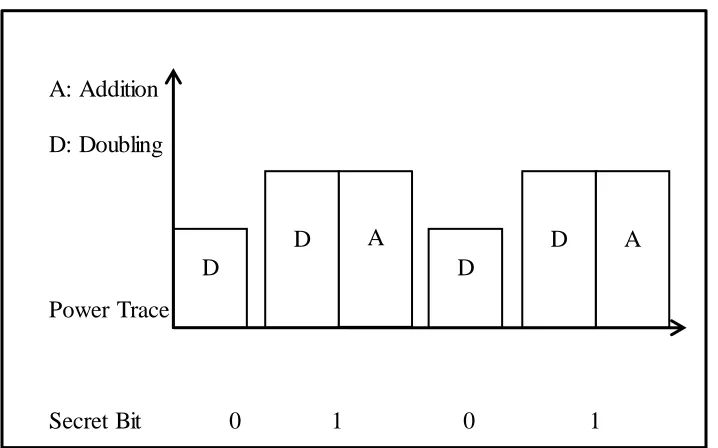
𝑘𝑖 = 1. In every iteration, the doubling operation is always performed, while addition only
happens when 𝑘𝑖 = 1. This variation responses directly into the power consumption. As
shown in Figure 4.1, D denotes doubling operation and A represents addition operation.
The secret bit is chosen as 𝑘 = (0101)2. The length of the power peak is different, thus
the attacker can observe the power traces and distinguish the secret bits. This figure shows
exactly how the double-and-add algorithm is vulnerable to the SPA attack. Because of this
major drawback, many other algorithms is have been developed.
Figure 4.1 Vulnerability of binary method to SPA
A high speed ECC processor is implemented by Hossain and Kong in 2015 [24].
Over field 𝐺𝐹(2233), their ECC processor can perform scalar multiplication 2.66 ms at
255.66 MHz in on a Xilinx Kintex-7 devices. This design features to speed up the overall
computation time. They applies the double-and-add algorithm to the design in a trade-off
for speed. As stated previously, this design can be easily crack by SCA attacks.
A: Addition
D: Doubling
Power Trace
Secret Bit 0 1 0 1 A
D
A D
23 4.2 Double-and-Add Always Algorithm
In order to achieve more security strength against SPA, Coron proposed a double-and-add
always algorithm in 1999 [7]. The main idea of this algorithm is to add a dummy operation
to standard double-and-add to equalize the power consumption of each cycle. As illustrated
in Algorithm 4.3, a dummy addition is executed when the processing bit is zero. In this
way, the algorithm is performing a doubling followed by an addition in every iteration.
Since the algorithm is regular now, it has resistance to SPA attacks.
Algorithm 4.3.Double-and-add always method
Input: 𝑃 𝜖 𝐸, 𝑘 = (𝑘𝑛−1, … , 𝑘1, 𝑘0)2 , 𝑘𝑖𝜖 0,1
Output: 𝑄 = 𝑘𝑃 𝜖 𝐸
Step 1: 𝑥 = 𝑂, 𝑦 = 𝑂;
Step 2: 𝑓𝑜𝑟 𝑖=𝑛−1 𝑑𝑜𝑤𝑛 𝑡𝑜 0 𝑑𝑜
Step 3: 𝑥 = 2𝑥;
Step 4: 𝑦 = 𝑥 + 𝑃;
Step 5: 𝑖𝑓 𝑘𝑖 = 1, 𝑡ℎ𝑒𝑛 𝑥 = 𝑦;
Step 6: 𝑒𝑛𝑑 𝑖𝑓
Step 7: 𝑒𝑛𝑑 𝑓𝑜𝑟
Step 8: 𝑅𝑒𝑡𝑢𝑟𝑛 𝑥
However, another fault attack called c-safe error attack [9] can easily crack this
algorithm. When the secret bit is zero, the addition result won’t affect the final result. When
the attacker altered one bit of the secret key to zero, the result can be compared with the
24
In the case the result changed, the attacker will figure that the secret bit is one and it is quite
easy to locate. This algorithm is taking as an unsuccessful sequence mask example since
the countermeasure takes to prevent SPA benefits other attacks [26].
Another attack threatening this algorithm is the doubling attack, which proposed by
Fouque and Valette in [25]. The name is from the fact this attack is based on the doubling
operation in the scalar multiplication. This type of attack only works when using left to
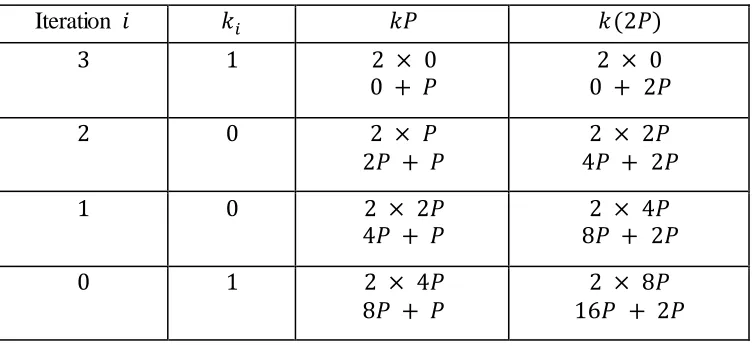
right algorithms. To better explain it, consider two points 𝑃, 2𝑃 and secret 𝑘 = 9 =
(1001)2 as input. Double-and-add always method is used to compute 𝑘𝑃 and 𝑘 (2𝑃). As
illustrated in Table 4.1, if we focus the doubling operation in each iteration, some of them
shares the same pattern. To be more specific, doubling operation at iteration 2 calculat ing
𝑘 (2𝑃) is the same as doubling operation at iteration 3 calculating 𝑘𝑃. Thus two zeros is
overserved by the adversary. This attack reveals all the bits with the value zero and using
these information, the whole secret bits can be revealed consequently.
Table 4.1 Doubling attack against double-and-add always algorithm
Iteration 𝑖 𝑘𝑖 𝑘𝑃 𝑘(2𝑃)
3 1 2 × 0
0 + 𝑃
2 × 0 0 + 2𝑃
2 0 2 × 𝑃
2𝑃 + 𝑃
2 × 2𝑃 4𝑃 + 2𝑃
1 0 2 × 2𝑃
4𝑃 + 𝑃
2 × 4𝑃 8𝑃 + 2𝑃
0 1 2 × 4𝑃
8𝑃 + 𝑃
2 × 8𝑃 16𝑃 + 2𝑃
To the best knowledge, implementation for double-and-add always algorithm is
25
more resistance to SPA, it is still vulnerable to many other attacks such like safe error
attack. This method later stimulated development of more advanced algorithms such like
MPL.
4.3 Non Adjacent Form Method
As stated in previous chapter, a point 𝑃 (𝑥, 𝑦) on elliptic curve E over binary field,
has additive inverse in the form – 𝑃 = (𝑥, 𝑥 + 𝑦). Thus subtraction of point is actually the
same as point addition on an elliptic curve. The non-adjacent form (NAF) is a signed digit
representation [27] inspired by this fact. In NAF method, the secret key is represented by
the following equation.
𝑘 = ∑ 𝑘𝑖2𝑖
𝑙 −1
𝑖 =0
, 𝑤ℎ𝑒𝑟𝑒 𝑘𝑖 ∈ {0, ±1}, 𝑘𝑙−1 ≠ 0
In this expression, there is no two continuous nonzero digits. The advantage of this
representation is that generally it has fewer nonzero bits [23], which leads to a reduction of
addition operation needed in the algorithm. The NAF method is shown in Algorithm 4.4.
Algorithm 4.4. Non Adjacent Form method
Input: 𝑃 𝜖 𝐸, 𝑁𝐴𝐹(𝑘) = ∑𝑙−1𝑘𝑖2𝑖 𝑖=0
, 𝑘𝑖𝜖 {0, ±1}
Output: 𝑄 = 𝑘𝑃 𝜖 𝐸
Step 1: 𝑥 = 𝑃, 𝑦 = 𝑂;
Step 2: 𝑓𝑜𝑟 𝑖=l−2 𝑑𝑜𝑤𝑛 𝑡𝑜 0 𝑑𝑜
26
Step 4: 𝑖𝑓 𝑘𝑖 = 1, 𝑡ℎ𝑒𝑛 𝑥 = 𝑥 + 𝑃;
Step 5: else 𝑖𝑓 𝑘𝑖= −1, 𝑡ℎ𝑒𝑛 𝑥 = 𝑥 + (−𝑃);
Step 6: 𝑒𝑛𝑑 𝑖𝑓
Step 7: 𝑒𝑛𝑑 𝑓𝑜𝑟
Step 8: 𝑅𝑒𝑡𝑢𝑟𝑛 𝑥
The doubling attack mentioned in previous section still applies to the NAF method.
Taking an integer 𝑘 = 29, and 𝑁𝐴𝐹 (𝑘) = (1, 0, 0 − 1, 0, 1). Then if the adversary
calculates 𝑘𝑃 and takes 𝑘 (2𝑃) as a reference. From Table. 4.2, it is shown that the
intermediate value at iteration i when computing 𝑘 (2𝑃) equals the result at iteration i-1
when computing 𝑘𝑃. All the secret bits with value zero is thus revealed. Since
approximately two third of the bits in NAF representation is zero [28], most bits are
retrieved applying doubling attack.
Table 4.2 Doubling attack against NAF method
Iteration 𝑖 𝑘𝑖 𝑘𝑃 𝑘(2𝑃)
4 0 2 × 𝑃 2 × 2𝑃
3 0 2 × 2𝑃 2 × 4𝑃
2 −1 2 × 4𝑃
8𝑃 + (−𝑃)
2 × 8𝑃 16𝑃 + (−2𝑃)
1 0 2 × 7𝑃 2 × 14𝑃
0 1 2 × 14𝑃
28𝑃 + 𝑃
27
Wang introduced his implementation of an ECC coprocessor over 𝐺𝐹(2233) in
2005 [29]. In this paper, a digit-serial multiplier which can achieve half or quarter clock
cycles compared to the full-serial multiplier is proposed. With proper precomputation, this
design can reduce the total calculating time by applying the projective coordinates. The
coprocessor can perform a scalar multiplication in 2.28 ms at 80 MHz. However, the
implementation algorithm chosen by the author is NAF method which vulnerable to attacks
like doubling attack.
4.4 Montgomery Powering Ladder Algorithm
4.4.1 Explanation of Algorithm
The Montgomery powering ladder is first proposed in [9] to provide a
countermeasure to SPA. For a given 𝑘 = ∑𝑙 −1𝑘𝑖2𝑖
𝑖 =0 , in order to compute 𝑘𝑃, the MPL is
constructed based on the following relationships. Define 𝐿𝑗= ∑𝑙−1𝑘𝑖2𝑖
𝑖=𝑗 and 𝐻𝑗= 𝐿𝑗+ 1.
𝐿𝑗 and 𝐻𝑗can then be represented as
{𝐿𝑗= 2𝐿𝑗+1+ 𝑘𝑗= 𝐿𝑗+1+ 𝐻𝑗+1+ 𝑘𝑗− 1. 𝐻𝑗 = 𝐿𝑗+1+ 𝐻𝑗+1+ 𝑘𝑗
So at iteration 𝑗, it is easy to express 𝐿𝑗 and 𝐻𝑗 using the previous values from iteration 𝑗 +
1
(𝐿𝑗, 𝐻𝑗) = {(2𝐿𝑗+1, 𝐿𝑗+1+ 𝐻𝑗+1) 𝑤ℎ𝑒𝑛 𝑘𝑗= 0 (𝐿𝑗+1+ 𝐻𝑗+1, 2𝐻𝑗+1) 𝑤ℎ𝑒𝑛 𝑘𝑗 = 1
The above equations implies the structure of MPL. The calculations are very similar to
each other and in each iteration one doubling is performed with one addition. Recall that
the main computation of scalar multiplication is point doubling and point addition, the
28
Algorithm 4.5. Montgomery Powering Ladder
Input: 𝑃 𝜖 𝐸, 𝑘 = (𝑘𝑛−1, … , 𝑘1, 𝑘0)2 , 𝑘𝑖𝜖 0,1
Output: 𝑄 = 𝑘𝑃 𝜖 𝐸
Step 1: 𝑥 = 0, 𝑦 = 𝑃;
Step 2: 𝑓𝑜𝑟 𝑖=𝑛−1 𝑑𝑜𝑤𝑛 𝑡𝑜 0 𝑑𝑜
Step 3: 𝑖𝑓 𝑘𝑖= 0, 𝑡ℎ𝑒𝑛 𝑦 = 𝑥 + 𝑦; 𝑥 = 2𝑥
Step 4: 𝑒𝑙𝑠𝑒 𝑖𝑓 𝑘𝑖= 1, 𝑡ℎ𝑒𝑛 𝑥 = 𝑥 + 𝑦; 𝑦 = 2𝑦
Step 5: 𝑒𝑛𝑑 𝑖𝑓
Step 6: 𝑒𝑛𝑑 𝑓𝑜𝑟
Step 7: 𝑅𝑒𝑡𝑢𝑟𝑛 𝑥
4.4.2 Advantage of MPL
In algorithm 4.5, it is obvious that the computations for point addition and point
doubling are independent. Thus they can be calculated parallel. This feature results in faster
calculation speed. Moreover, since in every circle, MPL executes the same operation, it is
considered highly regular. This structure makes it invulnerable to SPA.
Another c safe-error attack introduced in previous section also has no effect to MPL.
Unlike the double-and-add always algorithm, there is no dummy operation in MPL. So any
fault injected will lead an error in the result.
The doubling attack is considered ineffective. Assume there are two registers 𝑅0
and 𝑅1 to store the intermediate values. It could be the value stored in 𝑅0 or 𝑅1 performs
29
vulnerable to doubling attack all shares the fixed doubling pattern, the attacker cannot see
a repeated doubling operation when there is no continuous bits with the same value one or
zero. But if there exists successive bits carrying the same value, the algorithm is vulnerab le
to a relative doubling attack proposed in [30].
4.4.3 Relative Doubling Attack against MPL
While the doubling attack mainly focus on finding the 0 bits, the relative doubling
attack compares the value of two adjacent secret key bits. Let registers 𝑅0store the value
of 𝐿𝑖, and registers 𝑅1store the value of 𝐻𝑖. If 𝑘𝑖 = 𝑘𝑖 −1 = 0, the following doubling
computation is observed.
{𝑅0 ← 2 × 𝐿𝑖𝑃: 𝑖𝑡𝑒𝑟𝑎𝑡𝑖𝑜𝑛 𝑖 − 1 𝑤ℎ𝑒𝑛 𝑐𝑎𝑙𝑐𝑢𝑙𝑎𝑡𝑖𝑛𝑔 𝑘𝑃 𝑅0← 𝐿𝑖+1× 2𝑃: 𝑖𝑡𝑒𝑟𝑎𝑡𝑖𝑜𝑛 𝑖 𝑤ℎ𝑒𝑛 𝑐𝑎𝑙𝑐𝑢𝑙𝑎𝑡𝑖𝑛𝑔 𝑘(2𝑃)
Since 𝐿𝑖 = 2𝐿𝑖+1 when obviously the above equations are doing the same
computation. Thus, if such collisions are observed, the attacker get the information
𝑘𝑖 = 𝑘𝑖−1 = 0.
Similar situation applies to when 𝑘𝑖 = 𝑘𝑖 −1 = 1. Then in register 𝑅1,
{ 𝑅1← 2 × 𝐻𝑖𝑃: 𝑖𝑡𝑒𝑟𝑎𝑡𝑖𝑜𝑛 𝑖 − 1 𝑤ℎ𝑒𝑛 𝑐𝑎𝑙𝑐𝑢𝑙𝑎𝑡𝑖𝑛𝑔 𝑘𝑃 𝑅1 ← 𝐻𝑖+1× 2𝑃: 𝑖𝑡𝑒𝑟𝑎𝑡𝑖𝑜𝑛 𝑖 𝑤ℎ𝑒𝑛 𝑐𝑎𝑙𝑐𝑢𝑙𝑎𝑡𝑖𝑛𝑔 𝑘(2𝑃)
same computations will be carried because that 𝐻𝑖 = 2𝐻𝑖+1. While when ki is not equal to
𝑘𝑖−1, there is no collision detected.
Taking 𝑘 = 105 = (1101001)2, the adversary computes 𝑘𝑃 and 𝑘(2𝑃) as the
pattern shown in Table. 4.3. It is very clear that at iteration 1 and 2, collisions in register
𝑅0 is detected. This fact leads to secret key bits 𝑘2 = 𝑘1 = 0. Taking iteration 5 and 6 as
another example, the operations regarding values in register 𝑅1 is the same, thus the
30
adjacent secret bits are holding different values. Then the whole secret key is revealed from
the collision location bit by bit.
Table 4.3 Relative doubling attack against MPL
Iteration 𝑖 𝑘𝑖 𝑘𝑃 𝑘(2𝑃)
6 1 𝑅0 = 0 + 𝑃
𝑅1= 2 × 𝑃
𝑅0 = 0 + 2𝑃
𝑅1= 2 × 2𝑃
5 1 𝑅0 = 𝑃 + 2𝑃
𝑅1 = 2 × 2𝑃
𝑅0 = 2𝑃 + 4𝑃
𝑅1= 2 × 4𝑃
4 0 𝑅0 = 2 × 3𝑃
𝑅1= 3𝑃 + 4𝑃
𝑅0 = 2 × 6𝑃
𝑅1 = 6𝑃 + 8𝑃
3 1 𝑅0 = 6𝑃 + 7𝑃
𝑅1 = 2 × 7𝑃
𝑅0 = 12𝑃 + 14𝑃
𝑅1 = 2 × 14𝑃
2 0 𝑅0 = 2 × 13𝑃
𝑅1= 13𝑃 + 14𝑃
𝑅0 = 2 × 26𝑃
𝑅1= 26𝑃 + 28𝑃
1 0 𝑅0 = 2 × 26𝑃
𝑅1= 26𝑃 + 27𝑃
𝑅0 = 2 × 52𝑃
𝑅1= 52𝑃 + 54𝑃
0 1 𝑅0 = 52𝑃 + 53𝑃
𝑅1= 2 × 53𝑃
𝑅0 = 104𝑃 + 106𝑃
𝑅1= 2 × 10⁶𝑃
4.4.4 M-safe Error Attack against MPL
Despite the relative doubling attack, another fault attack M safe-error attack
introduced in [19] is also proven to be effective against MPL. In this scheme, the fault
induced by the attacker is temporary memory fault and it is very carefully timed. M
safe-error attack takes advantage of the two distinct operations carried out in each cycle of MPL.
Consider the different computation when 𝑘 𝑖 is different. When 𝑘 𝑖 = 1 , the two
operations are 𝑅0 = 𝑅0+ 𝑅1and𝑅1 = 2𝑅1. Any fault injected into 𝑅1will change the
value of the result, thus it is not a safe error. If 𝑘 𝑖 = 0, then 𝑅0 = 2𝑅0and 𝑅1= 𝑅0+
31
resigning of value in 𝑅1. In other words, the result still remains and the error is regarded a
safe-error. The attacker can retrieve the secret bit 𝑘 𝑖 based on the above fact.
4.4.5 Comparative Power Analysis against MPL
Comparative Power Analysis is proposed by Homma in 2010 [31]. It is a more
powerful attack which can compromise multiple scalar multiplication algorithms such like
double-and-add algorithm, double-and-add always algorithm and MPL algorithm. While
the original attack introduced is aiming at implementation of exponentiation, it also applies
to scalar multiplication.
Similar to the relative doubling attack, the basic idea of comparative power analysis
is also generating collisions by inputting a pair of carefully chosen message. More
specifically, the chosen inputs are set to satisfy the equation 𝛼𝑃 = 𝛽𝑄, where 𝛼 and 𝛽 are
integer. The input 𝑃 is computed with the target operation 𝛼𝑃 while the input 𝑄 is
illustrates the reference power trace. When the collision happens, the doubling operation
of the two input will have very similar power trace. By comparison of the power traces, the
target secret key bit is leaked. Unlike doubling attack, the collision can be retrieved from
different time frames.
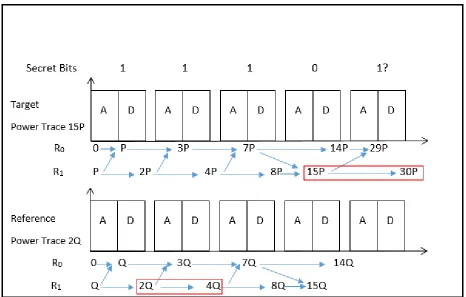
Figure 4.2 shows an example how the attack scheme works. The input condition is
chosen as 15𝑃 = 2𝑄. Consider the first four bits of the secret key is known to the attacker,
the target bit is the fifth bit. The attacker then make an assumption that the target bit is 1,
and illustrates the power traces. Then he examines the reference power traces at the time
frame 2𝑄 doubling is computing, if the power trace shares similarity with the target power
trace at the time frame computing 15𝑃 doubling, the target secret bit is 1. The assumptio n
32
power trace, the secret bit is 0. Note that the collision is generated at different timefra me
of the two power traces. By repeating the attack pattern, all the bits of the secret key will
be known.
Figure 4.2 Comparative power analysis against MPL
4.4.6 MPL based hardware implementation
Deschamps and G.Sutter implemented EC scalar multiplication over 𝐺𝐹(2163) in
2008 [32]. This design is implemented using MPL algorithm. The computation time is 1ms
at 100MHz and a comparison with binary algorithm implementation has been made. As
stated previously, implementation on unprotected MPL is still vulnerable to some SCAs,
33 CHAPTER V
ANALYSIS OF MODIFIED MPL WITH COUNTERMEASURES
In this chapter we introduce a modified MPL with sequence masking, exponent
splitting and point randomization proposed in [11]. A small modification has been done to
this algorithm to make it suitable for ECC scalar multiplication since it is origina l ly
invented for exponentiation operation.
5.1 Existing countermeasure techniques
In previous Chapters, it has been stated that unprotected MPL is still vulnerable to
a lot of side channel attacks. To offer protections in algorithm level, He, Huang and Wu
proposed a highly secure MPL for exponentiation operation [11]. Several countermeas ures
had been applied to enhance its security strength.
5.1.1 Coron’s three countermeasures to DPA
Coron has proposed three countermeasures against DPA to improve the origina l
MPL [7]. The first is to randomize the secret private exponent. The main idea is to change
the representation of the secret exponent. Denote #ε as the number of all the points on the
curve E, and select a random number k. Then the following computation is carried out to
calculate 𝑑′= 𝑑 + 𝑘#𝜀, the computation Q = dP is replaced by 𝑄 = 𝑑′𝑃. The correctness
of this transform is based on the fact that #𝜀𝑃 = 0. To expand this equation in detail, we
get the following proof.
𝑄 = 𝑑′𝑃 = (𝑑 + 𝑘. #𝜀)𝑃 = 𝑑𝑃 + 𝑘. #𝜀. 𝑃 = 𝑑𝑃 + 𝛰 = 𝑑𝑃
The size of the random number k is suggested to be 20 for better security performance. By
applying this countermeasure, the compute process is changed while the result 𝑄 still
34
The second countermeasure is to blind the point 𝑃. Choose a random 𝑅 on the same
curve as point 𝑃. Point 𝑅 is used as a mask to provide protection to the point 𝑃. Another
point 𝑆 is computed as 𝑆 = 𝑑𝑅. The cryptographic system then performs the scalar
multiplication 𝑑(𝑅 + 𝑃). In order to retrieve 𝑄 = 𝑑𝑃, a subtraction will be applied the
previous result. Since 𝑆 is already known, the final result will be recovered by 𝑑(𝑅 + 𝑃) −
𝑆. Point 𝑅 and 𝑆 will be updated in every initialization of the scalar multiplication.
The third countermeasure is to randomize to projective representation [33] of the
point 𝑃 (𝑥, 𝑦). Point 𝑃 can be represented in projective coordinates as (𝑋, 𝑌, 𝑍). Since it is
not the only projective representation point P has, it can be written as (𝜆𝑋, 𝜆𝑌, 𝜆𝑍) where
𝜆 ≠ 0. The binary representation of point 𝑃 is then guarded. Since this thesis mainly focus
on implementation in affine coordinates, this countermeasure will not be discussed in detail.
5.1.2 Exponent Splitting
Exponent Splitting technique is first proposed in [34]. While it is used in
exponentiation is the paper, the idea is the same in scalar multiplication. The basic thought
is based on the simple observation that
𝑑𝑃 = (𝑑 − 𝑎)𝑃 + 𝑎𝑃
In this splitting technique, the scalar d can be split into two parts as the above
equation indicated. First a random number 𝑟 is generated, where r is smaller than 𝑑. 𝑟’ is
then calculated by 𝑟’ = 𝑑 − 𝑟. The scalar multiplication then become
𝑑𝑃 = 𝑟𝑃 + 𝑟’𝑃
since 𝑑 = 𝑟 + 𝑟’, it is obvious that the result is the same without scalar splitting.
Since we can see from the equation, the splitting technique is basically transforming
35
consuming to put this technique into practice. Usually it takes two times the original time.
But considering the security strength, sometimes the trade-off is worthy. This technique
offers enhanced protection against SPA, and the randomization also helps to prevent some
differential attacks.
5.1.3 Blinded Fault Resistant Exponentiatio n
This technique is first proposed by Fumaroli and Vigilant in [35]. It is an extension
of Coron’s second countermeasure [7]. The main idea is to add a mask to the base point 𝑃
to construct a masked MPL. The algorithm is originally for exponentiation operation, but
by a small modification, it can be also applied to scalar multiplication.
Algorithm 5.1. Masked Montgomery Powering Ladder
Input: 𝑃 𝜖 𝐸, 𝑘 = (𝑘𝑛−1, … , 𝑘1, 𝑘0)2 , 𝑘𝑖𝜖 0,1
Output: 𝑄 = 𝑘𝑃 𝜖 𝐸
Step 1: 𝑆𝑒𝑙𝑒𝑐𝑡 𝑟𝑎𝑛𝑑𝑜𝑚 𝑝𝑜𝑖𝑛𝑡 𝑅 𝑜𝑛 𝐸;
Step 2: 𝑅0= 𝑅, 𝑅1= 𝑃 + 𝑅, 𝑅2 = −𝑅
Step 3: 𝑓𝑜𝑟 𝑖=𝑛−1 𝑑𝑜𝑤𝑛 𝑡𝑜 0 𝑑𝑜
Step 4: 𝑖𝑓 𝑘𝑖= 0, 𝑡ℎ𝑒𝑛 𝑅1= 𝑅0 + 𝑅1; 𝑅0 = 2𝑅0; 𝑅2 = 2𝑅2
Step 5: 𝑒𝑙𝑠𝑒 𝑖𝑓 𝑘𝑖= 1, 𝑡ℎ𝑒𝑛 𝑅0 = 𝑅0+ 𝑅1; 𝑅1= 2𝑅1; 𝑅2 = 2𝑅2
Step 6: 𝑒𝑛𝑑 𝑖𝑓
Step 7: 𝑒𝑛𝑑 𝑓𝑜𝑟
Step 8: 𝑅𝑒𝑡𝑢𝑟𝑛 𝑄 = 𝑅0+ 𝑅2
In Algorithm 5.1, at the beginning of the operation, a random point 𝑅 is picked. 𝑅


![Table 5.2 An example of bit-level imbalance [36]](https://thumb-us.123doks.com/thumbv2/123dok_us/1368266.1169575/52.612.87.564.104.285/table-example-bit-level-imbalance.webp)
