ISSN(Online): 2320-9801
ISSN (Print): 2320-9798
I
nternational
J
ournal of
I
nnovative
R
esearch in
C
omputer
and
C
ommunication
E
ngineering
(A High Impact Factor, Monthly, Peer Reviewed Journal) Website: www.ijircce.com
Vol. 7, Issue 6, June 2019
Analysis of Different Types of Arrhythmia
Using Ensemble Model
Harshitha. R 1, Dr. Suresh .L 2
M.Tech. Student, Department of CSE, Cambridge Institute of Technology, Bangalore, India1 Principal, Cambridge Institute of Technology, Bangalore, India2
ABSTRACT: Arrhythmia is a condition in which the human heart beats with an irregular or abnormal rhythm which may be immediately fatal or cause irreparable damage to the heart. This type of a fatal abnormality would require a model which gives high accuracy and takes short periods of time for classification.
In this project, a high dimensional clinical dataset consisting of Electrocardio (ECG) results of patients is used by individual classifiers like Multi-Layer-Perceptron(MLP), Support Vector Machine (SVM) and Naïve bayes to classify them into different types of Arrhythmia.
KEYWORDS: NA values, Arrhythmia, Ensemble Model, Accuracy.
I. INTRODUCTION
An Arrhythmia describes an irregular heartbeat - the heart may beat too fast, too slowly, too early, or irregularly. Arrhythmias occur when the electrical signals to the heart that coordinate heartbeats are not working properly. Many heart Arrhythmias are harmless however, if they are particularly abnormal or result from a weak or damaged heart, Arrhythmias can cause serious and even potentially fatal symptoms.
In this paper by using Multilayer perceptron (MLP), Support vector machine (SVM) and Naïve bayes classifiers gives accuracy which are comparatively low. Ensemble methods are techniques that create multiple models and then combine them to produce improved results. They produce more accurate solution than a single model would. Thus an Ensemble model is built which gives higher accuracy but takes more time for classification compared to individual models. The same Ensemble model is run on an environment called Anaconda where it reduce the execution time. Classifying Arrhythmia is a great significance to reduce the uncertainty for doctors on deciding the optimum treatment for patients
II. LITERATURESURVEY
Liangyuan Li, Mei Chen, Hanhu Wang presents an analysis of the importance of cost sensitive methodology in medical disease prediction .And C5.0 based cost sensitive ensemble approach is presented to support improving the effectiveness and decreasing the misdiagnosis cost in the same time. The verification is conducted on the real case from changhai hoapital renal registered (CHRR) data which consists of 483 records and 25 fields are used through variables selection. The real case expiriments show that their approach works effectively and could be used as an assistant approach for peritonitis analysis in some circumstances.
ISSN(Online): 2320-9801
ISSN (Print): 2320-9798
I
nternational
J
ournal of
I
nnovative
R
esearch in
C
omputer
and
C
ommunication
E
ngineering
(A High Impact Factor, Monthly, Peer Reviewed Journal) Website: www.ijircce.com
Vol. 7, Issue 6, June 2019
the accuracy of these algorithms. Based on the results the proposed hybrid methods achieved an F-measure of 86.8% which outperforms other competing methods.
III.METODOLOGY
The flow of our design is been shown in the below diagram (Figure 1). The goal for all the data collection is to capture quality evidence that allows analysis to lead to the formulation of convincing and credible answers to the questions that have been proposed. Health survey, administrative enrollment and billing records and medical records used by various entities including hospitals, CHCs, and health plan. We are using this data as it has multiple attribute about 279 with over four hundred records which help us to provide quality.
Figure 1: Block diagram of proposed system
The original data being used is UC Irvine machine learning repository which has a data set containing Arrhythmia information for 452 patients (row) .Each of these patients has 279 features (columns) and was classified into one of 16 categories which is 15 abnormal and 1 normal heart conditions. Our feature space comprised of 279 dimensions including patients information such as age, sex and channel information.
A. NAÏVE BAYES
ISSN(Online): 2320-9801
ISSN (Print): 2320-9798
I
nternational
J
ournal of
I
nnovative
R
esearch in
C
omputer
and
C
ommunication
E
ngineering
(A High Impact Factor, Monthly, Peer Reviewed Journal) Website: www.ijircce.com
Vol. 7, Issue 6, June 2019
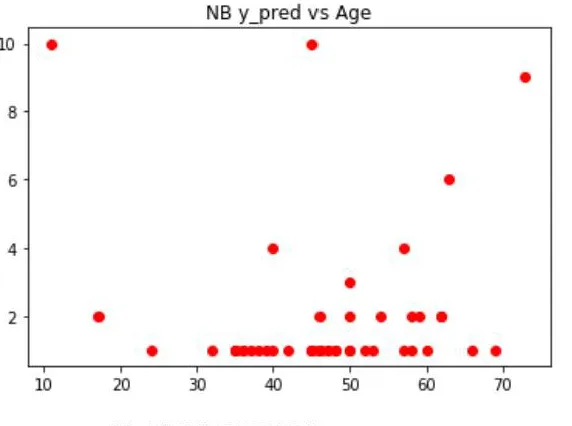
Figure 2. Classification report naive bayes
ISSN(Online): 2320-9801
ISSN (Print): 2320-9798
I
nternational
J
ournal of
I
nnovative
R
esearch in
C
omputer
and
C
ommunication
E
ngineering
(A High Impact Factor, Monthly, Peer Reviewed Journal) Website: www.ijircce.com
Vol. 7, Issue 6, June 2019
B. SUPPORT VECTOR MACHINE (SVM)
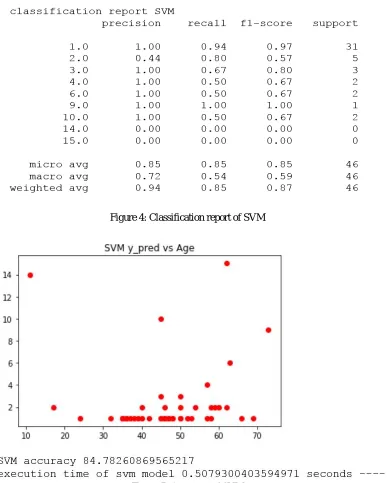
A Support Vector Machine (SVM) is a discriminative classifier formally defined by a separating hyperplane. In other words, given labeled training data (supervised learning), the algorithm outputs an optimal hyperplane which categorizes new examples. In two dimentional space this hyperplane is a line dividing a plane in two parts where in each class lay in either side.
ISSN(Online): 2320-9801
ISSN (Print): 2320-9798
I
nternational
J
ournal of
I
nnovative
R
esearch in
C
omputer
and
C
ommunication
E
ngineering
(A High Impact Factor, Monthly, Peer Reviewed Journal) Website: www.ijircce.com
Vol. 7, Issue 6, June 2019
C. MULTILAYER PERCEPRTON (MLP)
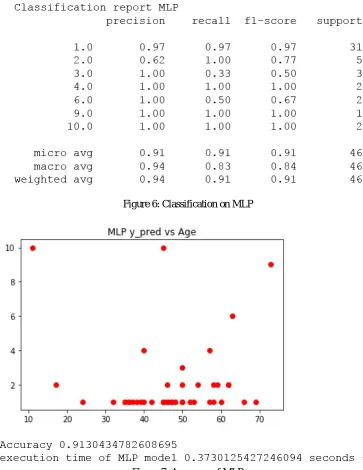
An MLP can be viewed as a logistic regression classifier where the input is first transformed using a learnt non-linear transformation. This transformation projects the input data into a space where it becomes linearly separable. This intermediate layer is referred to as a hidden layer. A single hidden layer is sufficient to make MLPs a universal approximator.
Figure 6: Classification on MLP
ISSN(Online): 2320-9801
ISSN (Print): 2320-9798
I
nternational
J
ournal of
I
nnovative
R
esearch in
C
omputer
and
C
ommunication
E
ngineering
(A High Impact Factor, Monthly, Peer Reviewed Journal) Website: www.ijircce.com
Vol. 7, Issue 6, June 2019
D. ENSEMBEL MODEL
The field of machine learning keeps getting better and better with time. Predictive models form the core of machine learning. Better the accuracy better the model is and so is the solution to a particular problem. In this post, you are going to learn about something called Ensemble learning which is a potent technique to improve the performance of your machine learning model.
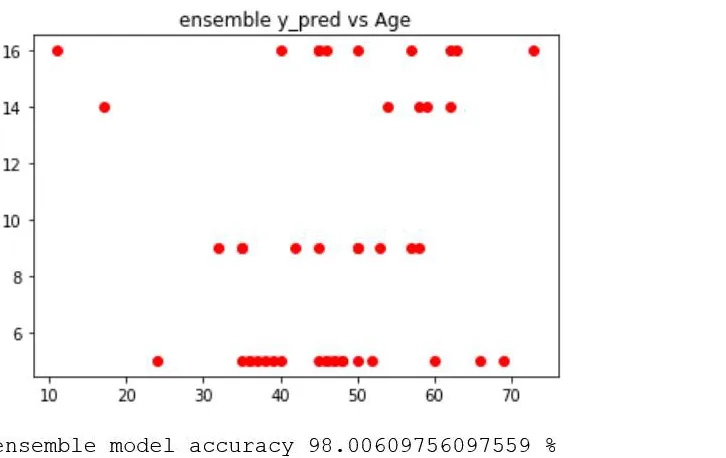
Figure 8: Accuracy of Ensemble model
IV. RESULTS
ISSN(Online): 2320-9801
ISSN (Print): 2320-9798
I
nternational
J
ournal of
I
nnovative
R
esearch in
C
omputer
and
C
ommunication
E
ngineering
(A High Impact Factor, Monthly, Peer Reviewed Journal) Website: www.ijircce.com
Vol. 7, Issue 6, June 2019
V. CONCLUSION
In this paper we selected a clinical dataset with 279 clinical features and on record 452 patients. We proposed the data and pruned by removing features having more than 60% NA values and the ones with lesser were modified with mean of the values. Later we developed MLP, SVM and Naïve Bayes model for predicting the accuracy of different kinds of arrhythmia based on these pruned 139 clinical features after data processing. An ensemble model for the same dataset gave accuracy of 98% higher than that of individual models.
REFERENCES
1. Liang Li, Mei Chen, Hunhu Wang, “cost sensitive ensemble method for medical prediction”, IEEE 2016.
2. Hamidreza Ashrafi Esfahani, Moreza Ghazanifari, “Cardiovascular disease detection using ensemble classifier”, 2017 IEEE international conference on knowledge based engineering and innovation(KBEI)
3. Tharaha S, Rashika K, “hybrid artificial neural network and decision tree algorithm foe disease recognition and prediction in human blood cells”, IEEE, 2017.
4. Jianfeng Xu, Dan Li, YuanjianZhang “ cluster analysis of multi-granular time series data for mortality rate rediction”, computing in cardiology, 2016 IEEE.
5. AH Chen, SY Huang, CH cheng, EJ lin, “HDPS: Heart disease prediction system”, computing in cardiology, 2017 IEEE
6. Tahira Mahaboob, Rida irfan, bazelah ghaffar “evaluating ensemble prediction of coronary heart disease using receiver operating characteristics”, IEEE 2017.
7. Tharaha S, Rashika K, “hybrid artificial neural network and decision tree algorithm foe disease recognition and prediction in human blood cells”, IEEE, 2017.
8. R. kavitha, E.Kannan, “an efficient framework for heart disease classification using features extraction and feature slection techniques in data mining”, 2017 IEEE.
9. Tanoy debnath, Md. Mehandi hasan, tanwi biswas, “analysis of ECG signal and classification of heart abnormalities using artificial neural network”,conference on electrical and computer engineering , 2016 IEEE.
10. Paurakh rajbhandary , benjsmin zhou gaspar Garcia jr. “detection heart abnormality using ECG with CART”, 2017 IEEE. 11. Vjay Pappu and panos m pardalos “high dimensional data classification”.
12. Swain m dash s. k and mohapatra “An approach for iris plant classification using neural network”, IBMRD’s computing vol. 3 NO1. Pp.79, 2012.