University of South Carolina
Scholar Commons
Theses and Dissertations
2015
Supporting Fourth Grade Reading Students Using
Retrospective Miscue Analysis As a Response To
Intervention Model
Michelle Davis
University of South Carolina
Follow this and additional works at:https://scholarcommons.sc.edu/etd Part of theElementary Education Commons
This Open Access Dissertation is brought to you by Scholar Commons. It has been accepted for inclusion in Theses and Dissertations by an authorized administrator of Scholar Commons. For more information, please [email protected].
Recommended Citation
Davis, M.(2015).Supporting Fourth Grade Reading Students Using Retrospective Miscue Analysis As a Response To Intervention Model.
SUPPORTING FOURTH GRADE READING STUDENTS USING RETROSPECTIVE MISCUE ANALYSIS AS A RESPONSE TO INTERVENTION MODEL
by
Michelle Davis
Bachelor of Arts Ball State University, 1978
Master of Arts Ball State University, 1989
Submitted in Partial Fulfillment of the Requirements
For the Degree of Doctor of Philosophy in
Elementary Education
College of Education
University of South Carolina
2015
Accepted by:
Lucy Spence, Major Professor
Diane DeFord, Major Professor
Heidi Mills, Committee Member
Michelle Martin, Committee Member
D
EDICATIONI dedicate this dissertation to my family who supported me throughout this
process. I also dedicate it to the children who touched my heart in all my classes. They
are the ones who made this study necessary and important for me to improve their
A
CKNOWLEDGEMENTSThis paper has been a long time in development. It would not have been possible
without the support and encouragement of many people. I am very grateful to my
dissertation committee. Dr. Diane DeFord for sticking with me through the long process,
providing a wealth of knowledge and information related to my study, and stepping up to
co-chair my committee in a time of need. Dr. Lucy Spence for being willing to take on
my committee to enable me to complete my degree. Dr. Heidi Mills for being a part of
my committee and providing her expertise along with exposing me to many relative and
informative professional books as part of her courses. Finally Dr. Michelle Martin for
agreeing to join my committee before we even had a chance to meet.
This dissertation would not have been possible without the support and
participation of my students. All the students in my class were instrumental in allowing
me to record and work with the four students who took part in this study. Also, I would
like to thank my fellow fourth-grade teachers for listening to me as I talked about the
study and their interest in wanting to try it themselves. I would also like to thank my
administrators, Mrs. Selina Latimore and Dr. Timothy Blackwell for their support as I
completed this study in my classroom and spent time completing my dissertation.
Most importantly I would like to thank my husband for helping me through this
process. His encouragement and nagging made it possible for me to continue with my
A
BSTRACTDespite extensive research on Response to Intervention and Retrospective Miscue
Analysis, students in fourth and fifth grade are still reading below grade level. This case
study investigated how Retrospective Miscue Analysis (RMA) implemented during
Response to Intervention (RTI) assists students in learning to apply new reading
strategies that increase comprehension. Over a twelve week period, data were collected
in four contexts. First, orally administered pre/post-Burke Reading Inventory. Secondly,
computer generated STAR assessment for screening and progress monitoring. Thirdly,
one-on-one Dominie. Finally, audio recording of student read aloud, retelling and
follow-up discussion. Students’ responses on pre-Burke Inventory indicated students
think reading is being able to say all the words. Screening results placed students at
second and early third-grade instructional reading levels. Dominie results were
somewhat similar. These initial recorded readings showed students unable to retell what
they read and unable to answer questions about the text. As students engaged in
recording their reading and discussions with the teacher, they learned strategies to
monitor and problem-solve during reading to better understand and remember what they
read. Students were more than willing to use the iPad for recording and to independently
listen to listen to their reading. By the end of the twelve-week period, students were
applying strategies learned during their recorded readings and conferences with the
indicated that students were more focused on understanding what they were reading.
While words were still important, they were more interested in the meanings of words to
help them understand the text they were reading. STAR and Dominie assessments both
indicated students improved in reading comprehension levels and were at or near grade
PREFACE
This dissertation was a study of the use of Retrospective Miscue Analysis with
fourth-grade students. It was designed to assist them in understanding the importance of
reading for comprehension and learning from their reading. I wanted them to love books
as much as I do. As students became more aware of how they were reading, they began
to challenge themselves as readers. They also became reader leaders within the
classroom engaging in conversations about books. This study enabled me to see my
students in new ways. I became more aware of my teaching practices and expectations of
students. It was clear that students responded positively to supportive discussions about
T
ABLE OFC
ONTENTSDEDICATION ... iii
ACKNOWLEDGEMENTS ... iv
ABSTRACT ...v
PREFACE ... vii
LIST OF TABLES ...x
LIST OF FIGURES ... ix
LIST OF ABBREVIATIONS ... xii
CHAPTER 1: THE NATURE OF THE PROBLEM ...1
CHAPTER 2: REVIEW OF RELATED LITERATURE ...10
2.1 RESPONSE TO INTERVENTION ...12
2.2 MISCUE ANALYSIS ...24
2.3 RETROSPECTIVE MISCUE ANALYSIS ...27
CHAPTER 3RESEARCH METHODOLOGY ...33
3.1 SETTING AND STUDENT SELECTION ...34
3.2 PARTICIPANTS ...37
3.3 DATA COLLECTION ...39
3.4 ANALYSIS ...43
CHAPTER 4 DATA COLLECTION AND FINDINGS ...46
4.3 POST STUDY ASSESSMENT DATA ...99
CHAPTER 5 DISCUSSION AND IMPLICATIONS ...119
5.1BOOK SELECTION AND ENGAGEMENT ...120
5.2READING STRATEGIES ...124
5.3PERSONAL REFLECTION ...131
5.4 FURTHER IMPLEMENTATION AND RESEARCH ...133
5.5 SUMMARY ...135
REFERENCES ...137
APPENDIX A–BURKE READING INVENTORY ...150
APPENDIX B– STUDENT RESPONSES TO INITIAL BURKE READING INVENTORY ...151
APPENDIX C– SCREENING DIAGNOSTIC REPORTS ...154
APPENDIX D–STUDENT RESPONSES TO POST-BURKE READING INVENTORY ...166
L
IST OFT
ABLESTable 1.1 PASS scores –percent of students scoring below grade level expectations ...2
Table 1.2 Number of fourth-grade students at a given instructional reading level at the beginning of the 2014-15 school year based on STAR Reading Assessments ....3
Table 3.1 Percentage of students meeting or exceeding expectations on PASS reading Assessment ...35
Table 3.2 Timeline in brief ...43
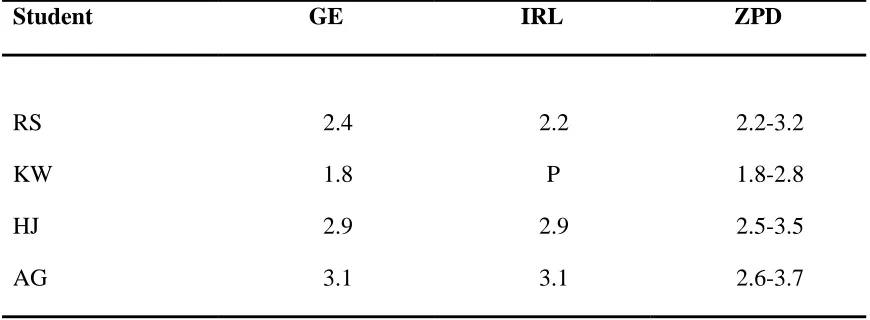
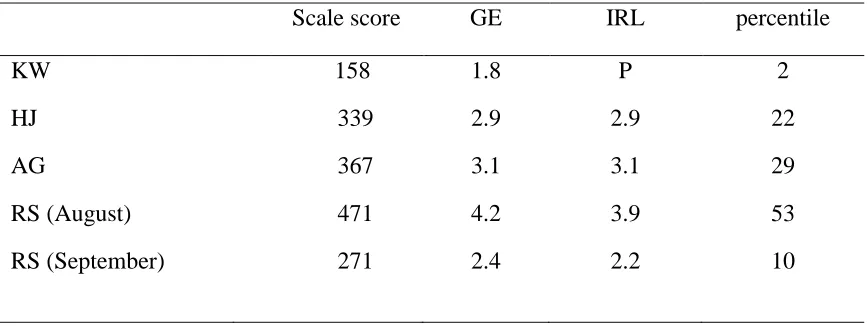
Table 4.1 STAR reading data from beginning of year indicating GE (grade equivalence), IRL Instructional reading level), and ZPD (zone of proximal development) ...55
Table 4.2 Screening data from STAR reading assessment ...56
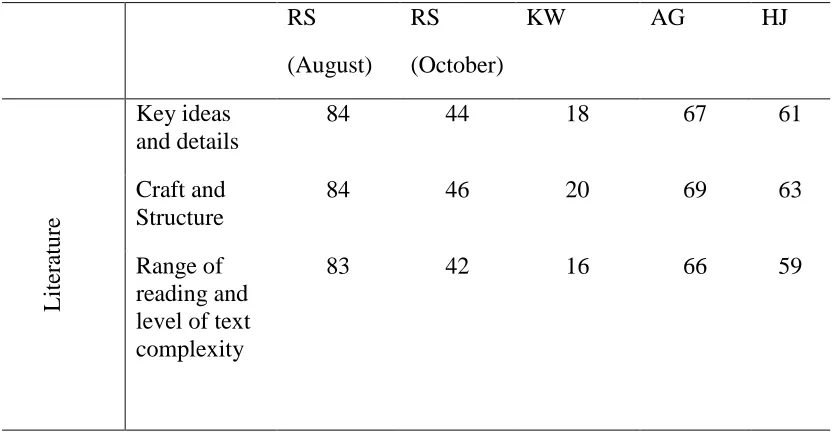
Table 4.3 Screening assessment domain scores from students’STAR diagnostic report .57 Table 4.4 KW’s criterion scores for Dominie administered at beginning of study ...62
Table 4.5 RS’s criterion scores for Dominie administered at beginning of study ...63
Table 4.6 HJ’s criterion scores for Dominie administered at beginning of study ...64
Table 4.7 AG’s criterion scores for Dominie administered at beginning of study ...66
Table 4.8 STAR reading data from end of year assessment ...104
Table 4.9 Summary of STAR domain scores from end of year assessments included on students’ diagnostic report ...110
Table 4.10 KW’s criterion scores for Dominie assessment at end of study ...114
Table 4.11 RS’s Criterion scores for Dominie assessment at end of study ...115
Table 4.12 HJ’s Criterion scores for Dominie assessment at end of study ...116
Table 4.13 AG’s Criterion scores for Dominie assessment at end of study ...117
L
IST OFF
IGURESFigure 2.1 Standard RTI model ...18
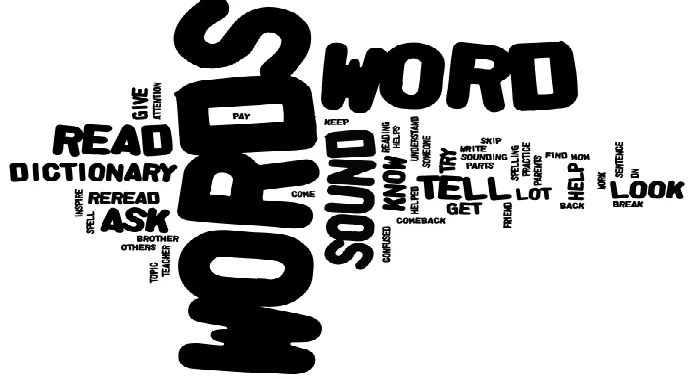
Figure 4.1 Wordle of class responses to Burke Reading Inventory ...53
Figure 4.2 Wordle of follow-up responses to Burke Reading Inventory ...102
Figure 4.3 KW’s progress monitoring graph of STAR reading assessment from
Renaissance Place teacher report ...105
Figure 4.4 RS’s progress monitoring graph of STAR reading assessment from
Renaissance Place teacher report ...107
Figure 4.5 HJ’s progress monitoring graph of STAR reading assessment from
Renaissance Place teacher report ...108
Figure 4.6 AG’s progress monitoring graph of STAR reading assessment from
L
IST OFA
BBREVIATIONSEAHCA ... Education for All Handicapped Children’s Act
GE ... Grade Equivalency
IDEA ... Individuals with Disabilities Education Act
IRL ... .Instructional Reading Level
PASS ... Palmetto Assessment of State Standards
PR ...Percentile
RMA ... Retrospective Miscue Analysis
RTI ...Response to Intervention
WPM ...words per minute
CHAPTER
1
The Nature of the Problem
Every year in my urban southeastern school, more and more students have
continued to read below grade level. Their test scores did not qualify them to receive
special education services, and usually screening assessment scores were just above the
cutoff for additional small group tutoring provided by reading specialists and grade level
tutors. These students disengaged when given time to read in class, and they did little if
any reading at home. They only utilized the library when the class went as a group and
were usually the last ones to choose books by grabbing any book when the class was
ready to leave. These students usually did not have books in the house and did not take
home the books they checked out of the library. Our school provided free books from
RIF (Reading is Fundamental) and books for students to take home for summer reading,
but the books were often thrown away or left in the classroom.
Data from testing showed that for the last five years, a substantial number of
students in grades four and five were performing below grade level expectations (see
Table 1.1). The data did not show significant improvement with 46% of fourth graders in
2014 not reaching grade level expectations. With the number of students falling below
grade level expectations there appeared a need for something to change, hence a need for
this research study.
assign students to either Tier 2 RTI with a tutor or Tier 3 RTI with an Interventionist for
additional support. These groups lasted the entire year and were limited to one or two
small groups of up to four students per grade level. Based on the data, it was apparent
Table 1.1 PASS scores - percent of students scoring below grade level expectations.
Grade 2014 2013 2012 2011 2010
Fourth 54.1% 36.7% 42.5% 26.8% 38.1%
Fifth 42.6% 42.0% 42.6% 38.2% 45.5%
that not all students performing below grade level received additional services; therefore,
their needs must be addressed within the classroom. This study implemented a strategy
with a group of students who were not meeting grade level expectations and did not
receive additional support from tutors or interventionists to attempt to bring their reading
levels up to grade level.
By the time students reach the fourth grade, they have already developed a set of
reading habits and attitudes. They either enjoy reading and feel they are good readers or
do not like to read, avoid reading, and think they are not good readers. After reading the
book Reading Conversations by Rita A. Moore and Carol Gilles (2005), I realized that
most classroom teachers tend to focus on weaknesses to help them improve their reading
skills. Teachers often do not spend time focusing on what students do well. Identifying
strengths helps students realize their successes and recognize the good reading strategies
they are already using with automaticity. Students are more motivated if they feel they
are successful and we as educators need to help them see their successes. The idea of
discussions about the reading process. Research shows that knowing their strengths and
talking about those strengths could help the students better understand themselves as
readers (Moore & Giles, 2005). I felt that this could be a missing link that might help
students who were reading below grade level, and that it might offer part of the solution
to the problem my school faced.
Many of the students in my school came to fourth grade one, two, and sometimes
three years below grade level expectations as indicated by STAR Reading test results (see
Table 1.2). The instructional reading levels of 78% of the students were below grade
level, making their independent reading level even lower. Most instruction in the
classroom tended to use material at or above grade level making it difficult for these
students to find success.
Table 1.2 Number of fourth-grade students at a given instructional reading level at the beginning of the 2014-15 school year based on STAR reading assessment.
When given time for self-selected reading, many of the students chose simple
picture books they could find and read quickly or spent time staring off into space
absentmindedly turning pages to look like they were reading. Still others spent time as
they said “looking for a book.” When conferring with students, many of them spent the
P-PP level 1.0-1.9 2.0-2.9 3.0-3.9 4.0-4.9 5.0+
Class 1 2 2 3 1 2 0
Class 2 3 3 4 3 2 0
Class 3 Advanced Academic Placement
0 0 1 3 4 3
time reading word-by-word and had difficulty talking about the book or retelling what
they just read. As a classroom teacher, I have observed that students who have the most
trouble even getting started and staying engaged with a book are students who are at least
two years behind in their reading levels. They choose books at or above grade level even
when multiple selections are available on their reading level. They respond very
negatively when asked to read. When invited to bring a book they are reading for
conferencing, they grab something from a book basket because they have not been
reading. They make little or no effort to read independently. No matter what book they
are given, what models provided them, they still cannot or perhaps will not read orally or
read independently. During conferences, they struggle to read the book they brought
with them and often give up saying they don’t like to read because they are not good
readers. Often the books they brought to conferences were above their reading level, and
they struggled reading the words. When offered a lower level book to read aloud, they
refused the book saying it was too easy or doesn’t look interesting. It was often difficult
to engage these students, and I am always on the lookout for strategies that would
encourage them to read more.
As I continued to read professionally, I found three topics that influenced my
thinking and helped me reexamine my teaching to better attempt to reach my students and
support them as readers. Those three topics were 1) cultural influence, 2) Response to
Intervention and 3) Retrospective Miscue Analysis.
After I read Shirley Brice Heath’s book Ways With Words (1983), I began to think
about the reason my students disengage. It might be because I was imposing my white,
As a child growing up, books were important in my family, and they were always in the
house including two different sets of encyclopedias. We went to the local library to
check out books almost every Saturday. I also spent my money buying books from the
book club flyers my teacher sent home. The student population I teach is urban African
American from low-income families. For many of the families, books do not appear to
hold the same place of value as they did for me. There are few if any books in the home.
They seldom went to the local public library to check out books, and they did not spend
money ordering books from book club flyers offered to them at school. I realized I
would need to reevaluate my thinking and teaching to reach the children with whom I
worked for them to see the importance of reading in their future lives.
I began to spend more time reading aloud to my classes making sure always to
choose a chapter book at or above grade level. I would read the book every day for a few
days until I got them to a point where they were asking me to read more because they
were so interested in the story. At that point, I would switch to a new book the next day.
Someone always asked to read the rest of the book because they wanted to know what
happened next. Sometimes several would read the book together, and I found multiple
copies to satisfy all who wished to finish the book. After hearing the book read aloud,
they did not struggle to finish the book because they could build on what they heard.
However, many students were still disengaged during independent reading and reading
achievement levels were not improving sufficiently.There had to be some other
intervention I was missing which led me to further research.
As a member of The International Reading Association, I received a copy of
2008). The book was part of my membership and piqued my interest. I had not heard the
term before and wanted to know more about it. As I read through the book, I realized
that the testing and data I had been gathering in my classroom was one of the principal
components of Response to Intervention (RTI). I saw reinforcement for the need to pull
small groups based on strengths and needs. Researching RTI, I found the key component
is providing early intervention through small group work. Intervention could occur in the
regular classroom accompanied by frequent progress monitoring (Brown-Chidsey, 2007;
Brown-Chidsey & Steege, 2005; Daly, Fletcher & Vaughn, 2009; Ysseldyke, 2008). Our
district already had in place several mandated methods of progress monitoring teachers
used regularly. The district also put Reading Interventionists in the elementary schools to
pull students for RTI. However, the program is not used with fidelity throughout the
school and the district. Our school even hired a reading tutor for each grade level to pull
small groups of students which has since changed to one tutor serving all third-grade
through fifth-grade classes. Having only one tutor limited the number of students served
in fourth and fifth grade because the school focused on third graders.
Research studies implementing RTI generally began in Kindergarten or first
grade, often following students through third grade (Barnett, D. W., VanDerHeyden, A.
M., & Witt, J. C. 2007; Compton, D. L., Fuchs, D., Fuchs, L. S., & Bryant, J. D., 2006;
Fuchs, D., Compton, D. L., Fuchs, L. S., Bryant, J., & Davis, G. N., 2008; and many
others). Research on the use of RTI in fourth and fifth grade is limited. After reading
over 45 studies using RTI, including several meta-analyses of multiple studies, I was able
to find only three that involved older students(Geer, 2008; Richards & Omdal, 2007;.
science class; Slavin, Chamberlain & Daniels was a middle school, and Greer was a case
study of two third graders and one fourth grader. There appears to be a need for
additional research in how starting RTI Tier II in a regular fourth-grade classroom can be
used to improve students’ reading further illustrating a need for this research study.
An additional method I recently discovered was the book Reading Conversations
Retrospective Miscue Analysis with Struggling Readers, Grades 4-12 by Rita Moore &
Carol Giles (2005). Retrospective Miscue Analysis (RMA) involves taking the data from
oral reading and analyzing the types of miscues the student makes then discussing the
impact those miscues made on comprehension (Brown, 1980; Goodman & Marek, 1996;
Goodman, 2008). The research shows that proficient readers tend to make miscues while
reading without impacting comprehension. Recognizing the fact that not every word
needs to be read correctly, but understanding what the author is saying was the missing
link for my students. Through classroom observations and reading conferences, it
appeared that students found a need to read every word correctly before moving on
causing them to lose the meaning of the text. RMA has sufficient research to show that it
is an effective, instructional strategy for helping students understand what good readers
do (Black, 2004; Brown, 1980; Costello, 1992; Goodman & Marek, 1996; Marek, 1987;
Martens, 1998; Moore & Seeger, 2009; Seeger, 2009; and Worsnop, 1996). RMA
research tends to begin with middle school students (Brown, 1980; Ohaver, 1972;
Paulson, 2001; Paulson & Mason-Egan, 2007; Seeger, 2009; Smith, 1980, and Warde,
2005). Even Moore and Gilles book (2008) focuses on research with middle and high
school students. Utilizing RMA might be beneficial to assist fourth-grade students in
Therefore, this study will address that need in an attempt to help them realize they are
good readers and use the strategies good readers use when they are reading. It is also
designed to help students realize it is not necessary to read every word correctly but to
understand the text.
Therefore, I designed this case study to determine if Retrospective Miscue
Analysis (RMA) as part of a Response to Intervention model can be implemented to help
upper elementary students become more proficient readers. This study will examine the
use of Retrospective Miscue Analysis in Classroom Tier III RTI with fourth-grade
students. The study focused on emphasizing student strengths and talking about reading
to enable the development of a positive attitude about their reading ability and an interest
in independent reading. Specifically, this study is designed to answer the following
question:
What is the impact of a Response to Intervention instructional program utilizing
Retrospective Miscue Analysis for fourth-grade students reading below grade level?
The study will:
1. Focus on students’ reading strategy use and improved strategy instruction.
2. Increase engagement in meaningful reading based upon student interests.
3. Engage students in conversations about reading and provide feedback to
students about their reading strengths.
The impact of the study will be determined by:
a. Burke Reading Interview as pre/ post measures to assess reading attitude
b. Analysis of scores on Dominie and STAR Reading to document changes in
achievement levels.
c. Analysis of transcripts of student/teacher conferences to identify reading
CHAPTER 2
Review of Related Literature
Levels of literacy in the United States have been a concern since early in the 20th
century. Historically, explanations for the cause of low literacy levels in individuals have
ranged from suggestions of low intelligence or a broad intellectual deficit to more
specific learning disabilities. The Education for All Handicapped Children’s Act
(EAHCA) in 1975 provided funds to diagnose and support specialized education for
children with specific learning disabilities. In 1990, this bill was reauthorized as the
Individuals with Disabilities Education Act (IDEA). Then in 2004, a significant
movement began with the reauthorization of the IDEA bill. This law requires that
identification of learning disabilities be based upon a history of service in regular
education settings where a record of students’ responses to appropriate, high-quality
instruction with qualified teachers is observed prior to placement. The term used in the
literature became Response to Intervention and RTI was its acronym. The bill raised a
persistent question about whether the instruction has been optimal before a determination
is made about specialized services (Johnston, 2010). This movement has helped in
mounting, monitoring, and adapting instructional plans for students who struggle with
reading, and has turned our attention to the quality of instruction offered in regular
classrooms.
As a classroom teacher of fourth grade students, I believe the results of this
their needs, and to marshal the most effective resources we can to mount the most
effective instruction we can, to address children’s literacy learning needs. If we are
successful, we can help to avoid the problems cited in the research that has led to the
unnecessary identification of children to special education services. The RTI movement
encouraged me to pose a research study to examine the impact of my RTI classroom
reading instruction for my lowest achieving students through the use of a case study
approach. The review of research led me to crafting the best methods; a combination of
high-interest literature, progress monitoring on a regular basis, miscue analysis, student
conferences, and small group guided reading focusing on students’ strategy use and
literature discussions.
This research study resulted from a review of theliterature on three main topics.
The topics included Response to Intervention (RTI), miscue analysis as a research tool,
and Retrospective Miscue Analysis (RMA) as an instructional strategy. This review
builds an argument to show that this study contributes to what is currently known about
assisting students in upper elementary classrooms to develop improved comprehension
skills as a means of improving their overall reading ability.
This review documents three important statements. That the research currently
available about Response to Intervention theory, while extensive, is limited to early
reading at primary grades as a strategy to avoid placement in special education. That
miscue analysis theories and research are limited to primary grades as well, with a focus
on qualities of miscues strategies, cueing systems, and the acceptability of structures
used. That theory and research focused on Retrospective Miscue Analysis as a classroom
limited. Taken together, these limitations on our current knowledge and research shows
that a study of this nature is needed. The study is designed to describe, analyze, and
document that Retrospective Miscue Analysis used as a Response to Intervention model
in an upper elementary classroom will improve reading comprehension levels of students
performing below grade level.
This chapter examines the broad base of research in literacy interventions and
focuses this discussion further to explore the research and theory relevant to the need to
build comprehension of struggling readers in the upper elementary grades. It is organized
around three key areas involved in this study (1) RTI and its practical implementation in
classroom instruction; (2) critical research on the use of miscue analysis as a research
tool; and (3), a review of how RMA can be used to engage upper elementary readers in a
personal interpretation of their reading strategy use as a means of deepening
comprehension and fostering reading growth.
2.1 RESPONSE TO INTERVENTION
In 2008, Response to Intervention (RTI) was recognized by the International
Reading Association as a “hot topic” for research by 75% of their readers (Mesmer &
Mesmer, 2008/2009). RTI is a systematic method of instruction and assessment that is
designed to meet the needs of all students to assist them in achieving greater academic
growth and accelerate the growth of “at-risk” students. There are four main components
of RTI: 1) universal screening, 2) intervention, 3) progress monitoring, and 4)
intervention efficacy and fidelity. RTI often uses a three-tier approach to support
students with varying instructional needs. Tier I includes all students using
achieved expectation levels of Tier 1 who receive additional instruction time and are
progress monitored for a given amount of time. Tier 3 addresses the needs of students
who have significant differences in their performance from that of other students.
(Brown-Chidsey, R.: 2007). Intervention is in addition to the regular class not in place of
the regular class (Jennifer Demski, 2009).
Numerous books have been published to help teachers and administrators
understand the RTI model and implement it in their classrooms and schools with efficacy
and fidelity. One of the first books written by Rachel Brown-Chidsey and Mark Steege
(2005) was Response to Intervention: Principles and Strategies for Effective Practice.
The book provides a guide for implementing a school-wide response to intervention
program with a theoretical and empirical foundation using a ten-step model. In 2008,
several more books were published. Fuchs, Fuchs, and Vaughn edited Response to
Intervention: A Framework for Reading Educators, to explain RTI and how to use it
emphasizing early and effective teaching using assessment data for decision making.
Also in 2008 Using RTI for School Improvement written by Cara Shores and Kim Chester
provides a step-by-step approach to implementing RTI as a school-wide improvement
process. A guide for elementary and secondary schools written by Matthew Burns and
Kimberly Gibbons (2008) entitled Implementing Response-to-Intervention in Elementary
and Secondary Schools: Procedures to Assure scientific-based practices, addresses
academic, social, behavioral, and emotional needs of students. Today over five hundred
books can be found on the subject of Response to Intervention ranging from general
handbooks to describe the process to materials that could be used when implementing
Because of the emphasis associated with RTI and IDEA of 2004 (Gersten &
Dimino, 2006), allowing districts to spend up to 15% of their federal special education
dollars on RTI programs, many companies label their products as RTI. They label their
products as RTI materials for intervention in reading and math as a marketing tool to sell
them to schools and districts across the nation. There are even websites devoted solely to
providing information on RTI that include descriptions and teaching strategies such as
www.rtinetwork.org and www.rtimdirct.com.
History and Development of RTI
In 1975, the Individuals with Disabilities Act was passed entitling every student
with a disability to a free public education to meet their unique needs and to enable them
to lead productive adult lives. In 1977, learning disability was defined as a “severe
discrepancy between achievement and intellectual ability” (U.S. Department of
Education). Many education professionals have traditionally relied on a wait-to-fail
process to identify and assist students experiencing academic difficulties (Jimerson,
Burns and VanDerHeyden, 2007). This model led to a skyrocketing number of students
identified as learning disabled, particularly minorities.
In 2001, the No Child Left Behind legislation was passed which mandated that
school-based professionals adopt scientifically based research to equalize reading
disparities among students. Fuchs, Deshler, and Reschly (2004) found that 2.72 million
children between the ages of 6 and 17 had an LD label representing nearly 6% of the
general population and slightly more than half of all children with disabilities.
reviewed various research studies that invalidated the claim that IQ is an important
marker for identifying learning disabilities
More than 80% of students identified with special education needs struggle with
literacy (Mesmer and Mesmer, 2008/2009). Laura Justice (2006) claims that students
who perform poorly in reading achievement do so because schools fail to provide
adequate instruction to at-risk children who exhibit significant risk factors that make
learning to read very difficult. She suggests that RTI prevention models implemented in
the earliest stages of their reading development and continued to the end of second or
third grade would make a difference. In 2004 Congress reauthorized IDEA and shifted
the emphasis from the identification process toward providing support and intervention
for struggling students early. This shift is similar to the Reading First provision of No
Child Left Behind.
Defining RTI
RTI is an acronym used interchangeably for Response to Intervention, Response
to Instruction, Responsiveness to Instruction or Responsiveness to Intervention. Johnston
(2010) noted that the first person to clearly articulate the logic behind RTI was Dr. Marie
Clay in her article entitled Learning to be Learning Disabled published first in 1987. She
argued, “Learning disability is more often acquired through inadequate instruction than
through genetics” (Johnston, p. 3). To her, ruling out the possibilities of inadequate
instruction would avoid costly, long-term specialized services.
Many researchers have provided definitions and guidelines for RTI
(Brown-Chidsey, 2007; Daly, Glover & McCurdy, 2006; Justice, 2006; Reschly,
instruction based on need accompanied by frequent progress monitoring. RTI is a
process of providing intervention as early as possible to address the needs of students
beginning in the general education classroom. A key goal of RTI is the prevention and
remediation of academic and/or behavioral difficulties through effective instruction and
intervention for all students (Fletcher & Vaughn, 2009; Hosp, 2008; Renaissance
Learning, 2008; Ysseldyke, 2008). All of these definitions incorporate the use of data to
identify the needs of students and to use those data to plan and implement instruction that
addresses particular needs.
Data analysis is only one part of RTI. The principal elements of RTI are
high-quality scientific research-based instruction/intervention, monitoring student progress,
and data-based decision making (Mesmer & Mesmer, 2008/2009; Ysseldyke 2008). The
National Center for Learning Disabilities (2009) adds the component of parental
involvement. RTI is a process, not a program, which is intended to reach students where
they are and take them where they need to be using the most efficient method. Five
fundamental principles common to all models based on a flexible approach include; (1) a
proactive and preventative approach, (2) ensuring a match between student skills,
curriculum, and instruction,; (3) progress monitoring and data-based decision making, (4)
utilization of effective and evidence-based practices, and (5) school-wide use. The
common features of RTI models are (1) multiple tiers, (2) a reliable and valid assessment
system, (3) protocol, and (4) evidence-based instruction. (Barnes & Harlacher, 2008)
RTI Models
All RTI models have these same basic components even though they may differ
protocol model and the problem-solving model sometimes called problem-analysis
(Fuchs, Deshler & Reschly 2004; Hale, Kaufman, Naglieri & Kavale, 2006). Hale,
Kaufman, Naglieri & Kavale (2006) explain the main difference between the two
paradigms as offering slightly different implementation and methods for determining
learning disabilities. Fuchs & Fuchs (2006) continue the comparison as a
problem-solving process that tends to be used by practitioners in an attempt to personalize
intervention and researchers tend to favor a standard protocol approach. Both models
incorporate problem-solving to identify needs. The primary difference being the use of a
universal screening to identify students in a standard protocol design, and a teacher or
other adult who presents the student to a team in a problem-solving model.
The standard protocol model utilizes a standard set of instructional approaches or
implementations applied to all students. It emphasizes scientific research-based
classroom instruction (Fuchs, Deshler & Reschly, 2004; Gerber, 2005; Marston, 2005:
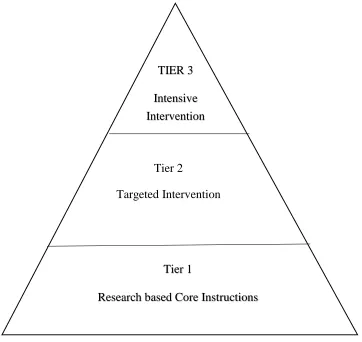
Ysseldyke, 2008). The standard protocol model is usually represented as a triangle
broken into at least three tiers as shown in figure 2.1. Students progress through the tiers
before placement in special education programs (Brown-Chidsey, 2007; Demski, 2009;
Fuchs, Fuchs & Vaughn, 2008; Ysseldyke, 2008). Tier 1 represents appropriate
evidence-based instruction and progress monitoring of all students in the general education
classroom and universal screening with about 80% meeting expectations. Students not
making satisfactory expectations move to Tier 2 where implementation of specific
interventions that are more specialized for varying lengths and times usually in small
triangle represents about 5% of the students significantly below established grade-level
expectations that need additional individualized interventions.
Figure 2.1: Standard RTI model
Another RTI model focuses on problem-solving, and it is this model that I address
in this study. The problem-solving model involves interventions on a case-by-case basis
(Ysseldyke, 2008). In the problem-solving model an identified problem is analyzed,
goals are set, and planned interventions are implemented and assessed (Renaissance
Learning, 2008). However, in the problem identification step the detection of a problem
by any adult who may interact with the student, including parents, replaces the universal
screening methods of the standard protocol model. The problem-solving model TIER 3
Intensive Intervention
Tier 2
Targeted Intervention
Tier 1
emphasizes scientifically-based instruction and also utilizes regular student progress
monitoring, data-based decision making, and strategically selected interventions
(Nebraska, 2006). The model further suggests individualized interventions and
measurement practices for non-responsiveness. Deno (2005) has identified a five-part
problem-solving model. This model includes (1) problem identification, (2) problem
definition, (3) designing intervention plans, (4) implementing the intervention, and (5)
problem solution. Once the problem it identified it is evaluated by the intervention team
to determine the magnitude of the problem that may include an additional screening
assessment.
The third step is the creation of an intervention plan designed specifically to meet
the needs of the student. In the fourth step, the plan is implemented as outlined and
progress is monitored based on the particular nature of the problem. Finally, the problem
is solved when certain preset criteria are met. If an intervention does not meet the
success criteria, an alternative intervention may be designed and implemented as needed.
The significant difference in the two models is the number of students addressed; in the
standard protocol model all students are screened and in the problem-solving model one
student at a time is discussed. In this study, Retrospective Miscue Analysis utilized the
problem-solving model by identifying individual needs and addressing them through
analysis and discussion of oral readings. However, an initial screening was administered
to all students to identify specific students for the study along with parental concerns and
Articles and Research Studies
Articles about RTI appeared in almost every major education publication such as
Educational Leadership, Education Week, and Reading Research Quarterly, to name a
few. Brown-Chidsey (2007); and Slavin, Chamberlain & Daniels, (2007) explained the
RTI model including case studies of a first grader, a kindergartner, and a middle school
reading class. They focused on reducing the number of students who needed special
education services. The first study incorporated the use of Open Court Reading in first
grade and DIBELS in kindergarten for assessment. The middle school group used a
program called Reading Edge. These studies reported an increase in student reading
levels.
One article from Education Week by Christine A. Samuels (2008), focused on a
description of a demonstration site in Oregon centered around children just learning to
read. They found an increase in DIBELS fluency scores of first graders. Reading
Research Quarterly has incorporated a large number of articles about RTI including those
by Sue Samson (2000), Gersten & Dimino (2006), McEneaney, Lose, & Schwartz
(2006), Klingner & Edwards (2006), and Fuchs & Fuchs (2006). These articles included
foundational information about RTI, addressed concerns with the implementation,
identified advantages and disadvantages, and described the use of Reading Recovery as
an RTI model. One concern identified in numerous studies of RTI models, both tier and
problem solving, is the use with fidelity and efficacy reflected in teacher training.
Advantages include not waiting for students to fail including the abandonment of the
deficit model and assumptions being made about reading difficulties. Most of the studies
Many more additional articles were found in educational journals. Other articles
were published in journals addressing special education and gifted education such as
Journal of Learning Disabilities, Exceptional Children, and Journal of Advance
Academics. In articles by Margo A. Mastropieri & Thomas E. Scruggs (2005) in The
Journal of Learning Disabilities, concerns addressed the theoretical and practical aspects
of RTI as an alternative method of identification for special education. Additional
Journal of Learning Disabilities articles reviewed several studies done with first-grade
students concluding RTI is beneficial in improving reading levels in some studies, but not
others suggesting a need for further studies. However, no particular program was
identified. Lynn S. Fuchs and Douglas Fuchs continue their discussion of the RTI model
in Teaching Exceptional Children article in an attempt to clarify misunderstandings and
confusion about the use of RTI. The Journal of Advanced Academics article by Richards
& Omdal (2007) is a study of a secondary science classroom where RTI was used and
demonstrated a difference in student performance. Additional articles explored studies
that used the RTI model to decrease placement in special education through case studies
as well as longitudinal studies.
The field of Psychology also saw relevance in the utilization of the RTI model.
They included articles in their journals; Journal of Educational Psychology, Journal of
Child Psychology and Psychiatry, School Psychology Review, Psychology in the Schools,
and California School Psychologist. Some of these articles included research studies as
well as opinion papers. Articles by VanDerHeyden, Witt, and Gilbertson (2007) in
Journal of School Psychology and Compton, Fuchs, Fuchs, Bryant (2006) in Journal of
using word identification fluency and one using a STEEP model. Both articles showed
increases in student performance and decreases in recommendations for special education
programs. A study by Hatcher et al. (2006) for Journal of Child Psychology and
Psychiatry, conducted over two 10 week periods with first graders, showed RTI as an
effective intervention, however, one-fourth of the students did not respond to the
intervention. There was no indication of the materials or strategies used in the study.
Additional studies were almost all implemented with first-grade students with some using
DIBELS for assessment.
Several organizations have devoted entire issues of their journals to the topic of
RTI. The Council for Exceptional Children focused on Responsiveness to Intervention in
their 2007 May/June (Volume 39 Number 5) issue of Teaching Educational Children.
The School Psychologist (winter, 2005), published by The American Psychological
Association, discussed studies of the RTI model’s implementation as a strategy to
improve reading and behavior (Volume 9 number 4). The International Reading
Association journal The Reading Teacher (volume 62 number 4) December 2008-January
2009 featured articles on what educators need to know about RTI. Even the 2007 issue
of The Journal of Positive Behavior Intervention focused on the use of RTI three-tier
models for reading and behavior intervention.
The majority of research conducted on the use of RTI focused on reading research
studies beginning in kindergarten or first grade with some research studies following the
students through third grade. Lipson and Wixson’s (2010) review of RTI models used in
all grade levels, including middle and high school, showed a need to expand RTI beyond
implementation of RTI primarily in early and emergent readers. Benefits identified by
McEneaney, Lose & Schwartz (2006) are no longer a need for students to “wait to fail”,
and avoid problems associated with process deficit and discrepancy models. RTI is
instructionally grounded enhancing the validity of the diagnostic process. Benefits
identified included identification of risk rather than a deficit, early identification, and a
link between assessment and instruction.
But the research base is less robust for older students and students in other
academic subjects. Further study is needed to inform other teachers in the upper
elementary, middle and high school as well as different content areas about best practices
in RTI to affect change in student achievement in these higher grade levels. Very few
studies have been conducted with upper elementary students beyond the third grade when
reading shifts from learning to read to reading to learn, emphasizing comprehension. A
discussion of late onset reading difficulties were not part of any study, but are becoming a
topic of interest in schools (Leach, J. M. & Scarborough, H.S., 2003). Late onset reading
difficulties could be due to the shift from learning to read to reading to learn.
After reviewing research, it appears that one major component seems to be
missing in the research. Most of the studies do not indicate the strategy used during RTI
sessions. However, some first-grade studies did use Reading Recovery (Clay, 2005). The
studies often identify assessment and progress monitoring tools and provide a time frame
for the study. Even the few studies with fourth graders through high school did not
implement Retrospective Miscue Analysis. Therefore, this study will offer valuable
2.2 MISCUE ANALYSIS
Miscue analysis is a window on the reading process (Goodman, 1973).
The majority of RTI research focused on reading in primary grades by screening
using some running record of oral reading followed by questions about the passage.
When assessing the reading experience of young readers the use of running records
provides insight into their abilities. It is a focus on what the reader is saying and
identifies the words read as correct or incorrect. Marie Clay (2002) introduced running
records as a way to assess text reading of young children by testing the number of letters,
sounds or words they know and recording any mistakes made during oral reading.
Running records account for the accuracy of text through a count of errors made during
oral reading and an assigned label of easy, instructional and hard depending on the
percent of words read correctly. Running records could also include questions about
comprehension but with caution because comprehension is dependent on the difficulty
level of the text. Teachers ask various questions providing an unreliable gauge of
comprehension, and answers are dependent upon the complexity of the sentence structure
of the question (Clay, 2002).
However, when looking at readers in the upper elementary grades, one wants to
go beyond running records and dig deeper into the kinds of miscues students make.
Along with what those miscues identify what strategies readers use as they to try to make
sense of the text. The term miscue is used instead of a mistake to indicate changes in the
text. Miscues suggest the reader’s use of language and knowledge of the reading process
and miscues may not interfere with comprehension. Miscue analysis has been studied
Goodman, K. 1965, 1972, 1973; K. Goodman, & Burke, 1973; Goodman, Y. 1976;
Martens, 1997; Tovey, 1979; Weaver, 2002; Wilde, 2000). A miscue is a reader’s
response that does not match the expected response (Davenport & Watson, 2002; K.
Goodman, 1967, 1996; Y. Goodman & Burke, 1972). Kenneth Goodman (1996)
analyzed the degree to which miscue changes, disrupts, or enhances the meaning of
written text. When conducting a miscue analysis, one is looking at the kind of miscues
being made by the reader and what it says about the reader. These miscues provide
information about the reader that involve the reader’s proficiency, knowledge about the
reading process, strategies used to understand text, construct meaning, and provide
evidence of reading problems (Goodman, Watson & Burke, 1987).
One of the significant differences between running records and miscue analysis is
the use of audio recording when conducting a miscue analysis to focus and build on the
reader’s strengths (Wilde, 2000). After a student reads orally, the student then retells the
story, and this is also audio recorded (Wilde, 2000; Goodman, Watson & Burke, 1987;
Weaver, 2002). The teacher carefully analyzes the story possibly with the reader.
In 1967 Goodman defined reading as a means of constructing meaning and
making sense of print. Kenneth Goodman spent four decades doing research on miscue
analysis. He concluded that proficient and non-proficient readers used a single reading
process that is best described asa transactive, socio-psycholinguistic perspective
(Goodman Y., 1996; Goodman, Watson & Burke, 1987). By analyzing the effects of
miscues on making meaning of the text, he developed the Goodman Taxonomy of
Goodman,1996), and delivered to classroom teachers as an assessment tool entitled A
Reading Miscue Inventory (Y. Goodman & Burke, 1972).
Many have written about the use of miscue analysis as an instrument for
diagnosis, evaluation, and instruction (Campbell, 1993; Davenport & Watson, 2002;
Flurkey & Xu. 2003; Goodman, 1973; Y. Goodman & Burke, 1972; Y. Goodman,
Watson, and Burke 2005; Y. Goodman, Watson, & Burke, 1987; Wilde, 2000). Wilde
(2000) provided a common sense interpretation of miscue analysis with a focus on the
strengths of readers and using those strengths to build proficiency. Methods for
conducting and using miscue analysis for evaluation and instruction through the use of a
reading miscue inventory were written by Yetta Goodman and Carolyn Burke (1972). In
1987, Yetta Goodman, Watson & Burke provided alternative methods for the reading
miscue inventory. An additional explanation of miscue analysis by Yetta Goodman,
Dorothy Watson, and Carolyn Burke (2005) also included research-based references and
a historical view of the development and use of miscue analysis. Davenport and Watson
(2002) explained the why and how of miscue analysis with an over the shoulders
approach. The teacher listens over the shoulder to a student read while taking quick
running records of some students, while others are reading independently.
Numerous studies using miscue analysis were conducted (Altwenger & Goodman,
1981; Brown, Goodman & Marek, 1996; Goodman, 1996; Long, 1985), but none of them
have addressed the use of miscue analysis in an RTI setting. The International Reading
Association published an annotated bibliography of research on miscue analysis written
by K. Goodman, Marek & Brown (1996). Miscue Analysis has also been the focus of
Margaret Lindberg, (1972), and Patricia Long (1985) among others.The research shows
that when teachers conduct miscue analysis of the students they are better informed of
students’ weaknesses as well as their abilities as readers and are better able to provide
effective instruction.
2.3 RETROSPECTIVE MISCUE ANALYSIS
Yetta Goodman (2008) states that there are two purposes for Retrospective Miscue
Analysis (RMA). The first purpose being an instructional tool and the second being a
research tool. As an instructional tool, it involves the reader in becoming consciously
aware of how they read and allows teachers to use miscue analysis to plan reading
instruction. As a research tool, it provides knowledge to teacher researchers about how
readers respond to their miscues and the role those miscues have in influencing reading
development. Classroom reading instruction should provide lessons personalized to
students’ needs as opposed to moving all students through a single core reading program
(Allington, 2006).
RMA is an instructional strategy that aims to heighten a reader’s awareness of the
reading process by recording their oral reading. The reader then listens to their reading
and analyzes their deviations from the written text. Examining these deviations from text
also allows the evaluator to note ways in which a reader is interacting with text to inform
future instructional decisions. RMA invites readers to build an understanding of
themselves as a reader and how they use the reading process. Students become
consciously aware of how they use reading strategies and their knowledge to respond to
written texts through collaboration. Engaging the reader in a discussion of those
on their strengths as a reader. RMA has been shown to help readers renegotiate their
view of themselves and how they implement reading strategies (Black, 2004).
Development
RMA is an extension of miscue analysis that involves readers in discussing their
oral reading and retelling. RMA was originally developed in the 1970s by a Canadian
secondary school reading specialist, Chris Worsnop. RMA is grounded in extensive
research on miscue analysis as a procedure that engages the reader in reflecting upon and
evaluating their reading process (Goodman & Marek, 1996, Marek, 1987). Yetta
Goodman (2008) provided an overview of RMA as an instructional strategy, where
readers actively construct meaning by realizing that miscues are an important part of the
reading process influenced by background, experiences, culture, and linguistic
differences.
Retrospective Miscue Analysis Research studies
Early research showed that RMA can be a successful instructional strategy
(Goodman & Marek, 1996; Goodman, Marek, Costello Flurkey, Wizinowich & Brown,
1989; Martens, 1998; Ohaver, 1972). Additional RMA research documents use with
third grade through college students; (S. C. Brown, 1980; E.A. Brown, 1996; Marek,
1987; Paulson & Mason-Egan, 2007). RMA has been shown to change the readers’
self-efficacy by allowing them to begin to see the strategies that they need to use to make
meaning of text and understand what good readers actually do while reading (Seeger,
2009). At the college level, RMA has been used with students who are underprepared for
the demands of reading at the college level. Paulson & Mason-Egan (2007) found that
hinders learning because if students believe they have the ability to read they will be
more engaged with the text enhancing comprehension (Goodman & Flurkey, 1996).
RMA with the students led to a dynamic instructional intervention through exploration,
reflection, and evaluation with students gaining insight about their reading strategies to
make changes in their reading actions.
Recent research has been done to analyze the effectiveness of RMA as an
instructional strategy (Almazroui, 2007; Black, 2004; Goodman & Paulson, 2000; Moore
& Aspergren, 2001; Paulson, 2001; Paulson & Mason-Egan, 2007 ; Seeger, 2009;
Sherman, 2010; Warde, 2005). Many of these studies realized that the students thought
of themselves as poor readers, so they avoided reading.
One study at the elementary level was conducted by Karima Almazroui (2007) as
a case study of a third grader during tutoring sessions outside of school. The student was
Arabic and bilingual with a below average reading level. The study exposed him to a
variety of reading materials. Miscue analysis was done in different genres using actual
texts revealing that he was highly phonetic and disregarded punctuation. RMA sessions
focused on comprehension allowing him to identify the theme and infer meaning from his
experiences. The student learned to accept miscues, increased his confidence, and was
able to discuss strategies to use when reading alone and helped him improve his ability to
choose books he likes.
Additionally, Rita Moore & Victoria Seeger (2010) conducted RMA with an
entire fifth-grade class using Socratic circles as an organization tool. The entire class
participated in recognizing strengths and reading behaviors of their peers. The whole
Communities: Retrospective Miscue Analysis and Socratic Circles. The students
benefited from the support of their peers only after they became familiar with the RMA
process.
Another elementary study conducted by Wendy Black (2004) implemented
weekly retrospective miscue analysis sessions with one fourth grade student over a
five-month period. Her focus involved metacognitive experiences producing metacognitive
knowledge by bringing effective reading strategies to a conscious awareness. Findings
included a change in student’s attitude and perception of himself as a reader. Also, the
student was able to verbalize more reading strategies that he used when reading.
Another case study conducted by Joan Leikam Theurer (2002) of a preservice
teacher who examined her personal reading strategies using new knowledge to
reconstruct her perception of the reading process. The study was conducted with an adult
reader enrolled in education classes. When asked how she would help a struggling reader
she focused on reading slowly to get every word correct reflecting on how she was taught
to read. She thought she read every word correctly, but after listening to herself read she
realized that was not the case. The use of RMA with the preservice teacher enabled her
to recognize what she did as a good reader, and changed her beliefs and understanding of
the reading process and how to teach reading.
As part of a graduate course with Rita Moore, Christine Aspegren (2001)
conducted an eight-week inquiry with a high school student in a juvenile correction
center. When she started her inquiry process, the student was reading four grade levels
below where he should be. Six sessions each 60-95 minutes in length were conducted
the 46th percentile and felt he was a better reader. Additional data in the study showed
the student was reading more for meaning than just word calling.
Victoria Seeger (2009) utilized Collaborative Retrospective Miscue Analysis with
a group of sixth-grade students. Seeger’s qualitative case study explored the self-efficacy
beliefs students held about their reading skills and abilities before and after the study. The
students taped their reading of the text followed by a retelling. The next day the student
and teacher discussed the miscues. The Burke Reading Interview and Self-Efficacy
Reading Scales completed by students in the study revealed positive changes in each of
the participants’ self-efficacy in reading.
A study exploring how Retrospective Miscue Analysis using discourse analysis
was examined by Goodman & Paulson (2000). Seven students representing different age
groups, ethnicity, and linguistic backgrounds engaged in RMA session for eight months.
The readers were found to develop a more positive view of themselves as readers. As
they spent more time discussing the text, the more in control of the sessions they became
and also became more fluent in the language of reading.
Andrew Sherman (2010) conducted research with a grant to examine a strategy
that teachers in Saulk Prairie School District could use to improve reading fluency and
comprehension. He suggested using RMA and digital recorders to assist struggling
students to develop fluency rates that were conversation-like in nature. Progreessing past
the necessity to decode every word freed the students to engage with strategies to
improve comprehension. The grant focused on struggling fifth graders using
Concluding Thoughts
Major conclusions that have emerged from Retrospective Miscue Analysis studies
(Brown, Goodman, Marek, 1996) include; (1) readers actively construct meaning as they
transact with written texts, (2) miscues are an important part of the reading process, (3)
readers use predicting, confirming and inference strategies to construct meaning, and (4)
there is a single reading process (Goodman, 2008). Retrospective Miscue Analysis
(RMA) helps students gain insights into themselves as readers by listening to and talking
about their miscues that emerge during oral reading.
A review of the research indicated few studies were done at the fourth-grade level
where students are working on making meaning of text instead of focusing on word
recognition. Secondly, RTI studies have not incorporated the use of RMA as a strategy
to assist students and improve reading ability. Building on previous research, this study
will add an element of student reflection to RMA, allowing students to guide their
learning by recognizing what they do well. In addition, it will demonstrate to students
that how they read affects their comprehension. By teaching strategies to students, they
will learn to identify and effectively use the strategies taught. Teaching strategies will
enable the students to move toward higher reading levels through improved
CHAPTER 3
Research Methodology
With the introduction of Response to Intervention, many school districts adopted
RTI policies for their schools. My school district implemented the standard protocol RTI
method utilizing a three tier model driven by data. Tier I involved classroom
differentiated instruction, Tier II small group or individual instruction within the
classroom, and Tier III was pull-out small group instruction. Tier II RTI in the classroom
was implemented according to the district protocol using a problem-solving model to
address individual needs of students identified by the teacher.
Tier I instruction in the standard protocol method was whole class literature-based
instruction. The district provided a curriculum and pacing guide that utilized a variety of
fiction and nonfiction literature with an emphasis on Common Core Standards for
English Language Arts. The instruction was research-based and used reading material at
and above grade level for all students. In addition, the district provided an instructional
guideline framework that required 10 minutes of read-aloud, 15 minutes of word study,
50 minutes of guided or shared reading, 25 minutes of writing, and 20 minutes of
independent reading. The school provided a two hour uninterrupted ELA block with all
instruction taking place within this time frame. ELA teachers were also to implement
differentiated instruction during the guided reading block.
Tier II classroom RTI was scheduled by school administration three days a week
materials or instructional strategies were mandated for classroom RTI and decisions
about instruction were left to the discretion of the teacher.
The pull-out RTI at Tier III had a specific curriculum provided by the district used
with the same group of students all year. The students were pulled out of class three days
a week for thirty minutes and worked with a tutor who was a retired teacher. The
pull-out occurred during whole class instruction time requiring the teacher to reteach the
content to the Tier III RTI students that they missed when they returned.
The purpose of RTI is to prevent failure by catching students when they begin to
struggle. The student must be provided instruction through scientifically proven
techniques and continuously monitored for progress. As I reviewed data for my students,
those students who were receiving pull-out RTI did not seem to be making progress and
often received the lowest scores on progress monitoring assessments. This data made me
question the effectiveness of the pull-out program. However, since they already received
additional services, I chose to implement Retrospective Miscue Analysis (RMA) as part
of the classroom Tier II RTI. The goal of this case study research was to measure the
effectiveness of the RMA strategy that would enable the students to show progress and
move towards grade level expectations by using students who were not receiving services
but were reading below grade level.
3.1 SETTING AND STUDENT SELECTION
Because mostRTI research did not include implementation beginning in fourth or
fifth grade, the focus group of this case study were fourth-grade students reading below
grade level who did not qualify for special education placement, or were not being served
as she wanted some extra help for her son, and the other three students had STAR reading
scores that were below grade level and they were not receiving any additional support
outside the classroom. The program was implemented two days a week during scheduled
RTI time within the classroom.
The selected students were from a predominantly African American Title 1 school
serving students in Pre-K through fifth grade with many from single-parent families of
low socio-economic status. Most of the students benefitted from free lunches and lived
in government subsidized housing. The school was one of the 28 elementary schools in
one of the two districts located in the state capital. The school had an enrollment of 450
students with 98% African American and 95% receiving free or reduced price lunches.
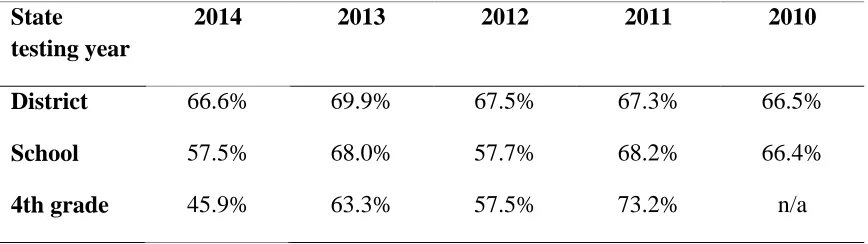
For the last five years, state-mandated test scores in reading were among the lowest in the
district as summarized in Table 3.1. The school continued to make progress in improving
test scores but remained below many schools in the district, particularly at fourth-grade
level.
Table 3.1 Percentage of students meeting or exceeding expectations on PASS Reading assessment,(fourth-grade scores for 2010 were not available).
The fourth-grade students received instruction from three different teachers. One
teacher taught English Language Arts and Social Studies, and the other teacher taught the
same group of students for Math, Science, and Health. My assignment was to teach all
State
testing year
2014 2013 2012 2011 2010
District 66.6% 69.9% 67.5% 67.3% 66.5%
School 57.5% 68.0% 57.7% 68.2% 66.4%