Simulation Based Comparative Performance
Analysis of Routing Protocol over Adhoc
Networks Using AODV, TORA and LEACH
Shilpi Sharma, Prof. Sourabh Jain
Research Scholar, Dept. of Computer Science & Engineering, Gyan Ganga Institute of Technology & Sciences,
Jabalpur, India
Assistant Professor, Dept. of Computer Science & Engineering, Gyan Ganga Institute of Technology & Sciences,
Jabalpur, India
ABSTRACT: Mobile Ad-Hoc Networks (MANETs) are autonomous and decentralized wireless systems. Mobile Ad hoc Network is a collection of mobile nodes in which the wireless links are frequently broken down due to mobility and dynamic infrastructure. Routing is a significant issue and challenge in ad hoc networks. Many Routing protocols have been proposed so far to improve the routing performance and reliability. There are many issues, problems in the Mobile Ad hoc Network; likewise there is Mobility issue when devices are moved independently. The aim of this research is to analyze the protocols on five parameters packet delivery fraction, average end to end delay, packet loss, remaining node energy and Routing overhead in terms of packet . AODV, TORA and LEACH protocols are studied in this research . LEACH is one of the most interested techniques that offer an efficient way to minimize the power consumption in sensor networks. These simulations are carried out using the NS-2 network simulator. The result presented in this work illustrates the importance in evaluating and implementing routing protocols in MANET. By using network simulator NS2, we setup and evaluate the performance of AODV, TORA and LEACH protocols with respect to the above mentioned parameters.
KEYWORDS: MANET, AODV, TORA, LEACH, NS-2, SIMULATIONS
I. INTRODUCTION
The Communication in Mobile Ad-Hoc Network (MANET) is to take place by using multi-hop paths. Nodes in the MANET share the wireless medium and the topology of the network changes erratically and dynamically. In MANET, breaking of communication link is very frequent, as nodes are free to move to anywhere. The density of nodes and the number of nodes are dependent on the applications in which we are using MANET. An ad hoc network is usually thought of as a network with nodes that are relatively mobile compared to a wired network. Hence the topology of the network is much more dynamic and the changes are often unpredictable oppose to the Internet which is a wired network. This fact creates many challenging research issues.
II. MOBILE ADHOC NETWORK (MANET)
MANET consists of set of wireless mobile nodes connected together to form temporary network in which the nodes are communicating with each other without centralized control. Mobile Ad-Hoc Networks are autonomous and decentralized wireless systems. In MANETs mobile nodes are free to move in and out of the network. Nodes are the systems or devices i.e. mobile phone, laptop, personal digital assistance, wireless devices and personal computer that are participating in the network and are mobile. When a node wants to communicate with another node, the destination node must lies within the radio range of the source node that wants to initiate the communication. The intermediate nodes within the network aid in routing the packets for the source node to the destination node.
Fig 1.1 MANET Network
These networks are fully self organized, having the capability to work anywhere without any infrastructure. In MANETs each device need to forward traffic that is not related to its own use and therefore each device work as a router. These nodes can act as host/router or both at the same time. They can form arbitrary topologies depending on their connectivity with each other in the network. These nodes have the ability to configure themselves and because of their self configuration ability, they can be deployed urgently without the need of any infrastructure and without any geographical restrictions. Each user has the opportunity of moving freely while communicating with others.
2.1 MANETs have several salient characteristics:
1) Dynamic topologies
2) Bandwidth constrained, variable capacity links 3) Energy-constrained operation
4) Limited physical security. 5) Adhoc based Network 6) Autonomous System 7) Multi-hop Routing
III. PROPOSED WORK
i. AODV: It is the base protocol. It tries to minimize required no. of broadcast. It is the improved version of DSDV. It creates routes on a on demand basis as opposed to maintain a complete list of routes for each destination. It has path discovery process, maintaining routes. It leads to frequent system wide broadcasts. Its size is strongly limited. AODV provides both a route table for uni-cast routes and a multicast route table for multicast routes. It combines uni-cast, multi-cast, and multicast communications but it uses symmetric links between neighbouring nodes.
ii. LEACH: A node in network is no longer useful when its battery dies so we use LEACH. It space out the lifespan of the nodes allowing it to do the only minimum work it needs to transmit data. It has 2 phases: setup phase, where cluster head are chosen and steady phase, in which CH is maintained when data is transmitted between nodes. Goal of LEACH is to increase the life of network. It is clustering based routing protocol minimizes global energy usage by distributing load to all nodes at different point in time.
iii. TORA: This is adaptive and scalable routing algorithm based on the concept of link reversal. It finds multiple routes from source to destination in a highly dynamic mobile networking environment. The concept of TORA is that control messages are localized to a small set of nodes.
VI. IMPLEMENTATION 4.1 Simulation Tool
The tool used for simulation is NS-2 which is highly preferred by research communities. The network simulator version 2 (NS-2) is a package of tools that simulates behaviour of networks. It is a discrete event network simulator developed at UC Berkeley that focuses on the simulation of IP networks on the packet level. It can simulate both wired and wireless network. Wireless network research in the last years is often based on simulation. Ns-2 is a widely used wireless network simulation tool for this purpose.
4.2 Simulation Parameter
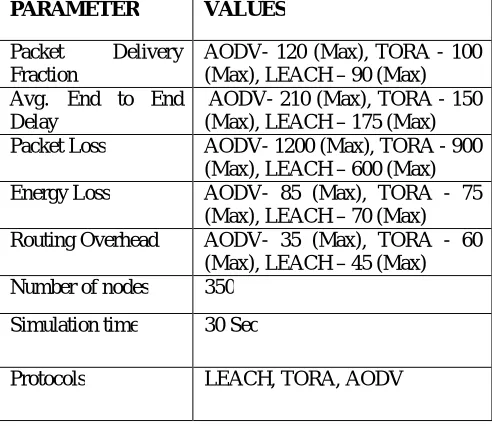
The following simulation parameters are used in this paper to analyse the performance of routing protocols.
PARAMETER VALUES
Packet Delivery Fraction
AODV- 120 (Max), TORA - 100 (Max), LEACH – 90 (Max) Avg. End to End
Delay
AODV- 210 (Max), TORA - 150 (Max), LEACH – 175 (Max) Packet Loss AODV- 1200 (Max), TORA - 900
(Max), LEACH – 600 (Max) Energy Loss AODV- 85 (Max), TORA - 75
(Max), LEACH – 70 (Max) Routing Overhead AODV- 35 (Max), TORA - 60
(Max), LEACH – 45 (Max) Number of nodes 350
Simulation time 30 Sec
Protocols LEACH, TORA, AODV
Table 1.1 Table of Simulation Parameter’s Values
V. RESULTS
has been made to evaluate the performance of three routing protocol AODV, LEACH and TORA according to the simulation results. NS2 simulator generated a AODV.tcl, LEACH.tcl, TORA.tcl file which contains all the statistics regarding number of packet delivery fraction, average end-to-end delay (in seconds), packet loss, energy loss and routing overhead in terms of packets.
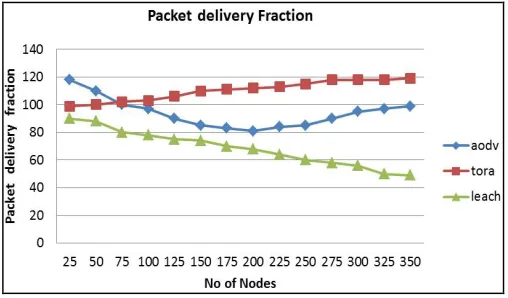
i. Packet delivery fraction
As we know packet delivery fraction shows the ratio of number of packets delivered to destination generated by constant bit source. So as per the characteristics we can easily see in the graph that AODV when works with limited number of nodes, delivers at very good rate of PDF but it decreases as we increase the number of nodes. TORA gives better performance for Packet Delivery Fraction because it is very highly adaptive and TORA is based on the concept of link reversal and selection process of a route includes three steps route creation, route maintenance and route ensure .So TORA provides loop free paths at all instants and multiple routes so that if one path is not available, other is readily available. It establishes routes quickly so that they may be used before the topology changes. But when we used leach protocol the ratio of PDF goes down as number of nodes increases. So we can conclude by our analysis that AODV and TORA gives better performance than LEACH.
Fig. 1.3 Packet Delivery Fraction Comparisons
ii. Average End-To-End Delay
Average end to end delay includes all the possible delays caused by buffering during route discovery, queuing at the interface queue, retransmission delay at the MAC, and propagation and transfer times. We analyzed that in starting LEACH gives high number of delay because of complex routing selection procedure but once route selection is done, it gives lesser no of delays. TORA gives less no of delays because in this if one link of connection fails, another one is ready to send data so it’s always be consistent in sending data without unnecessary delay But AODV gives higher no of delay because at the time of routing each time it sends request and reply messages and it creates unnecessary delay .
iii. Packet Loss
Packet loss is the concept which shows the no of packets which has been dropped because of any reason. A packet drops in two cases: buffer becomes full when packet needs to be buffered and the time that the packet has been buffered exceeds the limit. As we can see in the experimental scenario that AODV and TORA gives higher number of packet loss as compared to LEACH because of delay.
.
Fig. 1.5 Packet Loss Comparisons
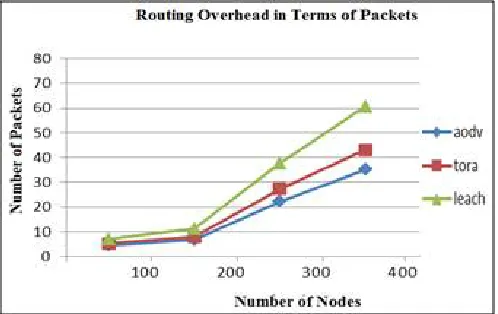
iv. Routing Overhead
The routing overhead is measured as the total number of routing packets transmitted. As per calculation,
Routing overheads = (Total number of bytes of control packet transmitted by routing protocol) / Total Bytes transmitted.
AODV has lower routing overhead as compared to both of the protocols because AODV only sends request and replay messages during route selection process. AODV gives less routing overhead than routing protocols which need to have all the information from source to destination node and AODV is also relatively quick to the topological changes in the network, and maintenance of route is also quite simple then other protocols. Leach and TORA gives higher routing overhead because of its route selection procedure.
v. Remaining Node Energy
With the help of this study we can see performance of all three protocols in terms of remaining node energy. Where we analyzed protocol AODV performed good at starting but when no of nodes get increased it does not perform consistently. Protocol TORA performs better than AODV rather it is also not consistent but when we analysed protocol Leach we saw that it perform good consistently because LEACH itself made for saving energy of node and its main aim is to optimized the energy requirement during path selection and establishment of route .
Fig. remaining node energy Comparisons
VI. COMPARISONS
The performances of routing protocols were evaluated on the basis of five performance metrics: i. Packet Delivery Fraction (PDF)
ii. Average End-to-End Delay iii. Packet Loss.
iv. Energy Loss v. Routing Overhead
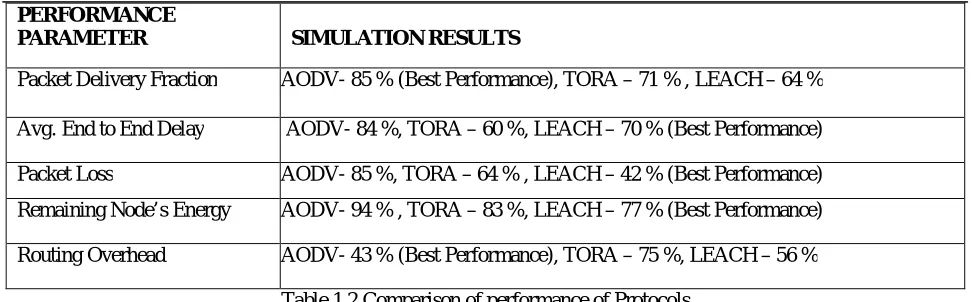
We compare the above parameters on the basis of simulation results on the protocols AODV, LEACH and TORA. The comparison of performance is given here in the table.
PERFORMANCE
PARAMETER SIMULATION RESULTS
Packet Delivery Fraction AODV- 85 % (Best Performance), TORA – 71 % , LEACH – 64 %
Avg. End to End Delay AODV- 84 %, TORA – 60 %, LEACH – 70 % (Best Performance)
Packet Loss AODV- 85 %, TORA – 64 % , LEACH – 42 % (Best Performance)
Remaining Node’s Energy AODV- 94 % , TORA – 83 %, LEACH – 77 % (Best Performance)
Routing Overhead AODV- 43 % (Best Performance), TORA – 75 %, LEACH – 56 %
VII. CONCLUSIONS
In the research, we have analysed and compared three popular routing protocols in the presence of different scenario in network. The performance of AODV, LEACH and TORA protocols are analysed on the basis of five parameters. The packet delivery ratio, average end to end delay, packet loss, remaining node’s energy and routing overhead are parameters for performance. In our research, after analysis in different state of network, we conclude that AODV is best for Packet Delivery Fraction. The LEACH gives better results among three protocols for Avg. End to End Delay, Remaining Node’s Energy and Packet loss.
REFERENCES
[1] Triana Mugia Rahayu, Sang-Gon Lee, Hoon-Jae Lee, Survey on LEACH-based Security Protocols, ISBN 978-89-968650-2-5, February 16~19, 2014 ICACT2014.
[2] Sukhwinder Kaur, R K Bansal & Savina Bansal, Performance Analysis Of AODV, DSR And OlSR Routing Techniques For Ad-Hoc Mobile Networks, International Journal of Computer Science Engineering and Information Technology Research (IJCSEITR), ISSN(P): 2249-6831; ISSN(E): 2249-7943, Vol. 3, Issue 5, Dec 2013, 195-200© TJPRC Pvt. Ltd.
[3] Er. Saurabh Mittal , Pinki, Performance Evaluation of AODV, DSR, DSDV and TORA Routing Protocols, International Journal of Multidisciplinary Research Vol.2 Issue 2, February 2012, ISSN 2231 5780.
[4] Sona Malhotra, Naveen Kumar, Performance Evaluation of Routing Protocols for Mobile Ad hoc Networks through Simulation, ISSN (Print): 2328-3491, ISSN (Online): 2328-3580, AIJRSTEM 13- 163; © 2013, AIJRSTEM All Rights Reserved.
[5] A. K. Dewivedi, Sunita Khushwaha, O. P. Vyas, Performance of Routing Protocols for MANETs & WSN: A Comparative Study, Int. J. of recent trends in Engineering, Vol.2, No.4, Nov.2009.
[6] M. Bani Yassein, A. AI. Zou, Y. Khamayseh, W. Mardini, Improvement on LEACH protocol of WSN (VLEACH).
[7] Y. B. Ko and N. H. Vaidya, Location Aided Routing (LAR) in MANET, In mobile computing and Networking (MOBICOM)98, Dallas. TX, USA, 1998, PP.66-75.
[8] J. Broth, D. A. Maltz, D. B. Johnson, Y-C.Hu and J. Jetcheva, A Performance Comparison of Multihop Wireless Network Routing Protocols‖, In
proceeding of the 4th annual ACM/IEEE International Conference on mobile computing and networking(MOBICOM)98, Oct.1998, pp.85-97. [9] Sachin Kumar Gupta, R.K.Saket, Performance Metric Comparison of AODV, DSDV Routing Protocols in MANETs using NS2, IJRRAS7(3), June.2011.
[10] Mohammad Reza Rohbanian, Mohammad Rafi Kharazmi, Alireza Keshavarz-Haddad, Manije Keshtgary, Watchdog-LEACH: A new method based on LEACH protocol to Secure Clustered Wireless Sensor Networks.
[11] Akshai Aggarwal,, Savita Gandhi, Nirbhay Chaubey, Performance Analysis of AODV, DSDV and DSR in MANETS, International Journal of Distributed and Parallel Systems (IJDPS) Vol.2, No.6, November 2011.
[12] Gagangeet Singh Aujla & Sandeep Singh Kang, Simulation Based Comparative Analysis of TORA, OLSR AND GRP Routing Protocols for Email and Video Conferencing Applications Over MANETS, International Journal of Computer Networking, Wireless and Mobile Communications (IJCNWMC) ISSN 2250-1568 Vol. 3, Issue 1, Mar 2013, 353-362 © TJPRC Pvt. Ltd.
[13] Dilpreet Kaur, Naresh Kumar, Comparative Analysis of AODV, OLSR, TORA, DSR and DSDV Routing Protocols in Mobile Ad-Hoc Networks, I. J. Computer Network and Information Security, 2013, 3, 39-46 Published Online March 2013 in MECS (http://www.mecs-press.org/) DOI: 10.5815/ijcnis.2013.03.05.
[14] Ammar Odeh, Eman AbdelFattah and Muneer Alshowkan, Performance Evaluation of AODV and DSR Routing Protocols in MANET Networks, International Journal of Distributed and Parallel Systems (IJDPS) Vol.3, No.4, July 2012.
[15] H. Nawaz, H. M. Ali, G. Nabi, Simulation based analysis of Reactive Protocols Metrics in MANET Using OPNET, Sindh Univ. Res. Jour. (Sci. Ser.) Vol.46 (4):531-538 (2014).
[16] Kajal V. Shukla, Research On Energy Efficient Routing Protocol LEACH for Wireless Sensor