Partial Replacement of Cement with Brick
Powder and Egg Shell Powder in Concrete
Aarcha S1, Ameena Shirin N S2, Suryalekshmi K S 3, Thasleema Rasheed 4, Harindranath S5
U.G. Students, Department of Civil Engineering, St Thomas college of Engineering and Technology, Chengannur,
Kerala, India1 2 3 4
Associate Professor, Department of Civil Engineering, St Thomas College of Engineering and Technology,
Chengannur, Kerala, India5
ABSTRACT:This paper reports an overview of experiments evaluating the use of egg shell powder from egg production industry and waste brick powder as partial replacement for ordinary Portland cement in concrete. The main aim of this study is to investigate the feasibility of using waste brick powder and egg shell powder in concrete as partial replacement for cement. The cement concrete in which cement is partially replaced with brick powder and egg shell powder as 0%, 2.5%, 5%, 7.5%, 10% by weight of cement. The chemical composition of the egg shell powder, appropriate mix design and compressive strength of the experimental concrete will be determined. Also the performance of conventional concrete and partially replaced concrete is going to be compared. The compressive strength will be determined at curing ages 28 days. In this direction, an experimental investigation of Compressive strength, Slump test and Water Absorption test will be under taken to use egg shell powder and brick powder as partial replacement for cement in concrete.
KEYWORDS:Egg shell powder, cement mortar, brick powder, compressive strength, slump test, split tensile strength, water absorption test.
I. INTRODUCTION
II. EARLIERRESEARCHES
Muhammad Nasir Ayaz Khan : et.al (2018) , in his research brick dust was used in plain cement concrete to check its fresh and hardened properties. Brick dust was used to check the workability and strength of concrete, using the water-cement ratio of 0.55 which was kept constant during research. Three samples were cast for each 3, 7, 14, 28 and 56 days with 0%, 5%, 10% 15% and 20% incorporation of brick dust. The test results reveals that replacing cement with brick dust shows higher workability than control sample for 5%, 10% and 15%, of which 15% was greater of all. However, strength results were quite competitive, replacing cement with 15% brick dust shows higher compressive strength. The split tensile test was also conducted, which shows high tensile strength by replacing cement with 15% brick dust. This research shows that cement can be replaced.
Praveen Kumar R:et.al (2015). In this study, the egg shell usually which are disposed is used as an alternate for the cement since the shell is made up of Calcium. Egg shells as an alternate to cement egg shell powder replaces 10%, 20% and 30% in addition with silica fume by 5%, 10%, 15% of weight of cement. Concrete is cast and Compressive test, Tensile and Flexural were carried out to find the best combination which results in optimum percentage of strength. The concrete compressive strength with egg shell powder as cement replacement material increases upto 15 percent without silica fume. Addition of silica fume also increases the strength but in economical point of view only the egg shell powder replacement is sufficient enough for getting higher strength. The split tensile strength of the egg shell powder concrete decreases with the addition of egg shell powder. This can be increased if the concrete is used with reinforcement. The flexural strength of egg shell concrete increases with the addition of egg sell powder up to 15 percent. They conclude that egg shell powder alone can be replaced as cement which increases the strength parameters meanwhile reduces the cement usage.
III.METHODOLOGY
MATERIALS
3.1Brick powder
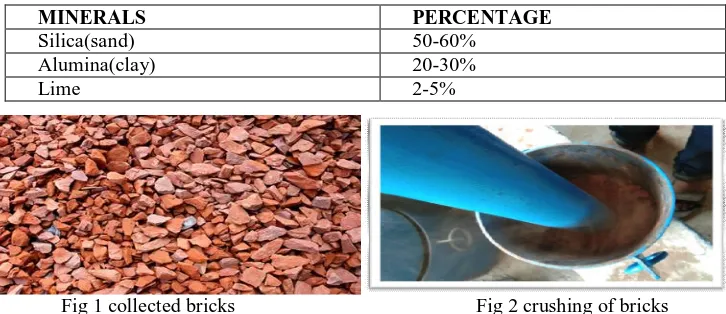
The waste bricks are collected from the demolished buildings and compound walls and broken them into pieces and then made as powder. Then sieved using 90micron to get the grading of cement and partially replaced up to 10% in cement. 0%, 2.5%, 5%, 7.5%, 10% brick powder is used for partial replacement of cement. Bricks are made up of different types of clays and other materials like sand. Clay is responsible for the pozzolanic behavior of brick. Clay itself has no pozzolanic properties but when fired together with lime during brick making process it gains pozzolanic nature.
Table 1 Chemical constituents of brick powder
Fig 1 collected bricks Fig 2 crushing of bricks
MINERALS PERCENTAGE
Silica(sand) 50-60%
Alumina(clay) 20-30%
Fig 3 sieving of bricks Fig 4 brick powder
3.2. Egg Shell Powder (ESP)
Calcium rich egg shell is a poultry waste with chemical composition nearly same as that of limestone. Use of egg shell waste instead of natural lime to replace cement in concrete can have benefit s like minimizing use of cement, conserving natural lime and utilizing waste material.Broken egg shells are collected from local sources. The shells are then washed and air dried. The shells then hand crushed, grinded and sieved through 90micron sieve. Material passed through 90micron sieve was used for cement replacement and the retained material was discarded. 0%, 2.5%, 5%, 7.5%, 10% egg shell powder is used for partial replacement of cement.
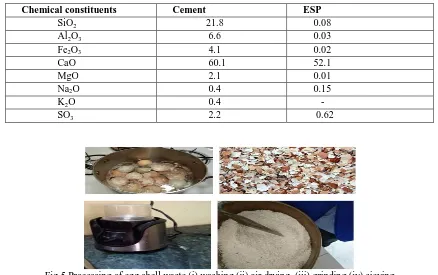
Table 2 Chemical composition of Cement, Eggshell powder
Fig 5 Processing of egg shell waste (i) washing (ii) air drying (iii) grinding (iv) sieving
Chemical constituents Cement ESP
SiO2 21.8 0.08
Al2O3 6.6 0.03
Fe2O3 4.1 0.02
CaO 60.1 52.1
MgO 2.1 0.01
Na2O 0.4 0.15
K2O 0.4 -
3.3 Cement
Cement is the individual unit of fine and coarse aggregate into a solid mass by virtue of its inherent properties of setting or hardening in combination with water. In this Ordinary Portland Cement of Grade 43, which is known for its rich quality and high durability is used.
3.4 Coarse Aggregate
The coarse aggregates passing through 20mm sieve and retained on 10mm sieve was used for the experiment.
3.5 Fine Aggregate
M-Sand passing through 4.75mm sieve was used for the experiment.
3.6 Water
Water is the key ingredient, which when mixed with cement forms a paste that binds the aggregate together. The water needs to be pure in order to prevent side reactions from occurring which may weaken the concrete. Fresh water available from local sources was used for mixing and curing of the specimens.
IV. EXPERIMENTAL WORK
4.1 Test on Brick powder
(i) Specific gravity
Table 3 Specific gravity of brick powder
Specific gravity = W5 (W3 – W1 )/(W5+W3-W4)(W2-W1)
= 13 (60-30)/ (13+60-70)(81-30) = 2.54
Specific gravity of Brick powder obtained is 2.54
(ii) Fineness of Brick powder
Fineness = (weight of residue/weight of sample) × 100 = (3.8/100) × 100
= 3.8
Fineness of Brick powder obtained is 3.8%
Table 4 Properties of Brick Powder
Properties Values obtained
Specific gravity 2.54
Fineness 3.8%
Weight of empty bottle, W1 30g
Weight of bottle + distilled water, W2 81g
Weight of bottle + kerosene, W3 60g
Weight of bottle + brick powder + kerosene, W4 70g
4.2 Test on Egg Shell Powder
(i) Specific Gravity
Table 5 Specific Gravity of Egg Shell Powder
Empty weight of density bottle , W1 31 g
Weight of bottle + Distilled water , W2 81 g
Weight of Bottle + Kerosene , W3 70 g
Weight of bottle + Eggshell powder + Kerosene , W4 79 g
Weight of eggshell powder , W5 14 g
Specific Gravity = W5 (W3-W1) / (W5+W3-W4) (W2-W1)
= 14 (70- 31) / (14+70-79) (81-31) = 2.184
Specific gravity of eggshell powder obtained is 2.184.
(ii) Fineness of Eggshell Powder
Fineness = (Weight of residue / Weight of sample) × 100 = (4 / 100) × 100
= 4
Fineness of egg shell powder is 4%.
Table 6 Properties of Eggshell Powder
Properties Values obtained
Specific gravity 2.184
Fineness 4%
4.3MIX PROPORTION
(A) Design stipulations for proportioning
Grade designation : M30
Type of cement : OPC 43 grade
Minimum cement content : 3 2 0 k g / m3
Maximum water cement ratio : 0.55
Workability : 50 mm (slump)
Exposure condition : Mild
Degree of supervision : Good
Type of aggregate : Crushed angular aggregate
Chemical admixture : Not used
(B) Test data for materials
a) Cement used : OPC 43 grade b) Specific gravity of cement : 3.14
c) Specific gravity of
d) Water absorption
Coarse aggregate : 0.15% e) Free (surface) moisture
Coarse aggregate : Nil (absorbed moisture full) Fine aggregate : Nil
f) Sieve analysis
Coarse aggregate : Conforming to Table 2 of IS: 383 Fine aggregate : Conforming to Zone I of IS: 383
(C) Target strength for mix proportioning f’ck = fck + 1.65 s Where,
f’ck = Target average compressive strength at 28 days
fck = Characteristic compressive strength at 28 days
s= Standard deviation, s = 5 N/mm2
Therefore, target strength = 30 + 1.65 x 5 = 38.25 N/mm2
(D) Selection of water cement ratio
From Table 5 of IS: 456-2000, maximum water cement ratio = 0.55 (Mild exposure)
Based on experience adopt water cement ratio as 0.42 0.42 < 0.55, hence ok
.
(E) Selection of water content
Maximum water content = 186litres (for 25mm – 50mm slump range) For 20 mm aggregates
Estimated water content for 125 mm slump = 186 + (9/100 ×186) = 203litres
(F) Calculation of cement content Water cement ratio = 0.42
Cement content = 203/0.42 = 484 kg/m3 >320 kg/m3 (given) From Table 5 of IS: 456,
Minimum cement content for mild exposure condition = 300kg/m3
Hence OK
(G) Proportion of volume of coarse aggregate and fine aggregate content Volume of coarse aggregate corresponding to 20 mm size aggregate and fine aggregate (Zone I) for water-cement ratio of 0.5= 0.62
In the present case w/c ratio is 0.42. That is, it is less by 0.08 as the water cement is reduced, it is desirable to increase the coarse aggregate proportion to reduce the fine aggregate content. The coarse aggregate is increased at the rate of 0.01 for every decrease in water cement ratio 0.05.
Increase in coarse aggregate = (0.01/0.05)×0.08 = 0.016
(H) Mix proportions for trial number 1 Cement = 484 kg/m3 Water = 203 kg/m3 Fine aggregate = 618 kg/m3 Coarse aggregates = 1023 kg/m3 Water cement ratio = 0.42 Obtained Mix Proportion 1: 1.27: 2.11
4.4 MIXING
The concretes were mixed in machine. Firstly, coarse aggregates and fine aggregates were dry mixed. Then cement, brick powder and egg shell powder were added to the dry mix and mixed together. Water was poured into the mixer drum and thoroughly mixed until a mix of uniform color is obtained.
4.5 CASTING
The cubes were casted in steel moulds of inner dimensions 150 x 150 x 150mm and the cylinders were casted in steel cylinders of 150mm diameter and 300mm height.
Fig 6 Concrete mixing Fig 7 Casted specimen
4.6 CURING
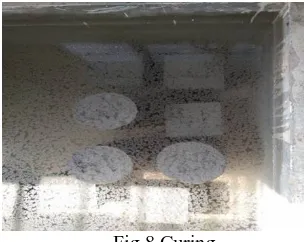
After 24 hours of casting specimens were cured by placing them in a curing tank for the period that preceeds laboratory testing.
V.RESULT AND DISCUSSION
5.1 Compressive strength test results:
Fig 9 Comparison of Compressive strength for 7 days and 28 days
Compressive strength is higher than normal concrete at 7 and 28 days of curing ages. Compressive strength increased up to 15% replacement and reduced at 20% replacement. Maximum compressive strength was obtained at 15% replacement.
5.2 Split tensile strengthtest results:
Fig 10 Comparison of tensile strength for 7 days and 28 days
Tensile strength is higher than conventional concrete at 7 and 28 days of curing ages. It was found to be maximum at 10% replacement and gradually decreased at 15% and 20% replacement.
VI. CONCLUSIONS
From the experimental studyof partial replacement of cementby brick powder and egg shell powder in concrete, following conclusions were obtained.
The compressive strength of concrete made by partial replacement of cement with egg shell powder and brick
powder increases up to 15 percent.
Compressive strength decreased at 20% replacement, but it is higher than the conventional concrete at 7 and
28 days.
After the curing of the concrete, it was found that the concrete got a reddish colour which increased the aesthetical view of the concrete.
The experimental results have shown that the use of brick powder obtained from the demolished buildings and egg shell powder in the replacement of cement in concrete can provide an alternative solution to minimize the environmental pollution due to unscientific disposal of these wastes. So the replacement of cement with brick powder and egg shell powder in concrete is really advisable.
REFERENCES
1. Praveen Kumar R et.al (2015), Experimental Study on Partial Replacement of Cement with Egg Shell Powder, International Journal of Innovation in Engineering and Technology, 2, 334-340.
2. Muhammad Nasir Ayaz Khan et.al (2018), Effect of Brick Dust on Strength anWorkability of Concrete, IOP Conf.Series: Materials Science and Engineering414, 1-5.
3. IS 456 : 2000 – Code of Practice for plain and reinforced concrete, Bureau of Indian Standards, New Delhi.
4. IS: 383-1970 – Specification for Coarse and Fine Aggregates From Natural Sources For Concrete, Bureau of Indian Standards, New Delhi. 5. IS: 8112-1989 – Specification for 43 grade ordinary Portland cement, Bureau of Indian Standards, New Delhi.