ISSN(Online): 2320-9801
ISSN (Print): 2320-9798
I
nternational
J
ournal of
I
nnovative
R
esearch in
C
omputer
and
C
ommunication
E
ngineering
(An ISO 3297: 2007 Certified Organization)
Vol. 3, Issue 7, July 2015
Video Surveillance System for Height
Detection by Adaptive Background Modelling
Algorithm and Face Recognition by Eigen
Face Algorithm
Yogesh P Moon1, Akash Choudhary 2 , Prof.Rahul Nawkhare3
M. Tech Student, Department of Electronics Engineering, Wainganga College of Engineering and Management, Nagpur, India
ABSTRACT: This paper addresses the building of a video-based height detection technique along with a face
recognition system using a static camera for people identification purpose. Height is one of the important features from the several gait features which is not influenced by the performance of camera and clothing style of the subject. For this purpose background subtraction is a very popular approach for foreground segmentation. which includes Adaptive Background Modeling Algorithm with Mat lab software. Similarly face recognition is done by using Principal Component Analysis (PCA) method for which we use eigenface algorithm. The results show that the proposed method runs, exactly and fits for the real time on different indoor and outdoor video sequence.
KEYWORDS:Height detection, face recognition ,background subtraction, PCA, eigenface algorithm.
I. INTRODUCTION
By using both height detection, and face-recognition system together Criminal detection can be very easier. This provides a new method for the height detection through calibrated camera. In video body height estimation of people has many important applications, as body height can be used to identify individuals, either uniquely or partially. Height has been long used in forensic measures for detecting the suspects, it is however, not distinctive enough to be used in biometric identification. Hence, detecting the heights of the tracked person using any camera and distance could provide us with an important additional feature .In this, we focus on solving the patterns of criminal identity based on records and suggest an algorithmic approach to revealing proper identities. We introduce our system for single moving object detection and tracking using a static webcam inside the building like corridor or at the parking area .The background is extracted from the video scene by learning a statistical model of the background, and subtracting it from the original frame. The system presented in this paper can detect and track moving objects in a video sequence. Similarly for face recognition purpose we used PCA method. It is based on the approach that breaks the face images into a small set of characteristic feature images. All images in the data are represented as linear combination of weighted eigenvectors called eigenfaces. These eigenvectors are obtained from covariance matrix of a image from the data. The weights are found out after selecting a set of most relevant Eigenfaces. Recognition is done by projecting a selected image onto the subspace spanned by the eigenfaces and then classification is done by measuring minimum Euclidean distance.
This article contents are. Section 2, related work on the topic. In Section . 3, simulation results of height and face detection. In section 4, conclusion of project.
II. RELATED WORK
ISSN(Online): 2320-9801
ISSN (Print): 2320-9798
I
nternational
J
ournal of
I
nnovative
R
esearch in
C
omputer
and
C
ommunication
E
ngineering
(An ISO 3297: 2007 Certified Organization)
Vol. 3, Issue 7, July 2015
A.HEIGHT DETECTION TECHNIQUE
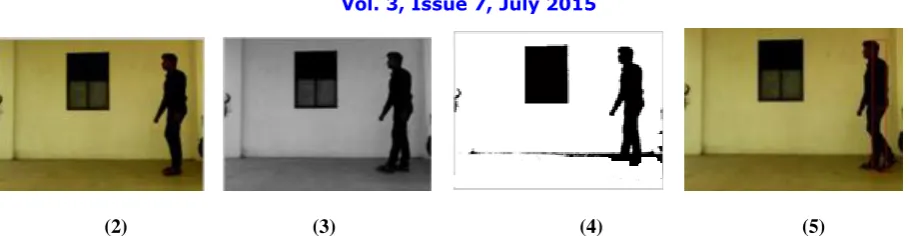
As shown in the block diagram, few used video as an input by using digital camera. This video is converted into individual frames and then converted into Portable Gray Map that is PGM format images. By using Frame difference method , the difference between two frames at every pixel position has been calculated. We used Frame difference algorithm because it takes less processing time and less memory. we used the background subtraction method for motion detection. It takes the difference of the current image and the background image for detecting the motion region.
To separates pixels into background and foreground we use segmentation. Segmentation is been used to extract information from the structure of objects .It separates and discern various parameters of interest within the data. The segmentation we used here is Threshold based segmentation. The concept of image thresholding is to divide the intensity range into two categories based on a threshold value (T) ,which is
Background = {0..T-1} and Object = {T..255}.
To implement this technique, a threshold (T) value has been chosen. Every pixel in the image is then compared to the value of T. Each pixel is given a region label of value 0 (background) if the pixel value is less than or equal to T or "1" (foreground) if it is greater than T. This form of region segmentation results in a binary image, in which each region is either 1(white) or 0 (black ).
The Static Background Subtraction system is not convinent for change in illumination ,hence we use an Adaptive Background Modeling scheme. The Adaptive Background modeling stage enclose the motion object and generates an approximate bounding box. The bounding box is been resized to 128X64 pixel size of dimension. The resizing makes the algorithm capable of scale and size to detect people of varying heights and dimensions. A scan is performed for a given image where the intensity values are more than limit. Features are extracted by colour and colour is been describe by the the intensity value. The intensity values from top, bottom, left and right are stored.A rectangular bounding box is plotted by using this dimension values.
By calculating Height and Width a bounding box is drawn
(1)Height = (bottom value-top value)/2 (2) Width = (right value-left value)/2
(1)
Original Video from camera
Converted into frames
Frames to image
binarisation Grey scale
convertion Boundary
box
Adaptive Background Modeling
ISSN(Online): 2320-9801
ISSN (Print): 2320-9798
I
nternational
J
ournal of
I
nnovative
R
esearch in
C
omputer
and
C
ommunication
E
ngineering
(An ISO 3297: 2007 Certified Organization)
Vol. 3, Issue 7, July 2015
(2) (3) (4) (5)
Figure : (1) Background Image (2) Original Colour Video (3) Gray Scale Image (4) threshold Image (5) Original Image with Bounding Box .
B.FACE RECOGNITION
Acquisition of face data, extracting face feature and recognition of face are three major steps for face recognition system.
In the first step face images are collected from different sources. The sources may be camera or readily available face image database on the website. In the next step that is theFeature extraction process is used to extract relevant information from a face image. In feature extraction, a mathematical representation of original image which is called a biometric template is generated, which is then stored in the database and it will be the basis (vector) of any recognition task. After which these extracted features will be used in recognition purpose. As we extracted and select the features then comes the next step to classify the image,which is the Appearance-based face recognition algorithms .It uses PCA method that is Principal Component Analysis Method in face recognition systems. It transforms faces into a small set of essential characteristics eigenfaces ,hence PCA approaches systems is also-called eigenface approach. It is better than other face recognition systems due to its speed, simplicity and insensitivity to small or gradual changes on the face.
III .PROPOSED ALGORITHM
Let face image be I(x,y) of two dimentional that is N by N array(vector of dimension N2 ) of intensity values. The main idea of PCA is to find eigevectors. Because they have face-like appearance, we call them “eigenfaces”.
let the set of images be Γ1 , Γ2 …ΓM . The average face of this set will be:
(1)
Subtract the average face vector as each face differs from the average face (vector) by the vector
ΦΓ−Ψ(2)
ISSN(Online): 2320-9801
ISSN (Print): 2320-9798
I
nternational
J
ournal of
I
nnovative
R
esearch in
C
omputer
and
C
ommunication
E
ngineering
(An ISO 3297: 2007 Certified Organization)
Vol. 3, Issue 7, July 2015
covariance matrix is
1
MC = ∑ΦiΦ
T i
M i=1
= AAT (3) A =[Φ1 ,Φ2…ΦM].
If the number of data points M for the image space is less than the dimention of space N2 there will be only M, rather
N2 .first solve f the eigenvectors of MxM matrix ,Then take appropriate linear combinations of the face images Φi by considering eigenvectors of AAT
AT Avi =µi vi
AAT Avi =µi Avi (4)
It shows that Avi are the eigenvectors. Now we consruct the MxM matrix
.
where
L
mn=
φ
Tm
φ
n,,
and now find M eigenvectors, vl of L.
These vectors determine linear combinations of the M training set face images to form the eigenfaces ul .
ul = ∑vlk φk ,
l =1…M
(5)
by a simple operation new face image ( Γ ) is been transformed into its eigenfaces components
.
wk = u T
k (Γ − Ψ) k =1,2,…, M
(6)
It describes set of point by point image multiplications and summations.
To describes the contribution of each eigenface in representing the input face image we consider Weights form a vector
ΩT = (w
1 , w2 ,…wM ), it treats the eigenface as a basis set for face images
.
IV.PSEUDO CODE FOR BOUNDING BOX
Step1. Read the video difference
Step 2. For (present position=initial value: final value) of Y resolution Step 3. For (present position=initial value: final value) of X resolution
ISSN(Online): 2320-9801
ISSN (Print): 2320-9798
I
nternational
J
ournal of
I
nnovative
R
esearch in
C
omputer
and
C
ommunication
E
ngineering
(An ISO 3297: 2007 Certified Organization)
Vol. 3, Issue 7, July 2015
Step 4. Height of the bounding box is = bottom valuefi top value Step 5. For (present position=initial value: final value) of X resolution Step 6. For (present position=initial value: final value) of Y resolution (a) Calculate the sharp change in intensity of image from left and right (b) Store the values in an array
Step 7. Width of the bound box = right value fi left value Step 8. Using the dimensions, draw boundary to the video Initial value: the starting position of the pixel in an video. Final value: the ending Position of the pixel in an video. Height = bottom: value ׃: top: value
Width = right: value:: left: value
Step 9. Add the height value with the top value and store it in a variable like mid top Step 10. Add the width value to the left value and store it in a variable like mid left Step 11. Assign the max intensity to the pixel at pixel value at (mid top, mid left)
V.SIMULATION RESULTS
The proposed approach was performed on MATLAB. we estimated body height and face by applying our technique there are two set of results. One for whole-body images, this set includes body height In Experimental result-1 and next for face recognition Experimental result-2.
A. HEIGHT DETECTION
ISSN(Online): 2320-9801
ISSN (Print): 2320-9798
I
nternational
J
ournal of
I
nnovative
R
esearch in
C
omputer
and
C
ommunication
E
ngineering
(An ISO 3297: 2007 Certified Organization)
Vol. 3, Issue 7, July 2015
B. FACE RECOGNITION
FEATURE EXTRACT
FEATURE VECTOR
OF PERSON 1
FEATURE VECTOR
OF PERSON 2
FEATURE VECTOR
OF PERSON 3
FEATURE VECTOR
OF PERSON 4
FEATURE VECTOR OF PERSON 5
FEATURE VECTOR
OF PERSON 6
PERSON 5 :TRUE IDENTITY
ISSN(Online): 2320-9801
ISSN (Print): 2320-9798
I
nternational
J
ournal of
I
nnovative
R
esearch in
C
omputer
and
C
ommunication
E
ngineering
(An ISO 3297: 2007 Certified Organization)
Vol. 3, Issue 7, July 2015
VI. CONCLUSION
Through this paper, we successfully detected human height on MATLAB which is a major application in security, surveillance. It shows that the background subtraction is useful in detecting and tracking people, and the background subtraction algorithm runs quickly. In this thesis we also implemented the face recognition system by using Principal Component Analysis(PCA) with an Eigenface approach. It successfully recognized the human faces and worked better in different light conditions. In this thesis paper, we worked with real time face recognition. Hence we tracked person by using both height detection and face recognition technique.
REFERENCES
1. Oyekanmi E.O, Oluwadare S.A, “A FRAMEWORK FOR TRACKING CRIMINALS USING IMAGE-BASED HEIGHT DETECTION TECHNIQUES” ISSN: 2321-8363 Vol.2 Issue. 2, February- 2014.
2. CRIMINALS USING IMAGE-BASED HEIGHT DETECTION TECHNIQUES” . ISSN: 2321-8363Vol.2 Issue. 2, February- 2014
3. R.S.Rakibe Prof.B.D.Patil “Human Motion Detection using Background Subtraction Algorithm” ISSN: 2277 128X Volume 4, Issue 2, February 2014
4. Sonia Das and Sukadev Meher , “Real Time Extraction of Human Gait Features for Recognition” May 2013
5. A.SAI SUNEEL, “PERSON OR OBJECT TRACKING AND VELOCITY ESTIMATION IN REAL TIME VIDEOS”, ISSN: 2230-8547; e-ISSN: 2230-8555 Vol 04, Special Issue01; 2013
6. Jin-Bin Yang, Min Shi, Qing-Ming Yi,“A New Method for Motion Target Detection by Background Subtraction and Update”, International Conference on Medical Physics and Biomedical Engineering,2012.
7. Shengyong chen, jianhua zhang, youfu li, and jianwei zhang,“A hierarchical model incorporating segmented regions and pixel descriptors for video background subtraction” IEEE transactions on industrial informatics, vol. 8, no. 1, february 2012.
8. Liton Chandra Paul , Abdulla Al Sumam, “Face Recognition Using Principal Component Analysis Method”, ISSN: 2278 – 1323 Volume 1, Issue 9, November 2012.
9. Saurabh P.Bahurupi, D.S.Chaudhari , Principal Component Analysis for Face Recognition. ISSN: 2249 – 8958, Volume-1, Issue-5, June 2012 10. Shemi P M, Ali M A, A Principal Component Analysis Method for Recognition of Human Faces: Eigenfaces Approach, International Journal
of Electronics Communication and Computer Technology (IJECCT),Volume 2 Issue 3 (May 2012).
11. D.S.Chaudhari, SaurabhP.Bahurupi, “Principal Component Analysis for Face Recognition”, International Journal of Engineering and Advanced Technology (IJEAT) June 2012.
12. Ali Irturk, Janarbek Matai and Ryan Kastner, “Design and Implementation of an FPGA-based Real-Time Face Recognition System”. IEEE International Symposium on Field-Programmable Custom Computing Machines.2011.
13. Abin Abraham Oommen, C.Senthil Singh, M.Manikandan “DESIGN OF FACE RECOGNITION SYSTEM USING PRINCIPAL COMPONENT ANALYSIS” eISSN: 2319-1163 | pISSN: 2321-7308 , Mar-2014
BIOGRAPHY
.
Yogesh Pramod Moon,pursuing Mtech in Electronics from Wainganga College of Engineering
and Management, Nagpur,India. He received B.E(ELECTRONICS) degree in 2011 from Nagpur University, MS, India. His research interests are Digital image processing (DIP), Matlab R2010a.
Akash Choudhary, pursuing Mtech in Electronics from Wainganga College of Engineering
and Management, Nagpur,India. He received B.E(ETC) degree in 2012 from Nagpur University, MS, India. His research interests are Digital image processing (DIP)
Prof. Rahul Nawkhare , Proffesor in the Electronics Department Wainganga College of