International Ayurvedic Medical Journal, (ISSN: 2320 5091) (September, 2017) 5(9)
A CLINICO-COMPARATIVE STUDY OF PATRAPINDA SWEDA WITH AND
WITHOUT INTERFERENTIAL THERAPY (IFT) IN GRIDHRASI WITH SPECIAL
REFERENCE TO SCIATICA
Sai Krishna C.V1, Praveen B.S2, Vikram Kumar3, Mathew Joseph4
1
PG Scholar,2Associate Professor and HOD,3Assistant Professor, Dept of Panchakarma;
PG Scholar, Dept of Samhita and Siddhanta
Alvas Ayurveda Medical College, Moodbidri, Dakshina Kannada, Karnataka-574227, India
Email:[email protected]
ABSTRACT
Introduction: Gridhrasi is a RujaPradhanaNanatmajaVataVyadhi, the Lakshanas of disease are Ruk, Toda, Muhurspanda, and Stambha in the Sphik, Kati, Uru, Janu, Jangha and Pada which may
be co-related to sciatica in which neuralgia along the course of Sciatic nerve often produces radiating pain into the buttock and lower limbs. About 50-70% of people get affected by low back pain with incidence of Sciatica. To compare and evaluate the effect of PatraPindaSweda with and without In-terferential Therapy on Gridhrasi. Method: 40 Patients (excluding two drop outs) fulfilling the diag-nostic and inclusion criteria belonging to either sex were selected for clinical study. They were ran-domly allocated into 2 equal groups A & B. Patients will be assessed on the 0th day (Before treat-ment) and 7th day (After treattreat-ment) and on 14th day for follow up. Result: Pre-Post comparison done by Paired ‘t’ test, Unpaired ‘t’ test was applied for comparison between the groups. Effect of treatment on Ruk, Toda, Stambha, Spandana, Aruchi, Tandra, Gourava, SLR, and Distance of walk-ing both groups showed highly significant results. But, the comparison between the groups, symp-toms like Ruk, Stambha, Spandanaand Distance of walking showed significant change in Group’ A’.
So an overall comparison between both the groups, showed effective result of Group B over Group A after treatment and after follow-up. Conclusion: Clinically, marked effect seen in Group B- that is
PatraPindaSweda with Interferential Therapy showed effective changes in all criteria and marked
relief, when compared to Group A- Patra PindaSweda without Interferential Therapy
Keywords: PatraPindaSweda, Gridrasi, Sciatica, Interferential therapy
INTRODUCTION
Currently people fall victim of various diseas-es because of the gradual shifting of lifdiseas-estyle
from a healthy living. Sedentary lifestyle, stress, improper posture, continuous jerky
JOURNAL
International Ayurvedic Medical Journal, (ISSN: 2320 5091) (September, 2017) 5(9)
A CLINICO-COMPARATIVE STUDY OF PATRAPINDA SWEDA WITH AND
WITHOUT INTERFERENTIAL THERAPY (IFT) IN GRIDHRASI WITH SPECIAL
REFERENCE TO SCIATICA
Sai Krishna C.V1, Praveen B.S2, Vikram Kumar3, Mathew Joseph4
1
PG Scholar,2Associate Professor and HOD,3Assistant Professor, Dept of Panchakarma;
PG Scholar, Dept of Samhita and Siddhanta
Alvas Ayurveda Medical College, Moodbidri, Dakshina Kannada, Karnataka-574227, India
Email:[email protected]
ABSTRACT
Introduction: Gridhrasi is a RujaPradhanaNanatmajaVataVyadhi, the Lakshanas of disease are Ruk, Toda, Muhurspanda, and Stambha in the Sphik, Kati, Uru, Janu, Jangha and Pada which may
be co-related to sciatica in which neuralgia along the course of Sciatic nerve often produces radiating pain into the buttock and lower limbs. About 50-70% of people get affected by low back pain with incidence of Sciatica. To compare and evaluate the effect of PatraPindaSweda with and without In-terferential Therapy on Gridhrasi. Method: 40 Patients (excluding two drop outs) fulfilling the diag-nostic and inclusion criteria belonging to either sex were selected for clinical study. They were ran-domly allocated into 2 equal groups A & B. Patients will be assessed on the 0th day (Before treat-ment) and 7th day (After treattreat-ment) and on 14th day for follow up. Result: Pre-Post comparison done by Paired ‘t’ test, Unpaired ‘t’ test was applied for comparison between the groups. Effect of treatment on Ruk, Toda, Stambha, Spandana, Aruchi, Tandra, Gourava, SLR, and Distance of walk-ing both groups showed highly significant results. But, the comparison between the groups, symp-toms like Ruk, Stambha, Spandanaand Distance of walking showed significant change in Group’ A’.
So an overall comparison between both the groups, showed effective result of Group B over Group A after treatment and after follow-up. Conclusion: Clinically, marked effect seen in Group B- that is
PatraPindaSweda with Interferential Therapy showed effective changes in all criteria and marked
relief, when compared to Group A- Patra PindaSweda without Interferential Therapy
Keywords: PatraPindaSweda, Gridrasi, Sciatica, Interferential therapy
INTRODUCTION
Currently people fall victim of various diseas-es because of the gradual shifting of lifdiseas-estyle
from a healthy living. Sedentary lifestyle, stress, improper posture, continuous jerky
JOURNAL
International Ayurvedic Medical Journal, (ISSN: 2320 5091) (September, 2017) 5(9)
A CLINICO-COMPARATIVE STUDY OF PATRAPINDA SWEDA WITH AND
WITHOUT INTERFERENTIAL THERAPY (IFT) IN GRIDHRASI WITH SPECIAL
REFERENCE TO SCIATICA
Sai Krishna C.V1, Praveen B.S2, Vikram Kumar3, Mathew Joseph4
1
PG Scholar,2Associate Professor and HOD,3Assistant Professor, Dept of Panchakarma;
PG Scholar, Dept of Samhita and Siddhanta
Alvas Ayurveda Medical College, Moodbidri, Dakshina Kannada, Karnataka-574227, India
Email:[email protected]
ABSTRACT
Introduction: Gridhrasi is a RujaPradhanaNanatmajaVataVyadhi, the Lakshanas of disease are Ruk, Toda, Muhurspanda, and Stambha in the Sphik, Kati, Uru, Janu, Jangha and Pada which may
be co-related to sciatica in which neuralgia along the course of Sciatic nerve often produces radiating pain into the buttock and lower limbs. About 50-70% of people get affected by low back pain with incidence of Sciatica. To compare and evaluate the effect of PatraPindaSweda with and without In-terferential Therapy on Gridhrasi. Method: 40 Patients (excluding two drop outs) fulfilling the diag-nostic and inclusion criteria belonging to either sex were selected for clinical study. They were ran-domly allocated into 2 equal groups A & B. Patients will be assessed on the 0th day (Before treat-ment) and 7th day (After treattreat-ment) and on 14th day for follow up. Result: Pre-Post comparison done by Paired ‘t’ test, Unpaired ‘t’ test was applied for comparison between the groups. Effect of treatment on Ruk, Toda, Stambha, Spandana, Aruchi, Tandra, Gourava, SLR, and Distance of walk-ing both groups showed highly significant results. But, the comparison between the groups, symp-toms like Ruk, Stambha, Spandanaand Distance of walking showed significant change in Group’ A’.
So an overall comparison between both the groups, showed effective result of Group B over Group A after treatment and after follow-up. Conclusion: Clinically, marked effect seen in Group B- that is
PatraPindaSweda with Interferential Therapy showed effective changes in all criteria and marked
relief, when compared to Group A- Patra PindaSweda without Interferential Therapy
Keywords: PatraPindaSweda, Gridrasi, Sciatica, Interferential therapy
INTRODUCTION
Currently people fall victim of various diseas-es because of the gradual shifting of lifdiseas-estyle
from a healthy living. Sedentary lifestyle, stress, improper posture, continuous jerky
movements, long travelling etc. put maximum pressure on the spine and lower portion of the pelvis1. Low back pain is more common among people aged 40-80 years, with the overall number of individual affected expected to increase as population ages2. Approximate-ly 9 to 12% of people have low back pain at any given point in time, and nearly 25% report having it at some point over any one-month period3. About 40% of people have low back pain at some point in their lives2. with esti-mates as high as 80 % among people in the developed world4. About 50-70% of people get affected by low back pain with incidence of Sciatica more than 40%5.
Gridhrasi is a RujapradhanaNanatmajaVata Vyadhi6. “Gridhrasi”- as the term meaning goes indicates the typical gait that resembles a
“Gridhra” or “Vulture”, which is often seen in
Gridhrasi. The Lakshanas of disease are Ruk, Toda, Muhurspanda, and Stambha in the Sphik, Kati, Uru, Janu, Jangha and Pada7
which may be co-related to sciatica in which neuralgia along the course of Sciatic nerve of-ten produces radiating pain into the buttock and lower limbs8. Sciatica, a form of nerve dysfunction occurs when there is a compres-sion on, or damage to the sciatic nerve. It is a very painful condition in which pain begins in lumbar region and radiates along the posterio-lateral aspect of thigh and leg9. As far as treatment of the disease Sciatica is concerned, use of analgesics and physiotherapy will help to certain extent but are not the ultimate cure10. Surgeries are moreover expensive and again there are chances of recurrence as well11. Sequential administration of the
Sne-hana, Swedana, Basti, Siravyadha and Agni-karma are lines of treatment of Gridhrasi as
expounded in the Ayurveda literature12.
Snehana and Swedana are considered as a
general line of treatment for VataVyadhi which can be taken as a line of treatment for
Gridhrasi also. Patra PindaSweda is one such
treatment modality comes under Snehana and
Swedana are considered as a general line of
treatment for VataVyadhi which can be taken as a line of treatment for Gridhrasi also. Patra
PindaSweda is one such treatment modality
comes under Snehana and Swedana and is known for its instant efficacy in relieving the symptoms. Narayana Taila is having
VataKa-phaShamaka and Shoolahara action.
Interfe-rential therapy (IFT) is a form of electrical treatment in which two medium frequency currents are used to produce a low frequency effect. A rhythmical frequency of 50-60 Hz has a suppressing effect on the autonomic nervous system and also has analgesic proper-ty13. So in this study an effort was made to compare the efficacy of Patra PindaSweda without Interferential Therapy and Patra
Pin-daSweda with Interferential Therapy on Grid-hrasi w.s.r to Sciatica.
Methods and Materials
Patients were selected from OPD and IPD of PG studies in Panchakarmaof Alva’s Ayurv e-da Medical College & Hospital, Moodbidri, Medical camps and other referrals.Samplesize of
40patientsfulfillingthediagnosticandinclusion criteria of either sex was selected for the com-parative study. They were randomly assigned into 2 equal groups A & B. Group A consist of
Patra PindaSweda without Interferential Therapy and group B consist of Patra
Pin-daSweda with Interferential Therapy. The
Narayana-Taila was prepared in the Alva’s Pharmacy
Mijar. Diagnostic criteria included: patients having pain over Sphik and Kati as well as pain radiating to Prishta, Bhaga, Uru, Janu,
Janga and Pada, Positive SLR test. Inclusion
criteria included: Patient fulfilling the diagnos-tic criteria like pain over Sphik, Kati, pain ra-diating to Prishta, Bhaga, Uru, Janu, Janga and Pada. Patients between the age group of 20 and 60 years. Patient who are fit for
Path-raPindaSweda and Interferential Therapy.
Exclusion criteria included: Traumatic, Infec-tive, Neoplastic, Degenerative conditions of spine and cauda equine syndrome, Develop-mental anomalies, Patients with systemic dis-orders which interfere with the course of the
treatment, Patients contraindicated for Sweda, Pregnancy and lactating women.
PatraPin-daSweda was prepared on the basis of
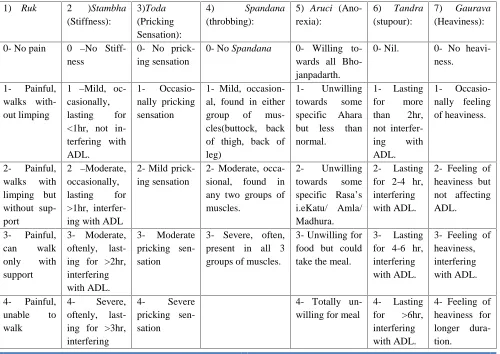
classic-al methods of preparation .Study duration was 14 days and intervention was done on first 7 days later from 8th to 14th day follow up. As-sessment criteria were done for both subjec-tive and Objecsubjec-tive parameters. Subjecsubjec-tive pa-rameters where Ruk, Stambha, Toda,
Spanda-na, tantra, Aruchi and gourava. These
para-meters where assessed based on grading it from (0-4).Objective parameters included: SLR test, Distance of walking and laboratory investigations including Hb%, TC, DC, E.S.R, X-ray of Lumbo Sacral Spine-AP and lateral view
Table 1: Grading for Assessment Criteria:
1) Ruk 2 )Stambha
(Stiffness): 3)Toda (Pricking Sensation): 4) Spandana (throbbing):
5) Aruci (Ano-rexia):
6) Tandra (stupour):
7) Gaurava (Heaviness):
0- No pain 0 –No Stiff-ness
0- No prick-ing sensation
0- No Spandana 0- Willing to-wards all Bho-janpadarth.
0- Nil. 0- No heavi-ness.
1- Painful, walks with-out limping
1 –Mild, oc-casionally, lasting for <1hr, not in-terfering with ADL.
1- Occasio-nally pricking sensation
1- Mild, occasion-al, found in either group of mus-cles(buttock, back of thigh, back of leg)
1- Unwilling towards some specific Ahara but less than normal.
1- Lasting for more than 2hr, not interfer-ing with ADL.
1- Occasio-nally feeling of heaviness.
2- Painful, walks with limping but without sup-port
2 –Moderate, occasionally, lasting for >1hr, interfer-ing with ADL
2- Mild prick-ing sensation
2- Moderate, occa-sional, found in any two groups of muscles.
2- Unwilling towards some specific Rasa’s
i.eKatu/ Amla/ Madhura.
2- Lasting for 2-4 hr, interfering with ADL.
2- Feeling of heaviness but not affecting ADL.
3- Painful,
can walk
only with support
3- Moderate, oftenly, last-ing for >2hr, interfering with ADL.
3- Moderate pricking sen-sation
3- Severe, often, present in all 3 groups of muscles.
3- Unwilling for food but could take the meal.
3- Lasting for 4-6 hr, interfering with ADL.
3- Feeling of heaviness, interfering with ADL.
4- Painful, unable to walk
4- Severe, oftenly, last-ing for >3hr, interfering
4- Severe
pricking sen-sation
4- Totally un-willing for meal
4- Lasting for >6hr, interfering with ADL.
with ADL
Results
The study was carried out in 40 patients of
Gridhrasi in 2 groups; of which 20 patients
were treated using Patra PindaSweda without IFT and 20 patients treated using Patra Pinda
Sweda with IFT. The data was collected from
patient before the treatment, after 7th day treatment, and on follow up period like 14th day.
Assessment of the condition was done based
on detailed performa adopting standard scor-ing method of subjective and objective para-meters. The assessment parameters include a mixture of qualitative and quantitative data. Two groups are compared for pre and post values using following statistical analysis.
Student t Test was done for comparing the ef-fectiveness of treatment between Group A and B. Paired t-test was performed for proving the effectiveness of Group A and B.
EFFECT OF TREATMENT IN SIGNS AND SYMPTOMS ON 7thDAY In Group A:
Signs and Symptoms Mean % SD ± SE “t” Value “p” Value
BT AT
Ruk 3.4 2.85 16 0.510 ± 0.114 4.818 0.001
Stambha 3.35 2.45 27 0.307± 0.068 13.076 <0.001
Toda 3.35 2.55 24 0.410 ± 0.091 8.717 <0.001
Spandana 2.85 2.1 26 0.444 ± 0.099 7.549 <0.001
Tandra 0.9 0.7 22 0.410 ± 0.091 2.179 0.04
Aruchi 1.25 0.95 24 0.470 ± 0.105 2.853 0.01
Gaurava 0.9 0.65 28 0.444 ± 0.099 2.516 0.01
SLR test 43 47.5 10 0.538 ± 0.344 13.076 <0.001
Distance of walking 28.55 31.45 10 1.333 ± 0.298 9.723 <0.001
In Group B:
Signs and Symptoms Mean % SD ± SE “t” Value “p” Value
BT AT
Ruk 3.4 2.85 16 0.510 ± 0.114 4.818 0.001
Stambha 3.35 2.45 27 0.307± 0.068 13.076 <0.001
Toda 3.35 2.55 24 0.410 ± 0.091 8.717 <0.001
Spandana 2.85 2.1 26 0.444 ± 0.099 7.549 <0.001
Tandra 0.9 0.7 22 0.410 ± 0.091 2.179 0.04
Aruchi 1.25 0.95 24 0.470 ± 0.105 2.853 0.01
Gaurava 0.9 0.65 28 0.444 ± 0.099 2.516 0.01
SLR test 43 47.5 10 0.538 ± 0.344 13.076 <0.001
Distance of walking 28.55 31.45 10 1.333 ± 0.298 9.723 <0.001
Comparative effect in group A and B
Signs and Symptoms Percentage Relief
%
“t”
Value
“p” Va l-ue
Ruk Mean Difference
Stambha 0.55 0.9 16 26 2.306 0.02
Toda 0.9 1.1 27 32 2.054 0.04
Spandana 0.8 0.95 24 31 1.179 0.24
Tandra 0.75 0.95 26 33 1.798 0.08
Aruchi 0.2 0.3 22 33 0.716 0.47
Gaurava 0.3 0.4 24 35 0.649 0.52
SLR test 0.25 0.3 28 33 0.345 0.73
Distance of walking 4.5 5.75 10 13 2.336 0.02
2.9 4.85 10 17 4.408 0.001
OVERALL EFFECT OF THE TREAT-MENT
The effect of the treatment is classified into five as mentioned in the chapter Clinical Study. Out of 40 patients, 52.5 % got mod-erately improved relief and 47.5% got par-tially improved relief
COMPARATIVE EFFECT OF THE TREATMENT
In Group A, 3 patients 15 % got 100 % re-lief whereas in Group B, 8 patients 40 % got 100 % relief. In Group A, 10 patients 50 % got more than 75 % relief and in Group B, 12 patients 60 % got more than 75 % re-lief. 7 patients 35 % of Group A got relief in between 50-75 % and 2 patients of Group B got relief in between 60-90 %
DISCUSSION
Gridhrasi is a RujapradhanaNanatmajaVata-Vyadhi, intervening with the functional ability
of low back and lower limbs. It is particularly seen in most active period of life, involving working class people causing hindrance in routine life. The Lakshanas of disease are Ruk,
Toda, Muhurspanda, and Stambha in the Sphik, Kati, Uru, Janu, Jangha and Pada
which may be co-related to sciatica in which neuralgia along the course of Sciatic nerve
of-ten produces radiating pain into the buttock and lower limbs. Low back pain is the major cause of morbidity throughout the world af-fecting mainly the young adults.
Swedana is a procedure which stimulates the
body temperature by contact with the external heat source, there by producing Sweda. “Pi n-daSweda” is a form of SankaraSweda. The word Sankara as it suggests the mixture of different medicines or drugs when used in the form of Pinda/ Pottali called as PindaSweda.
PindaSweda as a line of treatment mentioned
not only for VataVyadhi but also in other dis-eases like KarnaRoga, ShiroRoga and Arshas etc. Even in Sthira, Katina and
Mandalayuk-taKushthaPindaSweda are indicated. These
suggests the utility of PindaSweda in broad spectrum of diseases, performed either in the form of Sarvanga or EkangaSweda.
Prasari-niTailawas selected because of the direct
ac-tion on disease of Vata and Kapha. The present study on Patra PindaSweda shows following analysed factors.
It is BahyaSthanikaSnehana and Swedana procedure. Snehana mainly acts against the
RookshaGuna caused by Vata and Swedana
Sthaana-(DhamaniVyakaranaShareeram)
de-scribes that, out of four TiryakDhamani, each
Dhamani divides into hundred and thousand
times and become innumerable. These
Dha-mani form a network and spread all over body.
They have their openings in the Loma Koopa. The Dravya applied over the skin is absorbed through these openings and undergo Pachana by the help of BhrajakaPitta which is situated in the skin. The Dravya can be applied in var-ious forms such as Abhyanga, Parisheka, and
Avagaha etc. All the drugs applied in any of
these forms undergo Pachana in the way ex-plained above.
After treatment in both Patra PindaSweda without Interferential Therapy and Patra
Pin-daSweda with Interferential Therapy group all
criteria were significant. During follow up on 14th day in both Patra PindaSweda without Interferential Therapy and Patra PindaSweda with Interferential Therapy group all criteria were significant.
The comparison between the groups showed that the criteria Ruk, Stambha, SLR and Dis-tance of walking were found to be statistically significant on 7th day and all other criteria like
Toda, Spandana, Tandra, Aruchi and Gaurava
were statistically insignificant. The compari-son between the groups on 14th day showed that the criteria Ruk, Stambha, Spandana, SLR and Distance of walking were found to be sta-tistically significant. All the other criteria like
Toda, Tandra, Aruchi, and Gourava were
sta-tistically insignificant.
Overall effect of therapy shows majority of patients were moderately improved i.e. 52.5% and 47.5% patients showed partial
improve-ment. On comparison between the both groups 65%patients from Group B and 40% patients from Group A got moderately improvement and 35% patients from Group B and 60%patients from Group A got partial im-provement.
Ruk, Stambha, Toda, Spandana, is produced
mainly by VataPrakopa and Swedana is one of the best treatments for Vata. So the Snigdha and Swedana therapy Patra PindaSweda helped to improve the conditions of the pa-tients in Group A. In Group B the papa-tients re-ceived the Interferential therapy along with
Patra PindaSweda, so it helped more to
im-prove the patients’ conditions even better than Group A.
CONCLUSION
This clinical study reveals that both Patra
PindaSweda without Interferential Therapy
and Patra PindaSweda with Interferential Therapy procedures were effective in the management of Gridhrasi in signs and symp-tom like Ruk, Toda, Stambha, Spandana,
Aru-chi, Tandra, Gourava, SLR test and Distance
of walking. But on comparison between both the groups after the treatment on 7th day,
Pa-tra PindaSweda with and without
Interferen-tial therapy showed insignificant changes in
Toda, Spandana, Tandra, Aruchi, and Gaura-va. On comparison between both the groups
after 14thday showed insignificant changes in
Toda, Tandra, Aruchi, and Gaurava. On
com-parison between the groups Patra PindaSweda with Interferential Therapy was found to be more effective in the management of
REFERENCES
1. www.healthcommunities.com
/Swierzewski SJ, incidence and prevalence of Sciatica(dated on 24-12-2014)
2. Hoy D, bain C, WEilliam G et.al, “ A sy s-tematic review of the global prevalence of
low back pain” Arthitis Rheum 64(6): 2028-37
3. Vos T, “Years lived with disability for
1160 sequelae of 289 diseases and injuries 1990-2010: a systematic analysis for the
global burden of disease study 2010” La n-cet 380(9859):2163-96
4. VinodMalhotra; Yao, Fun-Sun F.: Fontes, Manuel da Costa. Yao and Artusio‟s Anesthesiology: Problem- Oriented Patient Management. Hagerstwon, MD: Lippin-cott Williams & Wilkins.pp. Chapter 49. 5. www.ijpba.info International journal of
pharmaceutical and biological archives 2011, vol 2, no.4, Pp: 1050, Epidemology, pathophysiology and symptomatic treat-ment of sciatica: A review by Manish ku-mar.
6. Agnivesa, Charakasamhitha with Ayurve-da Deepika Commentry of Chakrapani edited by AcharyaJadavjiTrikamji Pub-lished by Chaukamba Sanskrit Sansthan; Varanasi, Reprint Edition-2015. Sutra Sthana 20:11.Pp: 113
7. Agnivesha,CharakaSamhitha with „Ayu r-veda Deepika‟ Commentary of Chakrap a-nidatta, edited by Vaidya Y T Acharya, Chaukamba Orientation, Varanasi, Reprint (2006), Uttar Pradesh , ChikistaSthana 28:56 Pp:619.
8. Nicholas.A, Nicki.R, Brian.R, John A.A, editors. Davidson‟s Principles and Practice of Medicine. 20th Edition 26th chapter.
Pp:1242
9. Davidon‟s Principles and Practice of Me d-icine, edited by Nicholas A. Boon and oth-ers,20th edition, published by Churchill Living stone, New York. Pp:1242
10. Pinto RZ, Maher CG, Ferreria ML; Drugs for relief of pain in patients with Sciatica: Systematic review and Metaanalysis.BMJ 2012; 344: 497.
11. Valat JP, Geneway S, Marty M et al., Scia-tica. Best Pract Res ClinRheumatol2010; 24:241-252
12. Agnivesha, Charaka Samhitha with Ayur-veda Deepika‟ Commentary of Chakrap a-nidatta, edited by Vaidya Y T Acharya, Chaukamba Orientation, Varanasi, Reprint (2006), Uttar Pradesh , ChikistaSthana 28:101 Pp:621.
13. Choudhary BK, Bose AK, A Handbook of Physiotherapy,1st edition 2006, Chapter 6, Total page 132, Pg No: 22.
Source of Support: Nil
Conflict Of Interest: None Declared
How to cite this URL: Sai Krishna C.V Et Al: A Clinico-Comparative Study Of Patrapinda Sweda With And Without Interferential Therapy (Ift) In Gridhrasi With Special Reference To Sciatica. International Ayurvedic Medical Journal {online} 2017 {cited September, 2017} Available from: