Experimental Investigation on Effect and Analysis
of Piston Coating on Performance of Four Stroke
High Speed Diesel Engine
Tank Jinesh G Prof. Saumil A Shah
PG Student Assistant Professor
L. D College of Engineering L. D College of Engineering
Harshil S Patel Vijay C Patel
PG Student PG Student
L. D College of Engineering L. D College of Engineering
Himmatsinh R Chauhan
PG Student L. D College of Engineering
Abstract
It is very interesting to know about complete combustion in automobile engineering. Because in actual practice, perfect combustion is not at all possible due to various losses in the combustion chamber as well as design of the internal combustion engine. Moreover the process of burning of the fuel is also not instantaneous. However an alternate solution to it is by making the combustion of fuel as fast as possible. Titanium oxide coatings have applications as thermal barriers to improve the efficiency of the engine by reducing energy loss from the combustion chamber. The main aim of this work is o evaluate the effect of titanium oxide coating on diesel engine performance at different engine loads and speed. Experiments will be conducted with four stroke diesel engine. First, this engine was tested under different load and speed conditions without coating. Coating was done on the piston crown of the diesel engine. Titanium oxide layer were coated by using plasma coating method. The titanium oxide coated research engine was tested at the same conditions as standard engine. The results show a reduction in heat loss from cylinder, brake power and brake thermal efficiency increases and total fuel consumption.
Keywords: HSDI, K-Type Thermocouple
________________________________________________________________________________________________________
I.
INTRODUCTION
Nearly all agricultural tractors pump sets, farm machinery and transport vehicles operated under direct injection diesel engines. Out of them single cylinder diesel fuel HSDI engine have been selected for the present experimental investigations to study the performance and emission behaviours by using current combustion chamber geometry and injection timing.
Testing development specifically includes combustion chamber geometry modification. This chapter briefly explains the choice of typical engine development for experimental test rig with mountings, accessories and instrumentation. It also describes research methodology about the test techniques employed at different phases of this work for generation of the experimental data.
Need of Project Work: A.
1) Increasing the tremendously used of the vehicle in the world and especially in the urban area and the cost of the vehicle as well as the fuel also been increasing day to day.
2) Various losses occurs in the vehicles, due to these losses fuel consumption increase as well as the efficiency of the vehicles will be decreased.
3) To reduce losses as well as for increasing the life cycle of the vehicle. It is beneficial to coat the different parts of the engine of the vehicle as reduce the heat loss from the engine. It should be coated with different material to different parts or change the whole part with different material.
4) Modification of a 4-stroke diesel engine by titanium oxide coating to the piston for reducing of the heat losses occurring during the stroke and also increase the life of the piston.
Objective of Experiment: B.
1) Due to different losses occurs in the 4-stroke diesel engine its efficiency, performance and life gets reduce.
2) So for reducing its losses which is occurring in the Diesel engine will increase its Efficiency, performance and life of the engine.
3) There are techniques by which its losses can be reduced. So out this loss reduction technique in my work, I will concentrate on the heat losses occurring in the engine.
II.
EXPERIMENTAL SETUP AND METHODOLOGY
Experimental Set‒up: A.
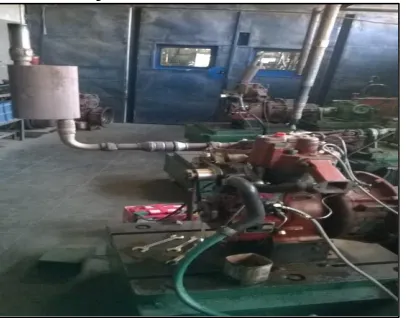
1) To evaluate the performance and emission characteristics, the specific type of engine used in this project is a single cylinder water cooled HSDI diesel engine. Set-up of the experimental engine is illustrated in Figure3.The engine is couple with a hydraulic dynamometer acting as a variable load system.
2) Various instruments and gauges are used to obtain different measurements. The engine speed measure with the help of digital tachometer. K-Type thermocouple with digital temperature indicator was used to measure exhaust temperature, cooling water as well as lubrication oil temperature.
Fig. 1: Photographic View of Tested Engine
Performance and Emission Analysis: B.
1) With a view to evaluate the performance parameters, important engine operating parameter such as engine shaft speed in rpm, time in second for 50 ml fuel consumption , engine exhaust emission engine exhaust gas temperature, Hydraulic dynamometer output, intake air temperature, cooling air inlet and outlet temperature and emission parameter such as CO, CO2 and HC.
2) The performance characteristics were determined from the fundamental relation while varying the 0%, 25%, 50%, 75%, 100. Significant engine performance parameters such as brake specific fuel consumption (BSFC), brake specific energy consumption (BSEC), brake mean effective pressure (BMEP), brake thermal efficiency (BTE), brake power output, brake specific diesel consumption, volumetric efficiency, mechanical efficiency for diesel engine were calculated. 3) Their uncertainties were estimated. Heating value and stoichiometric air fuel ratio of diesel, diesel density, swept
volume and discharge coefficient of the two orifices are considered constants. These results are analyzed and represented graphically as shown from subsequent figures.
III.
PERFORMANCE PARAMETERS
Effect of Torque on Corrected Brake Specific Fuel Consumption: A.
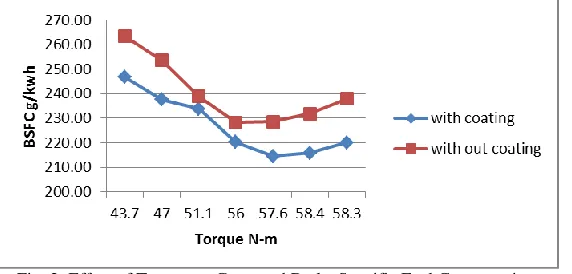
Fig. 2: Effect of Torque on Corrected Brake Specific Fuel Consumption
Figure shows the variation in BSFC (brake specific fuel consumption) with respect to brake power .It can be seen from the Figure that fuel consumption decrease with increase in load. Fuel consumption goes on decreases when load increases.
Effect of Brake Power on Corrected Brake Thermal Efficiency: B.
Fig. 3: Effect of Brake power on Corrected Brake Thermal Efficiency
The brake thermal efficiency of the engine is the one of the most important parameter for evaluating the performance of the engine. It indicates the combustion behavior of the engine to a greater extend.
Effect of Brake Power on Corrected Brake Specific Fuel Consumption: C.
From the figure it is shown comparison of the Brake power with respect to the Brake specific fuel consumption.
Fig. 4: Effect of Brake Power on Corrected Brake Specific Fuel Consumption
IV.
EMISSION PARAMETERS
Effect of Brake Power on Carbon Monoxide (CO): A.
The emission of carbon monoxide for different loads and also for different compression has been shown in Figure CO is the outcome of the poor atomization and incomplete combustion.
Fig. 5: Effect of Brake Power on Carbon Monoxide (CO)
Figure 4.4 Compares the CO emission of engine at varying brake power and at different compression ratios. It is seen that, CO emission decreases with increase in load. Because of the high temperature and due to high temperature its combustion of the engine has reduces its delay period, and due to modified engine, reduce its heat loss.
Effect of Brake Power on Carbon Dioxide (CO2):
B.
Fig. 6: Effect of Brake Power on Carbon Dioxide (CO2)
Figure 4.5, CO2 increases by increasing the compression ratio. The reason can be explained from the fact that at higher compression ratio, fuel consumption of engine increases due to reduction in ignition delay, the combustion charge attains higher temperature.
Figure 4.5, CO2 ¬ has decrease as the load and power its Carbon dioxide has decrease. It can be identifying that by getting modified engine carbon dioxide has been reduce compared to standard engine which is without modification.
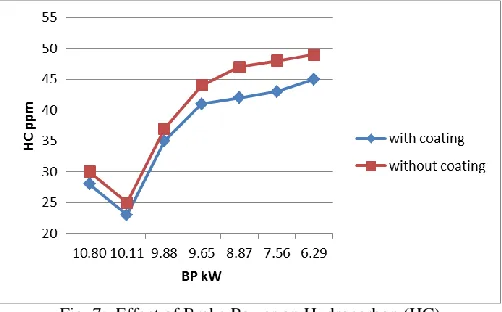
Due to decrease in ignition delay and increase in cylinder content temperature, HC is decreased from 2.1% compare to standard engine.
Effect of Brake Power on Nitrogen Oxide ( Nox ):
D.
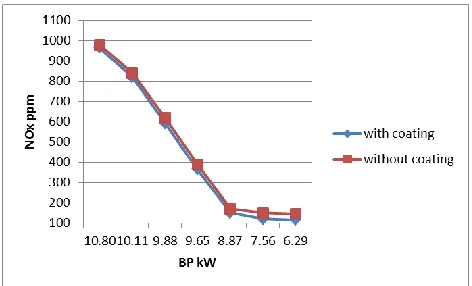
Fig. 8: Effect of Brake Power on Nitrogen Oxide ( NOx )
V.
CONCLUSION
1) An experimental investigation has been conducted on single cylinder four stroke HSDI diesel engine with great concern on exhaust emission such as CO, HC and NOx
2) Due to Decrease in BSFC, BTE (Brake thermal efficiency) increase by 2% to 4% of the regular engine. 3) Due to reduce the heat loss by titatinum oxide coated piston NOx, CO, CO2 and HC has decrease.
4) Due to modification of the engine is Brake Specific Fuel Consumption reduce from 470.71 g/kwh to 446.85 g/kwh and Brake Thermal Efficiency increase from 35.61% to 37.71%
REFERENCE
[1] NuovoPignoneS.p.A:viaF.matteucci, 2 – 50127 Florence
[2] K. Sridhar, 1 R. Reji Kumar, 2 M. Narasimha3, “Thermal barrier Analysis in Diesel” IJMER, Vol.3, Issue.3, May-June. 2013 pp-1435-1441
[3] A.R.Danavignesh.S.Siddarda, S.Karthickevan, M Prashashvasanth, Dr S.Sivasankaran, “Performance Testing of Diesel Engine With TiO2 coated Engine Parts” TAPSA- 2014 Volume 3, Special Issue 2, April 2014
[4] Vinay Kumar Domakonda, Ravi Kumar Puli, Application of thermal Barrier Coatings in diesel Engines, Energy And Power 2012, 2(1): 9-17