Yvonne Weeber is a landscape architect and urban designer presently employed as Adviser for Statutes for the Ministry for the Environment. She also lectures at Victoria UnitJersity of Wellington. This article was written while working at Lincoln University, New Zealand. Telephone: +64·4·387 8893 Email: [email protected] 143 Queens Drive, Lyall Bay, Wellington, New Zealand.
KEY WORDS Urban Design Mixed Use
Networks Scale and Grain Change over Time
Population Density Vital.ity
RESEARCH
Edge of Centres
YVONNE WEEBER
EDGE OF CENTRES ARE DESCRIBED by the United Kingdom's Department of the Environment's Planning Policy Guidance 6 (PPG6) in 1996 as areas within walking distance - approximately 200 to 500 metres - of a town centre retail core. PPG6 was brought in to stop the formation of large retail complexes on the rural edges of British towns and cities. In Britain, edge of centres form classic mixed-use areas with a variety of residential, retail and industrial uses situated side by side.
This paper compares two edge of centres, the first in Greyfriars, Stafford, England and the second in Tory Street, Wellington, New Zealand. Six attributes are discussed to expand the detlnition and knowledge of these dynamic areas. These are: mixed use, networks, scale and grain, change over time, population density and vitality in public space.
INTRODUCTION
T
ANDSCAPE ARCHITECTS IN NEW ZEALAND deal with a nUlnber of city and townLentre redevelopment projects. The projects focus on one particular edge or street and are generally known as 'Mainstreet' redevelopments. However, there are larger, more diverse edge areas that surround every town or city centre that, for the purpose of this paper, are called edge of centres.
The edge of centre is an untapped area of urban fabric, which requires the expertise of landscape architects to analyse, design and build in. The buildings in edge of centres remain relatively intact over time while uses within the buildings undergo rapid change. The landscape of streets, squares and underused spaces within an edge of centre require flexible designs, capable of adapting to different uses throughout the day, night and week over a number of years.
This is not a paper about how to design for an edge of centre, but rather what to expect in this area, and the underlying attributes of these unique city neighbour-hoods. By understanding an edge of centre's dynamics, landscape architects can contribute a robust urban design that works with the land's varied uses and meets the area's changing demands over time.
DEFINITIONS OF EDGE OF CENTRES
Edge of centre defined
in
PPG6
The Planning Policy Guidance notes are therefore a national set of policies which local governments have to consider and could be seen in a similar way to
New Zealand's National Policy Statements under Section 45 of the Resource Management Act 1991 (RMA). These policies are intended to achieve sustainable management in relation to matters of national significance. At present, however,
they are limited to the New Zealand Coastal Policy Statement 1994.
The New Zealand government set up the Urban Affairs Portfolio in 2003, to address the lack of an encompassing policy framework relating to urban areas, and outlined a Sustainable Development for New Zealand Programme of Action in 2003. From these initiatives, a statement of strategic priorities is being prepared for the Urban Affairs Portfolio. The New Zealand Urban Design protocol will be launched in early 2005, and will focus on gaining signatories in a non-statutory manner to support and demonstrate the principles of quality urban design outlined in it.
The 1996 version of United Kingdom's PPG6 sought to emphasise retail shopping in town centres and edge of centres and restrict the areas where large supermarkets, covered malls and shed retail outlets could be built. This was a revision of the 1993 PPG6 document, which focused mainly on town-centre enhancement, to counter out-of-town-centre retail competition. The 1996 version of PPG6 was developed primarily to stop the rapid decline of traditional town centres caused by large retail complexes being built on the rural periphery and dominated by private car connections. Often this type of retail complex destroyed the traditional retail base, of not only one but many small retail town centres surrounded by large out-of-town retail complexes .
....,._ ...
_-
...,."",,- ... -...., ...
...
....
",,""
...
---....
....
""
" , , ' """....
"'
...
" " " 200- 300 metres ... "
/ / 'easy w a l k i n g " "
I I d i s t a n c e ' " \
I I \ \
I I \ .... o:---;?~
\
\
, ,
"
I I 500 metres &om a public, ,
\ \ transport interchange I I
\ \ I I
\ " I
" " " " Edge of Centre ,. / , A
" .... Boundary One ... "" /
, , '
..._---.,..,.,
~/.... .... .... Edge of Centre ... "" ... ... Boundary Two . " . . . , ;
... ---""""--~
Edge of centres are defined in PPG6 as forming 'a location within easy walking
distance (ie 200-300 metres) of the primary shopping area, often providing parking facilities that serve the centre as well as the store, thus enabling one trip to serve several purposes' (Figure 1). This definition is extended for other uses such as
Figllre 1: Representation of the PPG6 edge of centre boundmies formed from a generalised growth modeL of urban development with concentric zones moving out from a town centre
offices and leisure 'to a region of 500 metres of the station or other public transport
interchange'. The primary shopping centre is considered to consist of a high proportion of retail shops, as defined in Class Al of the British Use Class Orders in 1996. Class A2 financial and professional services and Class A3 food and drink outlets are considered to be secondary shopping frontages. The 1996 PPG6
definition tries to explain the pattern of land use in cities and towns in terms of retail use only, and essentially restricts shopping complexes so as to minimise their impact on the traditional retail town centre.
The PPG6 definition of an edge of centre reflects the concentric zone theory of E.W. Burgess (1925), who asserted that urban growth occurs as a series of concentric circles expanding out from the core of the Central Business District (CBD) or city centre. Using Burgess's definition, an edge of centre is the transition zone between the city centre and the purely residential area. In the past, this definition was typified by a mixture of factories and workers' housing. The largely stable working population lived in older homes frequently lacking in amenity
(Harvey 1981). This pattern is found in a number of English edge of centres, such as Stafford, near Birmingham. The New Urbanism transect zone theory uses similar traditional urban patterns to arrange their core urban-rural continuum (Dauny, 2002; Talen, 2002).
These definitions are rigid and do not take into account changes over time and the multitude of mixed uses that occur in the edge of centre today. At their worst, these definitions do not allow for different settlement patterns. Single-use
zoning practices, combined with financial, health and building controls - and, in New Zealand, building standards relating to earthquake strengthening - have
radically changed edge of centres to the detriment of many compatible land uses that make up these mixed-use areas.
Another factor has been the desire to move people to and from the city centre, which results in concrete collars circling the city centre. For example, the
Birming-ham, England inner-city ring road and the Auckland, New Zealand motorway network circle these cities' edge of centres and constrain present and future growth. The lineal form of a motorway does not allow ebb and flow of activities from city
centre through edge of centre into the surrounding residential neighbourhoods. Past transport and neighbourhood connections, not to mention large areas of built fabric, are demolished to form the route of the motorway. This creates large
areas of lost space where car parking predominates. Moreover, land set aside tor further motorway expansion stands vacant or in a semi-derelict state for a number of years.
A
broader definition of edge of centres
An encompassing definition is required, which defines an edge of centre as a
/
/
use a combination of physical boundaries with a particular character and economic functional linkages to define a historic quarter. This allows the study of a discrete quarter, sector or precinct, providing different urban patterns and demonstrating how land uses have evolved.
This essay draws a comparison between two edge-of-centre neighbourhoods to consider the key attributes of an edge of centre. The first is the Greyfriars neighbourhood, a triangular area to the north of Stafford, a town in the West Midlands, approximately one hour in travel time from Birmingham (Figure 2). Stafford has grown from a small market town formed around a medieval centre to a population of around 60,000 today. The M6 motorway wraps around it, connecting the south to the Wolverhampton/Binningham conurbation and the north to the pottery area of Stoke on Trent. In the 1850s the shoe manufacturing
industry expanded out of the town centre into the rural area of Greyfriars, where shoe factories and surrounding residential terraced houses were built. Over the last 150 years Greyfriars has been an important edge of centre for Stafford.
However, due to the decline in the shoe manufacturing industry there are a number of vacant and decaying buildings within this edge of centre. Practices in the last 40 years of 'slum clearance', road alterations, restrictive planning constraints and
car parking requirements have caused its former mixed-use character to become dominated by residential development. The Greyfriars edge of centre stagnates while its set of landmark buildings waits for demolition.
The second area is a part of a city edge of centre in the Te Aro basin of Wellington, New Zealand. It is bounded by Cambridge Terrace, Buckle Street, Taranaki Street and Courtenay Place and centres on Tory Street (Figure 3). This area was surveyed
off immediately after the European settlement of Wellington in the 1840s and has undergone constant change from a residential to an industrial area of the city.
Initially, it had a mix of residential and commercial uses. There was a strong
Figllre 2 (left): Greyfl'ims, Stafford edge of centre forming a tTianglllm qllmter, ~(!ith patterns of detdopment ol'er the last 150 yeaTS Telated to the past shoe manufactltTing industry and associated Tesidential ten-aces,
FigltTe 3 (right): TOTY StTeet, Wellington edge of centTe fanning a rectangltiaT quarter, with patterns of development over
ethnic community as Fredrick Street and Haining Street were Wellington's Chinese quarter. Slum clearance was frequently talked about. A gradual removal of
residential accommodation corresponded with some major changes in the 1950s, and so Tory Street became an industrial workshop edge to the city with a mixture of low-rise buildings. The area is again seeing rapid change with a number of
residential apartments being built on top of the old commercial uses in the area. The Tory Street area is, in essence, a scene of dynamic change due to residential
influx.
Having defined the physical boundaries, it is important to know what character, identity, functions and economic attributes make up an edge of centre. While each neighbourhood is different, there is a set of key attributes that make an edge
of centre different from a strong central retail commercial core and residential suburbia. These attributes are linked to the uses and people of the neighbourhood and for simplicity have been reduced to six attributes, which are: mixed-use,
networks, scale and grain, change, population density and vitality in public space.
KEY ATTRIBUTES
Mixed use
The edge of centre areas have traditionally been mixed-use areas of a city, made up of residential, commercial and retail uses (Rowley, 1996). Mixed-use is the opposite of a single use, created either by a single-layer zoning system or a single-use policy
format found in the British planning system. Mixed-use developments provide vital and diverse edge of centres that are sustainable and safe. These areas do not often have high-quality open space surroundings. However, landscape architects can make a valuable contribution in developing edge-of-centre environments.
The primary motive of mixed-use developments is to combine residential and employment functions, allowing people to live close to their workplaces and providing a sustainable community. Mixed-use areas can occur between buildings or between floors of buildings. This reduces travel and places importance on the
£.t::11'11L :;'I=~L----?
HOl:E7€ M'~
REtAIL
£Blffi.mA1- _
J'-"'-HI< Figure 4: Greyfriars's b[ocl< structlLre is
made up of a mix tItre of uses and shows a dil'ersity of scale and grain tvith smaller residential terraced houses organised around
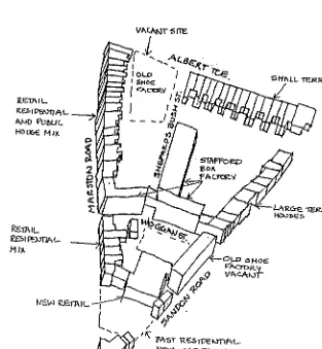
pedestrian environment. Sustainable mixed-use neighbourhoods therefore have a block structure, which combines community, residential and employment uses in one small area. This can be seen in the block structure of Greyfriars (Figure 4)
which shows a mixture of old and new uses plus the residential terrace houses. Mixed-use areas provide a challenge to landscape architects grappling with the edge-of.centre neighbourhood's complexity. In the Tory Street area of Wellington
the diversity of uses around one block include: a fish processing plant, a large wholesale supermarket, vertically and horizontally placed residential apartments, religious establishments, professional offices and a fitness centre.
Tory Street is within the Central Area zone of the Wellington City Council District Plan which promotes the opportunity to have this type of mixed use. The rapid increase of residential use in this area has resulted in the development of a new District Plan Rule, which sets a minimum requirement for insulation, double-glazing and ventilation of residential uses in order to reduce the level of outside noise. This is due to reverse sensitivity issues with other city uses such as light industry, pubs and nightclubs. In Greyfriars, the overlying residential zone has only discretely placed Class AI, A2 and very rare A3 uses.
Networks
Mixed-use edge of centres are made up of primary and secondary uses. The primary uses represent residential, major employment and service functions (Jacobs, 1961). In between these, a selection of secondary uses forms a mixture of smaller and newer firms which find accommodation in backyards, less attractive smaller buildings or lower-priced retail areas. Edge of centres are still some of the most attractive environments for embryo and infant enterprises. The firms are close to customers and suppliers and can utilise cheap accommodation.
Edges of town centres are important in the development of independent retail and small restaurants, due to lower rentals than traditional shopping centres or larger covered malls. Edge of centres can also become important shopping centres for alternative or non-mainstream retail. This is epitomised by a cluster of ethnic restaurants in the Tory Street area, forming a 'magnet use'. In the past 20 years, some of these restaurants, such as Tory Street's Il Casino, have given the area a reputation for outstanding cuisine.
Interestingly, in Greyfriars the restrictions on Class A3 food and drink outlets have made it impossible for the cafe culture to develop or even enter the market. Any food establishment that opened late at night was seen as a threat to the peace
of the residential houses - especially to the occupants of pensioner houses placed in the middle of the edge of centre after the 1960s slum clearance.
Secondary uses are important as they supply the local community with a
complex network of interdependent facilities. Many small and medium-sized finns in traditional mixed-use neighbourhoods exist as networks of compatible and inter-related production or service facilities that are interdependent on one another.
Figure 5: The net~vork of indUSl:des that grew OItt of the shoe manufacturing industry in Greyfriars, Stafford. Industries present today are highlighted in bold.
for exclusive niche markets (Loomis, 1995). The proximity to marketing and financing operations in the town or city centre gives these firms a competitive
edge (Loomis, 1995). The combination of a diverse range of secondary uses and incubation of new industry keeps the edge of centre and city alive (Zeidler, 1983).
In Greyfriars, the network of industries that developed around the shoe
manufacturing industry still plays a significant part in the economy of Stafford. In Figure 5 the network of past and present uses and its inter-relationship with the past shoe manufacturing industry of Greyfriars are described graphically. Many
of the existing Inajor employment industries of the town began as a secondary industry to shoe manufacturing.
SUBSIDIARY OF GEC
EVODE
DIESEL
ENGINES SHOE (ADHESIVE AND
/
TANNERS WHOLESALERS SEALANT SHOEMANUFACTURING MACHINES
SHOE KNIVES
PIECEWORK TO SMALL HOUSES NEAR FACTORY
SHOE INDUSTRY IN
STAFFORD
1
WOODEN HEELS AND BOXES
\
TIMBER INDUSTRY
MANUfACTURER)
/
SHOE POLISHES
CARDBOARD BOXES
1
BOX FACTORIES
In Tory Street, one network is based on car culture with a mixture of smaller
car-servicing enterprises. These facilities are slowly being pushed out of this edge of centre to make way for more residentially focused secondary industries, in a form of gentrification. The new residential apartment dwellers are catered for by
cafes open seven days of the week and interior decorating and furniture industries
(Figure 6).
Scale and grain
buildings for the people that live there at present, however, by having this mix, alternative uses are always able to enter the edge of centre.
To provide for a range of rentals that accommodates a variety of uses, Jacobs (1961) argues for an urban fabric made up of various types of buildings of different ages. To recoup the costs of constructing a new building, high rentals and sales prices are required. This attracts only a relatively small range of activities and enterprises, for example, office accommodation, which can financially afford a
newly developed area. In the case of Tory Street, all new buildings are high-q.Jality residential accommodation, such as the Sanctum Apartments in Ebor Street. Generally, the cost of rehabilitating an old building for reuse will be only
50-80
per cent of the cost of new construction, resulting in considerable financial savings (Highfield, 1987). In Tory Street and Wellington in general the construction of
lightweight timber-framed additions on top of existing buildings primarily for residential apartments has created a rapidly changing environment (Figure 7). This puts old buildings in a positive position as valuable urban assets and may stop demolition, because they represent a reservoir of cheap rents (Bentley, 1987) and are ideal for conversion at a later date.
Urban elements that require a large capital investment undergo little change over time, such as blocks or roading patterns and public open space systems (Bentley, 1987). Only with massive and expensive road alterations do block sizes alter. Unfortunately edge of centres going through a period of decay are often seen as ideal neighbourhoods to cut through with a motorway, ring road or bypass system, such as the Wellington Inner City Bypass cutting through southern Cuba Street.
As
edge of centres are made up of such a mixture of uses, a roading system cutting across the block structure will have ongoing negative implications to both the edge and city centre. Neither Greyfriars nor Tory Street are unscathedFigllre 6: An increase in residential dwellings within the Tory Street area has created an opportunity for netv bminesses to
develop that cater for the apaTtment-dweller sitch as Brooklyn - Bread and Bagel and Caffe VaffaTe in College Street.
Figltre 7: The addition of three floors of lightweight timber-frame on an existing building on the comers of Tory Street,
Lome Street and Tennyson Street has created a vibrant mixed-use building with
Figure 8: The old factones of the shoe
manuj'actltnng industries form important landmark buildings throughout Greyfnars and are used today as senlice clubs, churches, small office comlJlexes and a fitness club. They also hmle ongina/uses sllch as the
Stafford Box Company which manufactltres cardboard boxes.
by road widening and bypass schemes. A number of changes have occurred to the
boundaries of both these areas, reducing the land area, number of buildings and viable land uses.
Change
The progressive cycle of change with investment and divestment makes edge of
centres the expansion joints of the city. As property values fall and building costs rise, old existing buildings can begin to have more value than the land they stand on or buildings that could replace them (URBED, 1987). When there is a
down-turn in the economy, old buildings have a greater opportunity for survival and a viable end use. Additions and alterations to old existing buildings are seen as better than no development at all (Tiesdell, 1996). In Greyfriars the old shoe
manufacturing buildings form ilnportant landmarks that add to the visual, architectural and historical qualities of an urban edge of centre. They are the raw visual materials that show the changes in industry, commerce, leisure and the
retail sector (Figure 8).
Not every vacant building can be suitable for reuse. The reuse of buildings is
complex and cannot be tackled in the same manner as constructing new buildings. Conservation of buildings can only occur if a viable alternative is found, which requires an entrepreneurial approach. The old shoe manufacturing buildings of Greyfriars have a mLx of uses in them today, from service clubs, fitness centres and churches to small office complexes. The major problem is sustaining the uses in the face of ongoing maintenance costs. The larger and smaller buildings are most susceptible to destruction due to their int1exibility and lack of adaptability to alternative uses (Scheer, 1997). Within the Tory Street area, few of the original 1900s small lots with timber weatherboard houses remain due to demolition and amalgamation of adjoining lots for larger warehouse buildings. In Greyfriars, reuse of the large old shoe manufacturing buildings has the added burden of having to meet car parking standards worked out on floor area. This has meant a number of the buildings are only partially reused, leaving floor space vacant to meet the car parking standards (Figure 9).
When there is economic recovery, landowners invest in their buildings and accumulate land to develop their businesses. When these large landowners disinvest, the changes can be dramatic, if not catastrophic, as seen in the disinvestment of the shoe manufacturing industry in Stafford. Demolition of the largest Lotus shoe manufacturing factory opened up an entire block of land to residential development, reducing the amount of mixed use in the area.
of Tory Street with the introduction of a variety of other land uses such as cafes to Ineet the demands of the apartment-dwellers.
Catalytic change has greater benefits on edge of centres than a dramatic change as it allows the mixed-use community to live and grow. The opposite type of change is caused by large-scale urban renewal projects led by investors and local or central government who impose rapid and large-scale physical and single-land-use changes. While the changes were made to remove slums or improve traffic flow, they were detrimental to the edge of centre's mixed-use qualities. In Greyfriars the 1960s slum clearance removed a close-knit mixed-use neighbourhood and replaced it with a low-density pensioner housing area which has caused ongoing problems to the vitality of the area. Not least is the pensioner housing residents' continual resistance to the introduction of night-time uses such as cafes and food outlets. In Tory Street, residential use is being re-introduced and the prCNision of additional noise insulation within the new residential buildings protects the inhabitants from the existing and proposed land uses that surround them.
Population density
The edge of centre is the most important dormitory for the city centre. Within easy walking distance to the centre, it offers a lifestyle totally different from suburbia. If the edge of centre is to provide an alternative to suburbia, different types of accommodation combined with work and service-related uses must be offered so
that they cater for the affluent worker, rich retiree and struggling student, all in one neighbourhood.
The density of people living in an area must be sufficiently large to support the
facilities for its diverse range of residential occupants. The greater the concentration of people, the greater the possible number of land uses in the area. Town centres are
Figllre 9: Strict parking standards on
floor area have meant that a nllmber of the shoe manufacturing buildings remain vacant or semi-vacant, as only a nllmber
of floors can be Te1lSed to meet the car
dying, both in terms of retail and other uses, because the number of people coming into them and living in them is decreasing. Town centres and edge of centres need an interaction and critical mass of people to survive. Greater interactions and choices are offered in the larger towns and cities (Coupland, 1997).
The number of dwellings in the Greyfriars area has declined over the last 40 years. This was caused by a number of factors including road widening and the 1960s slum clearance. The decline is compounded by areas of house removal to the east of Greyfriars caused by ground subsidence from past underground salt extraction practices. The area needs innovative ideas which support the reuse of old buildings and vacant sites, more flexible car parking standards and, for the areas with subsistence problems, promotion of lightweight building construction
ideas used in New Zealand.
The Tory Street area is in a state of construction and reuse boom, in the form of residential apartments. The influx in the residential population has promoted a mix of new businesses developed in conjunction with the increasing population density. Studies have shown that 'empty nesters' (those not involved in child rearing) are more likely to live in the town centre or edge of centre (Coupland,
1997). They are interested in activities such as entertainment and sporting facilities. These need to be regarded as primary uses to attract and retain people living within an edge of centre. Wellington's Tory Street community has an increased
number of cafes, eating establishments and fitness centres, plus a wholesale supermarket. A similar mix of uses can be seen in a very restricted way in the
Greyfriars area.
Vitality
in
public space
Mixed-use edge of centres allow people to live close to their workplace and therefore provide a more sustainable community. 'Permeability' (Bentley, 1987), or the movement and access of pedestrians in the edge of centre, and the connections
with the town centre are extremely important. Walking to work is a way of lite in mixed-use areas where residences and workplaces are located a short distance from each other or actually sharing the same blocks and streets (Loomis, 1995).
Controlled motor vehicle movement to allow ease of pedestrian movement and interaction between pedestrians is a positive means of promoting vitality of the public spaces in an edge of centre. This places importance on the design of the
pedestrian environment so people will enjoy walking to work, local services and public transport connections.
An increased population density requires a high-quality, safe and exciting
environment to encourage pedestrian-based activity throughout the day and night (Roberts and Lloyd-Jones, 1997). A balanced mix of working, service and living activities provides a lively, stimulating and secure public realm, and promotes a sense of community in that edge of centre (Jacobs, 1961). To get this urban
functions) at different times of the day. This is similar to the multiplier effect of attracting people to magnet stores in shopping malls with a mix of smaller facilities
or secondary uses in-between (Roberts and Lloyd-Jones, 1997).
Often due to their multitude of uses and general messy appearance away from main retail and commercial streets, edge of centre areas are not allocated funding
for open-space improvements. These areas are hard to design for, as anything from high numbers of pedestrians through to large articulated trucks can be using
these streets at anyone time. This is where the expertise of the landscape architect is required to develop aesthetically pleasing designs that can withstand the multiple pressures of an active edge of centre.
CONCLUSION
The six attributes discussed demonstrate that edge of centres are made up of a
mixture of uses including retail, workshop, professional and residential. In these areas, both the residential and commercial uses are often networked through past
or present relationships. The mixed scale and grain of buildings, lot sizes, blocks and streets helps provide a continuation of old uses and formation of new enter-prises due to a range of rentals not obtainable in the primary shopping area. This creates a continually changing environment where the edge of centres often appear messy and unkempt. However a healthy edge of centre will have a mix of uses
where no particular use predominates and a vibrant residential population living within and around it.
This type of environment provides a constant challenge to landscape architects. Research into the history and potential direction of the uses in the edge of centre is a prerequisite for any landscape architect undertaking a design within one of
these areas. Consultation with the large variety of users and conducting surveys during the day, night, week and weekend are essential if designs are to survive for any length of time. These public spaces require a robust design framework rather
than a formulaic 'Mainstreet' design. The main design ingredient is the need to promote the mixture of uses rather than designing for one specific use to the
detriment of others. While this may appear to create a rather bland landscape, the opposite should be true, if the history and diversity of uses are narrated in the edge of centre's landscape.
ACKNOWLEDGEMENTS
Thanks to Chris McDonald of Victoria University and Jacky Bowring of Lincoln University for discussing this article with me. Thanks also to Ivor Samuels for his help and support while I undertook my Masters in Urban Design at Oxford
REFERENCES
Attoe, Wand Logan, D (1989) American Urban Architectnre. Catalysts in the Design of Cities, Berkeley: University of California Press.
Bentley, I (1987) Variety, Time and Urban Form, Urban Design Quarterly, vol 25, pp 16-19. Burgess, EW (1925) The growth of the city, in R Park, E Burgess and R McKenzie (eds), The City, Chicago: University of Chicago Press, pp 37-44.
Coupland, A (1997) Reclaiming TIte City - Mixed Use Development, London: E & FN Spon. Danny, A (2002) Introduction ro the Special Issue: The Transect, JOllrnal of Urban Design, vol 7, no 3, pp 251-260.
Department of the Environment (1993) Planning Policy Guidance: Town Centres and Retail
Developments, London: HMSO.
- (1996) Planning Policy Gllidance: Town Centres and Retail Det>elopments Revised PPG6, London: HMSO.
Harvey, J (1981) Urban Land Economics, Palgrave: Macmillan.
Highfield, D (1987) Rehabilitation and Re-llSe of Old Buildings, London: E & FN Spon. Jacobs, J (1961) The Death and Life of Great American Cities, New York: Random House. Loomis, JA (1995) Manufacturing Communities, Places, vol 10, no 1, pp 48-57. New Zealand Government (1994) Resource Management Act 1991, Wellington: New Zealand Government.
- (2003) SILStainable Development for New Zealand Programme of Action, Wellington: New Zealand Government.
Roberts, M and Lloyd-Jones, T (1997) Mixed Uses and Urban Design, in A Coupland (ed) Reclaiming The City - Mixed Use Development, London: E & FN Spon, pp 44-73.
Rowley, A (1996) ML'{ed-use development: ambiguous concept, simplistic analysis and wishful thinking? Planning Pmctice and Research, vol 11, no 1, pp 85-97.
Scheer, Band Ferdelman, D (1997) Morphology as Density: The story of Over-the-Rhine. Paper presented at the International Seminar on Urban Form, Birmingham, July 1997. Talen, E (2002) Help for Urban Planning: The Transect Strategy, Journal of Urban Design, vol 7, no 3, pp 93-312.
Tiesdell, S, Tanner 0, and Heath, T (1996) Revitalising Historic Urban Quarters, Oxtord: Oxford Architectural Press.
Urban and Economic Development Group Ltd (1987) Re-using Redundant Buildings, London: HMSO.
Whitehand, JWR (1987) The Changing Face of Cities. A SWdy of Development Cycles and Urban Form, London: Basil Blackwell.
Zeidler, EH (1983) Multi-use Architectnre in the Urban Context, London: Van Nostrand Reinhold Company.
The 1JieH's expressed in this article are the personal11iews of the author and do not represent the views of the