97
Volume 18, 2009
THINKING SKILLS IN THE TEACHING
AND LEARNING OF THE ENGLISH
LANGUAGE
Blanka Frydrychova Klímova University of Hradec Kralove, Czech Republic E-mail: [email protected]
Abstract
Thinking is as natural as breathing, drinking and eating. People have an innate eagerness to discover things, to reason about the processes and activities they are involved in. But for adults learning a second language in an academic institution various dimensions of thinking play a significant role, including their beliefs, at-titudes, their capacity to remember, and the use of strategies. The aim of the article is to list, categorize and define a few (lower order and higher order) thinking skills (according to Bloom’s Taxonomy of 1956 and Newcomb’s and Trefz’s model of 1987) which might contribute to the enhancement of communicative compe-tence in learning and which students might need when studying at the university, particularly when learning the English language. Finally, an implementation of thinking skills and the development of the receptive and productive communication skills in teaching and learning are demonstrated on two university courses run in the English language.
Key words: communication, second language learning, thinking skills.
Introduction
much has been written about thinking skills. consequently, there exists an abundant amount of definitions. For example, Barbara Fowler (2004) uses a variety of sources to make a list of 19 brief definitions of thinking skills, with special emphasis on critical thinking in particu -lar. However, for this paper, following Fisher (2006), the term thinking skills is used to mean the human capacity to think in conscious ways to achieve certain purposes. Such processes include remembering, questioning, forming concepts, planning, reasoning, imagining, solving problems, making decisions and judgements, or translating thoughts into words. Thinking skills are ways in which humans exercise the sapiens part of being homo sapiens.
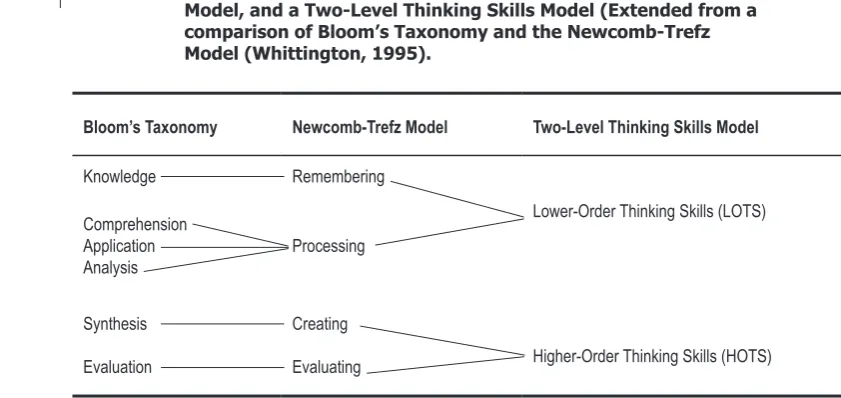
98 Table 1. A Comparison of Bloom’s Taxonomy, Newcomb-Trefz Levels of Learning
Model, and a Two-Level Thinking Skills Model (Extended from a comparison of Bloom’s Taxonomy and the Newcomb-Trefz Model (Whittington, 1995).
Bloom’s Taxonomy Newcomb-Trefz Model Two-Level Thinking Skills Model
Knowledge Remembering
Lower-Order Thinking Skills (LOTS) Comprehension
Application
Analysis Processing
Synthesis Evaluation
Creating
Evaluating Higher-Order Thinking Skills (HOTS)
Implementation of Thinking Skills into the Learning Process
In England, for example, the revised National Curriculum (DfEE, 1999) includes thinking skills in its rationale, stating that thinking skills are essential in learning how to learn. the list of thinking skills contains: information-processing, reasoning, enquiring, creative thinking and evaluating. they focus on knowing how as well as knowing what, not only as regards curriculum content but also for learning how to learn. Moreover, critical thinking is now offered as a subject which 16-18 year olds can take as an A-Level examination, and use to enter university, if they are successful.
It is generally known that the Communist regime had an enormous impact on people’s minds and, indeed, therefore, the entire educational system. children were mainly led to memo-rize facts, but to think or even think critically about the facts, was not acceptable. The Communists were threatened by critical thinking because it enables one to analyze, evaluate, explain, and re -structure our thinking, decreasing thereby the risk of adopting, acting on, or thinking with, a false belief. Therefore, critical thinking should be consciously developed already at the primary level. For instance, Dalton and Smith (1986) provide specific verbs, sample question stems and potential activities and products for each of Bloom’s types of thinking. This might help teachers to think about their lesson content before creating and implementing a syllabus.
Admittedly, creative teachers tend to promote thinking skills with their students while teaching the content. There are two phases to the learning of content. The first is the so-called internalization. Learners try to construct in their minds the basic ideas, principles, and theories that are inherent in content. The second phase is a process of application. this is when learners use those ideas, principles, and theories as they become relevant in learners’ lives. Teachers should strive to cultivate critical thinking at every stage of learning, including initial learning since criti -cal thinking represents a liberating force in education and a powerful resource in one’s personal and civic life. Furthermore, it motivates learners to acquire new knowledge or skills in any field of study they choose.
99
in the 21st century Volume 18, 2009 Key competences for lifelong learning recommended by the European
Parliament and the Council of the European Union („Recommendation,” 2006)
1. communication in the mother tongue; 2. communication in foreign language;
3. Mathematical competence and basic competences in science and technology; 4. Digital competence;
5. Learning to learn;
6. Social and civic competences;
7. Sense if initiative and entrepreneurship; 8. Cultural awareness and expression.
Their definition on learning how to learn is as follows: Learning to learn is the ability to pursue and persist in learning, to organize one’s own learning, including through effective management of time and information, both individually and in groups. This competence includes awareness of one’s learning process and needs, identifying available opportunities, and the ability to overcome obstacles in order to learn successfully. This competence means gaining, process-ing and assimilatprocess-ing new knowledge and skills as well as seekprocess-ing and makprocess-ing use of guidance. Learning to learn engages learners to build on prior learning and life experiences in order to use and apply knowledge and skills in a variety of contexts: at home, at work, in education and training. Motivation and confidence are crucial to an individual’s competence.
Thinking Skills and Communicative Competence in Language Learning
this is undeniably true for the learning of foreign languages. in the english teaching at the Faculty of Informatics and Management of the University of Hradec Králové students are instructed to use their metacognitive thinking, for example, in the subject on Academic Writing or Cultural History of Great Britain. Both subjects are aimed at first year students and the main goal is to steadily increase students’ communicative competence.
The university’s Academic Writing course aims to help both Czech and foreign or over -seas students of the faculty. These students study English as an applied language. The course is designed to develop the kind of English that students will most likely need in their future jobs, namely, business English. (Students graduating our faculty usually find jobs in tourism, finance and information technologies.) Undoubtedly, they will use written communication, such as writ -ing e-mails or reports, on a daily basis. The course focuses on the process of writ-ing from begin-ning to end, and gives advice on how to write professionally. It shows the component parts of the writing process, that is: envisaging what to write, planning an outline, drafting passages, writing the whole thing, revising and rewriting it, and finishing it in an appropriate form, together with publishing all or parts of a text. In addition, it concentrates on those features which are different in English and Czech, such as citations, compiling a bibliography or using appropriate English. As for the last aspect, there are independent sections on grammar structures in written English, lexi -cal structures, and punctuation. The course tries not only to address students’ lack of experience in writing formal English language but also to approach writing itself in a new way. The course exposes students to blended learning. That means students meet a teacher once every two weeks to discuss and clarify the mistakes they made in their assignments (i.e. essays), while at the same time, students are expected to undertake deep self-study of the materials that form their on-line e-learning course.
100 1. collecting information about the essay topic and reading the texts about the topic – knowledge (LOTS)
2. describing and explaining the background of the topic – knowledge and comprehen-sion (LOTS)
3. identifying and comparing arguments for and against – comprehension and analysis (LOTS)
4. formulating, debating and verifying conclusions – synthesis and evaluation (HOTS)
As the evaluation of the course reveals, students consider this subject quite important in their academic studies. in addition, they think the course would be useful for all students at the faculty.
The other university subject in which critical thinking skills are integrated into the syllabus is the cultural history of Great britain in which students learn about the british history and culture from the Pre-historic times up to modern Britain also attempts to develop their thinking skills together with all the productive and receptive communicative skills. For instance, in the winter semester, to obtain the course credit, students have to write an essay. The pass mark is 75%. The essay is evaluated for its content, accuracy, layout, references and bibliography. Obviously, students need knowledge of academic writing. but in this course, students’ essays must also show evidence of critical thinking both in terms of their approach to, and evaluation of, British history and literature. students are required to make reference to the study materials of the winter semester. Moreover, students are provided with a simple essay framework, which does double duty as a prompt and as a guideline to stimulate and facilitate their use of thinking skills. Again, this framework is based on bloom’s taxonomy:
1. knowledge(LOTS) – students should articulate what they have learned and read about the history and literature of a particular period;
2. comprehension (LOTS) – students should be able to articulate other students about the history of that period and the fiction book connected to this period you have read; 3. application (LOTS) – students should be able to apply and relate their historical
knowledge to describe and understand the literary work they read;
4. analysis(LOTS) – students should be able to analyze historical facts they consider important in the story, in the lives of the main characters ..;
5. synthesis (HOTS) – students should be able to develop their arguments for and against;
6. evaluation (HOTS) – students should be able to express their own point of view.
Sample essay topics are as follows: The Civil War and John Milton
(Discuss John Milton’s attitude to the Civil War of 1642-49. Demonstrate some aspects of the influence of the war on Milton’s Paradise Lost.)
literature of 18th Century England
(Discuss one of the literary works written within this historical period. Illustrate/describe the effect of some political, economic or social conditions on the work’s heroes and their activities.)
101
in the 21st century Volume 18, 2009
students’s comments on the course:
This subject can extend general scope and facts of every well-educated person. It is always appealing to gain some new information and in this subject you can also debate about it . . . . .
I appreciated the exercises, which we did and which helped us to learn how to logically structure the presentation . . . . .
Conclusion
In conclusion, to foster thinking skills, and critical thinking in particular, is a challenging task nowadays since learners are exposed to an enormous information influx, such as the Internet. they are offered pre-chewed chunks of ideas and opinions and often, they are not made to think about them. However, a critical thinker should be alerted and in his/ her inquisitive nature inquire, judge and evaluate all such sources critically. Hence, teachers should promote cognitive challenge, collaborative learning and metacognitive discussions in their classes. Without critical thinking systematically designed into instruction, learning is transitory and superficial. furthermore, a proper communicative competence, both organizational (including grammatical and discourse competence) and pragmatic (including sociolinguistic and illocutionary competence) becomes ineffective.
References
Bloom, B. (1956). Taxonomy of educational objectives. Handbook 1: The cognitive domain. new york: David McKay.
Dalton, J. & Smith, D. (1986). Extending children’s special abilities – strategies for primary classrooms. australia: ministry of education Victoria.
DfEE. (1999). The national curriculum: Handbook for primary teachers in England. london: Qca. Fisher, R. (2006). Thinking Skills. In J. Arthur, T. Grainger, & D. Wray (Eds.), Learning to teach in primary school (pp. 226–238). routledge falmer.
Fowler, B. (2004). Critical thinking definitions. Retrieved June 2, 2009, fromLongview Community College Web site: http://mcckc.edu/longview/CTAC/definitions.htm
Newcomb, L.H. & Trefz, M.K. (1987). Levels of cognition of student tests and assignments in the College of Agriculture at The Ohio State University. Proceedings of the Central Region 41st Annual Research Conference in Agricultural Education, USA, 26–30.
Recommendation of the European Parliament and of the Council of the European Union of 18 December 2006 on key competences for lifelong learning [Electronic version]. (2006, December). Official Journal of the European Union, 49(L 394),10–19.
Whittington, M.S. (1995). Higher order thinking opportunities provided by professors in college of agriculture classrooms. Journal of Agricultural Education, 36(4), 32–38.
Adviced by Pavel Čech, University of Hradec Králové, Czech Republic
Blanka Frydrychova Klímova PhDr, M.A., Ph.D., Assistant, University of Hradec Králové, Rokitanského 62, Hradec Králové 3, Czech Republic.