Page 69
STUDENT ATTITUDES TOWARD ACADEMIC DISHONESTY AT AN AMERICAN-STYLE LIBERAL-ARTS UNIVERSITY IN BULGARIA
Zlatinka Blaber1, Donald Brady2 1Salem State University, United States 2American University in Bulgaria, Bulgaria
Abstract
The purpose of this study is to examine student attitudes toward various types of academic dishonesty at a university in Bulgaria that employs the American liberal-arts educational model. The research questions addressed by this study are: 1) How do students’ attitudes toward academic dishonesty vary according to the perceived severity of academic misconduct, for example major or minor offenses? and 2) What is students’ overall attitude toward academic dishonesty? Student attitudes are analyzed using the Fishbein expectancy-value model (Ajzen and Fishbein 1980). Questionnaire data were obtained from a sample of 260 students. Women, respondents with a lower Grade Point Average (GPA), and underclassmen were found to hold attitudes more conducive to academically honest behavior than men, respondents with a higher GPA, and upperclassmen. Although 70.2 percent of the respondents held overall attitudes that favored academic honesty, room for improvement remains. Between 21 and 46 percent of the respondents had attitudes consistent with academically dishonest behavior toward the following three attributes: submitting a graded project containing material copied from another student’s project, submitting the same term paper in two or more classes without permission, and submitting a graded project containing material from a published source that is rewritten in the student’s own words without a proper citation. These are considered in the literature as minor academic offenses. In addition, unauthorized collaboration, one of the four categories of dishonest academic behavior examined, was sanctioned by 63 to 73 percent of respondents. Unauthorized collaboration is considered to be another minor academic offense. Strengthening efforts to instill in students the personal and societal benefits of behaving with academic integrity remains important to the objective of developing well-rounded, ethical, and liberally-educated future leaders in the region.
Keywords: academic dishonesty, academic integrity, attitudes, Bulgaria, ethical behavior, Fishbein attitude model
1. INTRODUCTION
Academic dishonesty, in all its forms, seems to be a perpetual problem in academia (McCabe & Bowers 1994; McCabe, Butterfield & Treviño 2012; McCabe & Treviño 1996; Spiller & Crown 1995; Wei et al. 2014). Therefore, academic dishonesty, also referred to as academic misconduct or cheating, has been the subject of considerable research since as early as 1928 (Brownell 1928). Although research has produced sometimes conflicting findings, one conclusion should be considered unanimous – academic dishonesty is a growing challenge and concern for university faculty, administrators, and business people (McCabe, Butterfield & Treviño 2012). Faculty and administrators are directly involved with academic misconduct. Since research has shown that students who commit academic dishonesty are found to be more likely to engage in and be accepting of unethical behavior in the workplace (Harding et al. 2004; Lawson 2004; Nonis & Swift 2001; Sims 1993), business people are indirectly affected by academic dishonesty. Bernard Madoff, the executives at Enron, WorldCom, and Adelphia, to name just a few, were all products of the university system. Could colleges and universities have prevented, at least partially, such large-scale unethical behavior by putting an extra emphasis on the importance of ethics in our classrooms and by extension in society at large?
Page 70
liberal-arts model. American liberal-arts colleges exist elsewhere in the world as well; for example, in Kuweit, the United Arab Emirates, France, and Egypt. Instruction in all of them is in English. Focusing on Bulgaria is meant to fill an important geographical research gap in the education and ethics literatures. The country is growing in importance as an EU academic study and workplace destination and thus merits the attention of academic research. Especially known for attracting foreign students are the universities in Blagoevgrad, Burgas, Plovdiv, Sofia, and Varna. Due to a highly qualified and multi-lingual workforce, low labor costs, low cost of living, and low income tax rates, Bulgaria has been attracting investments from other European and non-European countries, especially since 2007 when the country joined the EU. Students with a university education from Bulgaria, both Bulgarian and foreign, find employment in the EU and beyond and often become leaders in their fields of expertise. Given all these facts, studying academic ethics from the perspective of university students in the context of Bulgaria is crucial.
2. PRIOR RESEARCH
Academic dishonesty is not a well-defined concept as evidenced by the variety of academically dishonest activities that describe the phenomenon in the literature. Although subtle differences may exist in the definitions of academic dishonesty, all of them describe the same concept (Lambert, Hogan & Barton 2003). A predominant area of conflicting results for academic dishonesty research is in the incidents of dishonesty reported. Research seems to imply that the rates of occurrence of academic dishonesty have been increasing over the years and that academic dishonesty has turned into an “epidemic” (Haines et al. 1986, p. 342). For example, in three cross-sectional studies, rates of 11 percent (Bowers 1964), 54 percent (Haines et al. 1986), and 100 percent (Brown & McInerney 2008) were reported. A longitudinal study at nine schools over a 30-year period also found increasing rates of academic dishonesty (McCabe & Bowers 1994). Rates higher than 70 percent have been reported in additional studies (Brown & Abramson 1999; Brown & McInerney 2001; Brown & McInerney 2008; Chapman & Lupton 2004; Genereux & McLeod 1995; Meade 1992; Sims 1993). However, other studies have found that the incidents of academic dishonesty have not increased over time and that the reported differences have been the result of discrepancies in the way the research was conducted (Brown & Emmett 2001; Cole & McCabe 1996). No matter how much rates are increasing or decreasing, the numbers reported are alarming. The real gravity of academic dishonesty may even be understated particularly where voluntary reports have been used to collect the data because those who self-respond are more likely to be altruistic and concerned about cheating (Miller, Shoptaugh & Parkerson 2008).
Academic dishonesty can be viewed narrowly or broadly. Therefore, what is taken into consideration as being academically dishonest can vary from study to study. In other words, the basis for being academically dishonest is not consistent and therefore a standardized perspective on the topic is lacking. Different levels of severity of cheating (minor vs. serious violations) (Mirshekary, Yaltian & Mir 2010) and different types of offense (panic-based vs. planned) have also been identified (Stone et al. 2014). Studies narrowly focused on test cheating or plagiarism (for example, McCabe & Bowers 1994; McCabe & Treviño 1993) have reported either different results from those with a broader scope or no precise definition of academic dishonesty (for example, Blankenship & Whitley, Jr. 2000; Lambert, Hogan & Barton 2003). In a comprehensive analysis of 31 studies on students engaging in academic dishonesty published over 33 years, four variables common to all studies were examined. Only one variable – the number of academically dishonest activities – was found to be significantly related to the percentage of students found to be dishonest (Brown & Emmett 2001). Therefore, the percentages of instances of academically dishonest behavior reported in each study were influenced to some extent by what activities the researchers considered to be dishonest. Additionally, results can differ when the intent of the studies differs even though the specific research approach employed (for example the questionnaire) is the same (McCabe & Treviño 1997; Miller, Shoptaugh & Parkerson 2008). Thus, what is considered academically dishonest may impact results.
Page 71
misconduct was wrong compared to United States students and that they upheld different beliefs on what was or was not considered academic misconduct. A similar finding from the Czech and American perspectives was presented in Preiss et al. (2013). Another study compared American students with students from eight transitional countries, six of which were part of the former Union of Soviet Socialist Republics (USSR) and two – closely allied dependent states (Grimes 2004). The results of the study indicated that student cheating is socially acceptable and not considered ethically wrong. Students in the eight transitional economies were found to have relatively lower standards of academic honesty than American students. A study of academic dishonesty among Romanian college students found that only four percent of the students would report another student who cheated on an exam (Teodorescu & Andrei 2009). The conclusion was that students held a feeling of indifference and unresponsiveness toward academic integrity. A comprehensive cross-country study of students from 42 universities in 21 countries found that students in European countries, Eastern European countries in particular, had a high propensity toward academic dishonesty (Teixeira and Rocha 2010). The same study also found that students in Southern European countries were more likely to be academically dishonest than students from the United States, the United Kingdom, and the Scandinavian countries. Another study explored corruption, which includes academic dishonesty as a component, among university students in six Central Asian and Eastern European countries, one of which was Bulgaria (Heyneman, Anderson & Nuraliyeva 2007). The results indicated that corruption was prevalent in the countries studied, that students tended not to report the instances of cheating they observed, that they would cheat if they could get away with it, and that they would not feel guilty of cheating.
Research has found that the severity and type of academic offenses affect students’ perceptions of academic dishonesty (Stone et al. 2014; Trafimow & Fishbein 1994; Wei et al 2014; Whitley 1998). For instance, unauthorized collaboration – giving inappropriate assistance to others or obtaining inappropriate assistance from others is generally perceived by students as a minor offense, while plagiarizing is considered by students a major offense. Thus, the research questions addressed by this study in the setting of a university in Bulgaria that uses the American liberal-arts educational model are: 1) How do students’ attitudes toward academic dishonesty vary according to the perceived severity of academic misconduct, for example, major or minor offenses? and 2) What is students’ overall attitude toward academic dishonesty?
3. PURPOSE AND METHODOLOGY
The purpose of this study is to examine student attitudes toward various types of academic dishonesty at a university in Bulgaria that employs the American liberal-arts educational model. The “liberal arts” model is an educational approach where students take a significant number of general education courses in areas such as the humanities, social sciences, physical sciences, and mathematics. The remainder of required coursework to complete a Bachelor’s degree is in a specialized field of study called a “major”. The purported benefit of such an education is the formation of well-rounded graduates. In contrast, the traditional university in Bulgaria and Europe in general focuses only on the specialty, without requiring general education coursework. Thus, a Bachelor’s degree in the US takes about four years to complete, while in Bulgaria and the rest of Europe – about three years. This study examines student attitudes toward academic dishonesty and is exploratory in nature. The students at the study university, according to the university’s website at the time of this research, came from about 40 different countries, mostly Eastern European and Central Asian. Thus, the results are expected to represent the attitudes toward academic dishonesty of students from these areas, as well as from Bulgaria.
Page 72
respond to an object or behavior in a particular way. Attitudes are formed by a person’s beliefs (expectancy – a cognitive component) and feelings (value – an affective component) about an object or behavior (Ajzen 1991). A belief reflects how true or correct a person considers a proposition or premise about an object or behavior to be. A feeling is the sentiment or emotion a person holds about an object or behavior.
According to Ajzen & Fishbein (1980), attitude is determined by multiplying quantitative measurements of a person’s belief and feeling toward each relevant attribute of an object or behavior and summing the products of these attributes. Expressed mathematically, the Fishbein model is:
ni i i
O
B
a
A
1
where:
O
A attitude toward an object or behavior;
i
B a belief about how appropriate or inappropriate an ith outcome is;
i
a the evaluation of how likely or unlikely performingBiwill be;
n
the number of attributes;
i
a specific attribute.3.1. Sample and data collection
Questionnaire data were obtained from a sample of 260 students at the studied university. A convenience sample was employed to speed data collection, minimize costs, and facilitate the questionnaire process. Since a convenience sample is a non-probability-based sampling method, care was taken to assure the sample would be as representative as possible. Questionnaires were administered in all campus facilities and locations to increase the likelihood that representatives of all national groups present at the university were included in the sample. The sample size was calculated mathematically to provide a 95 percent confidence level and ensure precision of ± 3 percent error. Also, the sample represented approximately 24 percent of the student body. Therefore, the sample was expected to be as representative of all students as a probability sample would have been. When respondents did not answer a question, the question was ignored for statistical purposes. As a result, the sample size for the questions concerned was less than 260 by the number of non-responses.
The questionnaires were administered by students in a marketing research class under the supervision of the instructor. The students in the class were trained in the appropriate administration of the questionnaire. The questionnaires were implemented in teams of two students to minimize the possibility of cheating that is more easily done when a questionnaire is administered by one individual only. The respondents were screened for eligibility by the student teams and were guaranteed anonymity to assure that the questionnaires were answered as conscientiously as possible.
3.2. Questionnaire design
Page 73
behavior to be deliberate and intentional. Therefore, to be academically dishonest, students had to know that a behavior was inappropriate but decided to engage in it anyway.
Academic integrity was stressed at the study university, although a formal honor code was not adopted. All students were informed and knew what constituted inappropriate academic behavior. Thus, students should have known that the following four categories identified from the ten randomly examined U.S. schools were associated with academic dishonesty (see Table 1)
Table 1. Categories of academic dishonesty
Cheating – misrepresenting one’s true knowledge by accessing unauthorized sources of information or using inappropriate technical means to enhance what one knows.
Deceit – fraudulent use of materials by incorrect or inappropriate representation.
Plagiarism – taking credit for the work of another person in whole or in part as if the material were the student’s own effort.
Unauthorized collaboration – giving to or obtaining inappropriate assistance from others.
Identifying applicable instances of dishonest behavior associated with the four categories of concern above seems to be an appropriate way to ascertain the relevant attributes that influence overall attitude toward academic dishonesty. This is apropos because these attributes were important enough to be stressed in the honor codes of the ten sampled well-known U.S. colleges and universities. After identifying specific forms of academically dishonest behaviors specified in these schools’ honor codes, the ten attributes occurring most frequently were selected for inclusion in this study (see Table 2).
Table 2. The ten attributes of academic dishonesty Cheating
Looking at another student’s exam to improve one’s own exam answers;
Using previously prepared concealed notes to improve exam answers.
Deceit
Submitting a term paper purchased from a term paper-writing firm;
Submitting the same term paper in two or more classes without permission.
Plagiarism
Submitting a graded project containing material copied from another student’s project;
Submitting a graded project containing content copied word-for-word from a published source without a proper citation;
Submitting a graded project containing material from a published source that is rewritten in the student’s own words without a proper citation.
Unauthorized Collaboration
Asking another student who completed an exam in another section of the course about what questions are on the exam;
Providing another student with information from one’s graded project for inclusion in that other student’s project;
Page 74
A statement, i.e. a hypothetical situation for each of the ten attributes in Table 2, was created that was easy for respondents to understand. This was done to minimize the chances of ‘response error’ and to allow the respondents’ beliefs toward each attribute to be measured. The statement was written, so that respondents could report their beliefs about the degree of appropriateness or inappropriateness of engaging in or performing each attribute. In the same way, a statement was developed for each of the ten attributes to permit a respondent’s feelings toward the attribute to be measured. These statements were written, so that respondents could indicate how likely or unlikely they would be to engage in each attribute. Additional attributes were created for ethical behaviors and interspersed among the ten unethical attributes. This was done to disguise the real intent of the study as much as possible and to prevent ‘response set bias’ by forcing respondents to read each question and mark different sides of the scale for ethical and unethical activities or behaviors.
Seven-interval semantic differential scales were employed to quantify the responses to the twenty relevant questionnaire statements. For statistical purposes, the intervals were numbered from 1 ‘extremely inappropriate’ to 7 ‘extremely appropriate’ for the ten belief statements. Thus, the higher the number, the more appropriate the respondent would believe an attribute was; for example, a 7 would mean that the respondent believed that “looking at another student’s exam to improve one’s own exam answers” was extremely proper. The lower the number, the more inappropriately the attribute would be viewed. For example, a 1 would mean that the respondent believed that “using previously prepared concealed notes to improve exam answers” was extremely improper.
Similarly, intervals were numbered from 1 ‘extremely unlikely’ to 7 ‘extremely likely’ for the ten feeling statements to quantify the likelihood of engaging in the behavior described. Thus, the higher the number, the more likely a respondent could be to engage in the attribute’s behavior. For instance, a respondent who gave a 7 to “submitting a term paper purchased from a term paper-writing firm” would be extremely likely to do just that. The lower the number, the less likely a respondent would be to participate in the attribute’s behavior. For instance, a respondent who gave a 1 to “submitting the same term paper in two or more classes without permission” would be extremely unlikely to do just that. By multiplying a respondent’s appropriateness value (that measures belief) by his or her likelihood value (that measures feeling) for each attribute, a measure of attitude for that attribute was obtained, 1 (or 1x1) being the lowest value and 49 (or 7x7) being the highest value. A respondent’s overall attitude was determined by adding the scores for all ten attributes. This procedure is consistent with the Fishbein Expectancy-Value Theory (Ajzen & Fishbein 1980). The questionnaires were trial tested to identify wording and comprehension problems. Such problems were corrected before implementation.
3.3. Analytical procedures
Page 75 4. FINDINGS
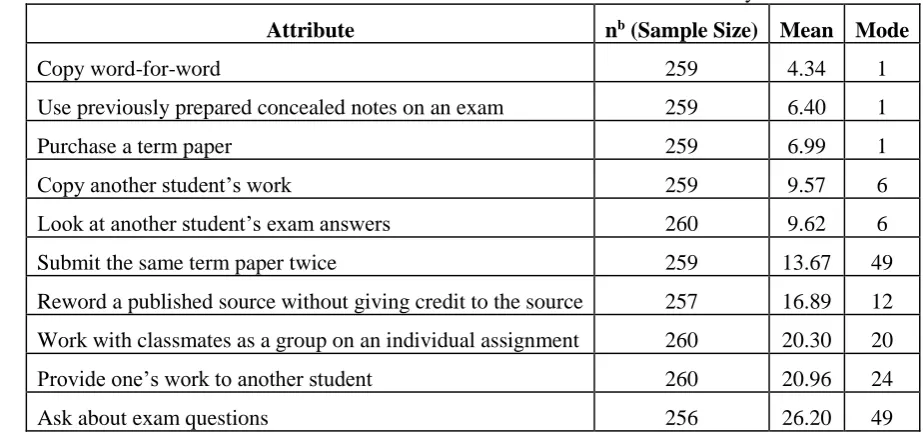
For each of the ten attributes of academic dishonesty measured (see Table 2), descriptive statistics associated with attitudes (the product of belief and feeling scores) are shown in Table 3.
Table 3. Attitudesa toward the attributes of academic dishonesty
Attribute nb (Sample Size) Mean Mode
Copy word-for-word 259 4.34 1
Use previously prepared concealed notes on an exam 259 6.40 1
Purchase a term paper 259 6.99 1
Copy another student’s work 259 9.57 6
Look at another student’s exam answers 260 9.62 6
Submit the same term paper twice 259 13.67 49
Reword a published source without giving credit to the source 257 16.89 12 Work with classmates as a group on an individual assignment 260 20.30 20
Provide one’s work to another student 260 20.96 24
Ask about exam questions 256 26.20 49
a = values for attitudes result from the product of a belief score and a feeling score for each attribute. b = the number of respondents answering both the belief and feeling questions allowing products to be calculated.
The higher the product (AO) for any attribute, the greater the respondent’s predisposition to be
academically dishonest with regards to this attribute, i.e. this is a case of an academically dishonest (supportive of unethical behavior) attitude. On the other hand, the lower this product, the greater is the predisposition to behave with academic integrity toward this attribute, i.e. this is a case of an academically honest (supportive of ethical behavior) attitude. To reiterate, the possible numerical scores for any one attribute of academic dishonesty range between 1 (extremely inappropriate/extremely unlikely or 1x1 = 1) and 49 (extremely appropriate/extremely likely or 7x7 = 49). The mid-point between the two extremes (neither/nor) is 16 (4x4). Thus, any score below 16 would be associated with an attitude supportive of ethical behavior toward that attribute and would be potentially contributing to academically honest behavior. Any score that is 16 or higher would be associated with an attitude supportive of unethical behavior toward that attribute and would be potentially contributing to academically dishonest behavior.
In terms of the individual attributes that composed a respondent’s overall attitude toward academic dishonesty as measured in this study, on average, respondents possessed the most integrity toward the following six attributes, in this order:
submitting a graded project containing content copied word-for-word from a published source without a proper citation;
using previously prepared concealed notes to improve exam answers;
submitting a term paper purchased from a term paper-writing firm;
submitting a graded project containing material copied from another student’s project;
Page 76
submitting the same term paper in two or more classes without permission.
This means that, on average, the respondents held the strongest attitudes opposed to the attribute of “submitting a graded project containing content copied word-for-word from a published source without a proper citation” and disapproved the most of this behavior.
On average, respondents had the least academic integrity with regards to the following four attributes, in this order:
submitting a graded project containing material from a published source that is rewritten in a student’s own words without a proper citation;
working with classmates as a group on a graded project assigned to be done individually;
providing another student with information from one’s graded project for inclusion in that other student’s project; and
asking another student who completed an exam in another section of the course about what questions are on the exam.
This means that the respondents had the least qualms of conscience with “asking another student who completed an exam in another section of the course about what questions are on the exam” and approved the most of this behavior.
Respondents’ attitudes may be considered supportive of ethical behavior toward the first six attributes in Table 3 because their mean scores were below 16. Attitudes may be considered supportive of unethical behavior with respect to the last four attributes in Table 3 because the mean scores were 16 or above. Attitudes supportive of ethical behavior are expected to contribute to academically honest behavior with respect to the first six attributes. Attitudes supportive of unethical behavior are expected to contribute to academically dishonest behavior with respect to the last four attributes.
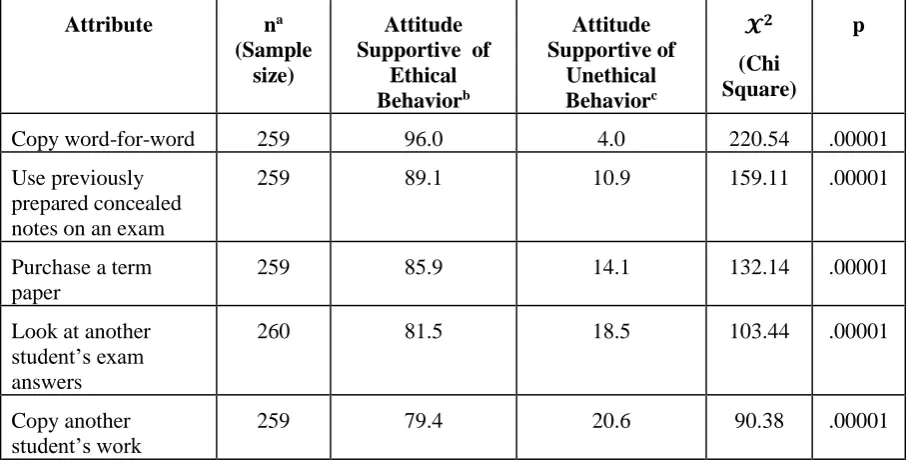
The percentage of respondents with attitudes supportive of ethical behavior could be calculated by summing the number of respondents scoring below 16 for each attribute and dividing this number by the total number of respondents for this attribute. Similarly, after adding the number of respondents scoring 16 or above for each attribute, the percentage of respondents with attitudes supportive of unethical behavior toward this attribute could be determined. These percentages are shown in Table 4.
Table 4. Percentage of respondents holding attitudes supportive of ethical behavior and attitudes supportive of unethical behavior toward the ten attributes of academic dishonesty
Attribute na
(Sample size)
Attitude Supportive of
Ethical Behaviorb
Attitude Supportive of
Unethical Behaviorc
𝓧𝟐
(Chi Square)
p
Copy word-for-word 259 96.0 4.0 220.54 .00001
Use previously prepared concealed notes on an exam
259 89.1 10.9 159.11 .00001
Purchase a term paper
259 85.9 14.1 132.14 .00001
Look at another student’s exam answers
260 81.5 18.5 103.44 .00001
Copy another
Page 77 Submit the same term
paper twice
259 68.5 31.5 34.84 .00001
Reword a published source without giving credit to the source
257 53.6 46.4 1.40 .23672
Work with classmates as a group on an individual assignment
260 36.7 63.3 18.84 .000014
Provide one’s work to another student
260 35.5 64.5 22.22 .00001
Ask about exam questions
256 27.0 73.0 54.40 .00001
a = the number of respondents answering both the belief and feeling questions allowing products to be calculated
b = the percentage of respondents scoring less than 16 on an attribute. c = the percentage of respondents scoring 16 or higher on an attribute.
Presented in this way, only the following three attributes show a majority (>50%) of respondents holding attitudes supportive of unethical behavior:
working with classmates as a group on a graded project assigned to be done individually;
providing another student with information from one’s graded project for inclusion in that other student’s project; and
asking another student who completed an exam in another section of the course about what questions are on the exam.
Chi Square goodness of fit tests for these three attributes were statistically significant beyond the .00001 level (see Table 4). This means that differences in percentages as large as those indicated in Table 4 were extremely unlikely to have occurred by chance alone. This claim could be made with essentially 100 percent confidence. The differences observed for the attribute “submitting a graded project containing material from a published source that is rewritten in the student’s own words without a proper citation” could have happened by chance. Because the probability associated with this attribute was greater than .05, the conclusion had to be drawn that no statistically significant difference existed in the percentage of respondents holding attitudes supportive of ethical behavior and attitudes supportive of unethical behavior. This means that the difference in percentages observed could be attributed to random sampling error, the play of chance alone. Therefore, on average, respondents were just as likely to engage in this activity as refrain from it.
4.1. Overall attitude toward academic dishonesty
Understanding respondents’ attitudes toward just some of the ten relevant attributes of academic dishonesty measured is insightful, but examining attributes individually does not indicate what respondents’ overall attitudes toward academic dishonesty are. According to the Fishbein model, to determine a respondent’s overall attitude, his or her attitudes for all attributes must be summed. Only by adding scores across all ten attributes can a respondent’s overall attitude toward academic dishonesty be determined.
Page 78
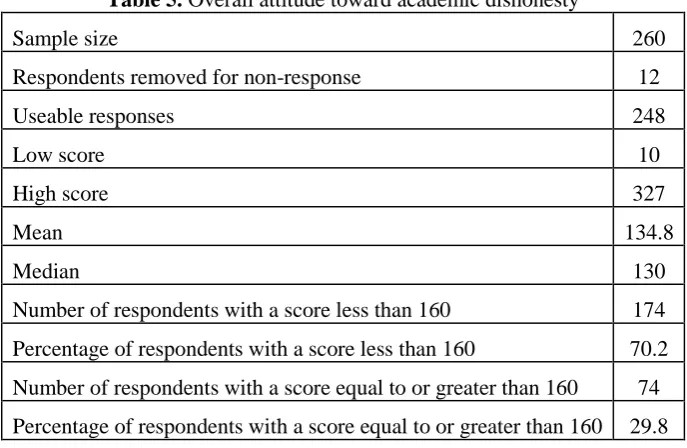
and those that are academically dishonest is 160 (neither/nor or 4x4 = 16 on all 10 attributes). Thus, a respondent having an overall score below 160 is considered to possess an overall attitude of academic integrity. Any respondent holding an overall score of 160 or higher is considered to have an overall attitude conducive to academic dishonesty. The summary results of the overall attitude scores for all 260 respondents in the sample are shown in Table 5.
Table 5. Overall attitude toward academic dishonesty
Sample size 260
Respondents removed for non-response 12
Useable responses 248
Low score 10
High score 327
Mean 134.8
Median 130
Number of respondents with a score less than 160 174 Percentage of respondents with a score less than 160 70.2 Number of respondents with a score equal to or greater than 160 74 Percentage of respondents with a score equal to or greater than 160 29.8
Multiplying a belief score by a feeling score is not possible when either the multiplicand or multiplier is missing. Therefore, twelve respondents were removed from the analysis because of non-response to at least one of the belief or feeling questions. As a result, calculations were based on 248 useable responses. Scores ranged from 10 to 327. The mean score was 134.8 which indicates that, on average, the respondents held attitudes that were somewhat supportive of ethical behavior (<160) for overall attitude toward academic dishonesty. Since the mean and median are close together (see Table 5), the sample distribution exhibits very little skew. Almost two-and-a-half times as many respondents (147 compared to 74) had an overall attitude score supportive of ethical behavior as those who had an overall attitude score supportive of unethical behavior. The respondents with an overall attitude score below 160 represented 70.2 percent of the sample, while those with a score of 160 or above were 29.8 percent of the sample. Therefore, approximately three respondents in ten possessed an overall attitude that predisposed them to academically dishonest behavior.
4.2. How respondent classification impacts attitudes
T-tests for independent samples were conducted to determine whether dichotomizing respondents by gender, class standing, GPA, and country of citizenship had any impact on attitude toward the individual attributes of academic dishonesty and on overall attitude toward academic dishonesty. Statistically significant differences in means were found to exist for various attributes in all classifications except country of citizenship. Where statistically significant differences were observed for gender, class standing, and GPA, those differences were unlikely to have occurred by chance alone. This claim can be made with a 95 percent confidence.
4.2.1. Gender
Page 79
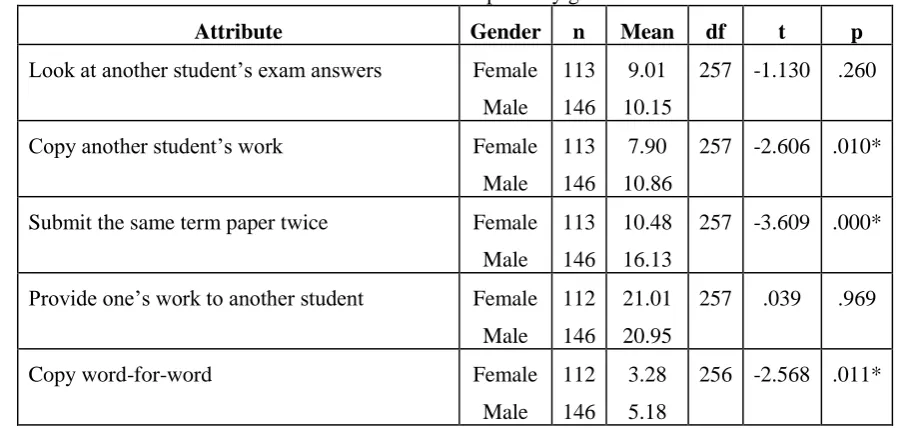
toward academic dishonesty. The following attributes showed t-values that were statistically significant beyond the = .05 level for a 2-tailed test assuming equal variances:
submitting a graded project containing material copied from another student’s project;
submitting the same term paper in two or more classes without permission;
submitting a graded project containing content copied word-for-word from a published source without a proper citation;
using previously prepared concealed notes to improve exam answers;
working with classmates as a group on a graded project assigned to be done individually;
submitting a term paper purchased from a term paper-writing firm; and
overall attitude toward academic dishonesty.
These attributes’ p-values are followed by an asterisk in Table 6. For six of the ten attributes, the mean score for the women was lower than the mean score for the men. This means that, on average, the men tended to have attitudes that could be more conductive to academic dishonesty with respect to these attributes than the women. Also, when all ten attributes were assessed collectively, the men were more likely than the women to have overall attitudes supporting more academically dishonest behavior. However, these findings are not really as inauspicious as may first appear. For only one attribute, where statistically significant differences occurred, the men’s average score above 16 and the women’s below 16 indicate that the men had a tendency toward academically dishonest behavior and the women toward academically honest behavior. This attribute was:
submitting the same term paper in two or more classes without permission.
For four of the attributes and overall attitude toward academic dishonesty where statistically significant differences resulted, even though the men scored more poorly than women, both the men and women recorded mean scores lower than 16. And, in one instance both the men and women had scores higher than 16. Also, in three instances where no statistically significant differences were found between men and women both recorded scores higher than 16 indicating the propensity to behave with academic dishonesty. Therefore, men were found to be less concerned about academically dishonest behaviors than women where statistically significant differences in mean scores were observed.
Table 6. Attitudes compared by gender
Attribute Gender n Mean df t p
Look at another student’s exam answers Female
Male 113 146
9.01 10.15
257 -1.130 .260
Copy another student’s work Female
Male 113 146
7.90 10.86
257 -2.606 .010*
Submit the same term paper twice Female Male
113 146
10.48 16.13
257 -3.609 .000*
Provide one’s work to another student Female
Male 112 146
21.01 20.95
257 .039 .969
Copy word-for-word Female
Male 112 146
3.28 5.18
Page 80 Use previously prepared concealed notes on
an exam
Female Male
113 145
5.38 7.23
256 -2.018 .045*
Ask about exam questions Female
Male 112 145
25.71 26.32
255 -.339 .735
Work with classmates as a group on an individual assignment
Female Male
113 146
18.19 21.95
257 -2.559 .011*
Reword a published source without giving credit to the source
Female Male
112 146
17.00 16.68
256 .215 .830
Purchase a term paper Female
Male 112 146
4.54 8.89
256 -3.855 .000*
Overall attitude toward academic dishonesty Female Male
106 141
122.06 145.06
245 -3.056 .002*
* = p < .05
4.2.2. Class standing
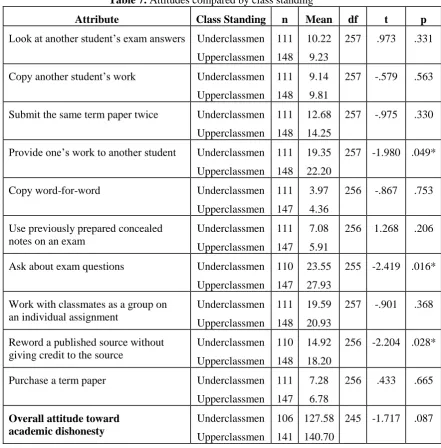
Respondents were also grouped according to the number of credit hours completed and classified as underclassmen (freshmen and sophomores) or upperclassmen (juniors and seniors). Statistically significant differences in means were found for class standing in only three of the ten attributes of academic dishonesty measured. See Table 7 for the results of the t-tests.
The following three attributes showed mean differences that were statistically different between underclassmen and upperclassmen beyond the = .05 level for a 2-tailed test assuming equal variances:
providing another student with information from one’s work on a graded project for inclusion in that other student’s project;
asking another student who completed an exam in another section of the course about what questions are on the exam; and
submitting a graded project containing material from a published source that is rewritten in the student’s own words without a proper citation.
Page 81
Table 7. Attitudes compared by class standing
Attribute Class Standing n Mean df t p
Look at another student’s exam answers Underclassmen
Upperclassmen 111 148
10.22 9.23
257 .973 .331
Copy another student’s work Underclassmen Upperclassmen
111 148
9.14 9.81
257 -.579 .563
Submit the same term paper twice Underclassmen Upperclassmen
111 148
12.68 14.25
257 -.975 .330
Provide one’s work to another student Underclassmen
Upperclassmen 111 148
19.35 22.20
257 -1.980 .049*
Copy word-for-word Underclassmen
Upperclassmen 111 147
3.97 4.36
256 -.867 .753
Use previously prepared concealed notes on an exam
Underclassmen Upperclassmen 111 147 7.08 5.91
256 1.268 .206
Ask about exam questions Underclassmen Upperclassmen
110 147
23.55 27.93
255 -2.419 .016*
Work with classmates as a group on an individual assignment
Underclassmen Upperclassmen 111 148 19.59 20.93
257 -.901 .368
Reword a published source without giving credit to the source
Underclassmen Upperclassmen 110 148 14.92 18.20
256 -2.204 .028*
Purchase a term paper Underclassmen Upperclassmen
111 147
7.28 6.78
256 .433 .665
Overall attitude toward academic dishonesty Underclassmen Upperclassmen 106 141 127.58 140.70
245 -1.717 .087
* = p < .05
4.2.3. Grade Point Average (GPA)
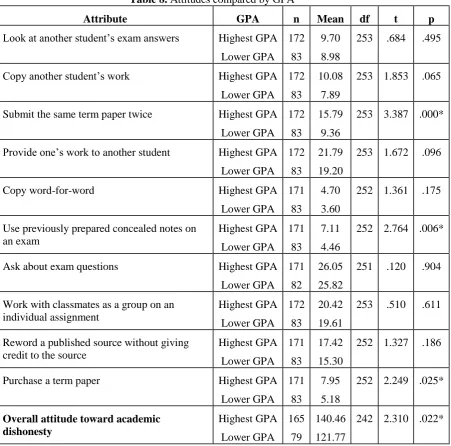
For analytical purposes, respondents were arbitrarily divided into two groups based on GPA. One group included respondents with the highest GPAs (3.5 or above on a 4.0 scale). The other group contained respondents with lower GPAs (under 3.5). Although arbitrary, the GPA dividing the groups was selected, so that each group contained enough respondents to permit the statistical tests to be valid. Five respondents – first semester freshmen – had completed no coursework and, therefore, had no GPAs. Thus, n = 255, of which 83 (32.5 percent) had GPAs of 3.5 or above and 172 (67.5 percent) had GPAs below 3.5. Three of the ten attributes of academic dishonesty and overall attitude toward academic dishonesty exhibited statistically significant differences in means beyond the = .05 level for a 2-tailed test assuming equal variances. The results of the t-tests for GPA are shown in Table 8.
Page 82
submitting the same term paper in two or more classes without permission;
using previously prepared concealed notes to improve exam answers;
submitting a term paper purchased from a term paper-writing firm; and
overall attitude toward academic dishonesty.
Table 8. Attitudes compared by GPA
Attribute GPA n Mean df t p
Look at another student’s exam answers Highest GPA
Lower GPA 172
83
9.70 8.98
253 .684 .495
Copy another student’s work Highest GPA
Lower GPA 172
83
10.08 7.89
253 1.853 .065
Submit the same term paper twice Highest GPA Lower GPA
172 83
15.79 9.36
253 3.387 .000*
Provide one’s work to another student Highest GPA
Lower GPA 172
83
21.79 19.20
253 1.672 .096
Copy word-for-word Highest GPA
Lower GPA 171
83
4.70 3.60
252 1.361 .175
Use previously prepared concealed notes on an exam Highest GPA Lower GPA 171 83 7.11 4.46
252 2.764 .006*
Ask about exam questions Highest GPA Lower GPA
171 82
26.05 25.82
251 .120 .904
Work with classmates as a group on an individual assignment Highest GPA Lower GPA 172 83 20.42 19.61
253 .510 .611
Reword a published source without giving credit to the source
Highest GPA Lower GPA 171 83 17.42 15.30
252 1.327 .186
Purchase a term paper Highest GPA
Lower GPA 171
83
7.95 5.18
252 2.249 .025*
Overall attitude toward academic dishonesty Highest GPA Lower GPA 165 79 140.46 121.77
242 2.310 .022*
* = p < .05
Page 83 4.2.4. Country of citizenship
Because students from about 40 different countries attended the studied university at the time of this research, the number of respondents from almost all countries except for Bulgaria was too small to permit valid statistical analysis. To permit statistical comparisons, citizenship was divided into two groups – Bulgarian and non-Bulgarian. The sample consisted of 61.3 percent Bulgarian citizens and 38.7 percent non-Bulgarian citizens. T-tests produced no statistically significant differences between means for any of the attributes of academic dishonesty or overall attitude toward academic dishonesty.
5. DISCUSSION AND CONCLUSION
The research results indicated that 70.2 percent of respondents had an overall attitude toward academic dishonesty score below 160. This implies that a significant majority of students at the studied liberal-arts university held attitudes that conformed to academically honest behavior. This is particularly encouraging because students from Eastern Europe and Central Asia have been found to be culturally inclined toward a tendency to sanction and tolerate academic dishonesty (Poltorak 1995; Yukhymenko-Lescroart 2014). Despite this broadly positive finding, other less gratifying observations are also implied.
The three attributes of academic dishonesty toward which respondents held attitudes that were the most supportive of unethical behavior in terms of percentage of respondents (see Table 4) happened to be in the same category of the four categories from Table 1 – “unauthorized collaboration”. Such collaboration is usually considered a minor offense (McCabe, Butterfield & Treviño 2012; Stone et al. 2014). These attributes were:
working with classmates as a group on a graded project assigned to be done individually;
providing another student with information from one’s graded project for inclusion in that other student’s project; and
asking another student who completed an exam in another section of the course about what questions are on the exam.
Results indicated that 63 to 73 percent of the respondents possessed attitudes that were consistent with academically dishonest behavior toward these three attributes. Thus, the answer to the first research question is that the students surveyed were more supportive of minor academic offenses than of major offenses, consistent with the literature on the severity of student academic misconduct.
Why such large percentages related to unauthorized collaboration? Perhaps, this aspect of the students’ training in academic integrity was deficient in some ways. Guidance on what constitutes unauthorized collaboration at the studied institution may have been inadequate or the emphasis on not engaging in unauthorized collaboration may have been insufficient. Also, unauthorized collaboration, an instance of collusion, may have been perceived as difficult to detect and, therefore, as less likely to be caught compared to the activities in the other three categories of academic dishonesty; thus, unauthorized collaboration may have been attractive to students. Topalli (2005) calls this helping behavior ‘appealing to higher loyalty.’ Helping behavior is usually perceived as altruistic and, as far as cheating is concerned, such behavior may have been viewed by students as a cheating justification. In collectivist societies (Hofstede 2001), such as these in Eastern Europe, solidarity, even unfair solidarity, tends to be highly valued. People in such societies may tend to value ‘higher loyalties,’ such as friendships, more than ethics.
Page 84
unauthorized collaboration may contribute to potentially dishonest academic and, later on, work place-related behavior.
Although respondents’ attitudes toward the following three attributes were supportive of ethical behavior (see Table 4), the percentage of respondents with attitudes supportive of unethical behavior was substantial enough to be considered undesirable:
submitting a graded project containing material copied from another student’s project;
submitting the same term paper in two or more classes without permission; and
submitting a graded project containing material from a published source that is rewritten in the student’s own words without a proper citation.
Between 21 and 46 percent of the respondents had attitudes consistent with academically dishonest behavior toward these three attributes. Copying another student’s work for submission as one’s own and rewording material from a published source in one’s own words without giving credit to the source are behaviors in the category of plagiarism (see Table 2). Submitting the same term paper to more than one class is in the category of deceit (see Table 2). The respondents did not view these behaviors as critically as they should have probably because all these behaviors may have been perceived as saving them significant amounts of time and effort toward a desirable benefit – a good grade. These may have been viewed as minor instances of academic dishonesty. Topalli (2005) sees such unethical behavior as being motivated by justifications and excuses. Specific examples of such justifications and excuses, according to this author, include: ‘denial of the injury’ in the sense that cheating hurts no one, ‘denial of the victim’ in the sense that everybody cheats, and ‘condemnation of the condemners’ in the sense that professors may sometimes give unfair exams. McCabe, Butterfield & Treviño (2012) found that such instances of cheating were viewed as consequences of pressures to cheat and as a way to get ahead in a competitive life.
A paradox appears to exist between respondents’ attitudes toward the two attributes of providing their work for a graded assignment to another student to use in preparing his or her assignment (unauthorized collaboration category; see Table 2) and submitting an assignment containing material copied from another student’s work (plagiarism category; see Table 2). The respondents had attitudes supportive of ethical behavior with respect to not copying from another student (79.4 percent supportive of this ethical behavior) but at the same time they had attitudes supportive of unethical behavior with respect to permitting classmates to copy their work (35.5 percent supportive of ethical behavior). Thus, providing assistance was viewed as being alright but receiving assistance was not. Assistance cannot be given without having obtained permission to receive it and therein lies the paradox. However, these findings are not necessarily inconsistent with each other because a few students may have been receiving inappropriate assistance from a lot of people supplying the inappropriate assistance. Perhaps, the old adage that “it is better to give than to receive” may explain this paradox. In any event, emphasizing the fact that academic integrity requires neither giving, nor receiving inappropriate assistance needs to be better acknowledged, stressed, and reinforced by university faculty and administrators.
Page 85
Although not so strong as for gender, GPA was also found to influence attitudes toward academic dishonesty. This finding is consistent with those of previous studies (Crittenden, Hanna & Peterson 2009; McCabe & Treviño 1997; Teodorescu & Andrei 2009). Students with the highest GPAs (3.5 and above) tended to have attitudes that were less supportive of academically honest behavior than students with lower GPAs (under 3.5). The implication is that academically weaker students are more likely to hold attitudes consistent with academically honest behavior. The reason for this is not easily deduced. Perhaps, academic dishonesty may be viewed as one way of improving one’s GPA. Such a view could cause dishonest behavior to be perceived as necessary for ‘getting ahead’ (Simkin & McLeod 2010) by maintaining a high GPA. Another possible explanation is that higher education recruitment may favor students with strong high school GPAs, some of whom may have earned these GPAs by dishonest means.
Class standing was found to weakly influence attitudes toward academic dishonesty. Although only three attributes were found to have statistically significant means beyond the .05 level, overall attitude toward academic dishonesty was significant at the .087 level (see Table 7). This means that a statistically significant difference can be claimed but only with slightly less confidence – 91.3 percent rather than 95 percent. The results of this study are consistent with those of previous studies that found that upperclassmen were more likely to be dishonest than underclassmen (Jordan 2001; Teixeira & Rocha 2010). However, other studies have shown just the opposite to be true (Dawkins 2004; Lin & Wen 2007). Perhaps, the weak association found in this study is indicative of the inconsistency of results found in previous studies.
Country of citizenship did not influence attitudes toward academic dishonesty. The reason that no significant differences were found between Bulgarian students and students from other countries may be that students from Eastern European and Central Asian countries are similar in the way they view academic dishonesty. Countries in these geographical areas tend to host collectivist, rather than individualist, societies (Hofstede 2001). Previous research has shown that students are highly influenced by the norms of collectivist societies (McCabe et al. 2008). Therefore, students from these countries may be expected to hold comparable attitudes.
Based on the above findings, the answer to the second research question is that students’ overall attitude toward academic dishonesty was found to be supportive of ethical academic behavior. However, room for improvement still remains. Strengthening efforts to instill the personal, organizational and societal benefits of behaving with academic integrity in students remains important to the objective of developing well-rounded, ethical, and liberally-educated students. Also, graduating students of academic integrity is important because such attitudes reinforce the legitimacy of the degrees and other credentials universities bestow upon them (McCabe, Butterfield & Treviño, 2012). Attitudes feed behavior. Unethical and fraudulent behavior amidst management and business leadership does not benefit society in any way. Therefore, attention to the ethical aspects of university education is vital. Since this study is exploratory in nature, its results cannot be used to explain why the relationships observed exist. The study may serve however as a basis of further discussion for future explanatory research on academic ethics. Thus, an understanding of relationships found may be reached. This study demonstrates the need for additional research on academic integrity in the Eastern European context, such as:
determining how the attributes examined interact and impact on one another;
determining what training procedures help improve students’ attitudes toward behaving with academic integrity;
determining what content should be included in educating students about how to behave with academic integrity;
explaining how training in academic integrity impacts attitude;
Page 86
determining how attitudes toward academic integrity are correlated with behavior.
Student attitudes toward various types of academically dishonest behavior in the setting of an American-style liberal-arts college in Bulgaria were presented in this study. Attitudes are known to be one significant influencing factor of behavior. However, other factors, such as an individual’s personal characteristics (for example, strength of moral character and ethical sensitivity), cultural environment (for example, religion and social norms), peer pressure, and perception of alternatives can also influence behavior. The authors hope this research will trigger additional academic studies on student attitudes toward academic integrity set in the context of Bulgaria and Eastern Europe given the growing economic, social, and political importance of the region.
REFERENCES
Ajzen, I 1991, ‘Theory of planned behavior’, Organizational Behavior and Human Decision Processes, vol. 50, no. 2, pp. 179-211.
Ajzen, I & Fishbein, M 1980, Understanding attitudes and predicting social behavior, Prentice-Hall, Englewood Cliffs, NJ.
Blankenship, KL & Whitley, Jr. BE 2000, ‘Relation of general deviance to academic dishonesty’, Ethics & Behavior, vol. 10, no. 1, pp. 1-12.
Bowers, WJ 1964, Student dishonesty and its control in college, Columbia University’s Bureau of Applied Social Research, New York, NY.
Brown, BS & Abramson, J 1999, ‘The academic ethics of undergraduate marketing majors’, Academy of Marketing Studies Journal, vol. 3, no. 1, pp. 62-71.
Brown, BS & Emmett D 2001, ‘Explaining variations in the level of academic dishonesty in studies of college students: Some new evidence’, College Student Journal, vol. 35, no. 4, pp. 529-538.
Brown, BS & McInerney, M 2001, ‘The academic ethics of business management students: A lesson for professors’, International Journal of Business Disciplines, vol. 11, no. 3, pp. 79-88.
Brown, BS & McInerney M 2008, ‘Changes in academic dishonesty among business students in the United States, 1999-2006’, International Journal of Management, vol. 25, no. 3, pp. 621-632.
Brownell, HC 1928, ‘Mental traits of college cribbers’, School and Society, vol. 27, p. 764.
Chapman, KJ & Lupton, RA 2004, ‘Academic dishonesty in a global educational market: A comparison of Hong Kong and American university business students’, International Journal of Educational Management, vol. 18, no. 7, pp. 425-435.
Cole, S & McCabe, DL 1996, ‘Issues in academic integrity’, in W.L Mercer (ed.), Critical issues in judicial affairs: Current trends in practice: New directions for student services, vol. 73, spring, pp. 66-77, Jossey-Bass, San Francisco, CA.
Crittenden, VL, Hanna, RC & Peterson, RA 2009, ‘The cheating culture: A global societal phenomenon. Business Horizons’, vol. 52, no. 4, pp. 337-346.
Dawkins, RL 2004, ‘Attributes and statuses of college students associated with classroom cheating on a small-sized campus’, College Student Journal, vol. 38, no. 1, pp. 116-129.
Genereux, RL & McLeod, BA 1995, ‘Circumstances surrounding cheating: A questionnaire study of college students’, Research in Higher Education, vol. 36, no. 6, pp. 687-704.
Grimes, PW 2004, ‘Dishonesty in academics and business: A cross-cultural evaluation of student attitudes’, Journal of Business Ethics, vol. 49, no. 3, pp. 273-290.
Page 87
Harding, TS, Carpenter, DD, Finelli, CJ & Passow, HJ 2004, ‘Does academic dishonesty relate to unethical behavior in professional practice? An exploratory study’, Science and Engineering Ethics, vol. 10, no. 2, pp. 311-324.
Harding, TS, Mayhew, MJ, Finelli, CJ & Carpenter, DD 2007, ‘The theory of planned behavior as a model of academic dishonesty in engineering and humanities undergraduates’, Ethics & Behavior, vol. 17, no. 3, pp. 255-279.
Heyneman, SP, Anderson, KH & Nuraliyeva, N 2007, ‘The cost of corruption in higher education’, Comparative Education Review, vol. 52, no. 1, pp. 1-25.
Hofstede, G 2001, Culture’s consequences: Comparing values, behaviors, institutions, and organizations across nations, 2nd edn, Sage Publications, Thousand Oaks, CA.
Jensen, L, Arnett, J, Feldman, S & Cauffman, E 2002, ‘It’s wrong, but everybody does it: Academic dishonesty among high school and college students’, Contemporary Educational Psychology, vol. 27, no. 2, pp. 209-228.
Jordan, AE 2001, ‘College student cheating: The role of motivation, perceived norms, attitudes, and knowledge of institutional policy’, Ethics & Behavior, vol. 11, no. 3, pp. 233-247.
Lambert, EG, Hogan, NL & Barton, SM 2003, ‘Collegiate academic dishonesty revisited: What have they done, how often have they done it, who does it, and why did they do it?’ Electronic Journal of Sociology, viewed 24 January 2018, <http://www.sociology.org/content/vol7.4/lambert_etal.html>. Lawson, R 2004, ‘Is classroom cheating related to business students’ propensity to cheat in the “real world”?’, Journal of Business Ethics, vol. 49, no. 2, pp. 189-199.
Lin, C-H S & Wen, L-Y M 2007, ‘Academic dishonesty in higher education – a nationwide study in Taiwan’, Higher Education, vol. 54, no. 1, pp. 85-97.
Lupton, RA & Chapman, KJ 2002, ‘Russian and American college students’ attitudes, perceptions and tendencies towards cheating’, Educational Research, vol. 44, no. 1, pp. 17-27.
Lupton, RA, Chapman, KJ & Weiss, JE 2000, ‘A cross-national exploration of business students’ attitudes, perceptions, and tendencies toward academic dishonesty’, Journal of Education for Business, vol. 75, no. 4, pp. 231-235.
McCabe, DL & Bowers, WJ 1994, ‘Academic dishonesty among ales in college: A thirty year perspective’, Journal of College Student Development, vol. 35, no. 1, pp. 5-10.
McCabe, DL, Butterfield, KD & Treviño, LK 2012, Cheating in college: Why students do it and what educators can do about it, Johns Hopkins University Press, Baltimore, MD.
McCabe, DL, Feghali, T & Abdallah, H 2008, ‘Academic dishonesty in the Middle East: Individual and contextual factors’, Research in Higher Education, vol. 49, no. 5, pp. 451-467.
McCabe, DL & Treviño, LK 1993, ‘Academic dishonesty: Honor codes and other contextual influences’ Journal of Higher Education, vol. 64, no. 5, pp. 522-538.
McCabe, DL & Treviño, LK 1996, ‘What we know about cheating in college: Longitudinal trends and recent developments’, Change, vol. 28, no. 1, pp. 29-33.
McCabe, DL & Treviño, LK 1997, ‘Individual and contextual influences on academic dishonesty: A multicampus investigation’ Research in Higher Education, vol. 38, no. 3, pp. 379-396.
Meade, J 1992, ‘Cheating: Is academic dishonesty par for the course?’ Prism, vol. 1, no. 7, pp. 30-32.
Miller, A, Shoptaugh, C & Parkerson, A 2008, ‘Under reporting of cheating in research using volunteer college students’, College Student Journal, vol. 42, no. 2, pp. 326-339.
Page 88
Nonis, S & Swift, CO 2001, ‘An examination of the relationship between academic dishonesty and workplace dishonesty: A multicampus investigation’, Journal of Education for Business, vol. 77, no. 2, pp. 69-77.
Philmore, A & Phillips, K 2011, ‘Exploring academic dishonesty among university students in Barbados: An extension to the theory of planned behavior’, Journal of Academic Ethics, vol. 9, no. 4, pp. 323-338.
Poltorak, Y 1995, ‘Cheating behavior among students of four Moscow institutes. Higher Education, vol. 30, no. 2, pp. 225-24.
Preiss, M, Klein, HA, Levenburg, NM & Nohavova, A 2013 ‘A cross-country evaluation of cheating in academia – A comparison of data from the US and the Czech Republic’, Journal of Academic Ethics, vol. 11, no. 2, pp. 157-167.
Rowe, NC 2004, ‘Cheating in online student assessment: Beyond plagiarism’, Calhoun Institutional Archive of the Naval Postgraduate School, pp. 1-8, viewed 20 January 2018, <https://calhoun.nps.edu/bitstream/handle/10945/36015/Rowe_Cheating_in_Online_Student_Assessm ent.pdf?sequence=1&isAllowed=y>.
Simkin, M & McLeod, A 2010, ‘Why do college students cheat?’ Journal of Business Ethics, vol. 94, no. 3, pp. 441-453.
Sims, RL 1993, ‘The relationship between academic dishonesty and unethical business practices’, Journal of Education for Business, vol. 68, no. 4, pp. 207-211.
Spiller, S. & Crown, D 1995, ‘Changes over time in academic dishonesty at the collegiate level’, Psychological Reports, vol. 76, no. 3, pp. 763-768.
Stone, TH, Jawahar, IM & Kisamore, JL 2009, ‘Using the theory of planned behavior and cheating justifications to predict academic misconduct’, Career Development International, vol. 14, no. 3, pp. 221-241.
Stone, TH, Jawahar, IM & Kisamore, JL 2010, ‘Predicting academic misconduct intentions and behavior using the theory of planned behavior and personality’, Basic and Applied Social Psychology, vol. 32, no. 1, pp. 35-45.
Stone, TH, Kisamore, JL, Jawahar, IM & Bolin, JH 2014, ‘Making our measures match perceptions: Do severity and type matter when assessing academic misconduct offenses?’, Journal of Academic Ethics, vol. 12, no. 4, pp. 251-270.
Teixeira, A & Rocha, M 2010, ‘Cheating by economics and business undergraduate students: An exploratory international assessment’, Higher Education, vol. 59, no. 6, pp. 663-701.
Teodorescu, D & Andrei, T 2009, ‘Faculty and peer influences on academic integrity: College cheating in Romania’, Higher Education, vol. 57, no. 3, pp. 267-282.
Topalli, V 2005, ‘When being good is bad: An expansion of neutralization theory’, Criminology, vol. 43, no. 3, pp. 797-835.
Trafimow, D, & Fishbein M 1994, ‘The moderating effect of behavior type on the subjective norm-behavior relationship’, Journal of Social Psychology, vol. 134, no. 6, pp. 755-763.
Wei, T, Chesnut, SR, Barnard-Brak, L & Schmidt, M 2014, ‘University students’ perceptions of academic cheating: Triangulating quantitative and qualitative findings’, Journal of Academic Ethics, vol. 12, no. 4, pp. 287-298.
Whitley, Jr., BE 1998, ‘Factors associated with cheating among college students: A review’, Research in Higher Education, vol. 39, no. 3, pp. 235-274.
Page 89
Wilson, BA 2008, ‘Predicting intended unethical behavior for business students’, Journal of Education for Business, vol. 83, no. 4, pp. 187-195.
Yeo, S 2007, ‘First-year university science and engineering students’ understanding of plagiarism’, Higher Education Research and Development, vol. 6, no. 2, pp. 199–216.