Open Access
Research article
Contextual adaptation of the Personnel Evaluation Standards for
assessing faculty evaluation systems in developing countries: the
case of Iran
Soleiman Ahmady*
1,2,3,4,8, Tahereh Changiz
4, Mats Brommels
5, F
Andrew Gaffney
6, Johan Thor
7and Italo Masiello
8Address: 1Department of Learning, Informatics, Management, and Ethics, Karolinska Institutet, Stockholm, Sweden , 2Educational Development
Center, Urmia University of Medical Sciences, Urmia, Iran, 3National Public health Management Center, Tabriz University of Medical Sciences,
Tabriz, Iran, 4Medical Education Research Center, Isfahan University of Medical Sciences, Iran, 5Medical Management Centre, Department of
Learning, Informatics, Management, and Ethics, Karolinska Institutet, Stockholm, Sweden, and Department of Public Health, University of Helsinki, Finland, 6Vanderbilt University School of Medicine, Nashville, Tennessee, USA, 7Medical Management Centre, Department of Learning,
Informatics, Management, and Ethics, Karolinska Institutet, Stockholm, Sweden and 8Centre for Medical Education, Department of Learning,
Informatics, Management, and Ethics, Karolinska Institutet, Stockholm, Sweden
Email: Soleiman Ahmady* - [email protected]; Tahereh Changiz - [email protected]; Mats Brommels - [email protected]; F Andrew Gaffney - [email protected]; Johan Thor - [email protected]; Italo Masiello - [email protected]
* Corresponding author
Abstract
Background: Faculty evaluations can identify needs to be addressed in effective development programs. Generic evaluation models exist, but these require adaptation to a particular context of interest. We report on one approach to such adaptation in the context of medical education in Iran, which is integrated into the delivery and management of healthcare services nationwide.
Methods: Using a triangulation design, interviews with senior faculty leaders were conducted to identify relevant areas for faculty evaluation. We then adapted the published checklist of the Personnel Evaluation Standards to fit the Iranian medical universities' context by considering faculty members' diverse roles. Then the adapted instrument was administered to faculty at twelve medical schools in Iran.
Results: The interviews revealed poor linkages between existing forms of development and evaluation, imbalance between the faculty work components and evaluated areas, inappropriate feedback and use of information in decision making. The principles of Personnel Evaluation Standards addressed almost all of these concerns and were used to assess the existing faculty evaluation system and also adapted to evaluate the core faculty roles. The survey response rate was 74%. Responses showed that the four principles in all faculty members' roles were met occasionally to frequently. Evaluation of teaching and research had the highest mean scores, while clinical and healthcare services, institutional administration, and self-development had the lowest mean scores. There were statistically significant differences between small medium and large medical schools (p < 0.000).
Conclusion: The adapted Personnel Evaluation Standards appears to be valid and applicable for monitoring and continuous improvement of a faculty evaluation system in the context of medical universities in Iran. The approach developed here provides a more balanced assessment of multiple faculty roles, including educational, clinical and healthcare services. In order to address identified deficiencies, the evaluation system should recognize, document, and uniformly reward those activities that are vital to the academic mission. Inclusion of personal developmental concerns in the evaluation discussion is essential for evaluation systems.
Published: 28 April 2009
BMC Medical Education 2009, 9:18 doi:10.1186/1472-6920-9-18
Received: 22 September 2008 Accepted: 28 April 2009
This article is available from: http://www.biomedcentral.com/1472-6920/9/18
© 2009 Ahmady et al; licensee BioMed Central Ltd.
Background
Performance evaluation of university faculty has received increased attention in recent years [1-4]. The intention is to improve faculty performance, professional develop-ment and healthcare practice. Given the importance of performing faculty evaluation in a reliable and valid man-ner, many medical schools today are searching for ways to effectively and constructively evaluate faculty perform-ance and ways to implement evaluation systems that are fair and standardized across departments [4-6].
In this study "faculty evaluation" is defined as formal measures made by academic authorities in medical schools to assess the academic performance of faculty members. These assessments result in a judgment about faculty performance and may be followed by either posi-tive or negaposi-tive promotion decisions. Thus, faculty evalua-tion system refers to the inter-related elements and processes that produce evaluation data, and provide use-ful performance feedback. By this definition, a compre-hensive faculty evaluation system proposes to systematically and fairly document and evaluate academic activities, ie, all activities related to teaching, research, administration and services [7-10].
Continuous professional development of faculty has also become an issue among authorities, policymakers, and leaders of academic institutions and healthcare delivery organizations. The reason for this is that faculty evalua-tion could provide relevant and reliable informaevalua-tion on which to base promotion, tenure, merit pay and/or for personal growth and improvement[6,10]. However, for optimal effectiveness, faculty evaluation systems should be linked to faculty development programs.
A variety of approaches on faculty evaluation have been reviewed by Bland et al[4]. For instance, the authors present a goal-based approach in which faculty members would prepare annual goals and be evaluated at the end of the year on goal accomplishment. Colbeck[11] presents an integrated faculty work approach (integration of two methods for evaluating: workload report and annual reports method). Another approach, is to apply an institu-tion-wide comprehensive system for faculty evalua-tion[7,12]. Arreola states[12] that there should be four key elements for the design of a faculty evaluation system: (i) establishing a good fit between the system and the envi-ronment, (ii) securing strong faculty involvement, (iii) providing not only feedback on faculty members' per-formances but also (iv) developing opportunities to improve their future performance. So, a comprehensive faculty evaluation approach should take a multi-dimen-sional view in which information is provided by students, colleagues, academic administrators, and faculty mem-bers themselves as self-evaluators[2,13-15].
Developing and implementing effective faculty evaluation systems is challenging[7]. Many stumbling blocks are dis-cussed in the literature, including: a dominance of admin-istrative summative purposes in faculty evaluations, faculty resistance, over-reliance on student opinions, over-reliance on self-report data, and administrative disin-terest[6]. Of those, two are believed by Arreola[5,16] to be major ones: faculty resistance and administrators' apathy. Also several solutions have been proposed. For instance, developing and using a comprehensive faculty evaluation system by considering all academic activities of faculty members[7], or also adopting the Personnel Evaluation Standards, which can address the technical process (build-ing reliable and valid measurement tools) and the politi-cal process (building consensus around shared values)[17].
Personnel Evaluation Standards (hereafter referred to as the Standards) provide a systematically developed and widely endorsed basis for evaluation of personnel evalua-tion systems [17-20]. Recognized Standards are those issued by the Joint Committee on Standards for Educa-tional Evaluation. These Standards are organized into four basic principles of sound evaluation: Utility (how to make evaluations more useful and more often used), Feasibility (how feasibly to conduct evaluations in the real world where little can be controlled and politically difficult situ-ations abound), Propriety (how to ensure propriety in all aspects of the evaluation), and Accuracy (how to promote accurate and dependable evaluation). These are described as "four main concerns about any evaluation", and each incorporates several standard measures[19,20].
The Standards have been used for evaluating the qualifica-tions and performance of teachers and other educa-tors[17,21,22]. Hence, universities and other educational institutions may use the Standards to develop a checklist of basic requirements of their evaluation systems, both to assure that they are sound and to guide needed or desira-ble improvements. Thus, adaptation of the Standards for faculty evaluation systems in medical schools can assure a systematic approach, and help acknowledge faculty's mul-tiple academic roles.
evaluation and development remains an open question. Furthermore, there is limited empirical data on attempts to link faculty development activities to faculty evaluation in order to continuously maintain and improve faculty performance and achieve high quality healthcare.
The current faculty evaluation system in Iranian medical schools is based on a highly refined checklist with ques-tionnaires related to the quantity and quality of teaching in classroom (classroom instruction/effectiveness). It relies also heavily on students opinions. On the other hand, decisions on faculty promotion and tenure mainly depend on the quantity and quality of their scientific pub-lications. So, it seems that other important components and responsibilities of faculty members are relatively neglected or weighted differently[1,4,8], as for instance the performance of clinical and community healthcare delivery[24].
A recent study on the faculty development system in Ira-nian medical schools showed that most schools lack an integrated system that provides medical faculty with rele-vant and appropriate opportunities for professional devel-opment. One of the major challenges was the poor linkage between faculty development and evaluation sys-tems[26]. The main reason behind this problem might be a failure of the evaluation system. Without a standardized, systematic and fair approach to faculty evaluation, the process becomes a threat and the antithesis of effective evaluation and development[5]. The necessity and chal-lenges related to establishing such a linkage have been shown before[27]. This not only requires accountability from both medical schools leaders and faculty members, but also necessitates a well established system for faculty evaluation and development.
The purpose of this study is to develop a foundation for the design of a comprehensive national approach to med-ical faculty evaluation by examining i) the views on eval-uation of faculty members in managerial and leadership position in Iranian medical universities, ii) which areas and components of faculty work should be evaluated, and iii) whether adaptation of the Standards will enable eval-uation that addresses all roles and responsibilities of fac-ulty members.
Methods
Research DesignOur research strategy utilized a three-step evaluation. First, senior faculty input was sought in order to learn about faculty evaluation in Iran. Second, the data were used to map against the Standards and adapt a new instru-ment to the Iranian context. And third, a broader perspec-tive then was explored through a national survey. Hence,
this study employed methodological triangulation with qualitative and quantitative data collection.
Semi-structured interviews
Semi-structured interviews were used to explore knowl-edge and perceptions of senior faculty leaders and to gain a better understanding about the current faculty evalua-tion process in Iran. An interview protocol was developed using a number of questions designed to allow respond-ents to focus on the topics and issues that they considered most important about their experiences in faculty evalua-tion. In this qualitative approach, randomization to select informants was not a primary concern, so a strategic or purposive sample of key informants was used to interview senior faculty leaders who have extensive knowledge, and experience performing faculty evaluations. In addition, maximal variation sampling was used by selecting inter-viewees with different responsibilities and levels of exper-tise in different levels of medical universities and the Ministry of Health and Medical Education. All partici-pants were approached personally by SA, consented to be interviewed and to the audio-taping of the interview. All tape-recorded interviews were transcribed verbatim by the same author. Analysis was performed using qualitative content method. The transcripts were analyzed and checked for accuracy by sending them back to the inter-viewees who were asked to report whether the text gave an accurate representation of the interview ('member check-ing'). In addition, to validate the findings transcripts were read and coded independently by two researchers (SA and a third-party investigator). Any difference was resolved by subsequent discussion. To reduce the data we constructed
meaning units throughout the analysis process. Then we extracted a short description of meaning units. These descriptions were then further condensed, so that catego-ries were developed during the iterative process of analysis and also discussion among the researchers in order to reach consensus.
Data saturation was reached when no new information was obtained and after interviewing 21 senior faculty leaders. The interviews served two major purposes. First, they provided the background and insights used in con-structing an instrument mapped against the Standards. Second, the interviews were data sources that we analyzed to suggest themes and important aspects of faculty mem-bers' experiences which might not be addressed in the Standards.
Consensus decision-making group
purpose of the decision-making group was to present and discuss the different views raised by the interviewees and finally reach consensus on which statements of the Stand-ards fit the interview data.
Adaptation of the Standards and development of the instrument
Adaptation of the Standards was conducted because of their widespread use in evaluation of personnel evalua-tion systems[21,22,28]. Some of the standard measures were dropped as not all were equally applicable to our context (see Additional file 1). Propriety includes seven standard measures, but we used only six; for accuracy, we used seven standards out of eleven; for feasibility, two out of three; and for utility all six standard measures were used. Finally, the instrument developed from interviews and the consensus decision-making group covered 21 standard measures distributed in 27 statements. Each statement was expected to provide information in five separate areas of faculty efforts, including teaching, research and scholarly activities, clinical and healthcare services, institutional administration, and self-develop-ment. A 5-point scale provided the answers: "Don't know", "Never", "Occasionally", "Frequently", and "Always" with the scores of 0, 1, 2, 3, and 4 respectively (see Additional file 2).
To get broad data and solicit the opinion of respondents, the instrument included a short survey of three open-ended questions asking participants to state the extent to which they thought that the current evaluation system facilitated faculty members' improvement. They were asked to write how faculty evaluation system could better support faculty and leaders in achieving the institution's mission. They also were asked to mention some barriers and limitations of the current approach to faculty evalua-tion and to give suggesevalua-tions for how to conduct a fair and effective evaluation system.
The instrument included demographic variables, as well addressing academic rank, departmental affiliation, cur-rent managerial or leadership position, curcur-rent roles, and experience. The instrument underwent all the necessary steps of development in order to test its validity and relia-bility in the new context. To address the validity of the questionnaire we had a formal group discussion with six experts from the medical university of Isfahan with expe-rience in the field of faculty evaluation. This group discus-sion provided credibility to the process of questionnaire development. A pilot study with 20 faculty members from two medical schools was conducted as well. Additionally, we examined whether the statements would have been better written in the form of statements or questions, and the appropriate response options with their respective
scale. After pilot testing the statements were turned into questions and were revised to improve clarity and face validity. Cronbach's alpha was calculated to estimate the reliability of the instrument and internal consistency of all questions. The Cronbach's coefficient α was 0.98.
Sampling and data collection
To represent all 40 public Iranian medical schools, we sur-veyed a national sample of 345 faculty members in differ-ent leadership and administrative positions, in twelve medical schools of different sizes. The sample selection for each school's faculty was stratified into large, medium and small size schools (sizing is based on the number of faculty members, number of students, conducting or not conducting postgraduate educational programs, carrying out residency or subspecialty programs etc), with four schools in each stratum. Respondents were head of departments and faculty members with administrative and managerial positions, as they are expected to have suf-ficient contact with faculty evaluation systems. Survey packages were mailed to participants. The questionnaire was coded to location so that the requested numbers of surveys were obtained for each site. The survey itself was completely anonymous. Subjects were advised in a cover letter that participation was optional and that consent was implied by the completion and return of the survey. They were instructed to answer specifically regarding their own institution's faculty evaluation processes at that time. Responders were asked also to return the completed sur-vey to their EDC. EDC's personnel carried out a series of follow-up activities, such as telephone reminders and repeated mailing of the full package, to encourage partici-pation and increase the response rate. In addition, a liai-son was recruited in each school to follow up and encourage survey completion.
Data entry and analysis
Data from the questionnaire were manually entered into a spreadsheet and afterward checked for accuracy. Data were analyzed using SPSS 11.5 (Statistical Package for Social Sciences). To identify differences, data were ana-lyzed using one-way ANOVA. Duncan's post hoc analysis was applied when appropriate. One-way ANOVA was also used to assess if differences existed by rank, roles of faculty and size of medical schools.
Ethical considerations
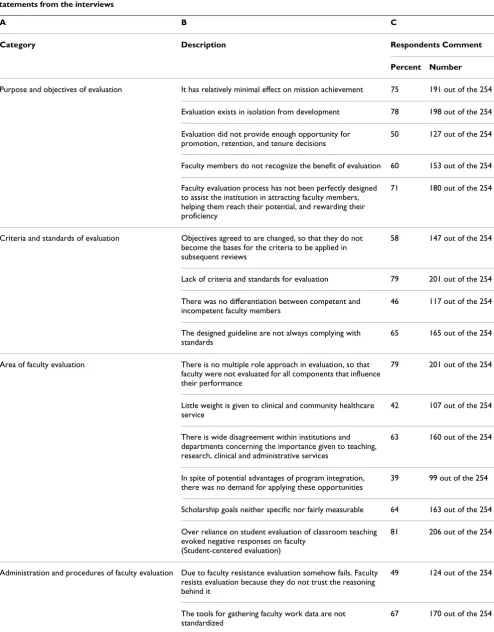
Table 1: Categories (A) developed from the analysis of the interviews; description statements (B) resulted from the interviews and making up the categories; and frequencies of the respondents' comments to the open-ended questions (C) which matched the statements from the interviews
A B C
Category Description Respondents Comment
Percent Number
Purpose and objectives of evaluation It has relatively minimal effect on mission achievement 75 191 out of the 254
Evaluation exists in isolation from development 78 198 out of the 254
Evaluation did not provide enough opportunity for promotion, retention, and tenure decisions
50 127 out of the 254
Faculty members do not recognize the benefit of evaluation 60 153 out of the 254
Faculty evaluation process has not been perfectly designed to assist the institution in attracting faculty members, helping them reach their potential, and rewarding their proficiency
71 180 out of the 254
Criteria and standards of evaluation Objectives agreed to are changed, so that they do not become the bases for the criteria to be applied in subsequent reviews
58 147 out of the 254
Lack of criteria and standards for evaluation 79 201 out of the 254
There was no differentiation between competent and incompetent faculty members
46 117 out of the 254
The designed guideline are not always complying with standards
65 165 out of the 254
Area of faculty evaluation There is no multiple role approach in evaluation, so that faculty were not evaluated for all components that influence their performance
79 201 out of the 254
Little weight is given to clinical and community healthcare service
42 107 out of the 254
There is wide disagreement within institutions and departments concerning the importance given to teaching, research, clinical and administrative services
63 160 out of the 254
In spite of potential advantages of program integration, there was no demand for applying these opportunities
39 99 out of the 254
Scholarship goals neither specific nor fairly measurable 64 163 out of the 254
Over reliance on student evaluation of classroom teaching evoked negative responses on faculty
(Student-centered evaluation)
81 206 out of the 254
Administration and procedures of faculty evaluation Due to faculty resistance evaluation somehow fails. Faculty resists evaluation because they do not trust the reasoning behind it
49 124 out of the 254
The tools for gathering faculty work data are not standardized
medical schools. So ethical approval was sought and obtained from the national ethics committee of the Min-istry of Health and Medical Education in Iran.
Results
Qualitative method findings
Interview data were coded, categorized, and tabulated using qualitative content analysis. The analysis yielded a number of statements which then identified four catego-ries (Table 1), including:
1. Purpose and objectives of evaluation;
2. Criteria and standards of evaluation;
3. Area of faculty evaluation; and
4. Administration and implementation of evaluation.
The categories and the statements making them up were subsequently analyzed against the open-ended questions of the survey responses. The percentages of the compara-ble comments are shown in Tacompara-ble 1, column C. The most frequent comments under the purpose and objectives of evaluation category were: 198 respondents (78%) wrote that evaluation is done in isolation from development, has minimal effect on mission achievement (191; 75%), and is not designed to attract, support or reward faculty members (180; 71%). Under the criteria and standards of evaluation category, 201 (79%) concurred that there is a lack of criteria and standards for evaluation. Under the area of faculty evaluation, 206 (81%) noted over reliance on student evaluation, while 201 (79%) agreed that there is no multiple role approach in evaluation. Lastly, under the administration and procedures of faculty evaluation category, 175 respondents (69%) concurred that the eval-uation systems do not provide necessary feedback to fac-ulty (Table 1).
Survey findings
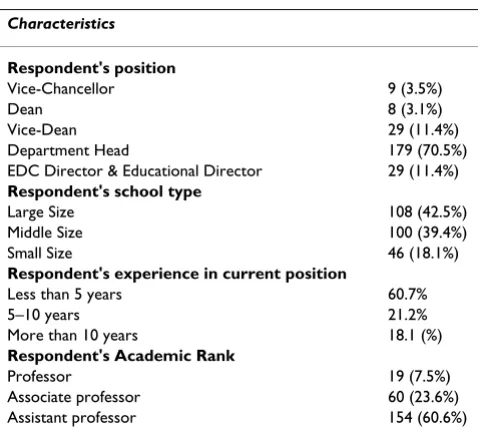
The number of returned questionnaires was 273 out of 345, 19 incomplete surveys were discarded. Conse-quently, 254 cases were considered for analysis (74% response rate). The respondents' positions were: 9 (3.5%) university vice chancellors, 8 (3.1%) school deans, 29 (11.4%) vice deans, 179 (70.5%) heads of departments and 29 (11.4%) educational directors or other senior administrators. Table 2 lists the characteristics of the respondents.
Table 2: Characteristics of respondents based on their position, rank, and school size
Characteristics
Respondent's position
Vice-Chancellor 9 (3.5%)
Dean 8 (3.1%)
Vice-Dean 29 (11.4%)
Department Head 179 (70.5%)
EDC Director & Educational Director 29 (11.4%)
Respondent's school type
Large Size 108 (42.5%)
Middle Size 100 (39.4%)
Small Size 46 (18.1%)
Respondent's experience in current position
Less than 5 years 60.7%
5–10 years 21.2%
More than 10 years 18.1 (%)
Respondent's Academic Rank
Professor 19 (7.5%)
Associate professor 60 (23.6%)
Assistant professor 154 (60.6%)
There are possibilities for subjective evaluation 59 150 out of the 254
Due to some insufficiency in evaluation system, feedback to faculty members is not provided
69 175 out of the 254
Evaluation process is somehow unclear and non-directive 61 155 out of the 254
Departments are not involved 44 112 out of the 254
Faculty are frustrated because evaluations take time but yield little benefit
56 142 out of the 254
The system does not provide adequate incentives (merit) for excellent performers
63 160 out of the 254
They have not been treated fairly in the process 51 130 out of the 254
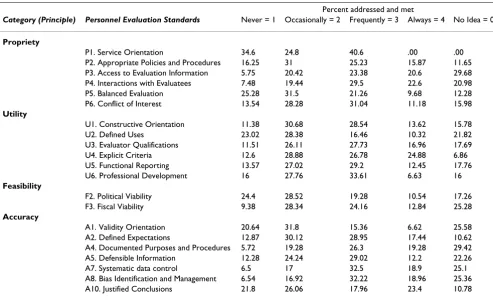
The 21 standard measures were assessed in the same order as they appear in the original document and are shown in Additional file 1. As the full document has been published previously[19,20], only a summary statement of results is provided to highlight the key findings. Additional details are provided in Table 3.
For the first propriety standard of service orientation, 40% of respondents stated that it was frequently met, while 35% responded that it was never met. For appropriate poli-cies and procedures, about 41% stated that it was frequently or always evaluated, while about 47% stated that it was never or only occasionally assessed. For balanced evalua-tion more than half of the respondents stated it was never or occasionally met. Regarding the Utility category, con-structive orientation, responses were equally split (40%, 42%) between frequently-always met and
occasionally-never met. For professional development more than a quarter of respondents (34%) stated that it was frequently met but for 16%, it was never met. Concerning the Accuracy standard, more than half of the faculty members stated that validity orientation was never or occasionally met, while another quarter provided no estimate. For systematic data control, more than half of faculty members stated that it was frequently or always performed, while a quarter of them did not know.
When considering mean scores of the four basic principles of sound evaluation in five domains of faculty members' roles (Table 4), we found that all mean scores were between "1" and "2", meaning that the corresponding standards were "never" or "occasionally" met. There were no mean scores around the "frequently" or "always" options. Within the different roles of faculty members,
Table 4: Mean scores of the four basic principles of sound evaluation based on academic roles and activities
Principles Mean (Std Dev)
Teaching Research Clinical & healthcare Service Administration Self-devel. Total
Propriety 1.82 (± 0.65) 1.71(± 0.72) 1.46(± 0.81) 1.48(± 0.74) 1.22(± 0.80) 1.55(± 0.64)
Utility 1.67(± 0.61) 1.61(± 0.68) 1.44(± 0.67) 1.38(± 0.68) 1.11(± 0.73) 1.48(± 0.63)
Feasibility 1.47(± 0.84) 1.37(± 0.86) 1.32(± 0.87) 1.21(± 0.89) 1.11(± 0.88) 1.30(± 0.79) Accuracy 1.73 (± 0.65) 1.58 (± 0.69) 1.50 (± 0.76) 1.42 (± 0.72) 1.15 (± 0.78) 1.48(± 0.63)
Table 3: Frequency of respondents in five scale based on principles of sound evaluation and Standards
Percent addressed and met
Category (Principle) Personnel Evaluation Standards Never = 1 Occasionally = 2 Frequently = 3 Always = 4 No Idea = 0
Propriety
P1. Service Orientation 34.6 24.8 40.6 .00 .00
P2. Appropriate Policies and Procedures 16.25 31 25.23 15.87 11.65
P3. Access to Evaluation Information 5.75 20.42 23.38 20.6 29.68
P4. Interactions with Evaluatees 7.48 19.44 29.5 22.6 20.98
P5. Balanced Evaluation 25.28 31.5 21.26 9.68 12.28
P6. Conflict of Interest 13.54 28.28 31.04 11.18 15.98
Utility
U1. Constructive Orientation 11.38 30.68 28.54 13.62 15.78
U2. Defined Uses 23.02 28.38 16.46 10.32 21.82
U3. Evaluator Qualifications 11.51 26.11 27.73 16.96 17.69
U4. Explicit Criteria 12.6 28.88 26.78 24.88 6.86
U5. Functional Reporting 13.57 27.02 29.2 12.45 17.76
U6. Professional Development 16 27.76 33.61 6.63 16
Feasibility
F2. Political Viability 24.4 28.52 19.28 10.54 17.26
F3. Fiscal Viability 9.38 28.34 24.16 12.84 25.28
Accuracy
A1. Validity Orientation 20.64 31.8 15.36 6.62 25.58
A2. Defined Expectations 12.87 30.12 28.95 17.44 10.62
A4. Documented Purposes and Procedures 5.72 19.28 26.3 19.28 29.42
A5. Defensible Information 12.28 24.24 29.02 12.2 22.26
A7. Systematic data control 6.5 17 32.5 18.9 25.1
A8. Bias Identification and Management 6.54 16.92 32.22 18.96 25.36
teaching and research efforts had the highest mean score (1.82 ± 0.65 and 1.71 ± 0.72 respectively); while clinical and healthcare services, institutional administration, and self-development activities were least likely to have been evaluated.
One-way analysis of variance examined the relationship between school size and the four basic principles of sound evaluation (Table 5). For the Accuracy principle, for exam-ple, there was a statistically significant difference between small, middle or large size schools (p ≤ .000, F = 8.95) so that Duncan's Post Hoc analysis revealed statistical signif-icance at the .05 level and identified differences between small size schools from other (middle and big size schools). Meanwhile, Duncan post hoc analyses for mul-tiple comparisons showed that there were statistically sig-nificant differences for all the basic principles observed in small size schools than middle and big size schools.
One-way ANOVA also showed that, irrespective of medi-cal school size and educational programs, there were sta-tistically significant differences in mean scores between the respondents' job position and the principles of evalu-ation (Table 6). There were statistically significant differ-ences between mean scores assigned by department heads and school deans, vice chancellors and other directors, in almost all principles of evaluation. For example in the
Utility category, the mean score for department heads was 1.38 but for vice chancellors and directors it was 1.5 and 1.86, respectively (p ≤ .003, F = 4.2) so that Duncan's Post Hoc analysis revealed statistical significance at the .05
level and identified differences between department heads
from other job positions.
Discussion
The initial interview findings showed how faculty mem-bers relate to and think about the evaluation systems used at their institution. The categories emerged from the semi-structured interviews highlights the difficulties and limita-tions of existing faculty evaluation systems within four large areas, purpose and objectives, criteria and standards, area, and administration of evaluation.
The categories were compared with the open-ended ques-tions of the survey which confirmed faculty's concerns regarding faculty evaluation. The results demonstrate a strong belief that medical school evaluations should address faculty members' needs, help performance improvement, yield defensible personnel decisions, and effectively provide high quality healthcare services and medical education. Furthermore, the analyses revealed that current faculty evaluation systems suffer from major barriers and limitations. They have shortcomings with regard to defining, designing, collecting, analyzing and reporting. Although the investigated medical schools have acknowledged efforts in the establishment of faculty eval-uation systems, there is still a need for a sound faculty evaluation.
However, if faculty evaluation is to be convincing and fair, it should be underpinned by standard measures. To fully explore these issues, we adapted the Standards to the
Ira-Table 6: Summary table of ANOVA for comparison between faculty member perceptions and principles of sound evaluation
Dept. Heads Deans Directors Vice Chancellor Total
Mean Std dev. Mean Std dev. Mean Std dev. Mean Std dev. Mean F P*
Propriety 1.49 ± .64 1.50 ± .66 1.97 ± .71 1.53 ± .71 1.55 3.60 .007
Utility 1.38 .58 1.4 .53 1.86 .68 1.50 .67 1.44 4.20 .003
Feasibility 1.2 .79 1.19 .69 1.8 .79 1.5 .82 1.30 5.11 .001
Accuracy 1.41 .61 1.57 .54 1.88 .74 1.57 .70 1.48 3.60 .007
*P < 0.05 Significant
Table 5: Summary table of ANOVA for comparison between school size and principles of sound evaluation
Large Size Middle Size Small Size Total
Mean Std dev. Mean Std dev. Mean Std dev. Mean F P*
Propriety 1.51 ± .58 1.42 ± .65 1.7 ± .68 1.55 5.51 .005
Utility 1.41 .52 1.29 .63 1.68 .62 1.44 7.88 .000
Feasibility 1.37 .75 1.00 .75 1.55 .82 1.30 9.26 .000
Accuracy 1.48 .59 1.36 .63 1.76 .64 1.48 8.95 .000
nian medical schools context. According to the new adap-tation we were able to look at faculty evaluation system considering the broad range of faculty members' roles. The mean scores of the four basic principles of sound eval-uation (utility, propriety, feasibility and accuracy) show that evaluation systems do not correspond to major fac-ulty responsibilities and are inconsistently addressed dur-ing faculty evaluations. The evaluation process mostly relies on research and teaching activities. Neglecting the other aspects of faculty members' roles yields an incom-plete and unbeneficial evaluation[1,11,27,29]. Systematic evaluation of all faculty academic activities and roles is vital to creating evaluation accountability, especially and more broadly to the fulfillment of academic institutions' mission[15,27]. The results of this study may elucidate potential features to be changed in the faculty evaluation system in Iran.
We showed that application of the adapted Standards confirms and complement the results of the qualitative data. For that matter, the adapted Standards could help detect and correct deficiencies. At the same time, they offered educators, administrators, and other policy mak-ers widely shared principles for reviewing existing approaches, for developing and assessing new or improved approaches, for guiding these approaches to work beneficially, and for defending sound approaches against legal and other challenges. We also are aware that involving all stakeholders such as administrators, stu-dents and other staff in the same approaches could benefit further the evaluation systems.
To compare some findings of this study with the broad international picture, we noted similarities among the fac-ulty evaluation systems including: i) Academic institu-tions accept standard-based evaluainstitu-tions and also adaptation of the appropriate Standards as the foundation for reforming their systems for assessing the organiza-tion's evaluation system[17]. ii) The perception that cur-rent academic systems add too much pressure to faculty members' workloads, while faculty members are not eval-uated against their performing roles and responsibilities. iii) Academic administrators struggled to conduct an effective evaluation system in order to provide enough feedback and opportunity for continuous professional development of their staff [30-33]. Our findings reveal that there is, to some extent, a global problem in several aspects of ongoing faculty evaluation systems that requires academic organizations to conduct sound evalu-ation systems. In establishing such a faculty evaluevalu-ation system, the main step is the appropriate adaptation of the Standards.
Conclusion
Current evaluation systems for medical school faculty do not distinguish between faculty performance and institu-tion performance, even though they should not be iso-lated from faculty development opportunities. Considering the results of this study we may conclude that faculty evaluation systems in Iranian medical schools con-gruent with the Standards. In order to address identified deficiencies, the evaluation system should recognize, doc-ument, and uniformly and equitably reward those activi-ties that are vital to the academic mission. If evaluation is to be optimizing faculty members' potential contribu-tions, it should be able to assess all aspects of the aca-demic system.
Faculty evaluation system can provide an overview of fac-ulty members' performance that is essential for their pro-fessional career. But no all systems are perfect. Academic institutions should be continuously exploring ways to improve their faculty evaluation systems. Finally, this paper is a brief report on a meta-evaluation of faculty eval-uation system that provides data-driven suggestions for improving faculty evaluation. Limitations in the current faculty evaluation systems must be kept in mind as future improvements and changes are made. Our analysis not only guides the design of a new approach to faculty eval-uation for Iranian medical schools, but also describes an experience of meta-evaluation that could be useful to investigators elsewhere.
Abbreviations
PES: Personnel Evaluation Standards; EDC: Educational Development Center; ANOVA: Analysis of Variance; KI: Karolinska Institutet; LIME: Learning, Informatics, Man-agement, and Ethics; CME: Centre for Medical Education.
Competing interests
The authors declare that they have no competing interests.
Authors' contributions
SA and TC, MB, IM participated in the design of the study and in the interpretation of the data. SA, TC performed the statistical analyses and prepared the manuscript. AG, JT, and IM edited the manuscript. All authors read and approved the final manuscript.
Additional material
Additional file 1
Summary of the Personnel Evaluation Standards checklist.
Click here for file
Publish with BioMed Central and every scientist can read your work free of charge
"BioMed Central will be the most significant development for disseminating the results of biomedical researc h in our lifetime."
Sir Paul Nurse, Cancer Research UK
Your research papers will be:
available free of charge to the entire biomedical community
peer reviewed and published immediately upon acceptance
cited in PubMed and archived on PubMed Central
yours — you keep the copyright
Submit your manuscript here:
http://www.biomedcentral.com/info/publishing_adv.asp
BioMedcentral
Acknowledgements
The authors would like to thank the Medical Education Research Center at Isfahan University of Medical Sciences and the National Public Health Man-agement Center at Tabriz University of Medical Sciences for their support both financially and administratively. Many thanks go to the faculty members who participated in the interviews and those who completed and returned the questionnaires. Also we would like to express our appreciation to asso-ciate professor Sayed Javad Moosavi vice-chancellor for education Urmia University of Medical Sciences for his administrative support.
References
1. Snell L, Tallett S, Haist S, Hays R, Norcini J, Rothman A, et al.: A review of the evaluation of clinical teaching: new perspec-tives and challenges. Medical Education 2000, 34:862-870. 2. Griner PF, Blumenthal D: New bottles for vintage wines: the
changing management of the medical school faculty. Acad Med. 1998, 73(6):720-724.
3. Jones RF, Froom JD: Faculty and administrative views of prob-lems in faculty evaluation. Academic Medicine 1994, 69:476-483. 4. Bland CJ, Wersal L, VanLoy W, Jacott W: Evaluating faculty
per-formance: a systematically designed and assessed approach.
Academic Medicine 2002, 77:15-30.
5. Theall M: Leadership in faculty evaluation. In Field guide to aca-demic leadership Edited by: Diamond MR. San Francisco: Jossey Bass; 2002:257-269.
6. Michael EG, Connie LE, Pierre F, Helen B: Faculty evaluation in department of family medicine: do our universities measure up? Medical Education 1998, 32:597-606.
7. Arreola RA: Developing a Comprehensive Faculty Evaluation System: a handbook for college faculty and administrators on designing and operating a comprehensive faculty evaluation system 2nd edition. Bolton, MA: Anker Publishing Company; 2000.
8. Fairweather JS: The ultimate faculty evaluation: promotion and tenure decisions. In New direction for institutional research Wiley Periodical Inc; 2002:97-100.
9. Pittman RB, Slate JR: Faculty evaluation: some conceptual con-siderations. Journal of Personnel Evaluation in Education 1989, 3:39-51.
10. Morrison J: ABC of learning and teaching in medicine: Evalua-tion. BMJ 2003, 326:385-387.
11. Colbeck CL: Integration: Evaluating faculty work as a whole. In New direction for institutional research Wiley Periodical Inc; 2002:43-52.
12. Arreola RA: Issues in developing a faculty evaluation system.
American Journal of Occupational Therapy 1999, 53:56-63.
13. Nutter DO, Bond JS, Coller BS, D'Alessandri RM, Gewertz BL, Nora LM, et al.: Measuring faculty effort and contributions in medi-cal education. Academic Medicine 2000, 75:200-206.
14. Spriggs DR: A new academic faculty evaluation tool using graphic representation of clinical, research, teaching and administration domains. Journal of Clinical Oncology 2005, 23:6095.
15. Cashin WE: Developing an effective faculty evaluation system. In IDEA Paper No. 33 Manhattan, KS: Kansas State University, Center for Faculty Evaluation and Development; 1996.
16. Rifkin T: The status and scope of faculty evaluation. ERIC Cus-tom Transformations Team 1995 [http://www.ericdigests.org/1996-1/ status.htm].
17. Stufflebeam DM: Strategies for institutionalizing evaluation: revisited. The Occasional Paper Series. 1997, 18: [http:// www.wmich.edu/evalctr/pubs/ops/ops18.pdf].
18. Shinkfield AJ, Stufflebeam DL: Teacher evaluation: guide to effective prac-tice 2nd edition. London: Kluwer Academic Publishers; 1997. 19. Stufflebeam DL: The Personnel Evaluation Standards: How to assess
sys-tems for evaluating educators Newbury Park, CA: Corwin Press; 1988. 20. Joint committee on Standards for Educational Evaluation: The
Person-nel Evaluation Standards Newbury Park, CA: Sage; 1988.
21. Reineke RA, Willeke MJ, Walsh LH, Walsh LH: Review of person-nel evaluation systems: A local application of the Standards.
Journal of Personnel Evaluation in Education 1988, 1:378.
22. Stufflebeam DL: The Metaevaluation Imperative. American Jour-nal of Evaluation 2001, 22:183-209.
23. Azizi F: The reform of medical education in Iran. Medical Edu-cation 1997, 31:159-162.
24. Marandi A: Integrating medical education and health services: the Iranian experience. Medical Education 1996, 30:4-8. 25. Ahmady S, Changiz T, Masiello I, Brommels M: Organizational role
stress among medical school faculty members in Iran: deal-ing with role conflict. BMC Medical Education 2007, 7:14. 26. Ahmady S, Changiz T, Gaffney DF, Brommels M, Masiello I: The
sta-tus of faculty development programmes in Iran after the medical education reform: a systematic and comprehensive approach. International Journal for Academic Development in press. 27. Mills M, Hyle A: Faculty evaluation: A prickly pair. Higher
Educa-tion 1999, 38:351-371.
28. Stufflebeam DL: A note on the purpose, development, and applicability of the joint Committee Evaluation Standards.
American Journal of Evaluation 2004, 25:99-102.
29. Liu S, Teddile C: A follow-up study on teacher evaluation in China: historical analysis and latest trends. Journal of Personnel Evaluation in Education 2005, 18:272.
30. Milanowski AT: Assessment of teacher reactions to a stand-ard-based teacher evaluation system: a pilot study. Journal of Personnel Evaluation in Education 2001, 15:193-212.
31. Stufflebeam DL: Conflicts between standards-based and post-modernist evaluations: toward rapprochement. Journal of Per-sonnel Evaluation in Education 1998, 12:287-296.
32. Davis DR: Teacher evaluation, leadership and learning organ-izations. Journal of Personnel Evaluation in Education 2002, 16:287-301.
33. Stronge JH: The dynamics of effective performance evaluation system in education: conceptual, human relations, and tech-nical domains. Journal of Personnel Evaluation in Education 1991, 5:83.
Pre-publication history
The pre-publication history for this paper can be accessed here:
http://www.biomedcentral.com/1472-6920/9/18/prepub
Additional file 2
A schematic view of the survey instrument.
Click here for file