Design & Analysis of Space Time Trellis Codes for
Different Fading Channels
Sanjay Kumar Sharma
I, Prashant Kumar Pandey
21Sai Nath University, 2GITM. Lucknow
[email protected], [email protected]
Abstract— We introduce a new family of space–time trellis codes that space–time block codes as building blocks in our new trellis codes. These codes combine set partitioning and a super set of space–time block codes in a systematic way to provide full diversity and improved coding gain.. It is also possible to maintain a tradeoff between coding gain and rate.. Simulation result (i.e. frame error rate) shows that the STTC in such environment (i.e. frequency selective) could not take full advantage of the multipath environment to increase coding advantage (i.e. shift of error rate curve) due to increase in parallel path of the decoding trellis. This paper investigates the performance of Space-time Trellis Code (STTC) designed primarily for non-frequency selective (i.e. flat) fading channel but now applied to a frequency selective fading channel. A new decoding trellis is proposed for the STTC in frequency selective fading environment. It was apparent that the number of state of the decoding trellis of the STTC in a frequency selective channel is a function of the number of divergent paths per state, the multipath ray and the original number of states of Simulation result (i.e. frame error rate) shows that the STTC in such environment (i.e. frequency selective) could not take full advantage of the multipath environment to increase coding advantage (i.e. shift of error rate curve) due to increase in parallel path of the decoding trellis. However the diversity order (i.e. slope of the error rate curve) performance is equivalent to that obtained in flat fading channel.
Index Terms— space-time codes frequency selective channel, multiple-input multiple-output
I. INTRODUCTION
A simple code providing full diversity for two transmit antennas is introduced by Alamouti in where transmitted symbols can be separately decoded based on a linear processing at the receiver. In Alamouti’s scheme is generalized to an arbitrary number of transmit antennas and named as space-time block coding. When more than two transmit antennas are considered, a full rate and full diversity space-time block code (STBC) design is not possible. A STBC provides full diversity and a very simple decoding scheme, but despite the name, its main goal is not to provide additional coding gain. [10] This is in contrast to space-time trellis codes (STTC) that provide full diversity as well as significant coding gains but at a cost of higher decoding complexity. Several schemes based on the concatenation of the STBC with an outer trellis code are than proposed in the literature to achieve satisfactory coding gains. The main disadvantage of these schemes is their rates, which are below the possible maximum rate. A new class of space-time codes called space-time trellis codes (STTCs) is introduced in to overcome this problem. These codes combine set partitioning and a super set of STBCs in a systematic way to provide full diversity and improved coding gain over earlier SITC constructions. The signal set is obtained by a constellation rotation. The structure of the new codes allows an increase in the coding gain, while providing full diversity and full rate. Since designs have been used as building blocks in STTCs, the decoding complexity remains low. In addition to Jafarkhani and Seshadri’s work [2], independent methods to expand the matrix set were developed in [7] and [8]. In this paper, STTC design technique is applied to space-time BPSK modulation schemes for fast fading channels in the case of 4 transmit antennas using the appropriate real design from and using the design criteria valid for this type of channel. Avoiding parallel state transitions in its trellis, a 16-state STTC is proposed for BPSK modulation with maximized symbol wise Hamming distance and maximized sum-product distance. Space-time code design criteria for fast Rayleigh fading channels and give a brief review of STTC design technique. The new BPSK STTC designed for fast-fading channels is
of the transmission matrices and standard set partitioning method [5]. In the set partitioning for the STTC’s are shown and the way the code maximizes coding gain, without sacrificing rate. However all the above mentioned techniques for space-time codes (i.e. STBC, STTC and STTC) performances in [2], [4] is based on two fundamental assumptions on the fading channel, viz. a) Non-frequency selective channel – the channel does not have temporal interference, b) The fading from each transmit antenna to any receive antenna are independently identically distributed – this assumption is valid if the antennas are located far apart from each other (to be precise /2 separation between antennas). The first assumption may not be guaranteed to be possible in an outdoor setting where delay spreads are significantly large making the channel frequency selective and thereby Space-time trellis codes provide full diversity and full rate. There exist some design criteria that must be satisfied to obtain full diversity. However there is no systematic design method available and one has to do a computer search to obtain best possible codes. Also it is not clear how to improve performance of such codes STBC provides full rate and full diversity with a very simple design but do not provide any coding gain. To achieve additional coding gain combine space - time block codes with trellis codes. However this reduces the rate of resultant code. To solve this problem, Jafarkhrmi and Seshadri proposed a, new coding also provide scheme which combines STBC with trellis codes and yet guarantees full rate. They also provide systematic design criteria similar to the design criteria of TCM. The authors of recognize that a space-time block code does not use all the possible transmission matrices. For example the following transmission matrix defines Alamouti’s scheme.
1 2 1 2
2 1
s
( , )
- *
s
c s s
s
s
However all possible 2 2 matrices are
1 2 1 2 1 - 2 1 2 1 2
2 1 2 1 2 1 2 1
s
s
s
s
( , )
- * *
- * *
* *
* - *
s
s
s
s
c s s
s
s
s
s
s
s
s
s
Fig .1 2- state BPSK space time trellis codes
space-time codes (STC) are essentially space-time trellis codes transmitting space-time block (STB) code words in each trellis section. The set of available STB code words are extended via rotations, while maintaining the codewords. Thus all the eight transmission matrics are used in
1 2 j j 2 1 , , 2 1 *
e
e
(
)
s
s
c s s
s
s
with
0
,2
The resulting code has a systematic design procedure, and shows better performance compared
to the reported STT codes. A two-state BPSK .-code is shown in Figure The labels on the branches show output of the trellis. The output of the trellis is used with Equation and then mapped to the two transmit antennas. We unveiled a new family of codes called the Space–Time codes for transmission using multiple transmit antennas over Rayleigh or Rician wireless channels. Many subfamilies ofspace–time codes were also introduced. The performance of these codes was shown to be excellent, and the decoding complexity comparable to codes used in practice on Gaussian High-rate STBC-MTCM Schemes for Quasi-static and Block-fading Channels: For the case of quasi-static fading channel, high rate Space-Time Trellis Codes have already been constructed y concatenating Multiple Trellis Coded Modulation (MTCM) and Space-Time Block Codes (STBC) called the STBC-MTCM scheme. The focus in all these constructions, was to increase the rate of transmission by using more than one design, while retaining the diversity advantage and little attention was paid to increase the coding gain advantage. In this paper, we present a systematic approach by which STTCs can be constructed by STBC-MTCM scheme, which achieve high rate, full diversity and increased coding gain advantage over the existing codes under certain conditions. Also we a present a systematic approach, to construct STTCs by STBC-MTCM codes which can achieve any given diversity for the case of block-fading channel. New differential space-time trellis codes STTC) with single-symbol maximum-likelihood (ML) decoding. Firstly, a new joint constellation, which can be used to construct a unitary matrix for space-time block code (STBC), is designed. Secondly, based on the joint constellation and criterion of maximizing the coding gain distance (CGD), set-partitioning is done. Finally, we introduce the simple single-symbol maximum-likelihood (ML) decoding. Simulation results show that our differential STTC can get better performance than the differential space-time trellis code (STTC) with four transmit antennas at the transmission rate of 1.5bits/s/Hz and lower decoding complexity than the differential space-time trellis codes (STTC) [11] and the differential STTC [10] at the transmission rate of 2bits/s/Hz.In the past few years, many space-time modulation techniques for transmit diversity over the wireless channels have been studied. However, most of the space-time schemes require the knowledge of the channel state information (CSI) at the receiver. Although the CSI can be obtained by sending training symbols or pilot tones, it is difficult to estimate the CSI, especially when the channel changes rapidly. In the past few years, several differential space-time modulations (DSTM) have been proposed [1-4], in which the CSI is not needed to know at the both transmitter and receiver. Hughes [1] has proposed a DSTM based on group codes. Tarokh and
sequence estimation can be employed with equalization [8]. In this paper, the later is used to mitigate the effect of the temporal signal interference. The paper proposes a new decoding trellis for the STTC to mitigate the effect of temporal signal interference. The performance of the STTC when equipped with the proposed trellis is shown with error.
II. RECEIVER STRUCTURE OF THE SPACE-TIME TRELLIS CODE IN DIFFERENT FADING CHANNEL
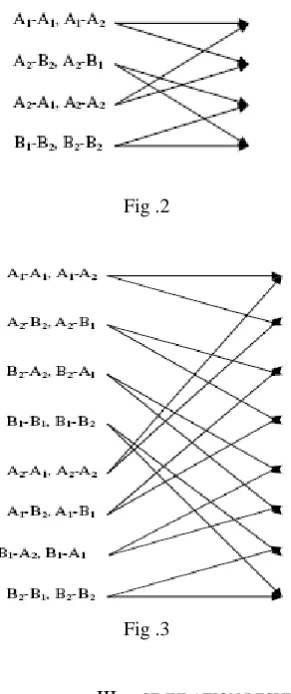
In this section, the receiver structures with maximum likelihood criterion for the STTC are enumerated to mitigate the effect of temporal signal interference.In this paper, we assume there are two rays in each subchannel and that the temporal interference spans two-symbol blocks. If there are more than two rays in each subchannel, the method enumerated here can be straightforwardly extended. The number of states of the receiver structure for the 2-state and 4-state QPSK STTC coding system increase to 4 and 8 respectively. The above trellises represent the equivalent decoding trellis for the 2-state and the 4-state STTC in a frequency selective fading channel with temporal interference that spans two- symbol block. The transition per state contains 64 parallel paths of signal sets. In the trellises above, Ai (or Bi) - Aj (or Bj) represent the delayed version of
two-symbol block Ai (or Bi) affected by the second tap and Aj (or Bj) represent the two-symbol block affected by
the first tap (our analysis assume k=2). It is apparent that the number of states of the receiver trellis for the STTC when the temporal interference spans two-symbol block with k rays is given by 2*(k-1)*l, where l is the original state number of the space-time trellis code.
Fig .2
Fig .3
III. SIMULATION RESULT
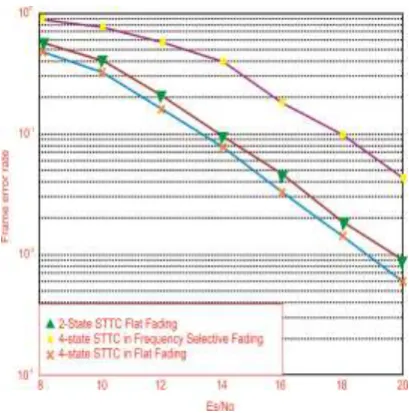
Figure.4 FER of a 2-state STTC with Nt =2, Nr=1 in fading channel
Figure 5 FER of STTC schemes with Nt =2, Nr=1in fading channel.
selective channel. This accounts for the performance loss obtained in terms of the coding advantage (i.e. shift in the error curve upward). This above stated explanation is also applicable to the performance degradation of the code in Figure 5.
IV. CONCLUSION
In this paper, the receiver structure of a space-time trellis code in a frequency selective channel is designed. The decoding trellises for a 2-state and 4-state code schemes are given. The formula for deriving the number of states of the STTC in frequency selective was derived as a function of th number of divergent path per state, the multipath ray and the original number of state of the STTC. The simulations results proved that although the code was designed for flat fading channel, it provide at least the same diversity advantage when applied to a frequency selective Rayleigh fading channel. Simulation results demonstrate the good performance of our new space–time trellis This paper investigates the performance of Space-time Trellis Code (STTC) designed primarily for non-frequency selective (i.e. flat) fading channel but now applied to a frequency selective fading channel. A new decoding trellis is proposed for the STTC in frequency selective fading environment. It was apparent that the number of state of the decoding trellis of the STTC in a frequency selective channel is a function of the number of divergent paths per state, the multipath ray and the original number of states of the STTC
REFERENCES
[1] G.J. Foschini, ―Layered space-time architecture for wireless communication in a fading environment when using multi-element antenna‖, Bell Labs Technical Journal, vol.1, no. 2, pp 41-59, Autumn 1996.
[2] V. Tarokh, H. Jafarkhani, and A. R. Calderbank, ―Space-time codes for high data rate wireless communication; Performance analysis and code construction,‖ IEEE Transaction Information Theory, vol.44, no.2, pp. 744-765, March 1998.
[3] S. Baro, G. Bauch, and A. Hansmann, ―Improved codes for space-time trellis-coded modulation,‖ IEEE
Communication Letters, pp. 20-22, January 2000.
[4] S. Alamouti, ―Space-time block coding: A simple transmitter diversity technique for wirelesscommunications,‖ IEEE Journal
on Selected Areas in Communication, vol. 16, pp. 1451-1458, Oct 1998.
[5] G. Ungerboeck, ―Channel Coding with Multilevel/Phase signals,‖ IEEE Transaction on Information Theory, vol.28, pp. 55-67, Jan. 1982.
[6] Yi gong, Khaled Ben Letaief, ―Performance evaluation and analysis of space-time coding in unequalized multipath fading links,‖
IEEE Transactionon Communications, vol. 48, no. 11, pp. 1778-1782, November 2000.
[7] Y. Hong, et. al. ―Performance analysis of space-time trellis coded OFDM system,‖ Institute for Telecommunication Research University of South Australia, 2005
[8] P. Luo, Y. Guan, ―Optimum receiver for space-time trellis code in multipath fading channel,‖ International Zurich Seminar on
Broadband Communication, pp. 43-1-43-5, February 2002.
[9] E. Lindskog, and A. Paulraj, ―A Transmit diversity scheme for delay spread channels,‖ in Proceeding of IEEE International
Conference of Communication (ICC 2000), July 2000.
[10] R. Asokan and H. Arslan, ―Detection of STBC signal in frequency selective fading channels,‖ in Proceeding of World
wireless congress, San Francisco, USA, May 2003.
[11] A.J. Viterbi, ―Error bounds for convolutional codes and an asymptotically optimum decoding algorithm,‖ IEEE Transaction on
Communication, vol. 13, pp. 260-269,