Volume 2007, Article ID 30548,7pages doi:10.1155/2007/30548
Research Article
Performance Analysis of Space-Time Block Codes in Flat
Fading MIMO Channels with Offsets
Manav R. Bhatnagar,1R. Vishwanath,2and Vaibhav Bhatnagar3
1Department of Informatics, UniK-University Graduate Center, University of Oslo, 2027 Kjeller, Norway 2Department of Electrical and Computer Engineering, University of California, Davis, CA 95616, USA 3Department of Electrical Engineering, University of Bridgeport, Bridgeport, CT 06604, USA
Received 19 June 2006; Revised 14 October 2006; Accepted 11 February 2007
Recommended by Yonghui Li
We consider the effect of imperfect carrier offset compensation on the performance of space-time block codes. The symbol error rate (SER) for orthogonal space-time block code (OSTBC) is derived here by taking into account the carrier offset and the resulting imperfect channel state information (CSI) in Rayleigh flat fading MIMO wireless channels with offsets.
Copyright © 2007 Manav R. Bhatnagar et al. This is an open access article distributed under the Creative Commons Attribution License, which permits unrestricted use, distribution, and reproduction in any medium, provided the original work is properly cited.
1. INTRODUCTION
Use of space-time codes with multiple transmit antennas has generated a lot of interest for increasing spectral efficiency as well as improved performance in wireless communications. Although, the literature on space-time coding is quite rich now, the orthogonal designs of Alamouti [1], Tarokh et al. [2,3], Naguib and Sesh´adri [4] remain popular. The strength of orthogonal designs is that these lead to simple, optimal re-ceiver structure due to the possibility of decoupled detection along orthogonal dimensions of space and time.
Presence of a frequency offset between the transmitter and receiver, which could arrive due to oscillator instabilities, or relative motion between the two, however, has the poten-tial to destroy this orthogonality and hence the optimality of the corresponding receiver. Several authors have, therefore, proposed methods based on pilot symbol transmission [5] or even blind methods [6] to estimate and compensate for the frequency offset under different channel conditions. Never-theless, some residual offset remains, which adversely affects the code orthogonality and leads to increased symbol error rate (SER).
The purpose of this paper is to analyze the effect of such a residual frequency offset on performance of MIMO system. More specifically, we obtain a general result for calculating the SER in the presence of imperfect carrier offset knowl-edge (COK) and compensation, and the resulting imperfect CSI (due to imperfect COK and noise). The results of [7–12]
which deal with the cases of performance analysis of OSTBC systems in the presence of imperfect CSI (due to noise alone) follow as special cases of the analysis presented here.
The outline of the paper is as follows. Formulation of the problem is accomplished inSection 2. Mean square er-ror (MSE) in the channel estimates due to the residual offset error (ROE) is obtained inSection 3. InSection 4, we dis-cuss the decoding of OSTBC data. In Section 5, the prob-ability of error analysis in the presence of imperfect offset compensation is presented and we discuss the analytical and simulation results inSection 6.Section 7, contains some con-clusions and in the appendix we derive the total interference power in the estimation of OSTBC data.
NOTATIONS
Throughout the paper we have used the following notations:
Bis used for matrix,b is used for vector,b∈borB,Band
bare used for variables, [·]His used for hermitian of matrix or vector, [·]T is used for transpose of matrix or vector,[I] is used for identity matrix, and [·]∗ is used for conjugate ma-trix or vector.
2. PROBLEM FORMULATION
2.1. System modeling
1
m . . .
Tx
. . . hm
ω0
Rx
Figure1: MISO system considered in the problem.
single receive antennas) shown inFigure 1, in which the fre-quency offset between each of the transmitters and the re-ceiver is the same, as will happen when the source of fre-quency offset is primarily due to oscillator drift or platform motion.
Herehkare channel gains betweenkth transmit antenna and receive antenna andω0is the frequency offset. The
re-ceived data vector corresponding to one frame of transmitted data in the presence of carrier offset is given by
y=Ωω0
Fh+e, (1)
where y = [y1y2· · ·yNt+N]T; Nt and N being the
num-ber of time intervals over which, respectively, pilot sym-bols and unknown symsym-bols are transmitted,F consists of data formatting matrix [StS] corresponding to one frame;
StandSbeing the pilot symbol matrix and space-time ma-trix, respectively, h =[h1 h2 · · · hm]T denotes the chan-nel gain vector with statistically independent complex cir-cular Gaussian components of variance σ2, and
station-ary over a frame duration, e is the AWGN noise vector [e1e2· · ·eNt+N]T with a power density ofN0/2 per
dimen-sion, andΩ(ω0)=diag{exp(jω0), exp(j2ω0),. . ., exp(j(Nt+
N)ω0)}denotes the carrier offset matrix.
2.2. Estimation of carrier offset and imperfect
compensation of the received data
Maximum likelihood (ML) estimation of transmitted data requires the perfect knowledge of the carrier offset and the channel. The offset can be estimated through the use of pilot symbols [5], or using blind method [6]. However, a few pi-lot symbols are almost always necessary, for estimation of the channel gains. Considering all this, therefore, we use in our analysis a generalized frame consisting of an orthogonal pilot symbol matrix (typically proportional to the identity matrix) and the STBC data matrix. In any case, the estimation of the offset cannot be perfect due to the limitations over the data rate, and delay and processing complexity. There could also be additional constraint in the form of time varying nature of the unknown channel. Thus, a residual offset error will al-ways remain in the received data even after its compensation based on its estimated value. This can be explained as follows: ifω0denotes the estimated value of the offsetω0, we have
ω0=ω0−Δω, (2)
which depends upon the efficiency of the estimator. The compensated received data vector will be
yc=Ω−ω0
y=Ω(Δω)Fh+Ω−ω0
e. (3) It is reasonable to consider ROE to be normally dis-tributed with zero mean and varianceσ2
ω. We have also as-sumed that carrier offset and hence ROE remains constant over a data frame. The problem of interest here is to analyt-ically find the performance of the receiver in the presence of ROE.
3. MEAN SQUARE ERROR IN THE ESTIMATION OF CHANNEL GAINS IN THE PRESENCE OF RESIDUAL OFFSET ERROR
Although it is possible to continue with the general case ofm transmit antennas, the treatment and solution becomes cum-bersome, especially since the details will also depend on the specific OSTBC used. On the other hand, the principle be-hind the analysis can be easily illustrated by considering the special case of two transmit antennas, employing the famous Alamouti code [1]. Suppose we transmitKorthogonal pilot symbol blocks of 2×2 size andLAlamouti code blocks over a frame. One such frame is depicted inFigure 2, wherexis a pilot symbol of unit power andsr(k) represents therth sym-bol transmitted by thekth antenna andx,sr(k)∈M-QAM.
The compensated received vector corresponding to K training data blocks (denoted here by matrixP) can be ex-pressed as
yc=yc1yc2· · ·yc2KT =Ω(Δω)2K×2KPh+Ω
−ω0
2K×2Ke2K×1,
(4)
whereΩ(Δω)2K×2K is the ROE matrix andΩ(−ω0)2K×2K is
compensating matrix, respectively, corresponding toKpilot blocks, ande2K×1is the noise in pilot data. It may be noted
that the last term in (4) can still be modeled as complex, circular Gaussian and contains independent components. As the receiver already has the information aboutP, we can find the ML estimate of the channel gains as follows [2,4]:
h= 1
K|x|2P
Hy
c. (5)
Substituting the value of ycfrom (4) into (5), we get
h=K1 |x|2P
HΩ(Δω)
2K×2KPh
+ 1
K|x|2P
HΩ−ω
0
2K×2Ke2K×1.
(6)
In the low mobility scenario where the carrier offset is mainly because of the oscillator instabilities, its value is very small and if sufficient training data is transmitted or an effi -cient blind estimator is used, the varianceσ2
ωof ROE is gen-erally very small (σ2
⎡
Training data (Kblocks) ⎡
STBC data (Lblocks)
Figure2: Complete frame for two transmit antennas and single receive antenna case.
first order Taylor series approximation for exponential terms inΩ(Δω)2K×2Kas
exp(jNΔω)=1 + jNΔω. (7)
After a simple manipulation, we can find the estimates of channel gains as
error due to residual offset
+ 1
error due to noise
=h+Δh,
the total error in estimates. It is easy to see that there are two distinct interfering terms in (8) due to ROE and AWGN noise. In the previous work [7–12], the interference only due to the AWGN noise is considered. However, here in (8) we are also taking into account the effect of the interference due to ROE. The mean square error (MSE) of channel estimate in (8) can be found as follows:
Assuming, elements of h,Δωand elements of eare statis-tically independent of each other, the expectation of cross
terms will be zero and the MSE would be simplified as follows:
This generalizes the results of mean square channel estima-tion error in AWGN noise only [7,8] to the case where there is also a residual offset present in the data being used for channel estimation. It is clear that the expression reduces to that in [7,8], whenσ2
ω =0.Figure 3depicts the results in a graphical form for two pilot blocks. It is also satisfying to see that the results match closely (except very large ROEs) those based on experimental simulations. The effect ofσ2
ωis seen to be very prominent as it introduces a floor in MSE value, independent of SNR.
4. ESTIMATION OF OSTBC DATA
Next, we consider the compensated received data vector cor-responding to the OSTBC part of the frame. Consider thelth STBC (Alamouti) block, which can be written as [1]
z=y(2v−1)
channel is known perfectly, then the ML estimation rule for obtaining estimate ofsis given as
10−4 10−3 10−2 10−1
M
ean
sq
uar
e
er
ro
r
(MSE)
0 5 10 15 20 25 30
SNR Analysis
Simulation
Figure3: Analytical and experimental plots of MSE in the chan-nel estimates for different values of ROE;σ2
ω=(2π/30)2, (2π/50)2,
(2π/100)2, (2π/250)2, (2π/1000)2, 0 from uppermost to downmost, respectively.
where
ρ=HHH, r=HHz. (13)
In the presence of channel estimation errors, as discussed in
Section 3, the vectorrwill be equal to
r=HHz=(H+ΔH)Hz, (14)
whereΔH = [Δh1 Δh2 Δh∗
2 −Δh∗1]. Substituting the value of z from
(11) into (14), we get
r=HH e
j(2v−1)Δω 0
0 e−j2vΔω
I
Hs
+
ej(2v−1)ω0 0
0 e−j2vω0 e(2v−1) e
∗
2v
T
.
(15)
Applying Taylor series approximation for the exponential term in the term (I) in (15), we will get
r=HHHs+HH
j(2v−1)Δω 0 0 −j2vΔω
Hs
+HH
ej(2v−1)ω0 0
0 e−j2vω0 e2v−1 e
∗
2v
T
.
(16)
r=ρs+ Δ HHHs interfering term (1)
+ H HHΩs interfering term (2)
+HH
ej(2v−1)ω0 0
0 e−j2vω0 e(2v−1) e
∗
2v
T
interfering term (3)
,
(17)
whereHΩ=[j(2v−01)Δω−j20vΔω]H. Clearly, estimation ofsvia minimization of (12) would be affected by the interfering terms (1)–(3) shown in (17). In the next section, we carry out an SER analysis by first obtaining expression for the total interference power and its subsequent effect on the signal-to-interference ratio (SIR).
5. ERROR PROBABILITY ANALYSIS
In order to obtain an expression for the SIR, and hence for the probability of error, we need to find the total interference power in (17). To simplify the analysis, we restrict ourself to those cases whenω0is typically much smaller than the
sym-bol period and if a sufficiently efficient estimator like [5,6] is used for carrier offset estimation,Δωis also very less than the symbol period. Under this restriction and assuming channel, noise, training data and S-T data independent of each other and of zero mean, the correlations betweenΔhandh,Δhand
Δω, andH andHΩ, which mainly depend uponω0andΔω,
would be so small that these could be neglected. We make use of this assumption in the following analysis for simplic-ity, but without any loss of generality. In this case, the total interference power in (17) is obtained in the appendix and the average interfering power will be
Poweravg=2Esσ2MSE +2(2v−1)2Esσω2σ2σ2+ MSE + 2σ2+ MSEN0.
(18)
Since the channel is modeled as complex Gaussian random variable with variance σ2, henceE{m
i=1|hi|2} = mσ2 and
the average SIR per channel will be
γ= Es 2 Poweravgσ
2
= Es 2Esσ2MSE+(2v−1)2Esσ2
ωσ2
σ2+MSE+σ2+MSEN 0
σ2,
(19)
whereEsis signal power. If there is no carrier offset present, that is,σ2
ω=0, and channel variance is unity, that is,σ2=1, (19) reduces into the following conventional form [7–12]:
γ= Es
2EsMSE +N0+N0MSE
. (20)
the expression of exact probability of error forM-QAM data received overJ-independent flat fading Rayleigh channels, in the terms of SIR, is suggested in [13] as
Probability of error in the frame consisting ofLblocks of OS-TBC data will be
Pe= 1L
where (Pe)idenote the error probability ofith OSTBC block. As all the interference terms in (17) consist of Gaussian data and have zero mean and diagonal covariance matrices (see the appendix), we may assume without loss of generality that all the interference terms are Gaussian distributed with zero mean and certain diagonal covariance matrices.
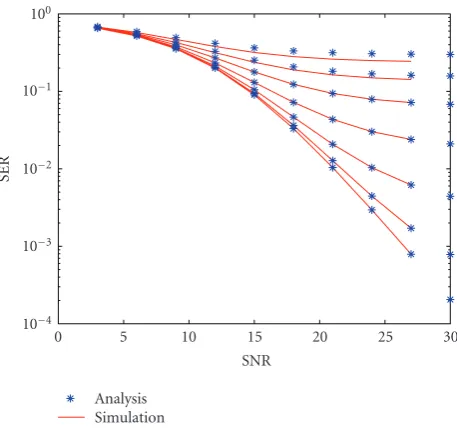
6. ANALYTICAL AND SIMULATION RESULTS
The analytical and simulation results for a frame consisting of two pilot blocks and three OSTBC blocks are shown in Figures4–6. All the simulations are performed with the 16-QAM data. The average power transmitted in a time interval is kept unity. The MISO system of two transmit antennas and a single receive antenna employs Alamouti code. The chan-nel gains are assumed circular, complex Gaussian with unit variance and stationary over one frame duration (flat fad-ing). The analytical plots of SIR and probability of error are plotted under the same conditions as those of experiments.
Figure 4shows the effect of ROE on the average SIR per
channel with −30 dB MSE, in channel estimates. Here, we have plotted (19) with different values of ROE. It is easy to see that there is not much improvement in SIR with the in-crease in SNR at large values of ROE, which is quite intu-itive. Hence, our analytical formula of SIR presents a feasible
−5
Figure4: Plot of average SIR per channel versus SNR for MSE= −30 dB (graphs are plotted for σ2
ω = 0, (2π/1000)2, (2π)2/105,
(2π/100)2from uppermost to downmost, resp.).
10−4
Figure 5: SER versus SNR plots for 16 QAM, with no MSE (graphs are plotted forσ2
ω=(2π)2/10000, (2π)2/20000, (2π/200)2,
(2π/300)2, (2π/500)2, (2π/1000)2, 0 from uppermost to downmost, resp.).
view of the behavior of OSTBC imperfect knowledge of car-rier offset in MIMO channels.
10−4 10−3 10−2 10−1
SER
0 5 10 15 20 25 30
SNR Analysis
Simulation
Figure6: SER versus SNR plots for 16 QAM, with MSE= −40 dB (graphs are plotted forσ2
ω=(2π)2/20000, (2π)2/80000, (2π/500)2,
(2π/1000)2from uppermost to down most, resp.).
such cases. Nevertheless, our analysis is still able to provide an approximate picture of the behavior of the S-T data with large residual offset errors.
7. CONCLUSIONS
We have performed a mathematical analysis of the behavior of orthogonal space-time codes with imperfect carrier off -set compensation in MIMO channels. We have considered the effect of imperfect carrier offset knowledge over the esti-mates of the channel gains and resulting probability of error in the final decoding of OSTBC data. Our analysis also in-cludes the effect of imperfect channel state information due to AWGN noise, over the decoding of OSTBC data. Hence, it presents a comprehensive view of the performance of OSTBC with imperfect knowledge of small carrier offsets (in case of small oscillator drifts or low mobility and an efficient offset estimator) in flat fading MIMO channels with offsets. The proposed analysis can also predict the approximate behavior of S-T data with large carrier offsets (in case of high mobility or highly unstable oscillators and an inefficient offset estima-tor).
APPENDIX
A. DERIVATION OF TOTAL INTERFERENCE POWER IN THE ESTIMATION OF OSTBC DATA
We will find the expression of the total interference power in (17) here. There are three interfering terms in (17). Initially, we will calculate power of each term separately and finally we will sum the power of all terms to find the total interference power. Before proceeding to the power calculation, we can also assumesbeing a vector of statistically independent
sym-channel estimation error, and ROE.
A.1. Power of first interfering term
In view of the discussion ofSection 5, we can write
EΔHHHs=EΔHHE{H}E{s} =0, (A.1)
implying that the first term has zero mean. Further, it can be shown thatE{ssH} =(Es/2)[I],E{HHH} =2σ2[I] and
E{ΔHHΔH} = 2(MSE)[I], where [I] is identity matrix of 2×2. In view of the uncorrelatedness assumption of ΔH,
Hand s, and using the results of [14], the covariance matrix associated with this term can be found as follows:
EΔHHHsΔHHHsH=EΔHHEHEssHHHΔH
=2Esσ2(MSE)
1 0 0 1
.
(A.2)
A.2. Power of second interfering term
The mean of the second interfering term, as per the discus-sion ofSection 5, will be
E HHHΩs=E HHEHΩE{s} =0, (A.3)
implying that the second term also has zero mean. Further, it can be shown that E{HΩHHΩ} ∼= 2(2v−1)2σ2
ωσ2[I] and
E{HHH} =2(σ2+ MSE)[I]. In view of the uncorrelatedness
assumption ofH,HΩands, and using the results of [14], the covariance matrix associated with this term can be found as follows:
E HHHΩs HHHΩsH
=E HHEHΩEssHHHΩ H
=2(2v−1)2Esσω2σ2
σ2+ MSE
1 0 0 1
.
(A.4)
A.3. Power of third interfering term
Assuminge,Handω0being statistically independent of each
other, the mean of the third interfering term will be
E
HH
ej(2v−1)ω0 0
0 e−j2vω0 e(2v−1) e
∗
2v
T
=E HHE
ej(2v−1)ω0 0
0 e−j2vω0
E'e(2v−1) e∗2v
T( =0,
(A.5)
implying that the third term also has zero mean. Further, it can be shown that
E
e(2v−1)
e∗
2v e ∗
(2v−1) e2v
=N0[I],
E
ej(2v−1)ω0 0
0 e−j2vω0
e−j(2v−1)ω0 0
0 ej2vω0
Using the results of [14], the covariance matrix can be found as follows:
E ⎧ ⎨ ⎩
HH
ej(2v−1)ω0 0
0 e−j2vω0 e(2v−1) e
∗
2v
T
×
HH
ej(2v−1)ω0 0
0 e−j2vω0 e(2v−1) e
∗
2v
TH⎫⎬
⎭
=E
HH
E
ej(2v−1)ω0 0
0 e−j2vω0
×
E
e(2v−1)
e∗
2v e ∗
(2v−1) e2v
×
e−j(2v−1)ω0 0
0 ej2vω0
H
=2σ2+ MSEN0
1 0 0 1
.
(A.7)
Apparently, all interfering terms are distributed identi-cally with zero mean and their covariance matrices are pro-portional to the identity matrix. Further, we note that the power in the three terms can be simply added, since, these can be shown to be mutually uncorrelated. Hence, the total interfering power will be
Powertot=2Esσ2MSE
1 0 0 1
+ 2(2v−1)2E
sσω2σ2σ2+ MSE
1 0 0 1
+ 2σ2+ MSEN 0
1 0 0 1
.
(A.8)
ACKNOWLEDGMENT
The authors are extremely thankful to Professor Are Hjørungnes, UniK, University of Oslo, for his help provided in the derivation of the expectation in the appendix.
REFERENCES
[1] S. M. Alamouti, “A simple transmit diversity technique for wireless communications,”IEEE Journal on Selected Areas in Communications, vol. 16, no. 8, pp. 1451–1458, 1998. [2] V. Tarokh, N. Seshadri, and A. R. Calderbank, “Space-time
codes for high data rate wireless communication: performance criterion and code construction,”IEEE Transactions on Infor-mation Theory, vol. 44, no. 2, pp. 744–765, 1998.
[3] V. Tarokh, H. Jafarkhani, and A. R. Calderbank, “Space-time block codes from orthogonal designs,”IEEE Transactions on Information Theory, vol. 45, no. 5, pp. 1456–1467, 1999. [4] A. F. Naguib, N. Sesh´adri, and A. R. Calderbank, “Increasing
data rate over wireless channels,”IEEE Signal Processing Mag-azine, vol. 17, no. 3, pp. 76–92, 2000.
[5] O. Besson and P. Stoica, “On parameter estimation of MIMO flat-fading channels with frequency offsets,”IEEE Transactions on Signal Processing, vol. 51, no. 3, pp. 602–613, 2003.
[6] M. R. Bhatnagar, R. Vishwanath, and M. K. Arti, “On blind estimation of frequency offsets in time varying MIMO chan-nels,” in Proceedings of the 3rd IEEE and IFIP International Conference on Wireless and Optical Communications Networks (WOCN ’06), p. 5, Bangalore, India, April 2006.
[7] L. Tao, L. Jianfeng, H. Jianjun, and Y. Guangxin, “Performance analysis for orthogonal space-time block codes in the absence of perfect channel state information,” inProceedings of the 14th IEEE International Symposium on Personal, Indoor and Mobile Radio Communications (PIMRC ’03), vol. 2, pp. 1012–1016, Beijing, China, September 2003.
[8] E. Ko, C. Kang, and D. Hong, “Effect of imperfect channel in-formation on M-QAM SER performance of orthogonal space-time block codes,” inProceedings of the 57th IEEE Semiannual Vehicular Technology Conference (VTC ’03), vol. 1, pp. 722– 726, Jeju, Korea, April 2003.
[9] E. G. Larsson, P. Stoica, and J. Li, “Orthogonal space-time block codes: maximum likelihood detection for unknown channels and unstructured interferences,”IEEE Transactions on Signal Processing, vol. 51, no. 2, pp. 362–372, 2003. [10] D. Mavares and R. P. Torres, “Channel estimation error effects
on the performance of STB codes in flat frequency Rayleigh channels,” inProceedings of the 58th IEEE Vehicular Technology Conference (VTC ’03), vol. 1, pp. 647–651, Orlando, Fla, USA, October 2003.
[11] G. Kang and P. Qiu, “An analytical method of channel es-timation error for multiple antennas system,” inProceedings of IEEE Global Telecommunications Conference (GLOBECOM ’03), vol. 2, pp. 1114–1118, San Francisco, Calif, USA, Decem-ber 2003.
[12] H. Cheon and D. Hong, “Performance analysis of space-time block codes in time-varying Rayleigh fading channels,” in Pro-ceedings of IEEE International Conference on Acoustics, Speech and Signal Processing (ICASSP ’02), vol. 3, pp. 2357–2360, Or-lando, Fla, USA, May 2002.
[13] M.-S. Alouini and A. J. Goldsmith, “A unified approach for calculating error rates of linearly modulated signals over gen-eralized fading channels,”IEEE Transactions on Communica-tions, vol. 47, no. 9, pp. 1324–1334, 1999.
[14] P. M. H. Janssen and P. Stoica, “On the expectation of the product of four matrix-valued Gaussian random variables,”