DEVELOP ENGLISH TUTORIAL
SYSTEM USING NATURAL LANGAUGE
PROCESSING WITH TEXT MINING
K. J. SATAO
Information Technology, Chhattisgarh Swami Vivekanand Technical University, North Park Avenue, Sector-8, Bhilai, Chhattisgarh 490009, India
MEETA DEWANGAN
Computer Science Engineering, Chhattisgarh Swami Vivekanand Technical University, North Park Avenue Bhilai, Chhattisgarh 490009, India
SURESH KUMAR THAKUR
Computer Science Engineering, Chhattisgarh Swami Vivekanand Technical University,North Park Avenue Bhilai, Chhattisgarh 490009, India
[email protected] Abstract:
This paper describes the model of an Interactive Tutoring system. The model enables a Indian user to generate computer-based tutorials without any programming knowledge, serves as a multiple domain tutor to English monolingual users who are learning English, and the prototype also incorporates an English-Hindi translation ability. Based on reviews of previous work, such features are usually incorporated separately in different systems and applications. Therefore, the primary goal of this paper is to describe an experiment which investigates the feasibility of integrating these features into one common platform. The implementation of the prototype is based on paradigms of a flexible and interactive user interface, and Natural Language Processing.
Keywords: Tutoring system; prototype; Natural Language Processing.
1. Introduction
The effectiveness of language teaching is often contingent upon the ability of the teacher to create and maintain the interest and enthusiasm of the student. The success of second language learning is also dependent on the student having ample opportunity to work on oral proficiency training with a tutor. And many more things come under this, but the basic tutor has the capability to evaluate the sentence given by user and the thing which they provide is according to TENSE.
English Tutoring Systems require three different kinds of knowledge: the domain to be taught, techniques of teaching, and characteristics of the student. As such it is worth considering the extent to which knowledge acquisition techniques for conventional expert systems can be applied, and in particular those which aim to semi-automate the process.
ability to translate student-tutor queries. The main aim here is to enable the students - who are learning the language via computer-based tutorials - to communicate with the tutor without any need to be fluent in each other’s language.
2. Natural Language Processing and Tense Generation
In the course of its evolution, English has lost most of the complexities which still characterize other Indo-European languages. Modern English, for example, has no declensions; it makes minimum use of the subjunctive mood and adopts 'natural' gender instead of the grammatical one. The language, on the other hand, has become more precise in other ways: cases have thus been replaced by prepositions and fixed word order while subtle meaning distinctions can be conveyed through a highly sophisticated use of tense expressions. Learning correct verb usage is however extremely difficult for non native speakers and causes troubles to people who study English as a foreign language. In order to overcome the difficulties which can be found in this and several other grammatical areas, various attempts have been made to utilize Artificial Intelligence techniques for developing very sophisticated systems, called Intelligent Tutoring Systems, in the specific domain of foreign language teaching [Barchan et al, 1985][Cunningham et all 1986][Schusteret all, 1986] [ Weischedel et all 1978] [ Zoch et all, 1986].
An Intelligent Tutoring System (ITS, for short) is a program capable of providing students with tutorial guidance in a given subject [Lawler et all, 1987][Sleeman et all, 1982][Wenger, 1987]. A full-fledged ITS: (a) has specific domain expertise; (b) is capable of modeling the student knowledge in order to discover the reason(s) of his mistakes, and (c) is able to make teaching more effective by applying different tutorial strategies. ITS technology seems particularly promising in fields, like language teaching, where a solid core of facts is actually surrounded by a more nebulous area in which subtle discriminations, personal points of view, and pragmatic factors are involved [Close, 1981].
An important part of the meaning of a sentence is constituted by temporal information. Every complete sentence must contain a main verb and this verb, in all Indo European languages, is temporally marked. The tense of the verb indicates the relation between the intervals or instant of time in which the situation (i.e. state, event, activity etc.) described in the sentence takes place and the moment in which the sentence is uttered, and may also indicate subtle temporal relations between the main situation and other situations described or referenced in the same sentence. Other information can be derived from the mood and aspect of the verb, from the lexical category which the verb is a member of and, more generally, from several kinds of temporal expressions that may appear in the sentence. Moreover, the choice of the tense is determined by other information, not directly related with temporal meaning, such as speaker's intention and perspective, rhetoric characteristics of discourse, etc. Very complex relations exist among all these features which native speakers take into account in understanding a sentence or in generating an appropriate tense for a given clause or sentence. The problem of choosing the right verb tense in order to convey the exact meaning a sentence is intended to express has aroused the interest of linguists, philosophers, logicians and people interested in computational accounts of language usage (see, for example: Ehrich, 1987; Fuenmayor, 1987; Matthiessen, 1984). There is however no agreement on, and no complete theoretical account of, the factors which contribute to tense generation. The different proposals which exist in the literature greatly vary according to the different features that are actually identified as being critical and their level of explicitness, i.e. which features are given directly to the tense selection process and which must be inferred through some form of reasoning..
3. Knowledge Acquision
in general [McGraw & Harbison-Briggs, 1989] but surprisingly little for the particular case of knowledge acquisition for intelligent tutoring systems. It should be stressed that the kind of knowledge required for an ITS, even the domain knowledge component, is different to that required for an expert system in the domain [Clancey, 1987]. It is quite possible to have an expert system in say medical diagnosis, that can perform the task well but that is poor at teaching or even explaining its reasoning because so much knowledge remains implicit, for example in the ordering of the rules in the knowledge base.
3.1.Applicable Rules as a Method of Knowledge Representation
In existing representations, a student's knowledge can be split neatly between those correct rules that are identical to those in the domain expert and syntactic perturbations of such rules that represent consistent incorrect patterns of activity. Examples of the latter are bugs [Brown & Burton, 1978] and malrules [Sleeman, 1982] Applicable rules differ in that they attempt to include some representation of the student's underlying beliefs that cause a particular pattern of action to be manifested. Thus in the case of a student of French who possesses the incorrect rule "possessive adjective agrees with the possessor" there is also included in an applicable rule representing this information a note that this is the same as the rule in English and thus the student (if a native English speaker) may have created the rule by analogy with English grammar. The point of calling these rules 'applicable' rather than 'wrong' is to move away from a tutoring viewpoint that regards the student as possessing a 'diseased' form of understanding that must be diagnosed and repaired - a very passive role for the student. We believe that the uses of such applicable rules are a useful and necessary stage in the process of mastery of a skill. It recognizes that students are intelligent and creative enough to generate their own rules by analogy, induction, generalization, etc. This is to be encouraged, but by the nature of this kind of learning it is dependent on the examples the students have experienced and which elements of those examples consider significant. Thus the process is inevitably going to lead to the generation of less than perfect rules. So students should not be discouraged from creating such rules but rather supported in revising and refining them at the appropriate stage in their learning experience.
There are other reasons for favoring the use of applicable rules besides the above educational pieties: In the domain of second language learning it is especially noticeable that the rules of grammar contain some
flexibility. The most obvious instances are grammatical constructions which are incorrect in written Hindi but perfectly acceptable in spoken Hindi. Thus there is the possibility of some debate between the student and the learner over context as to the correct usage. I claim that even in more formal domains however, there is the room for such flexibility at the higher levels of planning the application of formal rules.
It is a feature of applicable rules that they may work correctly in certain circumstances but fail in others and so need to be refined.
Even when the student is aware that the applicable rule she is using is less than perfect she may continue to use it in order to simplify operation in the domain. This applies whether she has generated the rule herself or whether she has been given the rule by a teacher and has ignored some of the more complex elements of it.
It may be that an applicable rule representation of successive refinements of rules is more similar to human knowledge representation, particularly in the context of learning, than the correct final rule representations of existing expert systems. This is pure speculation at the moment, but there are pieces of evidence that point to it. Firstly it is quite common for teachers to only present partial rules and explanations to students and then returning for more sophisticated explanations and elaborations of the same rule at a later stage in the student's learning, maybe pointing out that the techniques they have learned so far are only applicable to a special case.
3.2.Conventional Knowledge Acquisition
examples and various sorting techniques to indicate the relative importance of various criteria. Some techniques have even been developed into semi-automatic tools. Most such tools are based on the Repertory-Grid approach. Examples include AQUINAS [Boose & Bradshaw, 1987] and KRITON [Diederich et al., 1987]. Such tools are useful in analysis problems like classifying and diagnosing where it is necessary to determine the criteria that an expert is using and how they combine to produce a decision. They do not seem appropriate for ITS knowledge acquisition, not even for the diagnostic part of the mental model because the issues there appear to be swamped by the difficulties of plan recognition [Twidale, 1989]. One notable exception to the repertory grid approach is TEIRESIAS [Davis, 1977] which supports the creation of rules by such things as checks for consistency. Although such a system would be useful, it does not get to the real issues of why knowledge acquisition for an ITS is so difficult, which will be discussed next. Most of the current knowledge acquisition tools are research-oriented and consequently their application is aimed at a specific, manageable domain or knowledge type. It will be some time yet before they are at a stage where they are more widely applicable. Nevertheless there are issues in conventional knowledge acquisition that can be immediately and productively applied to knowledge acquisition for ITS. These include non-automated techniques for preparing, conducting and reviewing knowledge acquisition sessions involving a knowledge engineer and one or more domain experts [see McGraw & Harbison-Briggs, 1989 for a good survey of techniques].
3.3.Knowledge Acquisition as a Tutoring Technique
Given that teachers often do not have the opportunity to reflect on a student's errors in depth, an interface like IFAAR which was primarily designed as a knowledge acquisition tool could also serve a useful pedagogic function. This would be so both for student teachers and also students in the domain. In the case of the latter, considering the errors of a second party could encourage reflection about the underlying rules and bring to the surface areas of difficulty (such as first language interference) that the student themselves may possess.
4. Feedback In English Tutoring System
4.1.Study of Human Tutors: Expert versus Non-Expert
One recent result showed that the expert tutor did have better learning outcomes than the novice tutor but it’s still not known to what behavior this result attributes [Chae, H. M et all, 2005]. In the analysis, some findings support some predictions [Chi, M. T et all 2001][ Landsberger, et all, 2005]:
The expert tutor and the lecturer summarize more than the novice;
Students with the expert tutor and the lecturer do more explanations than the students with the novice tutor.
One recent result showed that the expert tutor did have better learning outcomes than the novice tutor but it’s still not known to what behavior this result attributes [Chae, H. M et all, 2005
The expert tutor does not answer more questions from his students; the novice tutor does and her students ask more questions;
The expert tutor does more procedural instructing, demonstrating and supporting; The novice tutor does more declarative instructing;
Declarative instructing provides facts about the problem. Procedural instructing provides hints to the student how to solve the problem rather than just provides information.
The individual analyses on the tutor and student moves are not enough for us to derive a computational model of expert tutoring. On the other hand, it is likely that one-on-one tutoring is more effective than classroom lecturing because of the deep interaction. Our next step was to compare the expert tutor to the non-expert tutors in interaction patterns. A pair of moves from two different speakers which appear in sequence is an interaction pattern, which is called "adjacency pair" in computational linguistics. For example, the student does an answer and then follows a tutor’s summarizing, that is called a student-tutor interaction pattern. My analysis concerns the following two issues:
Tutor-Student Interaction Pattern: What's the difference between each group of students' behaviors after each type of tutor move?
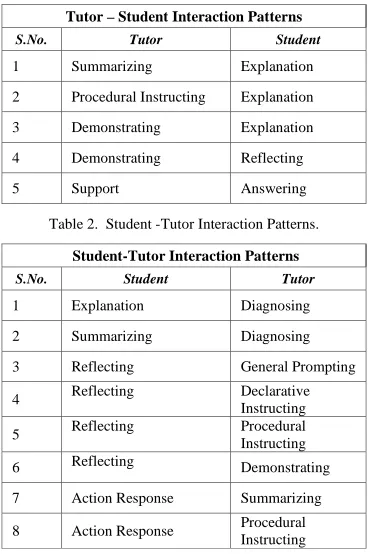
Table 1 and 2 summarizes the tutor-student and student-tutor interaction patterns in which the expert tutor is different from the non-expert tutors (p<0.05).
Table 1. Tutor – Student Interaction Patterns
Tutor – Student Interaction Patterns
S.No. Tutor Student
1 Summarizing Explanation
2 Procedural Instructing Explanation
3 Demonstrating Explanation
4 Demonstrating Reflecting
5 Support Answering
Table 2. Student -Tutor Interaction Patterns.
Student-Tutor Interaction Patterns
S.No. Student Tutor
1 Explanation Diagnosing
2 Summarizing Diagnosing
3 Reflecting General Prompting
4 Reflecting Declarative
Instructing
5 Reflecting Procedural
Instructing
6 Reflecting Demonstrating
7 Action Response Summarizing
8 Action Response Procedural
Instructing
5. Conclusion
This work proposed the implementation of an intelligent learning system between learner and tutor in English-learning environment. The goal of this system is to use the disciple approach to build intelligent mediator that expand the capabilities, generality and usefulness of intelligent learning software. The agent-oriented learning system aims to develop a new training paradigm. Intelligent Feedback System consists of various mediators: Interface mediator, Information mediator, and intelligent mediator. Intelligent Feedback System has a various communication type, a question and an answer, multi-test session, high degree of efficiency, high degree of cooperative, low degree of periodical cost and time constraint. Intelligent Feedback System is to provide an easy to use interface, so that the learners are motivated to use it for their learning. Intelligent Feedback System is designed to include a test paper editor to conduct English-learning system. We also developed a set of requirements that must be supported by agent in order to perform an effective learner English-evaluation. References
[1] Allen, J.F. (1984) Towards a General Theory of Action and Time. Artificial Intelligence, 23, 123- 154.
[2] Barchan, J., Woodmansee, B.J., and Yazdani, M. (1985) A Prolog-Based Tool for French Grammar Analyzers. Instructional Science,
14.
[3] Boose, J. & Bradshaw, J. [1987]. Expertise transfer and complex problems: Using Aquinas as a knowledge acquisition workbench for
expert systems. International Journal of Man-Machine Studies 26(1) 3-28.
[4] Brown, J.S. & Burton, R.R. [1978]. Diagnostic models for procedural bugs in basic mathematica skills.Cognitive Science 2 155-191.
[5] Chae, H. M., Kim, J. H., and Glass, M. (2005) Effective behaviors in a comparison between novice and expert algebra tutors. 16th
Midwest AI and Cognitive Science Conference, 25-30.
[6] Chi, M. T., Siler, S. A., Jeong, H., Yamauchi, T. and Hausmann, R. G. (2001) Learning From Human Tutoring. Cognitive Science, 25,
4, 471-533.
[7] Clancey, W.J. [1987]. Knowledge-based Tutoring: The GUIDON Program. MIT Press, Cambridge, Mass
[8] Clancey, W.J. [1987]. Knowledge-based Tutoring: The GUIDON Program. MIT Press, Cambridge, Mass.
[9] Close, R.A. (1981) English as a Foreign Language. London: Allen & Unwin.
[10] Cunningham, P., Iberall, T., and Woolf, B.(1986) Caleb: An intelligent second language tutor Proceed. IEEE Intern. Confer. On
Systems, Man, and Cybernetics. Los Alamitos, CA: Computer Soc. IEEE, 1210-1215.
[11] Davis, R. [1977]. Interactive transfer of expertise: Acquisition of new inference rules. In Proceedings of the Fifth International Joint Conference on Artificial Intelligence, 1977, pp.321-328.
[12] Di Eugenio, B., Kershaw, T. C., Lu, X., Halpern, A. C. and Ohlsson, S. (2006) Toward a Computational Model of Expert Tutoring: a
[13] Diederich, J., Linster, L., Ruhmann, I., & Uthmann, T. [1987]. KRITON: A knowledge acquisition tool for expert systems. International Journal of Man-Machine Studies 26(1) 29-40.
[14] Ehrich, V. (1987) The Generation of Tense. In: G. Kempen (Ed.), Natural Language Generation. Dordrecht, The Netherlands: M.
Nijhoff, 423-44