Study of Writing Problem in College General
English Course—Reflection on the Reform of
College English Course
Shujuan Wang
School of Foreign Language Education, Jilin University, Changchun, China
Yue Zhang
School of Foreign Language Education, Jilin University, Changchun, China
Abstract—Since the end of 2014, many well-known universities in China have launched an another English course reform under the guidance of College English Teaching promulgated by the Department of Education. They reform general English course into Special English course in order to improve students’ English writing capacity. We can see that the improvement and development of students’ English writing skills and ability have become the core content in this English course reform. This study examines the problem of non-English major students’ English writing in General English course based on the systemic functional linguistics and gives some suggestions. A variety of factors that influence English writing are found, such as the attitude toward English writing, the learning approach and strategy, the number of vocabulary, the integrity of sentence, the coherence of discourse and the transfer of native language. These factors interact to influence the development of students’ English writing ability. Some findings are different from the researches of predecessors. In addition, the survey about English writing sources and self-evaluation are helpful to analyze the problems. This study highlights the influence of discourse and suggests to pay more attention to cultivate students’ discourse awareness.
Index Terms—Non-English major, English writing, systemic functional linguistics
I. INTRODUCTION
As the result of under the guidance of College English Curriculum Requirements (Ministry of Education, 2007) English writing is considered to be the weak link in the process of English teaching due to its high requirements for students’ comprehensive ability. Some scholars do researches about English Writing Textbooks Present Situations in Chinese Universities (Cai, 2005). Some scholars do researches about the situation of Chinese college English writing teaching (Cai&Fang, 2006). This study tends to analyze the main problems that exist in the non-English major students’ English writing. Halliday (2008) believes that systemic functional linguistics in itself is a kind of language analysis tool and Zhang (2005) had ever introduce the guidance of systemic functional linguistics to foreign language teaching. Thus, systemic functional linguistics theory is the frontier of the current college English writing teaching research.
In this article, we report a study that examines Chinese non-English major students’ English writing problems in order to discover what factors facilitate or hinder the development of students’ writing ability. First, we review the literature which are some definitions relevant to the systemic functional linguistic. Second, we show the methods, instruments and data used in this study. After that, we report the main findings, which reveal the existing problems of non-English major students in China. Finally, we briefly discuss some implications for English writing teaching in China.
II. LITERATURE REVIEW
System-functional linguistics pays attention to the function of language, which is widely used in the social linguistics and language teaching. In The Third International Symposium on modern applied literature in July 1998, Mr.Cen (1994) from Hong Kong University introduces the development trend of Australian writing theory. Australian writing teaching has experienced three landmark changes: from put the work as the center, then to put the process as the center and finally centered the systemic functional linguistics on behalf of the new trend of the development of writing theory.
language in social communication, it can explain the nature of language, function and development, and clarify the universality and particularity of different languages. Halliday and Hasan (2001) in Cohesion in English, believes that sentence is not grammatical unit and it is the natural language in a certain context expression without the constraints of sentences and grammatical. Hu (1994)'s definition of discourse is summed up as follows: any natural language which is not completely constrained by the syntax of the sentence in a certain context. The important content of the text is generally accepted by the coherent proposed by Hallidy and Hasen and the coherence proposed by Wilson. Halliday believes that language has three functions: the ideational function, interpersonal function and textual function, in which textual function is the highest level of language acquisition. Therefore, discourse analysis has important practical significance in English writing.
System-functional linguistics pays attention to social function of language. Therefore, college students need to find their motivation of learning English writing so as to achieve the social function of writing. Learning motivation plays an important role in the process of foreign language learning and teaching. Some researches show that the influence of learning motivation towards students’ learning performance from 16%-20% studied by Herbert Walbery raise to 38% studied by Leslie Fyans and Martin Maehr. In addition, Robert Gardner, Richard Lalonde and R.Pierson have a deeper study about learners’ motivation of learning foreign language, and they find that there is a close causal relationship between learner’s foreign language learning performance and learning motivation. Gardner points out that learners’ foreign language learning motivation can be divided into three parts: attitude of learning language, aspect of learning language and effort of learning language. All these factors interact to facilitate learners’ knowledge acquisition. Facing the task they are interested, the foreign language learners would hold a positive learning attitude and enhance the learning motivation and thus obtained good learning performance. On the contrary, the bad learning attitude would bring a disappointing learning performance. This study examines college students’ attitude toward English writing, which could have a contribution to the development and improvement of motivation theory.
Recently, the influence of functional linguistics on language teaching has gained an increasing recognition. Zhang(2006) based on the book Functional Linguistics and Foreign Language Teaching and after summarized the researches by the premise of Halliday and his followers, he discussed the main aspect of the systemic functional linguistics that can be applied in foreign language teaching. He puts forward the systemic functional linguistics can be used to guide teaching and provide a teaching mode for writing. He thinks that language teaching puts discourse as the center and uses language to implement various function in the specific context of social and cultural context with the purpose of cultivating learners' language communicative ability. To a certain extent, language teaching is actually a discourse teaching. In the discourse teaching, we can use the bottom-up teaching method: starting from the text to explore the functional significance of lexical grammar and the relationship between context and cultural context. We can also use top-down approach: starting from the context of culture and context of situation, study the restrictions of context culture and context situation of generic structure and register features. Liao (2011) had a statistically analyze to a total of 27 papers about systemic functional linguistic in foreign language teaching (listening, speaking, reading, writing, vocabulary, grammar teaching) that published on three domestic core journal of foreign languages. The results can be summarized as five “diversification”: research object diversification, research content diversification, theoretical research diversification, research methods diversification and new teaching methods diversification. But there are some deficiencies in the research, that is the research content is unbalanced, the actual operational research needs to be strengthened, and part of the papers are obscure and difficult to understand.
III. METHODOLOGY
A. Overview
This study adopts a mixed-methods, which are the quantitative methods and qualitative methods. The quantitative method allows the researcher verifies the objective question through analyzing the relationship between the different variables (Zhou, 2012). By collecting data through questionnaires, this study aims to provide a rich understanding of the situation of non English major college students' writing. In addition, it adopts the qualitative method which is one way of study from nature. By interviewing some non-English major students, the authors could have a deeper understanding to the students’ psychology. The combination of qualitative and quantitative methods can allow the researchers to acquire a more complete picture of human cognition, behavior and experience (Tashakkori & Teddlie, 2003). Specially it intends to address the following two research questions:
(1) What factors affect non-English major students’ English writing ability?
(2) How to analyze the relationships among these factors to enhance the non-English major students’ English writing ability?
B. Research Context
college students to equip with the English writing ability. However, some problems exist in the process of English writing especially for English major students. This present the necessary of analyzing what factors effect non-English major student’s non-English writing ability and how to enhance their writing ability.
C. Participants and Data Collection
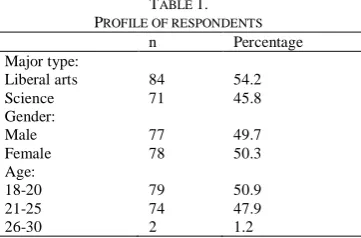
TABLE 1. PROFILE OF RESPONDENTS
n Percentage Major type:
Liberal arts 84 54.2 Science 71 45.8 Gender:
Male 77 49.7
Female 78 50.3 Age:
18-20 79 50.9
21-25 74 47.9
26-30 2 1.2
The participants of this study were non-English major students from different departments of Jilin University. First, 160 questionnaires were sent to non-English major students in the library of Jilin University to assess their situation about English writing. The sampling procedure took into account variations in terms of major, gender and age. Therefore, this study classifies major roughly into two types: liberal arts and science. When distributing the questionnaire, effort was made to obtain a roughly equal proportion of questionnaires from each type of majors(see Table 1).
One hundred and fifty-five valid questionnaires were returned, the return rate being 97%. Of these, 84 were from liberal arts students (54.2%) and 71 were from science students (45.8%). Male students (n=77; 49.7%) roughly equal to female students (n=78; 50.3%), reflect gender balance in Jilin University. In terms of age, about half of the respondents were between18-20(n=79; 50.9%) and another half between21-25(n=74; 47.9%). Only a handful number of students over 25(n=2; 1.2%).
TABLE 2.
BACKGROUND OF INTERVIEW PARTICIPANTS. Student Code Gender Major Age
S1 Male Science 19
S2 Male Science 22
S3 Female Science 21
S4 Female Liberal arts 20 S5 Female Liberal arts 21
After a preliminary analysis of the questionnaire data, five students (named S1 to S5 in this study) were invited to take part in semi-structured interviews using maximum variation sampling, in which the researchers select a small number of units or cases that maximize the diversity relevant to the research question. An equal number of non-English major students were chosen from different majors in order to gain a better understanding of students’ situation of English writing. Most of them have been studying English writing for at least one year, so they had rich experience about English writing. In terms of gender, two of students were male and three were female. Table 2 presents the background information of the interview participants.
D. Instruments
The questionnaire of Non English Major Students’ Problem of English Writing (see Appendix 1) was developed to assess the real situation about English writing. It drew upon one related questionnaire (ChenL,et al.,2011) in formulating the items. The questionnaires consisted of 15 items that measured students’ attitude, approach, the way of writing sources, the existing problems and self-evaluation. The items were rated on a five-point Likert scale (1= strongly disagree, 5=strongly agree). In addition, there are one semi-questionnaire about the way of getting writing sources and one open questionnaire about the students’ self-evaluation about their English writing in order to make the survey more objective. The questionnaire was written and administered in Chinese, and later translated into English.
In addition to the questionnaire survey, five students took part in semi-structured interviews. Each interview lasted at least half an hour and focused on the student’s writing situation about English writing and factors affecting his or her English writing. Some salient questions and problems that identified through the analysis of questionnaire data were added to the interview questions to seek the further clarification. The interviews were all asked in Chinese, audio recorded, transcribe in Chinese and then translate into English (for the main interview questions, see Appendix 2).
E. Data Analysis
considers the problems that the students may be met in the process of English writing, including words, phrase, sentence, discourse and transfer of Chinese. The second scale assesses students’ learning method, whether it is self-directed learning or teacher-guided learning. The third scale measures students’ attitude towards English writing, whether it is positive or negative. The fourth scale assesses some ways they acquire writing sources, including teacher recommended, sources from internet, books bought in the bookstore and others. The fifth subscale measures the self-evaluation of students about their English writing.
Descriptive statistics of all the subscales and items were obtained to examine what problems they would meet in the process of English writing and how to solve them. Scores of these items reflect the situation of non- major English students’ English writing. The scores higher than 3.0 pointed to an active attitude toward English writing while scores lower than 3.0 pointed to inactive attitude toward English writing. Table 3 presents the mean of each subscale.
The qualitative data from the interviews were analyzed using thematic analysis, which is a commonly used method in social sciences for analyzing qualitative data that involves identifying, coding, analyzing and reporting themes within data (Braun & Clarke, 2006). When dealing with the received questionnaires and interviews, we first code the data into two major categories which were the problems about English writing and the solutions. We then analyze the sub-categories of English writing problems from different aspects. Finally the quantitative and qualitative data were integrated to provide a more complete understanding of non- major English situation about English writing.
TABLE 3.
ITEMS AND MEANS OF THE SUBSCALES
Subscale Items Mean
The existing problems of English writing 7,8,9,10,11,12,13 3.8 Approaches of English writing 3,4,5,5,6, 3.3 Attitudes towards English writing 1,2 3.2 The way of acquire English writing sources 14 3.4 The self-evaluation of students themselves 15 2.0
IV. FINDINGS AND DISCUSSIONS
First of all, we have an overall analysis about the non-major English students’ situation about English writing. And then we analyze from five parts. We first analyze the main factors that influence the students’ writing ability based on the analysis of questionnaire and interview data. Second, we offer our interpretation of the multi-dimentional structure of the students’ writing methods by drawing upon selected interview data. Next, we discuss the students’ attitudes towards English writing, both quantitatively and qualitatively. Then, we show the results about where students acquire writing sources and analyze them. Finally, we have a conclusion about students’ self-evaluation about their English writing and provide some implications. We analyze 155 questionnaires through using SPSS 16.0. It reflects all the aspects of students’ English writing (see Table 4).
TABLE 4.
AN OVERALL DESCRIPTION ABOUT THE PRESENT SITUATION OF ENGLISH WRITING
Aspects Number Minimum Maximum Mean Standard deviation Difficulties &Problems 155 1 5 3.8 0.967
Approach & Strategies 155 1 5 3.3 1.021
Attitude 155 1 5 3.2 1.139
Using of sources 155 1 5 3.4 1.072
Self- evaluation 155 1 3 2.0 0.310
In this questionnaire, we use five-point Likert scale to show the results intuitively. 1 represents strongly disagree and 5 represents strongly agree. Therefore, the higher score represents that students identify the items of questionnaire. It is also on behalf that the students’ English writing situation more ideal, make good use of writing sources and writing methods and strategies more effectively. Through analyzing the data, we conclude the results are different from the previous studies. In terms of difficulties and problems, the mean is 3.8, which shows that students could realize the common difficulties and problems in English writing, however, it doesn’t represent that they can deal with them well. The mean of writing methods and strategies is 3.3, which is also a little higher than 3. So students’ cognition about writing methods and strategies is vague. The mean of students’ attitudes towards English writing is 3.2, which is a little higher than 3. It shows that students’ cognition about English writing is neither positive nor negative but more tend to positive. Upon the aspect of writing sources, the mean is 3.4, which shows that students could make use of all kinds of sources to exercise English writing. In the aspect of self-evaluation, the mean is lower than 3 and almost all the students believe that they need to improve their English writing ability. It shows that college students realize the importance of English writing in social life.
A. Survey about Difficulties and Problems of English Writing
Through the results of questionnaire, we can see that we divided the difficulties into some parts, such as vocabulary, sentence, discourse, writing format and the influence from their native language.
Almost all the students (94.8%) agree that rich vocabulary is the basic element to have an English writing. 80.3% students had ever recite good words or template to writing English. And almost all the students (85.1%) believe that English reading is good for English writing. All these data shows that college students have ability to express their ideas by using the appropriate and correct English words. This result comes from the reality that English teachers in China pay more attention to the teaching of words and grammar under the exam-oriented education system. The interview of S2 explains this phenomenon for us:
Since I began to learn English, I recite English words everyday. Although I was not willing to do this, my teacher and parents told us that only memorize words can we learn English well. Every English class from elementary school to high school, teacher would have dictation about new English words. If we write wrong words, we would be punished for writing the same word for many times. It is a disaster for us! However, I got good grades in College English Entrance Exam, which made me feel all the ‘disasters’ are deserve.
Although students learn vocabulary, grammar and sentence under the pressure of examination and the curriculum reform has weakened the status of this basic knowledge, it can help students lay a solid foundation to learn English writing.
A good English writing calls for students’ ability of discourse awareness, which based on the system-functional linguistics. According to the data analysis, most students do not pay attention to the fluency of language and the integrity of discourse. However, there only 37.4% students make an outline before English writing. This shows that most students realize the importance but they lack of the practical action. Now it’s high time to cultivate students’ discourse awareness under the guidance of system-functional linguistics.
As for the influence of native language, nearly half of students (52.3%) organize content in native language and then translate it. In some extent, the transfer of native language may have some influence on language structure and Chinglish expression. However, anyone who wants to have good second language writing has to master the knowledge of native language. The knowledge of native language could help students clarify the logical relationship and organize a complete discourse. The interviewee S1 shows her idea:
I always organize discourse in Chinese in my brain and then translate it into English. In this way, I may make some mistakes and express idea in Chinese style English. But I do not know how to solve this problem.
Through the corpus of S1, we find that native language has many positive effects on second language acquisition.
B. Survey about English Writing Approach and Strategy
We can see that most of students know about the writing approach and strategies, however, self-directed learning needs to improve. Except the uncertain students (31.3%), half of students (38.1%) would apply English writing to the real life such as leave a message and half (31%) not. Almost all the students (82.6%) realize that lots of exercises could help improve the ability of English writing. Unfortunately, only very few students (1.2%) could make writing plan for themselves and carry out strictly, most of students don’t do it. And the following data can explain the reason in some extent. 51% students do writing exercise under the guidance of their teacher. It shows that Chinese students’ dependence on their teacher is still serious, which is due to the tradition of China’s education. As for the writing strategy, the number of students who can make an outline before writing or reread after the writing accounts for a very small part. It is enough to prove the writing strategies that teacher teach in class have not been applied to the real writing.
Interview data provides further insights into students’ English writing approach and strategy. Generally speaking, the interview participants have favorable attitudes toward the approach and the strategy, buy they can not do it by themselves. In Chinese tradition, almost all the students study under the guidance of their teacher before they entered the university so that they can not adapt to the open learning environment in university. They do not know how to make a study plan and carry out. In addition to the tradition consideration, it is difficult for everyone to apply the second language to the real life. S3 says that they need some time to adapt these changes on English writing.
C. Aspect from Attitude
We can see that most of the students have positive attitude toward learning English writing and right consciousness of writing. 32.9% students like English writing and 29.6% students do not like English writing. Most of students do not know their feel about English writing. This finding is supported by interview data. The interview participants generally like English writing and always exercising English writing. However, they did not know what English writing is and did not have system knowledge about it although they have learned English for many years, according to the interview from S2. There are 56.8% students think that exercising English writing is not for exam and 31% students think it is for exam. This phenomenon shows that with the reformation of China’s education system, university pays more attention to cultivate students’ ability of practical application. However, this result contrasts to the interview data. S1 said in the interview:
the coherence of discourse and many other factors. I just say what I want to say.
This interview shows us that the negative attitude of students toward English writing may come from the strict acquirement of writing. And the students’ attitude towards English writing has a direct impact on students’ interest to English writing.
D. Survey about Writing Sources
Most of the students get English writing sources from internet. This phenomenon may be due to the rapid development of information technology and popularization, which is contrast to the predecessors’ research. In the thesis The Situation of College Students’ English Writing (Chen, et al.,2011) about sources, most students using traditional study material such as teaching material and counseling information bought in the bookstore. Now, most students prefer to acquire the recommendation from their teachers.S1 stated that he sometimes can not choose a good sources for himself. There are a variety of sources sale in both bookstore and internet, which make him difficult to choose. Teachers’ recommendation helps him a lot because teacher could recommend according to his real situation. And he found that these books are usually good for him to get good grades and pass the final examination. In addition, with the development of internet and the widely use of information technology in teaching, college teachers are more willing to use the internet sources in English writing teaching. Therefore, most students would find the resources that teacher recommended on the internet.
E. Survey about Students’ Self-evaluation about English Writing
Most of students (92.3%) believe that they need to improve their English writing abilities. Only 1.9% students are very confident to their writing ability and 5.8% students choose to give up. It shows that most students are willing to do some effort to improve their English writing ability. The reason of this phenomenon may be the increasing demand for English writing in the social work, such as international conference and daily e-mail connection. In addition, Chinese students may be influenced by Chinese traditional culture-modesty. Unless they do very well, they would think that they should continue to work hard.
V. CONCLUSION
The findings of this study have some differences comparing to the predecessors’ researches. As for the writing sources, more and more college students are willing to acquire sources from internet due to the convenient and diversity of net sources. In the time that the predecessors do the relative research, the network has not been widely used in the daily work and study. Thus, the results are different. Students’ attitude toward English writing is neither positive nor negative. They may be due to the curriculum setting of general English, which divides curriculum into four parts and writing only accounts for a quarter. The data about approach and strategy shows that college students do not have a clear cognition about approach or strategy of English writing, such as make a writing plan, write an outline before writing or reread after the writing. What’s more, a lot of teachers still pay more attention to the teaching of words and grammar and ignore the cultivation about students’ discourse awareness and comprehensive ability. Certainly, teachers have their own difficulties because they must teach students that could get good grades in examination. About self evaluation, almost all the students think that they need to improve their English writing ability, which shows the importance of English writing in social life. According to the newest data, the number of Chinese papers that published on SCI magazines ranks second in the world by 2010. We can find that English writing not only plays a crucial role in the daily international communication but also is applied in the academic writing. In a word, the status of non-English major students English writing needs to improve.
This study has implications for teachers about how to improve students’ English writing ability. First, college students’ English writing teaching should pay attention to cultivate the discourse awareness in content. Second, college students’ English writing teaching should adapt various ways in form to promote students’ initiative and creativity about English writing. Third, we should combine several kinds of teaching methods. The authors think process genre approach is suitable for students’ English writing. It not only pays attention to the teaching of basic knowledge but also cultivates students’ cognition awareness in writing process. In addition, many important issues such as the interaction between curriculum reform ideas with the teaching reality, the reformation of teaching material should be adequately considered. This paper also offers some reflections to the reform of special English course.
APPENDIX 1. QUESTIONNAIRE
Non-English Major College students’ English Writing Status Questionnaire Respected students:
Strongly Disagree Disagree Neither Agree or Disagree Agree Strongly Agree
1 2 3 4 5
(please circle the appropriate number)
1. I like English writing 1 2 3 4 5
2. I think exercising English writing is not for exam 1 2 3 4 5 3. I would apply English writing to the real life, such as leave a message, writing or keep a diary 1 2 3 4 5 4. I think we need lots of writing exercises to improve writing ability 1 2 3 4 5 5. I could make a writing plan to myself and carry out strictly 1 2 3 4 5 6. My writing exercise usually finish under the guidance of teacher 1 2 3 4 5 7. Rich vocabulary is good for English writing 1 2 3 4 5 8. Reciting template and good words is good for English writing 1 2 3 4 5 9. English writing base on a great number of English reading 1 2 3 4 5
10.I would make an outline before writing 1 2 3 4 5
11. In the process of English writing, I always organize content in native language and then translate it 1 2 3 4 5 12. In the process of English writing, I would pay more attention to the fluency of language and the integrity of discourse 1 2 3 4 5 13.After finish English writing, I usually reread and correct 1 2 3 4 5
14. Where you acquire writing sources? (For example: teacher recommended, wet sources, from the book store, or others)
15. Please evaluate the English writing to yourself (For example: very confident, need to improve, already give up)
APPENDIX 2. INTERVIEW OUTLINE
1. Can you briefly introduce yourself? 2. How do you think of English writing?
3. What problems have you met in the process of English writing? 4. What do you think of your English writing level?
5. Where do your writing sources come from?
REFERENCES
[1] Braun, V., & Clarke, V. (2006). Using Thematic Analysis in Psychology. Qualitative Research in Psychology, 3, 77-101. [2] Cai Huiping. (2005). The Present Situation of Our College English Writing Teaching Material Analysis and Thinking. Foreign
Languages and Teaching, 6, 29-31.
[3] Cai Huiping,Fang Yan. (2006). The Investigation and Analysis about the Present Situation of English Writing Teaching.
Foreign Languages and Teaching, 9, 21-24.
[4] Cen,S.J. (1994). The Research of Systemic Functional Linguistic Applied in Practical Writing Teaching. The Third Session of International Seminar on Modern Practical Writing. Hong kong: The Hong kong Council of Social Science Press.
[5] Chen Liang, Liao Ying,Hu Dengpan,Li Wanlin. (2011). The Analysis and Investigation of College Students’ Present Situation about English Writing. Journal of Southwest Petroleum University (Social Science Edition), 13 (6), 105-110.
[6] Halliday, M. A. K. (2008). An Introduction to Functional Grammar. Beijing: Foreign Language Education and Research Press. [7] Halliday, M.A.K., & Ruqaiya Hasan. (2001). Cohesion in English. Beijing: Foreign Language Education and Research Press. [8] Hu Zhuanlin. (1994). The Cohesion and Coherence of Discourse. Shanghai: Shanghai Foreign Language Education Press. [9] Kakh, S., & Bitchener, J. (2016). Short Communication on the 14th Symposium on Second Language Writing Learning to
Write for Academic Purposes: advancing theory, research and practice. Journal of Second Language Writing, 32, 36-38. [10] Liao Chuanfeng. (2011). An Interview of Systemic Functional Linguistics Applied in Foreign Language Teaching:
achievements and deficiencies. Shandong Foreign Language Teaching Journal, 6, 53-60.
[11] Ministry of Education. (2007). College English Curriculum Requirements. Beijing: Foreign Language Teaching and Research. [12] Tashakkori, A., & Teddlie, C. (2003). Handbook of Mixed Methods in Social and Behavior Research. Thousand Oaks, CA:
Sage.
[13] Zhang Delu. (2006). The Application of Systemic Functional Linguistics in Foreign Language Teaching. Educational Research on Foreign Language& Arts, 2, 17-20.
[14] Zhang Delu. (2005). An Overview of Functional Linguistics Teaching Research. Foreign Language and Teaching, 1, 19-22. [15] Zhou Xue. (2012). Thesis Writing and Data Treatment in Applied Linguistics. Beijing: Beijing University Press.
Shujuan Wang was born in Changchun, China in 1962. She received her Master degree in education from Northeast Normal University, Changchun, China in 1991.
She is currently an associate professor in Jilin University, Changchun, China. Her major publications: Study of Fluency of Spoken English from the perspective of English and Chinese Thinking Styles, Changchun: Journal of Changchun University, 2013. Exploration on the Teaching of Communicative Foreign Language Based on Cultivation of Application Abilities, Changchun: Vocational and Technical Education, 2012. The Role of Affective Filters in Language Output, Changchun: Journal of Educational Institute of Jilin Province, 2008. Research interests: Language education and applied linguistics.