Original Research Article
Effect of a parent-provided early intervention program on infant health
and development: a randomized controlled trial
Basavaraj K.
1, Sireesha S.
2*, Suresh J.
3INTRODUCTION
Children are the touch stone of a healthy sustainable society. How a culture or society treats its youngest members has significant influence on how it will grow, prosper and be viewed by others. Nevertheless, not all children are born healthy, not all children have access to good nutrition, adequate health care and acceptable housing, not all children are raised by parents who can provide comfort, nurture and challenge them
appropriately, and not all children are born free of disabilities or other biological vulnerabilities. It is the mission of early childhood intervention to help young children and their families to thrive. The fundamental challenge of early childhood intervention services is to merge the knowledge and insights of scholars and practitioners with the creative talents of those who design and implement social policy initiatives and to invest the product of this alliance in the future of children and thereby in the well being of society as a whole. The
ABSTRACT
Background: Early Intervention Program (EIP) is a unique way of providing ideal stimulation, education and care for children. EIP are designed to provide detection, treatment, prevention of handicaps, developmental delays, and environmental deprivation as early in a child's life as possible. Objective of present study were to assess the effect of parent-provided EIP on infant cognitive, psychomotor and socio- emotional behaviors at the completion of age 12 months and to evaluate whether these effects were moderated by the infant feeding practices, general health status and socio-demographic characters.
Methods: The present study was randomized controlled trial conducted at villages under Vantamuri PHC area attached to J.N Medical College, Belgaum during the period May 2012 to August 2013, with a sample size of 64, full term, normal babies and weighing ≥2.5 kg. At the end of 12 months, babies were assessed by an independent evaluator using BSID-II and ASQ/SE questionnaire.
Results: In the present study the mental index (MDI) scores were higher in intervention group than control group (106.63 Vs 94.45, P=0.0001). Problem solving skills were higher in intervention group compared to control group (21.33 Vs 11.56, P=0.000). Person social skills were higher for intervention compared to control (27.66 Vs 22.34, P=0.001). Children with fewer episodes of diarrhea and acute respiratory infections showed better performance.
Conclusions: Early Intervention Program effectively increases the cognitive, person social, problem solving and socio-emotional skills at 12 months of age.
Keywords: ASQ/SE questionnaire, Early intervention program, Partners for learning curriculum
1Department of Neonatology, K. R. Hospital, Mysore Medical College and Research Institute, Mysore, Karnataka,
India
2Department ofPediatrics, S. S. Institute Medical Sciences and Research Centre, Devangere, Karnataka, India 3Department ofForensic Medicine, J. J. M. Medical College, Devangere, Karnataka, India
Received: 20 January 2018
Accepted: 26 February 2018
*Correspondence:
Dr. Sireesha S.,
E-mail: [email protected]
Copyright: © the author(s), publisher and licensee Medip Academy. This is an open-access article distributed under the terms of the Creative Commons Attribution Non-Commercial License, which permits unrestricted non-commercial use, distribution, and reproduction in any medium, provided the original work is properly cited.
mandate is to provide support and intervene on behalf of infants and children- especially those who are vulnerable, and disabled, or at risk.1
The promise of early-childhood programs is based on fundamental facts about early human development. A child’s quality of life and the contributions that the child makes to society as an adult can be traced to his or her first years of life.2
Infants are born with an incredible capacity and desire to learn. The largest portion of brain development occurs between birth and three years with approximately 85% of the brain’s core structure developing by the time a young child is three years old. It is critical that their first steps are in the right direction.
Research-based standards are essential to build the foundation for a strong start, one that effectively provides infants and toddlers with skills and gives them the confidence to stay the course, graduate from high school or college, and contribute productively to communities and work places.3
The primary objective of the study was to perform a randomized controlled trial to evaluate the effect of a center-based, parent-provided Early Intervention and enhanced Health Counseling program vs. enhanced Health Counseling alone administered to parents of normal, term infants without any perinatal complications on cognitive, motor and social development of the infants at 12 months age. The anthropometric measurements of the two groups of infants like length, weight, and head circumference, mid arm circumference and body mass index were also compared. The secondary objectives were to evaluate whether the effects of the early developmental intervention are moderated by:
• Infant feeding practices: duration of exclusive breastfeeding, age of introduction of complementary foods, use of iron, zinc and vitamins as nutritional supplements.
• General health status of the infant during the first year of life: episodes of illness such as diarrhea and acute respiratory infections requiring medical intervention or hospitalization.
• Family and child characteristics: educational level, socio-economic status, Sex of baby and birth order.
METHODS
The present study was conducted in the Department of Physiology, J.N. Medical College, Belgaum. Study Design. The study was a randomized controlled trial to assess the effect of parent provided early intervention program on infant health and development, among the infants born in Vantamuri Primary Health Centre (PHC) area attached to the J. N. Medical College Belgaum, during the period May 2012 to August 2013, with a sample size of 62, full term, normal babies and weighing
≥2.5kg. Trained health workers provided HC and medical professional counseled mothers in EI once a month. At the end of 12 months, babies were assessed by an independent evaluator using BSID-II and ASQ/SE questionnaire. following illustration briefs the study design.
RESULTS
Socio-demographic characters of babies and parents
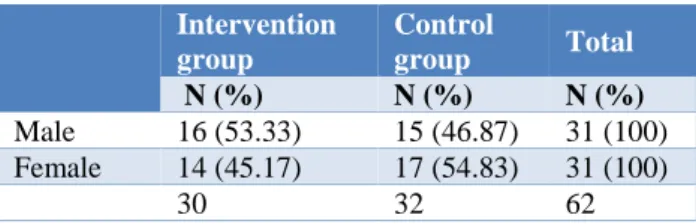
Parents of 62 babies were interviewed during the period of one year.
Table 1:Gender wise distribution of study participants in Intervention and control group.
Intervention group
Control
group Total
N (%) N (%) N (%)
Male 16 (53.33) 15 (46.87) 31 (100) Female 14 (45.17) 17 (54.83) 31 (100)
30 32 62
Majority of the babies 23, 28 (76.6%, 87.5%) were from joint family for EI and HC group. In this present study, majority 13, 17 (43.33%, 53.12%) of the babies were of 2nd birth order respectively for control and intervention group. A majority of the participated mothers were illiterates 10 (33.3%) for intervention group. While majority 14 (43.7%) of the participated mothers for control group had completed secondary education. Mothers 15 each for both the groups were house wives. Majority, 16, 17(53.3%, 50%) of the babies in both the groups belong to the family of class-III socio-economic status.
Table 2:Exclusive breastfeeding practice among intervention and control groups.
Groups
Exclusive breast
feeding practice Total
Yes No
n (%) n (%) n (%)
Intervention group 20 (66.66) 10 (33.33) 30 (100) Control group 14 (43.75) 18 (56.25) 32 (100)
34 28 62
All the 32 babies in the control group had received the nutritional supplements as against 22 (73.3%) in the intervention group.
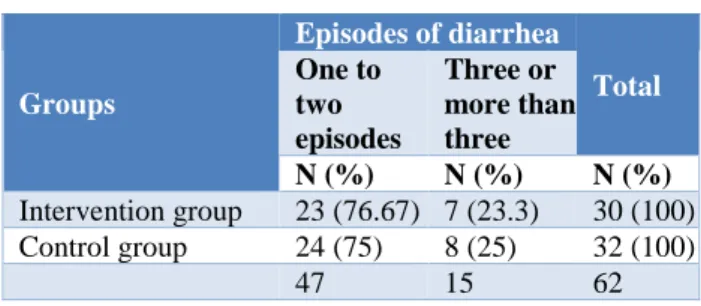
Table 3:General health status of the babies in intervention and control group.
Groups
Episodes of diarrhea
Total
One to two episodes
Three or more than three
N (%) N (%) N (%)
Intervention group 23 (76.67) 7 (23.3) 30 (100) Control group 24 (75) 8 (25) 32 (100)
47 15 62
Developmental outcomes
In intervention group, the mean height for the babies was significantly at higher level as compared to height of control group babies (75cms, 73.1cms). Babies of the intervention group weighed significantly at higher as compared against control group babies (9.6kgs, 8.7kgs). Mean head circumference for the intervention group was 45.1cms as against 44.8cms for the babies of control group. Mid arm circumference was 13.6 cm for EI group as against 13.8 cm for HC group. Bailey’s assessment outcomes
The Mental Developmental Index (MDI) in intervention group was significantly on higher side (106.63) with 12 points more compared to 94.45 of the control group. Psychomotor Development Index (PDI) was not significant. Ages and Stages Questionnaire and Socio Emotional problem-solving ability was found significantly on higher side (21.33) in intervention group babies as against (11.56) for control group babies. Babies in the intervention group had significantly higher skills (score at 27.66) for person social as against (score at 22.34) control babies. Socio-emotional skills were significantly on higher side (score at 172.83) for intervention group as compared to (score at 164.53) control group.
Socio-demographic characteristics versus developmental outcomes
In the present study Developmental parameters were similar irrespective of sex of the babies. There was a trend towards higher scores in both the groups for MDI, from third and more birth order to lower birth order. Communication and socio emotional skills were better for babies with higher birth order as compared to lower birth order babies. There was trend towards higher cognitive scores in the intervention group from class IV to class II socio economic status, values were not statistically significant. Same trend was carried for the communication skills for babies of both the groups. In the present study score for MDI was significantly better (108.6) for a child who stayed with fewer number of children at home as against (102) those who stayed with more number of children. In the intervention group, trend for MDI score was towards higher side (111.6) for
babies born to mother with higher literacy state as compared to babies born to mothers with lower literacy state, but values were not statistically significant.
Fine motor skills were significantly better (score at 25) in intervention group babies born to primary educated mothers as compared to (score at 19.5) the babies of illiterate mothers. Person social skills for babies who were born to secondary educated mothers were on higher side (33.3) as compared to other literacy status of mothers.
Feeding practices versus developmental outcomes
Babies who were exclusively breastfed for at least six or more months had higher scores (108.5) for MDI as against (105.7) for babies who had exclusively breastfed for less than six months. But values were not statistically significant. In control group, PDI scores were higher (114.5) for those who were exclusively breastfed for six or more months as against (111.5) those who were exclusively breastfed for less than six months.
In control group, PDI scores were higher (114.5) for babies who started weaning beyond sixth month as compared to (109) babies who started weaning at sixth month. Communication skills were higher (score at 35.8) for babies who were started weaning at sixth month as compared against (score at 31.1) those who started weaning before sixth month. But values were not statistically significant. In EI group socio emotional skills were higher (score at 165) for babies who started weaning beyond sixth month as against lowest (161.6) for babies who started weaning sixth month.
General health status of babies versus developmental outcomes:
In the present study, Communication skills were better (score at 33.7) for babies who had fewer episodes of diarrhea as against (30.8) those with higher frequency of diarrhea in EI group. Babies in EI group with fewer episodes of ARI had better cognitive score (109) as compared against (106.4) babies with more frequent ARI. Person social skills were significantly higher (score at 35) for EI babies with fewer episodes of ARI as compared to (score at 26.8) babies with frequent ARI. In EI group socio emotional skills were higher (score at176.6) for the babies who had fewer episodes of ARI as compared to (score at172.4) babies with frequent ARI. Cognitive scores were significantly higher (109.6) for EI babies who were never hospitalized for health problems compared against babies who were hospitalized more often.
DISCUSSION
Earlier studies have shown that low socio-economic status negatively affects infant’s developmental outcomes. Since employment, education and socio-economic status are interrelated, it can be concluded that parent’s low income occupation had a negative effect on the child’s developmental outcomes. Majority of the mothers who participated in the intervention group had breastfed exclusively for less than six months, whereas in the control group majority of the mothers had breastfed exclusively for six or more months. WHO recommends for a minimum six months of exclusive breastfeeding.4
The results of the present study show that exclusive breastfeeding had positive effect on the child’s developmental outcomes. It appears that counseling in the intervention group had no effect on promoting exclusive breastfeeding. Results of this study suggest that breastfeeding is particularly important for cognitive development in infants. Majority of the babies in intervention group had started with weaning at sixth or less than sixth month. While in control group majority of the babies had started with weaning after sixth month. WHO recommends weaning should be started at after six months along with continued breastfeeding. The present study shows that weaning after six months had a positive impact on the child’s developmental outcomes particularly on cognitive area. All the participants in the control group had supplemented with nutrients as against few in the intervention group. The present study results show that, supplementation of nutrients during the first year of life appears to have no effect on developmental outcomes of infants. Measuring nutrition is challenging due to the numerous difficulties in assessing diet. However, this type of research is important as diet is a potentially modifiable factor and nutritional interventions may help improve children’s cognitive development. It appears that counseling using IMCI guidelines seems to have worked better in the control group as against in intervention group since in EI stress in was given to the Partners for Learning curriculum. Majority of the children in both the groups had general health problems like diarrhea and acute respiratory infections. These health problems had an influence on the outcomes of infants. Those who had fewer episodes of health problems did better than those who had more frequent health problems. In the control group, the occurrence of general health problems was found to be less frequent and this may be due to the IMCI counseling for control group. The present study showed that Early Intervention Program had a positive impact on the anthropometric measurements of infants during the first year of life. Especially the weight gain and the increase in the height of the infant at 12 months were found to be significant. Weight gain is an important predictor of infant health and development during early years of life, especially for a newborn baby with low birth weight.5
Anthropometric assessments are useful because they provide a simple and practical way of describing the overall nutritional status of the population groups. Their
usefulness stems from anthropometry's close correlation with the multiple dimensions of individual health and development and their socio-economic and environmental determinants. 75 Anthropometric studies can help identify nutritional problems such as under nutrition and over nutrition and pinpoint groups with specific nutritional and health needs to be addressed in policy development and programming.6
Anthropometric indicators can define the extent of the problems and can be used as one criterion in ranking areas and population groups by need, thereby allowing the targeting of appropriate interventions and informing decisions on resource allocation. Where interventions are expected to be influenced by nutrition directly or indirectly, anthropometric measures may be used to evaluate progress and the outcome of an intervention. While anthropometry measures may help to indicate the existence and extent of nutritional problems, and also serve as markers of risk of ill-health, the information does not, by itself, identify specific causes of nutritional problems or the underlying factors that explain the association between anthropometric status and subsequent risk of morbidity and mortality. At the population level, weight-for-height and height-for-age may be useful for identifying sub groups with a high prevalence of wasting or stunting for directing resources to resolve the problems. In evaluating the effectiveness of interventions, it is more appropriate to use stunting rates of children less than two years of age because the effects of the long-term adverse conditions may not be reversible in older children. In developing countries, wasting (expected weight as a percentage of calculated weight for-height) and stunting (height for age) have been used to measure protein energy malnutrition (PEM), as these measures indicate the long-term effect of malnutrition.7
Greater height-for-age has little health significance in infants. Cognitive and psychosocial function, gross motor, fine motor and language are all important developmental abilities for infants, toddlers and preschool children. In this study, it was found that early intervention had a positive impact on cognitive abilities of the normal, term infants of the intervention group as compared against the control group. Intervention enabled two of the infants to achieve Mental Development Index (MDI) scores of more than 115, which are considered as accelerated performance. Psychomotor Development Index (PDI) scores were similar for both the groups. These findings correlated with few studies conducted for infants aged from birth to three years of age at U.S of America.8
babies with higher birth order, this may be due to the fact that babies with higher birth order had frequent chances to interact with other siblings as compared against the lower birth order babies. In intervention group, babies with lower birth order had better fine motor skills. Problem solving abilities in intervention group for higher birth order were slightly more than the lesser birth order. Also, socio-emotional skills were higher for child with higher birth order. This probably could be due to the fact that child might have more often come across communication, getting engaged in play along with other siblings at home. Any increases in the number of siblings in family, results in the decline of the quality of the intellectual environment in the family. Older children are at an advantage compared with younger children because they take on the role as a tutor to their younger siblings, thereby attenuating the negative effect of family expansion. An “only” child (a child without siblings) who does not have the opportunity to act as a tutor is predicted to have a lower score than an older child with a younger sibling. First-born children are also at an advantage because they are exposed to more verbal interaction with their parents. Larger age gaps between siblings are also considered to attenuate the effects of late birth order. These findings were similar to the study conducted in Taiwan.88 In this study analysis of most of the developmental outcomes, shows that children from higher socio-economic status can perform better. Parental income is being significantly associated with cognitive development. Research on children under two years of age has found that SES measures are significantly associated with infant measures of ability.9
The outcomes in this study showed that a child born to parents with more years of education performed well enough to surpass the abilities of a child born to parents with fewer years of education. A study of 1,120 infants found that after adjustment for potential confounders, maternal SES (a combination of maternal occupation and education) was significantly associated with higher MDI in 2-year olds. Maternal and paternal education has been found to be moderate to strong predictors of children’s cognitive ability. Socio-economic status, parental education parental occupation and income are associated. They are considered to measure different aspects of children’s environments. Family income is thought to impact more on the availability of material resources available to a child, whereas parental education is linked with nonmaterial resources such as parental attitudes towards education and understanding of child development. Parental education is a strong predictor of children’s cognitive ability and differences between children in high and low educated families are evident from infancy. It is important to note that all the mothers practiced exclusive breastfeeding, and these rates were at a much higher level as compared to the developed countries.
In this study among the intervention babies the results indicated that exclusive breastfeeding for six month or
more and introduction of complimentary food beyond the sixth month of age had a positive impact on MDI and communication area. However, these results were statistically not significant. Studies to explore the association between breastfeeding and nutritional supplementation with child’s developmental outcomes show a similar positive effect.10
CONCLUSION
Early Intervention Counseling has made a significant increase in the Mental Developmental Index (MDI) scores for the intervention group along with significant increase of scores in the problem solving, person social and socio-emotional skills for intervention group. There was an increased weight gain in the babies of intervention group as compared to control group babies. Intervention seems to have the largest impact for the babies with 1st birth order. Children of higher socio-economic status performed better compared to children of lower socio-economic status. The results imply that parental occupation and income are related to early child development. In the intervention program a child born to educated parents performed better with the intervention. In this study other socio demographic factors like sex of the baby and type of family seem to have made no differences on developmental outcomes. Exclusive breastfeeding for six or more months appeared to improve MDI, although the difference was not statistically significant. It appears that a repeated infection in early childhood puts the child at risk for poor psychomotor development.
Funding: No funding sources Conflict of interest: None declared
Ethical approval: The study was approved by the Institutional Ethics Committee
REFERENCES
1. Meisels SJ, Shonkoff JP. Hand Book of Early childhood intervention. 2nd ed. UK: Cambridge
University Press;2000.
2. Arthur JR, Grunewald R. Quality counts. Early intervention on a large scale. Education Week. Quality counts 2007. January 4 2007. Available at http://www.minneapolisfed.org/publications_papers/ studies/earlychild/early_ intervention.cfm.
3. Infant-Toddlers standards. Available at http:www.pafamilyliteracy.org/earlychildhood/lib/e arly_childhood/Infant_Toddler_Standards_4_07.pdf 4. World Health Organization. Global strategy for
infant and young child feeding, The Optimal Duration of Exclusive Breastfeeding 2001. Geneva.
Available at
http://www.who.int/gb/ebwha/pdf_files/WHA54/ea 54id4.pdf
countries. Bull World Health Organization. 2000;78(10):1207-18.
6. De onis M, Blossner M. The World Health Organi1zation global database on child growth and malnutrition: methodology and applications. Int J Epidemiol. 2003;32:518-26.
7. Grantham-McGregor SM, Fernald LC, Sethuraman K. Effects of health and nutrition on cognitive and behavioural development in children in the first three years of life. Food Nutr Bull. 1999;20(1):53-75.
8. United States. Administration for Children, Youth, and Families. Making a difference in the lives of infants and toddlers and their families: The impacts of Early Head Start. Technical Report, U.S. Department of Health and Human Services,
USA;2002. Available at
https://www.researchconnections.org/childcare/reso urces/119
9. Arriaga, RI, Fenson L, Cronan T, Pethick SJ. Scores on the MacArthur Communicative Development Inventory of children from low- and middle income families. Applied Sycholinguistics. 1998;19(2):209-23.
10. Jain A, Concato J, Leventhal JM. How good is the evidence linking breastfeeding and intelligence? Pediatrics. 2002;109(6):1044-53.