117
Culling Trends on a Hungarian Large Scale Dairy Farm
Violetta Tóth
1, Virág Nagypál
2, Ágnes Süli
1, Edit Mikó
11University of Szeged Faculty of Agriculture: Institute of Animal Sciences and Wildlife Management, Address: 6800
-Hódmezővásárhely, Andrássy street 15., Hungary
2University of Szeged Faculty of Agriculture: Institute of Economics and Rural Development, Address: 6800 -Hódmezővásárhely, Andrássy street 15., Hungary
Abstract
Different diseases experienced in dairy farms cause decreased productivity and profitability. When a decision is made regarding culling, age, phases of lactation cycle, milk production, reproduction phase and health stage all have to be taken into account. Main reasons of culling are reproduction disorder, mastitis, low milk production and lameness. Based on 5-year data of the farm of this research, main culling reasons were identified. Another aim of this study was to find out in which lactation culling had the highest proportion and why. A number of 1175 cows left the farm as a result of culling during 5-year period. Thirty percent of cullings was caused by udder diseases and 22% of cullings occurred due to reproduction disorder. Twelve percent of culling was caused by the sum of low milk production, lameness and metabolic diseases. Thirty five percent of culling was caused by other diseases (lung-inflammation, heart defect, heat stress) and managerial decisions. Culling trends in each lactation: 23 % in first, 32 % in second, 25 % in third, 12 % in fourth, 8 % in 4< (5., 6., 7. and 8.) lactations. In the first lactation the main reasons of culling were reproduction disorder (7.74 %), udder diseases (4.94 %) and low production (4.5 %). However, in the second lactation the highest culling ratio was caused by udder diseases (8.77 %), lower by reproduction disorder (7.83 %) and the lowest by low production (2.8 %). In the third lactation udder diseases (8.43 %), low production (5 %) and reproduction disorder (4.09%) was the distribution between the different factors causing culling.
Keywords: culling, dairy cattle, dairy farm, Holstein Friesian, lactation
1. Introduction
Cattle breeding is relevant economic activity all over the world providing safe livelihood for many people. Cattle serves basic foods and raw materials required for other products. Main aim of cattle breeders for the future is to satisfy higher food demand of humanity due to population growth. Improving efficiency and production quality of the sector is preliminary besides quantitative production. On a cattle farm varying disease cause decrease in productivity frequently. If an individual gets ill, it is not able to reach its genetically determined maximum milk yield. This results in income loss. Main aim of production to keep cattle with high productivity in production as
* Corresponding author: Violetta Tóth,
118 culling ratio of dairy cows in Canada is 28-30% nowadays [8]. This value in USA is 30-35% [9, 10]. Beaudeau et al. [2] claimed that at least half of culling is derived from cattle health issues. Currently veterinarian management focuses on prevention instead of treatment [11]. In order to increase profitability of a dairy farm, it is important to decrease production loss [12]. Losses need to be quantified, evaluated, analysed. As these data help farmers to economically appropriate culling decisions [13]. In Hungary culling of cows is after 3rd or 4th lactation on average. Therefore, many heifers have to be settled into production so all heifer which is suitable for reproduction has to be kept for breeding [14].
2. Materials and methods
Introduction of investigated farm
Investigations were carried out in a Hungarian dairy farm. Data about herd size can be seen in Table 1.
Table 1. Herd size
Cow 604
Milking cow 520
Pregnant heifer 190
Upgrowing 364
Calves (heifers + bulls) 102
There is untied keeping system on the farm. Cows are grouped based on productivity level and lactation stage. The platform is made of concrete. The litter is straw and manuring occurs every day. Every stable has runway with lean-to and feeder. Milking cows are in stables with two blocks and are located into seven groups. Besides this, there are calving house, stable for pregnant heifers and stable for ill animals. Parallel milking-house is equipped with 2x20 platforms, in which automatic udder nipple bathing and milking gum disinfection system. There is milking three times a day.
Description of investigation
In this research reasons of culling were investigated in the given herd in this research. From these, mastitis related culling was analysed in more details. Extent of cullings was analysed considering different lactations. Culling reasons in the first three lactations were identified. Distribution of somatic cell number of cows suffering from mastitis was demonstrated. Demonstration of mastitis was accomplished by applying Californian Mastitis Test. Cows suffering from mastitis were differentiated into specific groups and they were milked separately. Data about their productivity, medical treatment was recorded and stored in farm monitoring system.
Statistical methods applied for processing collected data
Statistical methods applied for investigation can be seen in Table 2.
Table 2. Statistical methods applied for investigation Applied statistical methods Investigated area
Chi2 probe Testing
coherence between variables
%-based distribution of culling reasons in each lactation Serial number of fertilisations depending on lactations Cross-Tabulation
Analysis
Data were gained from RISKA farm monitoring system. SPSS for Windows 18.0 program was used for the analysis. Results were presented in tables and figures during investigation.
3. Results and discussion
119
Figure 1. General investigation of culling reasons in the herd
During 5-years period 1175 cows left the farm as a result of culling during 5-year period, which meant 235 individuals annually. There were significant differences between culling reasons. Mastitis represented the highest ratio with 30% of the total cullings meaning 348 individuals. Twenty nine percent was caused due to other reasons meaning 346 individuals. Twenty two
percent of cullings was caused by reproduction biology reasons meaning 261 individuals. Culling due to low productivity was relatively low proportion 6% meaning 72 individuals during the 5-year period. Twenty two percent presented cullings caused by both lameness and metabolic disease meaning 41 individuals.
.
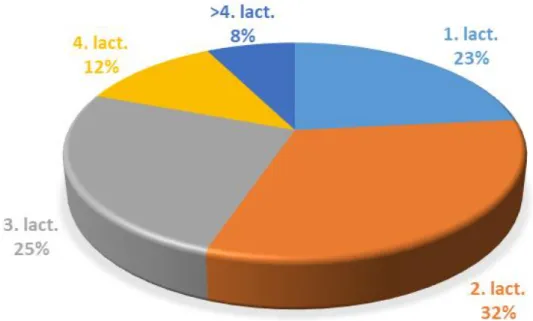
120 The proportion of culling based on number of lactations is presented in Figure 2. Results revealed that the highest proportion of culling occurred in the first three lactation. Culling proportion was similar in the first and third lactation with 23% and 25 %. Culling above 30% occurred only in the second lactation
meaning 374 cows independently from reasons. Culling proportions in the fourth lactation was 12%. Culling of cows above the fourth lactation did not reach 10% considering all of them. The oldest cow of the farm produced till its eleventh lactation.
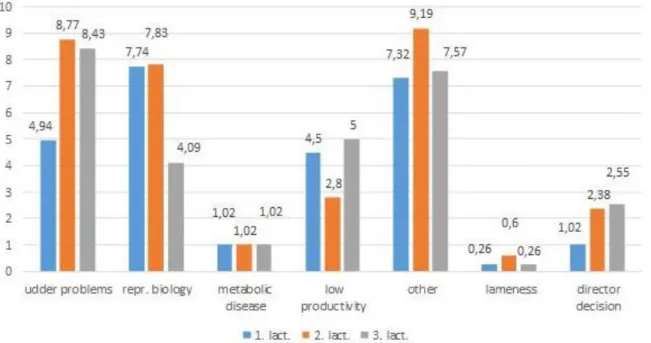
Figure 1. Trends of culling reasons in the first three lactations
Trends of culling reasons in the first three lactations can be seen in Figure 3. Eighty eight percent of the total cullings occurred in the first three lactations. Twenty three percent was the proportion of culling in the first lactation as can be seen in previous figure. Eight percent of this 23% was caused by reproduction biology disorders and 7% was caused by other animal health issues. The third culling reason was mastitis with 5%. Considering the second lactation, culling proportion was 32%. From this 9% was caused by other reasons and 8.77% by mastitis. Culling caused by reproduction biology disorders decreased under 8% in this lactation. In the third lactation main reasons for culling were udder problems representing 8.5% from 25%. The second most frequent meant other reasons meaning 7.5% from 25%. In this lactation culling due to low productivity also occurred with 5%. Significant difference was presented in the distribution of investigated indicators by statistical probe (Chi2=33,740, df=12, p=0,001).
121 cell/ml. As a conclusion, main reason of cullings was clinical mastitis. This was certified by Haraszti [19] who claimed that in case of 1 million cell/ml we can talk about clinical mastitis. Alhussein and Dang [20] considered this value between 500,000 and 750,000 cell/ml. Mastitis has a dangerous impact on animal health and productivity [21]. Mastitis is the most frequent and most costly disease of milk production [22; 23]. Mastitis often results in early culling [24]. Most individuals after the given lactation were culled without fertilisation. The reason of this could be that the individual did not get pregnant during lactation, suffered from paralysis from which
it did not heal or other diseases, injuries came up.
The most diseases appeared in the first 25 days of second lactation. Cows are treated after calving four times as an average in the given lactation. Culling decision influences the animal health issue and production too [25]. As a conclusion proportion of culling has to be minimised on the farm especially considering mastitis. Thus, production during lactation can be increased. As a result, genetic potential utilisation of individuals would be higher and production cost would be lower.
4. Conclusions
Milk production of Holstein Friesian takes place in the forefront of world-class ranking. However excellent milk productivity goes together with several animal health issues, as these individuals have sensitive constitution. The most cullings in a herd are caused by diseases. If an animal got ill, there will be decrease in milk quantity and quality. This can lead to early culling. It is really important to decrease annual culling proportion as much as possible. Thus, profitability of production can be increased. By decreasing culling proportion genetic potential utilisation of individuals would be higher and these individuals can be kept in production for longer period. Results of this research revealed that decrement of culling proportion more efficient and profitable milk production can be achieved. For these proper animal health management and consultancy is inevitable. Mastitis was the reason of cullings in most of the cases. Appropriate udder health program helps to roll back mastitis. As a result, productivity of animals is higher and culling proportion decreases.
References
1. Ózsvári L., Mibe kerül a korai selejtezés? Magyar Mezőgazdaság, 2007, (62. évf.) 6. sz. 16-17. p.
2. Beaudeau F., Cow’s health and farmer’s attitude towards the culling decision in dairy herds. Ph.D. Diss.,
Wageningen Agric. Univ., Wageningen, The
Netherlands, 1995
3. Magda S., Az állattenyésztés szervezése és ökonómiája. Szaktudás Kiadó Ház, Budapest, 2003, 211 pp.
4. McCullough D. A., Delorenzo M. A., Effect of price and management level on optimal replacement and insemination decision, J. Dairy Sci., 1996, Vol. 79. I. 2. pp. 242–253
5. Bascom S. S., Young A. J., A summary of the reasons why farmers cull cows, Journal of Dairy Science, 1998, Vol. 81., I. 8., pp. 2299–2305
6. Chiumia D., Chagunda M. G., Macrae A. I., Roberts D. J., Predisposing factors for involuntary culling in Holstein-Friesian dairy cows, Journal of Dairy Research, 2013, Vol. 80., I. 1., pp 45-50
7. Kerslake J. I., Amer P. R., O’neill P. L., Wong S. L., Roche J. R., Phyn C. V. C., Economic costs of recorded reasons for cow mortality and culling in a pasture-based dairy industry, J. Dairy Sci., 2018, Vol.101., I. 2., pp. 1795–1803
8. CDIC, Breed Improvement and Genetic Evaluation. Culling and replacement rates in dairy herds in Canada,
Canadian Dairy Informational Center (CDIC),
Accessed Dec. 28, 2017,
http://www.dairyinfo.gc.ca/index_e.php?s1=dff-fcil&s2=mrr-pcle&s3=cr-tr
9. Hadley G. L., Wolf C. A., Harsh S. B., Dairy cattle culling patterns, explanations and implications, J. Dairy Sci., 2006, Vol. 89, I. 6., p. 2286–2296
10. Pinedo P. J., De Vries A., Webb D. W., Dynamics of culling risk with disposal codes reported by Dairy Herd Improvement dairy herds, J. Dairy Sci., 2010, Vol. 93, I. 5, pp. 2250–2261
11. Derks M., Van Werven T., Hogeveen H., Kremer W. D. J., Associations between farmer participation in veterinary herd health management programs and farm performance, J. Dairy Sci., 2014, Vol. 97, I. 3, pp. 1336–1347
12. Lakner Z., Élelmiszer-gazdaság és modernizáció. Statisztikai Szemle, 1997, 75. évf. 922-939. p.
13. Ózsvári L., György K., Illés. B. Cs., Bíró O., A tőgygyulladás által okozott gazdasági veszteségek
számszerűsítése egy nagyüzemi holstein-fríz
tehenészetben, Magyar Állatorvosok Lapja, (125. pvf.) 2003, 5. sz. 273-279. p.
14. Holló I., Szabó F., Szarvasmarhatenyésztés. Kaposvári Egyetem-Pannon Egyetem elektronikus jegyzete, 2011, 51. p.
122 herds and genotype by environment interaction for longevity. Journal of Dairy Science, 2011, Vol. 94. I. 3.
1568-1575 p.
https://www.sciencedirect.com/science/article/pii/S002
2030211001111
16. Dobson H., Smith R. F., Royal M. D., Knight C. H., Sheldon I. M., The High‐producing Dairy Cow and its Reproductive Performance. Reprod Domest Anim., 2007, Sep;42 Suppl 2:17-23.
17. Gröhn Y. T., Eicker S. W., Ducrocq V., Hertl J. A., Effects og diseases on the culling of Holstein dairy cows in New York State, J. Dairy Sci., 1998, Vol. 81, I. 4 P. 966-978
18. Shook G. E., Schutz M. M., Selection on somatic cell score to improve resistance to mastitis in the United States, Journal of Dairy Science, 1994, Vol.77. I. 2. 648-658 p.
19. Haraszti J., A tejtermelés és a tejhigiénia tőgyegészségügyi vonatkozásai. pp. 151-179 In: Tejgazdasági kézikönyv (Szerk. MERÉNY I. – LENGYEL Z.) Gazda Kistermelői Lap- és Könyvkiadó Kft., Budapest 1996, 380 pp.
20. Alhussein M. N., Dang A. K., Milk somatic cells, factors influencing their release, future prospects and
practical utility in dairy animals: An overview. Vet Word, 2018, Vol.11., I. 5., 562–577 p.
21. Müller U., Sauerwein H., A comparison of somatic cell count between organic and conventional dairy cow herds in West Germany stressing dry period related changes, Livestock Science, 2010, Vol. 125, 30-37 pp. 22. Halasa T., Huijps K., Osteras O., Hogeveen H., Economic effects of bovine mastitis and mastitis management: A review. Vet. Q., 2007, 29:18–31. 23. Hogeveen H., Huijps K., Lam T. J. G. M., Economic aspects of mastitis: New developments. N. Z. Vet. J., 2011, 59:16–23.
24. Ansari-Lari M., Mohebbi-Fani M., Rowshan-Ghasrodashti A., Causes of culling in dairy cows and its relation to age at culling and interval from calving in Shiraz, Southern Iran. Veterinary Research Forum,
2012, Vol. 3, I. 4., 233–237.
https://www.ncbi.nlm.nih.gov/pmc/articles/PMC43130 41/