DEVELOPING A TRAUMA-INFORMED HEALTHCARE TRAINING
By
Anole Halper
A paper presented to the faculty of The University of North Carolina at Chapel Hill in
partial fulfillment of the requirements for the degree of Master of Public Health in the
Department of Maternal and Child Health. Chapel Hill, N.C.
(November 28, 2016)
Approved by:
Abstract
Sexual violence and other forms of trauma are widespread, with marginalized
communities disproportionately affected. Because trauma is linked to poor health
outcomes, there is evidence that trauma survivors are over-represented in healthcare
settings. However, providers are not routinely trained on how to serve survivors; as a
result, survivors report retraumatizing healthcare experiences. To address this cause of
health disparities, the author collaborated with the Orange County Rape Crisis Center to
design a trauma-informed healthcare training for providers. This paper documents the
training development process, which was guided by a survivor consultant board, and
drew upon a literature review, a survey of local providers, and key informant interviews.
Anole Halper Master’s Paper Table of Contents
Paper: Developing a Trauma-Informed Healthcare Training 4
Literature Review 4
Process of Information Gathering 5
Table 1: Survey Respondents Characteristics 10
Table 2: Survey Qualitative Findings 12
Table 3: Survivor Consultant Board Characteristics 14 Synthesizing Key Findings and Developing Deliverables 16
Works Cited 19
Appendices
A. Budget 21
B. Key Informant Interview Guides 22
C. Provider Survey 23
D. Provider Survey Results: Knowledge 24
E. Provider Survey Results: Organizational Competency 25 F. Provider Survey Results: Training Preferences 26 G. Survivor Consultant Board Recruitment Email 28 H. Survivor Consultant Board Recruitment Flyer 29 I. Survivor Consultant Board Phone Call Screening Script 30
J. Survivor Consultant Board Consent Form 31
K. Survivor Consultant Board Meeting 1: Descriptions of Ideal Medical Appointment
33
L. Survivor Consultant Board Word cloud: Descriptions of Ideal Medical Appointment
34
M: Survivor Consultant Board Meeting 2: Screening Process Brainstorm 35
N: Evaluation Tool of Survivor Engagement 37
O: Trauma-Informed Healthcare Training Pre/Post-Test First Draft 39
P: Pilot Training Anonymous Feedback Form 42
Q: Pilot Training Anonymous Feedback Results 44
R: Pilot Pre/Post-Test Findings 47
Deliverables
Revised pre/ posttest 50
Handout: SAMSHA checklist 53
Case studies 56
Dissemination opportunities 62
Paper: Developing a Trauma-Informed Healthcare Training
Literature Review
Sexual violence is widespread, with survivors from marginalized communities
often the most affected. Forty-four percent (44%) of women, 24% of men, and about 50%
of transgender people are survivors of sexual violence (Breiding 2014; Kenagy, 2005).
Rates are higher among racial minorities (Centers for Disease Control and Prevention,
2011).
Sexual violence also impacts survivors’ health: in one study, survivors of past
victimization were 2.16 times as likely to report generally poor health as non-survivors
(Choudhary, Coben, & Bossarte, 2008).Survivors are also over-represented in healthcare settings. One study of female survivors of intimate partner violence found that they had
1.54 times the number hospital visits and 1.17 times the number of primary care visits of
non-survivors (Rivara et al., 2007). However, medical schools do not routinely include
information about how to serve trauma survivors in their curricula (Raja et al.,2015).
Therefore, survivors are not only in greater need of healthcare, but providers’ lack of
training can impede survivors from obtaining the care they need. The Orange County
Rape Crisis Center (OCRCC) does not offer medical services but engages frequently with
medical providers to make referrals, advocate for survivors, and ensure survivors’ needs
are met. In order to improve survivors’ experiences with healthcare providers, decrease
re-traumatization, and ensure that survivors who access healthcare services are connected
with victim advocates, I designed a training for local healthcare providers in
trauma-informed care (TIC) that OCRCC will deliver to providers. TIC involves patient-centered
collaboration, and screening for trauma (Raja et al., 2015). The training also addresses
the specific needs of marginalized communities facing additional barriers, including
survivors of color and LGBTQ survivors. Training local providers in TIC will allow
OCRCC to develop a network of medical providers for mutual referrals and coordination.
Most importantly, trauma-informed care offers survivors the most effective services and
reduces painful barriers when navigating the aftermath of violence, resulting in improved
outcomes for healing.
Process of Information Gathering Partners
I am grateful for a $2000 Community Engagement fellowship provided by the
Carolina Center for Public Service. (For the fellowship budget, see Appendix A.) I also
partnered with Waruguru Gichane, a PhD student in health behavior with a focus on
gender violence, to develop the tools and frameworks that shaped the training, but I
developed actual training content. Waru offered expertise in research methods and
behavior change theory that allowed us to make sense of the information we were
gathering. Bethany Wichman-Buesher, the client services director at the Orange County
Rape Crisis Center, represented the interests of our client, the Orange County Rape Crisis
Center, who will be delivering the training. We participated in several meetings with
Bethany as we developed the training, ensuring we were on-track to meet the Center’s
needs.
The training draws upon three main sources of information: research, provider
engagement, and consulting with survivors. I began by utilizing the six components of
Administration (SAMHSA), to code both research and key-informant interviews. The six
themes are: safety; trustworthiness and transparency; collaboration and mutuality;
empowerment, voice, and choice; gender, historical, and cultural issues (Substance Abuse
and Mental Health Services Administration [SAMSHA], 2014). However, later in the
process, as the training’s structure developed, I abandoned this organizational technique
in favor of one that reflected the training of the organization itself. Overall, the process of
drawing on these sources to develop the training was iterative, with insight from one
information source leading to examining other information with fresh eyes.
Research
Literature was reviewed on trauma-informed care, patient-centered care, the
impact of trauma on health, and the healthcare experiences and preferences of trauma
survivors. Unfortunately, this initial literature review quickly led to the recognition that
evidence on trauma-informed care interventions in healthcare is very limited (Reeves,
2015). As a result, I broadened my research to parallel healthcare constructs with a
more established research basis and more credibility in the medical field, such as
patient-centered care, patient engagement, and patient empowerment. This expanded literature
became a rich source for evidence (Rathert, Wyrwich, & Boren, 2012), as I ultimately
used this body of evidence to support the needs identified by survivors and key
informants.
Provider Engagement
Key Informant Interviews. (See Appendix B for key informant interview guide.) Key informant interviews were undertaken with three types of providers: (1) Those who
by survivors in healthcare settings; (2) those with knowledge of medical culture and the
medical field offered advice on how to translate key findings to a healthcare audience; (3)
and those with expertise in trauma-informed care and/or health disparities explained the
key concepts I needed to emphasize. I struggled to reconcile the vastly different
worldviews and understandings these three groups of providers held-- to present the
information in a way that would appeal to my audience and their understanding of the
world, while still staying true to the needs of survivors.
Survivor support providers. Seven interviews were undertaken with social service providers who work with survivors. In these interviews, informants emphasized how
difficult it is for survivors to access medical care, and their own frustration with
healthcare providers’ lack of understanding. For example, one provider said:
Oftentimes, I hear [survivors’] experiences with medical providers who say
“why did you wait so long to come in [after the assault]?!” Within that one
sentence, it shows that you do not understand what the person has gone
through at all. It shows the huge divide between the doctor and patient. This
happened to them. They had no idea this was going to happen; they didn’t plan
for this. It’s probably the hardest thing that’s ever happened to them, and then
they had to figure out what to do. It’s like blindfolding me and putting me in a
car, driving me to the bottom of Mount Everest, and saying, “okay, climb.”
Providers also offered insight into what particular triggers and misunderstandings
survivors face in healthcare settings. For example, according to one provider, “patting
are not trauma-informed might see it as being aggressive or inappropriate.” Another
provider, referring to patterns of abuse, said, “Minimizing, denying, blaming are so
much a part of the medical language. Even good doctors don’t realize when they’re doing
it.” After that interview, I recognized that survivors and other informants discussing
negative healthcare experiences were sometimes describing relationships with providers
themselves as triggering, as opposed to specific triggers.
Medical culture experts. Four interviews were conducted with physicians or trainers of physicians. These key informants discussed the culture of medicine and how to
tailor our message to that culture, particularly emphasizing themes that reappeared in our
survey findings: a need to focus on evidence, a need for concrete strategies rather than
broad advice, and the scarcity of providers’ time. According to one informant, “When
you’re behind and you’re stressed, challenging patients can slow you down. It’s difficult
to provide care for a patient who needs 30 minutes in 15 minutes.”
Trauma informed care and health disparities experts. Five experts in trauma-informed care and health disparities offered thoughtful and candid guidance on how to
best represent the interests of survivors and marginalized communities. For example,
Karnwapal Daliwal, an organizer with RYSE who revised the Adverse Child Experiences
(ACE) pyramid to incorporate historical trauma, said “When I first saw the ACEs
pyramid, I had this ambivalence: Science has already caught up to what we know. Now
that we know that middle class white people have pain, we have to do something about it.
So how do we leverage that? We have to actually give our truth to [this model.]” These
providers challenged Waru and me to more fully incorporate an intersectional analysis
Survey.
Overview. A digital survey was also distributed to health care providers to assess their current level of knowledge and practice of trauma-informed care. The survey
questions were intentionally broad, in order to provide feedback on every topic I had
considered incorporating. The survey thus assisted me in narrowing the focus of the
training to more specific topics. In addition to demographic information, there were three
main categories of questions: (1) respondents’ personal knowledge, (2) respondents’
views on their workplaces’ competencies, and (3) respondents’ feedback on the topics
they would like covered in a training, and how they would like them covered. (See
Appendix C for survey questions.)
Survey development. Input into the survey questions was offered by Bethany Wichman-Buesher, Waru Gichane, and Kelli Raker, my internship supervisor and an
expert in evaluation and survey-design. The language of the qualitative questions was
based on the survivor consultant board’s brainstorming in session one about the
components of an ideal medical appointment.
The survey was also informed by findings from a previous survey distributed by
OCRCC to healthcare providers who had expressed interest in learning about
trauma-informed care. In that survey, a ceiling effect was observed as providers rated their
competency in TIC very highly. Bethany, Waru, and I surmised these results were due to
both selection bias and social desirability bias. In order to prevent selection bias, we
reached out to medical providers on Facebook, through the medical school, and through
professional contacts, and offered a $5 gift card as an incentive to the first twenty
Martin’s input, we extended the 5—point Likert scale to a 6- and 7-point Likert scale. We
also did not prompt respondents to assess their own competency.
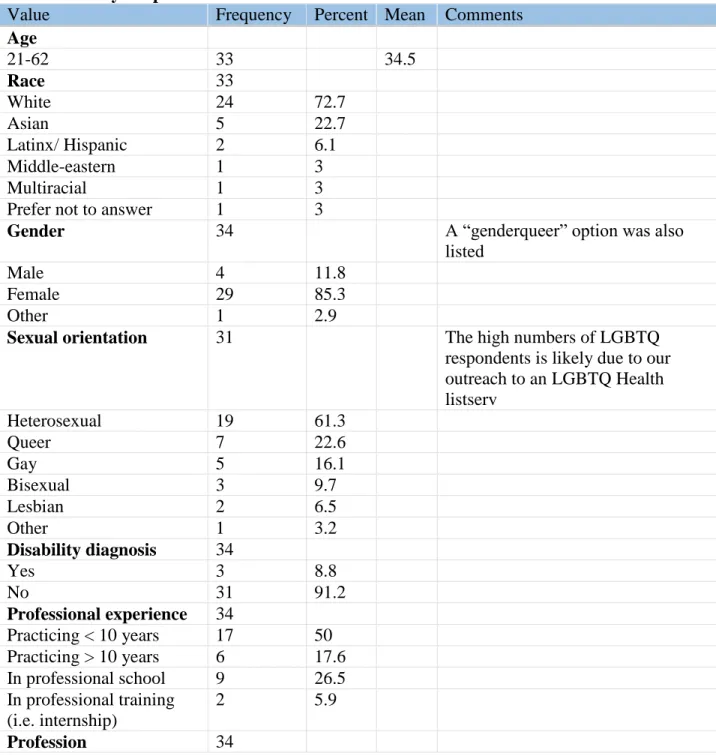
Survey sample. In total, there were 34 respondents, representing a wide range of local providers. See Table 1.
Table 1: Survey Respondents Characteristics
Value Frequency Percent Mean Comments
Age
21-62 33 34.5
Race 33
White 24 72.7
Asian 5 22.7
Latinx/ Hispanic 2 6.1
Middle-eastern 1 3
Multiracial 1 3
Prefer not to answer 1 3
Gender 34 A “genderqueer” option was also
listed
Male 4 11.8
Female 29 85.3
Other 1 2.9
Sexual orientation 31 The high numbers of LGBTQ
respondents is likely due to our outreach to an LGBTQ Health listserv
Heterosexual 19 61.3
Queer 7 22.6
Gay 5 16.1
Bisexual 3 9.7
Lesbian 2 6.5
Other 1 3.2
Disability diagnosis 34
Yes 3 8.8
No 31 91.2
Professional experience 34
Practicing < 10 years 17 50 Practicing > 10 years 6 17.6 In professional school 9 26.5 In professional training
(i.e. internship)
2 5.9
Other 17 50 This selection may be due to the high number of students in our sample
Physician 11 32.4
Nurse practitioner 5 13.7
Nursing assistant 1 2.9
Healthcare Field Primary care/ family medicine
16 47.1
Other 10 29.4 Respondents listed these responses.
Reproductive medicine/ OB/GYN
3 8.8
Pediatric medicine 2 5.9
Dentistry 1 2.9
Critical care medicine 1 2.9 Unknown: still deciding 1 2.9
Results and analysis.
Quantitative: Like the survey itself, quantitative findings were divided into
individual knowledge (Appendix D), organizational competence (Appendix E), and
training preferences (Appendix F). Some of the most surprising individual knowledge
findings were respondents’ lack of familiarity with the ACE studies and trauma-informed
care. The most striking organizational competency findings were that respondents felt
their organizations were best at shared decision-making and serving marginalized
communities, with the exception of transgender people; respondents also felt that the
organizations they worked for were less competent at screening for, and responding to,
trauma. The training preferences findings indicated that respondents most valued patient
health outcomes and patient satisfaction. In general, the quantitative findings affirmed the
need to educate providers on trauma-informed care, screening for trauma, and the effects
of trauma on health. The findings also revealed that framing the training content in terms
of health disparities, patient-centered care, and shared decision-making would build on
Qualitative: Waru and I both coded the qualitative responses and discussed
discrepancies. We did both open-coding and a priori coding using the five SAMSHA
categories described earlier. While we were primarily in agreement about the open codes,
we found that, more often than not, we disagreed about which a priori theme was being
discussed in a response. The exact rate of disagreement was not calculated. Rather than
reconcile these issues, we came to the conclusion that it was more important to determine
our own organizational structure for the training than to fit topics into SAMSHA’s
structure. We also had clear consensus about which themes emerged from the
open-coding of the data. These are listed below with some representative quotes.
Table 2: Survey Qualitative Findings
Theme Description & Comments Example Response(s) Connection
between physical and mental health
Providers understood that physical ailments could result from trauma, wanted more information about this, and were unsure about how to discuss this connection with their patients.
“[I want to learn] how to talk about physical pain worsened by emotional triggers that are not off-putting to trauma survivors - it's not all in their heads, but thoughts and feelings and experiences can provoke physical pain.”
Evidence-based practice
It was important to respondents that the strategies they employed were evidence-based.
“What's the latest research indicate?”
“Providers have a range of familiarity with new trauma research so you may be working with total beginners to people who are very familiar with trauma informed care. We are, however, all constrained by time and efficiency goals in clinic, and would benefit from evidence-based strategies to incorporate TIC into routine workflow”
How to sensitively screen for trauma
Respondents expressed uncertainty about how to screen for trauma without triggering patients, and how to empathetically respond to disclosures.
“[I want to learn] A smoother way to initiate a conversation about trauma. Are there often verbal triggers to avoid?”
assistant, but I've never been informed of a person's trauma history. I'm not sure if nurses don't think it's relevant or if we just don't know what to do with this information. So maybe just how to assess for trauma and how to effectively communicate pertinent care information to other staff members who may be helping to care for a patient.” Time Respondents were
concerned about how to integrate new strategies in limited very time.
“We have extremely limited time (10-15 minutes) per patient. If strategies take more than one minute of patient interaction time, they will likely not be implemented.”
Avoiding triggers
Respondents wondered about what parts of their practice might be triggering for patients, and how to avoid these
“What about our clinic does not feel safe? Are there procedures or aspects of the clinic experience that are
triggering?”
“How to help patients feel comfortable in the hospital, where we do a lot of potentially invasive / triggering things with high frequency (bathing, toileting, skin assessments, gathering health histories, etc.).”
Survivor Leadership
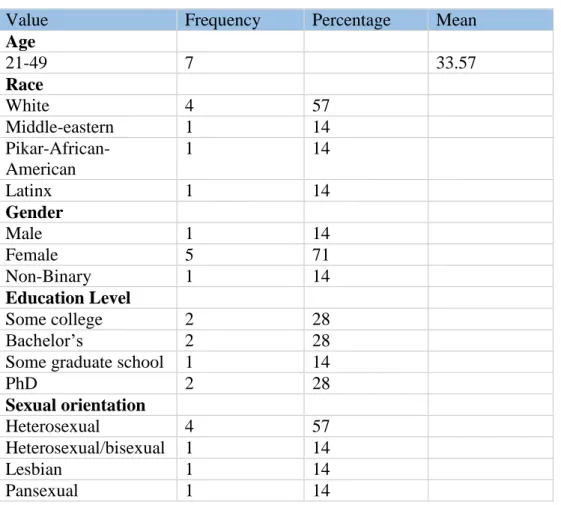
A survivor consultant board, consisting of seven diverse survivors of sexual
violence, was recruited through OCRCC’s Survivor Speaker’s bureau, other
organizations that served survivors, and the LGBTQ Center. (For email to speaker’s
bureau see Appendix G. For flyer, see Appendix H.) Those who expressed interest via
email were screened in a follow-up phone call (For screening guide, see appendix I). A
correspondence with the IRB revealed that this project was exempt from IRB approval.
Nonetheless, survivors completed a consent form designed in consultation with advisors
Dorothy Cilenti and Dr. Sandra Martin. (See Appendix J.) Survivors were compensated
When a consultant was unable to attend a meeting, they were offered the opportunity to
contribute their ideas in another way, such as through a one-on-one conversation or email
correspondence. One consultant dropped out after one meeting; the rest of the consultants
stayed in communication and contributed throughout the process, even when unable to
attend meetings.
Table 3: Survivor Consultant Board Characteristics
Value Frequency Percentage Mean
Age
21-49 7 33.57
Race
White 4 57
Middle-eastern 1 14
Pikar-African-American
1 14
Latinx 1 14
Gender
Male 1 14
Female 5 71
Non-Binary 1 14
Education Level
Some college 2 28
Bachelor’s 2 28
Some graduate school 1 14
PhD 2 28
Sexual orientation
Heterosexual 4 57
Heterosexual/bisexual 1 14
Lesbian 1 14
Pansexual 1 14
Meeting 1. In the first meeting, consultants came to consensus on group agreements. Then they reflected and brainstormed their ideal medical appointment,
writing the components of their vision onto post-its. They used a consensus-building
Results show that a recurring theme was a desire to be asked about both preferences and
trauma history (See Appendices K and L).
Meeting 2. In this meeting, we shared the results of the provider survey as well as the transcribed notes from the previous meeting and the word cloud of responses. We
then did an activity to address providers’ uncertainty and nervousness about how to
screen for trauma. Flip-chart pages were posted around the room, each representing a
stage in a medical appointment such as “on the form,” “at the front desk,” or “with the
nurse.” We asked consultants to circulate and write down, on the designated flip chart
page, what they would like screening to look like at each step. (See Appendix M). This
exercise became the basis of section 5 of the training. Finally, we distributed the training
outline and asked consultants to annotate the outline
Meeting 3. This meeting gave consultants an opportunity to review an early draft of the training. An online survey consultants completed before the meeting determined
which section I would be showing them; we focused on the section that covered the “how
tos” of trauma-informed care, and engaged in a discussion of how it could improve. Then
we brainstormed the primary components of the case studies that would serve as
exercises in the training (See page 55). Finally, we distributed a survey that assessed how
empowering and trauma-informed they had found their process of being a consultant.
(See Appendix N.) While most responses were 4-5 on our Likert scale, one respondent
answered all ones and two’s, indicating that they may have misunderstood the direction
of the Likert scale. Because of this possible information bias, we were unable to
Additional engagement. After the meetings, the board had access to the full training online, as it was drafted. . Board members were able to offer suggestions and
feedback. Board members were also invited to the pilot.
Synthesizing Key Findings and Developing Deliverables
After the second board meeting, Waru and I worked together to synthesize the
information we had gathered to generate training objectives and select a target audience.
We struggled to reconcile the inherently macro, institutional nature of trauma-informed
care with the need to offer concrete steps to our audience, who do not necessarily have
the power to easily make institutional change.
Target Audience
We had originally considered targeting our training to all healthcare providers
including administrative and paraprofessional staff because they all impact patient
outcomes. However, we decided to narrow our target audience to doctors and nurses
because appeals to front-line paraprofessional staff might require a different argument;
physicians and nurses were best represented in our survey respondents, and while it
would be difficult for us to appeal directly to administrators, doctors and nurses could
have influence over these stakeholders.
Objectives
In designing our objectives, we utilized the Integrated Behavior Model to map the
best path to the changes we sought: improved patient satisfaction and patient health
outcomes (Montario & Kasprzyk, 2008). We decided to target intentions, the most proximal determinant of behavior according to the model. Because the qualitative survey
implementing TIC, we also chose to target self-efficacy and skills. The following
objectives were generated:
Providers will:
Increase intentions/self-efficacy/skills to talk to patients about their experiences of
trauma using empowering/non-stigmatizing language
Increase intentions/self-efficacy/skills to ask survivors about their triggers
Increase intentions/self-efficacy/skills to offer patients more choices and
opportunities to consent
Increase intentions/self-efficacy/skills to practice empathetic, non-judgmental
communication about health behaviors
Increase intentions to talk to other staff about implementing these changes.
Increase intentions to provide referrals
Pre and Post-Test
We utilized these objectives to develop a pre- and post-test, drawing on existing
evaluation tools (Goodman et al., 2016; Zachariae et al., 2015) and a meeting with
Theresa Edwardsat the Odum Institute. (See Appendix O for pre/post-test). We then built
the training in concert with the pre/post-test.
Pilot
We held a 2-hour pilot training, recruiting participants through survey respondents,
the survivor board, and contacts in the medical and social services field, so that our
audience could offer expertise on both sexual trauma and healthcare. Approximate
Pilot feedback. Pilot participants had an opportunity to offer feedback via an
evaluation (see Appendix P for evaluation form.) The main findings from the evaluation
were that participants appreciated the training content, but wanted more concrete
language, examples, and activities. Further activities are included in the full training, but
were not covered in the pilot. (See Appendix Q for evaluation findings.)
Pilot pre and post-test findings. (See Appendix R.) While scores increased
significantly on the post-test for questions related to most objectives, participants’ scores
decreased on questions measuring the objective, “practice empathetic, non-judgmental
communication about health behaviors.” Further examination revealed a ceiling effect in
the pre-test, likely due to providers’ belief that they already express empathy well with
their patients; training content may have then caused provider to question this belief and
reduce their sense of self-efficacy. This problem has been addressed in three ways: (1)
Training content offers more opportunities to practice skills and improve providers’
self-efficacy on expressing empathy. (2) As per Theresa Edward’s suggestion, questions
pertaining to this objective are moving from the end of the questionnaire to the beginning
in order to capture respondents’ gut reaction. (3) Wording on questions targeting this
objective will shift from self-appraised skills to measuring more specific target behaviors,
related to how the training operationalized “expressing empathy.”
Implementation Plan
OCRCC has agreed to deliver the training to providers at least annually. In the
process of developing the training, opportunities also arose to build further partnerships
with providers and disseminate the trainings. A list of these opportunities are included in
Works Cited
Breiding, M. J. (2014). Prevalence and characteristics of sexual violence, stalking, and intimate partner violence victimization—National Intimate Partner and Sexual Violence Survey, United States, 2011. Morbidity and mortality weekly report. Surveillance summaries (Washington, DC: 2002), 63(8), 1.
Centers for Disease Control and Prevention. (2011). National intimate partner and sexual violence survey: 2010 summary report. Atlanta: National Center for Injury
Prevention and Control
Choudhary, E,. Coben, J.H., Bossarte, R.M. (2008). Gender and time differences in the associations between sexual violence victimization, health outcomes, and risk behaviors. American Journal of Men's Health. (2)254-259.
Goodman, L. A., et al. (2016). development and validation of the trauma‐informed
practice scales. Journal of Community Psychology, 44(6), 747-764.
doi:10.1002/jcop.21799
Kenagy, G. (2005). "The Health and Social Service Needs of Transgender People in Philadelphia," International Journal of Transgenderism 8(2/3):49–56; G. Montario, D. E., & Kasprzyk, D. (2008). Theory of reasoned action, theory of planned
behavior, and the integrated behavior model. Health Behavior and Health Education, Theory, Research and Practice. 4th ed. New York, NY: Jossey-Bass. Reeves, E. (2015). A synthesis of the literature on trauma-informed care. Issues in Mental
Health Nursing, 36(9), 698-709. doi:10.3109/01612840.2015.1025319
informed care in medicine: Current knowledge and future research directions.
Family & Community Health. (38)216-226
Rathert, C., Wyrwich, M. D., & Boren, S. A. (2012). Patient-centered care and outcomes:
a systematic review of the literature. Medical Care Research and Review,
1077558712465774.
Rivara, F. P., et al. (2007). Healthcare utilization and costs for women with a history of
intimate partner violence. American Journal of Preventive Medicine, 32(2),
89-96. doi:10.1016/j.amepre.2006.10.001
Substance Abuse and Mental Health Services Administration. (2014) SAMHSA’s Concept
of Trauma and Guidance for a Trauma-Informed Approach. HHS Publication No.
(SMA) 14-4884. Rockville, MD: Substance Abuse and Mental Health Services
Administration.
Zachariae, R., et al. (2015). The self-efficacy in patient-centeredness questionnaire – a
new measure of medical student and physician confidence in exhibiting patient-
centered behaviors. Bmc Medical Education, 15(1), 150.
Appendix A: Fellowship Budget
Line Item Description Amount
1 Printing and Publication Cost of printing/photocopying hand-outs 75.00
2 Program Supplies Flipchart 25.00
3 Food N/A. OCRCC has agreed to provide. 0.00
4 Survivors’ consultation
payments $15/hr X 50 hours of work 750.00
5 My consultation fee
$15/hr X 75 hrs of work (about 5
hours/week for four months) 1125.00
6 Childcare N/A. OCRCC has agreed to provide 0.00
Appendix B: Key Informant Interview Guides
Ask about quotes: anonymous quotes only? Can I give you credit in the training as a contributor?
For Survivor Support Providers
1. What barriers have your clients’/community faced in obtaining quality medical care?
2. Once they are engaging with a provider, what issues have come up for them? 3. What do you and your clients wish medical providers could know about them? 4. How do you and your clients wish medical providers would treat them?
5. What specific topics should I include in this training?
6. What advice would you give me about what to cut and what to make sure I include?
7. Would you like to come to the pilot?
For Medical Providers & Experts
1. What do I need to understand about medical culture in order to deliver an effective training?
2. What do I need to understand about healthcare professionals’ views of themselves?
3. What do I need to understand about their views of their patients? 4. What do I need to understand about their daily experiences?
5. How do I reframe macro social issues so that healthcare professionals see them as within their purview?
6. Is there any medical-specific vocabulary that I should include as I’m training on this topic?
Appendix C: Baseline Assessment Survey Enclosed is a link to the survey:
Appendix D: Provider Survey Results: Knowledge
Please describe your level of familiarity with the following topics, using this following guide.
1= I have never heard of this topic.
2= I am not familiar with this topic, but I have heard of it. 3= I am familiar with this topic: I could define it.
4= I know this topic: I could discuss it generally.
5= I am well-versed in this topic: I could explain it fully. 6= I am expert in this topic: I could teach it to someone else.
Key: Highest scores, lowest scores.
Question Mean Score
Patient-centered care 4.64
Trauma-informed care 3.03
The ACE score and its link to health outcomes 2.16
Cultural humility 3.26
How having a marginalized identity impacts physical health 4.1 How having a marginalized identity impacts mental health 4.1 Difficulties that people of different racial and cultural
backgrounds may face in healthcare settings
4.39
Difficulties that non-native English speakers may face in medical settings
4.45
Difficulties that lesbian, gay, bisexual and queer people may face in medical settings
4.29
Difficulties that transgender people may face in medical settings
4.03
Difficulties that survivors of psychological trauma such as sexual violence may face in medical settings
3.48
How psychological trauma, such as sexual violence, impacts the brain
3.16
How psychological trauma, such as sexual violence, impacts physical health
3.58
How psychological trauma, such as sexual violence, impacts mental health
3.74
How psychological trauma, such as sexual violence, impacts survivors' behavior in healthcare settings
3.29
Difficulties that survivors of psychological trauma may face in healthcare settings
3.23
Appendix E: Provider Survey Results: Organizational Competency
As you consider the following skills, please indicate the level of competence of the healthcare organization where you are working or completing your training. If you are still in school, indicate how competently these topics are addressed in the curriculum from a scale of:
1 (my healthcare org or school is not at all competent in this skill) to
7 (my healthcare org or school is extremely competent at this skill: there are no improvements needed)
Key: Highest scores, lowest scores.
Question Mean Score
meeting the needs of people of marginalized racial and cultural backgrounds
4.91
meeting the needs of sexual minorities like lesbian, gay, bisexual, and queer people
3.94
meeting the needs of non-native English speakers 4.56 meeting the needs of survivors of psychological trauma such
as sexual violence
3.74
meeting the needs of transgender people 3.29
working with survivor advocates 3.41
ensuring that patients feel physically and psychologically safe 4.59 being transparent with patients about organizational decisions 3.88 leveling the power differences between providers and patients 4.15 patients sharing in decision-making and goal-setting in their
treatment
4.97
working with language interpreters 4.85
communicating and collaborating with community organizations in meeting patients' needs
4.47
patients having a voice in how the organization is run 3.74
screening for sexual violence 3.47
incorporating policies, procedures, and processes that are responsive to racial, ethnic, and cultural needs of patients
4.2
Appendix F: Provider Survey Results: Training Preferences
Question Options Frequency % Mean
How interested are you in learning more about the topic of serving survivors of psychological trauma like sexual violence?
Likert scale 4.38
1 0
2 0
3 6 17.6
4 9 26.5
5 19 55.9
What length professional training would you be most likely to attend if you were interested in learning about the topic? Select all that apply.
1-hour training in one day
18 52.5
A 2-hour training in one day
26 76.5
A 2-hour training divided between two days
4 11.8
A 3-hour training divided between two days
1 2.9
A 4-hour training divided between two days
11 32.4
A 4-hour training divided between three-four days
1 2.9
N/A. I am not interested in attending any training.
1 2.9
What would most motivate you to learn and apply new approaches to patient care? Please choose no more than two.
Increased patient satisfaction
22 64.7
Smoother, more pleasant
interactions with patients
13 38.2
Improved health outcomes
33 97.1
Reduced cancellations
5 14.7
Improved cost-effectiveness
More efficient use of time
9 26.5
Other 1 2.9
As it pertains to trauma, what are you most
interested in learning more about?
Trauma survivors’ experiences
2 5.9
How trauma impacts the brain
4 14.7
Statistics about trauma
0 0
Strategies to provide effective medical care to survivors
Appendix G: Survivor Consultant Board Recruitment Email Hello!
You have received this email because we are working with OCRCC to recruit paid consultants for a project. We are UNC graduate students seeking to partner with survivors of sexual violence like you to create a training for medical professionals on how to work with survivors. The training we develop will teach medical professionals skills like how to screen for previous trauma and how to create a safe environment that is free of triggers.
If you have seen at least one medical provider, like a doctor or nurse, in the triangle in the past year, you may be qualified to be a consultant for this project. If you choose to participate you will be compensated for your time at an average rate of $15/hr for approximately 5-10 hours of work. Consultation consists of participating in project meetings where consultants will brainstorm how medical professionals can provide better care to survivors, review training materials, and offer feedback. Childcare and Spanish interpretation will also be available for meetings. Because the aim of this project is to create a training that focuses on addressing the needs of underserved populations, we are particularly seeking people of color, immigrants, LGBT persons, and people experiencing chronic illness to participate. We hope to gain different perspectives from people who have had variety of experiences in the medical system.
If you are interested in participating in this project, please email Anole at [email protected] or call or text 561.809.9652.
This project is funded by Community Engagement Grant from the Carolina Center for Public Service. Click here for more information about the grant and our project.
Appendix I: Survivor Consultant Board Phone Call Screening Script Thanks or expressing interest! The purpose of this call is to learn more about each other, see if this works for you, answer any questions you may have. I have a few questions to run through with you, but you can stop me anytime.
1. Have you seen a provider in the past year? (If no, disqualify.) 2. Have you had a negative experience with a medical provider? 3. What’s your availability this summer and fall?
4. Overview of project: a. 3 meetings b. Graduated pay c. Have to commit to 2
5. Does it sound like this might work for you? 6. Demographics:
Race and ethnicity- gender ID-
sexual orientation- Education-
Age-
7. Any questions or comments?
8. Do you foresee any issues or barriers to participation coming up for you? Problem-solve
9. What gift cards do you want? 10.How to contact you?
Email: Phone:
Appendix J: Survivor Consultant Board Consent Form
Trauma Informed Care Training Survivor Advisory Board Information About The Project
Anole Halper, a UNC graduate student, is working with community partners to create a training for medical professionals that focuses on developing skills on how to deliver trauma informed care (TIC). TIC is an approach to providing care that recognizes and responds to the needs of people who have experienced trauma. This includes practices such as screening for previous trauma and creating a safe environment that is free of triggers. In developing this training, we are particularly focused on the needs of
marginalized people that experience both health disparities and disproportionate rates of trauma, such as LGBTQ people and people of color. This project is funded by a
Community Engagement grant from the Carolina Center for Public Service.
Your Role in the Project
Consultation involves participating in up to four project meetings in which you would provide recommendations on how medical services can provide better care to survivors and review training materials. If you choose to participate, you will be compensated for your time with gift cards of your choice at the rate of $10/hr for the first meeting, $15/hr for the second meeting, and $20/hr for the third meeting. (Compensation for the fourth meeting is TBD, dependent on funding.) We encourage you to participate in at least two meetings, but you have the right to withdraw your participation at any time without impacting your compensation for that session.
Risks and Benefits
Risks of participation in this project are minimal. However, you may experience some emotional distress. While we may not directly ask you about specific incidents in your life, we will ask for insights as to how to improve care based on negative experiences. If at any point the conversations become too difficult, you are welcome to withdraw your participation. As a reminder the OCRCC hotline is always available for support. The phone number is 919.967.7273.
The primary benefit of participating is contributing to a training for medical providers in the triangle that may benefit other survivors who receive medical care.
Receiving Credit
It is your choice whether your participation is anonymous, or whether you are named in the training materials as a contributor. Please select your choice below:
I would like to be named as a contributor to this project, using the following
name: (please print)
I would like to remain anonymous.
Please select one of the options below:
I am comfortable with parts of my emails or phone calls being quoted directly and anonymously. (This would only be done for discussions of medical experiences.)
I would like to approve any quotes of mine before they go in the training.
I am not comfortable with my quotes being used in the training at all.
Questions
If you have questions about the project, you may ask them at any time by contacting anole at 561.809.9652 or [email protected]. You can also write your questions below.
Name:__________________________________
Appendix L: Survivor Consultant Word cloud: Descriptions of Ideal Medical Appointment
Appendix M: Survivor Consultant Board Meeting 2: Screening Process Brainstorm Front desk:
Is there anything outside what you scheduled your visit for that you’d like the doctor to know?
Is there anything you need to discuss or physically need (water, emotional support, etc.) Have brochures, handouts, etc. including “how to talk to your doctor about..”
Don’t verbally ask the reason for the visit. Instead, say, “may you please fill out this form with your reason for being seen.”
On form:
Using less stigmatized and triggering language in questions (i.e. since your last visit, have you felt unsafe/threatened emotionally, physically, sexually?)
Are you currently experiencing emotional distress? Are you in a safe relationship?
Have you ever experienced sexual trauma (i.e. rape, assault, non-consensual sex)? Have you experienced violence or unwanted sexual contact of any kind?
Are you interested in discussing this with a provider? Have you had a traumatic experience?
If yes, would you like to discuss this with a nurse or doctor?
Do you need resources or referrals for any situation that is affecting your health?
An open-ended question about trauma, like “is there anything your provider should know to give you better health today?”
With nurse/ first person you see:
Explain the specific questions before asking: why does that question matter? Why is it relevant?
Do you have a strong support network?
Have you experienced any kind of trauma (sexual, emotional, etc.)?
Have you ever experienced any sexual trauma that you feel is affecting your overall health?
Would you like to be referred to someone to give you ongoing/emotional support? Is there anything you wish to disclose or discuss today?
I’ll go through the steps of the appointment with you. Let me know if there’s anything that you may not be comfortable with.”
Do you want to keep your clothes on until the doctor gets here?
With provider:
Are there any incidents of violence or unwanted sexual contact you wish to disclose or discuss in this safe, private, and confidential space?
Would you feel more comfortable talking to another provider?
If patient has disclosed, ask if they’re ok, offer resources, ask about stress levels. Ask before touching or approaching the patient. Is it ok if I…?
Would you like someone to return with you to this visit to give you more support?
As you leave:
Have an advocate to speak with patient after appointment.
Here is a pamphlet about additional support for you outside of what we provide here. There’s also a 24-hr hotline to call for trained staff…
Is there anything else I can do for you before you leave? Do you have the support you need to leave safely?
This is a safe and private space. Is there any condition or experience you wish to discuss? Do you have any people outside the office who could provide you with support?
Appendix N: Evaluation Tool of Survivor Engagement
Thank you so much for participating in this project! We very much enjoyed working with you. This anonymous questionnaire will help us and OCRCC learn from this experience.
Please circle your responses to these questions on a scale from 1-5, where 1 means strongly disagree and 5 means strongly agree.
1. The facilitators understood trauma. 1 2 3 4 5
2. I could trust the facilitators. 1 2 3 4 5
3. The facilitators shared power with me. 1 2 3 4 5
4. This project recognized and built upon my strengths and experiences. 1 2 3 4 5
5. This experience was empowering. 1 2 3 4 5
6. We made important decisions in this project 1 2 3 4 5
7. Anole, Waru, and Monet were facilitators, not controllers, of the process. 1 2 3 4 5
8. We had an important role in creating the goals/ objectives for this project. 1 2 3 4 5
9. I valued the group process. 1 2 3 4 5
10.My input affected the final project. 1 2 3 4 5
11.Facilitators were transparent about their goals. 1 2 3 4 5
12.Facilitators were transparent about their activities. 1 2 3 4 5
13.I could trust my fellow participants. 1 2 3 4 5
14.I felt emotionally safe working on this project. 1 2 3 4 5
15.I felt physically safe working on this project. 1 2 3 4 5
16.The facilitators furthered social justice in how they addressed issues of race, gender, and other categories of difference.
1 2 3 4 5
What do you wish had gone differently?
Appendix O: Trauma-Informed Healthcare Training Pre/Post-Test First Draft Initials (first, middle, last):_________
Please only complete this instrument if you are a physician, a nurse, or a student in one of these fields.
When seeing a patient for the first time, how likely are you to do the following things... 1 = Very unlikely. 2 = Unlikely. 3 = Neutral. 4 = Likely. 5 = Very likely
1. Ask them about their experiences of trauma? 1 2 3 4
5
2. Ask about their triggers? 1 2 3 4
5
3. Ask them about their preferences for how the appointment goes? 1 2 3 4 5
Using the same scale, how likely are you to do the following things? 1 = Very unlikely. 2 = Unlikely. 3 = Neutral. 4 = Likely. 5 = Very likely
4. Talk to front-line staff about how to implement trauma-informed care practices into their work?
1 2 3 4 5
5. Talk to administrators about how to implement trauma-informed care practices into the
organization? 1 2 3 4
5
6. Offer to refer patients to other providers and resources when they disclose an experience of sexual violence?
1 2 3 4 5
7. Tell patients about what will happen in the appointment before it happens (i.e. when you will touch them)
1 2 3 4 5
8. What would you say to build rapport with a patient before screening them for trauma? ________________________________________________________________________ ________________________________________________________________________ ____________________________________________________________
9. What would you say to ask a patient about their experiences of sexual violence? ________________________________________________________________________ ________________________________________________________________________ ____________________________________________________________
10. What would you say in response to a patient’s disclosure of sexual violence?
11. What are some forms of non-verbal communication you could use to signal empathy and understanding to a patient after disclosure?
________________________________________________________________________ ________________________________________________________________________ ____________________________________________________________
How do you feel about the following things?
1= strongly disagree. 2= disagree. 3= neither agree nor disagree. 4=agree. 5=strongly agree.
12. Asking patients about their trauma history is difficult. 1 2 3 4 5
13. My role is to treat the presenting physical problem, not talk to patients about their emotional trauma.
1 2 3 4 5
14. I don’t have enough time to discuss trauma history with patients. 1 2 3 4 5
15. When patients don’t implement healthy behaviors, it’s because they face challenges.
1 2 3 4 5
16. I worry that asking patients about their trauma history will trigger them. 1 2 3 4 5
How confident are you in your ability to do the following things?
1= Not at all confident. 2=Not really confident. 3=Neutral. 4=Somewhat confident. 5=Very confident
17.Screen a patient for a history of sexual violence 1 2 3 4 5
18. Talk to my patients about their traumatic experiences 1 2 3 4 5
19. Respond to a patient’s disclosure of sexual violence 1 2 3 4 5
20. Refer trauma survivors to appropriate providers and/or services 1 2 3 4 5
21. Convey to the patient that I am genuinely interested in knowing what they think about their situation
1 2 3 4 5
22. Acknowledge the patient’s thoughts and feelings 1 2 3 4 5
23. Be attentive and responsive 1 2 3 4
5
24. Motivate my patients without using shame 1 2 3 4
5
a. White, straight men b. Elders
c. Black women d. Lesbians
e. Transgender people
26. What are the mechanisms for how a high ACE score leads to early death?
a. People with high ACE scores have dangerous coping skills that are detrimental to their health.
Appendix P: Pilot Training Anonymous Feedback Form Are you (check all that apply:)
Nurse or nursing student
Physician or medical student
Social worker or other mental health professional or student in a MH field
A provider of care for survivors or a survivor of trauma
Section 1: Evidence on Trauma Informed Care & Background on Training and partner
1) What did you think was effective about this section?
2) What do you think should have been done differently?
Section 2: Who Experiences Trauma
3) What did you think was effective about this section?
4) What do you think should have been done differently?
Section 3: How Trauma Affects Health & Behavior
6) What do you think should have been done differently?
Section 4: How to Practice Trauma—Informed Care
7) What did you think was effective about this section?
8) What do you think should have been done differently?
Section 5: How to Screen for Trauma
9) What did you think was effective about this section?
10) What do you think should have been done differently?
Appendix Q: Pilot Training Anonymous Feedback Results
Section Effective Suggested Changes
1: Evidence for TIC Definitions
Presenting evidence on how TIC
improves outcomes
Flow between presenters
Correlation between patient-centered care and TIC
Can do more succinctly
Add Images of how media portrays assault survivors
Too general
Give more specific examples of evidence
More background on training & partner
Great, just tighten up
Acknowledge that people in audience may be survivors
Bring back causal pathway throughout and highlight the part you’re mentioning? 2: Who Experiences
Trauma
Definition of sexual assault
Discussion of media bias “was effective in changing the way I think”
Descriptions/stats of who experiences trauma
Define trauma
Explain most common types of trauma
More info but may not be feasible
Pie graph with proportions
Speaker confidence! You got it girl, now own it!
Say explicitly: it can happen to anyone
More on implicit bias Word carefully
Make graphics clearer
3: How Trauma Affects Health & Behavior
Explanation of how fight and flight affects memory
Explanation of ACE and symptoms
Explanation of OR
Make more interactive
More specifics
Patient physiology
Love the emphasis on the patient and the prompt: when you see this, jump to TIC
Graphic on stress response
Discuss patient action and autonomy in metaphor
Link to the ACE website
Explanation of traumatic vs. narrative memory
Leave out odds ratio
Change the word “trigger”
Don’t say “difficult” about patients 4: How to Practice TIC Explanation of how
dynamic between survivors and HCP can be triggering
Activity
Emphasis on involving patient in decision-making
Informative to hear patient feedback
Good reminder of how to be more approachable, to reduce defensiveness
Examples of language
Give examples of how TIC has been successfully implemented
Define hedge
Change thumbs up graphic
Dissimilarities between stats in ppt and handout
Add highlights to the DV wheel
Explain what “triggering” means
Can focus more on how SV is also about taking away power and control
Need more time: work through how to integrate and apply these ideas into their sessions 5: How to Screen for
Trauma
Offering suggestion on how to ask patients about triggers
Suggesting specific phrases
Provide suggestions on how to use words other than rape or sexual assault in screening
Quote about how triggers are individualized
Emphasize that they have options and you’re there as a resource
The Peach pit!
Examples of screening
questionnaires even if imperfect
Could include an interactive sheet where people write down some
potential questions. Could include bad questions and ask people what’s wrong with them
Overall Make longer: 3—4
hrs
Focus more on sections 3-5
Check gendered language in packet
Some people who experience trauma ID with the word, “victim.” Explain that
Appendix R: Pilot Pre/Post-Test Findings Key: Bold= Greater than .7 difference
Highlighted= No improvement in post-test
Directions or notes Questions
Pre-test Mean Post-test Mean Diff.
When seeing a patient for the first time, how likely are you to do the following things... 1 = Very unlikely. 2 = Unlikely. 3 = Neutral. 4 = Likely. 5 = Very likely
1. Ask them about their experiences of trauma?
3.38 4.14 .76 2. Ask about their triggers? 2.88 3.86 .98 3. Ask them about their
preferences for how the appointment goes?
3.22 4.44 1.22
Using the same scale, how likely are you to do the following things? 1 = Very unlikely. 2 = Unlikely. 3 = Neutral. 4 = Likely. 5 = Very likely
Topic not covered in pilot 4. Talk to front-line staff about how to implement trauma-informed care practices into their work?
2.88 4.25 1.37
Topic not covered in pilot. 5. Talk to administrators about how to implement trauma-informed care practices into the organization?
3.33 4.25 .92
ceiling effect
6. Offer to refer patients to other providers and resources when they disclose an experience of sexual violence?
4.11 4.67 .56
ceiling effect 7. Tell patients about what will happen in the appointment before it happens (i.e. when you will touch them)
4.56 4.67 .11
How do you feel about the following things?
1= strongly disagree. 2= disagree. 3= neither agree nor disagree. 4=agree. 5=strongly agree.
Reverse scored. 12. Asking patients about their trauma history is difficult.
3.89 3.63 .26 Reverse scored. Floor effect. 13. My role is to treat the
presenting physical problem, not
talk to patients about their emotional trauma.
Reverse scored. 14. I don’t have enough time to discuss trauma history with patients.
2 1.88 .12
This topic is discussed much more in the full training than in the pilot.
15. When patients don’t
implement healthy behaviors, it’s because they face challenges.
3.66 3.5 -.16
Reverse scored. 16. I worry that asking patients about their trauma history will trigger them.
3 2.75 .25
How confident are you in your ability to do the following things? 1= Not at all confident. 2=Not really confident. 3=Neutral. 4=Somewhat confident. 5=Very confident
17. Screen a patient for a history of sexual violence
3 4 1
18. Talk to my patients about their traumatic experiences
3.11 4.13 1.02 19. Respond to a patient’s
disclosure of sexual violence
3.88 4.29 -.41 20. Refer trauma survivors to
appropriate providers and/or services
3.78 4.25 -.47
21. Convey to the patient that I am genuinely interested in knowing what they think about their situation
4.22 4.5 .33
22. Acknowledge the patient’s thoughts and feelings
4.33 4.28 -.05 23. Be attentive and responsive 4.55 4.28 -.23 24. Motivate my patients without
using shame
4.33 4.14 -.17
Objectives and How Much They Were Met
Objective Pre-test
Mean
Post- test Mean
Diff Increase intentions/self-efficacy/skills to talk to patients about
their experiences of trauma (q’s 1, 12, 13, 14, 17, 18, 19) 3.44 3.9 .46 Increase intentions/self-efficacy/skills to ask survivors about
their triggers (q 2)
2.88 3.86 .98
Increase intentions/self-efficacy/skills to offer patients more
Increase intentions/self-efficacy/skills to practice empathetic, non-judgmental communication about health behaviors (q’s 15, 21, 22, 23, 24)
4.2 4 -.02
Increase intentions to talk to other staff about implementing
these changes (q’s 4, 5) 3.14 4.14 1
Revised Trauma-Informed Healthcare Training Pre/Post-Test
P. 1 Initials (first, middle, last):_________
We cannot statistically analyze the results without your initials on every page.
Please only complete this instrument if you are a physician, a nurse, or a student in one of these fields.
When seeing a patient for the first time, how likely are you to do the following things... 1 = Very unlikely. 2 = Unlikely. 3 = Neutral. 4 = Likely. 5 = Very likely
1. Ask them about their experiences of trauma? 1 2 3 4
5
2. Ask about their triggers? 1 2 3 4
5
3. Ask them about their preferences for how the appointment goes? 1 2 3 4 5
Using the same scale, how likely are you to do the following things? 1 = Very unlikely. 2 = Unlikely. 3 = Neutral. 4 = Likely. 5 = Very likely
4. Talk to front-line staff about how to implement trauma-informed care practices into their work?
5. Paraphrase a patient’s underlying feelings when communicating with them 1 2 3 4 5
6. Talk to administrators about how to implement trauma-informed care practices into the
organization? 1 2 3 4
5
7. Offer to refer patients to other providers and resources when they disclose an experience of sexual violence?
1 2 3 4 5
8. Tell patients about what will happen in the appointment before it happens (i.e. when you will touch them)
1 2 3 4 5
9. What phrases would you use to build rapport with a patient immediately before screening them for trauma?
________________________________________________________________________ ________________________________________________________________________ ____________________________________________________________
9. What phrases would you use to screen a patient for sexual violence?
________________________________________________________________________ ________________________________________________________________________ ____________________________________________________________
________________________________________________________________________ ________________________________________________________________________ ____________________________________________________________
How do you feel about the following things?
1= strongly disagree. 2= disagree. 3= neither agree nor disagree. 4=agree. 5=strongly agree.
P. 2 Initials (first, middle, last):_________
We cannot statistically analyze the results without your initials on every page.
12. Asking patients about their trauma history is difficult. 1 2 3 4 5
13. My role is to treat the presenting physical problem, not talk to patients about their emotional trauma.
1 2 3 4 5
14. I don’t have enough time to discuss feelings with patients. 1 2 3 4 5
15. When patients don’t implement healthy behaviors, it’s because they face challenges.
1 2 3 4 5
16. I worry that asking patients about their trauma history will trigger them. 1 2 3 4 5
How confident are you in your ability to do the following things?
1= Not at all confident. 2=Not really confident. 3=Neutral. 4=Somewhat confident. 5=Very confident
17.Screen a patient for a history of sexual violence 1 2 3 4 5
18. Talk to my patients about their traumatic experiences 1 2 3 4 5
19. Respond to a patient’s disclosure of sexual violence 1 2 3 4 5
20. Refer trauma survivors to appropriate providers and/or services 1 2 3 4 5
21. Ask a patient about what triggers they might have in a healthcare setting 1 2 3 4 5
22. Paraphrase a patient’s underlying feelings when communicating with them 1 2 3 4 5
23. Ask a patient about their behaviors without saying “why” 1 2 3 4 5
24. Motivate my patients to change their behavior 1 2 3 4 5
e. People with high ACE scores have dangerous coping skills that are detrimental to their health.
Source: Substance Abuse and Mental Health Services Administration. (2014) SAMHSA’s
Concept of Trauma and Guidance for a Trauma-Informed Approach. HHS Publication
No. (SMA) 14-4884. Rockville, MD: Substance Abuse and Mental Health Services
Case Studies to Use in Training Activities OB/GYN CASE: SHARON
Section of the training
What the “provider” role knows What the “patient” role knows
4 (slide 72)
Sharon is a 24-year old black woman who presents with severe pelvic pain. According to her chart, she has already been tested for some somatic causes in the past with no conclusive results, but says she has to do something about the pain. Walk through the normal
appointment with Sharon and try to find at least five places to offer her a choice that you wouldn’t ordinarily.
You are Sharon, a 24-year old black woman. You identify as queer and have sex with people of all genders. You hate the doctor because you’ve grown up in the south and heard a lot of stories about doctors abusing the elders in your family because of racism, so you were dreading coming. But the severe pelvic pain you have had for a few years just keeps getting worse, so you had to go to the walk-in clinic. You work in
customer service and don’t have health insurance, so you’re afraid of how much this costs.
Your triggers are being naked and being touched. If the provider asks you to do these things, you get cold, removed, and shut-down. If you are given a choice, you stay engaged, but remain a little on-guard. You also want to know how much everything costs, but are afraid to ask. If your provider refers to your partner as a “he,” you will similarly shut down.
4 (slide 79)
She says she wonders if OxyContin might work.
When the pain first started, you got a bunch of tests done with no conclusive results, and the doctor made you feel like you were crazy, but you know there has to be something going on because you’ve never felt pain like this before. The pain you feel accompanies both menstruation and sex, but you are wary to disclose the pain from sex because you don’t want to talk about your sexuality or share your sexual identity with the provider.
hoping they could give you the drugs without an exam.
5 (slide 135)