R E S E A R C H B R I E F
To evaluate the correlation between gingival crevicular
blood glucose and capillary blood glucose to screen
diabetes mellitus in the dental office
Sumeha Lalge1, Mona U. Shah2, Yogesh Doshi2, Cauvery N. Karbhari2, Vidhi Kevadia2, Talat Mohammadi2
1Department of Periodontics, Pandit Deendayal Upadhyay Dental College, Solapur, Maharashtra, India, 2Department of Periodontology, Pandit Deendayal
Upadhyay Dental College, Solapur, Maharashtra, India
Abstract
Background: Most of the Indian population goes undiagnosed for diabetes due to
unawareness. This will lead to more serious and long-term complications of diabetes. Thus, there is a critical need to increase opportunities for diabetes screening and early
diabetes detection. Research has explored the dental office as a strategic venue of opportunity for glucose testing, examining the possibility of using gingival crevicular fluid
(GCF) for diabetes screening. Aim: The aim of this study is to evaluate the reliability of gingival crevicular blood (GCB) to screen the diabetes. Methodology: Thirty patients
were randomly selected based on bleeding on probing and probing depth. GCB and capillary finger blood (CFB) glucose levels were calculated using glucometer from patients. Data for glucose levels were statistically analyzed. Results: The correlation
between GCB and CFB was high. Conclusion: GCB can be used as the screening test for diabetes in the dental office. Clinical Significance: GCB blood glucose level detection
can be used as chairside screening test for diabetes patients.
Keywords: Diabetes mellitus, gingival crevicular fluid, periodontitis
Correspondence
Dr. Sumeha Lalge, Department of Periodontics, Pandit Deendayal Upadhyay Dental College, Solapur, Maharashtra, India. Phone: +91-9404729302. E-mail: [email protected]
Received 18 June 19; Accepted 10 September 19
doi: 10.15713/ins.ijcdmr.138
How to cite the article:
Lalge S, Shah MU, Doshi Y, Karbhari CN, Kevadia V, Mohammadi T. To evaluate the correlation between gingival crevicular blood glucose and capillary blood glucose to screen diabetes mellitus in the dental office. Int J Contemp Dent Med Rev, vol.2019, Article ID: 021219.
doi: 10.15713/ins.ijcdmr.138
Introduction
Diabetes mellitus is one of the leading diseases that affect
population worldwide, as well as in India, where 62.4 million
population is affected with this disease[1] and every fifth diabetic
person in the world is an Indian.[2] It is associated with a wide
range of complications such as retinopathy, nephropathy,
neuropathy, micro- and macrovascular disease, altered wound
healing, and periodontitis.[3,4]
Periodontitis is a chronic disease that affects 70% of the
global population.[5] As we know, periodontitis is the sixth most
common complication of diabetes mellitus.[6] Persons with poorly controlled diabetes are nearly 3 times more likely to have severe periodontitis than those without diabetes.[7] Adjusted cumulative odds ratio for the progressive loss of alveolar bone is
between 2.2 for well-controlled diabetics and up to more than 11
for patients with poor glycemic control have been reported for subjects suffering from type 2 diabetes mellitus.[8] Large number of patients suffering from periodontitis may have undiagnosed
diabetes mellitus,[6] as periodontitis and diabetes go hand in hand.
The wellinformed dentist plays a key role in detecting diabetes.[9] If the dentist is aware of the correlation between
periodontitis and diabetes, he/she can suspect the periodontitis patient as a diabetic. This helps in making patients more aware of their health, as a lot of cases of diabetes go undetected in India
every year. Early treatment and secondary prevention efforts can help in preventing long-term complications of diabetes which
are responsible to reduce the quality of life and increase the rate of mortality among the diabetic population.[10] The dental visit can be one of the great opportunities to screen diabetes
especially in highrisk populations. Thus, there is a crucial need to increase opportunities for diabetes screening and early diabetes detection.[11]
Nowadays, glucometers have gained popularity among diabetic patients. As they are convenient devices to check blood glucose levels at home. Recently, more sensitive self-monitoring devices have been developed for testing small amounts (<2 µl) of blood. In general, the accuracy of these novel glucometers has
device for screening any patient suspected to have diabetes in the dental office.[13]
Therefore, in addition to, looking after the oral health of people with diabetes, dentists also play a key role in screening for disease in the general population.[14] Hence, the aim of the present study was to evaluate whether gingival crevicular blood (GCB) can be used to screen for diabetes during regular
periodontal examination in periodontitis patients, and the
objectives were to estimate and correlate the capillary blood glucose level using blood drawn by finger method and GCB during routine periodontal examination and to know if GCB is equally effective in blood glucose estimation using glucometer.
Materials and Methods
Ethical clearance was obtained from the Institutional Ethical Committee. Thirty patients visiting the Department of
Periodontology, Pandit Deendayal Upadhyay Dental College, Solapur, were randomly selected. Informed consent was taken from all participants. The duration of the study was 1 week.
Patients aged 35 years and above with untreated Moderate to severe periodontitis with adequate bleeding on probing (BOP)
were included in the study. Known diabetes patients were not
involved. Participants with any other systemic diseases, under
any medication, and suppuration in the anterior teeth were excluded from the study.
Full mouth periodontal examination of the patient was done.
Maxillary anterior teeth having BOP are selected as it provides better access for the collection of GCB.
The glucometer used in this study was commercially available which is known as Dr. Morepen Gluco One (Morepen Industries, New Delhi, India). It follows the enzyme electrode principle. The blood glucose mixes with the enzyme glucose oxidase present on the test strip and are converted to gluconolactone
which generates DC electrical current. The strength of this current is directly proportional to the amount of glucose. The electrodes incorporated in the test strip measure the charge and
give a digital reading on screen.[15]
The unit has a meter and dry reagent test strips used for capillary blood glucose testing by diabetic patients or by healthcare professionals. These reagent test strips are calibrated
to report plasma glucose values.
First, the test strip is inserted into the test port of the glucometer. After that, a symbol of blinking drop appears on the monitor. This suggests that the meter is ready to use. After keeping the glucometer ready, the intraoral site was isolated
using cotton rolls and then dried by compressed air. Bleeding was induced using the periodontal probe. Blood oozing from the site was used as a sample to check glucose level [Figure 1].
Then, the reagent strip inserted in glucometer was placed in opposition to the bleeding sites in an isolated area. The white
window on the strip should be filled completely with blood. Blood
is automatically drawn into the strip by capillary action. The
glucose level from GCB provided within 5 s was noted down. Then, glucometer is turned off. The test strip is removed and disposed.
The next strip was inserted in glucometer to measure the
blood glucose level from the capillary finger. The blood sample was drawn from the fourth finger. The pad of finger was wiped
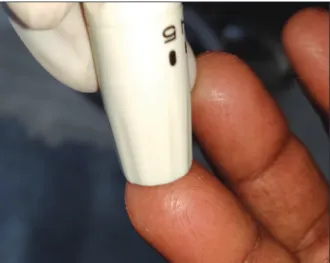
with alcohol followed by drying. After making the pad sterile, it was punctured using a disposable sterile lancet [Figure 2]. A
sufficient amount of blood allowed oozing out and the blood
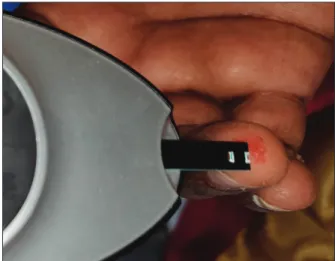
drop placed on the test strip of a glucometer [Figure 3]. The reading was obtained and noted down.
Data were tabulated and submitted to the statistician.
Results
The Pearson’s correlation coefficient was assessed to evaluate the correlation between GCB glucose (GCBG) and capillary finger blood glucose (CFBG). The range for GCB glucose (GCBG) varies from 85 to 156 mg/dl and that of CFBG varies from 87 to 156 mg/dl. The mean values of GCBG and CFBG are 130.4 and 130.6, respectively [Table 1 and Graph 1]. The Pearson
Correlation test value (r) is 0.981 which is statistically significant
Figure 1: Blood sample collected from intraoral site
[Table 1]. The results showed a strong correlation (r = 0.981, P < 0.01) between GCBG and CFBG glucose. Twenty-one participants show CFBG level more than 120 mg/dl, while 23 participants show GCBG level more than 120 mg/dl.
Discussion
Diabetes mellitus is one of the most common metabolic disorders not only in India but also worldwide. India is the diabetes capital
of the world, with 41 million Indians having diabetes; every fifth
diabetic in the world is an Indian.[2] The prevalence of diabetes in India ranges from 5% to 17% means 69.1 million people are suffering from this.[16] Although this number is rapidly increasing,
half of these cases go undiagnosed.
There are certain systemic conditions, considered as relative
risk factors for periodontal diseases. Diabetes mellitus is one of
the most important conditions having influence on periodontal
health. Considering the bidirectional relationship between periodontitis and diabetes,[17-19] dentists have great opportunities to screen diabetes.
Diabetes increases inflammation in the periodontal tissues. Hyperglycemia can result in the activation of pathways that increase inflammation, oxidative stress, and apoptosis. For example, gingival crevicular fluid (GCF) levels of prostaglandin E2 and interleukin 1 (IL-1β) are higher in Type 1 diabetic patients with either gingivitis or periodontitis compared with those in non-diabetic individuals with the same level of
periodontal disease. Whereas among Type 2 diabetic patients,
those with hemoglobin A1c (HbA1c) >8% had a significantly higher GCF IL-1β level compared with patients with HbA1c
<8%, and both HbA1c and random glucose were independent predictors of an elevated GCF IL-1β level.[20-22]
To measure blood glucose levels at home, glucometers are frequently used. Because the glucometer is very easy, quick, and sufficiently accurate to check blood sugar level at home. A drop of blood is required to measure the blood sugar level and gives
results within seconds. Hence, this can be used in the dental
office to screen the patients suspected to have diabetes.[23,24] Within the past few years, a lot of efforts have been taken to make the measurement of blood glucose level painless and noninvasive. BOP is one of the symptoms of periodontitis.
Hence, this blood can be used as the source of blood to detect
the blood sugar level instead of a finger prick. As periodontal inflammation with or without the complicating factor of diabetes mellitus is known to produce ample extravasation of
blood during the diagnostic periodontal examination, no extra
procedure, for example, finger puncture with a sharp lancet is necessary to obtain blood for glucometric analysis;[6] hence no
extra prick.
In the current study, readings from GCB are compared with the readings with the CFB and verified by correlating with it. The accuracy of the readings was verified by correlating glucose readings obtained using the patients GCB with those obtained through a traditional finger stick sample from the patient. This shows that GCB can be used to check the blood glucose level instead of CFB.
In literature, Beikler et al.[3] and Strauss et al.[11] have found a correlation between GCB and CFB. The results of the present
study are in agreement with the studies conducted by Müller and
Behbehani,[25] Parker et al.,[26] and Ashish et al.[27] In the present study, the correlation of these two readings is strong (r = 0.981) for patients with adequate BOP. This shows that GCB can be used for screening diabetes in a dental office which was in
agreement with other studies.[28]
However, in contrast to the current study, Kandwal and Batra,[28] and Debnath et al.[29] reported that GCB cannot be used
for screening blood glucose during a periodontal examination.
Dentists receive many patients suffering from periodontitis; hence, this dental visit can be used as an opportunity to screen for diabetes. Dental providers can perform the diabetes screening test using crevicular bleeding in periodontitis patients as BOP
has ample amount of blood for glucose measurement. Therefore,
researchers have used GCB from persons with periodontal
disease.[30]
The procedure involving probing and GCB blood collection took very less time and did not show any discomfort by patients.
Patients did not complain about any discomfort during the
probing or while the sample was being drawn. While CFB
Figure 3: Blood sample collected from finger pad
Table 1: Correlation between CFB and GCB using Pearson Correlation test
Groups Mean Standard deviation Mean difference 95% confidence interval for difference r P
Lower Upper
CFB 130.6000 17.88392 0.16667 -9.04758 9.38091 0.981 0.000
screening can cause discomfort for the patient as it needs extra prick. When the dentist probes to collect the necessary data for the diagnosis of periodontal disease, simultaneously, diabetes
screening can occur using a GCB sample. This makes use of a
blood sample that would generally be swabbed away.
This procedure is less time consuming, safe, easy to perform, and acceptable by the patient. Therefore, this helps to increase
the frequency of diabetes screening in dental offices. Although this is not a confirmatory test for diabetes, the suspected patients should undergo follow-up tests for the confirmation.
There are some limitations also in this study. We did not
collect the venous blood, which considered as a gold standard to measure the glucose level. Furthermore, participants were just screened for diabetes and the confirmatory test was not done after screening. The sample size is less in the current study. Hence, further studies should include large sample size and also improvised method with more accuracy to measure and identify the GCB glucose using small blood for the early detection of
diabetes mellitus.
Conclusion
This study suggested that there is a correlation between GCB glucose and CFBG and GCB can be used to screen the glucose level in the dental office itself. However, this cannot be used as an
adjunct to standards aids.
References
1. Agarwal AA, Jadhav PR, Deshmukh YA. Prescribing pattern and efficacy of anti-diabetic drugs in maintaining optimal glycemic levels in diabetic patients. J Basic Clin Pharm 2014;5:79-83. 2. Joshi SR, Parikh RM. India diabetes capital of the world:
Now heading towards hypertension. J Assoc Physicians India 2007;55:323-4.
3. Beikler T, Kuczek A, Petersilka G, Flemmig TF. In-dental-office screening for diabetes mellitus using gingival crevicular
blood. J Clin Periodontol 2002;29:216-8.
4. Pramod K, Panseriya BJ, Abhishek B. Gingival crevicular blood: A fast, safe, noninvasive and chair-side method of diabetic screening. Int J Sci Study 2013;1:26-31.
5. Pushparani DS. High acid phosphatase level in the gingival tissues of periodontitis subjects. J Basic Clin Pharm 2015;6:59-63. 6. Srikumar P, Hema S, Amrita D. Reliability of using gingival
crevicular blood in the diagnosis of diabetes. J Indian Acad Dent Spec 2010;1:16-8.
7. Centers for Disease Control and Prevention. National Diabetes Fact Sheet; 2007. Available from: http://www.cdc.gov/diabetes/ pubs/pdf/ndfs_2001.pdf. [Last accessed on 2016 Nov 18]. 8. Taylor GW, Burt BA, Becker MP, Genco RJ, Shlossman M.
Glycemic control and alveolar bone loss progression in Type 2 diabetes. Ann Periodontol 1998;3:30-9.
9. Bjelland S, Bray P, Gupta N, Hirsch R. Dentists, diabetes and periodontitis. Aust Dent J 2002;47:202-7.
10. Serota K. Blood from Periodontal Disease Can be Used to Screen for Diabetes. Available from: http://www.blogohj. oralhealthjournal.com. [Last accessed on 2016 Nov 18]. 11. Strauss SM, Wheeler AJ, Russell SL, Brodsky A, Davidson RM,
Gluzman R, et al. The potential use of gingival crevicular blood for measuring glucose to screen for diabetes: An examination based on characteristics of the blood collection site. J Periodontol 2009;80:907-14.
12. Rheney CC, Kirk JK. Performance of three blood glucose meters. Ann Pharmacother 2000;34:317-21.
13. American Diabetes Association: Bedside blood glucose monitoring in hospitals (consensus statement). Diabetes Care 1998;21(suppl 1):S78.
14. Gillis M, Saxon S. Dentistry in diabetes; diagnosis and management. Diabetes Voice 2003;48:14-7.
15. SKUP/2010/81. Accessed from: http://www.skup.nu/getfile. ashx?fileid=457. [Last accessed on 2016 Nov 18].
16. Tripathy JP, Thakur JS, Jeet G, Chawla S, Jain S, Pal A, et al. Prevalence and risk factors of diabetes in a large community-based study in North India: Results from a steps survey in Punjab, India. Diabetol Metab Syndr 2017;9:8.
17. Rees TD. Periodontal management of the patient with diabetes mellitus. Periodontol 2000 2000;23:63-72.
18. Katz J. Elevated blood glucose levels in patients with severe periodontal disease. J Clin Periodontol 2001;28:710-2.
19. Lösche W, Karapetow F, Pohl A, Pohl C, Kocher T. Plasma lipid and blood glucose levels in patients with destructive periodontal disease. J Clin Periodontol 2000;27:537-41.
20. Preshaw PM, Alba AL, Herrera D, Jepsen S, Konstantinidis A, Makrilakis K, et al. Periodontitis and diabetes: A two-way relationship. Diabetologia 2012;55:21-31.
21. Salvi GE, Yalda B, Collins JG, Jones BH, Smith FW, Arnold RR, et al. Inflammatory mediator response as a potential risk marker for periodontal diseases in insulin-dependent diabetes mellitus patients. J Periodontol 1997;68:127-35.
22. Engebretson SP, Hey-Hadavi J, Ehrhardt FJ, Hsu D, Celenti RS, Grbic JT, et al. Gingival crevicular fluid levels of interleukin-1beta and glycemic control in patients with chronic periodontitis and type 2 diabetes. J Periodontol 2004;75:1203-8.
23. Kaur H, Singh B, Sharma A. Assessment of blood glucose using gingival crevicular blood in diabetic and non-diabetic patients: A chair side method. J Clin Diagn Res 2013;7:3066-9. 24. Müller HP, Behbehani E. Methods for measuring agreement:
Mean Blood Glucose Leve
l
Groups
Graph 1: Comparison between CFB glucose level and GCB glucose
Glucose levels in gingival crevice blood. Clin Oral Investig 2005;9:65-9.
25. Müller HP, Behbehani E. Screening of elevated glucose levels in gingival crevice blood using a novel, sensitive self-monitoring device. Med Princ Pract 2004;13:361-5.
26. Parker RC, Rapley JW, Isley W, Spencer P, Killoy WJ. Gingival crevicular blood for assessment of blood glucose in diabetic patients. J Periodontol 1993;64:666-72.
27. Ashish B, Singh R, Atul S, Lehl SS. Towards lesser pain during blood glucose estimation. Int J Diabetes Dev Ctries 2000;20:125-6.
28. Kandwal A, Batra M. Gingival crevicular blood as a screening tool for diabetic patient: A randomized clinical trial. Ann Dent Spec 2014;2:6-8.
29. Debnath P, Govila V, Sharma M, Saini A, Pandey S. Glucometric assessment of gingival crevicular blood in diabetic and non-diabetic patients: A randomized clinical trial. J Oral Biol Craniofac Res 2015;5:2-6.
30. Strauss SM, Russell S, Wheeler A, Norman R, Borrell LN, Rindskopf D. The dental office visit as a potential opportunity for diabetes screening: An analysis using NHANES 2003-2004 data. J Public Health Dent 2010;70:156-62.