UNIVERSITY OF SHEFFIELD
Preference-inspired Co-evolutionary
Algorithms
by
Rui Wang
A thesis submitted in partial fulfilment for the
degree of Doctor of Philosophy
in the
Faculty of Engineering
Department of Automatic Control and Systems Engineering
The simultaneous optimisation of many objectives (say, in excess of 3), in or-der to obtain a full and satisfactory set of trade-off solutions to support a pos-teriori decision-making, remains challenging. To solve many-objective opti-misation problems (MaOPs), a novel class of algorithms, namely, preference-inspired co-evolutionary algorithms (PICEAs) is proposed based on a concept of co-evolving the common population of candidate solutions with a family of decision-maker preferences.
Two realisations of PICEAs, namely, PICEA-g and PICEA-w, are studied. PICEA-g co-evolves goal vectors with candidate solutions. The algorithm is demonstrated to perform better than or competitively with four of the best-in-class multi-objective evolutionary algorithms (MOEAs) on the bench-mark MaOPs. PICEA-w co-evolves weight vectors with candidate solutions. PICEA-w performs better than or competitively with other leading decom-position based algorithms on the benchmark MaOPs. Moreover, PICEA-w eliminates the need to specify appropriate weights in advance of perform-ing the optimisation, which leads the algorithm to be less sensitive to the problem geometries. As performance of MOEAs is often affected by the asso-ciated parameter configurations, parameter sensitivities of both the PICEAs are empirically studied, and some suggestions on the settings of parameters are provided.
This research also proposes a novel and unified approach, namely, interactive PICEA-g (iPICEA-g) fora priori orprogressivemulti-objective optimisation and decision-making. This approach is derived from PICEA-g by co-evolving goal vectors that are exclusively generated in regions of interest to a decision-maker. iPICEA-g, to the best of the author’s knowledge, is the first approach that is simultaneously able to handle multiple preferences types such as aspi-rations, weights or even via visually brushing, and that is also able to support multiple regions of interest. The iPICEA-g is demonstrated to be effective on different benchmark problems as well as a real-world problem – aircraft control system design problem.
Unless otherwise stated in the text, the work described in this thesis was carried out solely by the candidate. None of this work has already been accepted for any other degree, nor is it being concurrently submitted in candidature for any degree.
Candidate:
Candidate Name
Supervisor:
The completion of this dissertation could not have been possible without the help and support of the following. I thank all of them with my deepest gratitude.
First and foremost, I would like to express deepest appreciation to my su-pervisors Prof. Peter Fleming and Dr. Robin Purshouse. Thanks for their persistent support and valuable advice within the last three years. Prof. Pe-ter Fleming is very kind and always encourages me whenever and wherever I face difficulties. Dr. Robin Purshouse is very handsome, nice and strict. His invaluable input and guidance has been supporting me during the whole research. Thanks for them. Without them I would not have the opportunity to do postgraduate research and been able to finish this thesis in time. Many thanks go to my colleagues who have been involved in discussions that have helped to shape not only this thesis but also general research stud-ies: Martha Arbayani Bin Zaidan, Maszatul Munirah Mansor, Vigneshwaran Venugopalan, Hasanain Bashar, Rishi Relan, Andy Mills, Rajesh Kudikala and Ioannis Giagkiozis. A very special thank you goes to Renata Ashton for her kindest help in everything in Sheffield.
I would also like to thank my co-referee Dr. Roderich Gross and Prof. Yaochu Jin for their willingness to read and judge the thesis, for the challenging but fruitful comments on the manuscript and for coming to Sheffield for the final exam.
In addition, a thank you to Prof. Carlos Artemio Coello Coello for his kindest support and valuable advices during my visit to Cinvestav-IPN. Thanks also to people in Cinvestav-IPN, notably, Adriana Menchaca Mendez and Arturo Yee.
Further thank-yous are offered to my friends: Chang Liu, Biao Yang, HaoYu Wang, Yu Gu, Zuli Chen, Jiacheng Liu, Xueyan Zhao, Xiliang Zhang, Yuzhu Guo and Ramida Rattanakam. Thanks for their welcome distraction. With-out them this thesis could have been finished earlier.
I would also like to thank my parents for their endless love and support. This work is funded by a three year PhD Studentship from the Department of Automatic Control and System Engineering, The University of Sheffield, UK and the China Scholarship Council.
Liu Yanfang and Wang Ningning
with love and respect
...
...
To ber
...
...
To something I never know
...
Abstract iii
1 Introduction 1
1.1 Overview . . . 1
1.2 Motivation . . . 4
1.3 Outline of the thesis . . . 5
1.4 Contributions . . . 7
2 Literature review 11 2.1 Historical overview of MOEAs. . . 11
2.1.1 MOEAs from 1985 to 1998 . . . 12
2.1.2 MOEAs from 1999 to 2003 . . . 13
2.1.3 An introduction to co-evolutionary algorithms . . . 15
2.2 Multi-objective test problems . . . 18
2.2.1 ZDT test suite . . . 19 2.2.2 DTLZ test suite . . . 20 2.2.3 WFG test suite . . . 20 2.3 Performance metrics . . . 21 2.3.1 Convergence metrics . . . 22 2.3.2 Diversity metrics . . . 23
2.3.3 Measures for evaluating both convergence and diversity . . . 25
2.3.4 Visual inspection . . . 26
2.4 Many-objective optimisation. . . 28
2.4.1 Challenges of many-objective optimisation. . . 28
2.4.2 Methods for many-objective optimisation . . . 29
2.4.3 Summary . . . 41
2.5 Preference-based MOEAs . . . 41
2.5.1 A priori,progressive and posteriori decision-making . . . 42
2.5.2 Integrating DM preferences into MOEAs. . . 43
2.5.3 Summary . . . 49
2.6 Summary . . . 50
3 Preference-inspired co-evolutionary algorithm using goal vectors 51 3.1 Introduction. . . 51
3.2 PICEA-g . . . 52
3.2.1 Algorithm design: PICEA-g . . . 52
3.2.2 Algorithm analysis: PICEA-g . . . 58
3.3 Experiment description . . . 61
3.3.1 Test problems. . . 63
3.3.2 The considered competitor MOEAs . . . 63
3.3.3 General parameters . . . 68
3.3.4 Performance assessment . . . 68
3.4 Experiment results . . . 69
3.4.1 Attainment surface results . . . 69
3.4.2 Statistical results . . . 72
3.5 Discussion . . . 81
3.5.1 The effect of the scaling parameterα . . . 81
3.5.2 The effect of co-evolution . . . 83
3.5.3 The performance of goal vectors . . . 85
3.6 Summary of experiment findings . . . 86
3.7 An enhanced PICEA-g using adaptively generated goal vectors . . . 87
3.7.1 An analysis of the effect of goal vector bounds . . . 88
3.7.2 Adaptive goal vector bounds by thecutting plane . . . 92
3.7.3 Experiments . . . 95
3.8 Summary . . . 98
4 Preference-inspired co-evolutionary algorithm using weight vectors 101 4.1 Introduction. . . 101
4.2 Basics of decomposition based MOEAs . . . 102
4.2.1 Scalarising functions . . . 102
4.2.2 Weights . . . 105
4.2.3 Normalisation. . . 107
4.3 General issues of decomposition based algorithms . . . 108
4.3.1 Problem geometry . . . 108
4.3.2 Many-objective optimisation . . . 109
4.4 PICEA-w . . . 112
4.4.1 Algorithm design: PICEA-w . . . 112
4.4.2 Algorithm analysis: PICEA-w. . . 119
4.5 Experiment description . . . 119
4.5.1 Test problems. . . 119
4.5.2 The considered competitor MOEAs . . . 120
4.5.3 General parameters . . . 123
4.5.4 Performance assessment . . . 123
4.6 Experiment results . . . 124
4.6.1 Non-dominated Pareto fronts and the co-evolved weights. . . 124
4.6.2 Statistical results . . . 126
4.7 Discussion . . . 130
4.7.1 General discussion . . . 130
4.7.2 The effect of the angleθ . . . 131
4.7.3 The distribution of the co-evolved weights . . . 133
4.8 Summary . . . 133
5 Parameter sensitivity study for PICEAs 135 5.1 Introduction. . . 135
5.2 Parametric sensitivity analysis: a global manner . . . 136
5.2.1 The Sobol’ variance decomposition method . . . 136
5.2.2 Experiment description . . . 138
5.2.3 Experiment results . . . 138
5.3 Parametric sensitivity analysis: a local manner . . . 141
5.3.1 The effect of the number of preferences . . . 142
5.3.2 The effect of the genetic operator parameters . . . 144
5.4 Summary . . . 147
6 “Whatever works best for you”- a unified approach for a priori and progressive multi-criteria decision-making 149 6.1 Introduction. . . 149
6.2 Articulating decision-maker preference into PICEA-g: iPICEA-g . . . 151
6.2.1 The unified approach iPICEA-g: formulation . . . 151
6.2.2 The unified approach iPICEA-g: rationale . . . 154
6.3 Experiments. . . 157
6.3.1 Parameters and their effect in iPICEA-g . . . 158
6.3.2 Results fora priori preference articulation. . . 161
6.3.3 Progressive scenario . . . 166
6.4 Real-world application: aircraft control systems design . . . 169
6.4.1 Problem description . . . 169 6.4.2 Experiments . . . 174 6.5 Summary . . . 176 7 Conclusions 179 7.1 Key results . . . 179 7.2 Future work . . . 182
A Multi-objective test benchmarks 185 A.1 ZDT test . . . 185
A.2 DTLZ test. . . 189
A.3 WFG test . . . 194
B True hypervolume value of WFG problems 211
C An introduction to the Parallel coordinate system 213
1.1 Illustration of a multi-objective problem.. . . 1
1.2 Illustration of Pareto-dominance relation. . . 2
2.1 MOEAs from 1985 to 1998. . . 13
2.2 MOEAs from 1999 to 2003. . . 15
2.3 Illustration of two goals of multi-objective optimisation. . . 22
2.4 Illustration of the hypervolume metric. . . 25
2.5 Illustration of theIGD metric. . . 26
2.6 Illustration of methods to visualize the Pareto front. . . 27
2.7 The proportion of non-dominated vectors in a set of random vectors for different number of objectives. . . 28
2.8 Illustration of theα-dominance relation. . . 30
2.9 Illustration of a modified Pareto-dominance relation. . . 31
2.10 Illustration of theε-dominance relation. . . 31
2.11 Illustration of the coneε-dominance relation. . . 32
2.12 Illustration of different decision-making approaches in hybrid EMO-MCDM schemes. . . 42
3.1 A (µ+λ) elitist framework of PICEA-g. . . 54
3.2 A simple bi-objective minimisation example.. . . 54
3.3 Changes in comparability with objective scaling: Pareto-dominance and goal approaches. . . 59
3.4 Convergence analysis of PICEA-g. . . 60
3.5 Diversity analysis of PICEA-g. . . 61
3.6 Illustration of the limitation of the fitness assignment. . . 62
3.7 An example to illustrate the limitation of fitness assignment of PICEA-g. 62 3.8 Illustration of theε-dominance concept. . . 64
3.9 Illustration of the calculation of hypervolume contribution in HypE. . . . 65
3.10 Attainment surfaces for 2-objective WFG test instances (a: WFG2-2 to WFG5-2). . . 70
3.11 Attainment surfaces for 2-objective WFG test instances (b: WFG6-2 to WFG9-2). . . 71
3.12 Box plots of hypervolume results for 2-objective instances. . . 73
3.13 Box plots of hypervolume results for 4-objective instances. . . 75
3.14 Box plots of hypervolume results for 7-objective instances. . . 76
3.15 Box plots of hypervolume results for 10-objective instances. . . 78
3.16 The influence of parameterα on PICEA-g performance in terms of HV metric (1: α= 1, 2: α= 1.2, 3: α= 1.5, 4: α= 2 and 5: α= 4). . . 82
3.17 Illustration of the effect ofα. . . 82
3.18 Illustration of the performance of candidate solutions and goal vectors on WFG4-2. . . 85
3.19 Illustration of different goal vectors (Left) and the corresponding Pareto front (Right): Part I . . . 89
3.20 Illustration of different goal vectors (Left) and the corresponding Pareto front (Right): Part II. . . 90
3.21 Illustration of the useful goal vectors.. . . 92
3.22 Limitation of the previous goal vector bounds estimation method. . . 93
3.23 Illustration of thecutting plane.. . . 94
4.1 Behaviours of the weighted sum and Chebyshev scalarising function on non-convex Pareto front. . . 103
4.2 Contour lines of scalarising functions. . . 104
4.3 Contour lines of the weighted Lp function with differentp values. . . 105
4.4 Illustration of the distribution of random weights.. . . 106
4.5 Evenly distributed weights on a hyperplane and hypersphere in 3-objective case. . . 107
4.6 Illustration of the relation between weights and Pareto optimal solutions for a Chebyshev scalarising function. . . 109
4.7 The optimal distributions of weights for different Pareto fronts in a 2-objective case using a Chebyshev scalarising function. . . 110
4.8 An approximation of Pareto front of 2-objective DTLZ2 obtained by MOEA/D using 20 weights. . . 111
4.9 Illustration of the search behaviour using fixed weights and non-fixed weights. . . 111
4.10 A (µ+λ) elitist framework of PICEA-w. . . 113
4.11 Illustration of the neighbourhood of candidate solutions and weight vectors.115 4.12 Illustration of the co-evolution procedure of PICEA-w with a bi-objective minimisation example. . . 118
4.13 Pareto optimal fronts and the optimal distributions of weights for WFG41-2 to WFG44-WFG41-2. . . 121
4.14 Pareto optimal fronts and the optimal distributions of weights for WFG45-2 to WFG48-WFG45-2. . . 122
4.15 Pareto fronts and weights obtained by PICEA-w for WFG41-2 to WFG44-2.124 4.16 Pareto fronts and weights obtained by PICEA-w for WFG45-2 to WFG48-2.125 4.17 The Pareto front obtained by PICEA-w1 and PICEA-w2 for WFG47-2. . 131
4.18 The initial objective vectors and the Pareto optimal front for WFG47-2. . 132
5.1 The sensitivity of an individual parameter in PICEA-g measured by the Sobol’ variance decomposition method. . . 139
5.2 The sensitivity of an individual parameter in PICEA-w measured by the Sobol’ variance decomposition method. . . 140
5.3 The performance of PICEAs on 4-objective problems for different num-bers of preferences. . . 143
5.4 The SBX experimental results for PICEA-g. . . 145
5.5 The SBX experimental results for PICEA-w. . . 146
5.7 The PM experimental results for PICEA-w. . . 148
6.1 Illustration of a ROI. . . 150
6.2 Illustration of the parameters zR,wand θ. . . 152
6.3 Illustration of searching with aspiration level and weights. . . 152
6.4 Illustration of the brushing technique. . . 153
6.5 Illustration of parameters calculation for the brushing technique. . . 153
6.6 Illustration of the goal vectors generated in different cases.. . . 154
6.7 Illustration of a generated cone in 2-objective case. . . 155
6.8 Illustration of the decrease process of θwithmaxGen= 100. . . 157
6.9 Solutions obtained by iPICEA-g for different zR. . . 158
6.10 Solutions obtained by iPICEA-g for differentw.. . . 159
6.11 The distribution of solutions obtained by iPICEA-g with differentθ values.160 6.12 The obtained results withθ0=π/4 andθ0 =π/9 radians. . . 161
6.13 Illustration of searching with aspiration level on ZDT1. . . 162
6.14 Illustration of searching with aspiration level on DTLZ4-6.. . . 162
6.15 Illustration of searching with multiple aspiration levels.. . . 163
6.16 Illustration of searching with weights on DTLZ4. . . 164
6.17 Illustration of searching with weights on DTLZ2. . . 165
6.18 Weights: relative importance and reference direction. . . 167
6.19 Interactive scenario on a 30-variable instance of the ZDT1 test problem (viewed in objective-space). . . 168
6.20 Interactive scenario for a 4-objective instance of the DTLZ2 test problem: part A (viewed in objective-space). . . 170
6.21 Interactive scenario for a 4-objective instance of the DTLZ2 test problem: part B (viewed in objective-space). . . 171
6.22 Interactive scenario for an aircraft control system design problem (viewed in objective-space). . . 175
A.1 The Pareto optimal front of ZDT1. . . 186
A.2 Pareto optimal front of ZDT2. . . 186
A.3 Pareto optimal front of ZDT3. . . 187
A.4 Pareto optimal front of ZDT4. . . 188
A.5 Pareto optimal front of ZDT6. . . 188
A.6 Pareto optimal fronts of DTLZ1-2 and DTLZ1-3. . . 189
A.7 Pareto optimal fronts of DTLZ2-2 and DTLZ2-3. . . 190
A.8 Pareto optimal fronts of DTLZ3-2 and DTLZ3-3. . . 191
A.9 Pareto optimal fronts of DTLZ4-2 and DTLZ4-3. . . 192
A.10 Pareto optimal fronts of DTLZ5-2 and DTLZ5-3. . . 193
A.11 Pareto optimal fronts of DTLZ6-2 and DTLZ6-3. . . 194
A.12 Pareto optimal fronts of DTLZ7-2 and DTLZ7-3. . . 195
A.13 Pareto optimal fronts of WFG1-2 and WFG1-3.. . . 199
A.14 Pareto optimal fronts of WFG2-2 and WFG2-3.. . . 200
A.15 Pareto optimal fronts of WFG3-2 and WFG3-3.. . . 201
A.16 Pareto optimal fronts of WFG4-2 and WFG4-3.. . . 201
A.17 Pareto optimal fronts of WFG5-2 and WFG5-3.. . . 202
A.18 Pareto optimal fronts of WFG6-2 and WFG6-3.. . . 202
A.20 Pareto optimal fronts of WFG8-2 and WFG8-3.. . . 204
A.21 Pareto optimal fronts of WFG9-2 and WFG9-3.. . . 204
A.22 Pareto optimal fronts of WFG41-3 to WFG44-3. . . 208
A.23 Pareto optimal fronts of WFG45-3 to WFG48-3. . . 209
B.1 True hypervolume calculation.. . . 212
C.1 Mapping from Cartesian into parallel coordinates. . . 213
2.1 Properties of the ZDT test problems. . . 19
2.2 Properties of the DTLZ test problems. . . 20
2.3 Properties of the WFG test problems. . . 21
3.1 Parameters for MOEA/D. . . 66
3.2 Algorithm testing parameter settings. . . 68
3.3 HV results for 2-objective instances. . . 72
3.4 HV results for 4-objective instances. . . 74
3.5 HV results for 7-objective instances. . . 75
3.6 HV results for 10-objective instances . . . 77
3.7 GD results for selected 7-objective instances. . . 79
3.8 ∆ results for selected 7-objective instances. . . 79
3.9 C metric comparison results (mean±std) of NSGA-II and other MOEAs. 81 3.10 GD comparison results (mean±std) of PICEA-g with different α value. . 83
3.11 ∆ comparison results (mean±std) of PICEA-g with different α value. . . 83
3.12 HV comparison results (mean±std) of PICEA-g and random-g for 2-objective WFG instances. . . 84
3.13 HV comparison results (mean±std) of PICEA-g and random-g for 4-objective WFG instances. . . 84
3.14 HV comparison results (mean±std) of PICEA-g and random-g for 7-objective WFG instances. . . 84
3.15 HV comparison results (mean±std) of PICEA-g1 and PICEA-g2 for 2-objective WFG instances. . . 96
3.16 HV comparison results (mean±std) of PICEA-g1 and PICEA-g2 for 7-objective WFG instances. . . 96
3.17 GD comparison results (mean±std) of PICEA-g1 and PICEA-g2 for 2-objective WFG instances. . . 97
3.18 GD comparison results (mean±std) of PICEA-g1 and PICEA-g2 for 7-objective WFG instances. . . 97
3.19 ∆ comparison results (mean±std) of PICEA-g1 and PICEA-g2 for 2-objective WFG instances. . . 97
3.20 ∆ comparison results (mean±std) of PICEA-g1 and PICEA-g2 for 7-objective WFG instances. . . 97
4.1 Candidate solutions selection process. . . 118
4.2 Weights selection process. . . 118
4.3 Problem geometries of the WFG4X test problems. . . 120
4.4 Algorithm testing parameter setting. . . 123
4.5 HV results for 2-objective instances . . . 126 xix
4.6 HV results for 4-objective instances. . . 127
4.7 HV results for 7-objective instances. . . 128
4.8 HV results for 10-objective instances . . . 129
4.9 GD and ∆ results for WFG41 problems . . . 129
4.10 HV comparison results (mean±std) for WFG47 and WFG48. . . 132
4.11 Statistical comparison results of the distribution of optimal weights and the co-evolved weights for 2-objective problems. . . 133
5.1 The sampled parameter space. . . 138
5.2 Parameter settings of Ng. . . 142
5.3 Parameter settings of Nw. . . 142
5.4 Parameter settings of PICEAs. . . 142
5.5 The SBX operator parameter settings. . . 144
5.6 The PM operator parameter settings. . . 144
Acronyms
BCI bootstrapping confidence interval
EMO evolutionary multi-objective optimization
DE differential evolution
DM decision-maker
DTLZ Deb, Thiele, Laumanns and Zitzler test suite DTLZn-Y Then-th DTLZ problem with Y objectives
MOP multi-objective problem
MaOP many-objective problem
PCA principle component analysis
PM polynomial mutation
ROI region of interest
SBX simulated binary crossover
SOP single-objective problem
SPX simplex crossover
WFG walking fish group test suite
WFGn-Y Then-th WFG problem with Y objectives
ZDT Zitzler, Deb and Thiele test suite
Algorithms
COEA competitive-cooperation co-evolutionary algorithm CMOGA cellular multi-objective genetic algorithm
EA evolutionary algorithm
ε-MOEA ε-dominance based MOEA
g-NSGA-II g-dominance based non-dominated sorting genetic algorithm
GA genetic algorithm
G-MOEA guided multi-objective evolutionary algorithm
HypE an algorithm for fast hypervolume-based
many-objective optimization
iPICEA-g interactive preference-inspired co-evolutionary algorithm using goal vectors
IBEA indicator based evolutionary algorithm
MCDM multi-criteria decision-making
MOEA multi-objective evolutionary algorithm
MOEA/D multi-objective evolutionary algorithm based on decomposition
MOGA multi-objective genetic algorithm
MOGLS multi-objective genetic local search MSOPS multiple single objective Pareto sampling MOPSO multi-objective particle swarm optimization
NPGA niched Pareto genetic algorithm
NSGA muilti-objective optimization using non-dominated sorting in genetic algorithms NSGA-II A fast and elitist multi-objective genetic algorithm
PAES Pareto archived evolution strategy
PBEA preference-based evolutionary algorithm by thiele et al. PESA Pareto envelope-based selection algorithm
PESA-II Pareto envelope-based selection algorithm
PICEA-g preference-inspired co-evolutionary algorithm using goal vectors PICEA-w preference-inspired co-evolutionary algorithm using weight vectors PROMETHEE preference ranking organisation method for enrichment evaluations ELECTRE elimination and choice expressing and reality
R-NSGA-II reference point based evolutionary multi-objective algorithms by deb and sundar
r-NSGA-II r-dominance based NSGA-II
SMS-EMOA S-metric selection based evolutionary multi-objective optimization algorithm
SPEA strength Pareto evolutionary algorithm
SPEA2 improving strength Pareto evolutionary algorithm
VEGA vector evaluated genetic algorithm
Symbols
g goal vector
gmin lower bound of goal vector
gmax upper bound of goal vector
gws weighted sum scalarising function
gte weighted Chebyshev scalarising function
k position parameter of WFG problem
l distance parameter of WFG problem
n number of decision variables
nr replacement neighbour size used in MOEA/D
s a candidate solution
xi theith decision variable
xli lower bound on theith decision variable
xui upper bound on theith decision variable
pm probability of applying PM
pc probability of applying SBX
v genetic-variation process
z∗ reference point in a scalarising function
zR reference point in iPICEA-g
zide ideal vector
znad nadir vector
F its fitness of a candidate solution
F itg fitness of a goal vector
J ointS joint candidate solutions
J ointG joint goal vectors
J ointW joint weight vectors
G goal vector set
Gc offspring of goal vector set
GD General Distance
HV Hypervolume metric
HV∗ True hypervolume value
M number of objective, problem dimension
maxGen maximum number of generations
Np number of preferences
Ng number of goal vectors
N sp number of sampling points used in HypE
Nw number of weight vectors
N F S number of function evaluations
P(t) population at iteration t
S candidate solution set
Sc offspring of candidate solution set
Sv selection-for-survival process
Ss selection-for-variation process
T selection neighbour size used in MOEA/D
W weight vector set
W c offspring of weight vector set
Rn field of real numbers
∆ Spread metric
ηc SBX distribution parameter
ηm PM distribution parameter
Introduction
1.1
Overview
Optimisation problems arise in various disciplines such as engineering, economics, manu-facturing, mathematics, chemistry, robotics, logistics, medicine, architecture, etc.. These problems are often multi-objective in nature, that is, two or more objectives are required to be optimised simultaneously. In a multi-objective problem (MOP), objectives are of-ten in competition with one another. Thus, the optimal solution of MOPs is a set of trade-off solutions, rather than a single solution. Amongst these trade-off solutions, none of them is better in all objectives.
Figure 1.1: Illustration of a multi-objective problem.
As a general example, let us consider the task of purchasing a laptop. One always prefers a cheap and light laptop. That is, the first objective is to minimise the cost, and the second objective is to minimise the weight. However, these two objectives are typically contradictory, i.e. the lighter the laptop, the more the cost. Thus, it comes as
no surprise that the optimal solution set is composed of a set of trade-off solutions as shown in Figure 1.1. For any two solutions of this set, e.g. A and B, neither A nor B is better in both objectives. A is cheaper but is heavier. B is lighter but costs more. Without loss of generality, a minimisation MOP is defined as follows:
minimise fm(x) m= 1,2, ..., M
subject to gj(x)≤0, j = 1,2, ..., J
hk(x) = 0, k= 1,2, ..., K
xli≤xi ≤xui, i= 1,2, ..., n
(1.1)
A solution x is a vector of n decision variables: x = (x1, x2,· · · , xn),x ∈ Rn. Each
decision variable xi is subject to a lower bound xli, and an upper bound xui. fm
represents the m-th objective function. M is the number of objectives (generally, M ≥ 2). J andKare the number of inequality and equality constraints, respectively. Feasible decision vectors refer to those decision vectors that satisfy all inequality and equality constraints. Some fundamental concepts in multi-objective optimisation are introduced as follows:
Definition 1.1 (Pareto-dominance): For two feasible decision vectorsxandy,xis said to Pareto dominatey(denoted asxy) if and only if∀m∈1,2,· · ·, M, fm(x)≤fm(y)
and ∃m ∈1,2,· · · , M, fm(x) < fm(y). Seen from Figure1.2, we can find that AB,
AC,AD andE A. However, Aand P,A and Qare non-dominated.
Figure 1.2: Illustration of Pareto-dominance relation.
Definition 1.2 (Pareto optimality): A solutionx∈Rnis said to be Pareto optimal in
Rn if and only if@y∈Rn,yx.
Definition 1.3 (Pareto optimal set): The Pareto optimal set (P OS) is defined as the set of all Pareto optimal solutions, i.e. P OS={x∈Rn|
Definition 1.4 (Pareto optimal front): The Pareto optimal front (P OF) is defined as the set of all objective functions values corresponding to the solutions in P OS, i.e., P OF ={(f1(x), f2(x),· · · , fM(x)) :x∈P OS}.
In addition, a nadir point is a vector composed of all the worst (e.g., maximum for minimization problems) Pareto optimal objective values in a MOP. A ideal point is a vector composed of all the best (e.g., minimum for minimization problems) values of each objective (Miettinen,1999, p.15).
Multi-objective evolutionary algorithms (MOEAs), inspired from the natural evolution, are well suited for solving multi-objective optimisation problems: their population based nature leads naturally to the generation of an approximate trade-off surface in a single run (Deb, 2001;Coello Coello et al.,2007); their robustness on problem characteristics enables them to be used on a wide range of application domains. Similar to evolution-ary algorithms (EAs), in general a MOEA is composed of genetic-variation operator,
environment-selection operator and selection-for-variation operator, which can be de-scribed as follows (Purshouse and Fleming,2007):
P(t+ 1) =Ss(v(Sv(P(t))), P(t)) (1.2)
whereP(t) are the candidate solutions (population) at iterationt,Ssis the
environment-selectionoperator,vis thegenetic-variation (recombination and mutation) operator,Sv
is the selection-for-variation operator and P(t+ 1) are the newly generated solutions. Thus, a set of candidate solutions is evolved by successively applying recombination, mutation, and selection to yield better solutions in an iterative process.
Evolutionary multi-objective optimisation (EMO) has enjoyed popularity in the last two decades. Research on EMO mainly focuses on issues such as the design of efficient algo-rithmic methods for the approximation of efficient solutions and the issue of measuring the quality of the approximated solutions. The IEEE Transactions on Evolutionary Computation by IEEE Press and Evolutionary Computation journal by MIT Press are two of the most important journals in the core evolutionary computation field. There are also some conferences for EMO. The bi-annual international Evolutionary Multi-Criterion Optimization conference series is devoted especially to EMO. Three other important evolutionary computation related conferences that also report EMO research developments are:
• IEEE Congress on Evolutionary Computation (CEC).
• Genetic and Evolutionary Computation Conference (GECCO). • Parallel Problem Solving from Nature (PPSN).
1.2
Motivation
The central topic of this thesis is evolutionary multi-objective optimisation which links all the chapters. There are two motivations of this research: (i) to address many-objective optimisation problems; and (ii) to provide a unified approach for a priori or
progressive evolutionary multi-objective optimisation and decision-making.
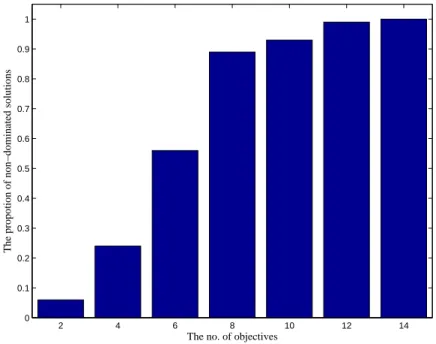
• Many-objective optimisation: Pareto-dominance based MOEAs were one of the earliest approaches for multi-objective optimisation. It is accepted that they perform well on MOPs with 2 and 3 objectives. However, studies have shown that their search capability often degrades significantly as the number of objectives increases (Purshouse and Fleming,2003c;Hughes,2005). This is because the pro-portion of Pareto-optimal (or non-dominated) objective vectors in the population becomes large when MOPs have more than 3 objectives, i.e. many-objective prob-lems (MaOPs). That is, the ability of the Pareto-dominance relation in offering comparability between alternative solutions is reduced. As a result, insufficient selection pressure is generated toward the Pareto front. Unfortunately, MaOPs occur frequently in practice (Fleming et al.,2005; Coello Coello et al.,2007). In another sense, it is often easier to specify as many objectives as possible in the early stage of an optimisation process. Thus, it is desirable to develop more effec-tive and efficient algorithms to handle MaOPs. This serves as the core motivation of this thesis.
It is known that by incorporating decision-maker preferences we can potentially gain comparability between otherwise incomparable solutions (Miettinen, 1999). By holding multiple sets of hypothetical preferences simultaneously, we can ob-tain multiple comparison perspectives simultaneously, which might be sufficient to adequately describe the whole Pareto front. Existing approaches have tended to explore the use of some types of preferences. For example, Fonseca and Fleming (1998a) incorporated decision-maker preferences specified as goals and priorities into their early work MOGA (Fonseca and Fleming, 1993) (a Pareto-dominance based MOEA). The use of preferences enables MOGA to approximate a part of the Pareto optimal front even when the problem dimension is high. Hughes(2003) proposed a ranking method based on how each solution performed against a set of pre-defined preferences expressed as weighted min-max formulations. However, none of the studies has attempted to answer the question below
– how can a set of suitable preferences be maintained adaptively in order to be employed to obtain a good approximation of the Pareto optimal front?
These observations motivate us to consider the type of preferences and how these preferences can be used. In this research, two of the most commonly used prefer-ences, goals and weights are studied. The usefulness of preferences is maintained by co-evolving them with candidate solutions during the search.
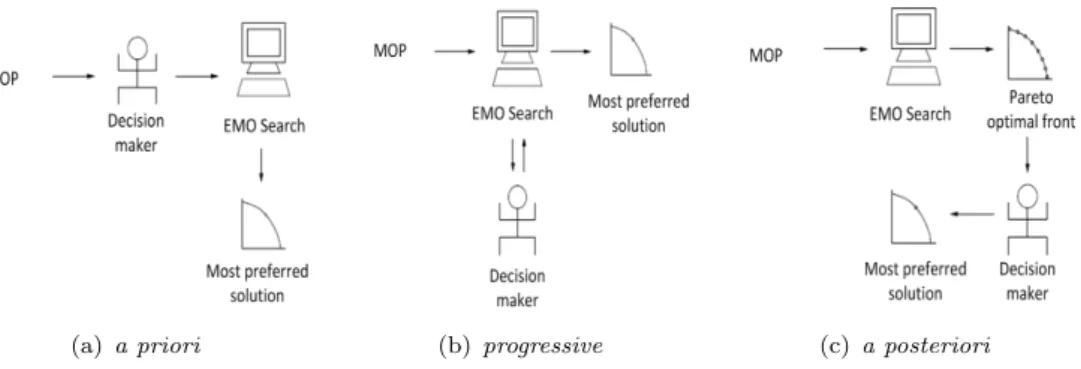
• a unified approach for preference-based MOEAs1: Having obtained a good approximation of the Pareto optimal front, the MOP remains unsolved as a decision-maker (DM) has to incorporate his/her2preferences, and selects the most preferred solution. In other words, the ultimate goal of solving a MOP is not to obtain a good approximation of the Pareto optimal front but it is to help a DM to consider multiple objectives simultaneously and identify a single Pareto optimal solution that satisfies him/her, i.e. assisting multi-criteria decision making (MCDM). However, the ultimate goal of solving a MOP is not to approximate the entire Pareto optimal front but to help a decision maker (DM) to consider the multiple objectives simultaneously and to identify a single Pareto optimal solution which is satisfactory. Therefore, in order to select a single solution to a MOP, it is necessary to resolve the trade-off between competing solutions by introducing subjective preferences that a DM has for varying levels of performance across the objectives. Incorporation of the DM preferences is an important part for a real-world decision support system. However, current methods developed for preference-based multi-objective optimisation are unable to handle, comprehensively, the range of ways in which a DM likes to articulate his preferences. Moreover, in some cases it is easier for a DM to express his preferences by aspiration levels and in others by weights or other forms. These observations motivate us to develop a unified approach which enables the decision-maker to articulate multiple preference types.
1.3
Outline of the thesis
There are seven chapters in this thesis, beginning with this Introduction. A literature review Chapter follows. Chapters 3 and 4 introduce two novel algorithms for multi-objective optimisation, in particular, many-multi-objective optimisation. Chapter 5 analyses parameter sensitivities of the proposed algorithms. Chapter 6 proposes a unified ap-proach for a priori and progressive multi-objective optimisation and decision-making. Chapter 7concludes. The content of each of these chapters is outlined below.
• Chapter 2 provides a comprehensive review of current literature relevant to this research. First, a historical overview of MOEAs is provided, followed by an intro-duction to multi-objective benchmark problems and performance metrics. Then,
1
MOEAs that incorporate decision-maker preferencea prioriorprogressivelyis termed as
preference-based MOEAs.
2
general issues on many-objective optimisation are introduced. Following this, a detailed review of the existing methods developed for solving many-objective prob-lems is provided. Finally, multi-objective evolutionary algorithms developed for a priori andprogressive decision-making are critically reviewed.
• Chapter3proposes a novel algorithm, called a preference-inspired co-evolutionary algorithm using goal vectors (PICEA-g) for MOPs (especially for MaOPs). This Chapter begins with an introduction to the concept of a preference-inspired co-evolutionary algorithm. Secondly, as a realisation of this concept, PICEA-g is proposed in which candidate solutions are co-evolved with a set of goal vectors. Thirdly, the performance of PICEA-g is empirically assessed by comparing it with four of the best-in-class MOEAs on multi-objective benchmark problems up to 10 objectives. Following that, some further discussions such as the effect of co-evolution and the performance of goal vectors are provided. In the last section of this Chapter, an effective strategy named thecutting plane is proposed to further improve the performance of PICEA-g.
• Chapter 4 proposes another realisation of the preference-inspired co-evolutionary algorithm, denoted as PICEA-w, where candidate solutions are co-evolved with weight vectors. The use of co-evolution enables PICEA-w to effectively handle the difficulties encountered by decomposition based methods. This Chapter first in-troduces the basics and general issues in decomposition based methods. Following that, PICEA-w is described in detail. Thirdly, the performance of PICEA-w is as-sessed on a set of problems with different Pareto front geometries. Following that, some further discussions such as the performance of weight vectors are provided. • Chapter 5 analyses the sensitivities of parameters in PICEAs. Parameter
sensi-tivity analysis is helpful to gain insight into the robustness of an algorithm and to provide suggestions with respect to the parameter settings for non-expert users. First, a global sensitivity method is used to analyse the sensitivities of all param-eters simultaneously, identifying the key paramparam-eters of PICEAs. Following that, further analysis is conducted on some key parameters. Finally, the settings of genetic operator parameters are studied.
• Chapter6 proposes a novel approach, namely, iPICEA-g fora priori and progres-sive evolutionary multi-objective optimisation and decision-making. iPICEA-g is derived from PICEA-g. It co-evolves candidate solutions with goal vectors that are exclusively generated in the regions of interest. This Chapter first introduces the preference formulation used in iPICEA-g and the rationale of iPICEA-g. Secondly, the performance of iPICEA-g is assessed on a set of benchmark problems. Finally, iPICEA-g is applied to solve a real-world multi-objective problem– aircraft control system design.
• Chapter 7 concludes the thesis. First, the main contributions of this thesis are summarised in depth. Second, the future work and some open questions in multi-objective optimisation are identified.
1.4
Contributions
The main contributions of this thesis are:
• – A novel multi-objective evolutionary algorithm, PICEA-g for many-objective optimisation. PICEA-g is based on the concept of co-evolution of candidate solutions and preferences. It co-evolves candidate solutions with preferences specified as goal vectors. A systematic empirical study is con-ducted to assess the performance of PICEA-g. Experimental results show that PICEA-g outperforms the four best-in-class MOEAs (NSGA-II, -MOEA, HypE and MOEA/D) on many-objective WFG problems.
– The use of the cutting plane to further enhance PICEA-g perfor-mance. PICEA-g is presented using an effective strategy named thecutting plane. The cutting plane works with the assumption of knowing the ideal
point beforehand. Using this strategy, suitable goal vector bounds can be determined adaptively along the search process. By co-evolving goal vectors generated within different goal vector bounds, PICEA-g can then adaptively distribute appropriate search effort towards different objectives, leading a better performance. Experimental results conducted on bi- and 7-objective problems have demonstrated the effectiveness of this strategy.
Related publications:
– Wang, R., Purshouse, R. C., Fleming, P. J., Preference-inspired co-evolutionary algorithms for many-objective optimisation, IEEE Transactions on Evolution-ary Computation., 17 (4), 474-494, 2013.
– Wang, R., Purshouse, R. C., Fleming, P. J., Preference-inspired co-evolutionary algorithm using adaptively generated goal vectors, Evolutionary Computation (CEC), 2013 IEEE Congress on. IEEE, Cancun, Mexico, 2013: 916- 923.
– Wang, R., Purshouse, R. C., Fleming, P. J., On Finding Well-Spread Pareto Optimal Solutions by Preference-inspired Co-evolutionary Algorithm, Pro-ceeding of the fifteenth annual conference on Genetic and evolutionary com-putation conference (GECCO 2013). ACM, Amsterdam, The Netherlands, 2013: 695-702.
• A preference-inspired co-evolutionary algorithm using weights (PICEA-w). PICEA-w is a new decomposition based algorithm that eliminates the need to
specify appropriate weights in advance of performing the optimisation. Adopting the concept of PICEA, in PICEA-w weights are adaptively modified by being co-evolved with candidate solutions during the search process. The co-evolution enables suitable weights to be adaptively constructed along the search process and thus guiding candidate solutions towards the Pareto optimal front more effectively and efficiently. Through rigorous empirical testing, we demonstrate that compared to other leading decomposition-based algorithms, PICEA-w is less sensitive to the Pareto front geometry of a problem and performs better on many-objective problems.
Related publications:
– Wang, R., Purshouse, R. C., Fleming, P. J., Preference-inspired co-evolutionary algorithms using weight vectors for many-objective optimisation, Proceeding of the fifteenth annual conference on Genetic and evolutionary computation conference (GECCO 2013), ACM, Amsterdam, The Netherlands, 2013, pp. 101-102.
– Wang, R., Purshouse, R. C., Fleming, P. J., Preference-inspired co-evolutionary algorithms using weight vectors, European Journal of Operational Research. (Under review)
• A novel and unified method, iPICEA-g for a priori and progressive
multi-objective optimisation and decision making. iPICEA-g is the first approach which can cater simultaneously to different types of decision-maker pref-erences, and that is also able to support multiple regions of interest. In particular, the use of the brushing technique is the first time, to the best of the author’s knowledge, that the decision-maker is able to articulate his/her preferences with-out using numerical values but simply by drawing on the Cartesian or Parallel coordinates in objective-space. As no direct elicitation of numbers is required, the cognitive burden on the decision-maker is reduced. The iPICEA-g is demonstrated to perform well on a set of benchmark problems as well as a real world application. Related publications:
– Wang, R., Purshouse, R. C., Fleming, P. J., whatever works best for you-a new method for a priori and progressive multi-objective optimisation, in: Evolutionary Multi-Criterion Optimization, Springer, 2013, pp. 337-351.
– Wang, R., Purshouse, R. C., Fleming, P. J., On finding preferred solutions by preference-inspired co-evolutionary algorithms, European Journal of Op-erational Research. (Under review)
• A parameter sensitivity analysis of PICEA-g and PICEA-w. An empirical study is conducted to analyse sensitivities of parameters used in both the PICEAs. Some valuable suggestions on parameter settings are provided, which facilitates the use of PICEAs for non-experts.
– Wang, R., Purshouse, R. C., Fleming, P. J., Preference-inspired co-evolutionary show robustness on parameter settings, International Journal of System Sci-ence. (Under review)
Some additional contributions resulted during the development of this thesis. For the coherency of the thesis, these contributions are not explicitly documented within the monograph itself but are briefly described as follows.
• A general framework for localised multi-objective evolutionary algo-rithms. This framework seeks to improve both the accuracy and the diversity of these solutions through the local application of evolutionary operators to selected sub-populations. A local operation-based implementation framework is presented in which a population is partitioned, using hierarchical clustering, into a pre-defined number of sub-populations. Environment-selection and genetic-variation are then applied to each sub-population. The effectiveness of this approach is demonstrated on 2- and 4-objective benchmark problems. The performance of each of four best-in-class MOEAs is compared with their modified local operation-based versions derived from this framework. In each case the introduction of the local operation-based approach improves performance. Further, it is shown that the combined use of local environment-selection and local genetic-variation is better than the application of either local environment-selection or local genetic-variation alone. This work has been published as
– Wang, R., Fleming, P. J., Purshouse, R. C., General framework for localised multi-objective evolutionary algorithms, Information sciences, 258(2), 29-53.
– Wang, R., Purshouse, R. C., Fleming, P. J., Local preference-inspired co-evolutionary algorithms, in: GECCO 2012: Proceedings of the Genetic and Evolutionary Computation Conference, ACM, Philadelphia, USA, 2012, pp. 513-520.
• Enhancement of the MOGA Matlab toolbox of the University of Sheffield.
The toolbox was first created by Andrew J. Chipperfield, Carlos M. Fonseca and Peter J. Fleming, then was enhanced by Robin C. Purshouse. During this PhD research, some new components are developed for the toolbox. For example, a set of differential evolution operators for doing recombination and mutation; the ε-dominance archiving strategy for obtaining evenly distributed solutions; some functions for generating randomly/evenly distributed points; a function to mea-sure the neighbourhood. These components will further facilitate the design of MOEAs.
Literature review
Many real-world problems have multiple conflicting objectives that are required to be optimised simultaneously. A variety of methods have been developed in the literature for solving such optimisation problems. Prior to introducing our methods, it is important to review the current literature relevant to this thesis. This review discusses the limitations of the current state-of-the-art algorithms and provides motivations for this research. This Chapter starts with an historical overview of MOEA, where co-evolutionary algo-rithms are also introduced (Section2.1). Secondly, in Section2.2, three multi-objective test suites are introduced, followed by an introduction to performance metrics in Sec-tion2.3. These test problems and performance metrics are used as means of comparing the performance of MOEAs. Section 2.4 provides a comprehensive review of many-objective optimisation, including the issues for MaOPs as well as the existing methods proposed for many-objective optimisation. Lastly, multi-objective evolutionary algo-rithms developed fora priori and progressive decision-making are critically reviewed in Section2.5.
2.1
Historical overview of MOEAs
Since the 1950s the operational research community has proposed approaches for solving MOPs. Typically, these approaches convert a MOP into a single objective optimisa-tion problem by using some user-defined procedures. A variety of such approaches are available in specialised literature such as Miettinen (1999) and Ehrgott (2005). Some representatives approaches are the weighted sum, weighted metric, ε-constraint, goal programming (e.g., weighted goal programming, Lexicography goal programming and Min-Max programming). These approaches have the following limitations:
i) Only one Pareto optimal solution can be expected be found in an algorithm run. Thus, a number of runs (with different parameter settings) are required in order to obtain a set of Pareto optimal solutions.
ii) These approaches are susceptible to problem characteristics. For example, the weighted sum approach fails to find Pareto optimal solutions in non-convex Pareto regions.
iii) These approaches require some problem knowledge or additional parameter settings. For example, the weight vector used in the weighted sum and weighted metric approaches, the parameterεused in theε-constraint approach and the target vector used in the goal programming approach.
These limitations greatly inhibit the applications of the traditional approaches and drive us to develop some more effective methods. Multi-objective evolutionary algorithms have generated considerable interest and acceptance. Their population based nature is helpful to generate a set of trade-off solutions in a single run. Moreover, MOEAs tend to be robust to underlying cost function characteristics (Deb,2001;Coello Coello et al., 2007). Over the last twenty years, many different MOEA approaches were proposed. The following sections provide a historical overview of these approaches based on the study of Coello Coello (2006).
2.1.1 MOEAs from 1985 to 1998
Vector Evaluated Genetic Algorithm (VEGA) (Schaffer, 1985) is often recognised as the first MOEA. VEGA is developed by modifying the selection mechanism of a basic genetic algorithm (GA). At each generation, proportional selection is performed to select a sub-population based on each objective function in turn. These sub-populations would be pooled together to form a new population. The genetic operations, i.e. crossover and mutation, are then performed on the new population in the usual way.
Later, Goldberg (1989) suggested two fundamental concepts for multi-objective opti-misation: the Pareto-dominance relation, selecting non-dominated solutions, and the niching technique, maintaining diversified solutions along the non-dominated frontier. These two concepts opened a new avenue and generated an overwhelming interest in MOEAs. Fonseca and Fleming (1993) proposed, to the best of the author’s knowl-edge, the first Pareto-dominance based MOEA, i.e. Multi-Objective Genetic Algorithm (MOGA). After that many other MOEAs that use Goldberg’s idea were implemented. Two representative algorithms are Non-dominated Sorting Genetic Algorithm (NSGA (Srinivas and Deb, 1994)) and Niched-Pareto Genetic Algorithm (NPGA (Horn et al., 1994)). Among the three algorithms, MOGA is the most effective approach, followed by NPGA, then NSGA and VEGA (Zitzler and Thiele,1999).
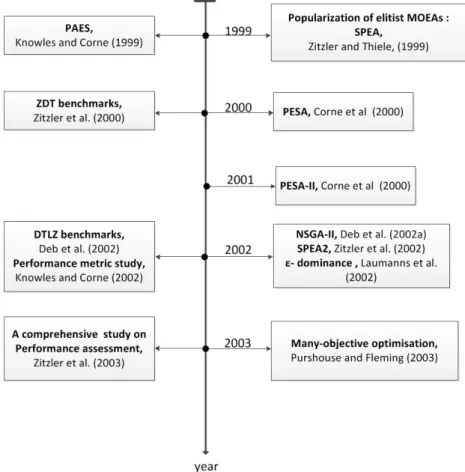
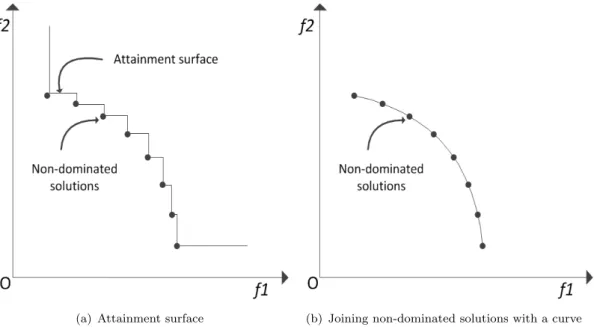
In addition to the mentioned MOEAs, Tanaka and Tanino (1992) proposed the first mechanism to incorporate decision-maker preferences into MOEAs. Fonseca and Flem-ing (1995b) provided the first survey of MOEAs, and introduced the first performance metric, i.e. attainment surface (Fonseca and Fleming, 1996). Moreover, Fonseca and Fleming(1998a) proposed one of the earliest preference-based MOEA where the decision-maker preferences are specified as goals and priorities and can be interactively incor-porated into MOGA so as to guide solutions towards a region of interest. However, in this period few studies were carried out on the development of performance metrics and benchmark problems. Comparisons were visual in most cases and most problems tackled were bi-objective. The main achievements in this period are summarised in Figure 2.1.
Figure 2.1: MOEAs from 1985 to 1998.
2.1.2 MOEAs from 1999 to 2003
The second generation of MOEAs starts when the elitism strategy gets popularised (Coello Coello,2006). Specifically, after the publication of Strength Pareto Evolutionary
Algorithm (SPEA) (Zitzler and Thiele, 1999) many researchers started to incorporate elitism into the design of MOEAs. Elitism became the third common practice (the first two are Pareto-dominance and diversity maintenance) in MOEAs. Typically, elitism is implemented as an external archive that stores all non-dominated solutions found during the search. It can also be induced by a (µ+λ)-selection framework, that is, parents and their offspring are first pooled together, then new parents are selected based on the pooled population.
In this period (from 1999 to 2003) researchers mainly focused on further improving the effectiveness and efficiency of MOEAs. Some representative algorithms include SPEA, SPEA2 (Zitzler et al.,2002), Pareto Archived Evolution Strategy (PAES (Knowles and Corne,1999, 2000)), Pareto Envelope-based Selection Algorithm (PESA (Corne et al., 2000)) and its improved version PESA-II (Corne et al.,2001) and Non-dominated Sorting Genetic Algorithm II (NSGA-II (Deb et al.,2002a)). In SPEA the fitness of solutions is determined by thePareto strength value (Zitzler and Thiele,1999); a clustering method is employed to maintain the diversity of solutions. SPEA2 is an improved version of SPEA where an enhanced fitness assignment and clustering method is used. PAES, PESA and PESA-II apply a hyper-grid based scheme to conduct selection and diversity maintenance.
NSGA-II probably is the most widely used MOEA (9767 citations accessed on 09/10/2013). It is implemented within a (µ+λ) framework. Solutions are selected based on their dominance level and crowding distance. Specifically, the non-dominated sorting strat-egy is applied to rank all individuals. The assigned rank is used as a primary criterion in the binary tournament selection for parent selection. If more than µ solutions are non-dominated, solutions with the same rank are further evaluated by their crowding distance. Roughly speaking, solutions in a sparse region are preferred to those in a crowded region when they have the same rank.
In addition to these studies, another concept,ε-dominance, was proposed byLaumanns et al. (2002). It was demonstrated that the use of ε-dominance is helpful in finding solutions with good proximity and diversity (Deb et al.,2003,2005). Several benchmark test suites and performance metrics were proposed which facilitates the assessment and comparison of MOEAs. The main achievements over this period are summarised in Figure 2.2.
MOEAs gained great developments during this period: the Pareto-dominance relation, diversity maintenance and elitism mechanism become three of the most common modules of MOEAs. MOEAs start to be applied in many application domains such as electri-cal engineering, aeronautielectri-cal engineering, robotics control, scheduling, etc. (Deb, 2001; Fleming et al.,2005). However, with the increasing applications of MOEAs, researchers subsequently found that Pareto-dominance based MOEAs, e.g. MOGA, NSGA-II and
Figure 2.2: MOEAs from 1999 to 2003.
SPEA2, face difficulties on MOPs with more than three objectives, termed as many-objective (optimisation) problems (MaOPs). Purshouse and Fleming(2003c) first iden-tified this issue and found that the search ability of Pareto-dominance based approaches degrades significantly as the number of objectives increases.
MaOPs arise in many applications, thus developing effective algorithms for MaOPs has become a hot topic. Additionally, researchers realised that often a decision-maker is not interested in obtaining the entire Pareto front but only a part of the Pareto front. Thus, some preference-based MOEAs were developed to incorporate decision-maker preferences into MOEAs. This thesis focuses on both the topics: many-objective optimisation and preference-based MOEAs. Relevant studies to these topics are critically reviewed in the next sections.
2.1.3 An introduction to co-evolutionary algorithms
Co-evolution refers to a process that simultaneously evolves different species. In co-evolution, the fitness of a solution in one species is measured based on its cooperative or competitive interactions with others (Goh et al.,2010). In cooperative co-evolution, different species evolve in a mutually beneficial relationship. In competitive co-evolution,
different species have opposing interests and the success of one species depends on the failure of others.
A number of co-evolution based MOEAs have been proposed. These are briefly reviewed next. Following that, possible issues of implementation of co-evolution based algorithms are introduced.
Cooperative co-evolutionary algorithms
In cooperative co-evolution, an individual is formed by combining sub-individuals from different species (sub-populations). Sub-individuals are ranked based on the fitness of the combined individual. To better understand cooperative co-evolution based algorithms, we briefly describe some representative studies.
Potter and Jong (2000) proposed a cooperative co-evolution based genetic algorithm (CCGA). In CCGA a sub-population is initialized for each decision variable. Each individual sub-population is evolved using a traditional GA. Two versions of CCGA (i.e., CCGA1 and CCGA2) are implemented. The difference between the two versions is as follows. In CCGA1 a sub-individual is evaluated by combining it with the best known sub-individual from the other sub-populations. In CCGA2 a sub-individual is evaluated by combining it either with a random or the best sub-individual from the other sub-populations. The best fitness of the two individuals is assigned as the fitness of the current sub-individual.
However, CCGA only applies to single-objective optimisation. Keerativuttitumrong et al. (2002) proposed a multi-objective cooperative co-evolutionary genetic algorithm (MOCCGA) based on CCGA2. The only difference is that the multi-objective optimizer, MOGA, is applied to optimise each sub-population. In a similar way,Maneeratana et al. (2006) applied this cooperative co-evolution concept to NPGA and NSGA, andIorio and Li (2004) applied this concept to NSGA-II. All the extended versions are reported to exhibit significant improvements over their canonical counterparts.
Coello Coello and Sierra (2003) proposed an alternative co-evolutionary MOEA called CO-MOEA. In their approach, some promising search spaces are identified during the search, and more search effort is distributed on these regions. Specifically, the search space is divided into some pre-defined sub-regions. The same number of individuals is initialised for each sub-region. The number of individuals in each sub-region is modified in proportion to the number of new non-dominated solutions discovered in the optimisa-tion process. CO-MOEA is demonstrated to outperform PAES and NSGA-II on 2 and 3-objective problems. However, obviously the performance of CO-MOEA depends on the choice of sub-regions.
Competitive co-evolutionary algorithms
In competitive co-evolution, an inverse fitness interaction exists between different species, and different species compete to survive.
Laumanns et al. (1998) were the first to incorporate the concept of competitive co-evolution into MOEAs. Their proposed algorithm is based on the predator-prey model. Candidate solutions (acting as preys) are placed on an undirected and connected graph. Objective functions (act as predators) are selected at random to evaluate all the candi-date solutions. In the neighbourhood of an objective function, the candicandi-date solution that has the worst objective value is replaced by its offspring.
InBarbosa and Barreto(2001), another competitive co-evolutionary algorithm was pro-posed for solving a graph layout problem. In their approach, two populations are co-evolved – a graph layout population (candidate solutions) and a set of weight vectors. The two populations are evolved by a separate genetic algorithm in a round robin process. First candidate solutions are evolved for several generations while the weight vectors are kept constant. Then a decision-maker is asked to select his/her preferred solutions. These selected candidate solutions are then held constant while the weight vectors are evolved in an attempt to produce suitable weights that can reveal the decision-maker’s preference.
Lohn et al.(2002) proposed an interesting competitive co-evolutionary algorithm called CGA, in which candidate solutions are co-evolved with target vectors. In CGA, the tar-gets gain higher fitness by being satisfied by fewer candidate solutions, and the candidate solutions gain higher fitness by meeting as many targets as possible. Experimental re-sults show that CGA performs better than SPEA and NSGA on 2-objective problems. However,Goh and Tan(2009) reported that CGA might be sensitive to the Pareto front geometries.
Combined cooperative and competitive co-evolutionary algorithms
There are also some algorithms that incorporate both competitive and cooperative co-evolutions, for example, the competitive-cooperation coevolutionary algorithm (COEA) Goh and Tan (2009). In COEA, sub-individuals are co-evolved both competitively and cooperatively. In the competitive mode, sub-individuals compete with each other to become a representative of a particular sub-population. In the cooperative mode, rep-resentatives from each sub-population co-evolve to generate better individuals. COEA is tested on three benchmark problems. Experimental results indicate that COEA per-forms well on problems with severe parameter interactions. A similar study is conducted by Goh et al. (2010) where this concept is applied to a multi-objective particle swarm optimisation (MOPSO) algorithm.
Possible issues of co-evolutionary algorithms
Co-evolution based algorithms potentially face the following issues the Red Queen Effect, cycling and disengagement (De Jong and Pollack,2004;Bongard and Lipson,2005).
(i) The Red Queen Effect means that the subjective fitness of the populations improves during the course of evolution but there is no consistent progress along the objective metric. Conversely, there is progress along an objective fitness but the improvement cannot be reflected by their subjective fitness. For example, consider students’ scores in examinations and their true ability. A series of difficult examinations may result in a low score (subjective fitness) while in fact their ability is improved. Alternatively, students may get high scores in a series of easy examinations but such scores do not represent their abilities.
(ii) Cycling refers to a scenario that solution a is better than solution b in one sub-jective metric, and simultaneously,a is worse thanb in another subjective metric. Cycling might occur when the subjective fitness criteria keeps changing over time. Cycling might arise in the situation that solutions keep searching the same space. (iii) Disengagement refers to a loss of fitness gradient in the process of co-evolution. That is, one population is completely better than another population; the sub-jective fitness of solutions becomes constant in such a way that selection becomes random. Disengagement often leads to over-specialization, that is, candidate solu-tions only progress on some objectives.
Overall, although co-evolution is an interesting and promising concept, and some useful algorithms have been developed based on this concept, a particular attention should be paid to the potential for pathologies when implementing a co-evolution based algorithm.
2.2
Multi-objective test problems
A number of multi-objective test problems have been proposed to benchmark the perfor-mance of MOEAs (Huband et al.,2006). This section reviews three of the most widely used benchmarks. Detailed descriptions of the objective functions and the Pareto opti-mal fronts (for 2- and 3-objective problems) are provided in AppendixA.
Prior to describing these problems, we introduce the following four terminologies. “Multi-modal” means there are multiple local optimal Pareto fronts. “Separable” means that the objective can be optimised by considering each parameter in turn. The global op-timal solution is the cross-product of each of the opop-timal parameters. specifically, in a multi-objective case, the ideal points for separable objectives can be determined by
considering only one parameter at a time. “Bias” means that an evenly distributed set of Pareto optimal solutions in the search space does not map to an evenly distributed set of objective vectors in fitness space1. “Deceptive” means a problem has at least two optima: a true optima and a deceptive optima. According toDeb(1999), deceptive func-tions are those in which low order building blocks do not combine to form higher-order building blocks: instead they form building blocks for a suboptimal solution.
2.2.1 ZDT test suite
Zitzler et al.(2000) proposed the first MOP test suite, the ZDT test suite. It contains six bi-objective minimisation problems. Characteristics of the six test problems are shown in Table2.1.
Table 2.1: Properties of the ZDT test problems.
Objective Separable Multi-modal Pareto optimal front
ZDT1 f1 Yes No Convex
f2 Yes No
ZDT2 f1 Yes No Concave
f2 Yes No
ZDT3 f1 Yes No Convex
f2 Yes Yes disconnected
ZDT4 f1 Yes No Convex
f2 Yes Yes
ZDT5 f1 Yes Yes Convex
f2 Yes Yes
ZDT6 f1 Yes No Concave
f2 Yes Yes
All the problems are real-valued except for ZDT5 which is binary encoded. The decision variable xi for all the real-valued problems is within [0,1] with the exception of ZDT4
where the x1 ∈ [0,1] and all the other xi ∈ [−5,5]. All the problems are separable,
that is, the Pareto optimal set can be achieved by optimising each decision variable separately. ZDT1, ZDT2, ZDT3 and ZDT6 problems have only one global optimal front and are not multi-modal while ZDT4 is multi-modal, having 219 local Pareto optimal fronts. The Pareto optimal front of ZDT1 is convex, ZDT3 is convex and disconnected. All the other problems have a concave Pareto optimal front. ZDT5 describes a deceptive problem. However, as mentioned above, it is binary encoded. Moreover, the search space of ZDT6 is non-uniform and thus is more difficult compared with ZDT2.
1
2.2.2 DTLZ test suite
The DTLZ test suite was proposed by Deb et al. (2002b). Unlike the ZDT test suite, the DTLZ test problems are scalable to any number of objectives. Properties of these problems are described in Table2.2.
Table 2.2: Properties of the DTLZ test problems.
Objective Separable Multi-modal Pareto optimal front
DTLZ1 f1:M Yes Yes Linear
DTLZ2 f1:M Yes No Concave
DTLZ3 f1:M Yes Yes Concave
DTLZ4 f1:M Yes No Concave
DTLZ5 f1:M Yes No a concave curve
DTLZ6 f1:M Yes No a concave curve
DTLZ7 f1:M−1 No No Disconnected
fM Yes Yes
For all DTLZ test problems, the domain of decision variables is within [0,1], and test problems are scalable with respect the number of decision variables n. For problems DTLZ1 to DTLZ6,n=k+l, wherekis the number of distance parameters andl=M−1 is the position parameters. For DTLZ7, n is suggested to be set as 10M. DTLZ1 has 115k−1 local optimal fronts and can be used to investigate an MOEA’s ability to converge to a hyper-plane; typically, DTLZ2, DTLZ3 and DTLZ4 are used to investigate an MOEA’s ability to scale up its performance for a large number of objective, obtaining a set of well spread solutions that are also close to the Pareto optimal front. DTLZ5 and DTLZ6 are used to test an MOEA’s ability to converge to a degenerated curve. DTLZ7 has 2(M−1) disconnected Pareto-optimal regions in the search space and therefore is used to test an MOEA’s ability to maintain sub-population in different Pareto optimal regions.
2.2.3 WFG test suite
The WFG test suite is proposed byHuband et al.(2006) which contains 9 test problems. These problems are all scalable to any number of objectives. Table 2.3summarises the properties of these problems.
Compared with the ZDT and DTLZ test suites, the WFG test suite is more challenging as problem attributes include separability/non-separability, unimodality/multimodality, unbiased/biased parameters and convex/concave geometries. A solution vector x con-tains k position parameters andl distance parameters, that is, the number of decision variables, n= k+l. k should be divisible by M −1 and l can be set to any positive integer, except for WFG2 and WFG3 where it must be a multiple of 2. The domain ofxi
Table 2.3: Properties of the WFG test problems.
Objective Separable Multi-modal Bias Pareto optimal front
WFG1 f1:M Yes No Polynomial convex, flat mixed WFG2 f1:M−1 No No convex, fM No Yes disconnected WFG3 f1:M No No linear degenerate
WFG4 f1:M Yes Yes concave
WFG5 f1:M Yes Yes concave
WFG6 f1:M No No concave WFG7 f1:M Yes No parameter concave dependent WFG8 f1:M No No parameter concave dependent WFG9 f1:M No Yes parameter concave dependent
the WFG2, WFG3, WFG6, WFG8 and WFG9 problems are all non-separable. With respect to multi-modality, problems WFG2, WFG4, WFG5 and WFG9 are multi-modal. None of the ZDT and DTLZ test problems contains bias. However, problems WFG1, WFG7, WFG8 and WFG9 all feature significant bias. Other than ZDT5, none of the ZDT or DTLZ test problems is deceptive. However, in the WFG test suite both WFG5 and WFG9 are deceptive. Additionally, all the WFG test problems have dissimilar trade-off ranges.
2.3
Performance metrics
Apart from the test problems, to measure the performance of MOEAs we still need some performance metrics. There are two distinct goals for multi-objective optimisation and these are shown in Figure 2.3:
• find solutions as close to the Pareto optimal front as possible, i.e. convergence; • distribute solutions evenly along the Pareto optimal front as widely as possible,
i.e. diversity.
Therefore, to evaluate the performance of MOEAs (the accuracy of the obtained approx-imation of the Pareto optimal front), both the convergence and diversity performance need to be assessed. According to the literature (Knowles and Corne,2002;Zitzler et al., 2003), a number of performance metrics have been proposed to either separately mea-sure convergence and diversity performance explicitly, or meamea-sure both convergence and diversity in an implicit manner.
Figure 2.3: Illustration of two goals of multi-objective optimisation.
2.3.1 Convergence metrics
A convergence metric measures the closeness of solutions in the approximated set S to the Pareto optimal front. Typically, the Pareto optimal front is described by a reference set of representative Pareto optimal solutions, denoted as P∗. A number of metrics have been proposed such as, error ratio (Van Veldhuizen, 1999), generational distance (Van Veldhuizen,1999) and C metric (Zitzler and Thiele,1999). Note that|S|denotes the cardinality of setS.
Error ratio: ER
The ER metric counts the number of solutions in S that are not members of P∗. The metric is defined by Equation2.1:
ER = P|S| i=1ei |S| (2.1) where ei = 0 di(ai, P∗)< δ 1 otherwise. (2.2)
and di is the minimum Euclidean distance of the ith objective vector ai in S to the
reference set P∗; δ is a user-defined tolerance. di(ai, P∗) < δ refers thatai could been
seen as a member of P∗.
Generational distance: GD
The generational distance (GD) metric measures the mean distance from solutions inS to the nearest neighbour inP∗ in objective-space (Knowles and Corne, 2002; Knowles,