EFFICIENTLY AND EFFECTIVELY LEARNING MODELS
OF SIMILARITY FROM HUMAN FEEBACK
by
Eric Heim
B.S. in Computer Science, Kutztown University, 2009
M.S. in Computer Science, University of Pittsburgh, 2010
Submitted to the Graduate Faculty of
the Kenneth P. Dietrich School of Arts and Sciences in partial
fulfillment
of the requirements for the degree of
Doctor of Philosophy
University of Pittsburgh
2015
UNIVERSITY OF PITTSBURGH
KENNETH P. DIETRICH SCHOOL OF ARTS AND SCIENCES
This dissertation was presented
by
Eric Heim
It was defended on
November 20th, 2015
and approved by
Milos Hauskrecht, Professor, University of Pittsburgh
Rebecca Hwa, Associate Professor, University of Pittsburgh
Jingtao Wang, Assistant Professor, University of Pittsburgh
Aarti Singh, Associate Professor, Carnegie Mellon University
Copyright © by Eric Heim 2015
EFFICIENTLY AND EFFECTIVELY LEARNING MODELS OF SIMILARITY FROM HUMAN FEEBACK
Eric Heim, PhD
University of Pittsburgh, 2015
Vital to the success of many machine learning tasks is the ability to reason about how objects relate. For this, machine learning methods utilize a model of similarity that describes how objects are to be compared. While traditional methods commonly compare objects as feature vectors by standard measures such as the Euclidean distance or cosine similarity, other models of similarity can be used that include auxiliary information outside of that which is conveyed through features. To build such models, information must be given about object relationships that is beneficial to the task being considered. In many tasks, such as object recognition, ranking, product recommendation, and data visualization, a model based on human perception can lead to high performance. Other tasks require models that reflect certain domain expertise. In both cases, humans are able to provide information that can be used to build useful models of similarity. It is this reason that motivates similarity-learning methods that use human feedback to guide the construction of models of similarity.
Associated with the task of learning similarity from human feedback are many practical chal-lenges that must be considered. In this dissertation we explicitly define these chalchal-lenges as being those of efficiency and effectiveness. Efficiency deals with both making the most of obtained feedback, as well as, reducing the computational run time of the learning algorithms themselves. Effectiveness concerns itself with producing models that accurately reflect the given feedback, but also with ensuring the queries posed to humans are those they can answer easily and without errors. After defining these challenges, we create novel learning methods that explicitly focus on one or more of these challenges as a means to improve on the state-of-the-art in similarity-learning.
Specifically, we develop methods for learning models of perceptual similarity, as well as models that reflect domain expertise. In doing so, we enable similarity-learning methods to be practically applied in more real-world problem settings.
Keywords: Similarity Learning, Kernel Learning, Metric Learning, Online Learning, Active Learning.
TABLE OF CONTENTS 1.0 INTRODUCTION . . . 1 1.1 Challenges . . . 2 1.2 Thesis Statement. . . 5 1.3 Contributions . . . 6 1.4 Outline . . . 8 2.0 PRELIMINARIES . . . 9 2.1 Notation . . . 9
2.2 Fundamental Models of Similarity . . . 10
2.2.1 Distance Metrics . . . 10
2.2.1.1 Generalized Mahalanobis Distance Metrics . . . 12
2.2.2 Kernels . . . 13
2.2.2.1 Kernel Matrices . . . 16
2.3 Forms of Human Feedback and Their Applications. . . 16
2.3.1 Labels . . . 17
2.3.2 Pair-wise Feedback . . . 19
2.3.3 Relative Triplet Feedback . . . 21
2.3.4 Comparison of Forms . . . 22 2.3.4.1 Model Effectiveness . . . 24 2.3.4.2 Human Efficiency . . . 25 2.3.4.3 Human Effectiveness . . . 27 2.3.4.4 Summary . . . 28 2.4 Similarity-Learning Settings. . . 30
2.4.1 Batch versus Online Learning . . . 30
2.4.1.1 Batch versus Stochastic Gradient Methods . . . 32
2.4.2 Random versus Active Learning. . . 35
3.0 RELATED WORK . . . 37
3.1 Metric Learning . . . 37
3.1.1 Large Margin Nearest Neighbors . . . 37
3.1.2 Metric Learning for Kernel Regression . . . 39
3.2 Kernel Learning . . . 40
3.2.1 Multiple Kernel Learning . . . 40
3.2.2 Non-Parametric Kernel Matrix Learning . . . 42
3.2.2.1 Relative Comparison Kernel Learning . . . 42
3.3 Online Learning . . . 46
3.4 Active Learning . . . 49
3.4.1 Active Sequential Triplet Query Selection . . . 49
3.4.2 Adaptive Crowd Kernel Learning . . . 51
4.0 SIMILARITY LEARNING FROM TRIPLET FEEDBACK WITH AUXILIARY INFORMATION . . . 53
4.1 Learning a Non-Parametric Kernel with Auxiliary Information . . . 54
4.1.1 Multiple Kernel RCKL . . . 55
4.1.2 RCKL with Auxiliary Kernels . . . 56
4.1.2.1 Projected Gradient Descent for RCKL-AK Methods . . . 58
4.1.3 Relationship to Metric Learning . . . 59
4.1.4 Experiments . . . 60
4.1.4.1 Synthetic Data. . . 61
4.1.4.2 Music Artist Data . . . 64
4.2 Actively Learning an Object Embedding with Auxiliary Information . . . 66
4.2.1 A Probabilistic Embedding-Learning Formulation with Auxiliary Features 67 4.2.2 Active Embedding-Learning with Auxiliary Features . . . 72
4.2.3 Experiments . . . 74
4.2.3.2 Yummly Food Data . . . 76
4.2.3.3 Zappos Shoes Data . . . 77
4.3 Summary. . . 80
5.0 ONLINE SIMILARITY LEARNING FROM TRIPLET RESPONSES . . . 81
5.1 Efficient Online Relative Comparison Kernel Learning (ERKLE) . . . 82
5.1.1 Stochastic Gradient Step . . . 83
5.1.2 Efficient Projection . . . 83
5.1.3 Passive-Aggressive Updates . . . 86
5.1.4 ERKLE with Multiple Passes . . . 89
5.2 Experiments . . . 89
5.2.1 Small-Scale Synthetic Data . . . 92
5.2.2 Large-Scale Synthetic Data . . . 93
5.2.3 Music Artist Similarity . . . 95
5.2.4 Outdoor Scene Similarity . . . 96
5.3 Summary. . . 97
6.0 METRIC LEARNING FROM AUXILIARY CONFIDENCE LABELS WITH AP-PLICATION TO CLINICAL DECISION MODELING . . . 99
6.1 Previous Work Using Auxiliary Confidence Labels. . . 101
6.2 Methodology. . . 102
6.2.1 Incorporating Confidence Labels . . . 104
6.3 Experiments . . . 106
6.3.1 Data Set Description . . . 106
6.3.2 Experimental Methodology . . . 108
6.3.3 Discussion . . . 109
6.4 Summary. . . 113
7.0 CONCLUSION AND FUTURE WORK . . . 115
7.1 Contributions . . . 115
7.2 Future Work . . . 119 7.2.1 Directions of Future Work Specific to Methods Introduced in this Dissertation119 7.2.2 Directions of Future Work in Similarity Learning from Human Feedback . 122
APPENDIX A. PROOFS OF CONVEXITY FOR RCKL-AK FORMULATIONS . . . . 124
A.1 Proof of Proposition 1 . . . 125
A.2 Proof of Proposition 2 . . . 126
A.3 Proof of Proposition 3 . . . 127
APPENDIX B. DERIVATION OF STE PASSIVE-AGGRESSIVE STEP SIZE . . . 128
LIST OF TABLES
1 Summary statistics for expert-labeled HIT data . . . 106 2 Methods used in CAMEL experimental evaluation . . . 107 3 CAMEL HIT data experiments: Mean (STD) sparsity statistics over all experiments 110
LIST OF FIGURES
1 The four categories of challenges considered in this work . . . 3
2 Directed graph depictions of relative feedback . . . 20
3 Example object embeddings using different forms of feedback . . . 23
4 Direct quantitative query vs. relative query . . . 27
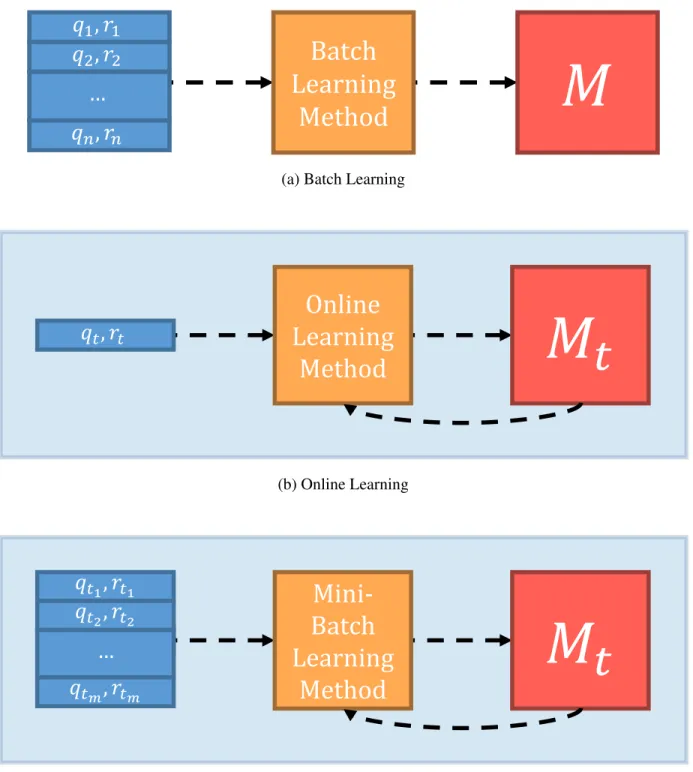
5 Batch, online, and mini-batch learning settings . . . 31
6 Random versus active query selection . . . 34
7 RCKL-AK synthetic data experiments: Test TQPE vs. number of training responses (ten trials, 95% CI) . . . 62
8 RCKL-AK synthetic data experiments: mean values of weight parameters (µ1 (red), µ2(blue),µ3(green),µ4(teal),µ5(pink),µ6(purple)) . . . 63
9 RCKL-AKaset400data experiment: Test TQPE vs. number of training responses (ten trials, 90% CI) . . . 65
10 Plate diagram depicting TACKL variable relationships . . . 69
11 Plate diagram depicting triplet query/object dependencies . . . 70
12 TACKL synthetic data experiments (ten trials, 90% CI). . . 75
13 TACKL Yummly data experiments (20 trials, 90% CI) . . . 75
14 Example task deployed via AMT to collect Zappos triplet data (three triplet queries per task) . . . 77
15 TACKL Zappos data experiments (ten trials, 90% CI) . . . 78
16 Example two-dimensional embedding learned by A-TACKL on Zappos data . . . . 79
17 ERKLE small-scale synthetic data experiments (ten trials, 95% CI) . . . 91
19 Results from experiments on the aset400 data set (ten trials) . . . 94 20 Results from experiments on the OSR data set (ten trials) . . . 97 21 CAMEL HIT data experiments: number of training instances vs. AUROC on test set
(Row 1 = Expert 1, Row 2 = Expert 2, ten trials, 95% CI) . . . 108 22 CAMEL HIT data experiments: feature weight statistics (CAMEL-CL, Expert 2, ten
trials) . . . 111 23 CAMEL HIT data experiments: normalized absolute values of L entries (left =
LIST OF ALGORITHMS
1 A Prototypical Batch RCKL Learning Algorithm . . . 43
2 Active Sequential Triplet Query Selection . . . 49
3 RCKL-AK Projected Gradient Descent . . . 58
4 Active TACKL . . . 73
5 Efficient PSD Projection . . . 84
6 Efficient online Relative comparison Kernel LEarning (ERKLE) . . . 85
1.0 INTRODUCTION
The ability to reason about how objects relate in a problem domain is of central importance for many machine learning methods to perform a task. To this end, amodel of similaritythat dictates how objects are compared to one another is required. Most commonly in machine learning, objects are represented by so-called feature vectors that are composed of uniquely defining characteristics drawn from raw data. Then, standard measures of similarity or distance are used on this predefined representation of objects. Take, for example, classicalk Nearest Neighbor (kNN) classification. Class membership is determined by standard Euclidean distance between feature vectors. In this scenario, both the features and the Euclidean distance metric, together, define a model of similarity that allows thekNN classifier to perform a task. The success of many machine learning methods, including thekNN classifier in this case, is highly dependent on the assumed model of similarity on which it acts. As a result, when applying machine learning methods to a task, it is of the utmost importance to have a model of similarity among objects that is useful for that task.
Unfortunately, it is often the case in real-world applications that simple features constructed from raw data alone do not result in similarity models that that lead to desirable performance. In these instances, a model of similarity must be designed to reflect a notion of how objects relate that is beneficial for a task. It is this observation that has motivated the development ofsimilarity-learning
methods [157,1,75,10]. Similarity-learning methods are a class of supervised learning methods that learn a model of similarity over a domain of objects given supervision or feedback regarding how objects relate. For instance, in classification tasks, the class labels themselves obviously give strong indication about which objects should be deemed similar and which should be deemed different in a problem domain. If that information was used to learn a model of similarity in which objects with the same class label are close together, then akNN classifier using this model could have improved performance over using one ignorant of this information.
However, like other supervised learning methods, similarity-learning methods require a source of feedback to provide supervision. For many tasks, humansare called upon to be this source of feedback. Humans tend to have an innate understanding of how common objects relate that is difficult to capture from raw data alone. As a result, thishuman perceptionthat most humans possess is useful in tasks where that require a model of similarity reflecting how the average human reasons about objects, such as in product recommendation, or for tasks that humans find easier to accomplish than computers, such as visual object recognition. In addition, certain humans have specific domain knowledge that allows them to make assessments on objects that the most humans cannot. Accordingly,expert feedbackcan be leveraged to learn a model of similarity for settings that require expertise in a specific domain.
In this dissertation, we focus on the general problem of learning models of similarity over objects from feedback obtained from humans. We consider both learningperceptual similaritythat can be used in tasks that require a model that reflects how the average person views the relationships among objects, as well asexpert similarityfor tasks that call for a model conveying specific expertise in a domain. Associated with this problem are a considerable number of challenges related to the methodology in learning similarity models as well as practical challenges in obtaining and using human feedback. In the next section, we define these challenges.
1.1 CHALLENGES
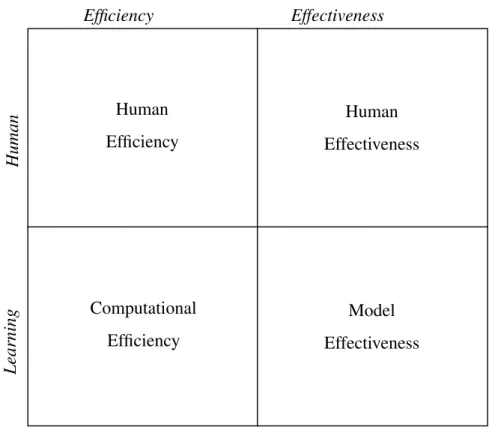
Though having a model of similarity based on human feedback is useful in many machine learning applications, the act of learning such a model faces numerous challenges. To better understand these challenges we separate them into four challenge categories formed by the union of two criteria depicted in Fig.1. One criterion separates the practical challenges that arise when prompting humans for feedback from methodological challenges in the learning algorithms themselves. The second criterion contrasts challenges inefficiency(reducing effort or cost) versus those ineffectiveness
(increasing accuracy). Below we explain each category:
Human Efficiency Obtaining human feedback requires time, and often money, especially in do-mains where expert feedback is required. As such, practically obtaining a sufficient amount of
Human Efficiency Human Effectiveness Computational Efficiency Model Effectiveness Efficiency Effectiveness Human Learning
Figure 1: The four categories of challenges considered in this work
feedback to learn an accurate model is often the most costly step in learning similarity. Thus, effort should be made to reduce the burden placed on humans by making the most of their service. By doing so, one can lessen the amount of feedback required to learn a useful model. Stated more plainly, a human efficient similarity-learning method would require as little human feedback as possible to learn an accurate similarity model.
Computational Efficiency In order for a model of similarity to be useful, it needs to take a form in which learning algorithms can use as input. For this reason, the models considered in this work take forms that allow their use in many popular techniques in machine learning. Unfortunately, this often imposes strict constraints that an lead to considerable computational overhead in learning the models. If no attempt is made to mitigate this overhead, the practical run time of learning a similarity model could be too high to warrant their use for certain applications.
Human Effectiveness Many of the models considered in this work represent complex relationships among a large number of objects. Humans may find it difficult to directly provide the similarity being conveyed in these models, which can lead to inaccurate or contradictory feedback. This noise that can lead to learned models that do not faithfully reflect the desired relationships of objects. To ensure a similarity-learning method is human effective, one must either assume that the form of feedback being given leads to many noisy responses, and attempt to reduce the effect of the noise, or ask queries that humans find easy to answer, and adapt their methods to learn from a form of feedback that may not directly convey the same information the learned model provides.
Model Effectiveness Another important characteristic that models of similarity should possess is accuracy. More specifically, a model should accurately reflect the notion of similarity being conveyed through given feedback. Furthermore, a learned model should also convey a more general sense of similarity that captures object relationships not explicitly given, resulting in a more complete model than one that only echoes obtained supervision. Less obviously, it is also important to ensure that both the model being learned and the questions being asked are expressive enough to capture the true relationships among objects that the human is trying to convey. If the choice for either cannot express object relationships essential for a task, then no similarity-learning method can produce a model useful for that task.
The similarity-learning methods discussed in Chaps. 5,4, and6provide methods with explicit focus on one or more of these challenges. Yet, providing a solution to a challenge in one category often creates a problem in another. For instance, one may choose to ask queries that humans find easy to answer (high human effectiveness), but by doing so, the number of queries needed to learn an accurate model may be large (low human efficiency). Or, one could learn a model of similarity that very closely adheres to given feedback (high model effectiveness), but the algorithm to learn such a model has a long run-time (low computational efficiency). In short, there is a trade-off between the challenge categories that must be considered when developing similarity-learning methods.
1.2 THESIS STATEMENT
Having defined these challenges, we are able to state the thesis of this dissertation:
By defining and explicitly attending to the practical challenges in learning models of similarity from human feedback, more efficient learning methods can be developed to learn more effective models that can be used in machine learning and data mining methods.
In order to confirm this thesis, we introduce four novel similarity-learning methods that focus on improving performance in one or more of the challenge categories defined in the previous section over previous methods, while ensuring not to reduce the performance in others to the point where they are impractical for real-world learning tasks. Indeed, the individual works discussed in the subsequent share a common goal: To develop similarity-learning methods can be used in practical, real-world learning scenarios where human feedback is obtained.
Two important items relating to this thesis statement must be defined. First, what is meant by a “model” of similarity? In this work, we define a model of similarity between objects to have two components: arepresentationof objects and ameasurein which they can be compared with respect to that representation. Without a representation, objects cannot be compared to one another. Once objects have a representation, the way in which they are compared must be described by a well-defined measure. Often the line between these two components can be blurred. We make a focused effort on explicitly defining both components in the similarity models used in the similarity-learning methods outlined in this dissertation.
The other item needed to be defined is how one evaluates a similarity-learning method’s performance in a challenge category. To measure computational efficiency, we use time complexity of the learning algorithms themselves as it a well-understood standard for algorithm analysis. In some cases we also show actual run-time of the algorithms to further emphasize differences in efficiency. The analogue of time complexity (number of elementary operations) for human efficiency is the number of queries asked to learn a given model. Human effectiveness is as much of a psychological issue as it is a machine learning one. Because of this, measuring human effectiveness is somewhat more nebulous than measuring computational or human efficiency. We dedicate a large
portion of Sec. 2.3to discussing human effectiveness in terms of the forms human feedback can take.
Finally, the model effectiveness of a method depends on task-specific measures of accuracy. In settings where the goal is to learn a perceptual model, which then can be used as a basis for numerous other machine learning tasks, measures of accuracy should reflect how well the learned model adheres to the general similarity being conveyed by humans. In similarity-learning settings with a particular task in mind, the model can be judged by it’s use for that task, thus task-appropriate measures of accuracy can be used. The distinction is subtle, but important. If one learns a model of similarity for the specific task ofkNN classification, then metrics for classification accuracy can be used to measure model effectiveness. If the goal is to simply learn a model that reflects how humans reason about objects that can be used in various machine learning tasks, then accuracy is determined by how well the learned model captures human similarity. As we evaluate the methods in this dissertation, we will introduce evaluation metrics that measure task-appropriate accuracy.
Because of the close relationship the challenge categories share, we evaluate similarity-learning methods as a function of two or more metrics measuring performance in different categories. For instance, in Chap 5 we evaluate methods in terms of run time as a function of the number of queries answered. In Chap4, we evaluate methods by a measure of model accuracy versus the number of queries answered. Though much of the discussion may revolve around performance in a single challenge category, the results can be viewed as comparing methods over multiple different categories. Through the evaluation of the methods introduced in this dissertation in terms of their ability to manage the effect of similarity-learning challenges, we aim to verify our hypothesis.
1.3 CONTRIBUTIONS
In Chap.4 we address the inherent human inefficiency of learning a model of similarity from a particular form of human feedback called relative triplet feedback. Relative triplet feedback is useful for modeling human perception as it is both sufficiently human and model effective for that task. However, it it inherently human inefficient. To mitigate this human inefficiency, we developed a novel framework for incorporating auxiliary information about object relationships
into common similarity-learning methods that use relative triplet feedback as input. By doing so, we permit the auxiliary information to model trends that allow the similarity models learned within our framework to generalize to object relationships not explicitly given, while requiring less feedback. Then, we use the intuition gained by developing this framework, and a specific similarity-learning technique as a basis to develop a novel active learning method that intelligently selects queries in order to further increase human efficiency.
In Chap.5 we address the computational inefficiency of common similarity-learning methods that learn from triplet feedback in the online learning setting. Traditional methods for this task consider the batch learning case. Their learning methods typically include a projection step that has time complexityO(n3). In the online learning setting, this is prohibitively expensive. In response to this, we develop a novel framework that can update models with online feedback in O(n2)time in the worst case. By taking advantage of the structure of our particular updates, we can even skip the projection step and perform constant time updates under certain conditions. In addition, we leverage recent techniques in online learning to determine how newly obtained feedback should affect the model. In doing so, we eliminate the need for users of our method to manually set any hyperparameters. Even with the improvements in computational efficiency and ease of use, we show that our method can learn models of similarity that are as accurate as traditional methods.
In Chap.6 we address the human efficiency and model effectiveness of learning a model of similarity to be used in a classification task in the clinical medical domain. Here, we consider the application of learning an inference model to alert a clinician when a patient is at risk for a disease from patient Electronic Health Record (EHR) data and expert provided class labels. For such a method to be practically useful, the model of similarity used to make inferences should have two properties. First, it should be able to convey more information about patient relationships with respect to disease than simply providing alerts. Second, it should be as human efficient as possible as expert supervision is especially costly. We develop a similarity-learning method with a focus on these two goals. The model our method learns can be used to give additional information about a prediction, such as how confident the model is, and what specific characteristics of the patient factored into the prediction. In addition, we formulate a version of our method that can take auxiliary confidence information from expert labels and utilize it to
learn more accurate classification models from fewer labeled patient instances.
1.4 OUTLINE
The rest of this dissertation proceeds as follows. Chapter2provides a review of foundational topics to be used in subsequent chapters, including those in fundamental models of similarity and the forms human feedback can take. Chapter3discusses work related to the methods presented in this dissertation to confirm out thesis. More specifically, we review two classes of similarity-learning methods, and two orthogonal learning settings. Chapters4,5, and6present the main contributions of this dissertation. Finally, Chap. 7concludes by recapitulating the contributions of this dissertation and discussing avenues of future work.
2.0 PRELIMINARIES
In order to begin our study of learning models of similarity from human feedback, we must first introduce the basic formalisms commonly considered similarity-learning. In this chapter, we define forms both human feedback and similarity models can take, and review foundations in each. Also, we provide a brief summary of the learning settings in which our methods act. We begin this chapter by defining the notation used in the remainder of this dissertation. Then, we review two fundamental measures of similarity that lay a foundation for the methods outlined in subsequent sections. Next, we discuss common forms of human feedback, provide example applications in literature, and compare them in terms of the challenge categories defined in the introduction. After that, we compare online learning to traditional batch learning as a means to motivate our online similarity-learning method in Chap. 5. Finally, we discuss active vs. random selection of queries to provided background for our active query selection algorithm presented in Chap. 4.
2.1 NOTATION
The following notation will be used in the subsequent. We denote vectors as bold, lower-case Latin or Greek letters (i.e. a), and use subscripts on non-bold letters to denote individual elements in vectors (e.g.ab is thebth element ina). Matrices are denoted by bold, upper-case letters (e.g.A), and we use superscripts to denote individual elements (e.g.Abcis the element in thebth row and cth column). Script capital letters denote sets (e.g.A). Italicized letters (i.e.aorA) denote either scalars or abstract objects. Which is being used should be clear in context. Set membership is denoted by subscripts (i.e. ifab ∈ A, thenbuniquely identifies the objectab from others inA).
real numbers, the set of non-negative real-numbers, the set of real row vectors of lengthA, and the set of real matrices withArows andB columns, respectively. For both vectors and matrices, the superscriptT denotes the transpose. The rank of a matrix (number of linearly independent rows or columns) is denoted by the functionrank. The trace of a matrix (sum of diagonal elements) is denoted by the functiontrace. A matrixM∈RA×Ais denoted as positive semi-definite (PSD), i.e. has no negative eigenvalues, byM0. The function[·]+is the “hinge” function that is equivalent tomax (0,·).
2.2 FUNDAMENTAL MODELS OF SIMILARITY
A common way to reason about the relationships among objects is through pair-wisemeasures, meaning similarity is expressed over pairs of objects. Pair-wise models of similarity are attractive because they provide a direct way to compare one object to another, but also can be used to express more complex relationships. Similarity between a large group of objects can be determined by measuring how similar each pair in the group is. If similarity to a single object is of importance to a task (e.g. for ranking or clustering using centroids), all other objects in a domain can be compared, pair-wise, to an object of importance. For this reason, many standard methods in machine learning, data mining, and information retrieval assume a pair-wise model of similarity. However, some of these methods do not necessarily use a measure of similarity, but one ofdistance. In this work, we consider similarity and distance to be one and the same. Distance is most commonly interpreted as a measure ofdissimilarity, which is the converse of similarity. As such, a measure of distance implies a measure of lack of similarity. Furthermore, we consider two specific models of similarity in this dissertation, each can be used to define a distance or similarity measure. These two measures represent a fundamental basis for which similarity-learning methods can build off of.
2.2.1 Distance Metrics
One of the most natural ways to quantify the relationships between pairs of objects is though the concept ofdistance. Distance, as most humans understand it, is concrete, but distance can also me
abstractly defined when considering objects without a specific representation. LetX be an abstract domain of objects, wherexi ∈ X is a single object. Letd :X xX → Rbe a distance measure that conveys a notion of distance or dissimilarity between two objects. This abstract definition of distance can characterize well understood notions of distance, such as physical distance between tangible objects (“That tree and that rock are 10 feet apart”), or less tangible ones (“The distance between these two directed graphs is 10”). The power in the abstraction of distance is that object in domains for which distance is not well-understood can have a means of comparison.
Distance measures allow for unitless real numbers to be considered as distances between objects without further definition. A more principled measure of distance can be defined throughmetrics. The functiond0 is a distance metric if it is a distance measure and also follows the following four properties for allxi, xj, xk ∈ X:
1. d0(xi, xj)≥0(Non-negativity)
2. d0(xi, xj) = 0iffxi =xj (Distinguishability) 3. d0(xi, xj) =d0(xj, xi)(Symmetry)
4. d0(xi, xk)≤d0(xi, xj) +d0(xj, xk)(Triangle Inequality)
In a sense, these properties express intuitive notions about the concept of distance, such as, distance should not be negative (non-negativity) and if a distance between two objects is zero, then those two objects are actually the same object (distinguishability). The space of objectsX in conjunction with a distance metricd0 over objects in X together make ametric space. Metric spaces can be viewed as models of similarity as they contain both components necessary to fulfill our definition of a model of similarity: a representationX and a means to compare objectsd0.
Many useful measures of distance can be defined as metric spaces. Possibly the most popular one of which is theEuclidean metric space, where objects are represented as real vectors (X =Rm) and distance between objects is defined as:
d2(xi,xj) = ||xi−xj||2 = v u u t d X k=1 xki −xkj2 (2.1)
Here,xi =xi ∈Rm, and|| · ||2 is the`2 or Euclidean norm:
||x||2 = m X i=1 √ xi∗xi (2.2)
This metric space is particularly convenient in machine learning where objects are typically repre-sented asfeature vectors. In data-driven tasks, object representations are often derived by extracting uniquely-defining characteristics about each objects from data. In many machine learning appli-cations, these characteristics are modeled as real-valued features, which when combined create a vector of real values that define an object. The Euclidean distance between these representations define and “ordinary” or “straight-line” distance between objects, which machine learning methods can use as a way to compare objects.
2.2.1.1 Generalized Mahalanobis Distance Metrics Because it is such an intuitive way to describe distance, the Euclidean distance metric is popular among machine learning methods to compare objects in a feature space. However, other distance measures can be used. Consider the case where objectsxi andxj are drawn from a normal distributionN(µ,Σ). TheMahalanobis
distance metricfor these two objects is defined as follows:
dΣ(xi,xi) =
q
(xi−xj)Σ−1(xi−xj) T
(2.3)
In short, (2.3) measures the distance between points with consideration of how the objects are distributed by normalizing based on the covariance between and within features. WhenΣ−1 is identity, (2.3) reduces to Euclidean distance. WhenΣ−1is diagonal with elementsσi, ...σm, (2.3) is known asnormalized Euclidean distance:
dΣ(xi,xj) = v u u t d X k=1 xk i −xkj 2 σj (2.4)
In practice,Σis estimated from data. However, the only requirement for (2.3) to be a valid metric is thatΣ−1 be PSD. As a result, one can define ageneralized Mahalanobis distance metric:
dM(xi,xi) =
q
(2.5) can be understood by interpretingMas aGram matrix. By definition of a Gram matrix,M
can be decomposed: M=LLT, whereL∈
Rmxm
0
. Thusly, (2.5) can be written as:
dM(xi,xj) = q (xi−xj)M(xi−xj)T = q (xi−xj)LLT (xi−xj)T = q (xiL−xjL) (xiL−xjL) T =d2(xiL,xjL) = dL(xi,xj) (2.6)
With this, (2.5) can be interpreted as simply the Euclidean distance metric after a linear transforma-tion of the objects into am0-dimensional metric space. IfLis not full-rank, then different objects in the original feature space can be projected onto the same point in the new space, and in doing so, breaking distinguishability. Thus, ifLis not full-rank, then (2.6) is apseudometricby having all the properties of a metric except distinguishability.
Because the only requirement for (2.5) to be a valid metric or pseudometric is thatMis PSD, one can learn Mor L so that the metric has properties that are beneficial to a task. This is the goal ofmetric learning[75,10] methods: use information regarding how objects relate to learn a generalized Mahalanobis distance metric that reflects this information. Note, that “metric learning” is sometimes used broadly to mean the problem of learning any form of a metric. For the sake of this work, we use the term restrictively to mean learning a generalized Mahalanobis distance metric. For the problem settings considered in this dissertation, one can employ metric learning methods to learn a model of similarity that reflects a given set of human feedback. We review metric learning methods in section3.1.
2.2.2 Kernels
While distance metrics represent a principled way to measure dissimilarity between objects,kernels
can be used as a way to measure similarity based on many of the same foundation as metrics. Let k :X × X →Rbe akernel function. Formally speaking, a kernel function is the canonical inner product of objects inX. Similar to a metric space, aninner product spaceis defined byX andk together with the following assumptions. First,X must be avector spacefor which vector addition and scalar multiplication are defined. Second,kmust have three properties:
1. k(xi, xj) = k(xi, xj)(Symmetry) 2. k(a∗xi, xj) =a∗k(xi, xj)(Linearity)
3. k(xi, xi) = 0 =⇒ xi = 0(Positive Definiteness)
An instructive example that illustrates the relationship between kernel functions and similarity iscosine similarity:
sim(xi,xj) =
hxi,xji
||xi||2∗ ||xj||2
(2.7)
Here, objects are real vectors (X ∈Rm), andh·,·iis the canonical inner productkfor real vectors, which is also known as the theEuclidean inner product
hxi,xji=xTi xj = d
X
k=1
xki ∗xkj (2.8)
Cosine similarity is simply the cosine of the angle between two vectors, which can be interpreted as a magnitude-independent measure of how similar two vectors are. If both feature vectors are normal, then the denominator in (2.8) is one. As a result, if objects are represented by normalized feature vectors, the inner product between them is equivalent to the cosine similarity, and thus can be used as a method of comparison. Also, Euclidean distance can be defined in terms of inner products:
d2(xi,xj) = ||xi −xj||2 = q (xi−xj) (xi−xj)T =xixTi +xjxTj −2xixTj =hxi,xii+hxj,xji −2∗ hxi,xji (2.9)
Thus, a model of similarity defined by feature vectors and the Euclidean inner product as a kernel function that can be used to define distance, as well.
The power of kernels, however, comes from the so-called “kernel trick”, popularized first by it’s use in Support Vector Machine (SVM) classification [29]. Since then, there have been numerous machine learning methods that utilize kernels as a model of similarity to perform various tasks [115], collectively calledkernel methods. The intuition behind the trick is as follows. Instead of assuming that the domain of objects is a vector space, assume that there exist afeature mapping
φ :X → H from the space of objects to an inner product spaceH. Now, we can write the inner product of objects ashφ(xi), φ(xj)iH=kH(xi, xj). The mappingφallows for abstract objects to
be given a representation. However,φneed not be explicitly defined as long askis a valid inner product. Mercer’s theorem states that aφexists for a given kernel functionkas long asksatisfies Mercer’s Condition: Z xi∈X Z xj∈X k(xi, xj)g(xi)g(xj)dxidxj ≥0 (2.10)
for all square integrable functionsg. As a result, objects from a domain can be given a model of similarity by choosingkthat satisfies (2.10).
This observation is powerful for two reasons. First, for some domains there may not be clear ways to represent objects. One can still define a well-principled model of similarity that can be used in kernel methods by designing a valid kernel function over that domain. For instance, it may not be clear how to represent strings of characters so that they can be successfully used in machine learning methods. Nevertheless, kernels over strings have been developed that allow machine learning methods to be applied to tasks such as text classification [86]. In addition, objects may have vector representations, but they may be ill-suited for a task. For instance, if a linear classifier is applied to a setting where the objects are not linearly separable, then performance of that classifier could be poor. However, a proper choice of a kernel functionk, can implicitly map the objects into a space where they are linearly separable, thus potentially increasing the performance of the classifier. For this, many different kernel functions have been designed to create more expressive models of similarity than just using the unchanged, original feature vector representation of objects.
A comprehensive review of all kernel functions currently in use is outside the scope of this dissertation. However, theGaussian kernel functionis of special note due to it’s relationship to work later in this document:
k(xi,xj) =
exp (−d2(xi,xj)/σ2)
σ√2π (2.11)
Here, it is assumed that the domain of objects are real-valued feature vectors. This function is at its maximum when the distance between objects is zero, and decreases as their distance increases. The parameter σ determines how rapidly the value ofk decreases as distances between objects increase, and is often called the “bandwidth” of the kernel due to it’s relationship to the width of the contours of a Gaussian distribution. The setting of the bandwidth has a rather large effect on the resulting model of similarity, which has lead to the popularity of the Gaussian kernel function
amongst practitioners, as it can approximate a large class of functions with different settings of the bandwidth [92]. Note, that the Gaussian kernel is a function of Euclidean distance. However, other distance metrics can be substituted to easily change the distance metric into a kernel function.
2.2.2.1 Kernel Matrices If an application requires a model of similarity not over a domain of objects, but a finite set of objects, then a function over the entire domain is unnecessary. In terms of kernels, this means that if similarity is only relevant to a task over a given set of objects, then simply having the values of the kernel function applied to all pairs of objects in the set is sufficient. To model this, often akernel matrixis used. Consider a set of objects{x1, x2, ..., xn} ⊂ X for which we require a model of similarity. A kernel matrixK ∈ Rn×n is a model of similarity in which
Kij =k(x
i, xj)fori, j = 1,2, ..., n; thus,Kmodels similarity amongst all objects in question. Learning such a model is practically useful. Much like having a valid kernel function eliminates the need to explicitly define a mapping functionφ, learning a valid kernel matrix directly eliminates the need to define a specific kernel functionk. The only two requirements for Kto be a valid kernel matrix is that it must be symmetric (Kij =Kji) and PSD (K 0). A special case of this is thecorrelation matrix, which imposes the additional constraint that the diagonal entries are one (Kii = 1for i = 1,2, ...n). Such a constraint means that the objects in the inner product space induced byKare normal. As a result, the entries of a correlation matrix are equivalent to the cosine similarity among objects. In addition, the Euclidean distance between objects inHcan be defined with simple operations on the elements ofK:
dK(xi, xj) =
p
Kii+Kjj−2Kij (2.12)
This comes directly as a consequence of construction ofK, the definition ofkas an canonical inner product, and (2.9).
2.3 FORMS OF HUMAN FEEDBACK AND THEIR APPLICATIONS
The mathematical constructs used to model similarity are only one component in modeling human notions of similarity. Another component is thefeedbackused to learn these models. Humans are
able to convey how they view the relationships among objects in many different ways. Because of this, feedback can take differentformsthat impart different kinds of information about object relationships. In this section, we compare and contrast some of the most widely-used forms of human feedback in terms of the similarity-learning challenge categories. More specifically, different forms are more expressive than others, affecting model effectiveness. Some forms give less information per query, thus having an impact on human efficiency. Finally, humans have the ability to provide certain kinds of feedback more easily than others, clearly influencing human effectiveness. Note that other forms of feedback exist that are not explicitly mentioned in this section. We limit the discussion to a sampling of the most popular forms, but much of the analysis performed here can be applied easily to those not included in this dissertation.
For a more formal viewpoint, first let Q = {q1, q2, ..., qm} be a set of queries, and R =
{r1, r2, ..., rm}be a set of valid responses. Though we refer to them as responses to emphasize the fact that they are how humans respond to queries, a name for elements inRmore common to supervised learning settings issupervision. We use the terms interchangeably. We can view humans providing feedback as a functionf :Q → R, and a set of human feedback to be pairs of queries and their corresponding responses{(q1, r1),(q2, r2), ...}. Indeed, the goal of many similarity-learning applications is to estimatef by learning modelM using a set of obtained feedback and a predefined way of answering queriesfˆM. Different forms of feedback are defined by the queries that can be askedQ, the valid responses to those queriesR, and the interpretation off. The space of queries is defined by the number of objects considered in a single query. For instance, letX ={x1, x2, ..., xn} be a collection of objects. Label feedback asks queries about single objects, which we denote
Q= Q1 =X. For pair-wise feedback,Q =Q2 = X × X, and so forth. Each of the following subsections discuss forms of feedback with a different choice forQ.
2.3.1 Labels
The most basic form of feedback humans can provide is judgments on single objects, whose responses are commonly calledlabels. Aclass labelindicates that an object is the member of a discrete category, i.e.,f(xi) = ri ∈ {C1, C2, ...Cc}. Class labels are one of the most studied forms of feedback, as they are the supervision considered in classification, a problem studied as early as
the 1930s [48] with entire textbooks dedicated to the subject [93,38]. Whenc= 2, class labels are called binary labels, which typically indicate the presence or absence of a characteristic. When c >2, then the labels are called multi-class labels. Another special case is when a single object has multiple labels [137], for which classification methods are often called multi-label classifiers.
Labels can also be real-valued (yi ∈R). Supervised learning techniques that use real-valued labels are regression methods, which have an even longer history than classification methods [82,51]. Important special cases of regression labels can be created by restricting their domains. For instance, regression labels can have a probabilistic interpretation by restricting the labels to[0,1]. Also, ordinal labels [89,49] are values on on an arbitrary scale where only the relative ordering of the labels is considered significant. For example, if yi < yj, then this implies that xi ≺ xj (interpreted as “precedes”) in a total ordering, or ranking of objects. This differs from traditional regression labels in that the exact difference betweenyi andyj is considered meaningless.
Of those listed in this section, the two kinds of labels classically used to obtain human feedback are class and ordinal labels. Class labels obtained from humans have been used in a variety of applications, ranging from perceptual tasks such as object recognition [36,42,46] to expert tasks like medical diagnosis [71,107,127], or bird call [2], leaf [77], and music genre classification [140]. There has even been work where human-perceptual class labels are used to mimic domain expertise [18]. As for ordinal labels, most recent usage has been in point-wise learning to rank techniques [32,125,27]. Here, the ordinal categories are meant to convey a human’s preference of the objects. As such, learning to rank techniques are motivated by applications where the goal is to model human preference, such as document retrieval or collaborative filtering.
In all these works, the labels are obtained for the sole purpose of learning an inference model to predict the label of unseen objects, i,e, they aim to findfˆM : X → Rthat estimatesf. However, recently there has been work to prompt humans for mid-level binaryattributes[47,79,45,103] whose purpose is to describe objects. The reason attributes are described as “mid-level” is that they are meant to represent concepts more abstract than what is typically reflected in features extracted from raw data, but less abstract than higher level concepts commonly represented by class labels. For instance, when describing images of scenes, features drawn from images of the scene can capture information about the color and shape of objects within the scenes. Binary attributes obtained from humans can describe more abstract concepts such whether scenes appear “cold”,
“man-made”, and/or “enclosed”. These human-perceptual attributes can be incorporated into a similarity model that can then be used in tasks where perception is valuable.
2.3.2 Pair-wise Feedback
Humans can provide pair-wise feedback by considering two objects at a time, i.e. f(qi = (xa, xb)) = ri. For some forms of pair-wise feedback, it is assumed that queries are symmetric, meaning f(xa, xb) =f(xb, xa). This is the case in pair-wise similarity/dissimilarity assessments. Here, it is assumed that pairs of objects belong to one of two classes: similar pairs of objectsS, or dissimilar pairs of objectsD. A responseri indicates whether(xa, xb)∈ S or(xa, xb)∈ Dforxa6=xb. As such,rican be seen as a binary class label over pairs of objects. In a more practical sense, this form of feedback is most commonly used to indicate whether pairs of objects are members of the same cluster or not [146,156,9]. This allows for “human in the loop” clustering [44], where a human is shown a visualization of the objects organized into clusters. Then, the human can provide feedback indicating where the clustering is wrong by indicating examples of similar and dissimilar pairs not reflected by the current clustering.
Pair-wise feedback can also berelative. Like with similarity/dissimilarity assessments, relative pair-wise responses can be viewed as binary labels applied to pairs of objects. In this case, however, responses indicate whetherxa≺ xborxa xb in a total order or ranking of objects. As a result, relative pair-wise feedback is asymmetric. Note that though this form of feedback is meant to convey information similar to ordinal labels, it only conveys a relative assessment of the ordering of two objects rather than the exact position of either object in the total ordering. Due to this, learning to rank methods that use this form of feedback are commonly categorized separately from those use ordinal labels [113,68,50,19,20].
As with labels, pair-wise feedback can convey mid-level attribute information. In this case, however, attributes are given in arelativefashion. Instead of describing the presence or absence of an attribute, a relative attribute [102,72,13] describes to what degree the object expresses the attribute relative to other objects. For example, an attribute can indicate that an image of Pittsburgh, Pennsylvania is “cold”, but relative attributes can indicate that Pittsburgh is “colder” than Miami, Florida, but “warmer” than Antarctica. This can be viewed as ranking objects according to attributes
𝑥𝑎 𝑥𝑎 ≺ 𝑥𝑏 𝑥𝑏 𝑥𝑏 ≺ 𝑥𝑐 𝑥𝑐
(a) Pair-wise
𝑥𝑎, 𝑥𝑏 𝑥𝑎, 𝑥𝑐 𝑥𝑎, 𝑥𝑑
(𝑎, 𝑏, 𝑐) (𝑎, 𝑐, 𝑑)
(b) Triplet
Figure 2: Directed graph depictions of relative feedback
rather than applying binary labels to them.
Two key ways pair-wise feedback differs from unary feedback are in concepts ofimpliedand
conflictingresponses. Intrinsic in the nature of pair-wise feedback is the ability to identify when a response is implied through previous feedback and when a set of responses cannot all be true. For instance, a person providing similarity/dissimilarity assessments could respond that objectsxaand xb and similar and thatxb andxcare similar, i.e. (xa, xb),(xb, xc)∈ S. Through these responses it is implied that(xa, xc)∈ S, meaning we already know the answer to the query asking whether xaandxcare similar or dissimilar. If the person gives a response(xa, xc)∈ D, then, this clearly creates a contradiction with the previous responses. For labels, without other information about the objects or model assumptions (e.g. classes are linearly separable) it is impossible to tell whether the responses contain conflicts or if certain feedback is unnecessary.
We can draw these conclusions by assuming that similarity, and conversely distance, between objects ismetricand follows the properties of metrics. Specifically in this case, we leverage the triangle equality to imply certain responses by transitive relationship among objects. A more illustrative example of this is looking at pair-wise ordinal feedback as a directed graph. In this case, vertices are objects and directed edges indicates the “precedes” relationship. Figure2aillustrates an example with three objects where responsesxa≺xb andxb ≺xc. The responsexa ≺xcis implied,
andxaxcwould conflict with the other responses. The idea of forms of feedback possibly having redundant or conflicting responses is useful in comparing it to other forms, which we will discuss in Sec. 2.3.4.
2.3.3 Relative Triplet Feedback
The idea of relative pair-wise feedback can be expanded to more than two objects. When three objects are considered they form relative triplet feedback. Triplet feedback can be positive or negative. Positive triplet feedback is meant to communicate how the similarity between one pair of objects compares to the similarity of another pair. In English, a positive triplet query is a question of the form “Is objectxamore similar to objectxb than it is to objectxc?”. Notationally, we define a positive triplet query as a tuple(a,{b, c}), wherexais theheadof the triplet being compared to a
pairof objectsxb andxc. The response to such a query is eitherborc. For ease of discussion, we denote triplet feedback (the query and response together) as a triplet. For instance, the response “a is more similar tobthan it is toc” implies the query(a,{b, c})was asked, thus we can represent triplet feedback as simply(a, b, c). Note the subtle notational difference from queries in thatbandc here are ordered in the feedback triple to indicate which was chosen.
Negative triplet queries are questions of the form: “Which one of these three objects, xa,xb, andxcis different than the other two?”, and the response is any of the three objects. Much like the positive form, negative triplet feedback gives relationships among each pair of objects. For instance ifxa,xb, andxcare being compared and a human choosesxc, this can be interpreted thatxaandxb are more similar than bothxaandxc, andxb andxc. Thus, a single unit of negative feedback gives two positive triplet responses:(a, b, c)and(b, a, c).
Two other special cases of triplet feedback include quadruplets, which use queries of the form: “Which pair of objects,xi andxj or xk and xl are more similar?”, and multi-triplets, which ask humans to select all objects from a set that are similar or dissimilar to each other. All of these forms of triplet feedback are closely related. Note that many works using either negative triplet feedback [59,35,5] or multi-triplets [155] effectively distill their forms to positive triplet feedback. Positive triplet feedback itself is a special case of quadruplet feedback in which the two pairs being compared share a common object. As a result, methods that use quadruplet feedback [74,4,141] can often
easily me applied to scenarios where positive triplet feedback is obtained. For ease of discussion going forward, we limit ourselves to positive triplet feedback (henceforth, simply “triplet feedback”) and note that much of the discussion and the techniques in the remainder of this dissertation can be extended to these other cases.
Triplet feedback is powerful in that it can impart similarity information in a general sense. Almost all forms of feedback require context for humans to provide it. Class labels need names so humans know how to categorize objects. Pair-wise relative feedback requires a context in which objects are ranked, such as relevancy to a query if the objects are documents, or a named attribute if relative attributes are trying to be learned. Triplet feedback requires no context and solely relies on a person’s ability to make relative assessments about how she views the objects in a general sense. As a result, triplet feedback can be used in many different applications including semi-supervised clustering [5], density estimation [141], and even to identify multiple unnamed attributes [6]. More commonly, however, triplet feedback is used to learn general models of similarity that simply capture how humans perceive objects [4,132,91,143]. It it for this reason that the methods presented in this dissertation use triplet feedback to learn perceptual models of similarity.
As with relative pair-wise feedback, triplet feedback can conflict or be implied. If responses
(a, b, c)and(a, c, d)are given then(a, b, d)is implied and(a, d, b)would conflict. Also like pair-wise feedback, triplet feedback can be represented as a directed graph [91]. We illustrate an example of a triplet graph in Fig. 2b. Here, a node in the graph represents a pair of objects while a directed edge represents a triplet response, or a “more similar than” relationship. Besides the interpretation of nodes and edges, the difference between pair-wise and triplet graphs is in how valid edges are defined. In a pair-wise graph, a valid edge can be drawn between any two nodes. In a triplet graph, only nodes with a common object can have an edge between them, as a unit of triplet feedback requires a single single “head” object. This implies that triplets allow not for a total ordering of the pair-wise similarity between objects, but apartial ordering.
2.3.4 Comparison of Forms
Clearly, different forms of feedback are meant to convey different kinds of information. Yet, the differences between the forms affect more than the information content within responses. These
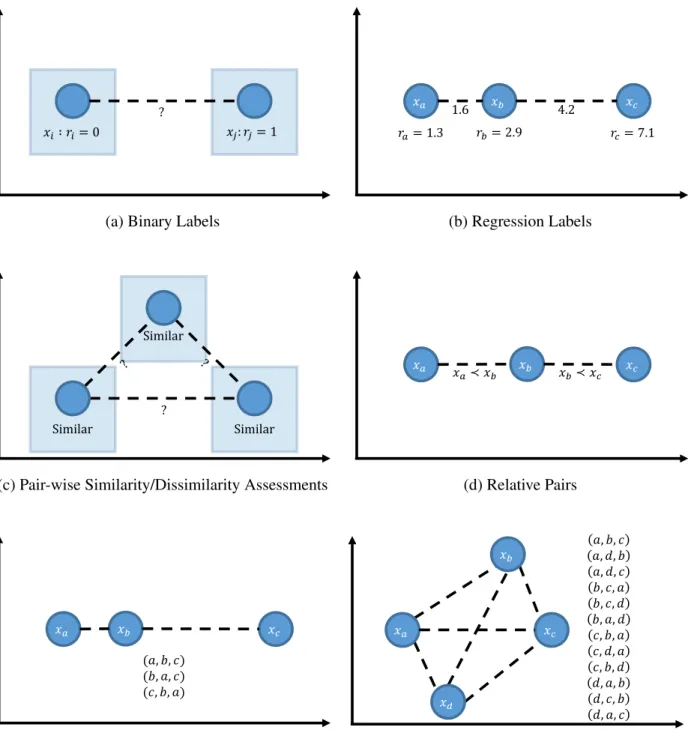
𝑥𝑖∶ 𝑟𝑖= 0 𝑥𝑗: 𝑟𝑗= 1
?
(a) Binary Labels
𝑥𝑎 𝑟𝑎= 1.3 𝑥𝑏 𝑟𝑏= 2.9 𝑥𝑐 𝑟𝑐= 7.1 1.6 4.2 (b) Regression Labels Similar Similar ? Similar
(c) Pair-wise Similarity/Dissimilarity Assessments
𝑥𝑎 𝑥 𝑎≺ 𝑥𝑏 𝑥𝑏 𝑥𝑏≺ 𝑥𝑐 𝑥𝑐 (d) Relative Pairs 𝑥𝑎 𝑥𝑏 𝑥𝑐 (𝑎, 𝑏, 𝑐) (𝑏, 𝑎, 𝑐) (𝑐, 𝑏, 𝑎)
(e) Relative Triplets (3 objects)
𝑥𝑎 𝑥𝑏 𝑥𝑐 𝑥𝑑 𝑎, 𝑏, 𝑐 𝑎, 𝑑, 𝑏 𝑎, 𝑑, 𝑐 𝑏, 𝑐, 𝑎 𝑏, 𝑐, 𝑑 𝑏, 𝑎, 𝑑 𝑐, 𝑏, 𝑎 𝑐, 𝑑, 𝑎 𝑐, 𝑏, 𝑑 𝑑, 𝑎, 𝑏 𝑑, 𝑐, 𝑏 𝑑, 𝑎, 𝑐
(f) Relative Triplets (4 objects)
Figure 3: Example object embeddings using different forms of feedback
differences must be considered when obtaining feedback for practical applications. In this section, we compare and contrast each form of feedback in terms of three of the four challenge categories in
learning models of similarity. Note that computational efficiency is not a good metric in which to compare forms of feedback as it is largely dependent on the learning algorithms themselves.
2.3.4.1 Model Effectiveness A form of feedback’s model effectiveness can be more succinctly described as its expressiveness. While certain forms are meant to convey a particular kind of information, others may be able to express more complex relationships among objects. If a task requires an intricate model of similarity, then prompting humans for simple forms of feedback may not be appropriate. To guide our discussion on expressiveness, we view forms of feedback in terms of learning a particular models of similarity called objectembeddings. An embedding of objects is a placement of each object in ad-dimensional real space where common Euclidean notions of distance and similarity can be used. An object’s placement in the space is entirely determined by the feedback given over it. As such, embeddings can faithfully reflect given feedback without biasing the model to common external factors, such as an assumed feature representation. Even so, these models are not perfect, as certain forms do not provide information regarding relationships, thus the embeddings must make certain assumptions. In practice, it is up to the embedding-learning methods themselves how to reconcile this lack of information in the learned embedding. For our comparisons, we remark when this is the case and use it to discuss the expressiveness of the models.
Figure3shows a number of object embeddings that reflect different sets of feedback of different forms. The most simple forms are those that express a categorical relationship among objects: class (including binary) labels, and pair-wise similarity/dissimilarity assessments. In our examples, objects expressed as similar or of the same class are positioned on exactly the same point, which we display in the figures as plates over unlabled points. Objects of different categories are embedded as different points. However, other embedddings that reflect the given feedback are possible. How pairs of objects in different categories or within the same category compare to each other is not expressed. In terms of embedding objects, this means that the distance between objects of different categories should be greater than those of the same category, but the exact distances are unknown. In fact, Fig. 3cshows a two-dimensional embedding from pair-wise similarity/dissimilarity assessments, but an accurate one dimensional embedding, as in Fig.3a, is also possible.
All other embeddings depicted in Fig. 3must position individual objects with nonzero distance between them to faithfully reflect their respective sets of feedback. Regression labels allow for
exact distances between objects to be known in the embedding (Fig. 3b). For the relative forms, the exact distance between objects is not known because their relationships are relative. In Fig. 3d, the feedback dictates thatxaprecedesxbin a total ordering, but information defining exactly how similar those two objects are is not given. Thus, the embedding that reflects the total ordering of objects can reflect the total ordering of objects, but must assume some distance betweenxaandxb. This is also true for relative triplet feedback. However, as more objects are sampled and feedback given, the number of constraints on pair-wise distances between objects increase. As a result, the distances between pairs of objects becomes more defined [126].
Possibly the most important factor when discussing expressiveness is thedimensionalityof the spaces for which a form is able to convey. All embeddings can accurately reflect their respective given feedback in one dimension: Regression labels simply indicate position on the real-number line, relative pairs indicate relative position in a single-dimensional total ordering, etc. The only one that cannot be accurately captured in one dimension is the triplet responses in3f. There does not exist a one dimensional embedding for which every triplet response on the right can be reflected in the embedding (e.g. for (a, b, c) objectsa and b should be closer together than a and c). As a result, if the true notion of similarity trying to be gained is multidimensional, relative triplets are the only one of these forms that can express multidimensional relationships. This is not to say that other forms cannot be modified to convey multidimensional similarity. Multiple binary or regression labels or relative pair-wise comparisons across multiple dimensions can be used to describe multidimensional spaces, but it requires putting names to the specific labels or comparisons. For instance, multiple, different relative attributes can be found over a given set of scenes, such as “warmth” or “plant growth”, but these individual attributes require names so humans have context for which comparisons can be made. Relative triplet feedback need not name the kind of similarity trying to be gained. As a result, if perceptual similarity is trying to be obtained from humans without biasing them to specific attributes, then relative triplets can be used.
2.3.4.2 Human Efficiency Informally, human efficiency for a form of feedback is the amount of information contained in a response. If humans can entirely describe a desired model of similarity by only answering a few queries of a particular form, then that form of feedback is considered human efficient. Unfortunately, because forms convey relationships of different complexity, they
are not directly comparable. Nevertheless, we attempt to compare each form in terms of human effectiveness, while introducing some alternative forms that could be more efficient, but have high impact on human effectiveness (discussed next section).
We compare each form by the total number of unique queries can be asked when procuring feedback overnobjects. As a result, we consider forms over fewer objects per unit of feedback to be more human efficient. Labels are the most efficient of the forms of feedback discussed, requiring only n queries to be responded to in order to obtain a complete set of responses. Symmetric pair-wise feedback requires n2queries, and asymmetric pair-wise feedback requiresn!/(n−2)!; both of which areO(n2). Finally relative, triplet feedback requiresn∗ n−1
2
= O(n3)queries (each head object can be compared to two other unique objects).
While this metric of comparison sheds some light onto the human efficiency of different forms, it does not tell the whole story. While pair-wise and triplet feedback has many more potential queries than labels, many responses can be redundant. As stated previously, some sets of pair-wise and triplet responses imply other responses without having to pose those queries to a human. As a result, the number of queries needed to be asked in order to obtain a complete set of responses can be less than the total number possible. For example, finding a total ordering using pair-wise relative comparisons is known to require onlyO(n∗logn)units of feedback in the worst case [70]. Similar reasoning can be used for triplet feedback. Triplet feedback can be seen as an ordering with respect to a single object of all other objects. In other words, it isnseparate orderings of n−1
objects. Because of this, finding a partial ordering that satisfies a complete set of triplet feedback using comparison-based sorting techniques requires onlyO(n2∗logn)units of feedback in the worst case.
The relative forms of feedback are clearly less human efficient than labels, though they have benefits in terms of model effectiveness. This provokes the question: Are there forms that have the expressiveness of relative feedback, while being more efficient? To answer this, consider instead of comparing pairs of objects to each other as in relative triplets, simply asking exactly how different two objects are. We will call this formquantitative pair-wisefeedback. This from can still be used to elicit multidimensional models of similarity, but requires asking onlyO(n2)queries to obtain a complete set of responses. Furthermore, quantitative pair-wise feedback can be interpreted as an exact measure of distance, eliminating any ambiguity in pair-wise distances between objects. In the
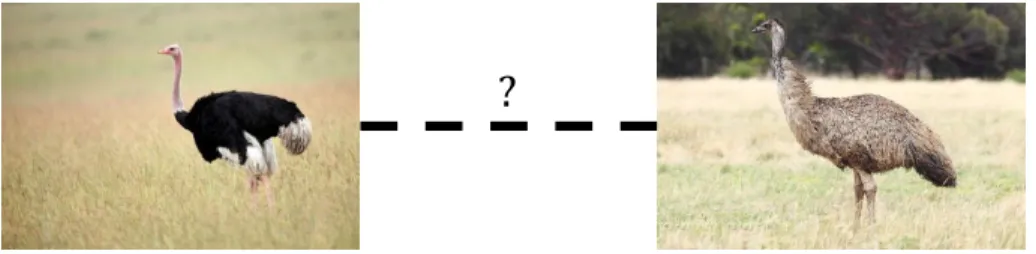
?
(a) Quantitative pair-wise query
?
(b) Relative triplet query
Figure 4: Direct quantitative query vs. relative query
next section, we discuss why prompting humans for exact, quantitative assessments about similarity can have practical issues, despite being otherwise attractive.
2.3.4.3 Human Effectiveness We define the human effectiveness of a form of feedback as the ease in which humans can answer queries of that form. If humans find queries to be easy to answer, then their responses contain more accurate information. While this particular challenge is more qualitative than quantitative, human effectiveness can be studied in a larger sense by what tasks
humans tend to find easy, and which they find difficult; A problem studied in cognitive psychology. Previous work [28] suggests that humans naturally categorize objects when they reason about them. As such, feedback that requires humans to reason about objects in a categorical sense (class labels, pairwise similarity assessments), tend to be easier for humans to respond to.
Also, humans tend to find relative assessments of objects easier to provide than exact, quantita-tive ones [135,130]. As a result, relative feedback is much easier to provide than exact measure of similarity or distance. Consider, again, quantitative pair-wise feedback. In Fig.4a, there are pictures of an emu and an ostrich. A quantitative pair-wise query would ask a human for a number, either discrete or real on a scale, of how similar the two images are. Such a query may be difficult for a human to answer because of the many factors involved in how she compares birds. In Fig.4b, there is a depiction of a relative triplet query. A human would most likely be able to answer this query with more ease because it requires her to compare two pair-wise similarities relative to each other. In addition, quantitative pair-wise feedback can be difficult for humans because they may not have the correct idea of the domain of objects. Assume the first query posed to a human is the one illustrated in Fig. 4a. If the human thinks the task is comparing animals, or birds, she could give a response indicating the images are very similar. However, if the domain of images is all ostriches and one emu, then she may have answered this query differently. Conversely, because relative triplet feedback can ground the response relatively, order of queries or knowledge of the domain is much less of a factor in the responses a human can provide. Therefore, responses could be more consistent. A similar argument can be made for relative pair-wise feedback versus ordinal labels. A human may find providing the exact positioning of an object in the total ordering to be challenging without knowledge of other objects. Because of this, ordinal labels may be difficult for humans to provide compared to relative pair-wise feedback.
2.3.4.4 Summary To summarize the strengths and weaknesses of each form of feedback dis-cussed in this section:
Class Labels
+ O(n)unique queries
- Cannot express information about the relationship between categories or objects within the same category
- Limited to modeling categories
Ordinal Labels
+ O(n)unique queries
+ Can convey ordering information
- Exact position of an object can be difficult for humans to provide without knowledge of all other objects
- Limited to conveying single dimensional relationships among objects
Pair-wise similarity/dissimilarity feedback
+ Asks for categorical information, which is often easy for humans to provide
+ Can be used to find clustering or unnamed classes of objects
- O(n2)unique queries
- Cannot express information about the relationship between categories or objects within the same category
Relative pair-wise feedback
+ Asks for relative information, which is often easy for humans to provide
+ Can convey ordering information
- O(n2)unique queries
- Limited to conveying single dimensional relationships among objects
Relative triplet feedback
+ Asks for relative information, which is often easy for humans to provide
+ Can convey multidimensional relationships among objects
- O(n3)unique queries
2.4 SIMILARITY-LEARNING SETTINGS
Now that we have discussed both the input (forms of feedback) and the output (models of similarity) of our problem, we can discuss the settings in which similarity-learning methods can act. Specifically, we discuss learning settings defined by two characteristics. The first concerns itself with how feedback is obtained for learning a model: all at once, or in small amounts at a time. The second separates learning settings where feedback is obtained at random, as opposed to settings where the learner is able to choose which queries humans are to respond to.
2.4.1 Batch versus Online Learning
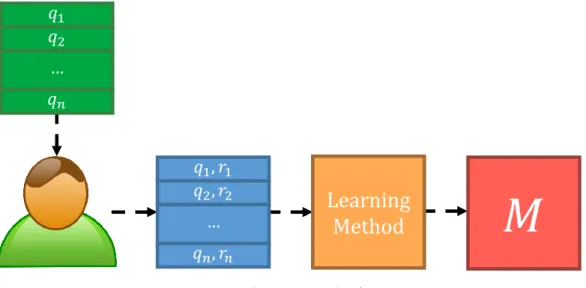
Traditionally in machine learning, data collection is assumed to be a separate step from learning a model from the data. As a result, the majority of machine learning applications consider feedback or supervision to be obtained inbatch. Figure5adepicts the batch learning process. Here, it is assumed that all feedback to learn a model is available at a single point in time, namelytrain time. At train time, all feedback{(q1, r1),(q2, r2), ...,(qn, rn)}is used as atrain setD ⊂ Q × Rto be used as the input to a learning algorithm, which in turn produces a learned modelM. Generally speaking, the model should in some way reflect the given feedback, and can then be used in the application it was made for. For instance, if the goal is to learn a functionfˆthat estimatesf, then a learned modelM can be a component in such a function, i.efˆM :Q → R. In Secs.3.1and3.2we discuss how this is done for a