2351-9789 © 2015 The Authors. Published by Elsevier B.V. This is an open access article under the CC BY-NC-ND license (http://creativecommons.org/licenses/by-nc-nd/4.0/).
Peer review under responsibility of the organizing committee of the Industrial Engineering and Service Science 2015 (IESS 2015) doi: 10.1016/j.promfg.2015.11.075
Procedia Manufacturing 4 ( 2015 ) 552 – 557
ScienceDirect
Industrial Engineering and Service Science 2015, IESS 2015
Biogeography-based optimization (BBO) algorithm for single
machine total weighted tardiness problem (SMTWTP)
Budi Santosa
a, Ade Lia Safitri
b*
a,b Industial Engineering Department, Institut Teknologi Sepuluh Nopember , Kampus ITS Surabaya 60111, Indonesia
Abstract
Scheduling problem is one of popular combinatorial cases. One of the basic scheduling problem is Single Machine Total Weighted Tardiness Problem (SMTWTP). This problem falls in NP-hard problem which is not easy to solve using an exact method as the scale getting larger. Nowadays, the number of research which develop and apply metaheuristics methods in solving combinatorial problems are quite high. One of new metaheuristics method which adopt biogeography phenomenon is Biogeography-based Optimization (BBO). BBO algorithm is known to have a quite good performance to solve continuous problems. In this research, BBO is developed to solve a discrete problem such as SMTWTP. Based on experimental results, BBO is able to solve 57 out of 75 instances. BBO has a better performance compared to Particle Swarm Optimization (PSO) with solving 19 out of 75. But, compared to modified Genetic Algorithm which can solve 67 instances, BBO is not better.
© 2015 The Authors. Published by Elsevier B.V.
Peer-review under responsibility of the organizing committee of the Industrial Engineering and Service Science 2015 (IESS 2015).
Keywords: Biogeography-based optimization; combinatorial, metaheuristic; single machine total weighted tardiness
1. Introduction
Scheduling is one of popular combinatorial optimization problems. Previously, there were a lot of research regarding scheduling for developing optimization knowledge. Many jobs are needed to be processed on machines which requires a well established schedule to meet the purpose of scheduling itself. Goal of scheduling is varied depends on scheduling criteria. Goal could be in forms to minimize tardiness, to minimize makespan time, to minimize tardy jobs, etc [1]
The basic problem of scheduling is Single Machine Total Weighted Tardiness Problem or commonly called by
* Corresponding author. Tel.: +62315939361; fax: +0-000-000-0000 .
E-mail address: [email protected]
© 2015 The Authors. Published by Elsevier B.V. This is an open access article under the CC BY-NC-ND license (http://creativecommons.org/licenses/by-nc-nd/4.0/).
SMTWTP [2]. In this problem we are trying find the solution in form of job sequence in one machine to minimize tardiness. Each job would be scheduled to have due date and tardiness weight variously from one another. The bigger of the weight, the penalty caused from it is also bigger. Hence needed a solution technique for achieving job sequence that enabling to minimize tardiness. SMTWTP is a combinatorial problem in term of Non Polynomial-hard (NP-hard) problem, which quite difficult to be solve using an exact methods. If this type of problem solved using exact method, for instance, integer programming, would require quite amount of time, foremost for cases with a tremendous amount of jobs. Previously, there are quite lot research using exact and metaheuristics to solve this problem. Some of the methods are Branch and Bound Algorithm [3] , an O(n2) time approximation algorithm [4], Tabu Search Algorithm [5], and etc.
Nowadays, there are high numbers of research developing metaheuristics algorithm for solving NP-hard problems. The most popular of metaheuristics are those which based on biology (biology based). These methods adopt nature phenomenon and animal behaviour in daily life. Biology based methods, among of them are, Particle Swarm Optimization, Ant Colony Optimization, Genetic Algorithm, and Biogeography-based Optimization.
Biogeography-based optimization is a metaheuristics method that newly introduced by Simon [6]. BBO algorithm is able to generate a competitive solution for unimodal or multimodal functions compared with other metaheuristics algorithms based on population. Because in termr of novelty, it is still new, this method is not frequent to be applied in real problems. BBO algorithm is adopted from nature phenomenon regarding the spread of living creatures in various islands. In these each islands, there will a migration whether it is emigration or immigration of its living creature. These islands with custom of their high living enviroment, whether it was density of rain, temperature and etc, will have more species in it compared with other islands. In scheduling case, island with high custom of its species represent of a good job sequence. Until this present time, BBO algorithm is never applied for scheduling cases, especially, SMTWTP. From here, this research will be conducted with development of BBO algorithm for solving SMTWTP problem.
2. Problemdefinition
In this paper we develop BBO to solve Single Machine Total Weighted Tardiness problem (SMTWTP) . SMTWTP is defined as follow [4] :
a. There are n job (J1, J2, J3,...., Jn ) available to process. b. There is only one machine available to handle the jobs. c. A machine can only handle one job at one time.
d. Each job (Ji) has processing time pi, due date di, and unit tardiness penalty wi. e. All jobs are available at time zero to be processed by machine without preemption.
The main goal of SMTWTP problem solving is to achive job sequence such that the total tardiness is minimized. The tardiness from each job formulated as follows.
T
i(π) =max {0, Ci(π) – di} (1)
which C
i(π) is completion time of job in order π and Ti (π) is tardiness of jobi in sequence π. While formula from the goal of SMTWTP can be formulated as below
݂ሺߨሻ ൌ σୀଵݓܶሺߨሻ (2)
In which f(π) is fuction to minimize and wi is unit tardiness penalty of jobi 3. Literature review
Biogeography-based Optimization (BBO) is one of the new metaheuristics method inspired by the natural phenomenon, biogeography. Biogeography is science learning about the distribution of some specific species depends on the geographic condition [7]. The BBO method was introduced by Simon [6] to solve some continuous
functions. Moreover, this method was made based on some principals that are how the species migrate from one island to another, how new species arise, and how the species become extinct. These are some concepts of BBO: 3.1 Biogeography
Based on the biogeography principals, island with the higher suitability have a large number of species, while the island with a low suitability have smaller number of species. Therefore, the solutions of the problems are analogous to those islands. The suitable island would have high Habitat Suitability Index (HSI). In other population-based optimization algorithms (Genetic Algorithm, for example), HSI is usually called “fitness”. The variables that characterize the HSI are called Suitability Index Variable (SIV). SIV can be considered the independent variable of habitat, and the HSI can be considered the dependent variable [6].
3.2. Migration
The habitats or islands that have high HSI or many species in it would have high emigration level and also low immigration level. Hence, the habitat with higher HSI would tend to be static. The species would tend to move to the nearest habitats since they have high emigration level, vice versa. Nevertheless, the species immigrating to another island would not completely disappear from their origins. Those species would appear in both islands at the same time. In general, the migration process would make the bad solution accept some features from the better solutions [6]. The higher the emigration level of an island means the lower its immigration level, vice versa. Nevertheless, the emigration level of the island depend on the number of species lived in it. An island with high emigration level would have more species than the others that have lowest emigration level. Fig. 3.1 shows the connection between emigration level, immigration level, and the number of species, also the comparison between two different solutions.
E=I rate S1 S2 Smax Immigration λ Emigration µ Number of species
Fig. 1. Illustration of two candidate solutions to some problem [6]
3.3 Mutation and Elitism
Besides the migration process, the mutation and elitism are also happen in the BBO method. Mutation is a cataclysmic event that happens on the habitat. The probability of mutation on some habitats are called mutation rate. Mutation rate of some habitats depend on the number of species lived in the habitats. Habitat with high HSI values would more likely have lower mutation rate compared to those that have low HSI values. Therefore, the good solution is rarely selected to be mutated so that it could last until the next generation. This mutation would bring new habitat to replace the old one that have low HSI values. If there is no mutation, the solutions with low HSI would be more dominant so that they could be trapped on the local optima. The mutation rate of every habitat could be formulated as:
݉
ൌ ݉
௫ቀ
ଵିೌೣೖቁ
(3) where mk is the mutation rate, mmax is the maximum mutation rate that is the user-defined parameter, Pk is the probability of the number of the species in the habitat, and Pmax is the maximum probability might be happened. The new habitat from the mutation would replace the old habitat. And with the elitism, the best solutions found before would remain. The mutation could happen on all of the solutions except for the best solutions with the highest probability (Pk). The mechanism of the mutation used in BBO could be varied just like the mechanism of the mutation that has been used on the Genetic Algorithm.3.4. BBO procedure for SMTWTP
Input data job and some BBO parameters would be needed in order to solve the SMTWTP with the BBO. The parameters needed are:
Smax : maximum species count
itmax : maximum iteration
mmax : maximum mutation rate
Emax : maximum emigration rate
Imax : maximum immigration rate
Elit
: elitism parameter
The development of the BBO algorithm will be described on these 3 main algorithms as follow:
Algorithm 1 (BBO)
1. Initialize the BBO parameters 2. Set iteration=1
3. Generate random initial population N x n, where N is number of habitats/islands and n is the number of job.
4. Transform the random number to sequence of job.
5. Evaluate the HSI of every habitat with minimize tardiness objective function. 6. Sort the population from best fit to the least fit.
7. Map the HSI to the number of species.
8. Calculate λi and µi
9. Modify the non-elite members of the population probabilistically with the migration operator according to
Algoritma 2
10. Mutate the non-elite members of the population with the mutation operator according to Algoritma 3.
11. Evaluate new habitats.
12. Replace the old habitats with the new ones.
13. Replace the worst habitats with the elite habitats on the previous step. 14. Iteration=iteration+1
15. Go to the step (5) until reaching the maximum iteration.
Algorithm 2 (Migration)
1. Copy the random number from the emigrating habitat to the immigrating habitat in order to replace the random number of the same order from emigrating habitat. This step was done based on the µi value to define which habitat that will be the emigration habitat.
2. Do step (1) for all SIVs (random number) in habitats.
4. Generate random number and then compare with the λscale. If random number< λscale, then SIV will be chosen to emigrate.
5. Do step (4) for all SIVs and habitats.
6. Replace the initial habitat with the habitat from migration operation. 7. Transform the SIV (random number) in to sequence of job.
8. Repeat step (1) until every habitat is selected to migrate.
Algoritma 3 (Mutation)
1. Calculate mutation rate.
2. Use mutation rate to choose the habitat that will be mutated. 3. Mutate the habitat with flip method.
4. Repeat step (1) for every ni\on-elite habitat.
5. Computational Experiment
The experiment of BBO implementation for solving SMTWTP was conducted in three different data sets. The results then compared with the results of modified GA and Particle Swarm Optimization (PSO). Modified GA have been applied on combinatorial problems with good perfomance [8]. Particle Swarm Optimization (PSO) has been successfully applied on other problem . Data sets used in this experiment are obtained from OR Library : 25 instances with 40 jobs ( wt40), 25 instances with 50 jobs (wt50), and 25 instances with 100 jobs (wt100). Each case was run as many as the number of replication using different parameter. For BBO algorithm used maximum mutation level as 0.03 and using flip method for mutation process. While in PSO algorithm, used number of rhomax as 0.9 and rhomin as 0.4. For knowing algorithm performance, will be looked up by how many of each algorithm be able to reach optimal number and best known for whole instance/case used. Tables 1 and 2 as follow represent the result of computational examples using BBO algorithm compared with GA modification and PSO methods
.
Tabel 1. Number optimum solutions using BBO, GA modified, and PSO
Method Number optimum Solutions wt40 wt50 wt100 BBO 25 25 7 GA modif 25 25 17 PSO 8 7 4
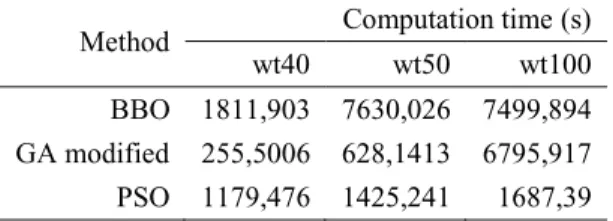
Tabel 2. Result of computing time BBO, GA modified and PSO
Method Computation time (s)
wt40 wt50 wt100
BBO 1811,903 7630,026 7499,894
GA modified 255,5006 628,1413 6795,917
PSO 1179,476 1425,241 1687,39
From computational experiment ,we see that BBO perfomance close to those of modified GA specially for smaller cases such as wt40 and wt50. Both algorithms solve all the problems optimally.. Yet, BBO only able to solve 7 from 25 cases of wt100, while GA result is better by able to solve 17 from 25 cases of wt100. The diffrence result is quite significance from BBA and GA modification, PSO algorithm which using random numbers as its particle element only able reaching optimal number of 8 for wt40, 7 for wt50 and 4 for wt100. Computational
example for PSO algorithm is conducted with iteration and designed number of particles so that convergance happened which there is no solution improvement eventough the number of iterations added.
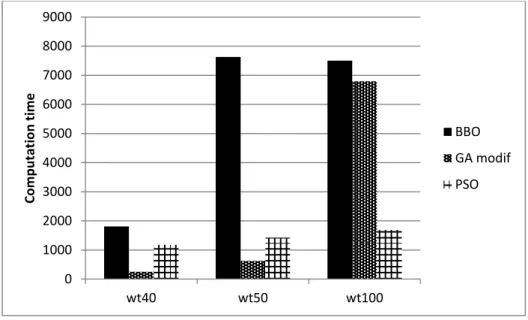
From the point of computional time, BBO need longer time compared with GA modification for obtaining optimal number. While time needed by PSO for obtaining convergence is shorter compared time needed by BBO alogartihm. In Fig. 2 as follows shows comparation graphic of computation time for BBO.
Fig. 2. Computation time comparison graphic BBO-GA modification
6. Conclusion
This paper investigated how BBO algorithm can be used to solve SMTWTP. From computational experiment, it can be concluded that BBO algorithm has a promising performance which able to solve 57 cases optimally out of 75 cases. Comparison was done with PSO and modified GA. BBO performance is better than PSO. PSO is only able to solve 19 cases out of 75 cases. But it is still worse than modified GA. The results of BBO is underperformed modified GA which able to solve 67 cases out of of 75 cases. Some modification might be applied to BBO in terms of mutation procedure or hybridized with other algorithms such that the performance will improve.
Acknowledgement
This research funding was supported by Directorate General of Higher Education of Indonesia.
Reference
[1] K.R. Baker, Introduction to Sequencing and Scheduling. John Wiley & Sons, Inc., New Jersey, 1974. [2] M. Pinedo, Scheduling Theory, Algorithms, and Systems, second edition. Prentice Hall. New Jersey, 2002. [3] K.R. Baker, D. Trietsch,Principles of Sequencing and Scheduling. John Wiley & Sons, Inc., New Jersey, 2009.
[4] Cheng, T.C.E, J.J. Yuan, Z.H. Liu, Single Machine Scheduling to Minimize Total Weighted Tardiness. European Journal of Operational Research, Volume 165, Issue 2, 1 September, 2005, Pages 423-443.
[5] W. Guohua, P. Benjamin, C. Yen, Tabu Search for Single Machine Scheduling with Distinct Due Windows and Weighted Earliness/Tardiness Penalties. European Journal of Operational Research, Volume 142, Issue 2, 16 October, 2002, Pages 271-281
[6] D. Simon, Biogeography-based Optimization. IEEE Transactions on Evolutionary Computation, vol. 12, no. 6, 2008. [7] J.R. Huggett, Fundamentals of Biogeography, second edition. Rouledge. Milton Park, Abingdon, 2004.
[8] B. Santosa, P. Willy, Metoda Metaheuristik Konsep dan Implementasi. Surabaya, Guna Widya, 2001. 0 1000 2000 3000 4000 5000 6000 7000 8000 9000 wt40 wt50 wt100 Computati o n time BBO GA modif PSO
![Fig. 1. Illustration of two candidate solutions to some problem [6]](https://thumb-us.123doks.com/thumbv2/123dok_us/896265.2615271/3.816.277.534.521.753/fig-illustration-candidate-solutions-problem.webp)