
Soft Computing Technique Based Economic
Load Dispatch Using Biogeography-Based
Optimization Algorithm
Narottam dutt upadhyay
1, Rameshwar singh
2P.G. Student, Department of electrical Engineering, NITM Engineering College, Gwalior, Madhya Pradesh , India1 Asst. Professor, Department of electrical Engineering, NITM Engineering College, Gwalior, Madhya Pradesh , India2
ABSTRACT:This paper presents a biogeography-based optimization (BBO) algorithm to solve both convex and
non-convex economic load dispatch (ELD) problems of thermal plants. Lack of exploration capability of biogeography-based optimization (BBO) leads to slow convergence. The proposed methodology can take care of economic dispatch problems involving constraints such as transmission losses, valve point loading, multi-fuel options and prohibited operating zones. Biogeography is the study of the geographical distribution of biological organisms. Mathematical equations that govern the distribution of organisms were first discovered and developed during the 1960s. The mindset of the engineer is that we can learn from nature. This motivates the application of biogeography to optimization problems; the BBO is based on two steps mutation and migration. The purpose of this work is to find out the advantages of application of the soft computing technique and BBO in particular to the economic load dispatch problem.
KEYWORDS: — Biogeography-Based Optimization (BBO), Economic Load Dispatch (ELD), Valve-Point Effect,
PSO..
I. INTRODUCTION
this paper a newly developed Biogeography based optimization (BBO) algorithm has been applied to the ELD problems. The BBO algorithm was developed by D. Simon in the year 2008 from the theory of Biogeography as its base [8].To show the effectiveness of the BBO, the BBO algorithm has been applied to without Valve-Point Effects and with Valve-Point Effects and comprising of three generating units .The results of BBO are compared with the PSO and its variants method and it has been found that the BBO algorithm shows superior performance.
II. ECONOMIC LOAD DISPATCH (ELD)
The objective of an ELD problem is to find the optimal combination of power generations that minimizes the total generation cost while satisfying equality and inequality constraints [9]. The fuel cost curve for any unit is assumed to be approximated by segments of quadratic functions of the active power output of the generator. For a given power system network, the problem may be described as optimization (minimization) of total fuel cost as defined by (1) under a set of operating constraints.
A. ELD Problem without Valve-Point Effects
𝐹𝑇= 𝑛𝑖=1 𝐹 (𝑃)𝑖= 𝑛𝑖=1 𝑎𝑖𝑃𝑖2+ 𝑏𝑖𝑃𝑖 + 𝑐𝑖 …….(1)
Where is FT total fuel cost of generation in the system ($/hr), ai, bi, and ci are the cost coefficient of the i th generator,
Pi is the power generated by the i th unit and n is the number of generators.
The objective of ELD is to minimize the overall cost of generation. Power balance constraint The total generation cost is minimized subjected to the following constraints
Power balance constraint
𝑃𝑖,𝑚𝑖𝑛 ≤ 𝑃𝑖 ≤ 𝑃𝑖,𝑚𝑎𝑥 for i=1,2,…n (2)
Generation capacity constraint
𝑃𝐷 = 𝑛
𝑖=1
𝑃𝑖− 𝑃𝐿𝑜𝑠𝑠… … … (3)
where Pi, min and Pi, max are the minimum and maximum power output of the i th unit, respectively. PD is the total load demand and PLossis total transmission losses. The transmission losses PLosscan be calculated by using B matrix
technique and is defined by (4) as,
where Bij is coefficient of transmission losses.
B. ELD Problem Considering Valve-Point Effects
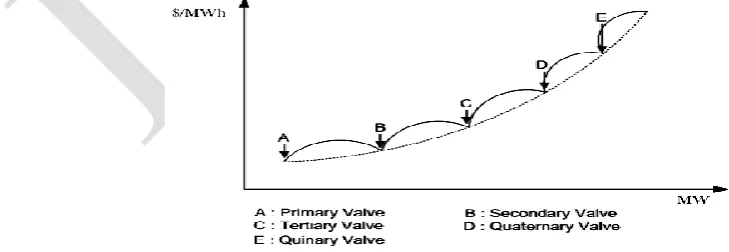
The generating units with multi-valve steam turbines exhibit a greater variation in the fuel-cost functions [15]. The valve opening process of multi-valve steam turbines produces a ripple-like effect in the heat rate curve of the generators.
These ―valve-point effects are illustrated in Fig. 1. The significance of this effect is that the actual cost curve function of a large steam plant is not continuous but more important it is non-linear.
The valve-point effects are taken into consideration in the ELD problem by superimposing the basic quadratic fuel-cost characteristics with the rectified sinusoid component as follows:
𝐹 Pi = min aiPi 2+ b
iPi+ ci+ ei× Sin fi× Pimin − Pi
N
i=1
(5)
where Fp(i)is total fuel cost of generation in ($/hr) including valve point loading, ei, fi are fuel cost coefficients of the i
th generating unit reflecting valve-point effects.
III. OVERVIEW OF BIOGEOGRAPHY-BASED OPTIMIZATION ALGORITHM (BBO)
TECHNIQUE
The Biogeography-based optimization algorithm [12] has been developed from the theory of Biogeography as its base. Biogeography is the study of the geographical distribution of biological organisms. Mathematical models of biogeography describe how the biological organisms or species, to be more specific, migrate from one island to another, how new species arise, and how these species become extinct. An island can be defined as any habitat that is geographically isolated from other habitats. The concept of BBO is based on the migration and mutation operations. The concept and mathematical formulation of the migration and mutation operations are briefed below:
A. Migration
In BBO, the migration operation refers to the process of either entering or leaving of the species into or from an island. Like PSO and other population based search techniques, BBO also uses a population of candidate solutions for optimization purpose. Representation of each candidate solution is done as a vector of real numbers. Here each real number in the population is considered as one suitability index variable (SIV). In ED problem, these SIVs are analogous to the power output of the generators. The SIVs in one array are used to calculate the habitat suitability index (HSI) of a habitat. The HSI is analogous to the objective function as used in other techniques. In ED problem, the HSI is analogous to the generation cost of a generator. Solutions with high HSI represent a superior solution whereas solutions with low HSI represent an inferior solution. The process of species entering a habitat is known as immigration whereas the process of leaving a habitat is known as emigration. The immigration rate, λ and the emigration rate, μ of each habitat is used to probabilistically share information with other habitats/solutions. Each solution is modified according to probability 𝑃𝑚𝑜𝑑𝑖𝑓𝑦, known as the habitat modification probability, based on other solutions. If a particular habitat is selected for modification, then its λ is used to probabilistically decide whether or not to modify each SIV of that habitat. If a particular SIV in a given habitat is selected for modification, then μ of other habitats are used to probabilistically decide which of the habitats should migrate a randomly selected SIV from those habitats to that particular habitat. Unlike other AI techniques where the recombination process is used to generate a completely new solution, the migration operation in BBO is used to bring changes within an existing solution. In order to prevent the best solutions from being changed by the migration process, few elite solutions are kept the same in the consequent iterations. Immigration and emigration rate for habitat containing 𝑛 species is given as
𝜆𝑛 = I (1 - 𝑛
𝑁 ) (5)
μn= E n N
(6)
I, E: the maximum immigration and emigration rates respectively
N: maximum number of species that a habitat can contain
B. Mutation
If some disastrous events happen, the HSI of a habitat can change drastically resulting in the species count to differ from its equilibrium value. In BBO this process is modeled as SIV mutation and the mutation rates of the habitats can be calculated using the species count probabilities given below Sudden changes in climate of one habitat or other incidents will cause the sudden changes in HSI of that habitat. In BBO algorithm, this situation can be model in the form of sudden changes in value of SIV. The probability of any organism can be calculated by the following equation.
PS=
−(𝜆𝑆 − μS)PS μS−1PS−1
− 𝜆𝑆− 𝜇𝑆 𝑃𝑆𝜇𝑆−1𝑃𝑆−1
− 𝜆𝑆− 𝜇𝑆 𝑃𝑆𝜇𝑆−1𝑃𝑆−1
Each member of one habitat has its own probability. If this probability is too low, then this solution has high chance to mutate. In the same manner, if probability of a solution is high that solution has a little chance to mutate. Consequently, solutions with high HSI and low HSI have a little chance to development a better SIV in the next iteration. Unlike high HSI and low HSI solutions, medium HSI solutions have a greater chance to development better solutions after mutation procedure.
In the following equation mutation rate of each solution can be calculated.
m (s) = mmax
1−Ps
Pmax (8)
Where,
m(s) : the mutation rate for habitat containing exactly s species
𝑃max : Largest of all the 𝑃s values
This kind of mutation is inclined to increase diversity between solutions. At this stage, there is also a elitism to prevent the answers from getting worse after mutation procedure. In this case, if a SIV is selected for mutation operation, one authorized random number is substituted.
C. Biogeography based Economic load dispatch algorithm
A new approach to implement the BBO algorithm will be described for solving the ELD problem. Especially, suggestion will be given on how to deal with the equality and inequality constraints of the ELD problems when modifying each individual’s search point in the BBO algorithm. The process of BBO algorithm can be explained as follows [8]- [11].
Step 1: Initialization of BBO parameters: Choose the number of generators i.e. number of SIVs, number of habitats i.e. population size, power demand, loss coefficients, habitat modification probability 𝑃𝑚𝑜𝑑𝑖𝑓𝑦 = 1, mutation probability = 0.1, maximum mutation rate 𝑚𝑚𝑎𝑥, maximum immigration rate I = 1, maximum emigration rate E = 1, step size for numerical integration dt = 1, elitism parameter = 2.
Step 2: Initialization of SIVs: Each SIV of a habitat is initialized randomly while satisfying the constraints of (3). Each habitat represents a potential solution to the given problem.
Step 3: Calculation of HSIs: HSI for each habitat is calculated for given immigration and emigration rates. HSI represents the fuel cost of the generators.
Step 4: Identification of elite habitats: Based on the HSI values, elite habitats are identified i.e. those habitats for which the fuel cost is minimum, are selected.
Step 5: Performing migration operation: For each of the non-elite habitats, migration operation is performed. HSI for each habitat is recomputed. SIVs obtained after migration must satisfy the constraints of (3).
Step 6: Performing mutation operation: Species count probability of each habitat is updated using (7). Mutation operation is carried out on the non-elite habitats. HSI value of each new habitat set is recomputed.
Step 7: Stopping criterion: Go to step 3 for next iteration. If the predefined number of iterations is reached, stop the process.
IV.RESULTS AND ANALYSIS
The applicability and validity of the BBO algorithm for practical applications has been tested on various test cases. All the programs are developed using MATLAB 7.01 and the system configuration is Pentium IV processor with 3.2 GHz speed and 1 GB RAM
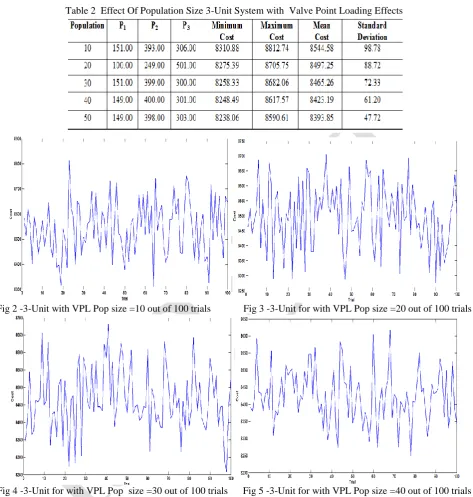
Case A - Effect of Population Size In 3-Generating Units with Valve Point Loading Effects
Table 2 Effect Of Population Size 3-Unit System with Valve Point Loading Effects
Fig 2 -3-Unit with VPL Pop size =10 out of 100 trials Fig 3 -3-Unit for with VPL Pop size =20 out of 100 trials
Fig 4 -3-Unit for with VPL Pop size =30 out of 100 trials Fig 5 -3-Unit for with VPL Pop size =40 out of 100 trials
Case B Effect of Population Size in 3-Generating Units without valve Point Loading Effects
Table 3 Effect Of Population Size 3-Unit System without valve Point Loading Effects
Fig 6-3-Unit for without VPL Pop size =10out of 100 trial Fig 7- 3-Unit for without VPL Pop size =20 out of 100trials
Fig8-3-Unit for without VPL Pop size =30 out of 100 trials Fig 9-3-Unit for without VPL Pop size =40 out of100 trails
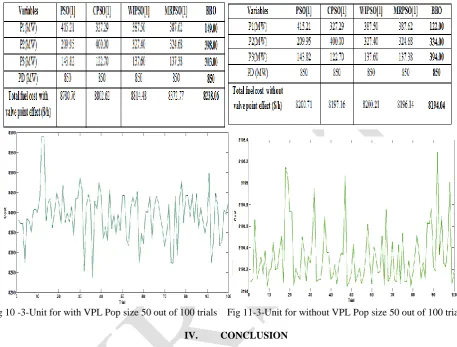
Case –C Comparison of Results for 3 unit system
Table 4 comparison result with valve point effect Table 5 comparison result without valve point effect
Fig 10 -3-Unit for with VPL Pop size 50 out of 100 trials Fig 11-3-Unit for without VPL Pop size 50 out of 100 trials
IV. CONCLUSION
APPENDIX
Table A1 generating unit with VPL effect [1] Table B1 generating unit without VPL effect [1]
REFRENCES
[1] Nagendra Singh1, Yogendra Kumar2,‖ Constrained Economic Load Dispatch Using Evolutionary Technique‖ Asian Journal of Technology &
Management Research [ISSN: 2249 –0892] Vol. 03 – Issue: 02 (Jul - Dec 2013).
[2] Aniruddha Bhattacharya, Member, IEEE, and Pranab Kumar Chattopadhyay, ―Biogeography-Based Optimization for Different Economic Load Dispatch Problems‖, Ieee Transactions On Power Systems, Vol. 25, No. 2, May 2010.
[3] N. Sinha, R. Chakrabarti and P. K. Chattopadhyay. Evolutionary Programming Techniques for Economic Load Dispatch, IEEE Trans. Evolutionary Computation, 2003, 7(1): 83-94.
[4] J. B. Park, K. S. Lee, J. R. Shin and K. Y. Lee. A Particle Swarm Optimization for Economic Dispatch with Non-Smooth Cost Functions, IEEE Trans. Power Systems, 2005, 20(1): 34-42.
[5] C. L. Chiang. Improved Genetic Algorithm for Power Economic Dispatch of Units with Valve-Point Effects and Multiple Fuels, IEEE Trans. Power Systems, 2005, 20(4): 1690-1699.
[6 ]W. M. Lin, F. S. Cheng and M. T. Tsay. An Improved Tabu Search for Economic Dispatch with Multiple Minima, IEEE Trans. Power Systems, 2002, 17(1): 108-112.
[7] Ali Nazari1, Amin Hadidi2*, ―Biogeography Based Optimization Algorithm for Economic Load Dispatch of Power System‖ AMERICAN JOURNAL OF ADVANCED SCIENTIFIC RESEARCH Ali Nazari and Amin Hadidi, Vol. 1, Issue. 3, pp. 99-105, 2012.
[8] Bhuvnesh Khokhar, K. P. Singh Parmar, SurenderDahiya, ―Application of Biogeography-based Optimization for Economic Dispatch Problems‖, International Journal of Computer Applications (0975 – 888), Volume 47– No.13, June 2012.
[9] Hardiansyah, ―A Modified Particle Swarm Optimization Technique for
Economic Load Dispatch with Valve-Point Effect‖ , I.J. Intelligent Systems and Applications, 2013, 07, 32-41 Published Online June 2013 in MECS DOI:10.5815/ijisa.2013.07.05.
[10] Hadi Sadat, Power System Analysis, Tata McGraw Hill, "Economic Dispatch Neglecting losses and including Generator limits, pg. no. 277, International Edition,1999.
[11] Jyoti Jain1, Rameshwar Singh2, ―Biogeography-Based Optimization Algorithm for Load Dispatch in Power System‖, International Journal of
Emerging Technology and Advanced Engineering Website: www.ijetae.com (ISSN 2250-2459, ISO 9001:2008 Certified Journal, Volume 3, Issue 7, July 2013)
![Table A1 generating unit with VPL effect [1] Table B1 generating unit without VPL effect [1]](https://thumb-us.123doks.com/thumbv2/123dok_us/1688009.1213228/8.595.66.532.198.353/table-generating-unit-vpl-effect-table-generating-effect.webp)
