1
Abstract—Decision making for sustainable manufacturing design and management requires critical considerations due to the complexity and partly conflicting issues of economic, social and environmental factors. Although there are tools capable of assessing the combination of one or two of the sustainability factors, the frameworks have not adequately integrated all the three factors. Case study and review of existing simulation applications also shows the approach lacks integration of the sustainability factors. In this paper we discussed the development of a simulation based framework for support of a holistic assessment of sustainable manufacturing design and management. To achieve this, a strategic approach is introduced to investigate the strengths and weaknesses of the existing decision supporting tools. Investigation reveals that Discrete Event Simulation (DES) can serve as a rock base for other Life Cycle Analysis frameworks. Simio-DES application optimizes system for both economic and competitive advantage, Granta CES EduPack and SimaPro collate data for M aterial Flow Analysis and environmental Life Cycle Assessment while social and stakeholders’ analysis is supported by Analytical Hierarchy Process, a M ulti-Criteria Decision Analysis method. Such a common and integrated framework creates platform for companies to build a computer simulation model of a real system and assess the impact of alternative solutions before implementing a chosen solution.
Keywords: Discrete Event Simulation, Life Cycle Sustainability Analysis, M anufacturing, Sustainability
I. I
INT RODUCT ION
HE global society is becoming more conscious of the degrading environment and the resulting global warming, increasing sea level, and uncontrollable disasters including the recent heat-wave in India [1]-[3]. Thus; stricter regulations and policies are driving many industries into eco-efficient or eco-innovation [4]-[6]. The global challenge today however, has been posited to be environmental, social and economics [7], [8];For example; the main cause of global warming has been attributed to the over consumption of energy and materials such as coal, fossil oil, water and natural gas es [9].For instance, the greenhouse effect which is due to emission of gases caused by industries and human activities has resulted into a temperature rise by over 0.6 degrees in the last 10 years [5]. Most of these contributions to unsustainable environment occur during company’s supply chain and distribution of products and services to the consumer [9]. Few
Mijoh A. Gbededo, Kapila Liyanage, Ilias Oraifige are with the College of Engineering and T echnology, University of Derby, United Kingdom (e-mail: [email protected], [email protected], [email protected]).
industries have resulted to the use of tools such as Eco -efficient and eco-innovation to transform from unsustainable development to one of sustainable development [10]. Business decision making and strategy formulation are anchored on either of these tools for products or services Lifecycle Assessment (LCA) and in response to the international regulations such as ISO 14040.
Strategic decision making for effective manufacturing development thus becomes a more complex task [11], with additional multiple criteria and variables to be considered simultaneously in order to achieve both competitive and sustainable development. Widok and
Wohlgemuth [12] defined sustainability in a capital
based approach as “the agglomeration of actions/campaigns/processes that have a positive effect on the regeneration of social, environmental and/or economical capital on the one hand, and/or reduce the degradation of this capital on the other”. In 1987, The United Nations General Assembly defined sustainable development as “development that meets the needs of the present without compromising the ability of future generations to meet their own needs” In 2005, it also quoted and agreed amongst many researchers that the three main components of sustainable development are economic development, social development and environmental protection [8], [12]-[14]. There are however various assessment tools adopted by industries to assess the impacts of each of this sustainable aspects such as Life Cycle Costing (LCC), Social Life Cycle Assessment (SLCA) and Environment Life Cycle Assessment (LCA) [15]. Many researchers have proposed the use of LCA in parallel with performance optimization tools such as lean manufacturing, value stream mapping, simulation, Activity Based Costing, and Decision Making Trial and Evaluation Laboratory [16], [17]. According to[8], the main world challenge is the integration of the economic, environmental and social features of the life cycle of a product. The author further stated that many companies claim activity towards sustainability at the strategic and operational levels, however, it appears that the frameworks used to support these activities are out of balance, being economically oriented and do not effectively account for environmental or acknowledge the social issues [1],
[12], [18]. There is therefore the need for a robust
sustainability evaluation process that enhances effective decision making.
In the past decades, s imulation has provided solutions to many challenges of high cost of experimenting with real life situation. It provides opportunity for testing
Mijoh A. Gbededo, Kapila Liyanage, Ilias Oraifige
Simulation Aided Life Cycle Sustainability
Assessment (LCSA) Framework for Manufacturing
Design and Management
different approaches and varying indicator compositions to enhance process flow and achieve potential desired measure before a real life application [12], [19]. Discrete Event Simulation (DES) has been used in manufacturing for optimization of processes and resource usage. In recent years, we experienced various efforts of developer to use DES to achieve sustainable manufacturing. The application of integrated Discrete Event Simulation with LCA (DES-LCA) or DES with Material Flow Analysis as in MILAN software [19] promises to resolve environmental and economic factors leaving behind consideration for social factors. This issue is common with many other integrated simulation software due to the difficulty to adequately incorporate all the three sustainability factors, most especially the social aspects into software [19], [20]. The social indicators are however relatively vast and interdependent on other sustainable factors thus resulting in ineffective sustainability decision making despite effective assessment of other indicators. According to [14], there is need for further innovative research and development in the area of Life Cycle Sustainability Assessment (LCSA) to address corporate policy and decision making. LCSA is a proposed integrated framework by researchers to balance and enable assessment and trade-off of the three factors for an effective sustainability decision-making process [12], [14]. It has been posited that the main challenge of designing and managing a s ustainable manufacturing system is the complexity of interdependent factors and variables to be handled simultaneously [18], [20]. This research therefore proposed a simulation aided decision making analytical tool for holistic assessment of sustainable manufacturing design and management. The tool will enhance DES-LCA by incorporating MCDA for analyses of stakeholders’ and other social interests to enable integrated decision making support method for sustainable manufacturing design and management. As this research is still work in progress, this paper does not aim to present a conclusive approach or methodology; rather, it presents a progressive step towards the development of a holistic analytical LCSA tool.
II. L
LIFE CYCLE ASSESSMENT (LCA) AND LIFE CYCLE SUST AINABILIT Y ASSESSMENT (LCSA)
The concept of life cycle approach to prod ucts and services design and its relevance towards achieving a sustainable production and consumption is widely discussed by many researchers. There are currently many frameworks, methodologies, methods, models, and tools that are now available and support ed by various policies and regulations for sustainability assessment [14]. The sustainability factors (Economic, Social and Environment) are however, being addressed separately under three subject areas: Life Cycle Costing (LCC), Social Life Cycle Assessment (SLCA) and Environmental Life Cycle Assessment (LCA) [15],
[21]. The latter which is hereafter referred to as LCA is
the most widely discussed [22] with the perspective of some authors that it also incorporates analysis that addresses economic and social sustainability, while
some researchers argued that there is need to develop an integrated life cycle assessment system in order to confront sustainability issues [22]-[26].LCA provides the elements to assess the environmental impacts (waste and emission) of a product throughout its life-span. The ISO 14000 is a process -based LCA, and ISO 14001 of 2004 defined its environmental feature as elements and activities that are capable of interacting with the environment [27]. According to [24], there are other LCA methods for example, “ecologically based LCA (Eco-LCA) assesses the ecosystems such as water, minerals, and carbon sequestration, Economic Input-Output LCA model is used to assess and understand environmental impact of materials flow within eco-economic systems such as Physical Input Monetary Output, and Materials Flow Analysis models ”. In addition to LCA methodology objective to assess environmental indicators, it is also possible to use LCA to capture life cycle inventory and import the result into a model for process optimization [25]. Conversely, the challenge with the use of LCA are the difficulty to capture and measure the environmental aspects across a product life cycle, unavailability of life cycle data of a product under design, and lack of standardized weighting methods [14], [27], [38]. Groover [28]
viewed this challenge under manufacturing process as a complex supply chain infrastructure consists of various phases and categories of suppliers, processes, and components of which their full existence might not be comprehended by the end consumer. Environmental LCA is therefore streamlined and interpreted to equivalent high level factors termed Environmental Impact. The Environmental Impact Assessment (EIA) tools such as Ecotax, Ecovalue08, Eco-Indicator95, Eco-Indicator99, Recipe [29], LC-Impact, LIME, and Impact 2002+ have been widely discussed and analysed. As in [30], the assessment of economic performances of a manufacturing process is in its matured state, this is due to the application of information technology which provides the necessary support for manufacturers to easily collate key performance indicators in order to assess its economic performances. However, assessment of the environmental and social performances is an ongoing challenge. In the past, through the industrial evolution and development, economic performances are in adversarial relationship to both the environment and the society. Thus, by incorporating environmental and social factors into product design while maintaining a competitive position with economic growth requires level of compromises and trade-offs. Halog and Manik [24] identified some indicators for SLCA to be considered during product sustainability assessment. These include: Health and safety, quality of working conditions, impact on employment, education and training, knowledge management, innovative potential, customer acceptance, societal product benefit, and social dialogue.
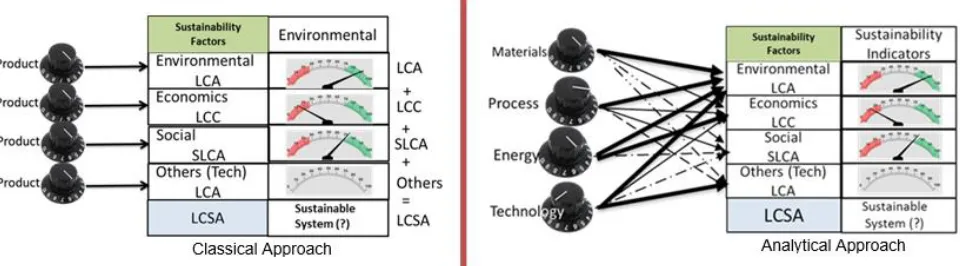
Initiative, have published a framework to support the development of holistic LCSA [14], [22], [31]. The framework provides the platform for scientist from various fields to discuss sustainability subject with a holistic life cycle perspective. Though the initial idea to combine LCA, LCC, and SLCA methodologies into a framework was first postulated by Klöpffer [32], the holistic view of LCSA framework refers to the evaluation of the social, economic and environmental impact and benefit of a product or service throughout its life span. Valdivia, et al. [22] posited that it is possible to combine LCA, LCC and SLCA to develop a holistic sustainability evaluation tool however; the authors stressed that the results of the evaluation should not be add up as portrayed in classical discipline approach to LCSA model but rather be jointly analysed (Fig. 1.). The field of analytical science or computation science thus becomes apparent in the development of LCSA.
Valdivia, et al. [22] further states that combining the
three methodologies into LCSA have the potential benefits which include cost and risk reduction,
consistency in reporting and effective engagement of the stakeholder. In the special review of [14], the authors discussed the state and direction of life cycle approach in the context of sustainability. The authors created an overview of the contribution of some key literatures in respect to the development of appropriate tools for LCSA framework. The authors noted that the enterprises’ behaviour of “ability to act on” [33], Life Cycle Thinking (LCT) which is an inherent nature of Sustainability Science (SS) [26] and Sustainability Analysis [34] are vital contributions toward framing a holistic LCSA tool. Parent, et al. [33] emphasized on the importance of LCT, LCA and SLCA in sustainable development and observed that SLCA is scarcely discussed under Statistical Process Control (SPC) and the social impact of products on consumer is hardly mentioned. Thus Corporate Social Responsibility (CSR) and their appropriate effort to act on social and customers’ demands are vital to sustainable development.
Fig.1 Example of Classical versus Analytical Approach to Life Cycle Sustainability Assessment (LSCA)
III. S
SUST AINABILIT Y SCIENCE (SS) AND LIFE CYCLE SUST AINABILIT Y ANALYSIS (LCSA)
In harmony with LCSA development, Sustainability Science (SS) has also been posited as a holistic approach to achieving sustainability [26]. This method approaches sustainability development from cultural, historic and institutional perspectives. According to
[26], its emergence compliments the inadequacies in
classical disciplines and s cience approach to the management of sustainability. Application of SS thus made it possible to “scientifically transcend reductionist analysis of classical science through system thinking approach to address sustainability factors within political and sustainability domain” [26]. One important feature of SS is that LCT and LCA are inherently embedded in it; these factors make it possible to explore dynamic activities and interactions between nature, human activities and the society in order to design a holistic sustainability framework [14], [26]. Guinée, et
al. [34] expressed the ideology of LCSA (Life Cycle
Sustainability Assessment) framework with a similar concept termed Life Cycle Sustainability Analysis (LCSA). This new framework better described the jointly analytical requirements of the combined LCA, LCC and SLCA methodologies. Sustainability Analysis
is core to SS and it interchangeably used with Sustainability Assessment in some literatures [14], [33]. According to the observation of [26], on the analysis of these two frameworks against SS criteria for addressing sustainability; the authors noted that, LCSA (Assessment) failed to consider the mutual interaction amongst the three sustainability pillars hence, devoid of holistic understanding of the s ystem under consideration however; LCSA (Analysis) framework overcame this inadequacy through an integrated approach. Sala, et al.
[26] also summarised the development of s ustainability
life cycle inventories in order to evaluate the sustainability indicators within the defined assessment boundary. Sala, et al. [26] highlights key sustainability development principles as "Precautionary principle; Irreversibility, Regeneration, Substitutability, Critical Loads/carrying capacity, Holistic approach, Polluter pays, Future generations, Good governance (subsidiarity, Proportionality and Public Participation)”. While there is full consideration for all the principles, our research is in particular, aimed to incorporate holistic approach and good governance into the proposed model. In our introduction we mentioned how DES will provide the necessary platform for integration and analysis of the three sustainability factors. DES is
widely accepted tool for evaluating and improving systems behaviour however, the existing commercially available DES does not include environmental and social factors in its modules.We are still evaluating the strengths of Simio-DES software to provide the capability of incorporating environmental and social factors nevertheless, we have viewed our approach as a step forward towards achieving the analytical requirements for a holistic sustainability development. MCDA is proposed for analysis of various stakeholders’ interest and to capture the social indicators, it will also provide the framework for interpreting the analysis results which involves value choices[14].
Fig.2 Simulation-Based Conceptual M odel for Life Cycle Sustainability Analysis (LCSA)
IV. S
SUST AINABILIT Y ASSESSMENT SCOPE AND BOUNDARIES
The challenge of having large data, and or lack of necessary data and information that cut across a product life cycle pose restriction in conducting an effective LCA. The system thinking approach to sustainability development involves understanding of the inter-dependences of the sustainability factors, the trade-off requirements amongst the sustainability pillars, and the occurrences of known or unknown desired or undesired consequences [14]. Guinée, et al. [34] have posited the need for comparative analysis of the options to avoid unintended negative consequences and to proactively optimise positive impacts in the aid of achieving sustainability objectives. The scope of the life cycle of a product under assessment could sometimes span combination of geographical coverage, time frame, activities, connecting mechanism, and Stakeholders or participating actors thus, making it complex to capture the required data. As in [14], the geographical scope of LCA can range from global to continental, country, regional, and up to the local scale.
In addition, under this scope, there could be geopolitical and regulatory implications. The complexity of this challenge is partly addressed by well accepted boundary classification such as "cradle to grave", "cradle to gate", "gate to gate", and "gate to grave". These strategic
boundaries’ definitions addresses and limit the extent of time coverage, activities involved and actors to be considered to a considerable and practicable scop e for assessment. Another challenge that associates with lack of data during sustainability assessment is the inability to influence top players in the supply chain [30]. Data identification and collection process could be overwhelming and having inefficient data can cause a serious delay and restriction during development of a simulation model [39]. It is therefore necessary to define to what extent an assessment can look outside the assessment domain for a particular product or service under design.
and abiotic resources, Environment; and Communities as: Culture, Groups, and Places. Examples of what to be developed under People as: Health, Life expectance, Education, Equity, Equal Opportunity, Security, Safety, Well-being; Economy as: Employment, Decent work, Dignity of workforce, desired consumption, Technology and transportation. Society as: Institutions, Social
Capital, States, and Regions ”. For this stage of the research, we proposed a strategic approach for the development of a simulation based impact analysis frameworks that support sustainable manufacturing decision making by defining and taking the following steps:
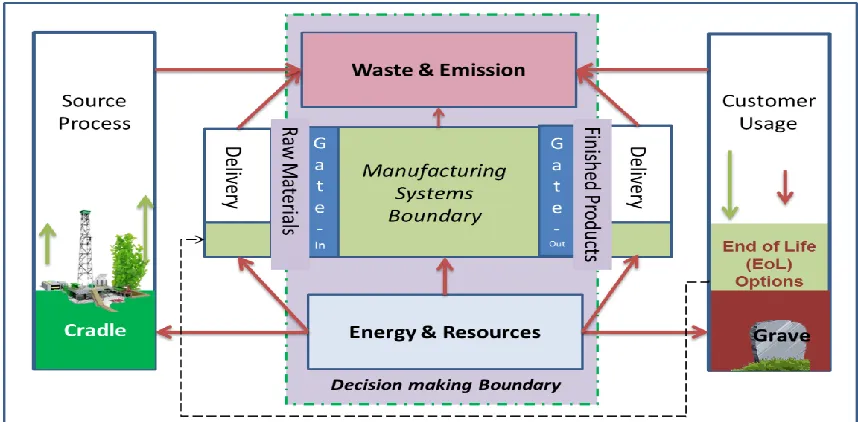
Fig. 3 Sustainable M anufacturing System Gate-to-Gate Boundary
V. P
PROPOSED FRAMEWORK FOR SUST AINABILIT Y ANALYSIS
Gate-to-Gate approach was mostly used when there was no factual or literature information to study [35] however, it has been repeatedly used recently in manufacturing process such as to study environmental impact of temperature change [25], [36]. Puettmann
and Wilson [37] also used gate-to-gate approach to
conduct a study of life-cycle inventory for the production of glued-laminated timbers. Jacquemin, et
al. [25] in their review of application fields dealing with
LCA, identified four researchers who used gate-to-gate approach in the last decade. In this research, we adopted gate approach as shown in Fig. 3. The gate-to-gate boundary definition limits the scope of decision and minimised the issues of LCA data. It is a progressive approach to achieve complete life cycle sustainability analysis of products or services. In our future research, we aimed to progress from gate-to-gate
to cradle-to-gate, gate-to-grave and cradle-to-grave. The cradle-to-grave will represent an all integrated analytical model that incorporates data from different stages of the product life cycle.
The definition of goal and scope is critical to
Fig.4 Integrated Framework for Sustainability Analysis
VI. C
CONCLUSION
Sustainability development has evolved from inefficient life cycle assessment of individual sustainability factors into a holistic, integrated analytic Life Cycle Sustainability Analysis (LCSA) that requires contributions from various fields of discipline including analytical and computational science. This research reviewed different challenges including scope and boundary definitions which often extend the data of a product life cycle beyond understanding of the end customer. We have proposed in this research a boundary strategy that could resolve the issues of unavailability of data that inhibit effective sustainability assessment. Further, the approach is to combine discrete event simulation with multi-criteria decision analysis tool to analyse various input data from both competitive and sustainability aspects within a defined boundary. The findings of this research will serve the basis for further work: it aims to model and gather discrete changes in the life cycle of a selected product and investigate the impact of the changes and the effects on decision making in a sustainable oriented manufacturing design. The outcome of the analysis would underpin the development of a simulation aided decision making tool for sustainability practitioners.
REFERENCES
[1] S. T akata, F. Kimura, F.V. Houten, E. Westkämper, M. Shpitalni, D. Ceglarek and J. Lee, “Maintenance: changing role in life cycle management” CIRP Annals - Manufacturing T echnology Volume 53, Issue 2, 2004, Pages 643 –655 [2] H. Anthony and M. Yosef, “ Advancing integrated systems
modelling framework for life cycle sustainability Assessment ”. Research Group for Industrial Ecology, LCA and Systems Sustainability (IELCASS), School of Forest Resources, University of Maine, Orono, ME 04469, USA”, 2011 3(2), 469-499; doi:10.3390/su3020469
[3] BBC News. “ India heat wave eases after nearly 1,700 deaths”. 29 May 2015 http://www.bbc.co.uk/news/world-asia-india-32926172 (Accessed 26/11/2015)
[4] WBCSD, “ Vision 2050: T he new agenda for businesses” World Business Council for Sustainable Development (WBCSD). (2010) http://www.wbcsd.org/vision2050.aspx
[5] E. Baroulaki and A. Veshagh, “ Eco-innovation and product design and innovation for the environment”. Proceedings of the 14th CIRP on life cycle Engineering, Waseda University, T okyo, Japan, June 11th-13th, 2007.
[6] J. Pekka, Korhonena, and L. Mikulas, “ Eco-efficiency analysis of power plants: an extension of data envelopment analysis”. European Journal of Operational Research: Volume 154, Issue 2, 16 April 2004, Pages 437–446
[7] F. Jovan, E. Westkamper and D. Williams, “ T he manu-future road: towards competitive and sustainable high-adding-value manufacturing”. 2009 ISBN 978-3-540-770114 Springer – Verlag Berlin Heidelberg
[8] I. Mastoris, “ T owards a framework of products life cycle sustainability assessment (LCSA)”. T he ESPRC Centre for Innovative Manufacturing in Industrial Sustainability Institute for Manufacturing, University of Cambridge 2011
[9] B. Willard, “ T he business case for sustainability”. International Student Energy Summit University of Calgary. June 13, 2009. www.sustainabilityadvantage.com
Isabell, S. Wolfgang and S. Silke, “ Eco-efficiency analysis by basf: the method”. T he International Journal of Life Cycle Assessment July 2002. Volume 7, Issue 4, pp 203 -218 [11] C. Jordi, “ Integrating sustainability in decision-making
processes: a modelling strategy” Computer Science Department University of T oronto T oronto, Canada 2012
[12] A.H. Widok and V. Wohlgemuth, “ Combining sustainability criteria with discrete event simulation”. Simulation Conference (WSC), Proceedings of the 2011 Winter. Pg 859 -870, 0891-7736
[13] S. Luong, K. Liu and J. Robey, “ Sustainability assessment framework for renewable energy t echnology”. Technologies for Sustainable Built Environment Centre. www.reading.ac.uk/web/FILES/tsbe/Luong_TSBE_Conference _Paper_2012.pdf (Accessed 26/11/2015)
[14] A. Zamagni, H. Pesonen and T. Swarr, “From LCA to life cycle sustainability assessm ent: concept, practice and future directions”. International Journal of Life Cycle Assessment (2013) 18:1637–1641 DOI 10.1007/s11367-013-0648-3 [15] L. Mitchell and Z. Radu, “ Life cycle cost and energy analysis of
a net zero energy house with solar combisystem”. Applied Energy. Volume 88, Issue 1, January 2011, Pages 232 –241 [16] Q. Deng, X. Liu and H. Liao, “ Identifying critical factors in the
eco-efficiency of remanufacturing based on the fuzzy DEMAT EL Method”. Open Access Sustainability (2015) ISSN 2071-1050 www.mdpi.com/journal/sustainability
[17] D. Sumrit and P. Anuntavoranich, “Using DEMAT EL method to analyze the causal relations on technological innovation capability evaluation factors in T hai technology-based firms”. 2013 International T ransaction Journal of Engineering, Management, & Applied Sciences & T echnologies. Vol. 4 No. 2 ISSN 2228-9860 eISSN 1906-9642
[18] A.N. Nambiar, “ Challenges in sustainable m anufacturing”. Proceedings of the 2010 International Conference on Industrial Engineering and Operations Management, Dhaka, Bangladesh, January 9-10, 2010
[19] A.H. Widok, L. Schiemann, P. Jahr and V. Wohlgemuth, “Achieving sustainability through a combination of LCA and DES integrated in a simulation software for production processes”. Proceedings of the 2012 Winter Simulation Conference
[20] J. Heilala, S. Vatanen, H. T onteri, J. Montonen, S. Lind, B. Johansson and J. Stahre, “Sim ulation-based sustainable m anufacturing system design”. Proceedings of the 2008 Winter Simulation Conference
[21] UNEP/SET AC, “ Life cycle initiative (2009) guidelines for social life cycle assessment of products”. ISBN: 978-92-807-3021-0. DT I/1164/PA
[22] S. Valdivia, C.M.L. Ugaya, J. Hildenbrand, M. T raverso, B. Mazijn, and G. Sonnemann, “ A UNEP/SET AC approach towards a life cycle sustainability assessment—our contribution to Rio+20; life cycle sustainability assessment: from LCA to LCSA”. Int ernational Journal Life Cycle Assessment (2013) 18:1673–1685 DOI 10.1007/s11367-012-0529-1. [23] R. Heijungs, G. Huppes and J. Guinee, “ Life cycle assessment
and sustainability analysis of product s, materials and technologies: t oward a scientific framework for sustainability life cycle analysis”. Polym. Degrad. Stabil. 2010, 95, 422-428. [24] A. Halog and Y. Manik, “ Advancing integrated systems modelling framework for life cycle sustainability assessment ”. Open Access Sustainability 2011, 3, 469-499; doi:10.3390/su3020469. www.mdpi.com/journal/sustainability [25] L. Jacquemin, P.Y. Pontalier and C. Sablayrolles, “ Life cycle assessment (LCA) applied to the process industry: a review”. International Journal of Life Cycle Assessment, Springer Verlag, 2012, vol. 17, pp. 1028-1041. <10.1007/s11367-012-0432-9>. <hal-00741389>
[26] S. Sala, F. Farioli and A. Zamagni, “ Progress in sustainability science: lessons learnt from current methodologies for sustainability assessment (Part I)”. Int Journal of Life Cycle Assess (2013a) 18:1653–1672 DOI 10.1007/s11367-012-0508-6 [27] S. Aguadoa, R. Alvarez and R. Domingo, “ Model of efficient and sustainable improvements in a lean production system through processes of environmental innovation ”. Journal of Cleaner Production 47 (2013) 141-148.
[28] M.P. Groover, “ Fundamentals of modern manufacturing: materials, processes and systems”. 2010 Edition, Fourth Published by John Wiley & Sons Inc.
[29] M. Goedkoop, R. Heijungs, M. Huijbregts, A.D. Schryver, J. Struijs and R.V. Zelm, “ ReCiPe 2008 A life cycle impact
assessment method which comprises harmonised category indicators at the midpoint and the endpoint level First edition (version 1.08) Report I: Characterisation”. 2013 Publication of Ministerie van VROM Rijnstraat 8. 2515 XP Den Haag. www.vrom.nl
[30] A. Cataldo, M. T aisch, B. Stah, “ Modelling, simulation and evaluation of energy consumptions for a manuf acturing production line”. Industrial electronics society, IECON 2013 - 39th annual conference of the IEEE. Pg. 7537 - 7542 [31] UNEP/SET AC, “ Life cycle initiative 2011: Towards a life cycle
sustainabilit y assessment ”. ISBN No: 978-92-807-3175-0. DT I/1412/PA
[32] W. Klöpffer, “Life cycle sustainability assessment of products”. International journal of life cycle assessment 2008 13(2):89–95 [33] J. Parent , C. Cucuzzella and JP. Revéret, “Revisiting the role of LCA and SLCA in the transition towards sustainable production and consumption” .Int J Life Cycle Assess (2013) 18:1642–1652 doi:10.1007/s11367-012-0485-9.
[34] J.B. Guinée, R. Heijungs, G. Huppes, A. Zamagni, P. Masoni, R. Buonamici, T . Ekvall and T. Rydberg, “ Life cycle assessment: past, present, and future”. Environ Sci T echnol. 2011, 45:90–96. [35] C. Jiménez-Gonzalez, S. Kim and M.R. Overcash, “Methodology for developing gate-to-gate life cycle inventory information”. Int. Journal of LCA 5 (3) 153 - 159 (2000) [36] J.F. Portha, J.N. Jaubert, S. Louret and M.N.Pons, “ Life cycle
assessment applied to naphtha catalytic reforming”. Oil & Gas Science and T echnology – Rev. IFP Energies nouvelles, Vol. 65 (2010), No. 5, pp. 793-805
[37] M.E. Puettmann and J.B. Wilson, “ Gate-to-gate life-cycle inventory of glued-laminated t imber production”. Wood and Fiber Science, 37 Corrim Special Issue, 2005, pp. 99 – 113 [38] C.M.V.B. Almeida, A.J.M. Rodrigues, S.H, Bonilla and B.F.
Giannetti, “ Emergy as a tool for Ecodesign: evaluating materials selection for beverage packages in Brazil”. Journal of Cleaner Production 18 (2010) 32–43.