On the performance of
emerging wireless mesh networks
Jiva Nath Bagale
Sustainable Computing Research Group
School of Computing and Technology
University of West London
A thesis submitted in fulfilment of the requirements for the
degree of
Doctor of Philosophy
I would like to dedicate this thesis to my wife, beloved parents, brother and sweet daughter for their continuous inspiration, support and love. I am really thankful to my parents for helping me to get the best education possible and
Declaration
I, Jiva N. Bagale, hereby declare that except where specific reference is made to the work of others, the contents of this dissertation titled, ’On the perfor-mance of emerging wireless mesh network’, are original and have not been submitted in whole or in part for consideration for any other degree or qualifi-cation in this, or any other University. This dissertation is the result of my own work and includes nothing which is the outcome of work done in collaboration, except where specifically indicated in the text. This dissertation contains less than 40000 words including appendices, bibliography, footnotes, tables and equations.
Acknowledgements
Foremost, I would like to express my sincere gratitude to my supervisor Dr. John Moore for the continuous support during my Ph.D. study and research, for his motivation, inspiration, enthusiasm and knowledge. I could not have imagined having a better support and guidance for my study as the one I received from him.
My sincere thanks also goes to my fellow Ph.D colleagues Antonio D. Kheirkhahzadeh for stimulating discussions, for inspiring to never give up and for always being there for motivation. The journey has definitely been smoother with a colleague like you.
Abstract
Wireless networks are increasingly used within pervasive computing. The re-cent development of low-cost sensors coupled with the decline in prices of embedded hardware and improvements in low-power low-rate wireless net-works has made them ubiquitous. The sensors are becoming smaller and smarter enabling them to be embedded inside tiny hardware. They are al-ready being used in various areas such as health care, industrial automation and environment monitoring. Thus, the data to be communicated can include room temperature, heart beat, user’s activities or seismic events. Such net-works have been deployed in wide range areas and various levels of scale. The deployment can include only a couple of sensors inside human body or hundreds of sensors monitoring the environment.
The sensors are capable of generating a huge amount of information when data is sensed regularly. The information has to be communicated to a central node in the sensor network or to the Internet. The sensor may be connected directly to the central node but it may also be connected via other sensor nodes acting as intermediate routers/forwarders. The bandwidth of a typical wireless sensor network is already small and the use of forwarders to pass the data to the central node decreases the network capacity even further. Wireless networks consist of high packet loss ratio along with the low network bandwidth. The data transfer time from the sensor nodes to the central node increases with network size. Thus it becomes challenging to regularly com-municate the sensed data especially when the network grows in size. Due to this problem, it is very difficult to create a scalable sensor network which can regularly communicate sensor data.
x
before communication. However the data can be modified without losing any information using compression techniques and the processing power of em-bedded devices are improving to make it possible.
Contents
Contents xi
List of Figures xv
List of Tables xix
List of Listings xxi
Nomenclature xxiv
1 Introduction 1
1.1 Emerging wireless networks . . . 2
1.2 Motivation . . . 4
1.3 Research approach . . . 5
1.3.1 Research questions . . . 5
1.3.2 Aims . . . 7
1.3.3 Objectives . . . 7
1.3.4 Approach . . . 8
1.3.5 Methodology . . . 9
1.4 Contributions . . . 10
1.5 Published materials . . . 12
1.6 Organisation of the thesis . . . 13
2 Related Work 15 2.1 Low bandwidth wireless networks . . . 15
2.2 Messaging models . . . 20
2.3 Data compression in sensor networks . . . 25
2.4 Fingerprinting across IoT . . . 27
xii Contents
2.4.3 Testbed architecture . . . 29
2.4.4 Fingerprinting the network . . . 32
2.4.5 Summary of the testbed . . . 33
3 Messaging protocols suitable for embedded devices 37 3.1 Background . . . 37
3.2 Related work . . . 38
3.3 Protocols . . . 40
3.3.1 Spread . . . 40
3.3.2 ZeroMQ . . . 42
3.4 Results and analysis . . . 45
3.5 Summary . . . 48
4 Real-time data sharing system for mobile and embedded devices 49 4.1 Background . . . 50
4.2 Related work . . . 51
4.2.1 Structured data . . . 51
4.2.2 Packedobjects . . . 54
4.2.3 Publish/Subscribe messaging . . . 55
4.3 PackedobjectsD architecture . . . 60
4.3.1 XML Schema . . . 61
4.3.2 Mobile based product search system . . . 62
4.4 Experimental setup . . . 64
4.5 Results . . . 64
4.6 Discussions . . . 67
4.7 Summary . . . 70
5 Energy consumption trade-offs for schema-aware XML compres-sion 73 5.1 Background . . . 73
5.2 Related Work . . . 74
5.3 Experimental setup . . . 76
5.3.1 Device and Tools . . . 77
5.3.2 Methodology . . . 77
5.4 Results . . . 79
5.4.1 Compression levels and compression ratio . . . 80
5.4.2 Compression speed and data transfer . . . 83
Contents xiii
5.4.4 Energy cost of compression and data transfer . . . 86
5.5 Summary . . . 88
6 Estimating TCP throughput for 6LoWPAN network using a mathe-matical model 89 6.1 Background . . . 89
6.2 6LoWPAN and IPV6 . . . 89
6.3 6LoWPAN header compression . . . 91
6.4 TCP throughput estimation on 6LoWPAN networks . . . 92
6.5 Calculations and results . . . 96
6.6 Summary . . . 101
7 Conclusions 103 7.1 Summary of the Thesis . . . 103
7.2 Technical contributions . . . 105
7.3 Limitations . . . 107
7.4 Future Work . . . 107
References 109 Appendix A Messaging Protocols 119 Appendix B PackedobjectsD 121 B.1 XML and Schema for product search system . . . 121
List of Figures
2.1 6LoWPAN frame format . . . 18
2.2 Point to point messaging with request-reply . . . 20
2.3 Asynchronous point-to-point with fire and forget . . . 21
2.4 Asynchronous point-to-point with queue in queue out . . . 21
2.5 RPC messaging model . . . 22
2.6 DSM messaging model . . . 23
2.7 Simple object-based publish/subscribe model . . . 24
2.8 Space, time and synchronisation decoupling with pub/sub . . . 25
2.9 Queuing model . . . 31
2.10 Ben Nanonotes and 6LoWPAN . . . 32
2.11 Insignificant fingerprint . . . 32
2.12 Undetermined fingerprint . . . 32
2.13 Right-skewed fingerprint . . . 33
2.14 Left-skewed fingerprint . . . 33
2.15 Sensor data decode performance across embedded devices and PC . . . 34
3.1 One Spread daemon for each client . . . 41
3.2 One Spread daemon for all clients . . . 42
3.3 Request reply model . . . 43
3.4 Parallel task distribution model . . . 43
3.5 Publish subscribe model . . . 44
3.6 Broker based publish subscribe model . . . 46
3.7 Spread message structure . . . 47
3.8 ZeroMQ message structure . . . 48
4.1 Data size comparison . . . 53
4.2 Simple Pub/Sub system . . . 56
xvi List of Figures
4.4 Total connections comparison . . . 57
4.5 PoD authentication server . . . 58
4.6 Architecture . . . 60
4.7 Searcher nodes . . . 63
4.8 Responder nodes . . . 63
4.9 Encode data size comparison . . . 65
4.10 PO encode CPU time . . . 66
4.11 Libxml2 encode CPU time . . . 66
4.12 PO encode and data transfer time . . . 67
4.13 Libxml2 encode and data transfer time . . . 67
4.14 PO Decode CPU time . . . 68
4.15 Libxml2 Decode CPU time . . . 68
4.16 Transfer time comparison for various network bandwidths . . . 69
5.1 Odroid smart power measurement tool . . . 77
5.2 Compression ratio comparison for different compression levels in ZLIB . . . 80
5.3 Compression ratio comparison for different compression op-tions in EXI . . . 81
5.4 Compression speed comparison for different compression lev-els in ZLIB . . . 81
5.5 Compression speed comparison for different compression op-tions in EXI . . . 82
5.6 Compression ratio comparison for various compression tech-niques . . . 82
5.7 Data encode and network transfer time for PO . . . 83
5.8 Data encode and network transfer time for LIBXML2 . . . 84
5.9 Data encode and network transfer time for ZLIB . . . 84
5.10 Data encode and network transfer time for EXI . . . 85
5.11 Overall compression and network transfer for all techniques . . 85
5.12 Memory consumption during compression for all techniques . . 86
5.13 Overall energy comparison for compressed and uncompressed data . . . 87
6.1 6LoWPAN frame format . . . 90
List of Figures xvii
6.3 The ratio of throughput for 75B MSS to 512 B MSS (BER=3
x10−4,α=10−1) . . . 98
6.4 Time taken to transfer 100 bits data with 75B and 512B MSS (BER=3 x10⁻⁴,α =10−1) . . . 99
6.5 Overall time comparison for compression and network transfer for average XML files . . . 99
6.6 Overall energy consumption comparison between PO and Libxml2 for various number of hops . . . 100
A.1 Graphical representation of control data overhead as a function of number of messages . . . 119
A.2 Request reply model with broker . . . 120
B.1 Responder Encode data size comparison . . . 126
B.2 Responder Encode CPU time comparison . . . 126
B.3 Searcher Decode data size comparison . . . 127
List of Tables
2.1 Hardware specifications for devices compared for decode per-formance . . . 34 5.1 Test XML files, data types and compression ratio . . . 78 5.2 Average energy consumption for 1 second during compression
in Joules . . . 87 6.1 6LoWPAN frame headers without header compression (in bytes) 91 6.2 6LoWPAN frame headers with header compression (in bytes) . 91 6.3 List of parameters assumed for simplifying of calculation of
number of bits sent per TCP segment . . . 93 6.4 Default parameters used during the analytical calculations . . . 94 6.5 Expected number of bits sent for a single TCP segment . . . . 96 6.6 Average energy consumption for 1 second during compression
List of Listings
4.1 XML representation of sensor data . . . 52
4.2 JSON representation of sensor data . . . 52
4.3 Hexdump for compressed binary of XML data . . . 52
4.4 XML Schema for sensor XML data . . . 53
B.1 XML Schema for product search system . . . 121
B.2 XML database for product search system . . . 123
B.3 Query XML for product search system . . . 125
Nomenclature
Acronyms / Abbreviations
2G Second Generation 3G Third Generation 4G Fourth Generation
6LoWPAN IPv6 over Low power Wireless Personal Area Networks AES Advanced Encryption Scheme
ARQ Automatic repeat Request ASN.1 Abstract Syntax Notation One
CSMA-CA Carrier Sense Multiple Access - Collision Avoidance DSM Distributed Shared Memory
EEWS Earthquake early warning systems FEC Forward Error Correction
IEEE Institute of Electrical and Electronics Engineers IETF The Internet Engineering Task Force
IOT Internet of Things
IPv4 Internet Protocol Version 4 IPv6 Internet Protocol Version 6
xxiv Nomenclature
Kbps Kilo Bit Per Second
LLNs Low-power and Lossy Networks MAC Media Access Control
MEMS Micro-Electro-Mechanical Systems MSS Maximum Segment Size
MTU Maximum Transmission Unit OS Operating System
PO Packedobjects POD PackedobjectsD Pub/Sub Publish Subscribe RPC Remote Procedure Call RTT Round Trip Time
SensorML Sensor Modelling Language
SGML Standard Generalised Markup Language SNMP Simple Network Management Protocol URI Uniform Resource Identifier
Chapter 1
Introduction
Wireless networks have been around in different forms since the 1980s. They emerged in the form of wireless voice networks which is now commonly known as mobile networks. Wireless data networks started emerging in the 1990s in the form of second generation (2G) networks and have continued to evolve until today where third generation (3G) and fourth generation (4G) networks are about to overtake the data usage of fixed line broadband. Today, wireless networks have become even more ubiquitous and the gap between physical objects in human life and virtual world of Internet is becoming narrower than ever. The new wave of wireless sense and control is about connecting every-day objects to the virtual world in unprecedented manner. The phenomenon is referred to with different terms including Internet of Things,Body Area Net-works, Vehicular Area Networks or Wireless Personal Area Networks. All of them have sensing and wireless communication in common and are differ-ent forms of Wireless Sensor Networks. The aim is to automatically monitor, control and respond to various environmental events (weather, tsunami, hur-ricanes or forest fires), traffic, household utility equipment and more.
net-2 Introduction
work to a base station either directly or via a mesh network of similar sensors. The sensor nodes mostly rely on battery or solar power in order to operate on those difficult conditions. Thus, it is challenging to create wireless network to provide continuous data collection, processing and communication while operating on limited power resources.
Power limitation in wireless sensor networks is an ongoing research area and there have been various efforts to save power consumption in order to improve the life of the sensor nodes. The consumption has been reduced by efficiently managing the communication process (e.g. turning off radio when not in use). It is well known that network communication consumes significant energy resources in comparison to the device computation. Thus it is also beneficial to reduce the amount of data communicated over a network by processing it on the device. However the trade-off between the savings from data processing and data size reduction must be studied properly. If the data processing on the device is proved to be beneficial, it can minimise usage of the two of the most limited resources on the sensor network field, the power and the network bandwidth.
1.1
Emerging wireless networks
Wireless networks are becoming increasingly pervasive with the popularity of sensors to interact with its surroundings. The decline in price of embedded hardware and sensors has made their implementation affordable and thus more common. The development of open wireless networking standards suit-able for resource-constrained systems has also been important. And as a result, wireless networks are being deployed in a wide range of areas and different levels of scale. They have been deployed in very small scale and in extremely sensitive area such as human body to track patient’s heart beat, blood sugar level or blood pressure. They have also been deployed in large scale to monitor various environmental factors, industrial automation or infras-tructure conditions.
1.1 Emerging wireless networks 3
to the sink node when it has to be communicated via other sensor nodes. The data transfer speed which is already low decreases further with the increase in the number of hops the data has to pass. The wireless network bandwidth degrades with packet loss in the medium and packet collisions due to a large number of wireless nodes. Thus it becomes interesting to reduce the amount of data that needs to be communicated over the network to improve the trans-fer time. However the quality and integrity of the data must be preserved in the process.
A typical sensor node may provide some data processing along with the task of sensor data collection and communication. Also embedded hardware have been improving a lot recently in terms of processing power, lower power consumption and the ability to run embedded OS. A minimal OS which can be run on tiny embedded devices to create wireless sensor networks allows improving the data processing features so that the sensor data can be com-municated more efficiently. Sensor data are predictable in terms of data type and range and naturally consist of robust structure. This feature of the sensor data can be exploited to represent them in highly structured data formats such as JavaScript Object Notation (JSON) or Extensible Markup Language (XML). These data formats can be used for communication as well as for storage so that there is no need of additional database to store these data. It saves valu-able time normally spent during data format conversion while sending and receiving these data.
4 Introduction
the original data. It is challenging to achieve the perfect balance between data size reduction and spending the constrained resources of sensor networks in order to create a scalable data sharing system.
1.2
Motivation
This research is motivated by the potential of wireless sensor networks to be used for a wider range of scenarios to connect the physical world to the Inter-net and to use it to sense, control and monitor the surrounding environment, traffic or even human body. The information collected from these sensors can be very valuable to predict future environmental activities like hurricane or earthquake or to provide better health-care. The aim is to provide an efficient data sharing system which can be used to improve resource limitations of the wireless sensor networks and to enable to create low-cost large scale sensor systems.
1.3 Research approach 5
1.3
Research approach
Wireless sensor networks have become ubiquitous as a result of the increas-ing number of sensors coupled with a decline in the price of hardware. They are already used in a range of areas including environment monitoring, logis-tic tracking and health-care management. The embedded sensors regularly produce a range of information such as temperature, location or blood glu-cose level. However these devices consist of limited processing capabilities, memory and bandwidth and they require running on limited power for longer period of time. It is fairly simple to implement networks with few sensor nodes (less than 5) in order to collect and communicate sensor data. The sensor nodes are often connected directly to a base station, normally a more pow-erful device e.g. laptop or PC, over wireless networks. The sensor nodes do not need to perform any data processing as the network is relatively less congested and scalability is not an issue. However the devices may have to connect to one or more sensor nodes before communicating to the base sta-tion as soon as the number of devices increases. A typical wireless network normally operates in a short distance range restricting the possibility of con-necting all sensor nodes to a single base station. Thus, sensor nodes often form a mesh network where some sensor nodes act as intermediate relay router and one acts a bridge/gateway to connect to the base station.
The network congestion increases with the number of sensor nodes and the already limited network bandwidth is reduced even further. It becomes difficult to provide a real-time data communication system which can be de-ployed in a larger scale. However the sensor data can be processed on the device to reduce its size without losing the quality before communication. The data compression process reduces the network bandwidth usage but it also consumes some resources too, namely time and energy.
1.3.1
Research questions
6 Introduction
be managed carefully in order to lengthen the life of the network. In addition, the compression time may impact the overall energy consumption if it is big-ger than the actual data transfer time. Similarly the energy consumption for the compression process must not exceed the energy savings achieved from the bandwidth usage reduction.
Main question
“What are the impacts of using data compression before communi-cating sensor data in wireless mesh networks?”This question focuses on the overall impacts of using data compression on an embedded device before communicating the sensor data over wireless mesh network. It will be evaluated by combining the results of compression and network trans-fer time for compressed and uncompressed sensor data with the results of energy consumption during the data compression and transfer process.
Sub questions
How much time can be saved during network transfer by applying data compression on the device over a given bandwidth and what are the possible impacts of data type or size on the time saving? The data size reduction from compression is definitely beneficial if the network bandwidth usage is considered. However the compression time may be an issue de-pending upon its value as it can affect real-time transmission of data and also the respective energy consumption could be higher. The compressed data must always arrive faster than the uncompressed data and it will de-pend highly on the available bandwidth and processing capabilities of the sending device.
1.3 Research approach 7
1.3.2
Aims
The aims of this research work are to explore compression of highly struc-tured sensor data on embedded devices and its impact on the overall network performance and to evaluate the energy consumption trade-off between com-munication of compressed and uncompressed data on such networks.
1.3.3
Objectives
• Review existing wireless technologies suitable for networking embedded devices.
• Explore existing messaging protocols and their suitability for embedded devices.
• Develop a prototype testbed to determine the best protocol candidate. • Develop a light-weight data sharing system using the best messaging
protocol.
• Explore existing structured data compression techniques suitable for embedded devices.
• Conduct an experiment by transferring compressed and uncompressed structured data to evaluate the compression time, compression ratio and the throughput of the network.
• Conduct an experiment to measure/estimate energy consumption of data compression and network communication.
8 Introduction
1.3.4
Approach
The processing capabilities of embedded devices have been improving bet-ter than the network capacity and power requirements. Most wireless sensor networks are designed in such a way that sensor nodes send data to a sink node which does the first data filtering and processing (Tsiftes and Dunkels, 2011). The nodes do not perform any data filtering or processing so all the sensor data must always travel to the sink node. However this approach is changing with better processing and memory capabilities of the nodes cou-pled with demand for scalable networks. It is beneficial to process the data on individual node if the applications are interested in particular events (e.g. a noise above certain level) rather than unprocessed data (Taysi et al., 2010). Also the data collected from the sensors are mostly highly structured in nature and the nature of the data from a specific sensor is predictable. For example, a typical temperature sensor always generates data that is within a certain range and the structure is always same. Thus, it is beneficial to represent them in highly structured data format instead of treating them as plain text or a string. The data format is crucial for compression purpose because highly structured data can be compressed very efficiently than plain text data when compressed using meta-data (Moore et al., 2013).
1.3 Research approach 9
1.3.5
Methodology
The research methodology is based on the development of a light-weight data sharing model suitable for embedded devices with constrained resources which can enhance the overall performance of networks of such devices. Ini-tially messaging models and messaging protocols are evaluated for determin-ing the most suitable model and protocol capable of runndetermin-ing on embedded hardware and minimal OS. Experiments are carried out to study messaging protocols for their portability to embedded hardware/OS, control data over-head per application data and simplicity of implementation. The control data overhead is measured by analysing the TCP segments when communicated over network and separating the application and control data sizes. Control data are useful to provide extra information and to improve the messaging protocol design but it is interesting to minimise the overhead specially when the actual application data sizes are small and the network bandwidth is also small.
The research focuses on highly structured text data to present various sensor and configuration information. Sensor data in image and video format is not considered but the research could apply to configuration data from such sensor networks. The nature of sensor data is structured in nature as the data generated are mostly predictable and of similar type.
10 Introduction
1.4
Contributions
This research investigates the compression of data to be communicated over wireless mesh networks in embedded devices. The study of data compres-sion in sensor networks is not new and comprescompres-sion of text, image, sound and video data formats have been discussed. This research focuses on the study of sensor data in the form of highly structured text data and does not include other data formats such as image, sound and video. However the concept of compression of sensor data in highly structured text format with the use of its meta-data is relatively new. Such compression methods commonly re-ferred as schema-aware compression has been used in traditional networks for their efficient compression ratio. And they can be beneficial for reducing network bandwidth in sensor networks too. However the usage of extra re-sources required to achieve such compression on sensor network must be studied carefully to determine any possible side-affects. This research evalu-ates the trade-off of compression time and energy consumption between com-pressed and uncomcom-pressed structured sensor data communication over wire-less mesh networks in these devices. The result of the experiment with the testbed network is validated for scalability by using a mathematical model. All the software and the wireless testbed created during this research are made public as Open-Source software. The wireless testbed and the messaging framework can be reused by researchers to improve the research area. More specifically, the contributions of this thesis are:
1. The possibility and challenges of embedded devices to communicate data on a regular basis using wireless mesh network is studied. IP-based wireless networks are mainly focused where the devices can communicate directly to other devices on the Internet without using any intermediate network gateway. It is found that regular data communica-tion quickly becomes challenging as the network size grows, mainly due to the low bandwidth availability and high packet loss in such networks. 2. ZeroMQ and Spread messaging protocols are studied to analyse their
1.4 Contributions 11
control overhead is compared while communicating sample sensor data in a publish/subscribe model.
3. A light-weight data sharing system for communicating highly struc-tured dataon embedded devices is developed. Existing systems focus on communicating a sample of the data or communicating the data at a later time to adjust to the limited bandwidth availability. However the knowledge about the data can be used to perform efficient loss-less compression. The amount of data can thus be reduced before com-municating it over the network. It is achieved by combining XML data format, Packedobjects compression and ZeroMQ messaging protocol. The data sharing system can be reused to create sensor networks to collect, process and communicate data in structured format in a range of areas such as environmental monitoring, health care or ICT for devel-opment.
4. An experiment is conducted by transferring the compressed and un-compressed structured data to evaluate the compression time, the data transfer time and the respective energy consumption for those processes. Thetime and energy consumption trade-offbetween communicating
compressedanduncompresseddata over low bandwidth network us-ing embedded device is then analysed. The results of the experiments can be reused to decide if sensor data compression will be beneficial for saving resources such as bandwidth and energy in wireless networks. 5. A mathematical model of the low bandwidth wireless mesh network is
12 Introduction
1.5
Published materials
The following work has has been disseminated during the research so far.
1. Moore, J., Bagale, J., Kheirkhahzadeh, A., Komisarczuk, P. "Finger-printing seismic activity across an internet of things", 5th IFIP Interna-tional Conference on New Technologies, Mobility and Security (NTMS 2012), May 2012
2. Bagale, J., Moore, J.,Kheirkhahzadeh, A., Komisarczuk, P. "Compar-ison of messaging protocols for emerging wireless networks", NTMS Workshop on Wireless Sensor Networks: Architectures, Deployments and Trends (WSN-ADT 2012), May 2012
3. Moore, J., Bagale, J., Kheirkhahzedah, A., “Teaching networking fun-damentals with sound.” The 13th IEEE International Conference on Ad-vanced Learning Technologies, July 2013.
4. Bagale, J., Moore, J., Kheirkhahzadeh, A., and Shiyanbola, A. Towards a real-time data sharing system for mobile devices. In Next Genera-tion Mobile Apps, Services and Technologies (NGMAST), 2014 Eighth International Conference on, September 2014
5. Bagale, J., Moore, J., Kheirkhahzadeh, A., and Rosunally, Y. Energy consumption trade-offs for XML compression on embedded devices. In Sustainable Internet and ICT for Sustainability 2015 (SustainIT 2015), 2015 4th IFIP/IEEE Conference on, April 2015
1.6 Organisation of the thesis 13
from energy consumption experiments which determines the impact of com-pression speed and ratio on the overall energy consumption of the wireless networks. This paper elaborates on contribution 4 discussed above.
Presentations/Posters
1. Bagale, J. (2011) On the performance of emerging wireless mesh net-works. In UWL annual MPhil/PhD conference, 11th May 2011, London (Poster)
2. Bagale, J. et al (2011) Energy efficient location-based disaster detection and reporting system Summer school of communications (University of Edinburgh) 13th -17th June 2011
(Awarded best collaborative research proposal)
3. Bagale, J. (2012) On the performance of emerging wireless mesh net-works. In UWL annual MPhil/PhD conference, 16th May 2012
4. Bagale, J. (2012) On the performance of emerging wireless mesh net-works. In PhD forum on 10th International conference on Mobile sys-tems, Applications and services, 25th June 2012
5. Bagale, J. (2013) Real time mobile trading. In Brentford dragon’s den, University of West London, 30th April 2013
6. Bagale, J. (2013) Mobile distributed real-time search system. In UWL annual MPhil/PhD conference, 22nd May 2013, London (Oral)
7. Bagale, J. (2014) Towards scalable real-time data sharing system for mobile and embedded devices In UWL annual MPhil/PhD conference, 21st May 2014, London (Poster)
(Awarded joint best poster presentation)
1.6
Organisation of the thesis
The rest of the thesis is structured as below.
14 Introduction
structured sensor data. Then it presents results from a prototype wireless network which communicates accelerometer sensor data over low bandwidth network.
Chapter 3 presents existing messaging protocols which can be used on embedded devices and compares ZeroMQ and Spread for analysing the sup-ported messaging models and the control data overhead required for commu-nicating application data.
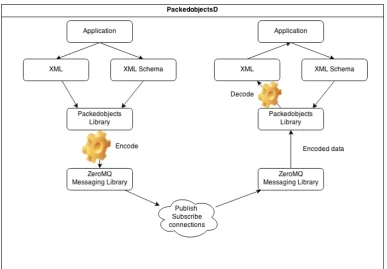
Chapter 4 presents a real-time data sharing system for mobile and em-bedded devices which uses the messaging protocol selected in Chapter 3. XML, a highly structured data format, and its meta-data (Schema) is dis-cussed along with publish/subscribe messaging model. They are combined with ZeroMQ messaging protocol to create a light-weight data sharing system which is suitable for low bandwidth networks.
Chapter 5 presents the experimental results from comparison of com-pressed and uncomcom-pressed data communication on embedded devices over low bandwidth network. The main focus of the experiment is on the com-pression time, comcom-pression ratio and data transfer time and the overall time required to communicate compressed and uncompressed data is compared. The importance of compression time and ratio on the overall time is then analysed. Similarly the energy consumption during the data compression and communication processes is analysed to evaluate the trade-off between compressing with various XML compression techniques and uncompressed data transfer.
Chapter 6 discusses a mathematical model to estimate TCP throughput for a 6LoWPAN network. The impact of small application data payload, TCP fragmentation and packet loss on the overall throughput of the network is analysed in the context of such networks. The result of this model is used to recalculate the data transfer time for various data in Chapter 5.
Chapter 2
Related Work
This chapter provides background information about low bandwidth wireless networks with particular focus on IP-based networks. These networks present unique challenges in terms of quantity of the data that can be communicated over them and the speed that can be achieved. In addition, various mes-saging models which are suitable for communicating data over low bandwidth networks are also studied. Finally, the results from a prototype experiment is presented in order to highlight the challenges in communicating sensor data about seismic activities in real-time. The next section provides background knowledge about various low bandwidth wireless networks.
2.1
Low bandwidth wireless networks
16 Related Work
A sensor network is defined as a collection of large number of smaller sensor nodes which are deployed densely within or nearby the area to be sensed. Sensor network may consists of one or more types of sensor nodes such as thermal, visual, acoustic, infrared, magnetic and seismic which can monitor a range of ambient conditions that include but are not limited to the following (Estrin et al., 1999):
• temperature, • humidity,
• vehicular movement, • lightning condition, • pressure,
• noise levels, • heartbeat,
• air pollution levels and more
Sensor networks are becoming more and more popular and are already used in many areas such as vehicular tracking (Ahmed et al., 2010), environ-mental monitoring (Werner-Allen et al., 2006), industrial automation (Krishna-murthy et al., 2005), infrastructure monitoring (Kim et al., 2007) and health-care monitoring (Chen et al., 2011; Hao and Foster, 2008; Jafari et al., 2005; Lai et al., 2013; Latre et al., 2011; Singh et al., 2009). The sensors networks are often interchangeably referred to as low power and lossy networks (LLNs) due to their association with wireless networks and often require running on limited power for long periods of time. The potentially harsh environmental condition (e.g. monitoring a remote glacier) or complexity of deployment (e.g. sensors with human body) can make it difficult to recharge or replace the power source of such nodes. Thus, it’s extremely important to manage the power consumption during the data sensing and communication process.
2.1 Low bandwidth wireless networks 17
small maximum transmission unit (MTU) size at MAC layer and low cost. They can operate on several wireless bands which includes 2.4GHz, 915 MHz and 868 MHz but 2.4GHz is used mostly as it can be used worldwide (not re-stricted in any region/country) and also provides better data rate. The data rate can be 20-250 Kilo bit per second (Kbps) depending on the band and mode implemented. However it does not define upper network and transport layers and thus various specifications are created by defining upper layers on top of the currently defined physical and MAC layer. These specifications can mainly be divided into category of IP-based and non IP-based standards.
Major non IP-based specifications
• ZigBee,
• WirelessHART, • ISA100.11a and • MiWi
18 Related Work
IP-based specifications
• 6LoWPAN
The concept of IP-based specification was started to connect everything
to the Internet. It allows collection of sensor data from anywhere over the Internet without using any intermediate gateway and also allow the sensor nodes to be controlled remotely. A simple network bridge or a router can be used to connect the sensor network to the Internet instead of a complex application/network conversion gateway as required by the non IP-based net-works. It also simplifies the device naming and addressing model as IP can be used in all the nodes. The use of IP within the network means existing net-work configuration, management and debugging tools can be used Mulligan (2007). For example, Simple Network Management Protocol (SNMP) (Case et al., 1988) can be used to manage an IP-based sensor networks and it is not necessary to write a new management protocol from scratch for the same purpose. The network administrators do not need to learn any proprietary protocols when IP is used throughout.
Fig. 2.1 6LoWPAN frame format
2.1 Low bandwidth wireless networks 19
formalise the standard (Mulligan, 2007). The main challenge of implement-ing IPv6 over IEEE 802.15.4 was to balance the extremely small MTU of 127 bytes and relatively large IPv6 headers of 40 bytes (Deering and Hinden, 1998). The IPv6 header consumes around 30% of the available MTU which leaves very minimum space for application data when other necessary head-ers are considered as shown in figure 2.1. The 6LoWPAN working group have developed a method of compressing and decompressing the IPv6 headers when they enter and leave the IEEE 802.15.4 networks (Kushalnagar et al., 2007) and has been improved further by RFC 4944 and RFC 6282 (Hui and Thubert, 2011; Montenegro et al., 2007).
6LoWPAN implementations
There are various open source implementations of 6LoWPAN standards al-ready which offer different levels of features (Mazzer and Tourancheau, 2009; Yibo et al., 2011) and the major implementations are briefly discussed in this section. Berkeley Low power IP (BLIP) is one of the most advanced 6LoW-PAN implementation and currently supports TinyOS (Levis et al., 2005). It provides most features defined in RFC 4944 namely header compression, fragmentation, addressing and neighbour discovery and supports mesh un-der routing (Culler, 2008a). µIPv6 is another 6LoWPAN implement which sup-ports Contiki OS (Dunkels et al., 2004). It also provides addressing, header compression, fragmentation and neighbour discovery but does not support mesh under and route over routing (Culler, 2008b). Similarly, Nanostack, also referred asnstack, provides addressing, fragmentation and header compres-sion but does not support neighbour discovery and mesh under routing but it is no longer supported Lembo et al. (2010).
20 Related Work
The 6LoWPAN frame format and IPv6 header compression is explained in more detail in Chapter 6. In the next section, different messaging models which can be used for data sharing system are discussed.
2.2
Messaging models
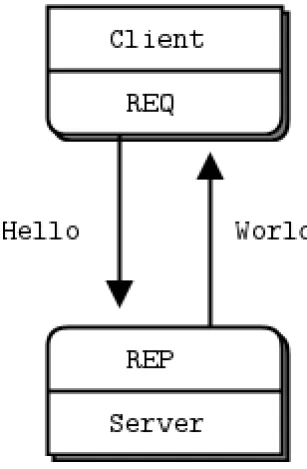
Message passing is crucial for the functioning of distributed systems which form the basis for the Internet itself. The simplest message communication model for such systems is point-to-point where two nodes talk to each other directly. The nodes must know each other before the communication and must remain active throughout the communication cycle. The messages can be optionally stored in a virtual channel commonly known as a queue temporarily. The message is guaranteed to be delivered to one and only one receiver even if there is more than one receiver in the queue. The message remains in the queue until read by a receiver unless it expires after the message expiry time. The messaging model is synchronous in nature and request-reply, as shown in figure 2.2, is one of the most common implementation. The client sends a message to the server and waits for the reply before sending another message.
2.2 Messaging models 21
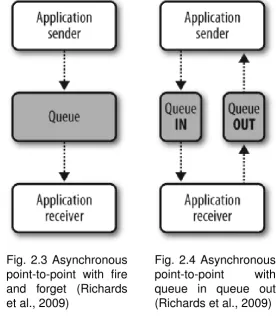
There are different variations of the point-to-point messaging model which improve the limitations caused by the synchronous nature of the model. As shown in figure 2.3, the sender can send a message to the queue but does not expect an immediate reply from the receiver which provides some decou-pling between the two nodes. Similarly, as shown in figure 2.4 the sender can send its messages on one queue and receive on another which provides decoupling between the two nodes.
Fig. 2.3 Asynchronous point-to-point with fire and forget (Richards et al., 2009)
Fig. 2.4 Asynchronous point-to-point with queue in queue out (Richards et al., 2009)
22 Related Work
sender and receiver will not be blocked from performing other tasks during communication. The complete decoupling of all three factors increases the speed of the communication and decreases the complexity for large-scale communications. Scalabilty is referred in the coming sections/chapters of this thesis as the ability of a network to communicate more amount of data for a given bandwidth resource. The extra amount of such data might come either from existing nodes or from newer nodes in the network. The other ma-jor messaging models are Remote Procedure Call (RPC), Distributed Shared Memory (DSM) and Publish/Subscribe (Pub/Sub) (Eugster et al., 2003) and references therein.
Remote procedure call
RPC is one of most commonly used distributed interaction and was initially proposed in 1983 for remote invocation for procedural languages (Birrell and Nelson, 1984; Tay and Ananda, 1990). However it has also been used for object oriented contexts. It consists mainly of three different nodes namely
Caller, Callee and Dealer. Calleesregister the procedures that they provide to theDealer and theCaller invokes the registered remote procedures by using the Uniform resource identifier (URI) provided by the Dealer. The Callee then runs the requested procedure by using the supplied arguments (if any) and re-turns the result to the Caller (if any). The Producer (mostly the invoking node) performs a synchronous call and the consumer (mostly the replying node) processes it asynchronously. The model is not completely asynchronous as there is time coupling on consumer side and space coupling on the producer side (as instance of remote object remains active). It is possible to decouple the sender and receiver nodes in RPC to some extent as shown in figure 2.5 but it cannot be fully decoupled.
2.2 Messaging models 23
Distributed shared memory
The concept of DSM, also referred as shared space or tuple space, started in the 1990s (Li and Hudak, 1989; Tam et al., 1990) and have been used to provide platform for accessing shared data. It is managed like an ordered queue where nodes can read, write or delete the data entries or the tuples. The model provides decoupling over time and space as the data producer and consumer remain anonymous to each other as shown in figure 2.6. However the consumers remain synchronous to the system when they pull new tuples from the space.
Fig. 2.6 DSM messaging model (Eugster et al., 2003)
Publish/Subscribe
The publish/subscribe message model is increasingly used in large scale or dynamic distributed environments to provide loosely coupled communication. Subscribers can register their interests in the form of an event, a pattern of events, topic or content. The interests can be registered either directly to a publisher or to an intermediate service manager as shown in figure 2.7. The publishers generate the data when there is a match for the registered interest and notify the registered subscribers via the service manager. The notification is passed from the publisher to the subscribers in completely asynchronous manner.
24 Related Work
Fig. 2.7 Simple object-based publish/subscribe model (Eugster et al., 2003)
need to know only the service manager. This provides thespace decoupling
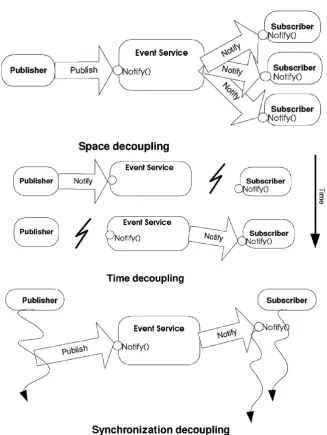
to the system as publishers do not need to know about the subscribers when sending the information and the subscribers do not need to know about the publishers when receiving the information. The communicating parties do not need to be active at the same time for the communication to be complete. The publisher can send information to the service manager and then discon-nect before any subscriber condiscon-nect. Then the subscribers can condiscon-nect to the service manager to receive the information. This provides the time decou-pling to the communication system. Finally, the synchronisation decoupling
is achieved as the publishers are not blocked while sending information and subscribers can receive the information while performing some other activity.
2.3 Data compression in sensor networks 25
Fig. 2.8 Space, time and synchronisation decoupling with pub/sub (Eugster et al., 2003)
2.3
Data compression in sensor networks
Sensor networks can generate data in a range of formats such as text, image, sound or video. Such data can represent environmental monitoring, seismic activities, vibration waveform and acoustic signals in bridges and health-care monitoring. The sensors regularly generate data as typical data collection frequency is 100 MHz or higher. Thus the data is often processed locally before communication.
26 Related Work
if the original data is required after communication. For example, lossy com-pression techniques have already been used to reduce data size at the ex-pense of reduced audio and video qualities (Sinha et al., 2000). The audio and video formats can be compressed by sacrificing some quality to reduce size but the original data can still be retained. However such compression techniques can not be applied to text data format and any text-based com-pression technique used must be able to retain the original data. Similarly, Mammeri et al. (2012) surveyed existing image compression techniques for visual sensor networks. Authors discuss the advantages and disadvantages of discrete cosine transform, discrete wavelet transform and non transform based algorithms in the context of sensor networks. Aghdasi et al. (2008) proposed video transmission architecture for wireless sensor networks to im-prove energy efficiency while maintaining video quality. Ahmad et al. (2009) present improvements to existing video compression techniques, PRISM and Wyner-Ziv encoders, for sensor networks. The use of multimedia in various wireless sensor networks is surveyed by Akyildiz et al. (2007).
2.4 Fingerprinting across IoT 27
2.4
Fingerprinting seismic activity across
Inter-net of things
This prototype testbed was created, firstly to check the suitability of low-cost hardware running minimal Linux OS to be used to collect sensor data, perform some data processing and communicate them over low bandwidth wireless networks. Sensor data have been previously collected from sensor nodes which have no capabilities to perform data processing or to run messaging software to be used for distributed communication. The testbed is also used to identify the challenges of running messaging software on embedded systems and of communicating large scale data over low bandwidth networks.
The aim of this prototype experiment is to use pervasive computing in order to create alternative seismic detection and recording system. The pro-totype is focused on using low-cost open hardware in developing countries to provide an alternative more sustainable solution to the costly infrastructure used in countries such as Japan. The work involves building a network of embedded computing devices capable of forming a broadcast group across a range of different networking technologies including emerging 802.15.4-based networks.
28 Related Work
2.4.1
Earthquake early warning systems
Earthquake early warning systems (EEWS) are not new and research has been carried out since mid 19th century. In 1868, an idea was published in the San Francisco evening bulletin to deploy sensors to detect earthquake and transmit warnings over telegraphic cables and to ring earthquake bell to alert citizens (Allen, 2008). Although there was no significant progress on development of such systems for the next century, it became the basis for new research on this area. Japan has successfully deployed EEWS across their country (Nakamura, 2004). Few other countries such as USA, Mexico, Taiwan and Turkey have followed on the success of Japan on deploying these systems (Allen and Kanamori, 2003). Although California is located between two tectonic plates and is heavily studied by seismologists, due to lack of investment its EEWS is poor in hardware and unable to dispatch a warning signal in reasonable times (Allen, 2008). The same applies to other nations where earthquakes can be even more destructive due to inadequate infras-tructure and the untrained population. These early warning systems use only a few powerful and expensive seismological stations to detect earthquakes. Although these systems are capable of saving lives by alerting people few valuable seconds in advance, they come at a very high price. Thus, these systems cannot be easily deployed in many developing and poor countries in the world. This led researchers to alternative approach of EEWS.
2.4.2
Embedded/Mobile earthquake early warning systems
2.4 Fingerprinting across IoT 29
But the requirement of computers and Internet access for the system has re-stricted implementation to the USA and European countries. However this approach has been extended (Collins and Moore, 2010; Moore et al., 2010) to mobile phones and other embedded devices with built-in accelerometers and is the focus of this prototype project. The mobile devices do not require the same infrastructure and skilled manpower as the computers and are also cheaper compared to computer and specialist seismic activity recording sys-tems. There are increasing numbers of mobile devices which have built in accelerometer sensor and can be used to detect the seismic activity. The sensors are not restricted to expensive smart phones but are now available with low-cost feature phones as well. If EEWS can be created using mobile devices, dedicated embedded devices can be built to detect and process the seismic data. There has been very limited research on early warning sys-tems consisting of mobile and embedded devices. It remains a challenge to communicate the earthquake shake data to other mobile devices in the net-work of EEWS. There is equal amount of challenge to correctly predict if any shake movement is an earthquake or not. There are chances of false warn-ing or chance of misswarn-ing real earthquake. There is no study to date to find the effectiveness of EEWS based on mobile devices. In the next section, the prototype architecture of mobile based seismic activity recording system is discussed and some initial results are presented.
2.4.3
Testbed architecture
30 Related Work
(6LoWPAN) which specifies various functions suitable for low powered em-bedded devices such as addressing, packet formats, interoperability, mesh topology and neighbour discovery (Mulligan and Bormann, 2005).
The target embedded system is primarily used to record seismic events with the possibility of issuing warnings. The target hardware should ideally have accelerometer sensors to detect seismic events. However, the software also allows devices to receive data from other devices without requiring ac-celerometer sensors. The software currently runs on a Linux-based PC, an Openmoko Freerunner mobile phone and a Ben NanoNote minicomputer. Ad-ditionally, the software can also run on home broadband routers such as the Buffalo G300NH which has a USB port capable of attaching an accelerometer. These different forms of hardware are connected to different groups based on their location. The groups are then connected to other nearby groups enabling sharing of data. There are various messaging protocols supporting broadcast feature required for the prototype. Protocols such as ActiveMQ, RabbitMQ, Mantaray, ZeroMQ and Spread are the most common examples. However it’s not feasible to port all of them to embedded devices as required for the prototype. Spread and ZeroMQ are very simple to implement and provide C API for message broadcasting and therefore are more suitable for embedded platforms.
Each device continually collects accelerometer data at a rate based on the sampling frequency of the accelerometer used. The X-axis and Y-axis values of the accelerometer sensor are recorded during the sampling process. The changes in X and Y axes is calculated as a covariance which measures the changes in two or more random variables. The covariance value can be used to determine the level of shaking that is recorded by the accelerometer sensor. For example, covariance between the two axes with sample size N can be defined as equation 2.1. The covariance of every 100 samples is calculated and then compared to a predefined threshold value. If the result is greater than the threshold the device communicates an alert to the rest of the group as summarised in algorithm below.
Covariance(X,Y) = N
∑
i=1
(xi−x¯)(yi−y¯)
(N) (2.1)
Where,
2.4 Fingerprinting across IoT 31
¯
X and Y¯ are average of respective axis values N is the sample size of the values
Algorithm 1Determining accelerometer activity
loop
calculate(covariance)
if covariance≥threshold then
broadcast(alertMessage)⇒group
else
donothing
end if end loop
Fig. 2.9 Queuing model
32 Related Work
2.4.4
Fingerprinting the network
Fig. 2.10 Ben Nanonotes and 6LoWPAN
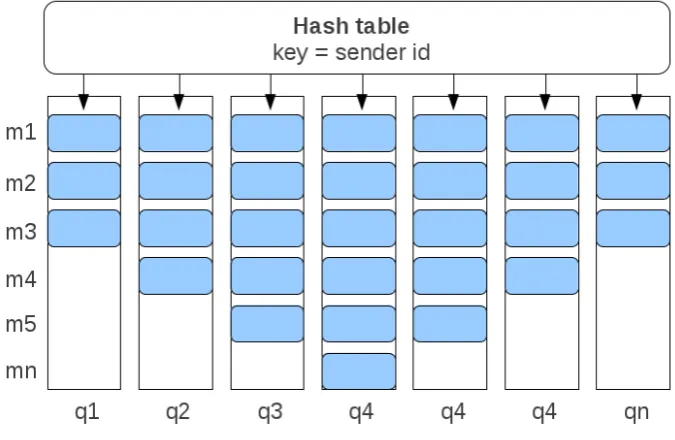
A key part of the prototype is being able to identify significant seismic events and the process is called fingerprinting. In order to evaluate the pro-totype a simple message broadcast system was created using Spread mes-saging toolkit. A Ben Nanonote minicomputer equipped with the Ben WPAN wireless chip was used for the experiment as shown in the figure 2.10. A fake accelerometer data generator program created by Bagale (2010) is used to create sample data for the experiment. It is run on each device to provide data similar to various levels of shaking as expected to be generated from seismic activities. The data is then communicated to all other devices immediately to establish queue size and fingerprint of the event.
Fig. 2.11 Insignificant fingerprint Fig. 2.12 Undetermined fingerprint
mes-2.4 Fingerprinting across IoT 33
sages in the sample period with little or no messages at other levels. This graph or fingerprint shows that although there was some activity on the net-work the amount of traffic and/or the number of devices is low, therefore, the result can ignored as being less significant. In figure 2.12, an example is shown where the fingerprint is scattered with some high and low samples size messages from significant number of machines. The pattern does not in-dicate any specific type of event and it is difficult to explain this pattern without knowing the circumstances for its occurrence over a period of time.
Fig. 2.13 Right-skewed fingerprint Fig. 2.14 Left-skewed fingerprint
In figure 2.13, a large number of devices are creating a right-skewed fin-gerprint which indicates an event occurred for a longer period of time. This kind of pattern would indicate that there has been a highly significant event based on the number of machines involved and the duration of the event. Similarly, figure 2.14 shows a large number of devices creating a left-skewed fingerprint which indicates an event occurred for a short time. This kind of pattern would indicate that there has been less significant event based on the number of machines involved and the brief duration of the event.
2.4.5
Summary of the testbed
34 Related Work
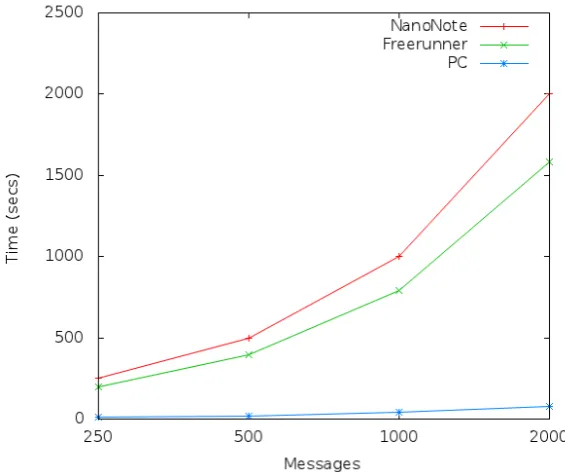
challenge to increase the scale of the network due to limited processing ca-pabilities of the devices and the limited network bandwidth. The sensor data serialisation/decode process was compared among embedded devices and a personal computer (PC) to highlight the challenges present in embedded devices for processing large scale data. The major hardware specifications of those devices are listed in table 2.1.
Fig. 2.15 Sensor data decode performance across embedded devices and PC
As shown in figure 2.15, the data serialisation process is extremely slow on embedded devices in comparison to a PC. It can be one of the challenges for creating a real-time large scale network as more time is required to pro-cess the data on the device. However this limitation is expected to improve with time as faster embedded devices (1GHz speed) are already becoming available on the market. It enables the improvement of the data processing performance in embedded devices.
Table 2.1 Hardware specifications for devices compared for decode perfor-mance
Device Processor RAM Architecture OS
Ben Nanonote 336 MHz 32 MB MIPS OpenWRT Freerunner Phone 400 MHz 128 MB ARM OpenWRT
2.4 Fingerprinting across IoT 35
Chapter 3
Messaging protocols suitable for
embedded devices
In this chapter messaging protocols that are suitable for mobile, embedded and wireless sensor networks are evaluated. Various messaging architec-tures/models provided by these protocols are studied to determine their suit-ability. The messaging protocol needs to be suitable for continuously sending large amount of highly structured data in low bandwidth mobile and sensor networks. Although processing capabilities of the embedded devices on such networks is increasing, it is considered as well. Various messaging architec-tures are examined with special focus on the size of overhead per message used by these protocols in order to create a light-weight messaging system.
3.1
Background
38 Messaging protocols suitable for embedded devices
Sensor nodes can filter data before sending it to the network. However it might result in loss of data and it is still possible that all the sensors may try to send important data at the same time. Also significant power is con-sumed in a sensor node when the radio transceiver is idle (Ye et al., 2002). Thus the lifetime of the network can be improved by controlling the number of transmissions from sensors. The sensors can subscribe only to the data which is related to selected topics/interests rather than all the available topics. This approach is called data centric communication and it enables communi-cation based on interest of receiver and not based on network address (Estrin et al., 1999). Publish Subscribe messaging systems (Pub/Sub) are common examples of such communication model. Pub/Sub model supports dynamic topologies in sensor networks and are scalable as well (Eugster et al., 2003). The information about topics can also be used to determine a path a message takes in the network and thus reducing the number of transmissions required (Rooney and Garces-Erice, 2007).
The major components of a Pub/Sub messaging system are subscribers, publishers and a broker (Hunkeler et al., 2008). Subscribers register their in-terest in information by subscribing to a topic. Publishers provide information to the subscribers by publishing. Broker facilitates the information delivery from publisher to a subscriber. The subscription in a typical Pub/Sub sys-tem can be done based on topic, content or type (Eugster et al., 2003). Topic based systems allow to define topics in advance which is then used to publish and subscribe information. Type based systems allow to specify the type of information to be used e.g. temperature data. Content based systems allow to describe the content of the information e.g. the light in on and temperature is below certain threshold (Hunkeler et al., 2008).
3.2
Related work
3.2 Related work 39
network consisted of embedded devices such as Ben Nanonote minicom-puter and a version of 6LoWPAN wireless standard (Almesberger, 2012). Ben Nanonote runs on OpenWRT Linux distribution. Tiny OS has also been used on many wireless sensor networks (Hao and Foster, 2008; Kim et al., 2007; Werner-Allen et al., 2006). However OpenWRT is used on this testbed because Linux is increasingly used on many embedded devices and also supports existing messaging and compression techniques. Although ZigBee standard is used on many sensor networks including home automation it’s use has been restricted by its proprietary licensing. Thus 6LoWPAN open standard is considered more suitable for this research.
The messaging protocols are mainly of two major types, synchronous and asynchronous. Synchronous messaging is carried out in traditional client server model. Both client and server device must be available to send/receive the message and acknowledgement message must be sent before another message can be sent. Asynchronous messaging does not require the client and the server to be available at all times and immediate acknowledgement is not mandatory. It is achieved by creating a middle-ware device between traditional client and server which is commonly known as broker. The broker acts as buffer for temporarily storing messages and utilises store and forward strategy. It allows the senders to send messages before receivers are active and can disconnect once the broker receives the message as the broker can forward the message to the subscriber later. It is suitable for sensor networks as nodes can fail or disconnect from the network.
40 Messaging protocols suitable for embedded devices
device is a challenging task and must be considered too. ActiveMQ, JBoss and MantaRay have not been ported to embedded operating system such as OpenWRT yet. The messaging libraries which are being discussed below are already ported to OpenWRT. Spread Toolkit provides a unified message bus for distributed systems (Amir et al., 2004). ZeroMQ is defined as intelligent transport layer and it provides light weight messaging library for distributed systems (Hintjens, 2007).
3.3
Protocols
In this section the messaging architectures provided by ZeroMQ and Spread are discussed. The architecture which is suitable for communicating sensor data is highlighted. The selection of ideal messaging model is determined by the size of extra control data overhead required for communicating the normal data.
3.3.1
Spread
Spread is a distributed messaging system and supports the group commu-nication model which makes it easier to build a large number of distributed applications. It provides abstraction of a group for participating nodes by fa-cilitating message multicast between themselves. The daemons keep record of membership of the machines and pass this information to other daemons in the same group (Amir et al., 2004). It also provides message ordering and reliable message delivery within a group. It also provides failure detection of members within the group and manages group membership changes. How-ever Spread does not provide any encryption mechanism for security.
3.3 Protocols 41
Fig. 3.1 One Spread daemon for each client
to maintain performance. Also a single configuration file can include details of up to 20 different LANs enabling the daemons to communicate with each other (Stanton, 2002).
Similarly in figure 3.2 there is a single daemon in the network which han-dles all the memberships and communications for all the connected clients. It is possible to connect hundreds of clients to a single daemon. However each new member in a group contributes 32 bytes extra towards the membership notification message which is sent when members join or leave the groups in that network. It causes the size of the notification message to increase and may have impact on performance of the system.
42 Messaging protocols suitable for embedded devices
Fig. 3.2 One Spread daemon for all clients
model using single daemon architecture. The daemon acts as a broker which can receive messages from different publisher clients and then forward these messages to the subscribers based on the groups they have joined.
3.3.2
ZeroMQ
ZeroMQ is defined as the socket library which works as a concurrency frame-work and is a light-weight, fast and scalable messaging library (Hintjens, 2007). It has been already used to create a range of real-time applications including stock trading, network traffic monitoring and electricity monitoring applications and it has been already ported to all major platforms and con-sists of bindings for most programming languages. It provides messaging services using sockets which can be connected in various patterns such as publish-subscribe, request-reply and task distribution (Hintjens, 2011).
3.3 Protocols 43
Fig. 3.3 Request reply model (Hintjens, 2011)
44 Messaging protocols suitable for embedded devices
The client must wait for the server’s reply before it can send another message. Also the server cannot send two messages in a row to the client. It is very simple communication model but it is not suitable for sending messages to multiple sensor nodes. The pipeline communication pattern shown in figure 3.4 is a parallel task distribution and collection model. The ventilator is the node which creates and pushes tasks that can be processed in parallel to the worker nodes who complete the tasks and send it to the sink node for collec-tion of the results. This communicacollec-tion model is not suitable for messaging requirements of a sensor network but more suitable for distributing processing tasks to multiple machines in a hierarchical design.
Fig. 3.5 Publish subscribe model (Hintjens, 2011)
3.4 Results and analysis 45
to be a publisher and each node also subscribing to receive from all other publishers but it is still challenging to manage multiple many to many connec-tions. However ZeroMQ allows creation of intermediate broker device which can act as both publisher and subscriber. It can receive message as sub-scriber from multiple publishers, store the message temporarily in a queue and forward it to the connected subscribers (Hintjens, 2011). Thus it is possi-ble to create multiple publisher multiple subscriber communication using the simple Pub/Sub model.
In the next section, the single daemon architecture in Spread and multiple-publisher-multiple-subscriber architecture in ZeroMQ are compared by look-ing at message structure with special focus on the actual data to control data overhead.
3.4
Results and analysis
In the single daemon message architecture for Spread as discussed above the daemon maintains a message queue to temporarily store the messages received from various clients. The message queue ensures ordered deliv-ery of the messages to all the subscriber clients who receive messages in exactly the same order as it was sent. This feature is very useful for data recording sensor networks as it ensures consistency in recorded data. A sin-gle Spread daemon can relay messages to subscribed clients from multiple groups. A client can choose to receive messages for groups A and B from the daemon while another client connected to the same daemon can choose to receive messages for groups A, B and C as shown in the figure above 3.2. Clients maintain a single connection to receive messages from all the groups they have subscribed with the daemon. The daemon must tag all the data with sending user’s identity and the group information. The same connection is also used to receive membership notification messages from the daemon which can cause delay to the actual data transmission. And the notification messages affect the latency as it increases linearly with the number of mem-bers in a group increases.
46 Messaging protocols suitable for embedded devices
Fig. 3.6 Broker based publish subscribe model
broadcast messages to each other. As shown in figure 3.6 a broker receives messages from different groups/topics as if it is subscribed to all 3 topics A, B and C. The broker then sends those messages selectively to the different subscribers based on the interests they showed. Both publishers and sub-scribers contact the broker before starting communication making it easier for creating complex many-to-many communication model in a simple manner. The broker does not permanently store any message while forwarding it from publishers to subscribers and it does not pass membership notifications like Spread daemon.
The size of message sent across the network by Spread and ZeroMQ is measured using the tcpdump network packet analyser (Jacobson et al., 1989). The main aim of this test was to find the size of the control data added to the original message by Spread and ZeroMQ before sending it across the network. Both tests were carried out with same application program imple-mented in Spread and ZeroMQ messaging. An application acting as a