DOI: 10.14738/abr.67.2907.
Ollows, L., Moro, A., & Mugo-Waweru, F. (2018). Soft Information Acquisition And Transfer In The Small And Medium Enterprise (SME) Lending Process: A Study Of Commercial Banks In Kenya. Archives of Business Research, 6(7), 1-11.
Soft Information Acquisition And Transfer In The Small And
Medium Enterprise (SME) Lending Process: A Study Of
Commercial Banks In Kenya
Lilian Ollows
School of Management and Commerce, Strathmore University, Nairobi, Kenya
Andrea Moro
School of Management,
Cranfield University, Bedfordshire, United Kingdom
Freshia Mugo-Waweru
School of Management and Commerce, Strathmore University, Nairobi, Kenya
ABSTRACT
Soft information use in SME lending has been well established and more so when commercial banks employ the relationship lending methodology. Relationship lending implies that lenders rely on soft information in making a lending decision. This “soft” data such as information about management skills, management ethics and moral principles is gathered over the course of a relationship with the borrower. Relationship lending has been posited as the preferred methodology for banks to employ especially when engaging with small and medium enterprises (SMEs) due to the information opacity that characterizes these firms. Soft information is distinguished from hard information which is that information about a borrower which is readily available at the time of loan origination and includes financial statements and collateral. Although extant literature recognizes the importance of soft information, particularly for lending to SMEs that are characterized by high levels of opacity, it does not pay much attention to how soft information is acquired and transferred for use in making a lending decision. This study explores the process of soft knowledge acquisition and transfer for use in the SME lending decision. A qualitative multiple case study of selected commercial banks in Kenya is employed to gain an in-depth understanding of how soft information is transferred from the SME client and eventually used in making a lending decision. Data is collected through semi structured interviews conducted with SME relationship managers (RM) who work closely with SMEs and are thus able to describe the process from the onset of the relationship to disbursement of a loan. The results suggest that when considering an SME lending decision, banks make use of both soft and hard information. The relationship manager or relationship officer is the primary collector of soft information and transfers this information after verification, through the channels of the loan application process.
Keywords: Relationship Lending, SME Lending, Soft Information
INTRODUCTION
difference between the use of soft information and hard information (Petersen & Rajan, 1994; Rajan, 1992; Stein, 2002). Transaction lending is the lending decision that is based on “hard” information which is relatively easily available at the time of loan origination whereas relationship lending relies on the “soft” data gathered over the course of a relationship with the borrower (Berger & Udell, 2006; Elyasani & Goldberg, 2004).
Relationship lending is recommended as the appropriate technique to use when lending to small businesses, which are commonly referred to as opaque enterprises, because information about these enterprises is not readily available (Carbo’ -Valverde, Rodri’guez-Ferna’ndez & Udell, 2009; Elyasani & Goldberg, 2004; Ono and Uesugi, 2009). Berger and Udell (2006, pp. 3), provide a definition of relationship lending that addresses the nature of the information exchanged when they define relationship lending as the lending technology where “decisions are primarily based on soft information gathered over the course of a relationship.” Earlier, Berger (1999) posits that the financial intermediary gathers confidential information through interaction with the borrower over time and usually through the use of multiple financial products/services. Similarly, Freixas (2005) emphasizes that the bank is the one that makes the necessary investment to obtain borrower-specific (often proprietary) information. Soft information is not easily quantified and consists of information gathered over time through contact with the firm and its stakeholders (Berger and Udell, 2006). According to Boh, Nguyen and Xu (2013), soft information is tacit knowledge which is “sticky”, context specific, has personal quality and is difficult to communicate and transfer even though its acquisition could be a major source of competitive advantage.
This study examines how loan managers collect and process soft information so as to build up knowledge about their customers in order to use this information to make lending decisions. This study adopts a qualitative multiple case study approach with the case studies being seven commercial banks in Kenya which are selected due to their prominence in SME lending. Data is collected through semi structured interviews with SME relationship managers so as to gain an in-depth understanding of how knowledge is transferred from the SME client to the bank for eventual consideration in making the lending decision and analysed using content analysis. The results show that the onus of collecting soft information is on the relationship manager (RM) who is the closest contact to the SME. The RM determines which soft information is relevant and is transmittable from an informal to formal platform so that it can be used in making the SME lending decision.
LITERATURE REVIEW Theoretical Review
The existing theories of financial intermediation stress the importance of the information production function of banks in alleviating information asymmetry (Diamond, 1984; Fama, 1985; Leland & Pyle, 1977; Ramakrishnan & Thakor, 1984). These theories emphasize the information production role of banks through screening (Diamond, 1991) and subsequently through monitoring (Rajan & Winton, 1995).
dependent on banks for external funds. However, banks do not have sufficient information to assess the credit risk associated with these informational opaque firms when they receive an initial loan application. Thus, banks which are interested in such firms need to first invest in acquiring information and processing the same, as well as subsequent monitoring of firm activities (Boot, 2000; Freixas, 2005).
The acquisition of soft information happens via the bank loan officer who has the most direct and frequent contact with the borrower (Berger and Udell, 2006). This loan officer plays a key role both in producing knowledge and in using it in order to take lending decisions. However, it may be quite difficult for the loan officer to transfer knowledge to others in the banking organization without significantly diluting its content (Stein 2002; Liberti & Mian 2006; Allessendrini et al. 2008).
Empirical Review
The empirical literature on relationship lending has tended to emphasize the link between the strength of the bank-borrower relationship and specific benefits such as credit availability and credit terms (Berger & Udell, 1995; Cole, 1998; Elsas & Krahnen, 1998; Harhoff & Körting, 1998 and Petersen & Rajan, 1994). However, these studies do not directly investigate information production.
Boot (2000) suggests that in originating loans, banks develop proprietary information and subsequent monitoring of borrowers yields additional private information. García-Appendini (2007) in a survey of small business finances (SSBF) targeting US for-profit firms, finds that hard public information may not be used in loan underwriting when banks have a strong relationship with the borrower and that soft information if available is the driving determinant in loan underwriting. Puri, Rocholl and Steffen (2010) concur when they find that prior relationships not only allow the bank to produce information that goes beyond publicly available information, but also allow it to better assess loan applicants’ creditworthiness.
Berger and Udell (2002; 2006) argue that as loan officers have the most frequent and personal contact with the firm, its owner, its employees, and the local community, they are able to obtain soft as well as hard information about the borrowers. Further, they suggest that the loan officer is able to collect relevant information about the firm, its owner and business conditions in the local market from other local firms and individuals because they typically live in the local community. Berger and Udell’s (2002) model is recently confirmed at least in part by Hattori, Shintani and Uchida (2015) who using unique data from heterogeneous banks in Japan, find that loan officers (located at the bottom of the banks’ hierarchy) collect soft information. This is because they are the person with whom a borrower has the initial and most frequent contact among bank staff. Even though existing studies find that loan officers indeed play an important role in the production of soft information, this does not rule out the possibility of someone else producing soft information. At smaller banks where job assignments are more flexible and the collection of information is not routinized by strict internal rules, decision makers might also directly acquire soft information through their own personal contact with borrowers, while at large banks, loan officers might be the sole producers of borrower information (Liberti & Mian, 2009; Agarwal & Hauswald, 2011). Hattori et al. (2015) also find that especially at smaller banks, branch managers who have direct contact with the borrowers also collect soft information, although less frequently. Further, other bank employees in the branch apart from the account loan officers also have direct and frequent contact with borrowers.
who may give specific information about the firm and owner or general information about the business environment in which they operate. Similarly, Schwarze (2006) gives examples of soft information which may be collected from the SME owner or other sources which include the character and reliability of the SME’s owner, communication with customers of the SME or neighbouring businesses.
Soft information is transferred through direct personal interaction and communication between loan officers and credit decision makers. Further sharing of soft information can occur during the decisions making process by loan committees that consist of multiple bank employees. Soft information is hardened (that is, quantified or digitized) so that it can be transmitted to a higher level (Liberti & Mian, 2009; Agarwal & Hauswald, 2011). Paravisini and Schoar (2012) conduct research with BancaMia, a for-profit bank in Colombia specialized in loans to small enterprises, and find that loan officers upload borrower information and the bank's management information system compiles in a single application file all the available borrower information for review by a credit committee. This information includes; the first-hand information collected by the loan officer, the borrower's past credit history in BancaMia and any available third-party information (for example, the borrower's credit score from a private credit bureau). Similarly, Nemoto, Ogura and Watanabe (2011) provide evidence from Japan and show that in small and medium sized banks, any information collected by employees in the branch is filed in a loan proposal, which even includes a record of casual conversations held with borrowers. This loan proposal is circulated within the branch with every staff of the branch having access to it resulting in communication and information sharing between account loan officers and other staff in the branch.
Mocetti, Pagnini and Sette (2010) find that investment in information and communication technologies has made it easier to share documentation and to combine information stored in different database. Hattori et al. (2015) find that at least for smaller banks, it is the branch managers (who are likely to be decision makers) who are the most important repository of soft information. This is inconsistent with the conventional view that loan officers are the sole repository of soft information (Berger & Udell, 2002; 2006; Scott, 2006). Scott (2006) provides a different perspective of looking at how loan officers may be the repository of soft information. Using data on SME lending from a survey of small businesses conducted by the National Federation of Independent Business (NFIB) in the U.S., Scott (2006) finds that greater loan officer turnover has a more adverse effect on the availability of credit for borrowers suggesting the importance of loan officers in the collection and transfer of soft information or alternatively that the repository of this information is the loan officer.
Hattori et al., (2015) conclude their study by suggesting that there are many important issues that remain untested concerning the collection, processing, and use of soft information within heterogeneous bank organizations.
Research Issue
RQ1: What are the sources of soft information and how formal or informal is the collection process (i.e. do you pay attention to rumours about the borrower or stick only to very reliable and sound sources even if they provide soft information)?
RQ2: How is the soft information processed? How does the loan manager transfer his opinion and personal evaluation based on the soft information to the next level? Do you formalize this soft information in some way or is the repository the loan manager?
RQ3: What are the social ties in which the lender-borrower relationship is embedded? Is there a link between the local loan manager and the local community? Does he/she live there?
METHODOLOGY
A qualitative multiple case study design is adopted for this study. Miles and Huberman (1994) argue that evidence from multiple cases adds “confidence” to the research findings while Herriot and Firestone (1983) and Yin (2004) add that the evidence from multiple cases is often more compelling and the overall study is therefore considered more robust. The seven commercial banks selected for this study are those that are engaged in SME lending and have been ranked amongst the top three in the banking survey carried out in Kenya by Think Business Limited (a leading strategic business intelligence, research and publishing company in Kenya specializing in the financial sector), for the years 2011-2014 (Banking Survey, 2014, 2013, 2012, 2011). Data is collected through semi structured interviews with relationship managers/relationship officers/branch managers (RM/RO/BM) with each interview lasting one and a half hours. The data is analysed using content analysis (Miles & Huberman, 1994) to tease out the emergent themes from the data and the outcome is a framework that describes how soft information knowledge transfer occurs in the context of SME lending.
RESULTS AND DISCUSSION
RQ1: What are the sources of soft information and how formal or informal is the
collection process (i.e. do you pay attention to rumours about the borrower or stick only to very reliable and sound sources even if they provide soft information)?
Table 1 Summary Sources of Soft Information Knowledge Acquisition Strategy
(F-Formal/ I- Informal) Respondents Frequency No. of Banks 1) Externally Generated Hard Information
• Certificate for city council/evidence of fee paid for shop (F)
• Electricity bills (F)
• Mpesa statements (F)
• Invoices (F)
• Credit reference bureau (CRB) for company credit history (F)
• Credit reference bureau (CRB) for directors credit history (F)
• Politically exposed persons (PEP) List (F)
• Caution countries list (F)
B1b B1b B1b, B6b B1b
B1a, B6c
B1a, B2a, B6c, B7b B1a B1a 13 1 1 2 1 2 4 1 1 4 1 1 2 1 2 4 1 1
2) Externally Generated Soft Information
• Rumours (verified) (I)
• Information in the Public Domain (F/I)
• Credit reference bureau (CRB) for directors character (F)
B3a, B3b, B7b B7a
B1a, B2a, B6c, B7b
8 3 1 4 5 2 1 4
3) Internally Generated Hard Information
• Make books (F)
• Context information from informal Sectors (F)
B1a, B3a, B3b B3a, B3b 5 3 2 2 2 1
4) Internally Generated Soft Information
• Instinct (I)
• Credit application form/standardized information profile (F)
• Former banker (F)
• Other bank staff (I)
Business Visit Summary Frequencies
• Business visit report/ Call report from business visit (F/I)
• Observation during business visit (I)
• Discussion with employees of business (I)
• During business visit, discussion with person operating neighbouring business (I)
• Other people in the small town (I)
B7a, B7b
B1c, B4a
B7a B7a
B1c, B3a, B3b, B5a, B5c B5b, B7b B5b B6a B7a 16 2 2 1 1 10 5 2 1 1 1 6 1 2 1 1 5 3 2 1 1 1
categories, information could be collected formally or informally, the distinction being that informal collection is primarily that which results from the personal evaluation of the loan manager.
As the interest of the enquiry was to determine how soft information is collected, the results reveal that internally generated soft information is the most preferred strategy for collecting soft information having garnered sixteen responses, compared to eight for externally generated soft information. The sixteen responses were received from respondents in six out of the seven banks, the only bank missing, B2a, had earlier indicated that they do not employ relationship lending which relies on soft information and as such this was a consistent result. The consensus therefore is that banks prefer internally generated soft information or that which is primarily generated by the RO/RM, as opposed to soft information generated or collected by parties external to the bank. Further, of the sixteen responses, the most frequent source of internally generated soft information is business visits which had ten responses. This shows that banks gather more soft information from the business visits made to their clients’ premises than any other internally generated source. Further this also indicates that the primary collector of soft information is the relationship manager or officer who makes the visit to the customer’s business premises. The methods cited for collecting soft information during the business visits are; observation during business visit(s), discussion with employees of the business, discussion with the person operating the neighbouring business and other people in the small town (B1c, B3a, B3b, B5a, B5b, B5c, B6a, B7a & B7b).
Other sources of internally generated soft information cited are; instinct, credit application form/standardized information profile, former banker and other bank staff while externally generated sources are; verified rumours, information in the public domain and CRB check for directors’ character.
RQ2: How is the soft information processed? How does the loan manager transfer his opinion and personal evaluation based on the soft information to the next level? Do you formalise this soft information in some way or is the repository the loan manager?
This section gathered data on how the soft information which is collected is transformed to a form that can be conveyed or transmitted in loan process. Additionally the researcher gathered evidence on how this information is then transferred to be used for making the SME lending decision.
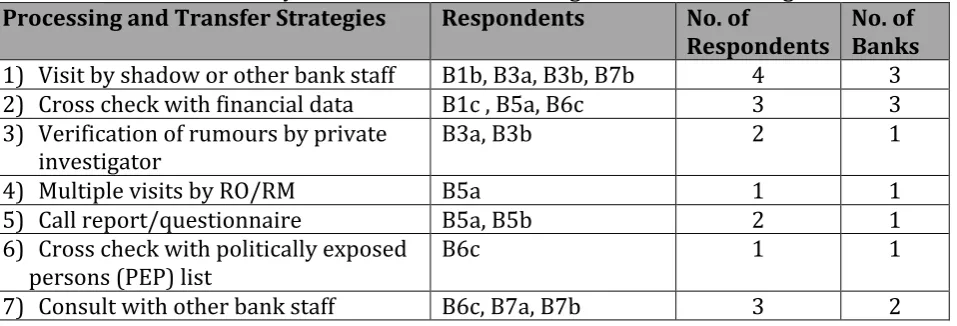
Table 2 Summary Soft Information Processing and Transfer Strategies Processing and Transfer Strategies Respondents No. of
Respondents No. of Banks
1) Visit by shadow or other bank staff B1b, B3a, B3b, B7b 4 3
2) Cross check with financial data B1c , B5a, B6c 3 3
3) Verification of rumours by private
investigator B3a, B3b 2 1
4) Multiple visits by RO/RM B5a 1 1
5) Call report/questionnaire B5a, B5b 2 1
6) Cross check with politically exposed
persons (PEP) list B6c 1 1
7) Consult with other bank staff B6c, B7a, B7b 3 2
common strategy of processing soft information is the visit by a shadow or other bank staff which is indicated by four respondents from three of the banks in the study. This strategy is closely followed by the cross check with the formal information, in this case the financial data of the SME, which is indicated by three respondents from three banks as well. Ranking third is the consultation with other bank staff which is also indicated by three respondents but from two banks in the study. A closer look at the respondents listed under each strategy reveals that a bank may employ multiple strategies to verify soft information, for example, B6c indicates the use of three strategies; the cross check with financial data, the cross check with politically exposed persons (PEP) list and consultation with other bank staff. Similarly, respondents in the same bank indicate the use of different strategies, for instance, B1b indicates the verification by a visit by shadow or other bank staff while, B1c indicates a cross check with financial data.
The top three strategies indicated by 5 banks in total go to show that banks again prefer to rely on their own internal mechanisms to process/verify soft information collected. Further, to note is that these processes of verification also allow for the transfer of such information. Additional means of transfer is through the call report and questionnaire (B5a and B5b) which capture information collected during the visit to the customer’s premises. Interestingly Bank 5’s verification by making multiple visits by the RO/RM suggests that loan managers transfer a lot of information (formal and informal) and as such may have a lot of power to indirectly influence a lending decision.
There is agreement that the soft information collected and processed is stored in a common system that is accessible by all authorised bank staff. This is the same system that records information from the application form and the call report and as such any soft information captured, especially in the call report, is also stored in this system. This system also captures credit information prepared by the credit analyst. The repository of soft information is therefore not the RM that is close to the customer but a system which is accessible by all authorised bank staff.
RQ3: What are the social ties in which the lender-borrower relationship is embedded? Is there a link between the local loan manager and the local community? Does he/she live there?
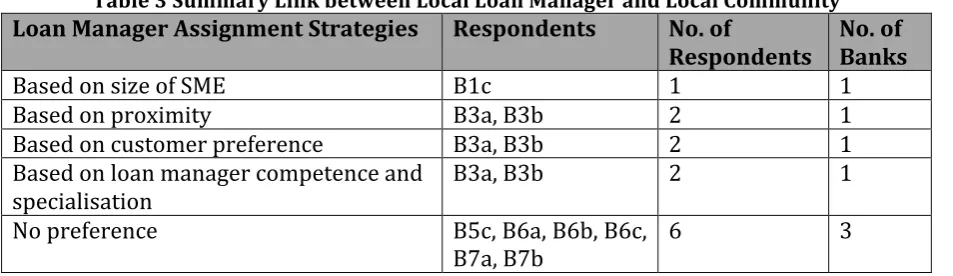
The purpose of this sub issue was to determine if the lender-borrower relationship was embedded in any social ties. This established whether there was any link between a local loan manager and customer in terms of whether the local loan managers could deal with only customers in his area of whether the loan manager was equipped to deal with customers from any area. The table below summarises the loan manager assignment strategies generated from the interview responses.
Table 3 Summary Link between Local Loan Manager and Local Community Loan Manager Assignment Strategies Respondents No. of
Respondents No. of Banks
Based on size of SME B1c 1 1
Based on proximity B3a, B3b 2 1
Based on customer preference B3a, B3b 2 1
Based on loan manager competence and
specialisation B3a, B3b 2 1
No preference B5c, B6a, B6b, B6c,
The table above shows that the highest numbers of respondents indicate that there is no link between the local loan manager and local community and as such all SME managers at a bank branch are equipped to handle any SME issue or query. This is indicated by six respondents from three banks. Interestingly, the results also show corroboration within banks as indicated by respondents in banks 3 and 6. However, three respondents from two banks indicate that there is a link between the local loan manager and local community and give these instances as based on; proximity, customer preference, loan manager competence and specialisation (B3a, B3b) and, based on SME size (B1c).
CONCLUSION
In conclusion, soft information is generated externally or internally with banks preferring to generate this information internally, or primarily through their own relationship managers or officers. The soft information is more frequently collected during the business visits made by the RM/RO to the clients’ premises suggesting that the RM/RO is the primary collector of soft information.
As regards soft information transfer, information is first processed by way of verifying it and then transferred through the channels of the loan application process. The verification strategies suggest that banks not only prefer to generate their own soft information but also prefer to rely on their own internal mechanisms to process or verify the soft information collected. To note is that the verification strategies employed also become a first step in the process of transmitting or transferring soft information. In most banks, soft information is not proprietary to the loan manager who comes into contact with the customer, but is made available to other relevant decision makers when this soft information is shared for decision making. Even though the primary collector of soft information is the RM/RO that comes into contact with the customer, there is agreement among all banks that the soft information collected and processed is stored in a common system that is accessible by all authorized bank staff.
Finally, most respondents indicate that all SME managers at a bank branch are equipped to handle any SME issue or query and as such there is no link between the local loan manager and the local community.
References
Agarwal, S., & Hauswald, R. (2011). Authority and Information. AFA 2011 Denver Meetings Paper. http://dx.doi.org/10.2139/ssrn.1566062.
Alessandrini, P., Presbitero, A. F., & Zazzaro, A. (2009). “Banks, distancesandfirms' financing constraints”, Review of Finance Vol.13, No. 2, pp 261-307.
Banking Survey, 2014. Kenya: Think Business Ltd. Banking Survey, 2013. Kenya: Think Business Ltd. Banking Survey, 2012. Kenya: Think Business Ltd.
Banking Survey, 2011, The Best Banks this Decade (2001-2010) Overall Rankings. Think Business Ltd. Banking Survey, 2010, The Best Banks in Kenya: Think Business Ltd.
Berger, A. (1999). The ‘Big Picture’ of relationship finance, in “Business Access to Capital and Credit” (J. L. Blanton, A. Williams, and S. L. Rhine, Eds.), pp. 390–400. A Federal Reserve System Research Conference.
Berger, A. N., & Udell, G. F. (2006). “A More Complete Conceptual Framework for SME Finance”, Journal of Banking & Finance, Vol. 30, No. 11, pp 2945-2966.
Berger, A. N., & Udell, G. F. (1995). “Relationship Lending and Lines of Credit in Small Firm Finance”, Journal of Business, Vol. 68, No. 3, pp 351–381.
Boh, W. F., Nguyen, T. T., & Xu, Y. (2013). “Knowledge transfer across dissimilar cultures”, Journal of Knowledge Management, Vol. 17, No. 1, pp 29-46.
Boot, A. W. A. (2000). “Relationship Banking: What Do We Know”? Journal of Financial Intermediation, Vol. 9, No. 1, pp 7–25.
Carbo´ -Valverde, S., Rodri´guez-Ferna´ndez, F., & Udell, G. F. (2009). “Bank Market Power and SME Financing Constraints”, Review of Finance 1–32. doi: 10.1093/rof/rfp003.
Cole, R. A. (1998). “The importance of relationships to the availability of credit”, Journal of Banking and Finance,
Vol. 22, No. 6-8, pp 959-977.
Diamond, D. W. (1991). “Monitoring and Reputation: The Choice between Bank Loans and Directly Placed Debt”,
Journal of Political Economy, Vol. 99, pp 688-721.
Diamond, D. W. (1984). "Financial Intermediation and Delegated Monitoring," Review of Economic Studies, Vol. 51, pp 393-414.
Elsas, R., & Krahnen, J. (1998). “Is relationship lending special? Evidence from credit-file data in Germany”, Journal
of Banking and Finance Vol. 22, pp 1283-1316.
Elyasiani, E., & Goldberg, L. (2004). Relationship Lending: A Survey of the Literature, Journal of Economics and Business, Vol. 56, No. 4, pp 315–330.
Fama, E. F. (1985). “What’s different about banks”? Journal of Monetary Economics, Vol. 15, No. 1, pp 29-39. Freixas, X., (2005). “Deconstructing Relationship Banking”, Investigaciones Economicas, Vol. 14, No.1, pp 3-31. Garcia-Appendini, E. (2011). “Lending to Small Businesses: The Value of Soft Information”, (online),
http://ssrn.com/abstract=1750056 or http://dx.doi.org/10.2139/ssrn.1750056
Harhoff, D., & Körting, T. (1998). “Lending relationships in Germany: Empirical results from survey data”, Journal of Banking and Finance, Vol. 22, pp 1317-54.
Hattori, M., Shintani, K., & Uchida, H. (2015). “The Repository of Soft Information within Bank Organizations”,
Journal of Money, Credit and Banking, 47, 737–770. doi: 10.1111/jmcb.12226.
Herriott, R. E., & Firestone, W. A. (1983). “Multisite qualitative policy research: Optimizing description and generalizability”, Educational Researcher, Vol. 12, No. 2, pp 14-19.
Leland, H., & Pyle, H. (1977). “Informational Asymmetries, Financial Structure, and Financial Intermediation”,
Journal of Finance, Vol. 32, No. 2, pp 371-387.
Liberti, J., & Mian, A. (2006). “Estimating the Effect of Hierarchies on Information Use”, Review of Financial Studies, Society for Financial Studies, Vol. 22, No.10, pp 4057-4090.
McNulty, J. E. (2002). “Finance Theory, Lender Liability, and the Value of Banking Relationships: A Survey and Interpretation”, QuarterlyJournal of Business and Economics, Vol. 41, No.3 & 4.
Miles, M. B., & Huberman, M. A. (1994). Qualitative data analysis, an expanded sourcebook (2nd edition), London: SAGE Publications, Thousand Oaks.CA.
Mocetti, S., Pagnini, M., & Sette, E. (2010). Information Technology and Banking Organization. Bank of Italy Working Paper No. 752.
Nemoto, T., Ogura, Y., & Watanabe, W. (2011). Report on a Fact-Finding Survey of the Credit-Decision System and
Loan Pricing in Small Business Financing in Japan. Discussion papers 11053, Research Institute of Economy, Trade
and Industry (RIETI).
Ono, A., & Uesugi, I. (2009). The Role of Collateral and Personal Guarantees in Relationship Lending: Evidence from Japan's Small Business Loan Market. Journal of Money, Credit and Banking, 41(5), 935–960.
doi: 10.1111/j.1538-4616.2009.00239.x
Paravisini, D., & Schoar, A. (2012). The Technological and Agency Effects of IT: Randomized Evidence from Credit Committees. Massachusetts Institute of Technology Working Paper.
Petersen, M. A., & Rajan, R. G. (1994). “The Benefits of Lending Relationships: Evidence from Small Business Data”,
Puri, Rocholl & Steffen (2010). On the Importance of Prior Relationships in Bank Loans to Retail Customers. SSRN Electronic Journal 10/2011; DOI: 10.2139/ssrn.1572673.
Rajan, R. (1992). “Insiders and Outsiders: The Choice between Informed and Arm’s Length Debt”, Journal of
Finance, Vol. 47, pp 1367–1400.
Ramakrishnan, S., & Thakor, A. V. (1984). Information Reliability and a Theory of Financial Intermediation. Review of Economic Studies, Vol. 51, pp 415-432.
Schwarze, F. (2006). Relationship Banking and Profitability - An Empirical Survey of German Banks. Available at SSRN: http://ssrn.com/abstract=967235 or http://dx.doi.org/10.2139/ssrn.967235
Scott, J. A. (2006). Loan Officer Turnover and Credit Availability for Small Firms. Journal of Small Business
Management, 44, 544-562.
Sharpe, S. A. (1990). “Asymmetric Information, Bank Lending and Implicit Contracts: A Stylized Model of Customer Relationships”, Journal of Finance, Vol. 45, No. 4, pp 1069-1087.
Stein, J. C. (2002). “Information production and capital allocation: Decentralized vs. hierarchical firms”, Journal of
Finance Vol. 57, pp 1891-1921.
Yin, R. K. (2004). Case Study Methods. In J. L. Green, G. Camilli & P. B. Elmore (Eds.), Handbook Of Complementary
Methods In Education Research (pp. 111-122). American Educational Research Association, Lawrence Erlbaum