Research Note
Predicting Problematic Internet Use in a
Sample of Canadian University Students
Henry P.H. Chow
University of ReginaThe growth of Internet users in Canada has been phenomenal. The most recent Canadian Internet Use Survey revealed that 83% of Canadian households had access to the Internet at home in 2012, compared with 79% in 2010 (Statistics Canada, 2013). Doubtlessly, the Internet has become an increasingly important feature of the learning environment for students. Excessive use of the Internet, however, can pose various serious risks for the users. In fact, the negative consequences that can arise from excessive Internet usage have attracted increasing research attention. Studies have demonstrated that academic under-performance, failure to exercise and to engage in face-to-face social activities, negative affective states, sleep deprivation, decreased ability to concentrate, health problems, and family conflicts were the frequently reported consequences of excessive internet use (Gür, Yurt, Bulduk, & Atagöz, 2015; Hetzel-Riggin & Pritchard, 2011; Lam & Lam, 2016; Sari & Aydin, 2014; Snyder, Li, O’Brien, & Howard, 2015; Weinstein & Lejoyeux, 2010). This article presents the findings from a survey that disentangled the determinants of problematic internet use (PIU) in a sample of undergraduate students.
Method
Data for this research were collected as part of a larger investigation into internet use and study habits among university students in Regina (Chow, Hage, & Jurdi, 2012). Using a convenience sample, 348 undergraduate students completed a self-administered questionnaire.1 The sample
consisted of 108 (31.5%) male and 235 (68.5%) female students with a mean age of 21.70 years (SD=5.28). Caucasian students (n=287, 84.4%) and Canadian citizens (n=329, 95.6%) constituted an overwhelming majority of the sample. A sizable proportion of the respondents were registered with the Faculties of Arts (n=184, 53.3%), Administration (n=41, 11.9%), and Social Work (n=39, 11.3%). Regarding marital status, most were never married or single (n=297, 86.8%). Over half of the sample had a father (n=183, 56.2%) or a mother (n=207, 61.8%) with post-secondary education. As well, over two-thirds of the sample (n=214, 67.0%) reported an annual family income of more than $60,000.
Data Analysis
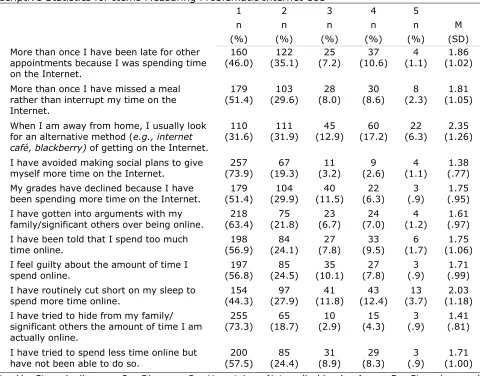
5=strongly agree). The descriptive statistics are presented in Table 1. A summated score using these 11 items was computed and used for regression analysis. This scale was found to be internally consistent, with a Cronbach’s alpha reliability coefficient of .847.
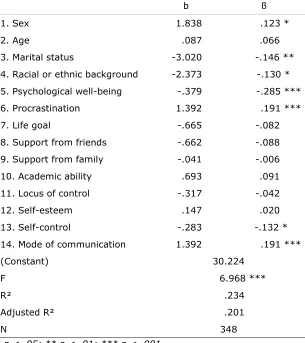
To explore the major determinants of PIU among the respondents, a multiple OLS regression model was constructed using 14 predictor variables.2 The regression model for problematic
internet use as shown in Table 2 was found to be statistically significant (F(14, 333)=6.968,
p<.001) and accounted for 20.1% of the variation. Sex (β=.123, p<.05), marital status (β=-.147,
p<.01), ethnicity (β=-.130, p<.05), emotional well-being (β=.285, p<.001), procrastination (β=.191, p<.001), self-control (β=-.132, p<.05), and internet as a mode of communication (β=.191,
p<.005) were found to be significantly associated with engagement in PIU. Specifically, male respondents and those who were single, non-Caucasian, reported academic procrastination, scored lower on emotional well-being scale, demonstrated lower levels of self-control, and considered the Internet as an important mode of communication were more likely to engage in PIU.
Table 1
Descriptive Statistics for Items Measuring Problematic Internet Use
1 2 3 4 5
n n n n n M
(%) (%) (%) (%) (%) (SD) a. More than once I have been late for other
appointments because I was spending time on the Internet.
160 (46.0) 122 (35.1) 25 (7.2) 37 (10.6) 4 (1.1) 1.86 (1.02)
b. More than once I have missed a meal rather than interrupt my time on the Internet.
179
(51.4) (29.6) 103 (8.0) 28 (8.6) 30 (2.3) 8 (1.05) 1.81
c. When I am away from home, I usually look for an alternative method (e.g., internet
café, blackberry) of getting on the Internet.
110
(31.6) (31.9) 111 (12.9) 45 (17.2) 60 (6.3) 22 (1.26) 2.35
d. I have avoided making social plans to give
myself more time on the Internet. (73.9) 257 (19.3) 67 (3.2) 11 (2.6) 9 (1.1) 4 (.77) 1.38 e. My grades have declined because I have
been spending more time on the Internet.
179 (51.4) 104 (29.9) 40 (11.5) 22 (6.3) 3 (.9) 1.75 (.95) f. I have gotten into arguments with my
family/significant others over being online. (63.4) 218 (21.8) 75 (6.7) 23 (7.0) 24 (1.2) 4 (.97) 1.61 g. I have been told that I spend too much
time online. (56.9) 198 (24.1) 84 (7.8) 27 (9.5) 33 (1.7) 6 (1.06) 1.75 h. I feel guilty about the amount of time I
spend online. (56.8) 197 (24.5) 85 (10.1) 35 (7.8) 27 (.9) 3 (.99) 1.71 i. I have routinely cut short on my sleep to
spend more time online. (44.3) 154 (27.9) 97 (11.8) 41 (12.4) 43 (3.7) 13 (1.18) 2.03 j. I have tried to hide from my family/
significant others the amount of time I am actually online.
255
(73.3) (18.7) 65 (2.9) 10 (4.3) 15 (.9) 3 (.81) 1.41
k. I have tried to spend less time online but
have not been able to do so. (57.5) 200 (24.4) 85 (8.9) 31 (8.3) 29 (.9) 3 (1.00) 1.71
Discussion
Consistent with previous studies that underlined the significance of psychological variables such as loneliness (Bozoglan, Demirer, & Sahin, 2013; Kim, LaRose, & Peng, 2009) and depression (Chen & Lin, 2016; Fortson, Scotti, Chen, Malone, & Del Ben, 2007; Moreno, Jelenchick, & Breland, 2015) on internet use, the present study has found that lower level of psychological well-being emerged to be the strongest predictor of PIU. As in prior studies (Mohammadi, 2015; Odaci, 2011), the association between academic procrastination and PIU was also revealed. There is a substantial amount of empirical evidence demonstrating low self-control as a major cause of a wide range of impulsive and risk-taking behaviour (Gottfredson & Hirschi, 1990). This analysis ascertains the strong association between lower level of self-control and the outcome variable (Akın, Arslan, Arslan, Uysal, & Sahranç, 2015; Kim, LaRose, & Peng, 2009; Mehroof & Griffiths, 2010; Muusses, Finkenauer, Kerkhof, & Righetti, 2015). As expected, respondents who relied heavily on the Internet as a mode of communication were more likely to engage in PIU (van den Eijnden, Meerkerk, Vermulst, Spijkerman, & Engels, 2008).
Table 2
Unstandardized and Standardized Ordinary Least-squares Regression Coefficients for Effects of Socio-demographic & Background Variables on Problematic Internet Use
b ß
1. Sex 1.838 .123 *
2. Age .087 .066
3. Marital status -3.020 -.146 ** 4. Racial or ethnic background -2.373 -.130 * 5. Psychological well-being -.379 -.285 *** 6. Procrastination 1.392 .191 *** 7. Life goal -.665 -.082 8. Support from friends -.662 -.088 9. Support from family -.041 -.006 10. Academic ability .693 .091 11. Locus of control -.317 -.042 12. Self-esteem .147 .020 13. Self-control -.283 -.132 * 14. Mode of communication 1.392 .191 ***
(Constant) 30.224
F 6.968 ***
R² 00.234
Adjusted R² 00.201
N 348
Regarding socio-demographic variables, this survey corroborates findings from earlier studies that male respondents were more likely to engage in PIU (Demirer & Bozoglan, 2016; Morahan-Martin & Schumacher, 2000; Poushter, 2016). Marital status also emerged to be a significant predictor. It is conceivable that single students might have fewer family responsibilities and more free time to use the Internet than the single counterparts. Finally, the finding that non-Caucasian students were more likely to engage in PIU requires further research attention. In fact, emerging evidence shows notable cultural differences among problematic internet users (Chen & Nath, 2016; Cheng & Li, 2014).
Conclusion
In conclusion, it is vital to identify students who engage in PIU. Results from this preliminary analysis should be of interest to academic advisors, counselors, and educators. The findings may be used to design intervention programs to help students control their excessive internet use. As the current findings are limited by the cross-sectional design of the study and the use of a non-random sample of students, causal interpretations must be made cautiously. A further limitation of the present study concerns the reliance on self-reported measures of PIU. Future studies need to further develop the diagnostic criteria for PIU among university students in light of the changing technology. Other predictor variables such as personality traits should be taken into consideration. It will also be worthwhile to investigate the positive effects of students’ use of the Internet and other digital technology.
Acknowledgements
This survey was conducted under the auspices of the Department of Sociology and Social Studies at the University of Regina. Acknowledgement is due to Sam Hage, Christine Andrews, Michelle Biden, Giustina Di Paolo, Krystal Glowatski, Danielle Loire, Charlotte Morrissette, Katherine Morrissette, Joanne Ogilvie, Morayo Oladele, Mari Petroski, Tyler Plomp, Tara Schuster, Jesse Scobie, Curtis Shuba, Cris Soica, Daniel Way, Adam Belton, and Stephen Wang for their research assistance, and to Thomson Yu, Chap-ning Wong, Yau-tsang Chan, Simon Kwan, Sutton Cheung, Samuel Wong, Shue-ho Chow, She-wing Chow, and Angel Chow for their unwavering support.
References
Akın, A., Arslan, S., Arslan, N., Uysal, R., & Sahranç, Ü. (2015). Self-control management and internet addiction. International Online Journal of Educational Sciences, 7(3), 95-100. doi:
10.15345/iojes.2015.03.016
Anderson, K. (2001). Internet use among college students: An exploratory study. Journal of American College Health, 50(1), 21-26. doi:10.1080/07448480109595707
Bozoglan B., Demirer V., & Sahin, I. (2013). Loneliness, self-esteem, and life satisfaction as predictors of Internet addiction: A cross-sectional study among Turkish university students. Scandinavian Journal of Psychology, 54, 313-319. doi:10.1111/sjop.12049
Chen, L., & Nath, R. (2016). Understanding the underlying factors of Internet addiction across -cultures: A comparison study. Electronic Commerce Research and Applications, 17, 38-48.
Chen, S. K., & Lin, S. S. J. (2016). A latent growth curve analysis of initial depression level and changing rate as predictors of problematic Internet use among college students. Computers in Human Behavior, 54, 380-387. doi: 10.1016/j.chb.2015.08.018
Cheng, C., & Li, A. Y. (2014). Internet addiction prevalence and quality of (real) life: A meta-analysis of 31 nations across seven world regions. Cyberpsychology, Behavior, and Social Networking, 17(12), 755-760. doi: 10.1089/cyber.2014.0317
Chow, H. P. H., Hage, S., & Jurdi, R. (2012). Internet use, study habits, academic procrastination, physical activity, and health status: A survey of university students in Regina. Regina: University of Regina.
Demirer, V., & Bozoglan, B. (2016). Purposes of internet use and problematic internet use among Turkish high school students. Asia-Pacific Psychiatry, 8, 269-277. doi: 10.1111/appy.12219
van den Eijnden, R. J., Meerkerk, G. J., Vermulst, A. A., Spijkerman, R., & Engels, R. C. (2008). Online communication, compulsive internet use, and psychosocial well-being among adolescents: A longitudinal study. Developmental Psychology, 44(3), 655-665. doi: 10.1037/0012-1649.44.3.655 Fortson, B. L., Scotti, J. R., Chen, Y. C., Malone, J., & Del Ben, K. S. (2007). Internet use, abuse, and
dependence among students at a southeastern regional university. Journal of American College Health, 56(2), 137-144. doi: 10.3200/JACH.56.2.137-146
Gottfredson, M., & Hirschi, T. (1990). A General Theory of Crime. Stanford University Press. Gür, K., Yurt, S., Bulduk S., & Atagöz, S. (2015). Internet addiction and physical and psychosocial
behavior problems among rural secondary school students. Nursing and Health Sciences, 17, 331-338. doi: 10.1111/nhs.12192
Hetzel-Riggin, M. D., & Pritchard, J. R. (2011). Predicting problematic internet use in men and women: The contributions of psychological distress, coping style, and body esteem. Cyberpsychology, Behavior, and Social Networking, 14(9), 519-525. doi: 10.1089/cyber.2010.0314
Kim, J., LaRose, R., & Peng, W. (2009). Loneliness as the cause and the effect of problematic internet use: The relationship between internet use and psychological well-being. Cyber Psychology & Behavior, 12(4), 451-455. doi: 10.1089/cpb.2008.0327
Lam, L. T., & Lam, M. K. (2016). eHealth Intervention for Problematic Internet Use. Current Psychiatry Report, 18, 107. doi: 10.1007/s11920-016-0747-5
Mehroof, M., & Griffiths, M. D. (2010). Online gaming addiction: The role of sensation seeking, self-control, neuroticism, aggression, state anxiety, and trait anxiety. Cyber Psychology and Behavior, 13(3), 313–317. doi: 10.1089/cyber.2009.0229
Muusses, L. D., Finkenauer, C., Kerkhof, P., & Righetti, F. (2015). Partner effects of compulsive internet use: A self-control account. Communication Research, 42, 365-386. doi: 10.1177/0093650212469545 Mohammadi, M. (2015). The relationship between Internet use and academic procrastination of EFL
learners across years of study. International Journal of Applied Linguistics & English Literature, 4(1), 1-11. doi: 10.7575/aiac.ijalel.v.4n.1p.231
Morahan-Martin, J., & Schumacher, P. (2000). Incidence and correlates of pathological internet use among college students. Computers in Human Behavior, 16, 13-29. doi:
10.1016/S0747-5632(99)00049-7
Moreno, M. A., Jelenchick, L. A., & Breland, D. J. (2015). Exploring depression and problematic internet use among college females: A multisite study. Computers in Human Behavior, 49, 601-607. doi: 10.1016/j.chb.2015.03.033
Odaci, H. (2011). Academic self-efficacy and academic procrastination as predictors of problematic internet use in university students. Computers & Education, 57, 1109-1113. doi:
10.1016/j.compedu.2011.01.005
Poushter, J. (2016). Smartphone Ownership and Internet Usage Continues to Climb in Emerging Economies. Pew Research Center.
Eurasian Journal of Educational Research, 54, 135-150. doi: 10.14689/ejer.2014.54.8
Snyder, S. M., Li, W., O’Brien, J. E., & Howard, M. O. (2015). The effect of U.S. university students' problematic internet use on family relationships: A mixed-methods investigation. PLoS One, 10(12), 1-13. doi: 10.1371/journal.pone.0144005
Statistics Canada (2012, November 26). Canadian internet use survey. The Daily.Retrieved from: http://www.statcan.gc.ca/daily-quotidien/131126/dq131126d-eng.htm
Weinstein, A., & Lejoyeux, M. (2010). Internet addiction or excessive internet use. The American Journal of Drug and Alcohol Abuse, 36, 277-283. doi: 10.3109/00952990.2010.491880
Notes
1 This survey was approved by the university’s Ethics Review Board. Although the respondents were recruited from Sociology and Social Studies classes, they were officially registered with the Faculties of Business Administration, Arts, Education, Fine Arts, Kinesiology & Health Studies, Science, Social Work, and Applied Science & Engineering.
2 Fourteen predictor variables were used in the regression model for problematic internet use: Sex (1=male; 0=female), marital status (1=single or never married; 0=other) and ethnicity (1=Caucasian; 0=other) were categorical variables. Age was measured in years (M=21.69, SD=5.28). Support from friends was based on respondents’ degree of agreement or disagreement with the statement “The support I receive from friends meet my needs” (M=3.65, SD=.93) on a 5-point scale (1=strongly disagree to 5=strongly agree). Family support was based on respondents’ degree of agreement or disagreement with the statement “The support I receive from family members meet my needs” (M=3.91, SD=1.03) on a 5-point scale (1=strongly disagree to 5=strongly agree). Psychological well-being was a summated score (M=18.11, SD=5.09) based on respondents’ frequency of feeling sad, lonely, stressed, like crying,
depressed, hopeless, and angry in the past 30 days on a 5-point scale (1=never to 5=very frequently). This 7-item scale has a Cronbach’s alpha reliability coefficient of .825. Self-control was a composite score (M=8.95, SD=3.23) based on respondents’ degree of agreement or disagreement with four statements using a 5-point scale (1=strongly disagree to 5=strongly agree): (1) I lose my temper quite easily; (2) I often behave in a reckless manner; (3) I will try almost anything regardless of the consequences; and (4) I usually say the first things that come into my mind. This 4-item scale has a Cronbach’s alpha reliability coefficient of .695. Procrastination (M=3.78, SD=.956) was based on how frequently was procrastination a factor which prevented the respondents from studying using a 5-point scale ranging from 1 (almost never) to 5 (almost always). Life goal (M=4.01, SD=.86) was based on respondents’ agreement or disagreement with the statement “I have a set of achievable goals for my future” using a 5-point scale (1=strongly disagree to 5=strongly agree). Academic ability (M=3.76, SD=.91) was based on respondents’ degree of agreement or disagreement with the statement “My academic ability is strong” using a 5-point scale (1=strongly disagree to 5=strongly agree). Locus of control (M=3.89, SD=.92) was based on