Original Research Article
A Study to Assess the Effectiveness of Planned
Teaching Programme Regarding Prevention of
Cervical Cancer in Terms of Knowledge and
Attitude among Women of Reproductive Age Group
in Selected Rural Community of Delhi
Ms Nidhi Dagar
Nursing Officer, Bhagwan Mahavir Hospital, Pitampura, New Delhi
ABSTRACT
Introduction: Cancer of cervix is a common malignancy among women especially in the lower socio economic group. A major cause of concern to health care system in the developing countries is to enforce surveillance programmes thereby detecting cancer cervix in later advanced stage.
Materials and methods: The research approach adopted for the study was evaluative and educative with one group pre-test post-test design. The population comprised of women residing in TilangPurKotla New Delhi. Convenient sampling technique was used to select a sample of 60 women of reproductive age group. The tool consisted of structured interview schedule. The women of reproductive age group who participated in the study were given a pre test and planned health education given. Post test was conducted on 7th day.
Results: Percentage of women having adequate knowledge increased from 0% to 63.34% after giving planned teaching program. Whereas 18.33% population reported inadequate Knowledge Post test and 18.33% population have moderate knowledge post test. Post test knowledge score improved 38.46% after planned teaching program. T-ratio was statistically significant as the obtained value (32.11) is higher than the tabulated value (2.00) required for t-ratio to be significant at .05 level of confidence. Maximum of the participants got benefitted from the planned teaching programme on changing their attitude towards prevention of cervical cancer. There was a significant difference between pre test and post test knowledge and attitude regarding prevention of cervical cancer and between post test knowledge and post test attitude regarding prevention of cervical cancer among women of reproductive age group. Thus hypothesis 1 & 2 were accepted. Chi-square values of post test knowledge score with demographic variables were age 11.09 which was significant whereas chi-square values with other variables like educational qualification (4.2); occupation (1.4); income group (3.1); marital status (0.9) and number of children (7.3) were not significant. This indicates that H3 is partially accepted with age only. Chi-square values of post test attitude score with demographic variables age (4.86) educational qualification (6.3); occupation (4.6); income group (1.5); marital status (1.7) and number of children (4.4) were not significant. This indicates that H4 is rejected and null hypothesis is accepted.
Conclusion: Planned health education programme on cancer cervix was found to be effective.
Key Words: Knowledge, attitude, correlation, association, planned teaching program
INTRODUCTION
Cancer of cervix is a common malignancy among women especially in the
Rural Community of Delhi
can occur as early as age 18 years. Risk factors vary from multiple sex partners to smoking to chronic cervical infection.
Herald ZurHauzen was awarded with noble prize for medicine in 2008 for his effort in identifying HPV as the causative agent for cancer of cervix.
Cervical cancer is a fully preventable, curable at low cost and at low risk when screening to facilitate the timely dictation of early precursor lesion in asymptomatic women is available together with appropriate diagnosis, treatment, and follow-up.
Cervical cancer has a long latent phase and can be prevented easily by early detection by using various screening procedure like Pap smear, HPV, DNA testing and visual inspection of cervix neither requires a second person for interpretation of result nor second visit by the patient to collect the reports and CT allows the use of “Screen and Treat” methodology reported by alliance by cervical cancer.
Women Health is a unique specialty of health care. Women are becoming more and more aware of their health status as a result of modern education, electronic, print media and health agencies .while women have made progress in most of the field but still she tends to inexplicably neglect her own health .Though in the present age women are aware of their problems, the readiness to seek help from health personnel is hindered by economic constraints social stigma and rigid superstitious beliefs regarding health problems.
Invariably most common Health problem seen among women is cervical cancer. Cervical cancer has a major impact on women lives worldwide. It is the second most common cancer and is the major cause of mortality among Indian women. Cervical cancer creates long term problems for families and challenge for Health care systems.
The chance of an individual developing cancer depends on both genetic & non genetic factors. A genetic factor is an
inherited. Unchangeable trait, while a non-genetic factor is a variable in a person’s environment. Which can after be changed. Non genetic factors may include diet, exercise or exposure to other substances present in our surroundings. These non-genetic factors are often referred to as environmental factors.
The most important cause of cervical cancer is infection with a high risk type of human papilloma virus. The types HPV most commonly linked with cervical cancer are HPV 16 and HPV 18, but several other high risk types contribute to cancer as well. HPV infection is extremely common and generally occurs soon after an individual becomes sexually active.
Cervical cancer screening program is acknowledged currently as the most effective approach for cervical cancer control. Cervical cancer prevention has focused on screening sexually active women using different diagnostic test and control.
Nurses have a vital role in significantly reducing the incidence of cancer by teaching healthy life style, attitudes as well as risk, prevention and early diagnosis. WHO has warned that India is the next hub for cancer? 38 new cancer centers will be linked to district hospital. ANM’s are being trained to identify warning signs of cancer.
Objectives of the Study
1. To assess the existing knowledge of women of reproductive age group regarding prevention of cervical cancer. 2. To assess the attitude regarding
prevention of cervical cancer among the women of reproductive age group. 3. To evaluate the effectiveness of planned
teaching program regarding prevention of cervical cancer on knowledge and attitude of women of reproductive age group.
Rural Community of Delhi
5. To associate the post test knowledge and post test attitudes of women of reproductive age group regarding prevention of cervical cancer with selected demographic variables.
METHODOLOGY
Evaluative research approach was adopted for the study.
Research Design was pre-experimental one group pre –test, post-test design was selected for the study by including planned health education programme regarding prevention of cancer cervix as an intervention. (O1 x O2)
The conceptual framework is based on King Imogene theory of goal attainment. Research Setting was Village TilangPurKotla New Delhi. VillDhansa, New Delhi was selected for the pilot study.
Population:- The population comprised of women residing in TilangPurKotla New Delhi.
Sample size was 60 women of reproductive age group.
Sampling technique- convenient sampling technique. Sampling criteria for inclusion included Women who are residing in the selected rural area. Women of reproductive age group who were willing to participate in the study. Women who can understand and speak Hindi
Variables under study were
Dependant variables: Are knowledge and attitude of women of reproductive age group regarding prevention of cervical cancer as evident from structured knowledge questionnaire and attitude scale.
Independent variables: planned teaching program regarding prevention of cervical cancer among women of reproductive age group.
Extraneous variables: age, sex,
occupation, religion, income, age of marriage, age of menarche, no. of children if married
Research hypothesis:
H1: there is a significant difference between pre test and post test knowledge and attitude
regarding prevention of cervical cancer among women of reproductive age group.
H2: there is a significant co relation between
post test knowledge and post test attitude regarding prevention of cervical cancer among women of reproductive age group.
H3: There is a significant association of post test knowledge score among women of reproductive age group with the selected demographic variables.
H4: There is a significant association of post test attitude score among women of reproductive age group with the selected demographical variables.
Extensive literature review was done on literature related to cervical cancer – prevalence, causes, risk factors, signs and symptoms, prevention and knowledge and attitude; effectiveness of planned teaching programme.
Data collection tool & technique: consisted of structured interview schedule of six parts: Part 1: Demographic Data (07 items); Part B: Structured knowledge questionnaire regarding Prevention and Control Of cancer of cervix (24 items). Reliability co-efficient of structured knowledge questionnaire and of attitude scale was calculated by using Split half Spearman’s – Brown formula. The reliability of knowledge questionnaire was found to be 0.85; attitude scale was 0.73 and were found to be reliable.
The data collected was tabulated in a master sheet. Descriptive and inferential statistics was used for analysis and interpretation.
The health education programme was developed under the following headings:
Section-A (Introduction of Cancer of Cervix)
Section-B (Pathology of Cancer of Cervix) Section-C (sign and symptom, and diagnosis of cancer of cervix)
Section-D (Prevention and Management of Cancer of Cervix)
Rural Community of Delhi
study revealed there was significant improvement in the post test knowledge and attitude of the women of reproductive age group regarding prevention of cervical cancer with signifies the feasibility to conduct the main study. No problem was faced during the pilot study.
Data collected from 01 Nov 2014 to 08 Nov 2014.
Demographic data -
Age: The findings revealed 60.0%(36) Women of reproductive age group was in the age group of 20-30 years, 33.33%(20) Women of reproductive age group was found in the age group of 31-40 years, and 6.67%(4) was found in the age group of between 41 - 45 years.
Qualification: The findings revealed that 20% (12) Women of reproductive age group are Illiterate, 56.66% (34) Women of reproductive age group are studied Upto 12 and 11.67% (7) Graduate and 11.66% (7) Women of reproductive age group are >graduate.
Occupation: It was found that 5.00% (3) Women of reproductive age group in Private sector, 11.67% (7) Women of reproductive age group are working in Government sector, and 83.337% (50) Women of reproductive age group are Housewife and no respondent is found employed in any other field.
Fig:1 Percentage distribution of women of reproductive age group according to age
Fig 2: Percentage distribution of women of reproductive age group according to education qualification
Fig 3: Percentage distribution of women of reproductive age group according to occupation.
Religion: The study findings revealed that 100% (60) women who participated in this study are Hindu.
Fig 4: Percentage distribution of women of reproductive age group according to religion
Rural Community of Delhi
Fig 5: Percentage distribution of women of reproductive age group according to income.
Marital Status: the findings revealed that 93.33 % (56) Women of reproductive age group are Married, 6.6% (4) Women of reproductive age group are Widow.
Fig 6: Percentage distribution of the women of reproductive age group according tomarital status.
No. of Children: It was found that 45.00% (27) Women of reproductive age group have one child, 51.67% (31) Women of reproductive age group have two children, and 3.337% (2) Women of reproductive age group have three children and no respondent has more than four children.
Fig 8: Percentage distributions of the women of reproductive age group according to age of menarche.
Age at Menarche: The study findings revealed that 8.3%(5) Women of reproductive age group reported age of menarche <12 Age , 43.3%(26) Women of reproductive age group reported age of menarche 12-14 age, and 48.34% (29) Women of reproductive age group reported age of menarche 15-18 age and no respondent reported age of menarche more than 18 years.
The data presented in Table 1 shows that the Percentage of women having adequate knowledge increased from 0% to 63.34% after giving planned teaching program. Whereas 18.33% population reported inadequate Knowledge Post test and 18.33% population have moderate knowledge post test.
Table 2 showed increase in the mean score in all aspects of knowledge along with decrease in standard deviation. That means plan teaching program is an effective tool to increase knowledge of the women regarding prevention of cervical cancer.
Table 3 shows Effectiveness of planned teaching program among Women of reproductive age group in improving Knowledge scores regarding prevention of cervical cancer. Post test knowledge score improved 38.46% after planned teaching program. T-ratio was statistically significant as the obtained value (32.11) is higher than the tabulated value (2.00) required for t-ratio to be significant at .05 level of confidence.
From Table 4, it was evident that shows pre test and post test comparison of attitude scores of women of reproductive age group. Maximum of the participants got benefitted from the planned teaching programme on changing their attitude towards prevention of cervical cancer.
Table 1: Comparison of pre test and post test level of knowledge N = 60
Level of Knowledge
Pre Test Post Test
Frequency Percentage (%) Frequency Percentage (%)
Inadequate 60 100 11 18.33
Moderate 0 0 11 18.33
Adequate 0 0 38 63.34
Rural Community of Delhi
Table 2: Comparison of pre test and post range, mean, standard deviation of various aspects of knowledge score N = 60
Aspects of Knowledge Max
score
Respondent knowledge (Pre test)
Respondent knowledge (Post test)
Mean SD Mean SD
General Information regarding cervical cancer 7 3.8 1.49 6.4 0.71 Predisposing factors and sign and symptoms of cervical cancer 8 3.52 1.265 7.43 0.69 Prevention and management of cervical cancer 9 3.58 1.23 8.42 0.94
Table 3: Effectiveness of prevention of cervical cancer by comparing pre and post mean % and S.D. scores of knowledge score. N = 60
Pre test (X) Post(Y) Effectiveness (Y-X) Observed
T – value
Mean S.D Mean S.D Mean S.D
10.90 2.21 22.13 1.58 11.21 0.63 32.1
Table 4: Comparison of pre test and post test attitude score of women of reproductive age group N = 60 Level of
Attitude
Pre test Post test
Frequency Percentage (%) Frequency Percentage (%)
Inadequate 0 0 14 23.3
Moderate 60 100% 19 31.6
Adequate 0 0 27 45
Overall 60 100 60 100
Table 5: Effectiveness of planned teaching program regarding prevention of cervical cancer by comparing pre test and post test scores attitude scale. N = 60
Attitude Max Score
Pre test Post test “t”
value
Mean SD Mean SD
Attitude score.
80 51.6 4.1 71.7 4.03 26.7 *
Significant
Table 6: Correlation co-efficient between post test knowledge and post- test attitude scores of women of reproductive age group N = 60
Variable Mean SD „r‟
Post-test knowledge scores 22.1 1.5 .4 Post-test attitude scores 71.5 3.9
* Significant positive correlation
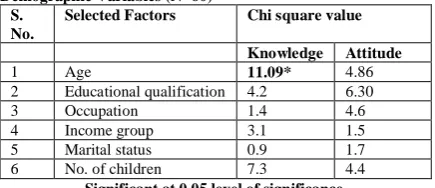
Table 7: Chi Square Values Showing Association between Post-test knowledge and attitude Scores with Selected Demographic Variables (N=60)
S. No.
Selected Factors Chi square value
Knowledge Attitude
1 Age 11.09* 4.86
2 Educational qualification 4.2 6.30
3 Occupation 1.4 4.6
4 Income group 3.1 1.5 5 Marital status 0.9 1.7 6 No. of children 7.3 4.4
Significant at 0.05 level of significance
Data presented in Table 5, indicates Mean & S.D of Pre Vs Post test Attitude scores of Women of reproductive age group regarding prevention of cervical cancer at selected Rural Community in Delhi.., i.e. Pre group are 51.65±4.18, Post are 71.75±4.03. As per the table the mean difference of pre Vs post attitude score is 19.9. There is 24.9% more effective attitude scoring after administering planned teaching program. And the t-value was statistically
significant as the obtained value (26.76) is higher than the tabulated value (2.00) required for t-value to be significant at .05 level of confidence.
The data presented in Table 6, depicts the Correlation Co-efficient between Post-Test knowledge and Post- Test attitude scores of woman of reproductive age group. r was 0.4 which indicated a significant positive relationship between knowledge and attitude of woman of reproductive age group regarding prevention of cervical cancer. This showed that the planned teaching program was effective in enhancing the knowledge as well as developing highly favorable attitude towards prevention of cervical cancer among women of reproductive age group. Research hypothesis H2 was accepted. Hence it can be concluded that planned teaching program for women of reproductive age group regarding prevention of cervical cancer is a tool in increasing knowledge and attitude.
Rural Community of Delhi
significant whereas chi-square values with other variables like educational qualification (4.2); occupation (1.4); income group (3.1); marital status (0.9) and number of children (7.3) were not significant. This indicates that H3 is partially accepted with age only.
Chi-square values of post test attitude score with demographic variables were age (4.86) educational qualification (6.3); occupation (4.6); income group (1.5); marital status (1.7) and numbers of children (4.4) were not significant. This indicates that H4 is rejected and null hypothesis is accepted.
DISCUSSION
IJ Korfage, et al conducted a study to assess the health-related quality of life (HRQoL) impact of cervical cancer screening in women with normal test results in Maastricht, the Netherlands. A cohort of 789 women was followed from screening invitation until after the receipt of screening results. A female age matched reference group (n = 567) were included. Questionnaires were sent to the home address of the women before screening, after screening, and again with the screening results. The results revealed that a total of 60% of screening participants completed questionnaire 1(n = 924): 803 of these women granted permission to access their files; 789 of these 803 women had normal test results (Pap 1), and were included in the analyses. Generic HRQoL (SF-12, EQ-5D) and anxiety (STAI-6) scores were similar in the study and reference groups. Before screening, after screening, and also after the receipt of test results, screening participants reported less screen-specific anxiety (PCQ, P < 0.001) than the reference group (n = 567), with differences indicating clinical relevance. 19% of screening participants were bothered by feelings of shame, pain, inconvenience, or nervousness during smear taking, and 8 and 5% of women experienced lower abdominal pain, vaginal bleeding, discharge, or urinary problems for 2–3 and 4–7 days, respectively, following the Pap smear. (1)
Beining, Robin Marie conducted a study to explore the role of awareness and knowledge of cervical cancer as a barrier to screening participation among urban women in Tamil Nadu; and further to identify the potential impact of increased cervical cancer awareness and knowledge on screening attitude. Quantitative and qualitative methods were used to characterize existing levels of awareness and knowledge of cervical cancer and screening among 207 women from the metropolitan area of Chennai. The results suggest that the majority of women (69.6%) were not aware of cervical cancer and very few (16.4%) were aware of screening. Demographically, women with secondary levels of education or higher were significantly more likely to have heard of cervical cancer and screening. Of the women that were aware of cervical cancer screening, most reported receiving information through television (33%) or a healthcare provider (28.6%). (2)
M Urasaand E Darj conducted a study to determine nurses' awareness of cervical cancer and their own screening practices at a hospital in Tanzania. A descriptive cross sectional study using questionnaires on 137 nurses. The study findings revealed that less than half of the nurses had adequate knowledge regarding cervical cancer. There was a significant association between knowledge levels of causes of cervical cancer and transmission of HPV and age. Knowledge was more adequate among the young nurses (p = 0.027) and knowledge differed significantly between cadres. Registered nurses had more adequate knowledge than enrolled nurses. The majority did not know screening intervals and a few were aware of HPV vaccine. Most nurses (84.6%) had never had a Pap smear examination. This reflected a need for continuing medical education, creation of cervical cancer prevention policies and strategies at all levels of the health sector. (3)
Rural Community of Delhi
of women residing in two urban slums of Lagos, Nigeria. Multistage sampling was used to select 240 women who were interviewed with a structured questionnaire. The results revealed that only 10 (4.2%) women in this study were aware of cervical cancer and none of them believed they were at risk of developing the disease. Most (73.3%) were willing to undergo a cervical cancer screening test. Age, education and previous history of vaginal examination were positively associated with willingness to undergo screening (p <0.05). The respondents had a high prevalence of major risk factors for cervical cancer such as early age at sexual debut, multiple sexual partners and male partner with other female partners. The authors concluded that efforts need to be intensified to increase awareness of this condition and to promote low-cost cervical cancer screening among this underserved population. (4)
Sawitree Visanuyothin, et al conducted a cross-sectional study to examine the factors associated with cervical cancer screening adherence. Stratified sampling with the proportional to size method was used to select registered women aged 30–60 years. 96.2% of self-administered questionnaires were returned. Approximately 65.4% of the women were considered to be adherent to cervical cancer screening (i.e., maintainers) as defined by at least one screening within the recommended 5-year screening interval and the expectation of attending a screening in the future. Chi-square tests revealed that occupation, marital status, number of children, sexual activity, health insurance scheme, history of oral contraceptive pill use, perceived barriers, perceived benefits, and knowledge about cervical cancer prevention were significantly associated with cervical cancer screening adherence. After adjusting for occupation, marital status, number of children, and health insurance in the model, perceived barriers and knowledge remained significant predictors of cervical cancer screening adherence. The findings suggested that the
non-housewives, women of single/ separated/ divorced/widowed status, and women with no children should be the first priorities for getting Pap tests. Strategies included promoting the use of mobile units for cervical cancer screening, and strengthening and promoting educational programmes. (5)
Langley and Mary conducted an exploratory, descriptive survey at a Radiation Oncology Outpatient Department of a large academic hospital in Gauteng. With an aim to explore and describe the action patients had taken when they noticed symptoms, which they consulted, how many health care providers they saw before the diagnosis, their awareness of the Pap smear, the stage of the disease they presented with and to identify their predisposing factors. Data was obtained using a questionnaire on a systemic random sample. The findings showed most of the participants were diagnosed at advanced stages of cervical cancer, 54% (n=65) at stage 2b and 22% (n=26) at stage 3b of cervical cancer Most went to a clinical facility when they noticed symptoms: 45% (n=55) to a hospital and 42% (n=52) to a clinic. Almost half of the respondents: 49% (n=57), did not know what caused the symptoms, a similar number (n=57) took some time to consult a clinician after noticing symptoms and 53 (n=60) knew what a Pap-smear was but had only had it done when they became ill. The study revealed that women’s general knowledge of cancer of the cervix is very poor. It was apparent that the health care facilities are effective in performing Pap smears as the majority of the participants saw only two health care providers before the diagnosis was made. (6)
CONCLUSION
Knowledge deficit and unfavorable attitude existed regarding prevention of cervical cancer among women of reproductive age group.
Rural Community of Delhi
attitude of the women of reproductive age group.
There was an increase in knowledge scores of women of reproductive age group regarding prevention of cervical cancer among women of reproductive age group after administration of planned teaching program.
There was development of desirable favorable attitude of women of reproductive age group regarding prevention of cervical cancer among women of reproductive age group after administration of planned teaching program.
The planned health education programme was found to be effective in increasing the knowledge and developing favorable attitude of the women of reproductive age group regarding cancer cervix.
REFERENCES
1. IJ Korfage, M van Ballegooijen, B Wauben,
CWN Looman, JDF Habbema, M-L Essink-Botc. Having a Pap smear, quality of life before and after cervical screening: a questionnaire study. DOI: 10.1111/j.1471-0528.2012.03344.x www.bjog.org
2. Beining, Robin Marie. "Screening for cervical cancer: an exploratory study of urban women in Tamil Nadu, India." PhD (Doctor of Philosophy) thesis, University of Iowa, 2012. http://ir.uiowa.edu/etd/2820. 3. M Urasaand E DarjKnowledge of cervical
cancer and screening practices of nurses at a regional hospital in Tanzania. Afr Health Sci. 2011 Mar; 11(1): 48–57.
4. Balogun MR, Odukoya OO, Oyediran MA
and Ujomu PI. Cervical Cancer Awareness and Preventive Practices: A Challenge for Female Urban Slum Dwellers in Lagos, Nigeria. African Journal of Reproductive Health March 2012; 16(1): 75.
5. Sawitree Visanuyothin, Jiraporn
Chompikul, Aroonsri Mongkolchati.
Determinants of cervical cancer screening adherence in urban areas of Nakhon Ratchasima Province, Thailand. Journal of Infection and Public Health. November–
December 2014, 8(6); 5543-552.
https://doi.org/10.1016/j.jiph.2015.04.018
6. Gayle Langley and Nonhlanhla Mary.
Health Seeking Behaviours of Women with Cervical Cancer. J Community Med Health Educ 2012, 2:8 DOI: 10.4172/2161-0711.1000170.
******