Optimizing Textual Entailment Recognition Using Particle Swarm
Optimization
Yashar Mehdad
University of Trento and FBK - Irst Trento, Italy
Bernardo Magnini
FBK - Irst Trento, Italy [email protected]
Abstract
This paper introduces a new method to im-prove tree edit distance approach to tex-tual entailment recognition, using particle swarm optimization. Currently, one of the main constraints of recognizing textual en-tailment using tree edit distance is to tune the cost of edit operations, which is a dif-ficult and challenging task in dealing with the entailment problem and datasets. We tried to estimate the cost of edit operations in tree edit distance algorithm automati-cally, in order to improve the results for textual entailment. Automatically estimat-ing the optimal values of the cost opera-tions over all RTE development datasets, we proved a significant enhancement in accuracy obtained on the test sets.
1 Introduction
One of the main aspects of natural languages is to express the same meaning in many possible ways, which directly increase the language variability and emerges the complex structure in dealing with human languages. Almost all computational lin-guistics tasks such as Information Retrieval (IR), Question Answering (QA), Information Extrac-tion (IE), text summarizaExtrac-tion and Machine Trans-lation (MT) have to cope with this notion. Textual Entailment Recognition was proposed by (Dagan and Glickman, 2004), as a generic task in order to conquer the problem of lexical, syntactic and se-mantic variabilities in languages.
Textual Entailment can be explained as an as-sociation between a coherent text (T) and a lan-guage expression, called hypothesis (H) such that entailment function for the pair T-H returns the true value when the meaning of H can be inferred from the meaning of T and false, otherwise.
Amongst the approaches to the problem of tex-tual entailment, some methods utilize the
no-tion of distance between the pair of T and H as the main feature which separates the entailment classes (positive and negative). One of the suc-cessful algorithms implemented Tree Edit Dis-tance (TED), based on the syntactic features that are represented in the structured parse tree of each string (Kouylekov and Magnini, 2005). In this method the distance is computed as the cost of the edit operations (insertion, deletion and substi-tution) that transform the text T into the hypothesis H. Each edit operation has an associated cost and the entailment score is calculated such that the set of operations would lead to the minimum cost.
Generally, the initial cost is assigned to each edit operation empirically, or based on the ex-pert knowledge and experience. These methods emerge a critical problem when the domain, field or application is new and the level of expertise and empirical knowledge is very limited. In dealing with textual entailment, (Kouylekov and Magnini, 2006) tried to experiment different cost values based on various linguistics knowledge and prob-abilistics estimations. For instance, they defined the substitution cost as a function of similarity between two nodes, or, for insertion cost, they employed Inverse Document Frequency (IDF) of the inserted node. However, the results could not proven to be optimal.
Other approaches towards estimating the cost of operations in TED tried to learn a generic or discriminative probabilistic model (Bernard et al., 2008; Neuhaus and Bunke, 2004) from the data, without concerning the optimal value of each op-eration. One of the drawbacks of those approaches is that the cost values of edit operations are hidden behind the probabilistic model. Additionally, the cost can not be weighted or varied according to the tree context and node location (Bernard et al., 2008).
In order to overcome these drawbacks, we are proposing a stochastic method based on Particle
Swarm Optimization (PSO), to estimate the cost of each edit operation for textual entailment prob-lem. Implementing PSO, we try to learn the op-timal cost for each operation in order to improve the prior textual entailment model. In this paper, the goal is to automatically estimate the best possi-ble operation costs on the development set. A fur-ther advantage of such method, besides automatic learning of the operation costs, is being able to in-vestigate the cost values to better understand how TED approaches the data in textual entailment.
The rest of the paper is organized as follows: After describing the TED approach to textual en-tailment in the next section, PSO optimization al-gorithm and our method in applying it to the prob-lem are explained in sections 4 and 5. Then we present our experimental setup as well as the re-sults, in detail. Finally, in the conclusion, the main advantages of our approach are reviewed and fur-ther developments are proposed accordingly.
2 Tree Edit Distance and Textual Entailment
One of the approaches to textual entailment is based on the Tree Edit Distance (TED) between T and H. The tree edit distance measure is a simi-larity metric for rooted ordered trees. This metric was initiated by (Tai, 1979) as a generalization of the string edit distance problem and was improved by (Zhang and Shasha, 1989) and (Klein, 1998).
The distance is computed as the cost of editing operations (i.e. insertion, deletion and substitu-tion), which are required to transform the text T into the hypothesis H, while each edit operation on two text fragments A and B (denoted asA → B) has an associated cost (denoted asγ (A→B)). In textual entailment context, the edit operations are defined in the following way based on the depen-dency parse tree of T and H:
• Insertion (λ → A): insert a node A from the dependency tree of H into the depen-dency tree of T. When a node is inserted it is attached to the dependency relation of the source label.
• Deletion (A → λ): delete a node A from the dependency tree of T. When A is deleted all its children are attached to the parent of A. It is not required to explicitly delete the children of A, as they are going to be either deleted or substituted in a following step.
• Substitution (A → B): change the label of a node A in the source tree into a label of a node B of the target tree. In the case of substi-tution, the relation attached to the substituted node is changed with the relation of the new node.
According to (Zhang and Shasha, 1989), the min-imum cost mappings of all the descendants of each node has to be computed before the node is encountered, so the least-cost mapping can be selected right away. To accomplish this the al-gorithm keeps track of the keyroots of the tree, which are defined as a set that contains the root of the tree plus all nodes which have a left sibling. This problem can be easily solved using recursive methods (Selkow, 1977), or as it was suggested in (Zhang and Shasha, 1989) by dynamic program-ming. (Zhang and Shasha, 1989) defined the rel-evant subproblems of treeT as the prefixes of all special subforests rooted in the keyroots. This ap-proach computes the TED (δ) by the following equations:
δ(FT, θ) =
δ(FT −rFT, θ) +γ(rFT →λ) (1)
δ(θ, FH) =
δ(θ, FH −rFH) +γ(λ→rFH) (2)
δ(FT, FH) =
min
δ(FT −rFT, FH) +γ(rFT →λ)
δ(FT, FH−rFH) +γ(λ→rFH)
δ(FT(rFT), FH(rFH))+
δ(FT −T(rFT), FH −H(rFH))+
γ(rFT →rFH)
(3)
whereFT andFHare forests ofTandH, while
rFT andrFH are the rightmost roots of the trees inFT andFH respectively. θis an empty forest. Moreover, FT(rFT) andFH(rFH) are the forests rooted inrFT andrFH respectively.
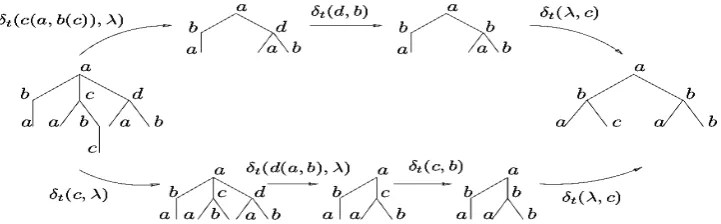
Estimating δ as the bottom line of the compu-tation is directly related to the cost of each oper-ation. Moreover, the cost of edit operations can simply change the way that a tree is transformed to another. As Figure 11 shows (Demaine et al., 2007), there could exist more than one edit script for transforming each tree to another. Based on the
Figure 1: Two possible edit scripts to transform one tree to another.
main definition of this approach, TED is the cost of minimum cost edit script between two trees.
The entailment score for a pair is calculated on the minimal set of edit operations that transform the dependency parse tree of T into H. An entail-ment relation is assigned to a T-H pair where the overall cost of the transformations is below a cer-tain threshold. The threshold, which corresponds to tree edit distace, is empirically estimated over the dataset. This method was implemented by (Kouylekov and Magnini, 2005), based on the al-gorithm by (Zhang and Shasha, 1989).
In this method, a cost value is assigned to each operation initially, and the distance is computed based on the initial cost values. Considering that the distance can vary in different datasets, con-verging to an optimal set of values for operations is almost empirically impossible. In the follow-ing sections, we propose a method for estimat-ing the optimum set of values for operation costs in TED algorithm dealing with textual entailment problem. Our method is built on adapting PSO optimization approach as a search process to auto-mate the procedure of the cost estimation.
3 Particle Swarm Optimization
PSO is a stochastic optimization technique which was introduced based on the social behaviour of bird flocking and fish schooling (Eberhart et al., 2001). It is one of the population-based search methods which takes advantage of the concept of social sharing of information. The main struc-ture of this algorithm is not very different from other evolutionary techniques such as Genetic Al-gorithms (GA); however, the easy implementation and less complexity of PSO, as two main charac-teristics, are good motivations to apply this opti-mization approach in many areas.
In this algorithm each particle can learn from the experience of other particles in the same
pop-ulation (calledswarm). In other words, each parti-cle in the iterative search process, would adjust its flying velocity as well as position not only based on its own acquaintance, but also other particles’ flying experience in the swarm. This algorithm has found efficient in solving a number of engineering problems. In the following, we briefly explain the main concepts of PSO.
To be concise, for each particle at each itera-tion, the positionXi (Equation 4) and velocityVi (Equation 5) is updated. Xbi is the best position of the particle during its past routes and Xgi is the best global position over all routes travelled by the particles of the swarm. r1 andr2 are random variables drawn from a uniform distribution in the range [0,1], while c1 andc2 are two acceleration constants regulating the relative velocities with re-spect to the best local and global positions. The weightω is used as a tradeoff between the global and local best positions and its value is usually selected slightly less than 1 for better global ex-ploration (Melgani and Bazi, 2008). The optimal position is computed based on the fitness func-tion defined in associafunc-tion with the related prob-lem. Both position and velocity are updated dur-ing the iterations until convergence is reached or iterations attain the maximum number defined by the user. This search process returns the best fit-ness function over the particles, which is defined as the optimized solution.
Xi=Xi+Vi (4)
Vi=ωVi+c1r1(Xbi−Xi)
+c2r2(Xgi−Xi) (5)
Algorithm 1PSO algorithm
for allparticlesdo
Initialize particle
end for
whileConvergence or maximum iteration
do
for allparticlesdo
Calculate fitness function
iffitness function value > Xbithen
Xbi⇐fitness function value
end if end for
choose the best particle amongst all in Xgi
for allparticlesdo
calculate Vi
update Xi
end for end while
returnbest particle
4 Automatic Cost Estimation
One of the challenges in applying TED for rec-ognizing textual entailment is estimating the cost of each edit operation which transforms the text T into the hypothesis H in an entailment pair. Since the cost of edit operations can directly affect the distance, which is the main criteria to measure the entailment, it is not trivial to estimate the cost of each operation. Moreover, considering that imply-ing different costs for edit operations can affect the results in different data sets and approaches, it mo-tivates the idea of optimizing the cost values.
4.1 PSO Setup
One of the most important steps in applying PSO is to define a fitness function which could lead the swarm to the optimized particles based on the ap-plication and data. The choice of this function is very crucial, since PSO evaluates the quality of each candidate particle for driving the solution space to optimization, on the basis of the fitness function. Moreover, this function should possibly improve the textual entailment recognition model. In order to attain these goals, we tried to define two main fitness functions as follows.
1. Bhattacharyya Distance: This measure was proposed by (Bhattacharyya, 1943) as a sta-tistical measure to determine the similarity or distance between two discrete probabil-ity distributions. In binary classification, this
[image:4.595.77.298.63.321.2]method is widely used to measure the dis-tance between two different classes. In the studies by (Fukunaga, 1990), Bhattacharyya distance was occluded to be one of the most effective measure specifically for estimating the separability of two classes. Figure 2 shows the intuition behind this measure.
Figure 2: Bhattacharyya distance between two classes with similar variances.
Bhattacharyya distance is calculated based on the covariance (σ) and mean (µ) of each dis-tribution based on its simplest formulation in Equation 6 (Reyes-Aldasoro and Bhalerao, 2006). Maximizing the distance between the classes would result a better separability which aims to a better classification results. Furthermore, estimating the costs using this function would indirectly improve the perfor-mance specially in classification problems. It could be stated that, maximizing the Bhat-tacharyya distance would increase the separa-bility of two entailment classes which result in a better performance.
BD(c1, c2) = 14ln{14(σ 2 c1 σ2
c2
+σc22 σ2
c1
+ 2)}
+14{(µc1 −µc2)2 σ2
c1+σ2c2
} (6)
2. Accuracy: Accuracy or any performance measure obtained from a TED based system, can define a good fitness function in optimiz-ing the cost values. Since maximizoptimiz-ing the accuracy would directly increase the perfor-mance of the system or enhance the model to solve the problem, this measure is a pos-sible choice to adapt in order to achieve our aim. In this method, trying to maximize the fitness function will compute the best model based on the optimal cost values in the parti-cle space of PSO algorithm.
development set, as the fitness function, we could estimate the optimized cost of the edit operations. Maximizing the accuracy gained in this way, would lead to find the set of edit operation costs which directly increases our accuracy, and consequently guides us to the main goal of optimization.
In the following section, the procedure of esti-mating the optimal costs are described in detail.
4.2 Integrating TED with PSO for Textual Entailment Problem
The procedure describing the proposed system to optimize and estimate the cost of edit operations in TED applying PSO algorithm is as follows.
a) Initialization
Step 1) Generate a random swarm of particles (in a simple case each particle is de-fined by the cost of three operations). Step 2) For each position of the particle from
the swarm, obtain the fitness function value (Bhattacharyya distance or accu-racy) over the training data.
Step 3) Set the best position of each particle with its initial position (Xbi).
b) Search
Step 4) Detect the best global position (Xgi) in the swarm based on maximum value of the fitness function over all explored routes.
Step 5) Update the velocity of each particle (Vi).
Step 6) Update the position of each particle (Xi). In this step, by defining the boundaries, we could stop the particle to exit the allowed search space. Step 7) For each candidate particle calculate
the fitness function (Bhattacharyya distance or accuracy).
Step 8) Update the best position of each parti-cle if the current position has a larger value.
c) Convergence
Step 9) Run till the maximum number of iter-ation (in our case set to 10) is reached or start the search process.
d) Results
Step 10) Return the best fitness function value and the best particle. In this step the optimum costs are returned.
Following the steps above, in contrary to de-termine the entailment relation applying tree edit distance, the operation costs can be automatically estimated and optimized. In this process, both fit-ness functions could be easily compared and the cost values leading to the better model would be selected. In the following section, the experimen-tal procedure for obtaining the optimal costs by exploiting the PSO approach to TE is described.
5 Experimental Design
In our experiments we show an increase in the per-formance of TED based approach to textual en-tailment, by optimizing the cost of edit operations. In the following subsections, the framework and dataset of our experiments are elaborated.
5.1 Dataset Description
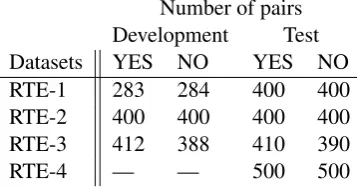
Our experiments were conducted on the basis of the Recognizing Textual Entailment (RTE) datasets2, which were developed under PASCAL RTE challenge. Each RTE dataset includes its own development and test set, however, RTE-4 was re-leased only as a test set and the data from RTE-1 to RTE-3 were used as development set. More de-tails about the RTE datasets are illustrated in Table 5.1.
Number of pairs Development Test Datasets YES NO YES NO
RTE-1 283 284 400 400
RTE-2 400 400 400 400
RTE-3 412 388 410 390
[image:5.595.325.504.516.610.2]RTE-4 — — 500 500
Table 1: RTE-1 to RTE-4 datasets.
5.2 Experimental Framework
In our experiments, in order to deal with TED approach to textual entailment, we used EDITS3 package (Edit Distance Textual Entailment Suite)
2http://www.pascal-network.org/Challenges/RTE1-4 3The EDITS system has been supported by the
(Magnini et al., 2009). This system is an open source software based on edit distance algorithms, and computes the T-H distance as the cost of the edit operations (i.e. insertion, deletion and substi-tution) that are necessary to transform T into H. By defining the edit distance algorithm and a cost scheme (assigning a cost to the edit operations), this package is able to learn a TED threshold, over a set of string pairs, to decide if the entailment ex-ists in a pair.
[image:6.595.73.291.308.438.2]In addition, we partially exploit the JSwarm-PSO4(Cingolani, 2005) package, with some adap-tations, as an implementation of PSO algorithm. Each pair in the datasets is converted to two syn-tactic dependency parse trees using the Stanford statistical parser5, developed in the Stanford uni-versity NLP group by (Klein and Manning, 2003).
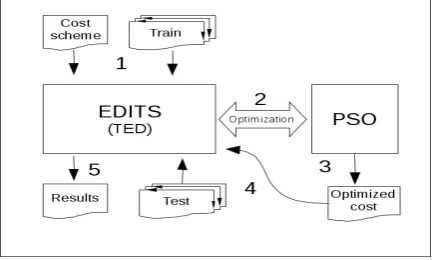
Figure 3: Five main steps of the experimental framework.
In order to take advantage of PSO optimization approach, we integrated EDITS and JSwarm-PSO to provide a flexible framework for the experi-ments (Figure 5.3). In this way, we applied the defined fitness functions in the integrated system. The Bhattacharyya distance between two classes (YES and NO), in each experiment, could be com-puted based on the TED score of each pair in the dataset. Moreover, the accuracy, by default, is computed by EDITS over the training set based on 10-fold cross-validation.
5.3 Experimental Scheme
We conducted six different experiments in two sets on each RTE dataset. The costs were estimated on the training set and the results obtained based on the estimated costs over the test set. In the first
4http://jswarm-pso.sourceforge.net/
5http://nlp.stanford.edu/software/lex-parser.shtml
set of experiments, we set a simple cost scheme based on three operations. Implementing this cost scheme, we expect to optimize the cost of each edit operation without considering that the opera-tion costs may vary based on different character-istics of a node, such as size, location or content. The results were obtained considering three dif-ferent settings: 1) the random cost assignment; 2) assigning the cost based on the human expertise knowledge and intuition (called Intuitive), and 3) automatic estimated and optimized cost for each operation. In the second case, we used the same scheme which was used in EDITS by its develop-ers (Magnini et al., 2009).
In the second set of experiments, we tried to compose an advanced cost scheme with more fine-grained operations to assign a weight to the edit operations based on the characteristics of the nodes. For example if a node is in the list of stop-words, the deletion cost is set to zero. Otherwise, the cost of deletion would be equal to the number of words in H multiplied by word’s length (num-ber of characters). Similarly, the cost of inserting a word w in H is set to 0 if w is a stop word, and to the number of words in T multiplied by words length otherwise. The cost of substituting two words is the Levenshtein distance (i.e. the edit distance calculated at the level of characters) be-tween their lemmas, multiplied by the number of words in T, plus number of words in H. By this in-tuition, we tried to optimize nine specialized costs for edit operations (i.e. each particle is defined by 9 parameters to be optimized). We conducted the experiments using all three cases mentioned in the simple cost scheme.
In each experiment, we applied both fitness functions in the optimization; however, at the final phase, the costs which led to the maximum results were chosen as the estimated operation costs. In order to save breath and time, we set the number of iterations to 10, in addition, the weightω was set to 0.95 for better global exploration (Melgani and Bazi, 2008).
6 Results
Data set
Model RTE-4 RTE-3 RTE-2 RTE-1
Simple RandomIntuitive 49.651.3 53.6259.6 50.3756.5 50.549.8
Optimized 56.5 61.62 58 58.12
Advanced RandomIntuitive 53.6057.6 52.059.37 54.6257.75 53.555.5
Optimized 59.5 62.4 59.87 58.62
Baseline 55.2 60.9 54.8 51.4
[image:7.595.73.529.69.202.2]RTE-4 Challenge 57.0
Table 2: Comparison of accuracy on all RTE datasets based on optimized and unoptimized cost schemes.
the better comparison, we also present the results of the EDITS system in RTE-4 challenge using a combination of different distances as features for classification (Cabrio et al., 2008).
In the first experiment, we estimated the cost of each operation using the simple cost scheme. Ta-ble 2 shows that in all datasets, accuracy improved up to 9% by optimizing the cost of each edit opera-tion. Results prove that the optimized cost scheme enhances the quality of the system performance, even more than the cost scheme used by experts (Intuitive cost scheme) (Magnini et al., 2009).
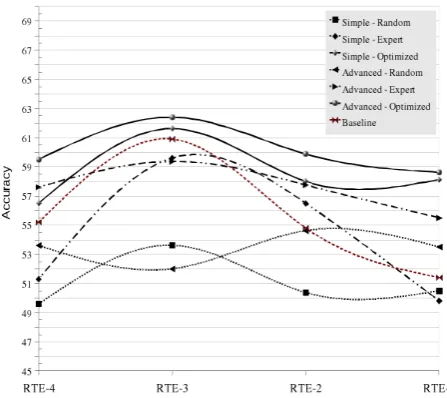
Furthermore, in the second set of experiments, using the fine-grained and weighted cost scheme for edit operations we could achieve the highest re-sults in accuracy. The chart in Figure 4, illustares that all optimized results outperform the word-overlap baseline for textual entailment as well as the accuracy obtained in RTE-4 challenge using combination of different distances as features for classification (Cabrio et al., 2008).
By exploring the estimated optimal cost of each operation, another interesting point was discov-ered. The estimated cost of deletion in the first set of experiments was0, which means that delet-ing a node from the dependency tree of T does not effect the quality of results. This proves that by setting different cost schemes, we could explore even some linguistics phenomena which exists in the entailment dataset. Studying the dataset from this point of view might be interesting to find some hidden information which can not be explored eas-ily.
In addition, the optimized model can reflect more consistency and stability (from 58 to 62 in accuracy) than other models, while in unoptimized models the result varies more, on different datasets
(from 50 in RTE-1 to 59 in RTE-3). Moreover, we believe that by changing some parameters such as maximum number of iterations, or by defining a better cost scheme, there could be still a room for improvement.
Figure 4: Accuracy obtained by different experi-mental setups.
7 Conclusion
[image:7.595.313.537.334.533.2]recog-nizing textual entailment.
We believe that for further development, ex-tending the cost scheme to find weighted and specialized cost operations to deal with different cases, can lead to more interesting results. Besides that, exploring and studying the estimated cost of operations, could be interesting from a linguistics point of view.
Acknowledgments
Besides my special thanks to Farid Melgani for his helpful ideas, I acknowledge Milen Kouylekov for his academic and technical sup-ports. This work has been partially sup-ported by the three-year project LiveMemories (http://www.livememories.org/), funded by the Provincia Autonoma di Trento.
References
Marc Bernard, Laurent Boyer, Amaury Habrard, and Marc Sebban. 2008. Learning probabilistic models of tree edit distance. Pattern Recogn., 41(8):2611– 2629.
A. Bhattacharyya. 1943. On a measure of diver-gence between two statistical populations defined by probability distributions. Bull. Calcutta Math. Soc., 35:99109.
Elena Cabrio, Milen Kouylekovand, and Bernardo Magnini. 2008. Combining specialized entailment
engines for rte-4. In Proceedings of TAC08, 4th
PASCAL Challenges Workshop on Recognising Tex-tual Entailment.
Pablo Cingolani. 2005. Jswarm-pso: Particle swarm optimization package. Available at http://jswarm-pso.sourceforge.net/.
Ido Dagan and Oren Glickman. 2004. Probabilis-tic textual entailment: Generic applied modeling of
language variability. In Proceedings of the
PAS-CAL Workshop of Learning Methods for Text Under-standing and Mining.
E. Demaine, S. Mozes, B. Rossman, and O. Weimann. 2007. An optimal decomposition algorithm for tree
edit distance. In Proceedings of the 34th
Inter-national Colloquium on Automata, Languages and Programming (ICALP), pages 146–157.
Russell C. Eberhart, Yuhui Shi, and James Kennedy.
2001. Swarm Intelligence. The Morgan Kaufmann
Series in Artificial Intelligence. Morgan Kaufmann.
Keinosuke Fukunaga. 1990. Introduction to
statisti-cal pattern recognition (2nd ed.). Academic Press Professional, Inc., San Diego, CA, USA.
Dan Klein and Christopher D. Manning. 2003. Fast exact inference with a factored model for natural
language parsing. InAdvances in Neural
Informa-tion Processing Systems 15, pages 3–10, Cambridge, MA. MIT Press.
Philip N. Klein. 1998. Computing the edit-distance
between unrooted ordered trees. InESA ’98:
Pro-ceedings of the 6th Annual European Symposium on Algorithms, pages 91–102, London, UK. Springer-Verlag.
Milen Kouylekov and Bernardo Magnini. 2005. Rec-ognizing textual entailment with tree edit distance
algorithms. InPASCAL Challenges on RTE, pages
17–20.
Milen Kouylekov and Bernardo Magnini. 2006. Tree edit distance for recognizing textual entailment:
Es-timating the cost of insertion. In PASCAL RTE-2
Challenge.
Bernardo Magnini, Milen Kouylekov, and Elena
Cabrio. 2009. Edits - edit distance
tex-tual entailment suite user manual. Available at http://edits.fbk.eu/.
Yashar Mehdad and Bernardo Magnini. 2009. A word overlap baseline for the recognizing textual entail-ment task. Available at http://edits.fbk.eu/.
Farid Melgani and Yakoub Bazi. 2008.
Classi-fication of electrocardiogram signals with support vector machines and particle swarm optimization.
IEEE Transactions on Information Technology in Biomedicine, 12(5):667–677.
Michel Neuhaus and Horst Bunke. 2004. A proba-bilistic approach to learning costs for graph edit
dis-tance. In ICPR ’04, pages 389–393, Washington,
DC, USA. IEEE Computer Society.
C. C. Reyes-Aldasoro and A. Bhalerao. 2006. The bhattacharyya space for feature selection and its ap-plication to texture segmentation. Pattern Recogn., 39(5):812–826.
Stanley M. Selkow. 1977. The tree-to-tree editing problem.Inf. Process. Lett., 6(6):184–186.
Kuo-Chung Tai. 1979. The tree-to-tree correction
problem.J. ACM, 26(3):422–433.
K. Zhang and D. Shasha. 1989. Simple fast algorithms for the editing distance between trees and related