Abstract
CLAMANN, MICHAEL PETER. The Effects of Levels of Invocation Authority on
Adaptive Automation of Various Stages of Human Information Processing. (Under the
direction of David B. Kaber.)
Adaptive automation (AA) has been explored as a solution to problems associated
with extended periods of manual control and static automation in complex systems
including fatigue, high workload, and loss of situation awareness. Several important
decisions must be made regarding the implementation of AA in the design process,
including who will decide when to invoke automation and what function or functions will
be automated. Several studies have recently proposed models of automation based on
four stages of human-machine system information processing, including information
acquisition, information analysis, decision making, and action implementation. It is
possible to apply AA to several of these functions simultaneously or independently.
Management authority over automation (invocation authority) can be extended to a
human operator, to a computer controller, or distributed between both through mutual
suggestions and approvals of each authority. Both invocation authority over dynamic
function allocations (DFAs) and the type of AA have both been shown to independently
influence task performance, situation awareness, and workload in adaptive systems. It is
possible that different levels of authority may have different effects on overall
human-machine system performance when applied to various automated functions, such as
detection tasks as compared to tasks requiring higher cognitive functions, like decision
The goal of this study was to assess the performance and workload effects of
applying AA to four stages of human- machine system information processing using a
performance-based approach and facilitating DFAs through two levels of computer
authority (suggestion and mandate). The research was expected to provide insight into the
existence of any interaction between these aspects of AA design. It was expected that
higher level automation, such as information analysis and decision making, would be
more compatible with mandated allocations, while lower levels, such as information
acquisition and action implementation, would be more effective under partial human
control. The additional task load imposed by the requirement of operator acceptance of
DFAs suggested by a computer authority was expected to adversely affect performance
of the more cognitive tasks.
Forty naïve subjects performed an air traffic control task as part of a dual-task
scenario in which a secondary, gauge- monitoring task served as the objective measure of
workload that controlled DFAs in the primary task. Each subject experienced one of four
forms of automation (or no automation for control subjects) and both types of authority
(suggest and mandate) during two trials (Each trial incorporated only one of the two
authority types.). Results confirmed performance differences due to AA across the
various aspects of information processing as well as between the two types of invocation
authority. Specifically, subjects performed significantly better in the primary task during
periods of automation as part of information acquisition AA as compared to decision
making. During those same automated periods, subjects also performed significantly
better when automation was suggested as compared to mandated. Contrary to the central
suggestions were combined with AA of higher cognitive functions (information analysis
and decision making), there was no evidence of an interaction effect of the two
experimental manipulations. However, the individual results regarding automation type
and authority were consistent with results appearing in the literature.
The results of this study provide evidence that the effectiveness of AA is
dependent upon both the type of automation presented to an operator and the type of
invocation authority designed into the system. This could potentially provide additional
THE EFFECTS OF LEVELS OF INVOCATION AUTHORITY ON ADAPTIVE AUTOMATION OF VARIOUS STAGES OF HUMAN INFORMATION
PROCESSING
by
MICHAEL CLAMANN
A thesis submitted to the Graduate Faculty of North Carolina State University
in partial fulfillment of the requirements for the Degree of
Master of Science
PSYCHOLOGY
Raleigh
2002
Approved By:
________________________________ _________________________________
Biography
Michael Clamann abandoned the rocky mountains of Colorado to pursue a
graduate degree in Ergonomics at North Carolina State University in August 2000.
Michael grew up in Richmond, Virginia and attended James Madison University in
Harrisonburg, Virginia where he received a dual degree in International Business and
German. Prior to attending NCSU, he spent five years as a consultant specializing in the
design and deployment of custom business software. His research interests include
Acknowledgements
There are several people I need to recognize for their contributions to this project.
My advisor, David Kaber, provided guidance, support and access to his wealth of
knowledge and experience.
Thanks to Lance Prinzel of NASA Langley Research Center, I had the
opportunity to take part in the NASA Graduate Student Researchers Program, which
funded this research.
My committee members, Mike Wogalter and Eric Wiebe, offered additional
advice and direction along the way.
My uncle, Henry Nuttle, helped me make the transition from Denver to Raleigh
and provided an open door to me both on campus and off.
My fellow graduate students generously gave me their time, diverse skills and
perspectives, and valuable friendships. In particular, I am grateful to Srikanth Jayanthi
for his contributions.
Laura Wiencek offered patience, understanding and unconditional emotional and
spiritual support. Thanks, babe.
Finally, and most importantly, a very special thanks goes to my parents, Professor
H. Peter Clamann and Eva Clamann for being my source of inspiration. Your strength
Table of Contents
List of Tables ...v
List of Figures ...vi
List of Abbreviations ... vii
1 Introduction... 1
1.1 Adaptive Function Allocation... 2
1.2 Locus of Control in Automated Systems ... 5
1.3 Automation of Stages of Human Information Processing ... 13
1.4 Controlling Allocations ... 18
1.5 Summary... 21
2 Problem Statement ... 24
3 Methods... 27
3.1 Task... 27
3.2 Participants ... 38
3.3 Equipment and Environment ... 39
3.4 Experimental Design ... 40
3.5 Variables ... 42
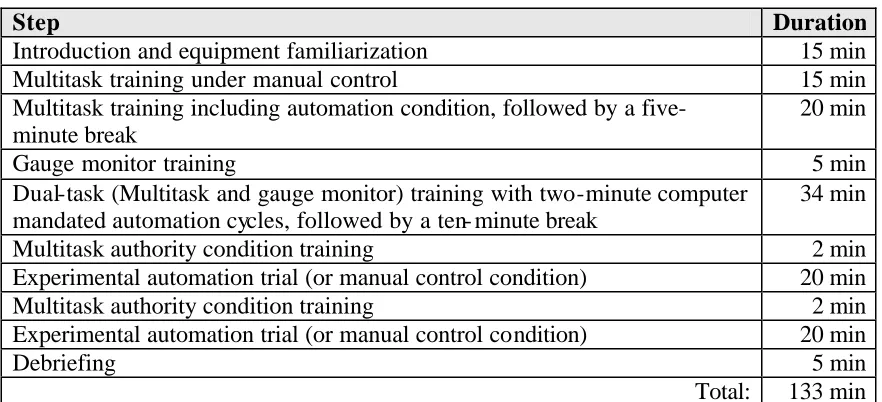
3.6 Procedures... 43
3.7 Hypothesis ... 47
4 Data Analysis ... 48
5 Results ... 52
5.1 Objective Performance Measures ... 52
5.2 Subjective Workload Ratings ... 59
5.3 Correlation Analysis ... 60
6 Discussion... 62
6.1 Interaction... 62
6.2 Automation ... 62
6.3 Invocation Authority... 64
6.4 Primary Task... 65
6.5 Secondary Task... 66
7 Conclusions ... 69
7.1 Caveats... 69
7.2 Adaptive Automation in Air Traffic Control... 70
7.3 Future Research ... 70
8 References ... 73
Appendices... 76
Appendix A: Multitask Hierarchical Task Analysis ... 77
Appendix B: Instructions for Participants... 79
Appendix C: Subjective Temporal Demand Assessment ... 98
List of Tables
List of Figures
Figure 3. 1: Multitask with automated information analysis ... 28
Figure 3. 2: Various aircraft types ... 28
Figure 3. 3: Information analysis decision aid ... 31
Figure 3. 4: Decision making decision aid ... 32
Figure 3. 5: Action implementation decision aid ... 33
Figure 3. 6: Automation Status Indicator... 35
Figure 3. 7: Gauge Monitor ... 37
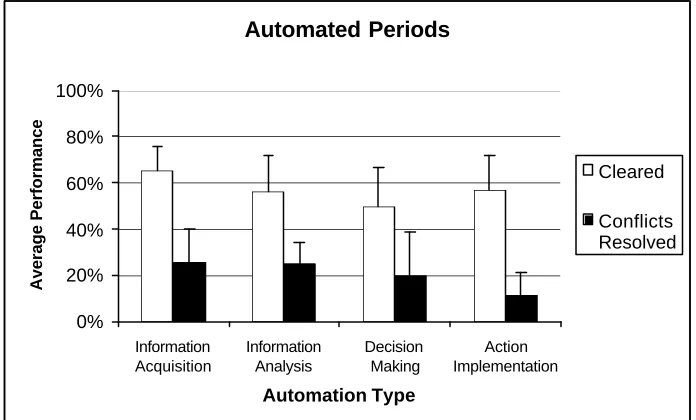
Figure 5. 1: Primary task performance during automation by automation type ... 53
Figure 5. 2: Primary task performance during automation by authority... 54
Figure 5. 3: Primary task performance during manual control by automation type ... 55
List of Abbreviations AA Adaptive Automation
AFA Adaptive Function Allocation
ANOVA Analysis of Variance
ATC Air Traffic Control
DFA Dynamic Function Allocation
FA Function Allocation
GCAS Ground Collision Avoidance System
MAT Multi-Attribute Task
MCH Modified Cooper-Harper
SA Situation Awareness
SD Standard Deviation
1 Introduction
Automation is pervasive in modern systems, including industries such as aviation,
transportation, and retail. It is represented by autopilot systems designed to reduce pilot
workload in extended flights, controls in automobiles that increase comfort by regulating
interior temperature and maintaining consistent highway speeds, and computer systems
that allow consumers to make purchases using their computers from remote locations
outside business hours. Billings (1997) describes automation as a tool that allows a
human operator to accomplish a task with less effort, or to complete a task that would
have been impossible otherwise.
Wickens and Hollands (2000) offer four categories that summarize the reasons a
designer might take advantage of automation when designing a system. The first
includes tasks that cannot be performed by a human operator due to human limitations,
such as the complex and dynamic calculations required for guiding a rocket, or
manipulation of materials in hazardous environments. Another reason for automation is
to assist with tasks that can be performed by human operators but result in poor
performance or high workload for the operator. Autopilots, airborne collision advisory
systems, and nuclear process control can be included in this category. Third, automation
can augment, rather than replace human performance. In this category, automation
serves as an aid rather than a replacement for the human operator. This is similar to the
second category, except peripheral tasks are aided so the operator can focus on a central
task. Examples include visual scratch pads that augment working memory by displaying
computer input by keyboard or voice command. Finally, in many cases automation can
robot workers in manufacturing plants, automated bank tellers, and telephone operators.
Unfortunately, this final category tempts designers and managers to automate anything
that has a monetary benefit, ignoring the operator who is left behind to monitor the
system (Parasuraman and Riley, 1997). There are many important issues, such as
determining what system functions should be automated and implementing alternatives to
traditional static automation, that must be examined when designing an automated
system. Each variable has its own unique advantages and disadvantages, which must be
understood prior to designing an effective automated system. Several of these issues that
can be controlled by designers are discussed in the following sections.
1.1 Adaptive Function Allocation
Although many modern systems have benefited from the introduction of
automation, not all system functions must be allocated exclusively to machines.
Responsibility can be divided between a human operator and an automated system. This
division of tasks is referred to as function allocation (FA; Sanders and McCormick,
1993). The traditional approach to FA involves a firm division between the human
operator and automation: a task is either automated all the time, or not at all. When
designing using this approach to FA, task requirements are compared to the capabilities
of humans and the capabilities of the automated system in order to determine which
entity (human or automation) can most effectively perform the task. Tasks are then
allocated either to the automation or to the human operator based on these comparisons
(Sanders and McCormick, 1993). Scallen and Hancock (2001) cite several weaknesses in
system, reducing the possibility for cooperation between the two. In addition, the
extended periods of either manual or automated control brought about by an absolute
division of tasks between human and automation can lead to new problems for the human
operator. For example, manual control over extended periods often results in fatigue,
increased error rates and reduced effectiveness. However, extended periods of
automation can also have negative effects on a human operator. If a task is handed off to
automation, the human’s role becomes that of a monitor, a task for which humans are
poorly equipped (Kaber and Endsley, in press). In these situations when the operator
must remain in a control loop, but assumes a passive role in the system yielding to full
automation, there are potential problems with the operator maintaining situation
awareness (SA). Other results of extended automation can include complacency and skill
decay (Parasuraman, 2000). In the event of an automation failure, any of these problems
could lead to catastrophic outcomes.
Adaptive function allocation (AFA) provides a plausible solution to the
challenges existing under traditional FA, such as managing workload, maintaining SA,
preventing complacency, and maintaining operator skills. AFA differs from traditional
FA in that task allocations may occur while the task is being performed. According to
Scallen and Hancock (2001), in AFA, “the control of tasks shifts dynamically between
humans and machines based on specified thresholds for environmental factors, operator
confidence, or psycho-physiological factors.” The form of automation that allows for
these dynamic function allocations (DFAs) between automated and manual control is
referred to as adaptive automation (AA; Kaber, Riley, Tan and Endsley, 2001; Hilburn,
situational demands by adjusting operating characteristics such as interface features or
task functions. In these systems, the human operator and the machine assume a team
relationship that facilitates optimal system performance (Bubb-Lewis and Scerbo, 1997).
One goal of AA is to strike a balance between the potential excessive workload problems
associated with manual control and the losses in SA resulting from extended periods of
automated control (Wickens and Hollands, 2000).
Adaptive automation technology is still maturing, but some prototypes have
already been produced (Scerbo, 1996). Citing Scott (1999), Scerbo et al. (2001) provide
a real-world example for an application of AA in an aviation system involving the new
Ground Collision-Avoidance System (GCAS) designed by the United States Air Force,
Lockheed Martin, NASA, and the Swedish Air Force, which is currently being tested in
the F-16D. The GCAS is designed for the rare occasion when excessive workload or a
loss of SA prevents a pilot from maintaining a safe altitude, and provides the pilots with a
tool that can react to emergency situations faster than their own reflexes. Piloting a
modern military aircraft is a highly complex task in which operators are subject to a huge
number of stimuli from both the cockpit and the environment. During periods of high
workload, such as complex maneuvering or combat situations, a pilot can run the risk of
missing an important signal. The GCAS is intended to be used during these periods of
intense workload to prevent fighter pilots from losing SA and crashing into terrain. This
automated system processes internal, external, and pilot input information to make
in-flight calculations of altitude. If the sys tem predicts that the aircraft will cross below a
predetermined minimum altitude, the pilot receives a warning notifying him or her that
accordingly within approximately five seconds of the warning, the GCAS assumes
control. The task of adjusting the aircraft’s heading is then offloaded to the automation,
the aircraft’s heading is corrected and the automation returns control to the pilot. The
system provides appropriate feedback for the return to manual control so the pilot is
informed of the system’s status. This system is being evaluated for installation in three
different fighter aircraft in the U.S. and Swedish Air Forces (Scerbo, Freeman, Mikulka,
Parasuraman, & Prinzel, 2001).
When designing an AA system such as the GCAS, there are several important
decisions that must be made regarding the implementation. These include who will make
the decision to invoke automation, what function or functions will be automated, and the
criteria to be used as a basis for triggering automation that determines the timing of
invocations. These three issues are discussed in the following sections.
1.2 Locus of Control in Automated Systems
A critical issue that exists when designing a system to include AFA involves
determining who makes the allocation decisions, also referred to as the locus of control
(Parasuraman, 2000). In other words, should the computer or the human operator
mandate the shift to, or from, automated control? Arguments exist for both
operator-initiated and system- operator-initiated invocation. Harris, Hancock and Arthur (1993) provide
reasons in favor of operator- initiated invocations:
• Allowing the operator to maintain control over allocations helps keep him or her
• Control over allocations provides the operator with a feeling of being in charge
and can help maintain SA, both of which can help make workload more
manageable.
• It is possible that novel situations may arise for which the automation was not
designed. In these cases, the human operator’s judgment may be more effective
than the automation (Inagaki, 2000).
These examples do not necessarily mean that the operator should always control
allocations. Scerbo (1996) cites several potential problems with operator-initiated
invocations:
• Automation may need to change at a precise time at which the operator may be
too busy to make the change.
• If there is a sudden increase in workload, the human operator may not be able to
manage the automation correctly.
• As the human operator becomes fatigued, he or she will be less likely to take
advantage of automation.
• In extreme cases of risk to the operator, the system might need to have authority if
the operator is unable to maintain control (e.g., the GCAS described in the
previous section).
However, in many cases, even if a computer maintains control, the human operator and
system observers may still perceive the operator as having the ultimate decision
responsibility. Consequently, from the operator’s standpoint, he or she should manage
The problems that could result from assigning invocation authority to the
computer or the human can vary in relevance depending on the context of the system
being designed. For example, in a manufacturing system the causes and consequences of
automation failures may be quite different from those occurring in an air traffic control
(ATC) system. Both of these situations differ not only in the costs of failure, but also in
who is perceived as being responsible (the automation designer or the human operator).
Understanding how system context can affect the philosophy for determining invocation
authority can help a designer manage these potential problems. Golikov and Kostin
(1997) describe three approaches to FA based on which party bears the ultimate
responsibility for the success of the system. These include a human-centered approach, a
machine-centered approach and an equivalent approach to automation. Each of these
approaches offers a different recommendation for the degree of human operator control
of function allocations. Machine-centered approaches attempt to maximize the extent of
system control through automation to the point where the human can be eliminated from
the loop. In these systems, the designers rather than operators bear the ultimate
responsibility for the system’s success or failure. Machine-centered systems are often
implemented in manufacturing facilities (Golikov & Kostin, 1997).
In the human-centered approach, the automated system offers assistance and
serves as a tool to the human operators, who are ultimately in control of the system.
These systems offer “semiautomatic control” instead of the fully automated scenario
promoted by the machine-centered approach. The human operator is in charge of
supervising and controlling the system, which requires the automation to be adaptable to
manage novel or emergency situations when automation fails. This approach is common
in modern aviation systems.
Golikov and Kostin (1997) do not believe either of these approaches is an
adequate solution for modern systems. Human operators may be better suited for
qualitative analysis in the case of novel situations than a fully automated system.
However, there are some unexpected emergency situations in which a human operator
may not be prepared to respond. In reaction to the potential shortcomings of these two
approaches, the authors propose an equivalent approach, in which the designers and
operators each share equal responsibility and work together to ensure the reliability and
success of the system. The authors believe that modern integrated systems with complex
controls require this equivalent approach, which would allow for resolution of both types
of extreme situations. In the case of unexpected automation failures or novel situations,
the human operator is best left in control, and in severe cases when the human operator
cannot react adequately, he or she must be released from control by automation. In the
latter case, the operator may regain control from the system when he or she is ready.
Application of the equivalent approach can combine the advantages of the human and
machine-centered approaches for managing fluctuating situations such as these, which
occur in dynamic environments. This research suggests that there will be situations in
modern systems, such as those found in aviation, when either the operator or the
computer will need to be in control. It is therefore important for designers to understand
the impacts of both authority conditions.
Hilburn, Molloy, Wong, and Parasuraman (1993) also considered exceptional
experiments that examined operator performance when manipulating various aspects of
AA, including authority over invocations. Citing Barnes and Grossman (1985), they used
the terms executive and emergency logic to describe two perspectives regarding human
and system-centered authority. When a system implements executive logic, the human
operator has the final authority, while emergency logic places the control with the
computer. At the time of their study, the authors noted a prevailing assertion that
operator control was superior to system- initiated allocations. They performed an
experiment in order to verify this assertion while observing the effects of executive and
emergency logic within an adaptive system. Their experiment used the Multi-Attribute
Task (MAT) battery, a PC-based simulation of flight tasks including simultaneous
presentations of compensatory tracking, system monitoring, and fuel management tasks.
Performance in the MAT is based on composite scores in each task, including monitoring
reaction time and accuracy and errors in the tracking and fuel management tasks. In
Hilburn et al. experiment, the fuel management and monitoring tasks were performed
under manual control. Tracking was either automated or manual, depending on the
experimental condition. Each participant completed four 20- minute sessions. In two of
the sessions, tracking automation authority was under computer control, while in the
other two sessions, the participant had control of automation shifts. Once automation
was invoked (by the human or computer), the tracking task was performed by completely
reliable automation for two minutes, then control of the tracking task was returned to
manual. Using a model-based approach to AA, which uses a predefined scheme to
determine the timing of DFAs, subjects shifted between manual and automated control at
their own initiation. Hilburn et al. results confirmed a performance cost of automation
shifts calculated across the three tasks (two monitoring and one tracking). However,
these costs were reduced if the shifts were under operator control.
Expanding on these results, the authors describe situations requiring executive or
emergency logic as two extremes of a continuum representing the control of a complex
system. Between these two extremes, systems could provide recommendations for
automated support, but grant final authority to the human operator, or the operator could
request automated assistance from the system when he or she believes it is necessary.
There are numerous other examples of intermediate stages along this continuum at which
the human operator initiates, agrees to, or is directed by, automation. Rather than having
a system that utilizes either executive or emergency logic, allocations could be the result
of an operator agreement to a system suggestion, or vice versa (Hilburn, Molloy, Wong,
and Parasuraman, 1993).
In a follow-on experiment, Hilburn et al. (1993) compared operator control under
three different model- and performance-based approaches to AA system control. Using
the MAT battery, three groups of subjects were exposed to shifts from automated to
manual control in operation of the system based on different criteria. Only the
monitoring task could be automated, while the tracking and fuel management tasks were
always under manual control. One group of subjects experienced a model-based
approach with emergency logic applied to invocation authority and system control was
automatically switched to manual control in the fifth minute of a nine minute trial. The
second and third groups experienced two types of performance-based approaches to
their performance fell below 57%. This represented emergency logic. The third group,
which utilized executive logic, would also revert to manual control if their performance
fell below this level, but could override the allocation if desired and remain under
automated control. The results of this experiment indicated that automation benefits
continued after participants returned to manual control. The type of adaptive logic
(model- or performance-based and emergency or executive logic) did not reveal any clear
advantages for any of the three conditions, although the authors acknowledge that
additional analysis of the results could reveal a different conclusion. However, the
general results of both studies by Hilburn et al. indicate that the locus of control in an AA
system can have an effect on overall system performance.
In another study, Kaber and Riley (1999) also addressed the issue of human or
automation initiated invocation of adaptive automation. This research assessed the
usefulness of a secondary task measure for assessing workload and directing DFAs in a
primary cognitive task. In their experiment, subjects performed two tasks: a primary
dynamic control task, and a secondary gauge monitoring task. The primary task
consisted of a “radar scope” display that presented randomly appearing square targets
traveling at different speeds and directions toward the center of the display. The subjects
were required to select and eliminate targets before they reached the center. The
interface provided two levels of automation, including “manual control” and “blended
decision- making.” In the latter condition, the computer would first produce a list of
decision options from which it would select a course of action. Implementation of the
action required the consent of the human operator. The operator could either agree to the
then carry out the action selected by the operator (Kaber and Riley, 1999). The
secondary task, which required subjects to maintain a moving pointer within a defined
range on a fixed scale display, served as an objective measure of workload. Subjects
were divided into two groups according to who was in charge of dynamic control
allocations (the human or computer). The first group received mandates from the
computer on when to invoke control allocations between the manual and automated
control modes. The second group received control allocation suggestions from the
computer, but was not required to make the allocations. The results showed that under
manual control conditions, mandated subjects performed significantly better than the
group receiving suggestions. Furthermore, subjects who received suggestions rather than
mandates were more likely to accept automation, but less likely to agree to manual
control. These results suggest that the additional cognitive requirements required for
evaluating the decision to make an allocation may redirect the resources required for
attending to the primary task.
These examples from the literature suggest that intermediate approaches to
assigning authority in AA systems provide alternatives to static human- and
machine-centered approaches to FA and the reliance on extreme executive or emergency logic to
govern dynamic allocations. By modifying the invocation logic, a designer can manage
the impact of DFAs on the operator. It is important to fully understand these impacts
prior to implementing an AA system.
Although this review of literature points to a need for exploration of
‘intermediate’ levels of authority in invoking automation (such as suggestion and
(1993) investigated the effects of human versus computer authority, but not at possible
intermediate stages, such as approvals and suggestions for automation. Kaber and
Riley’s (1999) investigation focused on intermediate and high levels of authority. They
compared the effects of computer mandates and computer suggestions on adaptive
system performance. However, the scope of these studies has only considered the
application of AA to a limited number of possible complex system functions (aspects of
human-machine system information processing). It is possible that the levels of authority
investigated by Kaber and Riley may have different effects on overall human- machine
system performance when applied to various automated functions, such as detection tasks
as compared to tasks requiring higher cognitive functions, like decision making.
Intermediate stages of authority should be investigated fully in a generalizable context in
order to understand the effects of authority for implementation in a variety of systems.
Models for generalizing automation functions are discussed in the following section.
1.3 Automation of Stages of Human Information Processing
Wickens and Hollands (2000) state that automation can be designed in terms of
how it assists the human operator in three different stages of information processing. In
the first stage, which includes information acquisition and analysis, the system acquires,
interprets, and/or integrates information, which replaces early human sensory processes,
such as attention or perception (Wickens & Hollands, 2000). Examples include graphic
displays such as electronic maps and ecological displays. Information presented by the
automation at this stage supports decision making, the next of Wickens and Hollands’
automation offers or imposes constraints on choices available to the operator. An
example of this type of automation would be an airborne traffic warning systems that
advises pilots of a particular maneuver based on an emergency situation. In the final
stage, execution, the automation carries out an action on behalf of the human operator.
High levels of automation of any of these stages can be beneficial if its functions meet the
expectations of the designer and the human operator (Wickens and Hollands, 2000).
Endsley and Kaber (1999) developed a similar stage model of human-machine
system information processing by analyzing the common features of dynamic cognitive
and psychomotor tasks common to the domains of ATC, piloting, advanced
manufacturing, and teleoperations. From the common features, they identified four
generic functions, including:
• Monitoring - scanning displays to perceive status
• Generating options - formulating options or strategies for achieving goals
• Selecting - deciding on an option or strategy
• Implementing - carrying out the chosen action
From these four functions a detailed taxonomy of ten levels of automaton was developed
that divided the responsibilities for the functions between the human operator and the
computer.
Endsley and Kaber (1999) applied their taxonomy to the performance of a
dynamic control task, which yielded several notable results. First, subjects had better
performance under levels of automation that combined human option generation with
computer implementation as compared with automated option generation or fully manual
assistance and were somewhat hindered when assistance was provided with higher- level
cognitive functions. Finally, generation of options resulted in worse performance when it
was divided between the human and the computer than when it was performed by either
one individually. These results show that various levels of automation, based on a stage
model of human- machine system information processing, applied to a dynamic control
task can have different effects on overall system performance.
In another study, Parasuraman, Sheridan, and Wickens (2000) introduced a model
of types and levels of automation that also identified stages of information processing. In
this model, type refers to the stage of information processing that is automated
(information acquisition, information analysis, decision making, action implementation),
while level indicates the degree of automation of a specific function. Automation can be
designed according to a continuum ranging from completely manual control (low- level
automation), in which all aspects of a function are under human control, to full
automation (high- level automation), in which the machine controls the function and only
the products of its operations are available to the human operator. Between these two
extremes, types of automation can occur at varying levels to create innumerable
combinations depending on task and system requirements.
For each type, Parasuraman et al. (2000) described the scope and examples of
levels of automation. Automated information acquisition affects the sensing and
registration of input data, which supports human sensory processes. Low leve ls of this
type of automation might include data gathering, while higher levels could range from
organizing the data to filtering the data so only a portion of it reaches the operator.
working memory and inference. Low levels of this type of automation might involve
providing task processing predictions to operators, while high levels could involve data
integration (i.e., combining several data variables into a single value for decision
processes). Automated decision and action selection includes generating hypotheses and
selecting from among several alternatives. Sheridan’s (1992) hierarchy of ten different
levels of automation is relevant to this stage. The final automation type, action
implementation, executes an action choice. In essence, it replaces the motor operation or
command of the human operator (Parasuraman, Sheridan, and Wickens, 2000). An
example of this type of automation is the motor commands required to correct an
aircraft’s altitude in the GCAS described in an earlier section.
The first two steps in Parasuraman et al. (2000) model for designing an automated
system are to (1) recognize that automation varies by type and (2) decide which stage
should be automated. When resolving the second step, the four automation types can be
established at varying levels and in varying combinations for the design of an automated
system. All or none of the human information processing stages can be automated at
low, moderate, or high levels, depending on the contextual requirements of the system.
Given the numerous available alternatives when designing an automated system, it is
important to understand the effects of automation on the four general stages of
human-machine system information processing in order to create technology that optimizes
human performance.
The categories of automation described in this section are all based on generic
models of human information processing. The four functions included in Parasuraman et
information processing in complex system operation. However, they do not define any
specific levels of automation, instead they only describe “low” and “high” levels. This
makes it convenient to describe existing systems in terms of the model, but difficult to
systematically examine the effects of these levels prior to system design.
The types of automation included in Parasuraman et al. (2000) model are similar
to the stages described by Wickens and Hollands (except that information acquisition and
analysis has been divided into two distinct processes) and nearly identical to the stages
defined by Endsley and Kaber (1999). Endsley and Kaber, unlike Parasuraman et al.,
produced ten discrete levels of automation by combining types of automation and
invocation authority to be used as a basis for systematically assessing the effects of these
levels of automation on operator performance (in terms of workload and SA) and to make
general recommendations for system design. However, none of these combinations
isolated any of the four stages of information processing, so the advantages and
disadvantages of each stage and type of authority is confounded within each le vel of
automation.
The human factors literature includes several models of human-machine system
automation defined on the basis of information processing models (Wickens and
Hollands, 2000; Endsley and Kaber, 1999; and Parasuraman et al., 2000). Each of the
complex functions identified by these models can be applied to systems in an adaptive
manner. However, automating these functions may have varying effects in terms of
operator performance, SA and workload. As described earlier, these effects may be
further influenced by the interaction of various types of invocation authority that are used
improve the effectiveness of AA as applied to, for example, information acquisition as
compared to information analysis, etc.
At this point in time additional research is needed to further examine the
performance effects of automating various stages of human- machine system information
processing and different forms of authority over the invocation of automation.
Systematically isolating automation of each stage of information processing (information
acquisition, information analysis, decision making, and action implementation) and using
different levels of invocation authority, as described in the previous section (computer
mandating or computer suggesting) in a laboratory experiment may provide additional
insight into the effectiveness of AA for complex systems. System designers could
potentially use the resulting information to better understand in advance the effects of
general types of automation and who is in charge during normal system operations.
1.4 Controlling Allocations
In addition to determining whether the locus of control should be given to the
human or the computer and which system functions to automate, another important issue
that must be addressed in designing AA systems is to determine the circumstances that
trigger an allocation. An effective trigger should relieve the operator under high
workload conditions and return control when operator workload returns to normal levels;
thereby, maximizing the benefits of adaptive automation. Several methods for triggering
dynamic control allocations have been proposed, including model-based approaches,
physiological assessment, and performance-based approaches. The type or method of
authority over automation invocations. For example, performance-based systems
typically operate under a computer authority that assesses operator functional state and
makes decisions about types and levels of automation.
Triggers that incorporate models are based on expectations that workload will
increase or decrease at a particular time or under predefined conditions. Hilburn et al.
(1993) incorporated a model-based approach in order to determine the costs of frequent
cyclings between periods of automated and manual control. Physiological measures can
be used to infer operator mental workload while a task is being performed. In one study,
Prinzel, Scerbo, Freeman, and Mikulka (1995) used arousal measurements recorded
within an electro-encephalogram to trigger AA in a dynamic system. Their closed-loop
system was able to successfully evaluate task workload and to predict appropriate system
function allocations. Performance-based approaches to AA rely on observations of
previous performance in a task to determine when periods of automation may be
effectively initiated (Hilburn, Molloy, Wong, and Parasuraman, 1993). Another
performance-based approach incorporates real-time assessments of workload using a
secondary task measure. In these systems, performance variations in the secondary task
serve as an indicator for levels of operator workload. The experiment performed by
Kaber and Riley (1999) that addressed the issue of invocation authority of AA evaluated
the efficacy of a secondary task measure as a triggering mechanism for adaptive
automation. It was determined that basing primary task performance control allocations
on secondary task performance can serve as an effective means for managing primary
In a recent study, Kaber, Wright, and Clamann (2002) utilized the same secondary
task workload measure used in Kaber and Riley (1999) to compare the effects on
human-machine performance of applying AA exclusively to four stages of information
processing (information acquisition, information analysis, decision making, and action
implementation) in a primary dynamic control task. The goal of this study was to
examine the impact of AA on cognitive task performance and to determine which stages
of human information processing are most conducive to adaptive automation. The
dual-task scenario in this study involved subject performance of the primary dynamic control
task and secondary gauge monitoring, simultaneously. Performance in the gauge
monitoring task determined allocation of information processing functions to the human
or the computer. The results provided evidence that the stage of human information
processing that is automated has an impact on overall system performance. The results
also further demonstrated the efficacy of a secondary task measure when integrated with
an AA system for managing operator workload by effectively triggering dynamic
function allocations.
The type of trigger used in an AA system directly affects the applicability of the
authority condition. Regardless of type, each trigger provides some information to the
automation that is designed to maximize system performance. Model-, physiological-
and performance-based approaches for determining the timing of DFAs all imply some
level of computer authority. The information developed based on the triggers used in
these approaches is not necessarily known by the human operator and, therefore, must be
presented either in the form of computerized advice or decision aiding, which constitutes
human is in control. Without computer aiding, the operator responds to his own
suggestions, which can be influenced by other factors, such as heuristics, experience and
training. Existing AA systems will therefore typically have some degree of computer
authority.
1.5 Summary
Wickens and Hollands (2000) list three primary areas of concern for designers
considering the implementation of adaptive automation. These areas include decisions on
who controls the allocations, what functions are adapted, and how the system should infer
the need for adaptation. These three areas have been addressed in previous sections and
can be summarized as follows:
• Who controls the allocations:
Designers who wish to achieve a locus of control that distributes responsibility to
both the operator and the designer, as described by Golikov and Kostin (1997), must
recognize where the machine’s performance can surpass the operator’s and where the
operator can outperform the machine. These decisions can include intermediate
stages of authority such as suggestion and agreement. They must also understand the
performance effects of these authority conditions on the human who is left to operate
or monitor the system.
• What functions are adapted:
The literature identifies four stages of human information processing that can be used
to define types of automation for complex system functions. Each stage of
include automation of information acquisition, information analysis, decision making,
or action implementation functions. Each stage has its own unique effects on
operator performance in terms of workload.
• How to infer the need for adaptation:
A secondary task can be used to track and provide feedback on excess resources not
allocated to the primary task. When resources are no longer needed by the primary
task (due to a reduction in task workload, for example), they can be allocated to the
secondary task, which can result in increases in secondary task performance. These
fluctuatio ns in secondary task performance can be used to control AA in the primary
task as well as draw conclusions on aspects of the primary task that lead to the
increases in workload. According to Kaber, et. al (2002), a secondary task
performance measure can be used to control allocations in an AA system that
automates one or more stages of information processing. Based on the previous
discussion, this type of trigger is most compatible with a computer authority
condition.
In a performance-based AA system, the re are several interactions among these areas of
concern for system designers, each potentially having an influence on the other as well as
on operator workload. For example, there is the cyclical relationship of a closed- loop
system (e. g., Prinzel, Scerbo, Freeman, & Mikulka, 1995; Kaber & Riley, 1999). When
the system is in use, increases or decreases in operator workload may cause a
secondary-task trigger to indicate that a function allocation is necessary. The trigger notifies the
controlling authority (computer) of the task status, who then invokes the function
then closed by this allocation affecting the operator workload (i.e., feedback on the cost
or benefit of the allocation).
There may be other interactions within AA systems as well. There are the
individual (main) effects of various authority conditions (Hilburn, Molloy, Wong and
Parasuraman, 1993; Kaber and Riley, 1999) and of automating different stages of
information processing (Kaber, Wright and Clamann, 2002), which may also produce an
interaction effect on overall system performance. This interaction may dictate the
combinations of authority and automation of human- machine system information
processing that optimize operator performance. It is this interaction that is of primary
2 Problem Statement
When designing an adaptive system, it is important to understand the impact of
the automation on the human operator. Adaptive automation using intermediate levels of
automation has been shown to benefit human operators in terms of workload and SA and
to result in performance that exceeds static automation or completely manual control
(Harris, Hancock and Arthur, 1993). However, a review of the literature on AA reveals
that there are several design dimensions/parameters, such as who controls DFAs and
which functions are automated, on which there is limited knowledge and that could have
a major effect on operator performance.
There are prevailing assumptions that some complex system operating conditions
are more compatible with either operator or computer authority over function allocations,
such as emergencies to which a human might not be able to respond, or novel situations
not anticipated by the designers of expert systems (Scerbo, 1996). The literature shows
that authority, or locus of control, in and of itself, may also have performance
implications. Hilburn et al. (1993) found that operator control of invocations reduc ed the
performance cost of model-based allocations in a tracking task more than
computer-controlled allocations. However, the results of Hilburn et al. experiment comparing the
performance effects of emergency and executive logic were inconclusive and may
warrant additional investigation. Kaber and Riley’s (1999) study with a
performance-based system showed that computer- mandated control allocations caused subjects to
perform better than when they simply received suggestions.
The four stages of human information processing identified in models of
automated in an adaptive system (Parasuraman, Wickens and Sheridan, 2000; Kaber and
Endsley, in press) and there is evidence that humans may be more or less adaptable to
flexible automation of different stages (Kaber, Wright, and Clamann, 2002). However,
the interaction of the stage to which AA is applied and the form of invocation authority
has not been investigated systematically. Kaber and Endsley (in press) investigated
various levels of automation defined by combining automation of specific stages of
human-machine system information processing with different forms of authority. This
research provided information on the effects of combinations of automation types, but the
interaction effects of the forms of authority and automation conditions were not isolated.
Although there has been some research on the effects of authority in
performance-based AA systems including, for exa mple, automated decision making (Kaber and Riley,
1999), there has not been a systematic investigation of the combination of the four stages
of information processing identified in the general models of automation and
intermediate levels of invocation authority. Given that authority and type of automation
can each have an effect on performance, it is important to know if there is any systematic
interaction between these two areas of concern for automated system designers. In a
performance-based system, operator performance is measured and reported by the
system; therefore, it is necessary for there to be some degree of computer authority.
The goal of this study was to assess the performance and workload effects of
applying AA (using a performance-based approach) to the four stages of information
processing described in Parasuraman et al. (2000) model and facilitating DFAs through
two levels of computer authority (suggestion and mandate). Performing a systematic
performance-based approach was expected to demonstrate the existence of any
interaction between these aspects of AA design. The results should provide additional
insight for effective AA design in complex systems.
In specific, it was expected that higher levels of automation, such as information
analysis and decision making would be more compatible with mandated allocations,
while lower levels, such as information acquisition and action implementation, would be
more effective under partial human control. The additional load imposed by the
requirement of operator acceptance of DFAs was expected to adversely affect the more
highly cognitive tasks. Conversely, the computer suggestion for the lower levels of
automation could have prevented the operator from being “surprised” by the automation;
3 Methods 3.1 Task
The experiment included two computer-based tasks, a dynamic control task
(Multitask©) and a secondary gauge-monitoring task. Both of these tasks were modified
versions of tasks employed by Endsley and Kaber (1999), Kaber and Riley (1999), and
Kaber et al. (2002) in studies of the performance and workload effects of AA in dynamic
control tasks and the effectiveness of a psychophysical-based approach to AA under
different forms of authority for managing operator workload.
3.1.1 Multitask
Multitask is a dynamic control simulation analogous to a low-fidelity ATC task.
Multitask was originally designed to incorporate common features of dynamic control
tasks such as piloting and ATC (i.e., multiple competing goals, multiple tasks of varying
relevance competing for the operator’s attention, and high demands under limited time
resources). It has been used successfully in several recent studies (e.g., Bolstad and
Endsley, 2000; Endsley and Kaber, 1999; Kaber and Riley, 1999) to investigate, for
example, the effects of intermediate levels of automation and the usefulness of a
secondary task measure for assessing workload and directing DFAs. A high- level task
analysis of Multitask appears in Appendix A.
The Multitask interface (see Figure 3.1) presented several targets simultaneously
on a radarscope display. Targets were represented by icons of three different types of
aircraft (military, commercial, and private; see Figure 3.2) traveling at different speeds
aircraft had the highest maximum speed, followed by commercial aircraft and then
private aircraft. There was some variation of speed within each type of aircraft. Targets
required between approximately 60 and 120 seconds to reach the center of the display
subsequent to their appearance on the screen.
Figure 3. 1 Multitask with automated information analysis.
Private Military Commercial
The operator’s task was to locate and “clear” aircraft for landing before they
reached the center of the display (airport) or collided with another aircraft. Clearing an
aircraft required two steps: (1) establishing a communication link and (2) issuing a
clearance. To establish a communication link, participants moved a cursor to an aircraft
using a mouse controller, and then pressed the left mouse button. The aircraft flashed for
several seconds, signifying a processing stage. After the aircraft stopped flashing, the
subject clicked the aircraft with the right mouse button. The aircraft flashed again, this
time for a significantly longer period. Once the aircraft stopped flashing the second time,
a tone was played indicating that the clearance had been issued and the aircraft could
safely approach the airport. Depending on the stage of processing, the color of aircraft
may have been red (a new target), flashing red (a communication link pending), yellow (a
communication link established), flashing yellow (a clearance pending), or green (a
clearance issued). Clearing each aircraft required at least 30 seconds (seven seconds for
establishing a link followed by 23 seconds for the clearance) and the operator could clear
multiple aircraft simultaneously.
During all training and experiment trials, the majority of the Multitask radar
display was not visible to the participant (as shown in the central portion of Figure 3.1).
Only a small area was made visible through a portal, or keyhole, that could be moved by
the participant in horizontal, vertical, and diagonal directions using the numeric keypad
as part of the keyboard. In order to establish communication links or clear aircraft,
participants had to first locate them using the portal. Audio feedback was provided when
aircraft collided, reached the center of the display without being issued a clearance, or
The version of Multitask used for this study provided one-of- five different modes of
automated assistance to a user. Each mode was designed to automate a single stage of
information processing and is described as follows:
1. Manual - No additional assistance was provided.
2. Information Acquisition - The computer controlled the movement of the portal,
which moved in a circular motion toward the center of the display. Each full
cycle of the portal covered the entire display. By pressing a key, participants
could optionally lock the portal on to aircraft as the portal’s automatic movements
exposed them. This feature is referred to as ‘automatic tracking.’ With the
tracking feature enabled, the portal moved in its regular pattern around the display
until it revealed any part of an aircraft that had not yet been selected for clearance.
Once an aircraft was located, the portal centered itself on the aircraft and
continued to follow the aircraft’s path until the participant started to issue a
clearance (i.e., the aircraft was flashing yellow) or released the portal from the
aircraft by pressing the enter key. This type of automation is similar to military
ATC, which also uses a fixed-scanning pattern radar and can also optionally lock
on to specific targets (Parasuraman, Sheridan, and Wickens, 2000).
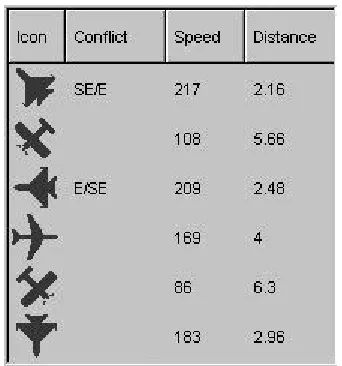
3. Information Analysis - A decision aid was presented on the display showing the
layout of all aircraft, including type, direction, speed, distance from the center of
the display, stage of processing, and a projection on whether or not the aircraft
might have been involved in a collision (see Figure 3.3). Information on each
to the converging runway display aid used in ATC that automatically projects the
approach paths for multiple aircraft (Parasuraman, Sheridan, and Wickens, 2000).
Figure 3. 3 Information analysis decision aid.
4. Decision Making - A decision aid similar to the one used in the information
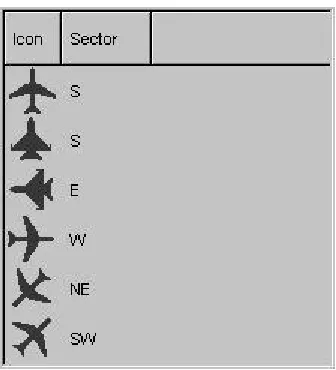
analysis condition was presented, but without the speed, collision, and distance
information (see Figure 3.4). Instead, the decision aid sorted aircraft for
processing according to priority, from the top to bottom of the display. Priority
was calculated by the computer. The highest priority was given to aircraft on
collision courses with other aircraft, then to those aircraft closest to the center of
the screen. The Multitask algorithm that determined priority did not always
provide the best recommendation. For example, since the recommendations were
based, in part, on proximity to the center of the screen, it was possible for the
computer to prioritize an aircraft that could not be cleared in the time remaining
decision aids that provide suggestions to air traffic controllers for resolving
potential aircraft collisions as an example of automated decision making in ATC.
Figure 3. 4 Decision making decision aid.
5. Action Implementation – This form of automation presented a decision aid listing
only the number of aircraft and their stages of processing (see Figure 3.5). In this
mode, the clearance was issued automatically after the communication link was
established. Participants were only required to click aircraft once to issue a
clearance. This final stage of automation was similar to the automated transfer of
an aircraft from one sector to another in commercial ATC systems that can be
completed with a single press of a button once the controller has made the
Figure 3. 5 Action implementation decision aid.
In addition to automation modes, there were also four types of automation
invocation authority available in the Multitask simulation. These were determined by the
locus of control (computer or human) and the level of authority assigned (mandate or
suggest). When the authority level was “mandate,” the computer or human (depending
on the condition assigned) had full control of automation and manual control invocations.
Computer allocations occurred at the precise time a “performance event” occurred, such
as an operator’s performance in the secondary task falling below a predetermined
criterion, or a substantial increase in the level of operator workload due to the primary
task. Optionally, the system could be configured to mandate allocations at timed
intervals instead of according to operator performance. Human allocations of automation
or manual control occur red when the operator pressed the space bar on a keyboard
integrated with the system running the multitask simulation. When the authority level
was “suggest,” these same events (human presses the space bar or the computer detects a
control allocation, depending on who had authority. The various settings for locus of
control and level of authority had the following implications for Multitask performance:
1. Computer Mandate – Computer had full control of allocations. The state of the
automation was determined, based on either on operator performance events or a
predetermined schedule of manual and automated control periods (e.g.,
automation cycles every two minutes). Human input had no effect on triggering
automation.
2. Computer Suggest – Computer had to initiate allocations. Operator performance
events changed the state of the automation to “automation recommended” or
“return to manual recommended.” Human had to agree to automation or manual
control before an allocation could occur. Input by the human prior to a computer
suggestion was ignored.
3. Human Mandate – Human had full control of allocations. Human input
determined the state of the automation. Operator performance eve nts had no
effect on triggering automation.
4. Human Suggest – Human had to initiate allocations. Human input changed the
state of the automation to “automation recommended” or “return to manual
recommended.” Computer had to agree to automation or manual control before
an allocation could occur. The computer would only respond to an operator
performance event if automation had been suggested by the human.
In order to make a direct comparison with Kaber and Riley’s (1999) research, the present
study considered the first two options - computer mandate and computer suggest.
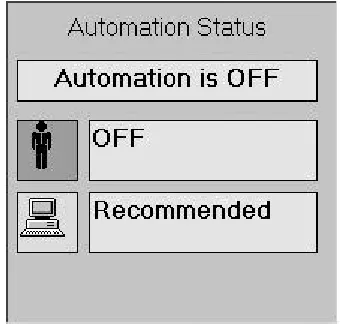
provided by an additional window on the Multitask display (see Figure 3.6 and upper- left
corner of Figure 3.1). If the level of the authority was “suggest” (Settings 2 and 4
described above), icons of a computer and a person provided feedback on the state of the
recommendation or agreement. The background color of the icon reflected the state of
the automation request. “Blue” designated a request for manual control while “yellow”
signified a request for automation. An allocation occurred when both colors matched
(yellow for automation and blue for manual control).
Figure 3. 6 Automation Status Indicator.
Under each condition, the participant’s goal was to maximize task reward points.
There were no partial rewards assigned in the task. One point was awarded for every
fully cleared aircraft and an additional point was added if a cleared aircraft was on a
collision course with another aircraft; that is, two or more aircraft were within a
predefined “buffer zone” of each other. This buffer zone was the airspace surrounding
3.1.2 Gauge Monitor
The gauge- monitoring task presented a fixed-scale display with a randomly
moving pointer (see Figure 3.7). The fixed-scale included a color-coded “acceptable”
central region and both an upper and a lower “unacceptable” region. The acceptable
region was “green” and the unacceptable regions were colored “red”. Participants were
required to monitor vertical pointer movements in order to detect when a deviation
occurred into either of the unacceptable regions. Participants could correct for pointer
deviations by pressing keys on the keyboard, which centered the pointer on the fixed
scale.
Although the pointer generally moved in a random manner, it was designed to not
stay in the unacceptable region for extended periods of time. This was done in order to
maintain a consistent number of deviations among subjects. If the pointer remained in
the unacceptable range for more than three seconds, it would move back into the
acceptable range on its own and register a “miss.” This design produced approximately
six deviations per minute. Three seconds was determined in previous pilot testing to be
ample for scanning between the primary task and the gauge.
Performance in the gauge task was recorded as a ratio of the number of hits to the
number of unacceptable pointer deviations (i.e., the hit-to-signal ratio). Significant
variation in this performance measure resulted in dynamic allocations of system
information processing functions to the Multitask computer system or to the operator, as
Figure 3. 7 Gauge Monitor.
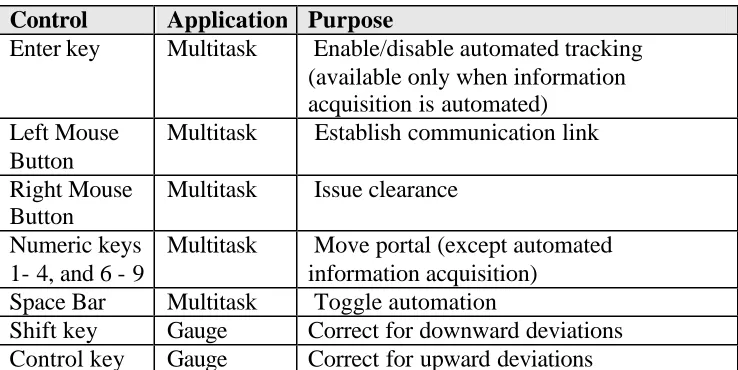
Table 3.1 contains a summary of the controls used in Multitask and the Gauge
Table 3. 1 Summary of Task Controls.
Control Application Purpose
Enter key Multitask Enable/disable automated tracking (available only when information acquisition is automated)
Left Mouse Button
Multitask Establish communication link
Right Mouse Button
Multitask Issue clearance
Numeric keys 1- 4, and 6 - 9
Multitask Move portal (except automated information acquisition)
Space Bar Multitask Toggle automation
Shift key Gauge Correct for downward deviations Control key Gauge Correct for upward deviations
3.2 Participants
Forty-eight subjects were recruited for participation in this experiment from the
North Carolina State University student population. They ranged in age from 19 to 34
years. All were required to have 20/20 or corrected to normal vision and some degree of
windows-based computer or video game experience. All subjects were provided with
$15 total compensation for their participation. There was an additional incentive in the
form of a $30 gift certificate awarded to the participant who achieved the best overall
performance during the experiment.
Of the 48 persons who volunteered for the study, only 40 subjects actually
experienced AA (dynamic control allocations) during test trials based on their
performance in the gauge monitoring task (objective workload). The task load posed in
the Multitask simulation and the nature of the automation may have also been factors in
whether subjects experienced AA. Since the specific objective of this research was to